China Optical Communications Deep Dive: Potential FCC Regulatory Paths, Overseas Capacity Boundaries, and AI Supply-Chain Constraints

目录
Too Long; Didn't Read
1. Separate Three Things: Effective Rules, Requests for Comment, and Media-Reported Drafts
2. Three Potential Paths Determine What Overseas Factories Actually Mean
3. Why the Share of Overseas Capacity Cannot Be Equated Directly with Safety
4. Comparing Companies Requires More Than Comparing Factories
5. U.S. Supply-Chain Dependence May Constrain Implementation Speed, but It Does Not Eliminate Risk
6. How Regulatory Text Would Flow Through to Operating Results
7. Three Possible Outcomes Have Three Entirely Different Operating Implications
8. Stop Guessing Every Day and Follow Five Public Signals
9. Supply-Chain Reallocation Does Not Mean Demand Disappears, but It Changes Where Profits Accrue
Conclusion: Price the Path, Not a Future Outcome as Though It Has Already Happened
本内容基于公开资料和研报数据整理,不构成任何投资建议,不代表任何个人观点,仅供学习参考,请理性阅读
Optical transceivers have not yet been subjected to a comprehensive restriction that is already in force, but the FCC has several regulatory templates that could be extended to them. Whether overseas factories can provide a buffer depends on whether the final rules are defined by company, production location, or country of origin.
Too Long; Didn't Read
As of August 10, 2026, the FCC has not formally designated optical transceivers as a broadly restricted category. FCC 26-50, which is already in effect, mainly closes a loophole that allowed covered entities' logical hardware components to evade equipment-authorization restrictions. Potential measures targeting optical transceivers reported by the media still lack formal regulatory text.
The value of overseas factories depends on the scope of coverage. If restrictions apply only to goods of Chinese origin, capacity in Thailand and Vietnam could provide a buffer. If restrictions are based on a company list or cover all production outside the United States, even a high share of overseas capacity would not provide sufficient protection.
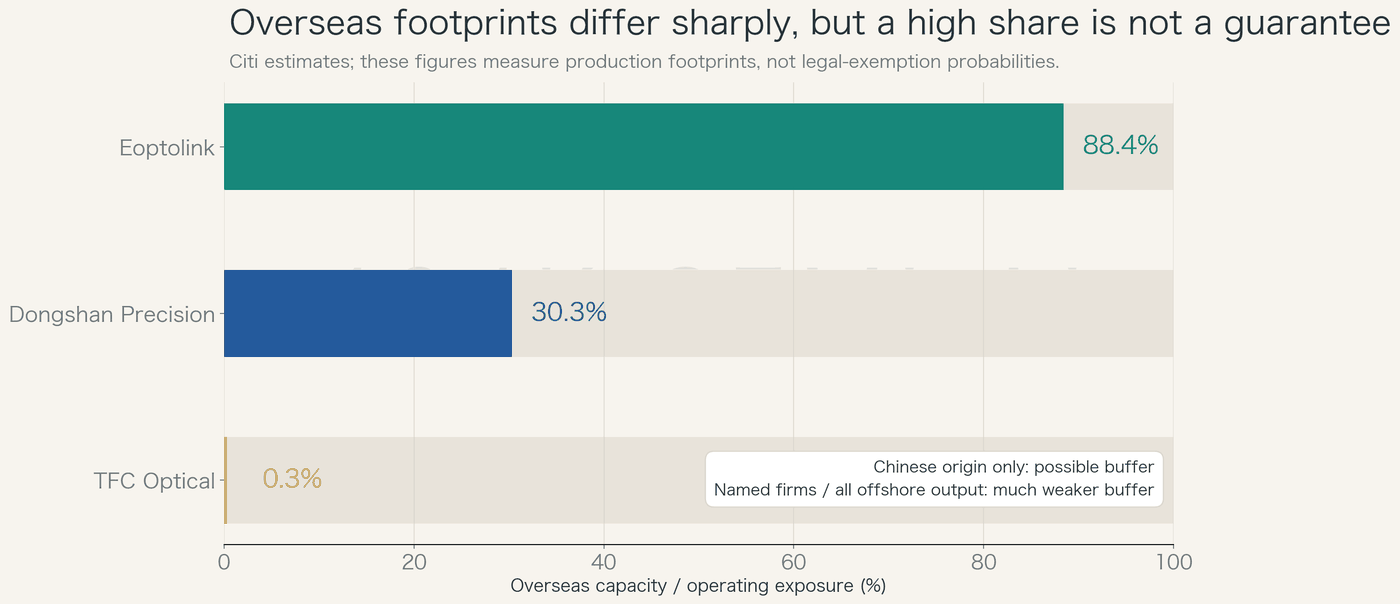
Citi estimates that overseas capacity or overseas operating exposure accounts for approximately 88.4% at Eoptolink, 30.3% at Dongshan Precision, and 0.3% at TFC Optical. These figures measure production footprints, not the probability of a legal exemption.
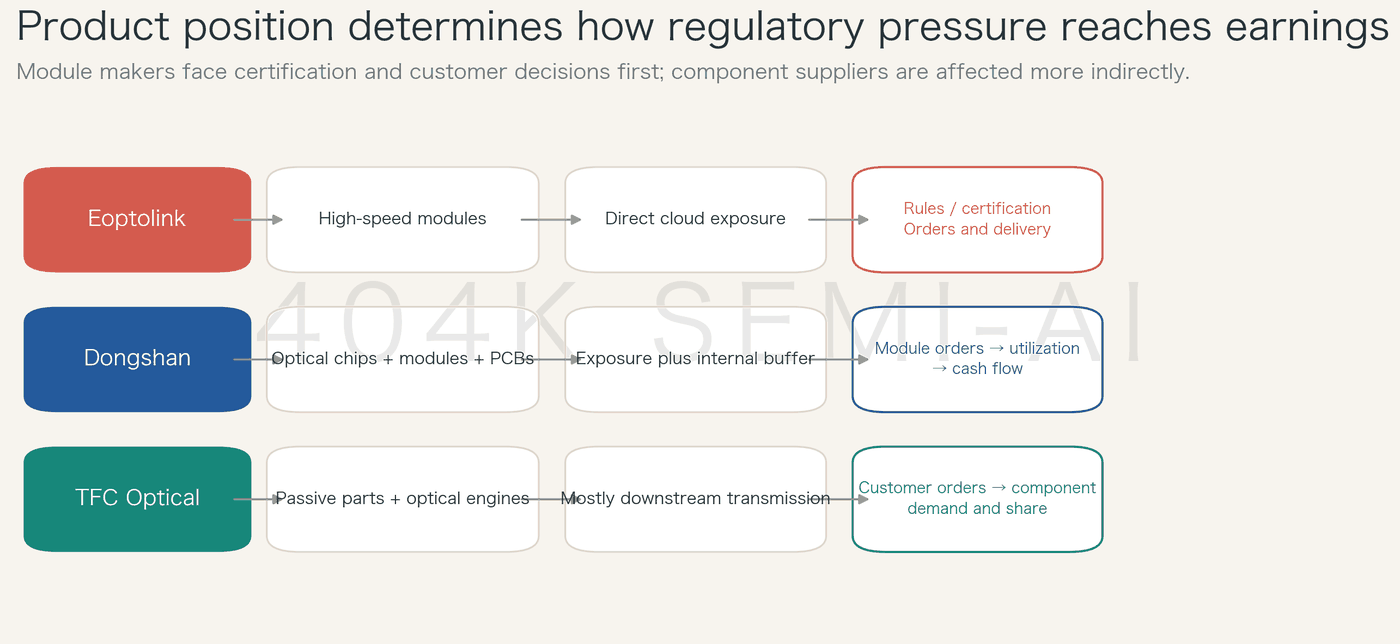
The transmission paths differ across the three companies. Eoptolink sells directly to overseas cloud customers. At Dongshan Precision, exposure across optical chips, optical transceivers, and PCBs can reinforce itself. TFC Optical's exposure is transmitted mostly indirectly through downstream module customers' orders and inventories.
Citi estimates that Chinese suppliers account for 60% to 70% of the high-speed optical transceivers purchased by major U.S. cloud service providers. This dependence may constrain the speed at which broad restrictions can be implemented, but it does not eliminate the risk. Transition periods, exemptions, and customer-shortage exceptions are the most important signals to watch in future regulatory text.
1. Separate Three Things: Effective Rules, Requests for Comment, and Media-Reported Drafts
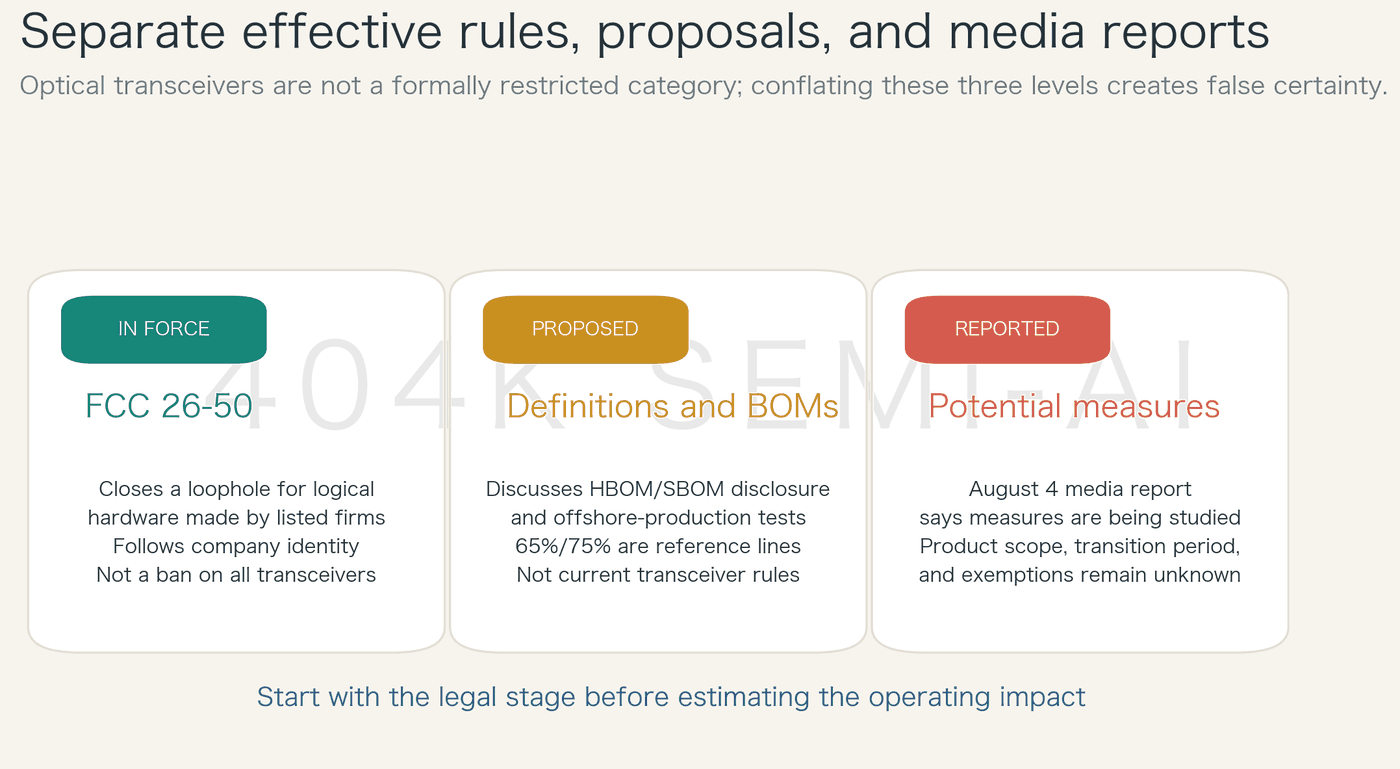
FCC 26-50 has already completed one specific repair to the regulatory framework. If certain hardware components with logical functions are manufactured by companies already on a covered list, incorporating those components into another device can no longer automatically bypass equipment-authorization restrictions. Put simply, the rule closes the loophole of hiding critical components made by listed companies inside other equipment. It follows company identity and existing covered lists; it does not mean that all optical transceivers supplied by Chinese companies are already restricted.
There is another boundary that is easy to overlook. The FCC's core tools are equipment authorization and market access, not a direct rewrite of a company's total global revenue. The ultimate impact must pass through four filters: product category, model authorization, customer procurement, and delivery destination. Policy risk becomes quantifiable revenue risk only when all four filters point to the same group of products.
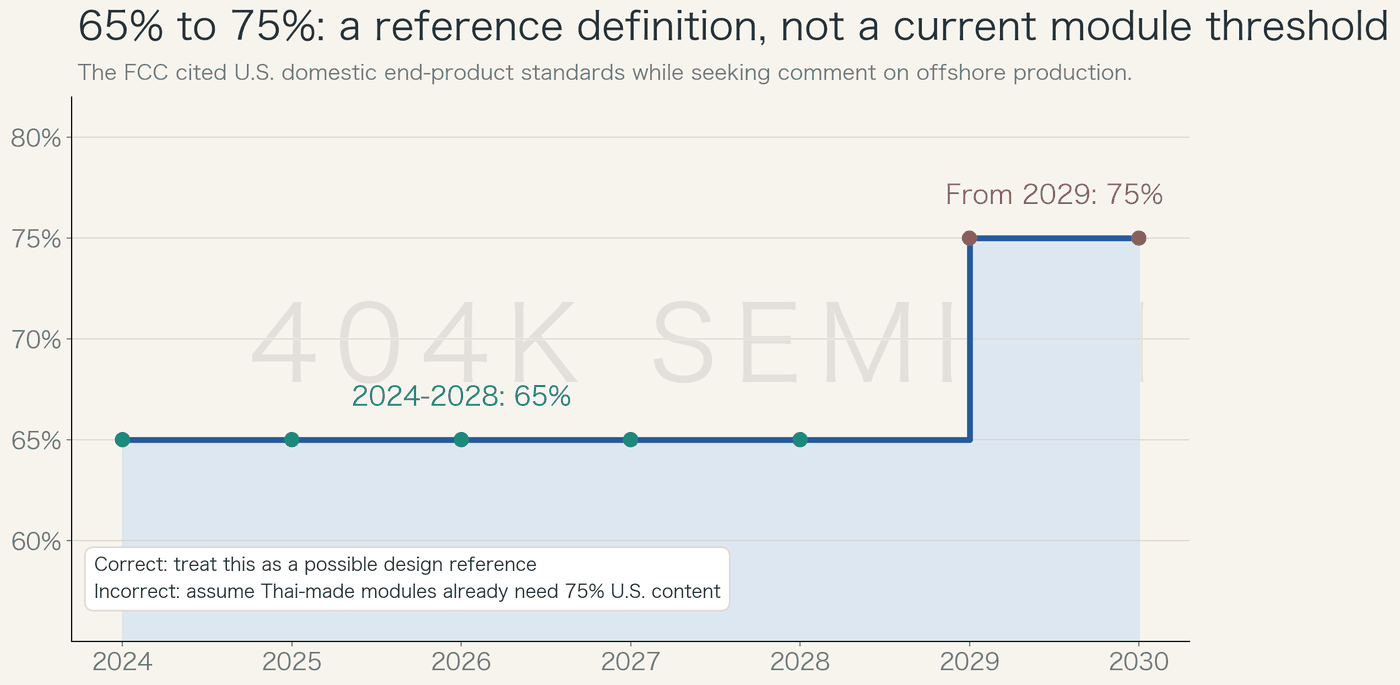
The second issue is rule design that remains under consideration. The FCC has discussed whether to require hardware bills of materials and software bills of materials, as well as how to define production outside the United States. The document cites the U.S. domestic end-product standard as a reference for discussion: 65% from 2024 through 2028, rising to 75% from 2029 onward. However, 65% and 75% are reference thresholds for a possible definition, not U.S.-content thresholds that are already in force for optical transceivers.
The third issue is the August 4 media report that regulators were reportedly studying potential measures aimed at Chinese optical transceivers. This is useful as an early warning for the market, but it has not yet become formal regulatory text. The three levels must be kept separate so that known facts can be identified while unknowns remain in scenario analysis.
2. Three Potential Paths Determine What Overseas Factories Actually Mean
If future rules do target optical transceivers, they can broadly be divided into three paths.
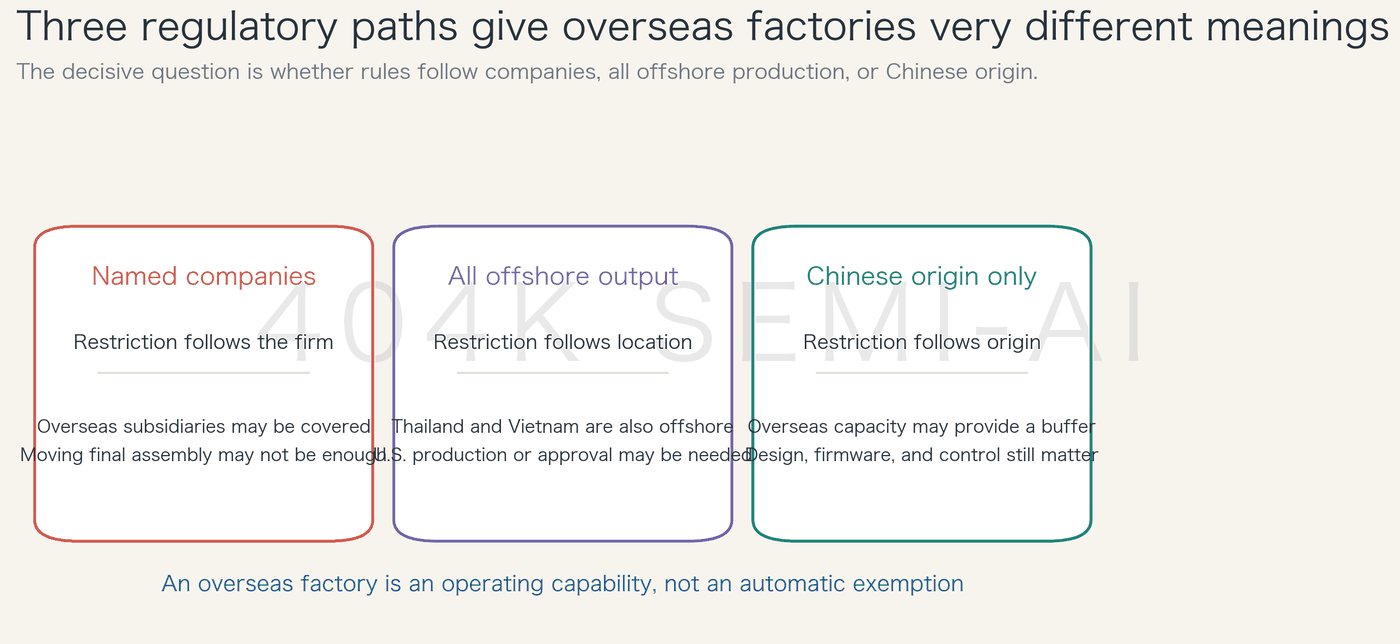
The first path is to name specific companies. Under this approach, restrictions follow the company and its controlled entities. Whether subsidiaries in Thailand, Vietnam, or elsewhere are covered would depend on the final text's definitions of control, subsidiaries, and brands. If only final assembly moves overseas while design, firmware, supply-chain control, and the transacting entity remain unchanged, an overseas factory alone is unlikely to solve the problem.
The second path is to restrict relevant equipment produced anywhere outside the United States. In this case, the specific Asian country of production is not the key issue, because Thailand and Vietnam are also outside the United States. Companies may need more than a backup factory in Asia; they may need U.S. manufacturing, conditional approval, or an explicit exemption. For the supply chain, this is the broadest path and the one with the greatest potential impact on U.S. supply.
The third path is to restrict only goods of Chinese origin. Overseas capacity is most likely to provide a buffer under this approach, but a series of questions would still need answers. Is origin determined by final assembly, value added, or critical technology? How are design, firmware, and testing completed in China treated? How must transshipment and subsidiary relationships be demonstrated? Having an overseas factory is therefore an operating capability, not an automatically valid policy exemption.
3. Why the Share of Overseas Capacity Cannot Be Equated Directly with Safety
Citi estimates that overseas capacity or operating exposure accounts for approximately 88.4% at Eoptolink, 30.3% at Dongshan Precision, and 0.3% at TFC Optical. These figures illustrate differences in the companies' international production footprints, but they do not reveal which company will necessarily avoid future rules. Under a China-origin-only scenario, Eoptolink's Thai footprint clearly provides greater flexibility. Under a company-list scenario, that buffer weakens materially. Under a scenario in which all production outside the United States is restricted, none of the three companies' Asian factories provides a complete answer.
What companies really need is a set of capabilities that customers and regulators can verify: where each model is designed, where its components come from, who controls the firmware, where assembly, testing, and shipment occur, and how the relevant legal entities are related. This is why discussions about hardware and software bills of materials matter. Future competition may be determined not only by cost, speed, and yield, but also by which company can most quickly provide an explainable, traceable, and continuously auditable supply chain.
4. Comparing Companies Requires More Than Comparing Factories
Eoptolink has the most direct exposure. The company generated approximately RMB24.842 billion of revenue in 2025, up 187.29% year over year, and approximately RMB9.532 billion of net profit attributable to shareholders of the listed company, up 235.89%. Overseas revenue accounted for 96.16%. The second phase of its Thailand factory began operating in early 2025, giving the company greater flexibility under a narrow restriction focused on Chinese origin. However, Eoptolink supplies high-speed optical transceivers directly to overseas cloud customers, so any change in equipment authorization or customer certification would also appear most quickly in orders and deliveries.
Dongshan Precision has an additional layer of complexity. Source Photonics already covers optical transceivers from 10G to 1.6T and is developing 3.2T products. It is also extending upstream into optical chips such as 100G/200G PAM4 EMLs and CW lasers, forming a longer internal value chain together with Dongshan Precision's PCB capabilities. This vertical integration can improve cost, delivery, and traceability management, but it can also transmit policy risk along the chain from module orders to optical-chip utilization, depreciation, and cash flow. If overseas expansion encounters certification delays, large capital expenditures may show up in the financial statements before the related revenue does.
TFC Optical is positioned more in passive components, optical engines, and optical packaging. It is less likely than a complete module producer to face equipment authorization first; much of its risk would instead be transmitted through downstream module customers' orders, product transitions, and inventories. The company's July 2026 investor-relations record shows that passive products in Building A in Thailand were already operating and Building B had been delivered. Active products had completed certification but remained in small-scale production because of constraints in 200G EML supply. This indicates that the overseas factory is an option still ramping up; delivery of the building cannot be treated as equivalent to effective capacity.
5. U.S. Supply-Chain Dependence May Constrain Implementation Speed, but It Does Not Eliminate Risk
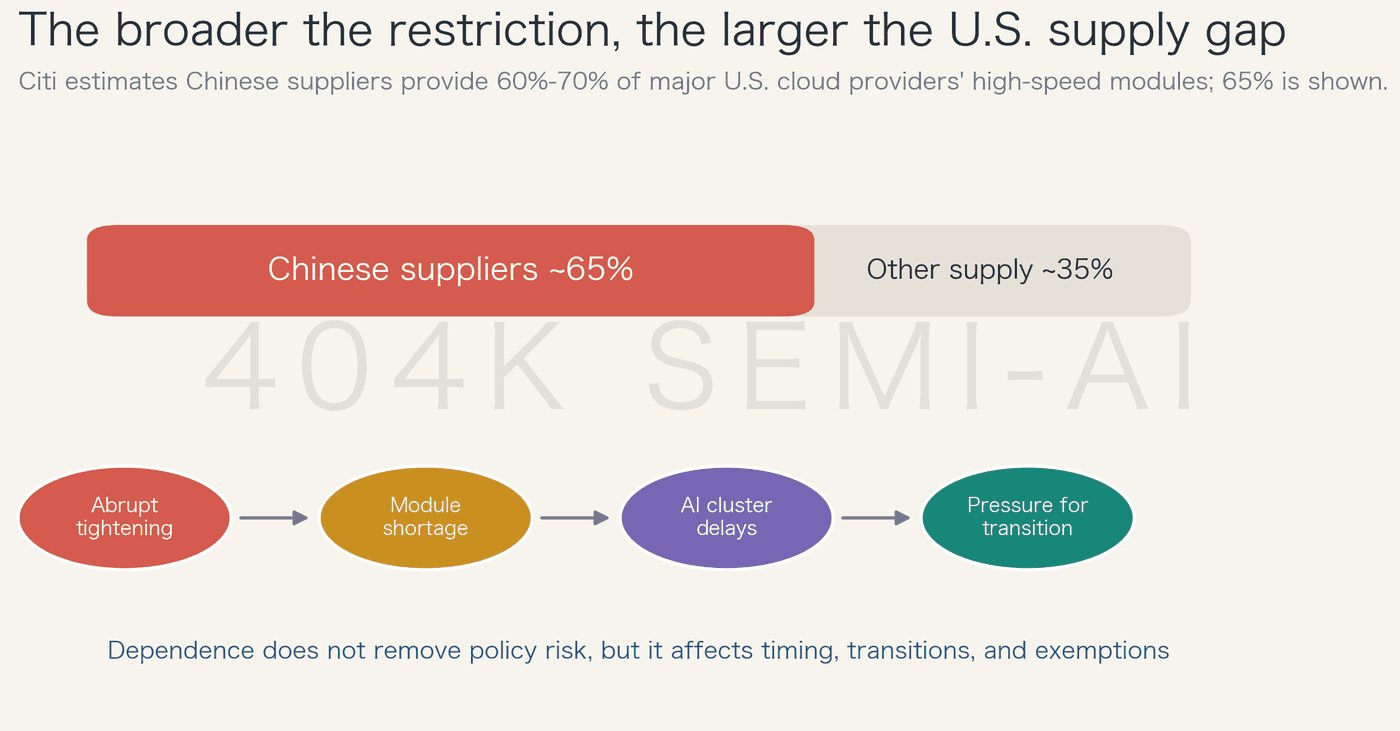
Citi estimates that Chinese suppliers account for 60% to 70% of the high-speed optical transceivers supplied to major U.S. cloud service providers. If this estimate is broadly correct, an immediate and sweeping restriction without a transition period would affect not only Chinese suppliers but also the deployment schedules of AI clusters at U.S. cloud providers. GPUs may arrive on schedule, but without enough high-speed optical connectivity they cannot be assembled into usable computing capacity in time.
This dependence is more likely to change the timetable and accompanying mechanisms of a rule. Final regulations might initially affect only new models while allowing a longer transition period for existing authorizations. They might also provide conditional approvals, shortage exceptions, or phased implementation based on available market supply. These are reasonable scenarios, but they are not yet announced facts.
Conversely, this also explains why the strategic value of automated optical-transceiver production in the United States may rise. If rules no longer focus only on corporate headquarters but require proof of production location, material origin, and software control, a production line that relies entirely on local labor will struggle to replicate the Asian cost model. Local production may become viable gradually only with greater automation, fewer product variants, and stable contracts with large customers. Supply-chain dependence is therefore a self-imposed constraint on implementation, not a permanent moat on which companies can rely.
6. How Regulatory Text Would Flow Through to Operating Results
Earlier optical-communications research focused mainly on 1.6T, 3.2T, optical-chip supply, and data-center network expansion. That thesis remains intact, but potential regulation adds another constraint: companies must not only manufacture the product, they must also prove that it can be used within customers' legal and supply-chain boundaries.
The transmission chain typically has four steps. First, formal regulatory text determines which models must re-establish eligibility. Second, cloud service providers and equipment vendors change certification, backup sourcing, and order allocation. Third, the effects appear in module shipments, pricing, and inventories. Fourth, overseas-factory utilization, depreciation, expedited logistics, and duplicate certification expenses ultimately flow into profit and cash flow.
Financial analysis of this chain should not use a blanket assumption that all U.S. revenue falls to zero. A more reasonable sequence is to identify product revenue related to U.S. cloud customers, estimate the share of models that may fall within the rule, and then deduct the portion preserved by transition periods, existing authorizations, overseas switching, and customer exemptions. The revenue effect must then be separated into price, volume, and margin. If orders simply move to an overseas factory, revenue may not disappear, but processing, certification, and logistics costs could compress margins first. Only when orders move to competitors would the company lose both revenue and capacity utilization.
The impact on corporate value should also be viewed in two stages. Before formal rules are published, markets mainly reprice the uncertainty premium. Only after formal text and customer behavior become visible can revenue, earnings, and cash-flow assumptions be revised. Treating price volatility in the first stage as an earnings fact in the second stage is one of the easiest analytical mistakes to make today.
Therefore, if there is still no formal text and no change in customer orders, the most that can be said is that the risk premium has risen; revenue decline cannot be treated as already having occurred. Likewise, a company's announcement of an overseas factory should not immediately be treated as protection for its revenue. Valid operating evidence consists of completed customer certification, stable shipments of qualified products, and rising utilization, rather than factory floor area or installed equipment.
7. Three Possible Outcomes Have Three Entirely Different Operating Implications
The first outcome is that final rules cover only goods of Chinese origin and provide transition periods for new models and existing customers. In this scenario, Eoptolink's Thai capacity and Dongshan Precision's overseas production and value-chain management capabilities would become more valuable, while TFC Optical's indirect exposure would be relatively manageable. The conclusion would still depend on the final definition of origin and the completion of customer certification.
The second outcome is restriction based on a company list. The direct protective value of overseas capacity would weaken, while corporate control, subsidiary relationships, brands, and software control would become critical. Direct risk would be higher for module producers than for suppliers focused solely on passive components, but upstream suppliers would still be affected indirectly through customer switching and changes in procurement volumes.
The third outcome is a broad restriction covering all production outside the United States. This would create the greatest near-term shock to U.S. AI infrastructure and would require more transition periods, exemptions, or local-capacity arrangements during implementation. Without these buffers, it would not only reallocate orders among Chinese optical-communications companies but could also make high-speed optical connectivity a new delivery bottleneck for U.S. AI clusters.
8. Stop Guessing Every Day and Follow Five Public Signals
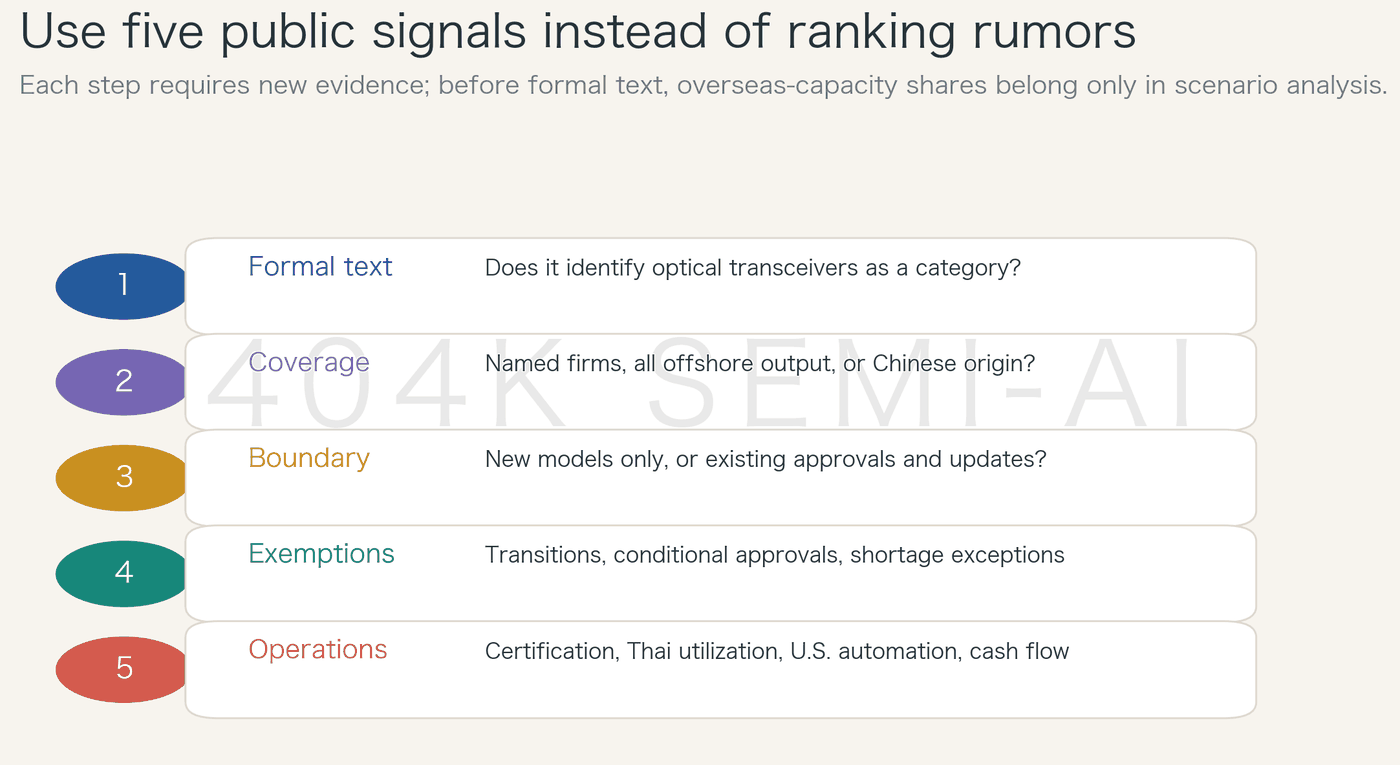
First, watch whether formal text actually identifies optical transceivers as a product category. Media quotations without regulatory text are not sufficient for precise modeling.
Second, watch the scope of coverage. Whether rules name companies, restrict all production outside the United States, or apply only to goods of Chinese origin directly determines the significance of overseas factories.
Third, watch the implementation boundary. The pace of the impact differs completely depending on whether rules apply only to equipment authorization for new models or extend to existing authorizations, firmware updates, and current customers.
Fourth, watch exemptions and transition arrangements. Customer-shortage exceptions, conditional approvals, treatment of existing contracts, and transition periods determine whether the policy creates a one-time shock or a multi-year supply-chain restructuring.
Fifth, watch operating evidence. Whether customer certification takes longer, Thai capacity utilization rises, automated U.S. lines secure stable orders, and inventories and cash flow weaken is closer to the truth than any static overseas-capacity ratio.
9. Supply-Chain Reallocation Does Not Mean Demand Disappears, but It Changes Where Profits Accrue
If policy ultimately causes customers to switch suppliers, the first-order effect on the optical-communications industry may not be a disappearance of total demand. U.S. cloud service providers still need to build AI clusters, and high-speed networks still require optical transceivers. The initial changes concern which module vendor receives the order, which factory ships it, and which party bears the cost of duplicate certification and low utilization. Industry volumes can continue growing even while profits at certain companies come under pressure.
The second-order effect continues upstream. Alternative suppliers that increase high-speed optical-transceiver output still need EMLs, CW lasers, optical components, optical engines, and packaging capacity. Orders lost by one module vendor do not necessarily translate one-for-one into a permanent loss for upstream suppliers; they may move through another module vendor and return to some of the same optical-component suppliers. The actual impact on upstream companies such as TFC Optical therefore depends on customer mix and content per system, not only on the share of one downstream customer.
The third-order effect concerns inventory and cash conversion. While rules remain uncertain, customers may order simultaneously from multiple suppliers, and companies may move raw materials and work in progress overseas in advance. Near-term shipments may therefore remain strong even as inventory, accounts receivable, and cross-regional transfer costs rise. Such pre-positioning represents effective demand only if end deployments, customer payments, and capacity utilization subsequently improve together; otherwise, it merely moves uncertainty from the order book to the balance sheet.
Conclusion: Price the Path, Not a Future Outcome as Though It Has Already Happened
This report uses three paths to correct an overly simple question: are overseas factories useful? The answer is yes, but the degree of usefulness depends entirely on the final definition used by the rules. There is currently no evidence that any company has obtained a policy exemption, and no evidence that any company's U.S. business has already been damaged.
If formal text fails to appear for an extended period while customer certification, orders, and deliveries remain normal, the current change is mainly an increase in the risk premium. If formal text clearly expands restrictions to all production outside the United States without adequate transition periods and exemptions, while local U.S. capacity improves rapidly, the view that broad restrictions will be constrained by supply-chain dependence would need to be reassessed.
Understanding this issue does not require amplifying each new rumor into a final outcome. First distinguish the legal stage, then determine the coverage path, and finally monitor customer certification, capacity utilization, and cash flow. Only then can policy risk be transformed from a vague concept into an operating framework that can be tested.
Related Reading
Rubin Ultra HBM Capacity Cut to 192GB: Supply and Power Constraints Drive Roadmap Downgrade