
Contents
1. Higher Earnings Estimates, Unchanged Valuation Method
2. Ultra-High-IOPS SSDs: The Next Catalyst, Still Outside the Forecasts
3. Why Kioxia Trades Below SanDisk: Capital Returns and Contract Duration
4. NAND Supply and Demand: Contracts Moderate Price Gains as Volume Takes Over
5. FCF Valuation and Dividend Scenarios: Deriving ¥131,000
6. Risks and Tests: What Could Keep the Discount Intact?
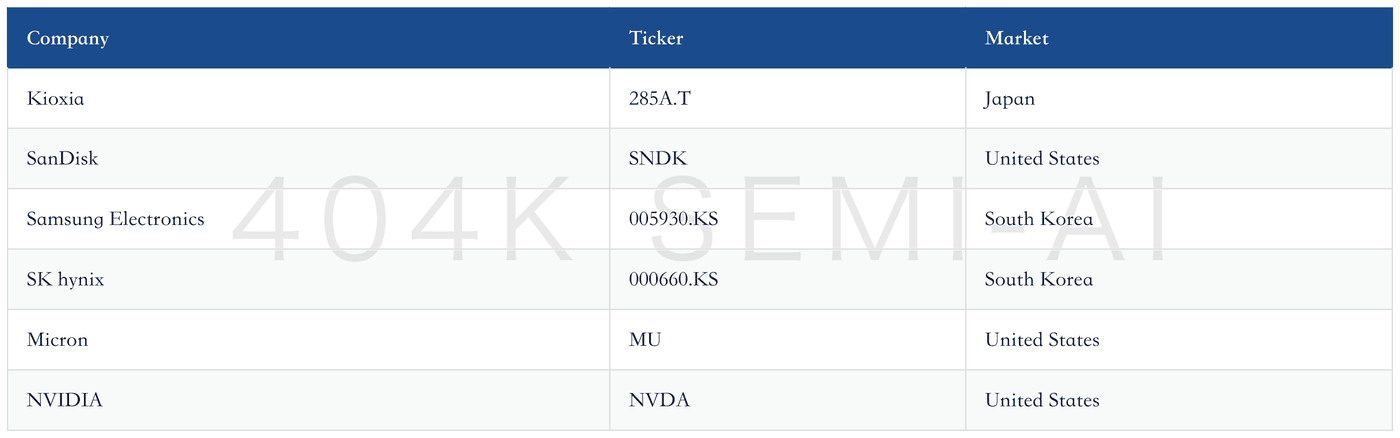
Key Stock Tickers
This content is compiled from publicly available information and research reports. It does not constitute investment advice or represent any individual's views. For educational reference only; please read critically.
Nomura raised its Kioxia price target from ¥126,000 to ¥131,000, valuing the company at 10 times its forecast ¥7 trillion in free cash flow for the fiscal year ending March 2028. The central question is why Kioxia trades at a discount to SanDisk—and whether that gap will narrow.
1. Higher Earnings Estimates, Unchanged Valuation Method
In its September 8 report, Nomura reiterated its Buy rating on Kioxia and raised its price target from ¥126,000 to ¥131,000. The increase reflects higher earnings estimates, rather than a higher valuation multiple. Following actual results for April–June 2026, the first quarter of FY3/27, Nomura raised its operating profit forecasts from ¥7.5 trillion to ¥7.9 trillion for FY3/27 and from ¥10.7 trillion to ¥11.1 trillion for FY3/28.
The valuation method is unchanged: 10 times FY3/28 free cash flow. Nomura raised its FCF forecast from ¥6.9 trillion to ¥7 trillion. Based on its projected share count, that equates to approximately ¥13,179 in FCF per share, supporting a target near ¥131,000 at 10 times FCF. As a cross-check, the target implies 8.7 times FY3/28 earnings. Across FY3/27, FY3/28 and FY3/29, it implies P/E multiples of 12.4, 8.7 and 7.3 times, respectively, and price-to-FCF multiples of 16.8, 9.9 and 7.8 times.
The table summarizes Nomura’s revisions. FY3/27 denotes the fiscal year ending March 2027; subsequent years follow the same convention. Figures are in ¥ billion, except EPS, which is in yen.

Nomura trimmed its FY3/29 revenue forecast from ¥1.7539 trillion to ¥1.743 trillion while raising operating profit and EPS. The upgrade therefore rests on profitability rather than scale: margin assumptions matter more than revenue assumptions. Forecast operating margins of 76.6%, 76.8% and 76.7% across the three fiscal years are essentially flat. Nomura sees Kioxia reaching a margin plateau, with subsequent growth driven mainly by revenue expansion.
The target increase follows the correction in memory stocks since late June. Nomura attributes deteriorating sentiment toward AI investment primarily to concerns over Chinese open-weight models, while arguing that NAND fundamentals have not materially changed. Its monthly performance data show Kioxia falling 47% in July, recovering 7% in August and gaining another 12% through September 4. SanDisk also fell 47% in July, then rebounded 28% in August and 11% in September. Their nearly identical July declines point to a sector-wide sentiment correction rather than a Kioxia-specific problem.
Nomura believes sentiment has begun to recover. It cites OpenAI’s September 3 release of GPT-6 Astra, which scored 99.9% on ARC-AGI-3; Chief Scientist Pachocki’s September 6 essay, An Alien Mind; and the upcoming OpenAI DevDay on September 29 as catalysts. For memory demand, advances in frontier-model capabilities imply continued growth in inference workloads, leaving the NAND demand thesis intact.
Nomura’s price-target history also provides useful context. All targets below are in yen.
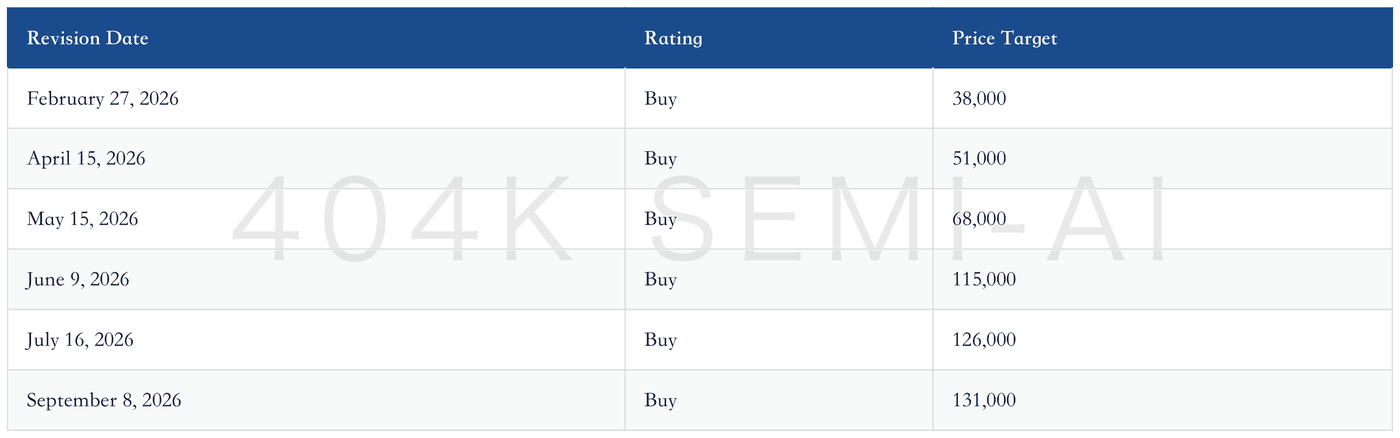
The target rose repeatedly from ¥38,000 in February to ¥131,000 in September. The largest increase came on June 9, from ¥68,000 to ¥115,000, when Nomura incorporated ultra-high-IOPS SSDs into its investment thesis. The two subsequent increases were smaller, earnings-driven revisions within the same valuation framework.
In our late-June analysis of Goldman Sachs’s increase in its Kioxia target to ¥116,000, we characterized the report as a moderate bull case built around prices remaining elevated for longer than the market expected. Nomura’s framework is similar, but shifts the valuation anchor from margins to free cash flow.
Kioxia Deep Dive: Goldman Sachs Raises Its Target to ¥116,000—How NAND Shortages Could Reprice the AI Storage Cycle
2. Ultra-High-IOPS SSDs: The Next Catalyst, Still Outside the Forecasts
Nomura sees formal adoption and mass production of ultra-high-IOPS SSDs as Kioxia’s next major fundamental catalyst. IOPS—input/output operations per second—measures a storage device’s random-access performance. These SSDs could serve as working memory alongside HBM, extending their role beyond conventional enterprise storage.
The latest product details came from Kioxia’s September 3 media briefing. Its first product, GP1, will offer capacities of 800GB to 1.6TB, with samples due in the second half. Kioxia envisions at least one SSD per GPU. Nomura estimates that adoption across 1.2 million AI servers annually, each equipped with four GPUs, would imply approximately 3.8EB of capacity at 800GB per drive or 7.7EB at 1.6TB. Those figures represent 1.7% and 3.4%, respectively, of its forecast Kioxia bit shipments for FY3/27.
The capacity contribution looks modest, but pricing is materially different. Nomura says these products use an SLC architecture and command at least three times the price per bit of TLC enterprise SSDs. A 1.7%–3.4% share of bit shipments could therefore make a disproportionately large contribution to revenue and profit. Crucially, Nomura explicitly excludes this demand from its earnings forecasts. A successful ramp in 2027 could support further earnings and price-target upgrades.
The technical thesis centers on the KV cache. Kioxia’s CMX technology offloads KV caches from GPU memory to enterprise SSDs. Nomura cites OpenAI’s practices to illustrate the growing requirement: before GPT-5.5, OpenAI retained KV caches for only 5–10 minutes; with GPT-5.5, retention increased to around 30 minutes and as long as 24 hours; from GPT-5.6 onward, retention is at least 30 minutes. Longer retention requires more storage, while fast random reads make ultra-high-IOPS SSDs particularly relevant.
Nomura also traces the architecture’s origins. NVIDIA proposed BaM in 2022 to enable GPUs to access storage directly. Kioxia plans to provide samples capable of up to 100 million random-read IOPS in 2027. At a 512-byte I/O size, that translates into 51.2GB/s of bandwidth, compared with 13.9GB/s for Kioxia’s existing CM9-R at 4KiB. This remains orders of magnitude below HBM’s low-single-digit TB/s bandwidth, but is sufficient for an intermediate tier between GPU memory and conventional storage.
In our early-July analysis of UBS’s memory-sector report, we identified KV caching as a new variable for NAND: active data remains in faster memory tiers, while inactive caches migrate to TLC and QLC SSDs. Nomura takes that argument from capacity requirements to performance requirements. Ultra-high-IOPS SSDs address how quickly data can be read, rather than simply how much can be stored. Formal adoption by GPU vendors and cloud providers could make NAND part of the compute process itself.
Memory Deep Dive: Stocks Retreat as DRAM Prices Surge, NAND Moves Beyond Restocking and KV Caches Extend AI Demand to SSDs
For now, however, the thesis is supported by product samples and a technology roadmap, without customer orders or a mass-production timetable. Nomura’s treatment of it as a catalyst rather than a forecast assumption is appropriately cautious. For investors, ultra-high-IOPS SSDs represent optionality outside the current valuation.
3. Why Kioxia Trades Below SanDisk: Capital Returns and Contract Duration
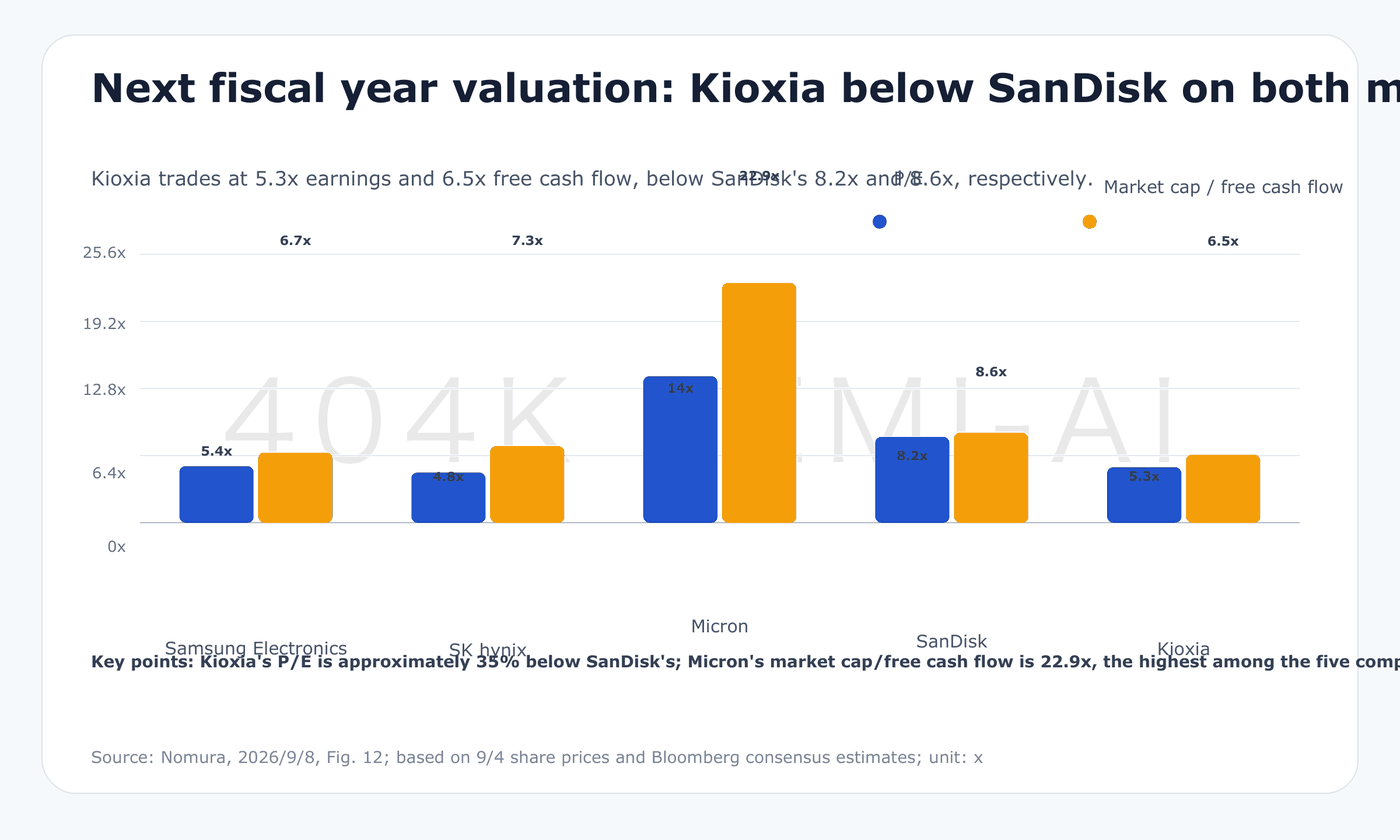
Nomura’s peer comparison quantifies the discount. Based on September 4 share prices and pb consensus estimates, Kioxia trades at 5.3 times next-fiscal-year earnings, versus 8.2 times for SanDisk; 6.5 times FCF, versus 8.6 times; and 3.6 times EV/EBITDA, versus 6.3 times. Kioxia is materially cheaper on all three measures.
One year further out, Kioxia’s P/E falls to 3.9 times, against SanDisk’s 6.7 times, while price-to-FCF falls to 4.2 times, against 6.8 times. The discount persists across the forecast period.
Nomura’s comparison of five memory companies is shown below. P/E and price-to-FCF use next-fiscal-year estimates; market data are as of September 4.
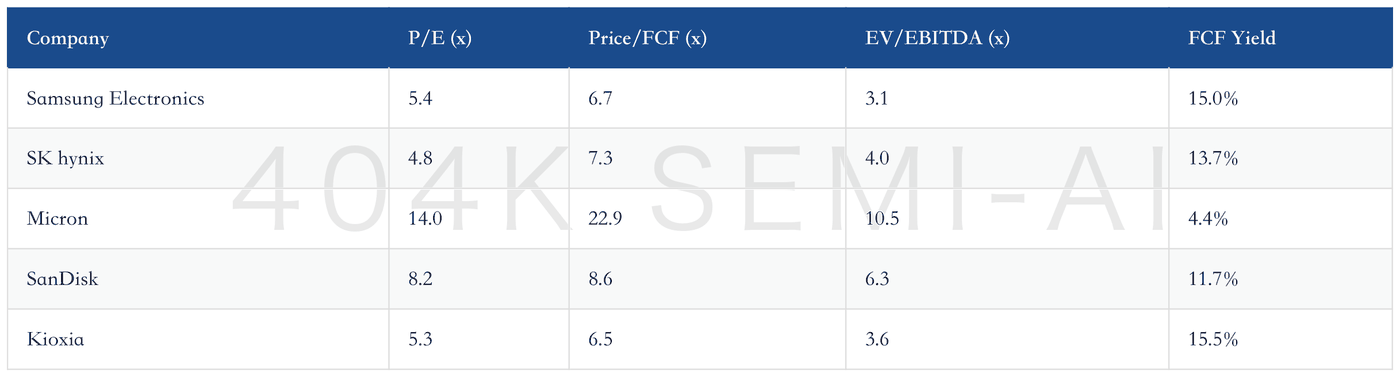
SanDisk is the most relevant comparison because the companies share the same joint-venture production capacity, roughly 60% attributable to Kioxia and 40% to SanDisk, producing the same NAND. Partners since 2000, they have highly similar products and cost structures. With shared capacity and products, the valuation gap must stem from company-level differences. Nomura identifies two.
The first is shareholder-return policy. SanDisk allocates 100% of residual cash to shareholders, while Kioxia prioritizes strategic investment. Historically, this was a meaningful distinction. Kioxia only listed on the Tokyo Stock Exchange Prime Market in December 2024; before that, it had been privately held following the Bain-led consortium’s 2018 acquisition, with balance-sheet repair taking priority.
Nomura believes the gap is narrowing. Kioxia announced a buyback on July 31 and completed it by August 10. The approximately ¥800 billion authorization exceeded its ¥749 billion of FY3/27 first-quarter FCF and represented 72% of the ¥1.117 trillion generated over the preceding four quarters.
In our early-August analysis of JPMorgan’s assessment of Kioxia’s results, we emphasized that a buyback’s spending ceiling and actual purchasing power are different: at the prevailing share price, ¥800 billion would not have purchased the full 30 million shares permitted under the authorization. Nomura now confirms completion, resolving the execution question. The remaining issue is whether repurchases become recurring.
Nomura’s dividend forecasts provide part of the answer. It projects dividends per share of ¥2,110 in FY3/27, ¥3,000 in FY3/28 and ¥3,600 in FY3/29, at a 20% payout ratio. The corresponding cash outflows are ¥1.122 trillion, ¥1.596 trillion and ¥1.915 trillion. Nomura argues that expectations for shareholder returns are beginning to support the share price, giving Kioxia characteristics of a value stock.
There is a clear expectations gap. The pb consensus forecast for Kioxia’s next-fiscal-year dividend is just ¥843.6 per share, implying a 1.5% yield, well below Nomura’s ¥2,110 forecast. If Nomura is right, the market substantially underestimates Kioxia’s capital returns. If consensus is right, the discount has a rationale. This divergence is the first key test of whether the valuation gap can close.
The second explanation is contract duration. SanDisk’s multiyear contracts run for approximately five years, compared with three years for Kioxia. Longer contracts provide greater revenue and earnings visibility, supporting higher valuation multiples.
Nomura illustrates this with NVIDIA’s purchase commitments, totaling $279 billion: $92 billion in FY2027, $87 billion in FY2028 and $88 billion in FY2029, followed by a sharp decline to $6 billion, $5 billion and $1 billion in FY2030 and subsequent years. NVIDIA’s commitments are thus concentrated through 2029, which Nomura aligns with the visibility provided by SanDisk’s five-year contracts; Kioxia’s three-year contracts offer a shorter horizon.
In our mid-May analysis of Citi’s SanDisk target increase, we described long-term agreements as a dividing line in memory-stock valuation. Contract-backed earnings can shift a company’s valuation from the 7–8 times typical of a cyclical business toward 9–10 times. Nomura’s report supports that assessment from another angle: much of the Kioxia–SanDisk valuation gap reflects the difference in visibility between three- and five-year contracts.
SanDisk’s Price Target Rises to $2,025: How Citi Uses NAND Long-Term Agreements, eSSD Pricing and Kioxia’s Results to Revalue a Cyclical Stock
Kioxia is not lagging in earnings growth. Nomura compares the companies’ quarterly operating profits in US dollars. In calendar Q3 2025, Kioxia generated $593 million versus SanDisk’s $245 million. In Q1 2026, the figures were $3.85 billion and $4.22 billion; in Q2, $8.29 billion and $7.1 billion; and for Q3, Nomura forecasts $11.73 billion and $8.33 billion.
Kioxia’s operating profit relative to SanDisk’s rose from 0.91 times in Q1 2026 to 1.17 times in Q2 and is forecast to reach 1.41 times in Q3. Sequential revenue growth tells the same story: Kioxia grew 76% in Q2 and is forecast to grow 35% in Q3, compared with 51% and 18% for SanDisk. With shared production capacity, Kioxia’s profit is expanding faster, yet its valuation is lower.
This is the core of Nomura’s Buy thesis. Kioxia’s discount reflects two potentially changeable factors—capital-return policy and contract duration—rather than weaker operating performance. The completed buyback and dividend expectations are already narrowing the first gap. The second depends on Kioxia securing longer customer contracts. Progress on both would give its valuation multiple room to converge toward SanDisk’s.
4. NAND Supply and Demand: Contracts Moderate Price Gains as Volume Takes Over
Nomura expects long-term contracts to slow the increase in NAND prices per bit, while tight supply and demand prevent prices from declining. Its quarterly KPI forecasts make that view explicit.
In Q1 FY3/27, Kioxia’s price per bit rose 70% sequentially, while bit shipments increased just 1%. The surge in profit was almost entirely price-driven. Nomura forecasts sequential price and shipment growth of 23% and 12% in Q2, 5% and 12% in Q3, and 5% and 5% in Q4. For the four quarters of FY3/28, it projects price changes of 2%, 1%, 0% and 2%, alongside shipment changes of 1%, 6%, 12% and −4%.
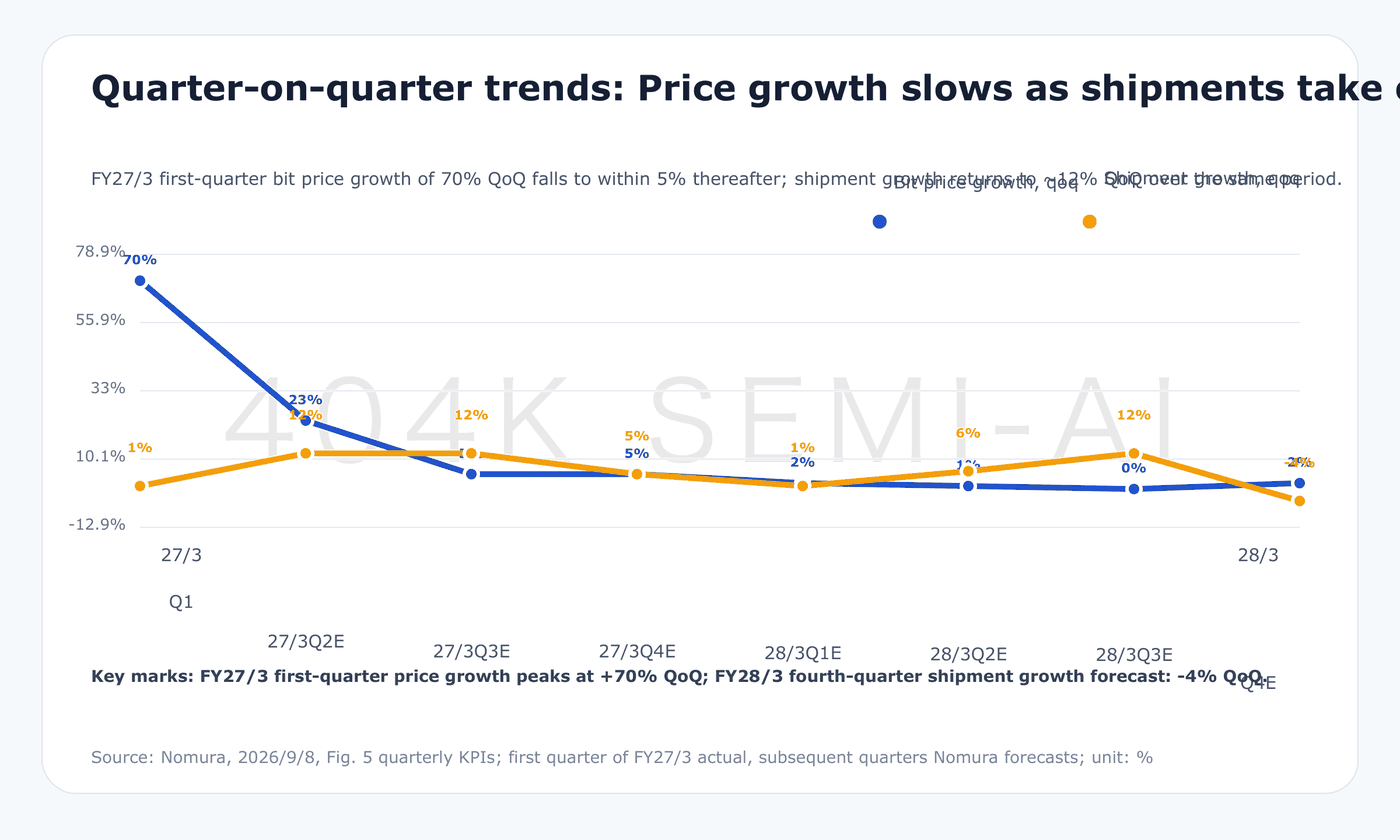
The model concentrates the major price increases in 2026, followed by a plateau as volume becomes the main growth driver. In US dollars, Kioxia’s selling price per GB rises from $0.226 in Q1 FY3/27 to $0.306 in Q4, then from $0.312 to $0.322 during FY3/28. Cost per GB rises from $0.056 to $0.069 during FY3/27 and ranges between $0.069 and $0.075 in FY3/28. The widening price–cost spread across the forecast period underpins operating margins of 76%–77%.
The annual figures are clearer still. Nomura forecasts price-per-bit increases of 251% in FY3/27, 14% in FY3/28 and just 1% in FY3/29, while bit shipments grow 18%, 24% and 24%. Average annual selling prices per GB rise from $0.279 to $0.317 and then $0.320. Beyond FY3/28, revenue growth therefore largely tracks shipment growth, with almost no pricing contribution. This is more conservative than Goldman Sachs’s late-June thesis of an extended period of elevated prices, although Nomura likewise assumes no price decline.
Multiyear contracts explain the slower pricing trajectory. Nomura notes that their pricing provisions allow prices per bit to rise more slowly than spot prices, in exchange for committed purchase volumes. Kioxia gives up some pricing upside for greater shipment certainty. Nomura agrees with consensus that supply and demand will remain tight, but its pricing assumptions are clearly milder than spot-market gains.
Quarterly earnings follow the same pattern. In Q1 FY3/27, revenue was ¥1.7671 trillion, operating profit ¥1.27 trillion and operating margin 71.9%. Non-GAAP operating profit was ¥1.3262 trillion, with a gross margin of 78.1%. Nomura forecasts Q2 revenue of ¥2.4566 trillion, operating profit of ¥1.9127 trillion and an operating margin of 77.9%. Kioxia’s own Q2 guidance calls for ¥1.9 trillion in non-GAAP operating profit and a 79.5% margin, broadly consistent with Nomura’s forecast. Nomura projects Q3 and Q4 revenue of ¥2.9157 trillion and ¥3.1703 trillion, with operating profit of ¥2.2599 trillion and ¥2.4538 trillion.
By segment, SSD & Storage accounts for all the growth. Nomura forecasts revenue rising 474.8%, from ¥1.3626 trillion in FY3/26 to ¥7.8317 trillion in FY3/27, followed by ¥12.3042 trillion and ¥15.1976 trillion in the next two years. Smart Devices revenue rises from ¥760 billion to ¥2.1868 trillion, then broadly levels off, at ¥1.8583 trillion in FY3/28 and ¥1.8797 trillion in FY3/29. Enterprise SSDs, rather than consumer demand, are driving this cycle.
Nomura expects a limited impact from Yangtze Memory Technologies Corp. (YMTC), for three reasons. First, YMTC prices its products at or above competitors’ levels, indicating that it is not using discounts to gain share. Second, its share of enterprise SSDs—the core market in this cycle—is small. Third, its capex-to-revenue ratio is declining, with January–March 2026 capital expenditure running at an annualized rate of approximately ¥700 billion. Nomura also notes that data-center customers outside China favor customized products with high supplier-switching costs, making near-term entry difficult for YMTC.
Nomura addressed Chinese open-weight models in a July 28 thematic report, concluding that they do not alter the direction of memory demand. Its August 25 global memory-sector report also maintained the view that supply and demand remain tight. These reports provide the industry backdrop to the latest Kioxia target increase.
5. FCF Valuation and Dividend Scenarios: Deriving ¥131,000
Nomura’s preference for price-to-FCF over P/E draws on memory-sector history. It examined peak market-capitalization multiples of trailing 12-month FCF for Micron and SK hynix during upcycles since 2011 and selected 10 times as a reasonable multiple. FCF deducts capital expenditure, making it a better measure than operating profit of cash potentially available to shareholders.
Kioxia’s FCF history illustrates the strength of the current cycle. It generated ¥148.8 billion in FY3/22, negative ¥159.5 billion in FY3/23, negative ¥79.7 billion in FY3/24, ¥303.4 billion in FY3/25 and ¥395 billion in FY3/26. Nomura forecasts a jump to ¥4.1444 trillion in FY3/27, followed by ¥7.0095 trillion in FY3/28 and ¥8.891 trillion in FY3/29. The increase from ¥395 billion to ¥4.1444 trillion takes place within a single fiscal year.
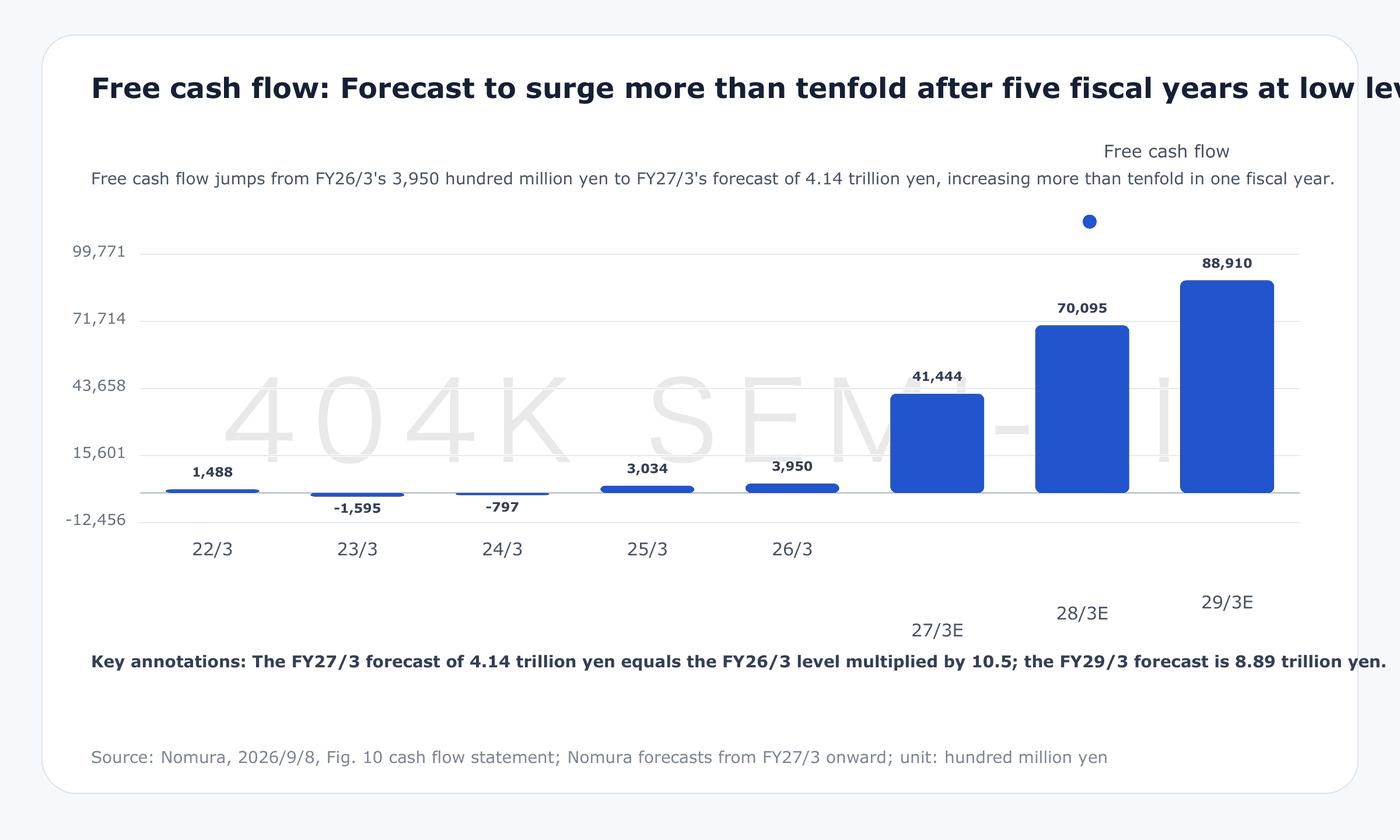
The components explain the scale of that increase. Nomura forecasts operating cash flow of ¥4.674 trillion in FY3/27, ¥7.709 trillion in FY3/28 and ¥9.606 trillion in FY3/29, against capex of ¥530 billion, ¥700 billion and ¥715 billion. Capex falls from 12.1% of revenue in FY3/26 to 5.1%, 4.8% and 4.1%. This is the key reason FCF growth can materially outpace operating profit growth: Nomura assumes Kioxia will not reinvest a large share of profits in capacity expansion. Depreciation and amortization are forecast at ¥426 billion, ¥492 billion and ¥545 billion, while R&D; spending is ¥200 billion in FY3/27 and ¥323 billion in FY3/28.
Net profit is forecast at ¥5.6243 trillion, ¥7.9685 trillion and ¥9.5823 trillion across FY3/27–FY3/29, with net margins of 54.6%, 54.9% and 55.0%. FCF per share is ¥7,791.9, ¥13,178.7 and ¥16,716.2. Dividing the ¥131,000 target by FY3/28 FCF per share of ¥13,178.7 gives 9.9 times.
The projected balance-sheet transformation is equally striking. Nomura expects cash and equivalents to rise from ¥471 billion at the end of FY3/26 to ¥2.432 trillion in FY3/27, ¥7.846 trillion in FY3/28 and ¥14.822 trillion in FY3/29. Shareholders’ equity rises from ¥1.399 trillion to ¥5.101 trillion, ¥11.474 trillion and ¥19.141 trillion, with the equity ratio increasing from 68.0% to 80.3% and 86.1% across the forecast years. By the end of FY3/29, cash would be the most prominent item on Kioxia’s balance sheet.
That pace of cash accumulation makes dividend-based valuation scenarios relevant. Using FY3/28 EPS of ¥14,982 and a 20% payout ratio, Nomura calculates an implied share price of ¥74,909 at a 4% required dividend yield and ¥149,818 at a 2% yield.

If investors value Kioxia as a high-yield cyclical stock, the implied price is around ¥75,000. If they accept a 2% yield for a growth stock, it approaches ¥150,000. Nomura’s ¥131,000 target sits toward the upper end of that range. With the payout ratio at just 20%, a future increase would support a higher share price at the same dividend yield.
Exchange rates provide another quantifiable variable. Kioxia assumes ¥162 per US dollar, while Nomura uses ¥159.84 for FY3/27 and ¥160.00 for FY3/28. Nomura estimates that each ¥1 weakening of the yen against the dollar adds ¥13 billion to operating profit in July–September 2026. An exchange rate of ¥162 rather than ¥160 would therefore provide modest upside to its operating profit forecast.
Forecast ROE underscores the cycle’s extremes: 173.1% in FY3/27, 96.2% in FY3/28 and 62.6% in FY3/29. The decline reflects rapid growth in the equity base, rather than falling earnings. This also helps explain Nomura’s use of FCF instead of ROE or price-to-book as its valuation anchor.
6. Risks and Tests: What Could Keep the Discount Intact?
Nomura identifies five risks to achieving its target: weaker NAND demand from slower AI investment or declining consumer confidence; intensified competition from new NAND suppliers; exchange-rate volatility; component-supply risks; and emerging technologies. The first two are conventional demand- and supply-cycle risks; the remaining three concern operating conditions.
The report’s own data also offer several challenges to the thesis.
First, the model already assumes slower price increases, but more conservative pricing provisions in multiyear contracts could turn FY3/28’s projected sequential price changes of 0%–2% negative. With forecast operating margins on a 76%–77% plateau, high operating leverage would amplify the profit impact of each percentage-point decline in pricing. The first quarter demonstrates the sensitivity: a 70% price increase lifted the operating margin to 71.9%, from 37.2% in the previous fiscal year. The same sensitivity exists in reverse.
Second, closing the capital-return expectations gap requires corporate action. Only an announced dividend policy can resolve the difference between consensus DPS of ¥843.6 and Nomura’s ¥2,110 forecast. The buyback is complete, but it was a one-off action. Without explicit payout guidance at the next results announcement, investors would have reason to continue pricing in lower shareholder returns, preserving the discount.
Third, the contract-duration gap is difficult to close quickly. Moving from three-year to five-year contracts requires customer agreement, and customers clearly favor shorter commitments in a rising-price cycle. NVIDIA’s concentration of purchase commitments through 2029 itself suggests uncertainty over longer-term demand. Kioxia may need to offer pricing concessions to secure longer contracts, returning to the first risk.
Fourth, ultra-high-IOPS SSDs bring both opportunity and risk. Nomura treats them as upside optionality outside its forecasts, but that option could lose all value if GPU vendors adopt other solutions for KV caching or if the product ramp slips beyond 2027. Emerging technologies, Nomura’s fifth listed risk, could benefit competitors as readily as Kioxia.
Fifth, the lower FY3/29 revenue forecast suggests greater caution about longer-term growth. Raising operating profit while cutting revenue depends on margin assumptions—and margins are among the least reliable variables in cyclical businesses.
Six checkpoints over the coming quarters can test Nomura’s thesis:
Whether July–September 2026 non-GAAP operating profit reaches company guidance of ¥1.9 trillion, with a 79.5% margin.
Whether sequential price-per-bit growth approaches 23% and shipment growth approaches 12%, confirming the expected transition in growth drivers.
Whether Kioxia issues FY3/27 dividend guidance, with DPS near ¥2,110.
Whether ultra-high-IOPS SSD samples ship in the second half, and how customers respond.
Whether USD/JPY remains above 160.
Whether YMTC continues to price in line with the industry.
If the first three checkpoints align with Nomura’s expectations, there would be a basis for Kioxia’s discount to SanDisk to narrow. If price growth falls materially short of 23% and dividend guidance remains absent, the discount would reflect real uncertainty rather than market mispricing. Nomura’s Buy thesis ultimately depends on valuation convergence, and Kioxia’s own actions must drive it.
Key Stock Tickers
Related Reading
Kioxia Deep-Dive Update: 75% Margin, ¥800 Billion Buyback, and ¥155,000 Valuation Anchor