Victory Giant Technology Removed, Shengyi Technology Added: The M9 Materials Logic Behind Goldman Sachs’ APAC Conviction List Reshuffle

目录
TL;DR
The Real New Move: Addition to the Conviction List, Not Another Price-Target Increase
Why Now: Goldman Sachs Puts Four Growth Drivers into the Same Model
In the Context of the Full August List: Goldman Sachs Prefers Execution amid Supply Constraints
Why M9 Matters: Rising Value per Unit Is More Important Than Server Volumes
RMB5.2 Billion Capacity Expansion: Both a Moat and the Most Easily Overlooked Stress Test
Margin Path: From 15% to 20%, Price Increases Alone Will Not Suffice
How the RMB247 Target Is Derived: 50.4x Is a Condition, Not an Outcome
Victory Giant Removed, Shengyi Technology Added: Does This Signal a Rotation from PCB Manufacturers to Materials?
Breaking RMB247 into Three Scenarios Makes the Disagreement More Intuitive
After August 14, Test the Thesis Against Five Questions
Final Assessment: The List Upgrade Has Already Happened; Valuation Delivery Is Just Beginning
本内容基于公开资料和研报数据整理,不构成任何投资建议,不代表任何个人观点,仅供学习参考,请理性阅读
Goldman Sachs added Shengyi Technology to its APAC Conviction List in August but did not raise its RMB247 price target again. The real new information lies in changing materials bottlenecks, the M9 upgrade, and relative allocation priorities.
TL;DR
What was raised this time was investment priority, not the price target. Goldman Sachs added Shengyi Technology to its APAC Conviction List on August 2, 2026, while maintaining its Buy rating and RMB247 12-month price target. The target was raised from RMB217.6 to RMB247 on July 14; it was merely reiterated in August.
The core rationale for Shengyi Technology’s inclusion is the scarcity value of high-end materials created by “AI demand × M9 specifications × mass-production capability.” Goldman Sachs expects the company’s net profit to grow 104% and 73% year over year in 2026 and 2027, respectively, with AI server PCBs accounting for approximately 40% of revenue in 2027 and more than 50% over the long term.
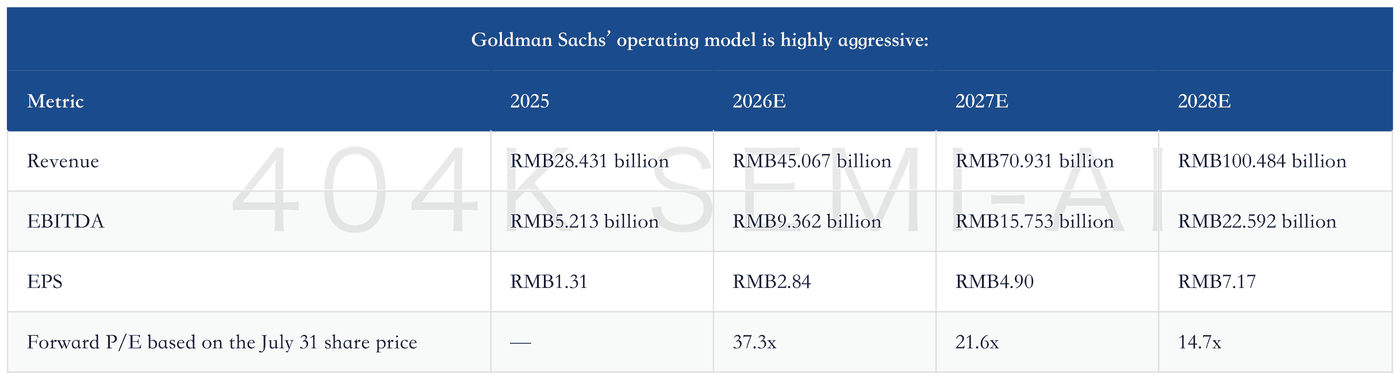
The RMB247 target prices in both earnings and valuation. It is derived by applying a 50.4x target P/E multiple to 2027 EPS of RMB4.90. Based on the July 31 closing price of RMB105.64, the report indicates 133.8% share-price upside and 137% potential 12-month total return including expected dividends.
The largest gap between Goldman Sachs and the market lies in 2027. Its 2026 and 2027 EPS forecasts are 18% and 42% above Bloomberg consensus, respectively. This means delivering the 2026 results would only complete the first step; M9 penetration, ASIC customer expansion, and margin improvement in 2027 will determine whether the price target can hold.
The removal of Victory Giant Technology and addition of Shengyi Technology may indicate a relative preference for upstream materials bottlenecks, but it cannot be interpreted as Goldman Sachs downgrading its analyst rating on Victory Giant Technology. The report explicitly states that additions to and removals from the Conviction List are decided by a committee and do not necessarily represent changes in analysts’ ratings.
The nearest hard validation point is the second-quarter results on August 14. The market needs to see not only high profits, but also a higher high-end product mix, price increases covering raw-material costs, RMB5.2 billion of expansion spending translating into effective capacity, and further upgrades to 2027 earnings forecasts.
The Real New Move: Addition to the Conviction List, Not Another Price-Target Increase
Goldman Sachs’ APAC Conviction List is not simply a collection of Buy-rated stocks. From among Buy-rated stocks within its Asia-Pacific coverage, it selects 20—30 ideas that its research teams consider the most differentiated and most attractive on a risk-adjusted-return basis, with the Investment Review Committee updating the list monthly. The August list contained 26 stocks, with Samsung Electronics, Keyence, Shengyi Technology, BYD, and Hong Kong Exchanges and Clearing added, while Victory Giant Technology and Yaskawa Electric were removed.
Accordingly, a “Buy” rating and “inclusion on the Conviction List” represent two different tiers. The former is an analyst’s assessment of a stock’s return potential relative to its coverage group, while the latter is a committee-led prioritization across the entire Asia-Pacific universe. Shengyi Technology was already rated Buy; the new information is that Goldman Sachs is now willing to rank it ahead of many other Buy-rated names.
The price target, however, was not raised again in August. Goldman Sachs disclosed the following history:
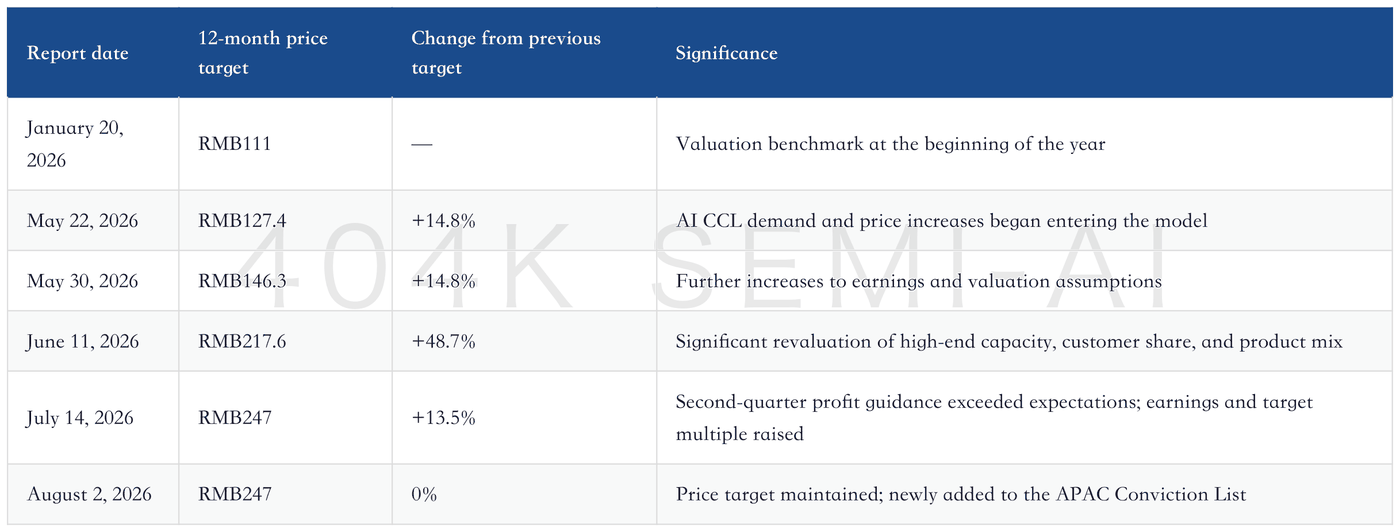
There is another detail in this timeline: Goldman Sachs noted that the price-target history was not adjusted for corporate actions. Therefore, figures spanning long periods cannot mechanically be treated as a fully like-for-like series. However, the July 14 company update explicitly raised the target from RMB217.6 to RMB247, while the August report directly retained RMB247. The conclusion is clear: the price target was indeed raised, but not in this August Conviction List report.
Why Now: Goldman Sachs Puts Four Growth Drivers into the Same Model
Shengyi Technology has not lacked an AI narrative over the past six months. The real change is that four growth drivers have begun feeding into the income statement simultaneously.
The first is demand. Goldman Sachs expects AI server shipments to continue ramping, with next-generation rack-scale servers entering mass production in the third quarter of 2026. As servers move from individual accelerator cards to full racks, computing density, transmission speeds, and interconnect complexity increase. Demand for high-end CCLs and PCBs per server no longer rises merely in line with “server unit volumes”; specification upgrades also increase content value.
The second is materials specifications. Leading GPU-based AI server racks will migrate toward M9-grade CCLs in 2026—2027. M9 matters not simply because it is a higher-grade designation, but because it offers lower signal loss, a lower coefficient of thermal expansion, and better heat dissipation. The higher the transmission speed and the more complex the board stack-up, the more difficult it becomes to maintain materials consistency, resin formulations, copper-foil bonding, and mass-production yields—leaving fewer suppliers capable of delivering consistently.
The third is pricing. Shengyi Technology has implemented multiple rounds of CCL price increases since the beginning of 2026. These increases are first used to offset higher raw-material costs, including copper foil, fiberglass cloth, and resin; only the portion exceeding cost pass-through contributes to margins. By presenting price increases alongside the M9 product-mix upgrade, Goldman Sachs indicates that its focus is not an industry-wide rise in ordinary materials prices, but the greater pricing spread the company can retain through high-end specifications.
The fourth is customer expansion. The company originally benefited from leading GPU-based AI server racks and is now expanding into application-specific integrated circuit (ASIC) servers. GPU and ASIC are not mutually exclusive: as cloud service providers expand their internally developed chips, they create additional server platforms and board-level materials qualification opportunities. If Shengyi Technology can serve both technology paths, its growth will no longer depend solely on a single customer or a single accelerator-chip architecture.