
Contents
1. Q3 Expected at the High End of Guidance; Full-Year Growth Reaches 41%
2. Capex: $90 Billion in 2027 and $105 Billion in 2028
3. 3nm Capacity Shifts from Smartphone Chips to AI
4. Revenue Mix: High-Performance Computing Reaches 74%
5. Volume and Pricing: Utilization Above 100%, Annual Wafer ASP Growth Above 15%
6. Earnings and Valuation: Above Consensus, with the Price Target Held at NT$3,650
7. What Could Undermine These Forecasts?
8. Key Numbers to Watch on the Earnings Call
This content is compiled from publicly available information and research reports. It does not constitute investment advice or represent any individual's views. For educational reference only; please read critically.
UBS has raised its TSMC capital expenditure forecasts to $90 billion for 2027 and $105 billion for 2028. As 3nm capacity shifts from smartphone chips to AI processors, gross margins are holding near 67%. Equipment inflation, dilution from 2nm production, and weak consumer electronics demand remain the key variables.
1. Q3 Expected at the High End of Guidance; Full-Year Growth Reaches 41%
Ahead of TSMC’s third-quarter 2026 results, UBS’s September 28 preview forecasts dollar revenue of approximately $45.7 billion, up 14% sequentially, and a gross margin of 67.1%. Both would be at the high end of company guidance. UBS expects fourth-quarter revenue to rise another 10% sequentially to approximately $50.3 billion, driven by seasonal flagship smartphone inventory builds and accelerating high-performance computing chip shipments. Gross margin is expected to remain broadly flat at 67.0%, as the ramp of 2nm (N2) production and overseas fabs offsets the benefit of higher revenue.
TSMC’s full-year 2026 guidance calls for dollar revenue growth slightly above 40%. UBS forecasts 41%, or $172.2 billion, followed by 40% growth to $240.7 billion in 2027, above consensus growth of 36%. The demand outlook underpins these estimates: UBS’s recent industry work finds no sign of slowing cloud AI demand, with stronger prospects than previously expected for CPUs, GPUs, and custom chips (ASICs) in 2027–2028.
In New Taiwan dollars, UBS forecasts 2026 revenue of NT$5.48 trillion, up 44%. The three-percentage-point difference from dollar revenue growth reflects exchange rates. UBS assumes NT$32.0 per US dollar from Q3 onward and a 2026 average of NT$31.8, versus NT$31.1 in 2025. For 2027, it models sequential revenue growth of 4% in Q1, 10% in both Q2 and Q3, and 6% in Q4, taking fourth-quarter revenue to approximately $67.4 billion.
The revision is clearer against the outlook five months earlier. After April’s first-quarter results, UBS raised its 2026 dollar revenue growth forecast to 35%, projected a full-year gross margin of 65.7%, and lifted its price target from NT$2,500 to NT$2,650. At the time, TSMC guided 2026 capex toward the high end of a $52 billion–$56 billion range. UBS subsequently raised its target in May, June, and July to NT$3,000, NT$3,400, and NT$3,650, respectively. Its current 2026 forecasts are 41% revenue growth, a 67.0% gross margin, and $63 billion of capex. Over five months, the revenue growth forecast has risen by six percentage points and the gross margin forecast by 1.3 percentage points.
This time, UBS left its rating and price target unchanged, with little change to 2026 and 2027 revenue and earnings estimates. Revisions focus on two areas: capex in 2027–2028, and revenue and earnings in 2028.
2. Capex: $90 Billion in 2027 and $105 Billion in 2028
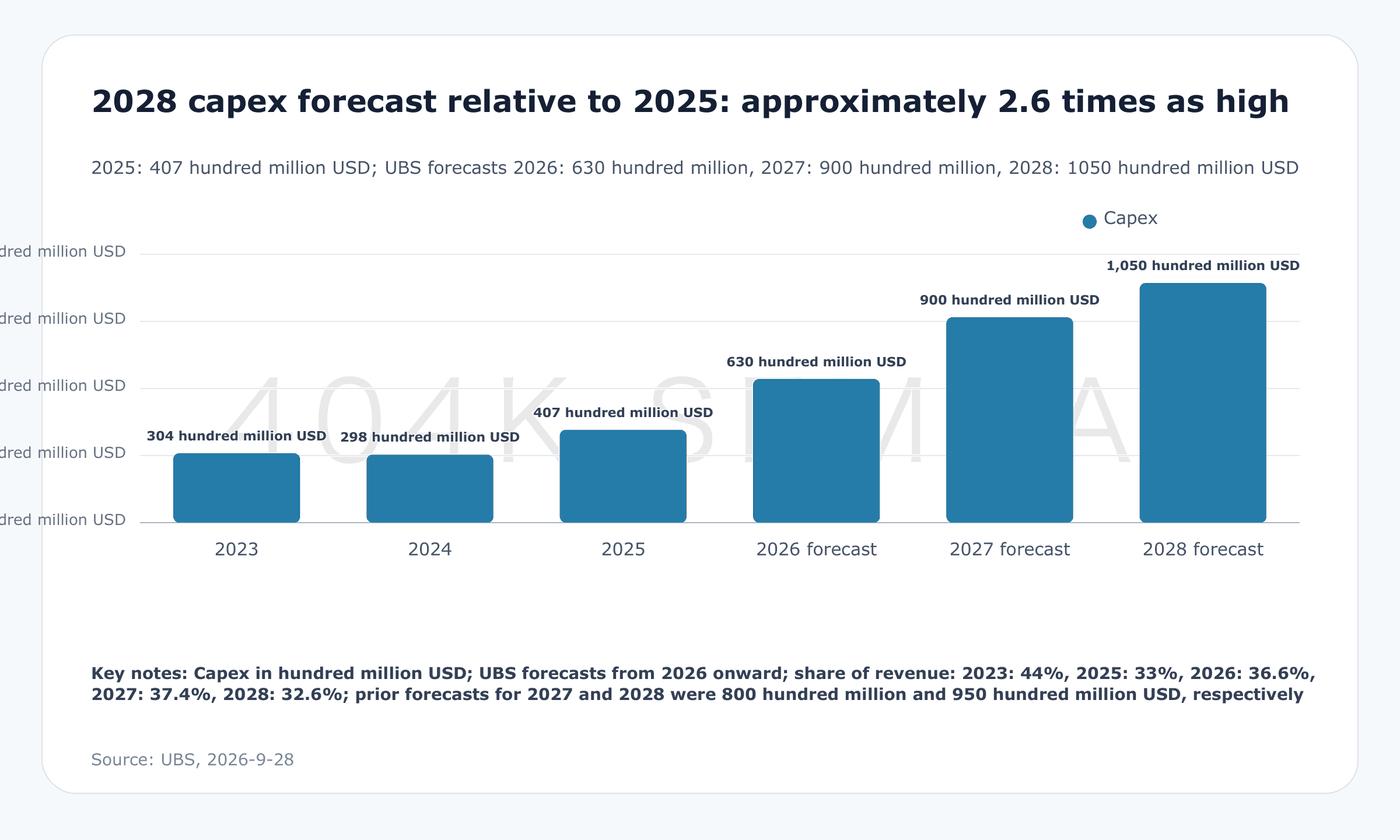
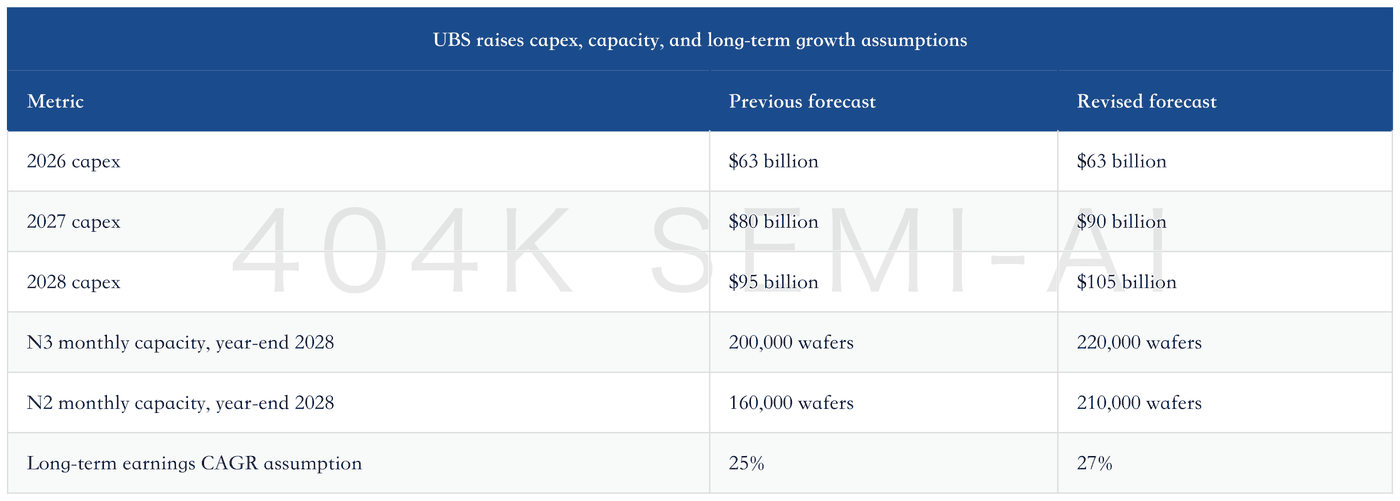
UBS maintains its 2026 capex forecast of $63 billion, raises 2027 from $80 billion to $90 billion, and lifts 2028 from $95 billion to $105 billion. For context, TSMC spent approximately $30.4 billion in 2023, $29.8 billion in 2024, and $40.7 billion in 2025. UBS’s 2028 forecast is roughly 2.6 times the 2025 level.
There are three reasons for the increase. First, TSMC is accelerating capacity expansion in 3nm (N3) and 2nm, while bringing forward equipment deliveries for A14 to provide more capacity when that node enters volume production in 2028. UBS accordingly raises its year-end 2028 monthly capacity estimates from 200,000 to 220,000 wafers for N3 and from 160,000 to 210,000 wafers for N2—an increase of roughly 30% for N2. Second, equipment price increases are more pronounced than previously expected, and suppliers are requiring advance payments. Third, advanced packaging capex is rising.
These drivers have different implications. Faster expansion adds capacity that can generate future revenue. Higher equipment prices and advance payments increase the cost of the same capacity and bring cash outlays forward, without directly adding output. Advanced packaging investment supplies the backend capacity needed to ship AI chips. UBS does not quantify the contribution of each driver, so the public figures do not establish how much of the additional $10 billion in each year will translate into incremental capacity.
Capex intensity provides a better measure of the investment burden. UBS expects capex as a share of revenue to rise from 36.6% in 2026 to 37.4% in 2027, before falling to 32.6% in 2028. The ratio was 44% in 2023 and approximately 33% in both 2024 and 2025. In growth terms, 2027 capex rises approximately 43%, broadly matching revenue growth of 40%. In 2028, capex growth slows to about 17% while revenue still grows 34%, reducing the ratio. That decline depends on delivery of the 2028 revenue forecast.
