
Contents
From a Seven-Week Wait to a Unanimous Hike
The Rate Path for the Next Two Years Has Shifted Markedly Higher
Rate Hikes Must Prevent Energy Shocks from Spreading
AI Investment Makes Rate Judgment More Complex
Chair’s Opening Statement
Press Conference Q&A
AI Risks and the Fed’s Mandate
Must Employment Be Sacrificed to Lower Inflation?
This content is compiled from publicly available information and research reports. It does not constitute investment advice or represent any individual's views. For educational reference only; please read critically.
The Fed voted unanimously to raise rates by 25 bp and marked up its rate projections for next year and the year after. The press conference further explained the policy shift: employment is firmer, inflation is not falling fast enough, and financial conditions still have an accommodative element. But the Chair did not commit to action at the next meeting.
From a Seven-Week Wait to a Unanimous Hike
On September 16 ET, the Fed voted 12-0 to raise the target range for the federal funds rate to 3.75%-4.00%. In July, the result was 9-3 to hold, with the three dissents favoring a hike. Between the two meetings, support for action broadened notably.
The Chair gave three reasons: broader data confirmed the economy was strengthening; the summer inflation trend failed the standard of falling sufficiently quickly; and the judgment on geopolitics had changed. The July decision to wait was about obtaining more information. Seven weeks later, that information did not provide sufficient reason to keep waiting.
The more critical phrase was “remove some accommodation.” The Chair argued it is hard to describe overall financial conditions as restrictive, and colleagues broadly shared that view. This means one cannot conclude the economy has already endured sufficiently strong tightening simply because the policy rate is above its longer-run projection. Credit, capital investment and real economic performance also entered the Committee’s judgment.
The Rate Path for the Next Two Years Has Shifted Markedly Higher
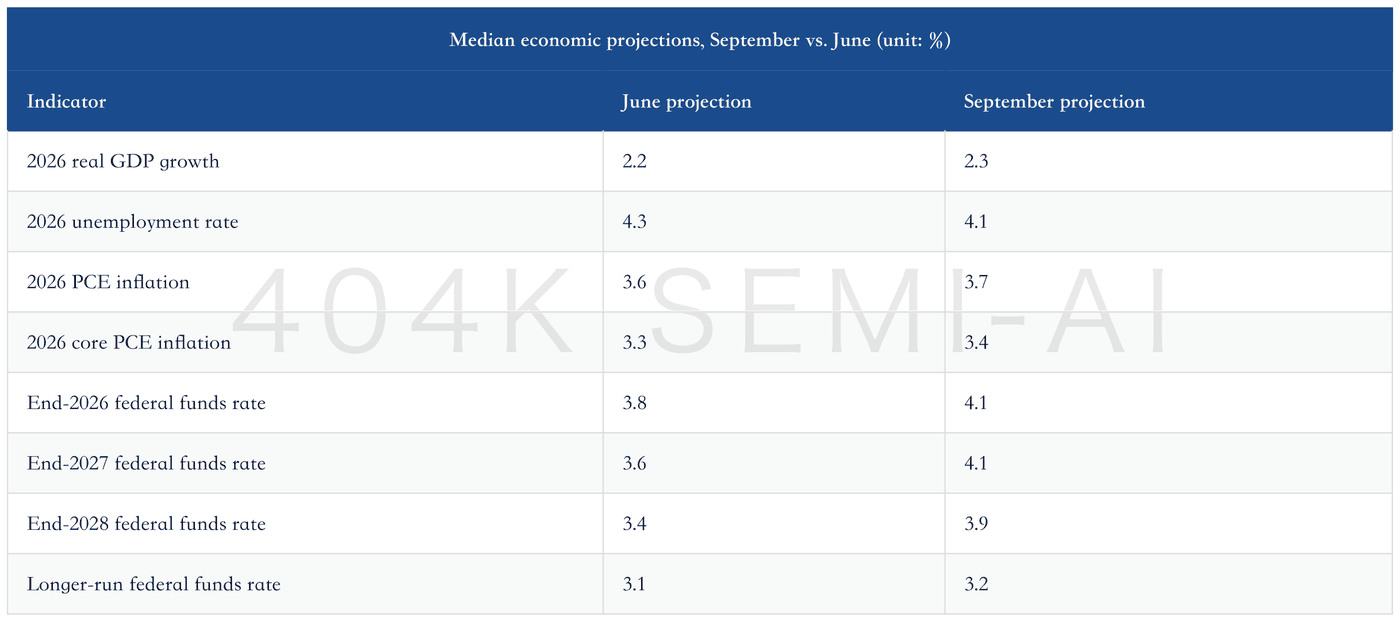
In the Fed’s SEP, median rates for 2027 and 2028 are each about 0.5 pp above June, while the longer-run value was revised up only 0.1 pp. That combination better supports the judgment that “high rates will last longer,” but it is not enough to show the long-run rate center has shifted by the same magnitude.
Using the midpoint of the post-hike range, 3.875%, as the baseline, of the 18 forecasters, 12 saw another 25 bp by year-end, 4 saw another 50 bp, and 2 saw no change. Further hikes are therefore the mainstream year-end view.
However, the end-2026 and end-2027 medians both at 4.1% only mean there is no net decline between those two year-ends. It does not follow that there will be no cut at every 2027 meeting. The Chair also explicitly said he did not submit projections and does not pre-judge future decisions. The dot plot provides policy bias, not a pre-scheduled action calendar.
Rate Hikes Must Prevent Energy Shocks from Spreading
A reporter asked a direct question: rate hikes cannot reopen the Strait of Hormuz, so why raise rates? The Chair responded that the Fed cannot determine the price of a single commodity, but it must prevent relative price changes from spreading into second- and third-round effects.
This also clarifies the statement’s wording. The September statement removed July’s explanation of energy and other supply shocks, but the press conference still acknowledged supply factors. The policy focus is preventing those shocks from turning into more generalized and persistent inflation. Removing a sentence of attribution should not be read as supply factors having disappeared.
The employment assessment gave room for this choice. The 2026 unemployment forecast was cut from 4.3% to 4.1%; the number seeing unemployment risk skewed to the upside fell from 7 to 0. Meanwhile, 17 still saw inflation risk skewed to the upside, unchanged from June. The change was concentrated in easing employment concerns, not in a further increase in the number worried about inflation.
The Chair does not believe the labor market must be hurt to bring inflation down. That is the current policy judgment, and it also creates a test point: if unemployment rises markedly, or hiring continues to weaken, the Committee will need to reweigh the cost of further hikes.
AI Investment Makes Rate Judgment More Complex
On long-term bond yields, the Chair listed three explanations: a stronger economy, competition for capital, and geopolitics, specifically mentioning hyperscaler financing. Under that interpretation, capex expansion increases demand for funds, so long-term yields cannot be explained only by the next hike or cut. This is the Chair’s attribution, not a completed empirical decomposition.
AI’s ultimate impact on the supply side remains to be assessed. The Chair proposed a working group to report on the policy implications by year-end, while leaving AI regulatory choices to other parts of government. Investment demand and future productivity gains may appear at different times, and it is too early to conclude that AI has eliminated the inflation constraint.
For future policy, the Chair repeatedly stressed trends and refused to give forward guidance around any single CPI reading. The real things to watch are therefore whether core inflation keeps slowing, employment remains stable, and corporate financing and capex remain strong. Only if these changes move in a consistent direction will “how long will high rates last” have a clearer answer.
Chair’s Opening Statement
Chair:
As the policy statement just released notes, economic activity is expanding solidly. Although uncertainty remains high, partly because of geopolitics, domestic spending is resilient.
Productivity growth is strong, and capital investment is solid. Employment growth is broadly in line with labor force growth, and the unemployment rate is little changed.
But inflation remains elevated. Today’s policy action will support a more timely return of inflation to the Committee’s 2% goal. The Committee will achieve price stability.
Let me elaborate. We made this decision as the U.S. economy appears to be strengthening: new hiring, private-sector earnings, and business capital investment have all improved in recent months and are moving in a good direction. Credit provision is strong, especially business credit.
As I said at the Jackson Hole policy symposium, I find it hard to describe overall financial conditions as restrictive. The Committee broadly shares that view. We therefore removed some accommodation. Given the shocks and uncertainty from the geopolitical environment, the resilience of the U.S. economy is even more notable.
Given that resilience, and the economy’s potential to perform better, over the past two days inside the FOMC I heard a sense of optimism.
A basic sign of economic strength is the condition of the U.S. labor market. The unemployment rate remains low, around 4.1%. Job openings and weekly hours are increasing. The four-week moving average of jobless claims is consistent with full employment.
