
Contents
1. The Market Is Bullish, but Starting to Price the Cost
2. HBM Disagreement: How Much Are Customers Willing to Pay?
3. Long-Term Agreements Improve Operations but Have Not Eliminated the Cycle
4. Supply Shortages Can Also Prompt Customers to Use Less Memory
5. Samsung’s Opportunity: Multiple Business Lines Improving Together
6. SK hynix’s Appeal Is More Linked to the Cash Shareholders Receive
7. Behind Target Prices, Earnings Durability Matters More Than the Stock Price Number
8. What to Track Next: Results That Would Actually Change the Judgment
This content is compiled from publicly available information and research reports. It does not constitute investment advice or represent any individual's views. For educational reference only; please read critically.
Memory supply-demand tightness remains, but optimism alone is no longer enough to drive investors to add. The next differentiation between Samsung and SK hynix will depend on how much HBM price increases are realized, whether long-term agreements can stabilize profits, and how cash earned is returned to shareholders.
1. The Market Is Bullish, but Starting to Price the Cost
The memory market has entered a more demanding phase. Goldman Sachs’ Sept. 14 summary of North American investor feedback showed broad recognition of industry fundamentals and high attention on both Samsung Electronics and SK hynix. But the lack of major near-term catalysts, plus concerns about positioning, continued to limit incremental allocations. Being bullish on the industry and being willing to add at current expectations are now two different questions.
This observation came from investor meetings in Toronto, Boston, New York and San Francisco. Goldman sensed North American investors were more positive than Asian investors, but found no clear, consistent preference between the two companies. Because the number of participants and sampling method were not disclosed, the feedback is useful for identifying debates, not as a statistical conclusion on global allocation.
The more informative shift is within the optimism itself. Most respondents expect third-quarter 2026 DRAM and NAND average selling prices to rise about 20% quarter on quarter. DRAM primarily handles runtime data access, while NAND primarily stores data that must persist after power loss; their demand structures are not identical. The ~20% figure is surveyed investors’ expectation for quarterly ASPs, not a realized gain, and cannot directly substitute for company revenue growth.
Higher prices can improve revenue and profit, but the final statements still pass through shipments, product mix, costs and foreign exchange. Respondents are particularly worried that significant KRW appreciation against the USD this quarter could pressure both companies’ earnings. Even if USD-denominated ASPs continue to strengthen, KRW-denominated operating results may not increase proportionally; the magnitude also depends on revenue, costs and FX management arrangements, and the available material does not provide a directly applicable sensitivity coefficient.
The stock’s next question therefore becomes specific: can the ~20% price expectation be achieved, will FX offset part of the gain, and will shipment growth occur simultaneously? If these results merely meet expectations that have already been raised, the industry boom may remain strong while the stock lacks a new reason to rise. Treating “prices are still rising” as a complete investment conclusion misses the most important benchmark.
2. HBM Disagreement: How Much Are Customers Willing to Pay?
HBM—high bandwidth memory—is a key memory product in AI computing systems. It is the center of this debate, but respondents have not formed a consensus on next year’s price. Conservative investors model a roughly 50% year-on-year increase and worry customers cannot absorb too high a cost; optimistic investors argue that to bring HBM margins closer to conventional DRAM, price increases need to significantly exceed 100%. Goldman’s own view lies between the two, expecting 2027 HBM blended ASP to rise about 100% year on year.
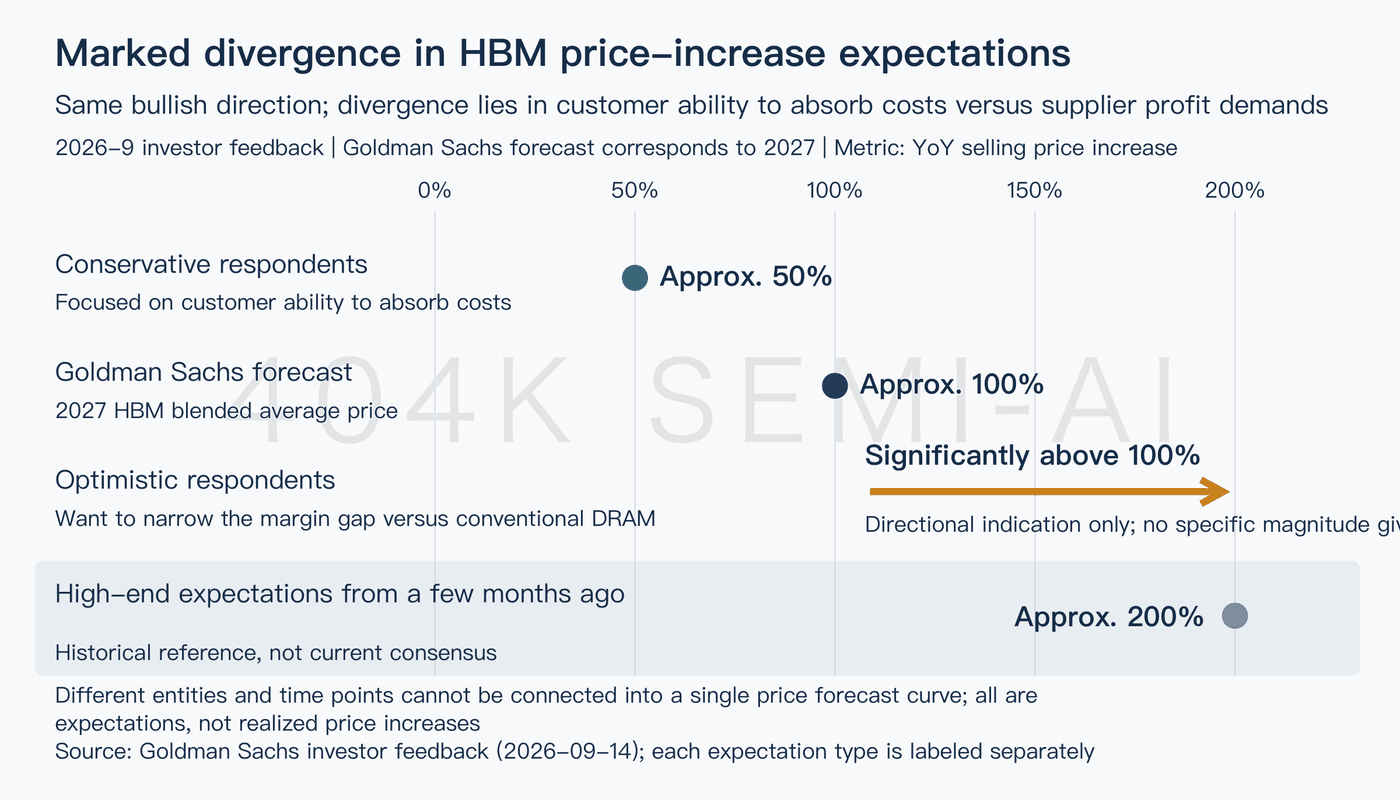
These numbers show the market still expects large HBM price increases, but the debate has shifted from how high suppliers can ask to how high customers can accept. The retreat from early high-end expectations of ~200% to ~100% is not a decline in product prices. Both point to price increases, just at different magnitudes; for assets already priced for higher increases, that difference still matters.
Using a price index as an illustration: if the base is 100, a 50% increase gives 150, while a 100% increase gives 200. Under the assumption of identical shipments and product mix, the former corresponds to sales 25% lower than the latter. This is a mathematical comparison of two price assumptions, not a forecast of Samsung’s or SK hynix’s revenue, and certainly not a direct inference that profit would also be 25% lower. It shows that even if everyone is bullish on HBM, the disagreement is still enough to change an earnings model.
Optimistic investors’ use of conventional DRAM margins as a reference also reveals an easily overlooked economic constraint. High technical content does not automatically mean the best economic return. When ordinary memory product prices are good, suppliers compare revenue, costs, production resources and customer relationships across products. If HBM carries more complex production and delivery requirements but cannot provide commensurate profit, its pricing needs to be renegotiated. The margin definition here is not further specified and should not be interpreted as gross or operating margin.
Customer constraints come from total system cost. How much performance and efficiency benefit memory products can deliver affects the degree to which customers accept price increases; buyers may also absorb costs by reconfiguring capacity, optimizing usage or adjusting procurement arrangements. Conservative respondents emphasize this affordability issue, not a confirmed decline in HBM demand. Strong technical demand and intense price negotiations can coexist.
Goldman’s use of “blended ASP” also means product and customer mix must enter the analysis. A rising blended ASP can come either from price increases on the same products or from a higher share of higher-value products. Goldman sees more upside for Samsung in product and customer mix, but did not give HBM price increase magnitudes for each company separately. The industry blended ASP forecast of ~100% cannot be mechanically applied to all HBM revenue at either company.
