
Contents
I. Three Milestones in Two Weeks: Starship in Orbit, Starlink Acceleration, and Compute Contracts Form
II. Valuation Horizons Dictate How Much AI Value Is Priced In
III. Compute: What Is 1 GW Worth, and How Wide Is the 2027 Capacity Gap?
IV. Product Layer: Grok Bot and Cursor Must Prove Enterprise Willingness to Pay
V. Starlink: Subscriber Growth Accelerates as Price Cuts Expand the TAM
VI. Starship: Flight 14 Proves Orbital Insertion, but Reuse Cadence Remains Contested
VII. Capital Allocation: Capex, Cash Burn, and Debt Financing
VIII. Key Catalysts Ahead of Q3 Results: Consensus Variance and Six Critical Metrics
This content is compiled from publicly available information and research reports. It does not constitute investment advice or represent any individual's views. For educational reference only; please read critically.
In mid-to-late September, five major investment banks aligned on the directional trajectory for SpaceX: Starship reached orbit, Starlink subscriber growth accelerated, and compute-leasing contracts formalized. Yet their price targets diverge widely from $210 to $300. Virtually all of this spread comes down to differing expectations for how large the AI compute business can scale and how many years into the future analysts are willing to anchor their valuations.
I. Three Milestones in Two Weeks: Starship in Orbit, Starlink Acceleration, and Compute Contracts Form
On September 28, Starship Flight 14 achieved orbital insertion for the first time, deploying 26 operational Starlink V3 satellites directly into the constellation. Each V3 satellite delivers 1 Tbps of downlink capacity—ten times that of the operational V2 mini satellites. UBS estimates this single mission added over 25 Tbps of constellation capacity. Marking the first time Starship deployed satellites directly into an active orbital constellation, UBS characterized the flight as a meaningful partial de-risking milestone.
Starlink's underlying growth is also accelerating. UBS estimates Q3 net additions reached 2.3 million—up from 1.7 million in Q2—bringing total subscribers to approximately 14.3 million at quarter-end (the company previously disclosed crossing 13 million in August). With net adds accelerating by 600,000 quarter-over-quarter, UBS highlighted aggressive promotional campaigns across multiple channels, which should sustain subscriber momentum ahead of the full commercial deployment of the V3 constellation.
AI compute is evolving the fastest. In late September, Elon Musk disclosed that another cluster of 220,000 NVIDIA GB300 GPUs would become fully operational that week, followed by another 220,000 in November, and potentially one more batch by late December "if lucky." Based on Deutsche Bank's conversion of ~440 MW per 220,000 GB300 GPUs, SpaceX's compute capacity will expand from 1.4 GW at the end of Q2 to ~2.3 GW by late November and ~2.7 GW by early 2027. Demand-side figures have also taken shape: Deutsche Bank estimates that annualized revenue across five signed compute-leasing customers totals roughly $54.5 billion, while UBS projects that contracts secured post-Q2 will drive cloud annualized run-rate revenue to approximately $54 billion by December.
All five investment banks maintain positive ratings, yet their price targets are widely dispersed.
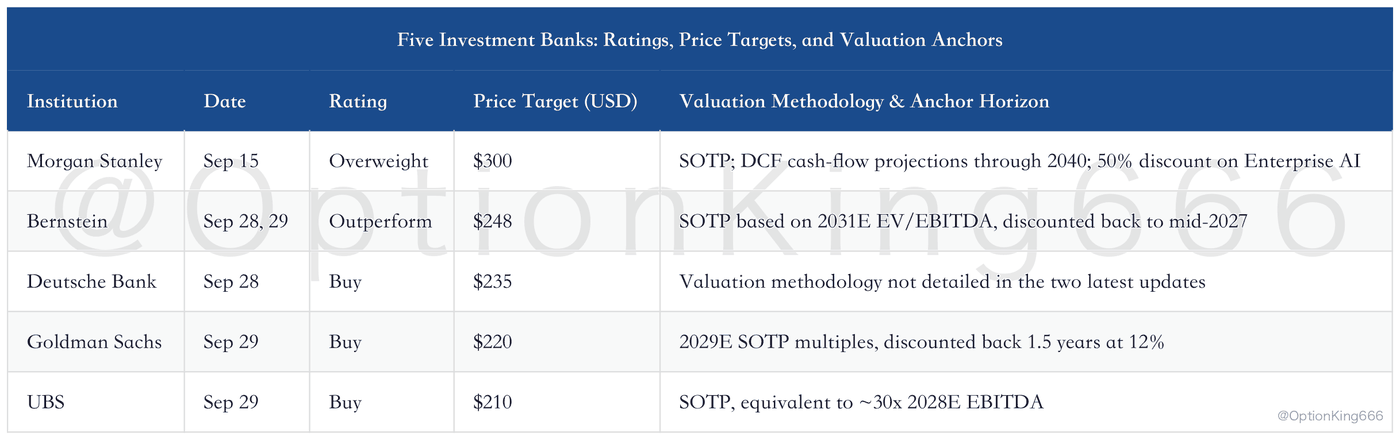
The $90 spread between the highest and lowest targets represents roughly 60% of the current share price. While all five firms agree on the trajectory of the three operational milestones, they diverge on two longer-term questions: how large the AI compute business can ultimately become, and how many years of future earnings should be discounted back to the present.
II. Valuation Horizons Dictate How Much AI Value Is Priced In
Morgan Stanley’s $300 price target is built on four components: Launch at $8, Connectivity (Starlink) at $118, X & Grok at $8, and Enterprise AI at $165. The two AI-related segments total $173, representing nearly 60% of the target price—even after applying a 50% haircut to Enterprise AI for execution risk. In other words, to the street-high bull, SpaceX is fundamentally an AI company, with rockets and satellites serving as physical infrastructure to convert power into compute.
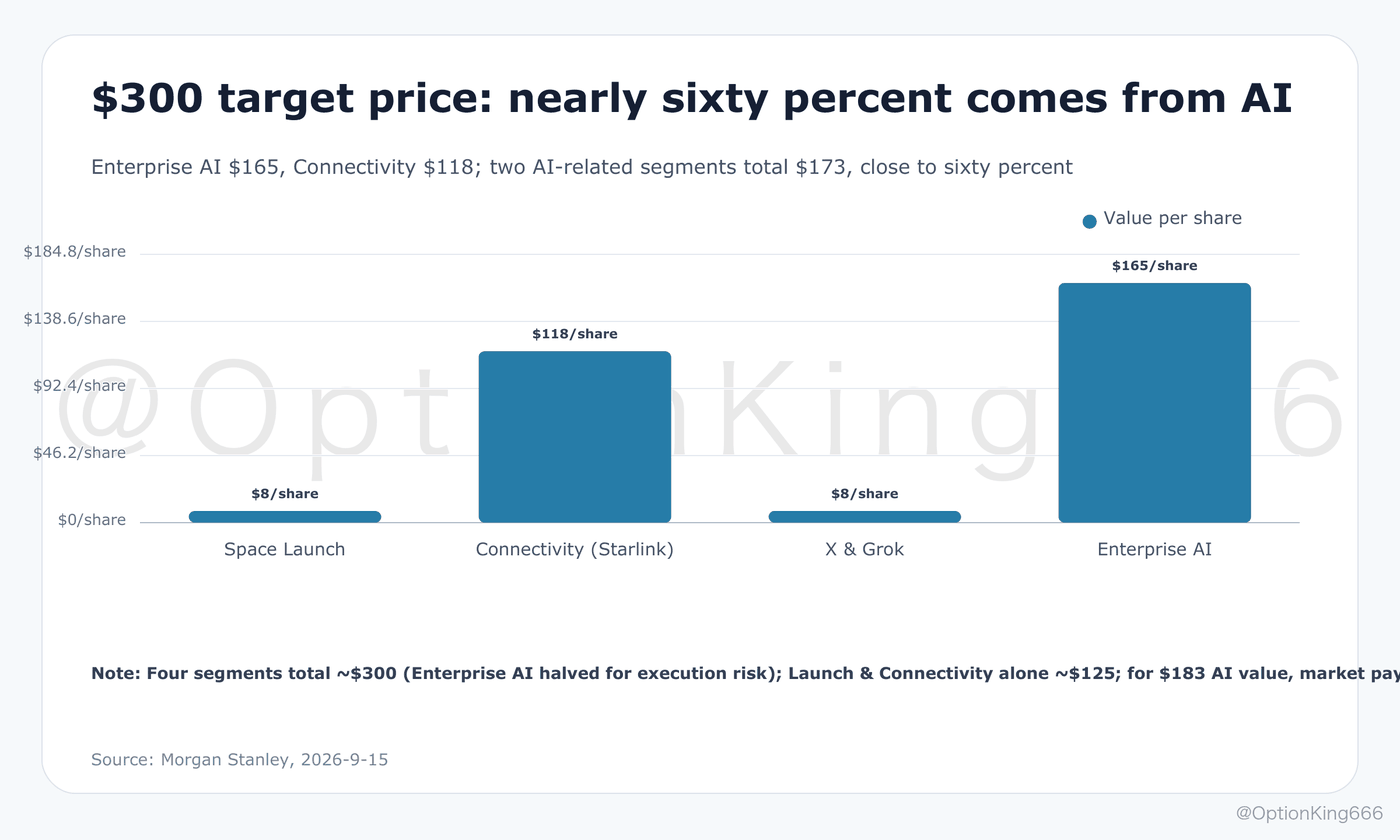
This same sum-of-the-parts (SOTP) framework establishes a valuation floor. Morgan Stanley calculates that if the market attributes zero value to AI and values only Launch and Connectivity, the implied stock price is approximately $125—what it terms the "AI for free" price. With the stock trading below $150, the market was paying only ~$17 for its estimated $183/share of total AI value (less than 10%), effectively pricing the long-dated call option on orbital AI at zero. During its August assessment of the Cursor acquisition, Morgan Stanley derived an implied AI value of ~$12/share based on a ~$133 share price. While this implied AI value rose to $17 a month later, the market still prices in only a fraction of its modeled potential.
This floor was the starting point for Morgan Stanley’s thesis. In mid-September, when industry calls to voluntarily slow foundation model training over safety concerns weighed on the AI sector, Morgan Stanley outlined five reasons why SpaceX offers superior downside resilience among AI holdings:
Business diversification: Starship flight milestones are decoupled from AI trading cycles, and Starlink subscriber growth exceeds 100% YoY without relying on broader tech AI capex.
Long-dated optionality: The commercial inflection point for space-based AI infrastructure lies post-2030, while robotics partnerships with Tesla and domestic semiconductor manufacturing collaborations with NVIDIA and Intel remain essentially unpriced.
Balance sheet headroom (discussed further below).
Valuation support: The aforementioned "AI for free" floor.
Musk’s execution during high-volatility periods, citing Tesla’s production ramp in 2018–2019.
Among these five arguments, the bedrock supporting the stock price remains the cash flows and foundational valuations of Starlink and Launch—the exact areas where Street consensus is tightest.
The methodological variances among the other three firms map directly to their target prices. Bernstein explicitly argues that multi-trillion-dollar valuations hinge primarily on orbital data centers, necessitating a 2031E EBITDA anchor; applying 2028 multiples would capture only Launch, terrestrial compute, and near-term Starlink, entirely excluding orbital compute. Bernstein values each segment on 2031E EBITDA to derive a 2030 enterprise value, then discounts back to mid-2027 to reach $248. Goldman Sachs anchors on 2029: Launch at 9.5x EV/Sales, Connectivity at 24x EV/GAAP EBIT, and AI at 28x EV/GAAP EBIT, discounted back 1.5 years at a 12% discount rate to arrive at $220. UBS’s $210 target equates roughly to 30x 2028E EBITDA.
Viewed side by side, the pattern is unmistakable: the further out the valuation anchor, the higher the price target. UBS stops at 2028; Goldman Sachs looks to 2029; Bernstein extends to 2031; Morgan Stanley runs DCF projections out to 2040. Each additional year pushed into the future capitalizes another year of hyper-growth in AI compute into today's price.
The disagreement centers on AI, not Starlink, as directly evidenced by comparing the detailed segment models published by Bernstein and UBS.
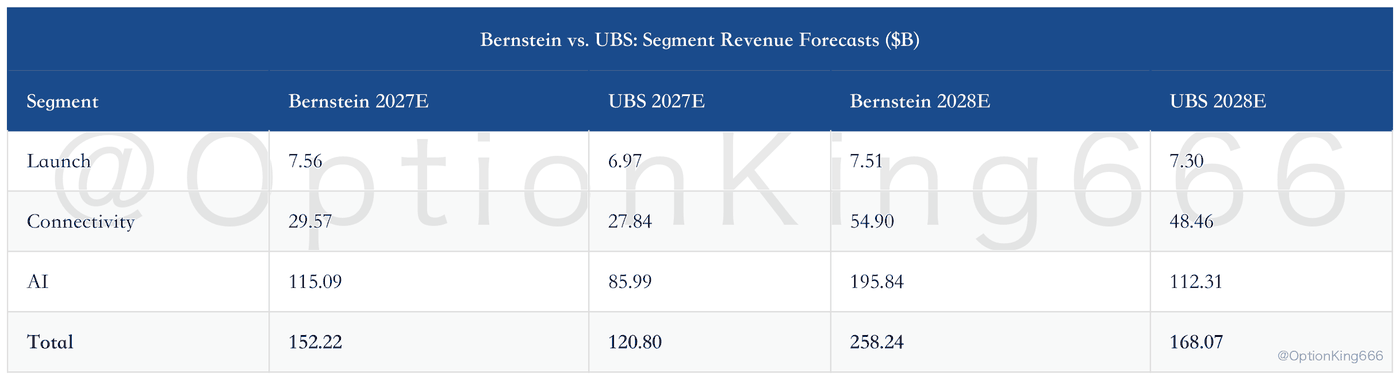
By 2028, the two firms' forecasts for Connectivity revenue differ by ~$6.4 billion, whereas their AI revenue forecasts diverge by ~$83.5 billion. Launch expectations are nearly identical, and the Starlink gap is modest; AI alone accounts for the vast majority of the top-line variance. Starlink provides the valuation floor: Morgan Stanley assigns Connectivity $118 per share, and Bernstein projects Connectivity EBITDA will surpass $100 billion by 2031. How high the valuation stacks above that foundation is determined entirely by AI.
III. Compute: What Is 1 GW Worth, and How Wide Is the 2027 Capacity Gap?
The scale of AI revenue depends first and foremost on the deliverable power capacity of its compute infrastructure. Deutsche Bank’s cluster breakdown shows that Colossus I comprises 230,000 GPUs requiring ~300 MW. Colossus II, built across multiple phases alongside the cluster codenamed Minihard, totals 1.21 million GPUs and ~2,410 MW. To support this expansion, SpaceX is also constructing the largest grid-tied battery energy storage system (BESS) in the United States, with a capacity of 3.3 GWh.
