
Sinocera Materials Deep Dive Update: 5,000 Tons of AI-Grade MLCC Powder, a RMB136 Target Price, and New Ceramic Substrate Orders as Validation
目录
Too Long; Didn’t Read
I. The Conclusion First: The Re-Rating Has Happened; Delivery Has Just Begun
II. From 2024 to 2026: The Same Company’s Valuation Anchor Changed Three Times
III. AI and Automotive-Grade MLCC Powders: The Real Acceleration Point Comes After 3Q26
IV. Electronic Paste: Sinocera Is Not Just a Powder Supplier
V. Dental, Catalysts, New Energy, and Precision Ceramics: They Determine the Valuation Floor, Not the Ceiling
VI. Ceramic Substrates and the Option Layer: Sinocera Creation Orders Make the Second Growth Curve More Concrete
VII. Financial Model: Revenue Recovery Does Not Equal Profit Conversion
VIII. Valuation Discipline: RMB136 Is Not the Conclusion; It Represents a Higher Evidence Threshold
IX. Capability Transfer: From Oxide Powders to a High-Reliability Materials Platform
X. Official A-Share Abbreviation and Overseas Aliases: Investment Language Should Be Standardized Around Sinocera Materials
XI. Differences Versus Peers: Reference Points From Chaozhou Three-Circle, Fenghua Advanced Technology, and Overseas MLCC Manufacturers
XII. Data Scope: Which Numbers Belong in the Model, and Which Should Only Go on the Watchlist
XIII. Falsification Checklist: The Most Important Things to Track Are Not News Items, but Four Quarters of Hard Data
XIV. Three Worldviews: Platform Materials Stock, Certification-Right Asset, Multi-Option Platform
XV. How to Use Sell-Side Divergence: The Target Price Is Not the Conclusion; the Validation Points Are
XVI. Roadmap for the Next Four Quarters: Focus on a Few Hard Metrics Each Quarter
XVII. Cash Flow and R&D Investment: Platform Expansion Cannot Rely on Slogans
XVIII. Formal Disclosures and Research Clues: What Is Already in the Financials, and What Is Still on the Way
19. Differences versus the Prior View on Sinocera Materials: From “Materials Ticket” to “Monetization Checklist”
20. Weighting Adjustment Framework: When to Raise the Tracking Level and When to Cool Down
21. Conclusion: Buying Materials Certification Rights, Not Full Delivery of Every Option
本内容基于公开资料和研报数据整理,不构成任何投资建议,不代表任何个人观点,仅供学习参考,请理性阅读
The key point in this update on Sinocera Materials is not how much the share price has already risen, but the evidentiary bar behind JPMorgan’s increase in its target price from RMB60.40 to RMB136: whether AI-grade MLCC powder can ramp in volume, whether ceramic substrates can absorb new orders, whether electronic-materials gross margin can return to historical highs, and whether that ultimately flows through to cash flow and ROE.
Too Long; Didn’t Read
Sinocera Materials’ valuation anchor has shifted to high-end powders. JPMorgan raised its target price in July from RMB60.40 to RMB136. The core is not simply higher revenue forecasts, but applying a 93x one-year forward PE to 2028E EPS of RMB1.46, while assuming high-end MLCC powder revenue accounts for more than 35% of the electronic-materials segment in 2027. This means market pricing has moved from “MLCC cycle recovery” to “AI and automotive-grade materials qualification rights.” Subsequent validation must come from high-end powder tonnage, electronic-materials gross margin, and customer adoption, rather than piling on more new-materials narratives.
5,000 tons of high-end capacity is the main thread of the report. Sinocera Materials already has 10,000 tons of standard MLCC powder capacity. Its high-end target capacity for AI servers and automotive applications is 5,000 tons, of which 2,000 tons came online by end-2025, with the remaining 3,000 tons expected by end-2026. The company has hydrothermal barium titanate technology and can mass-produce 50-100nm high-end powders. Customer leads include Samsung, Fenghua Advanced Technology, and Yageo. If volume supply materializes in 2H26, the electronic-materials segment will shift from volume recovery to mix-driven price uplift.
Powder price increases have more elasticity than the market expects. From March to May 2026, Murata and Samsung Electro-Mechanics already raised prices for high-end MLCCs, with upstream dielectric powders following. The real issue is the pricing ladder: consumer-grade, automotive-grade, and AI-server high-capacitance powders are clearly tiered by per-ton value, gross margin, and qualification difficulty. Contract liabilities have also begun to show order momentum, indicating that price increases and demand are not merely industry rumors.
Ceramic substrates are the second incremental growth line. Through Sinocera Saichuang, Sinocera Materials has built integrated capabilities in “powder + ceramics + metallization.” LED ceramic substrates are already supplied steadily to global customers. Revenue from low-orbit satellite RF microsystem chip packaging housings grew rapidly in 2025, and a RMB100mn order signed in June 2025 is expected to be completed in 1H26. Optical-module TEC has achieved small-batch sales, while PCB ceramic substrates remain under testing by major customers. The company expects substantive progress and new orders in 2027, making Sinocera Materials more than an MLCC powder asset.
A RMB136 target price requires stricter evidence. JPMorgan’s new model raises both 2027-2028 earnings and valuation multiples. The core assumption is that after high-end MLCC powder ramps, electronic-materials gross margin can return close to historical highs. This target price is already near the upper end for AI-related high-growth materials platforms. Whether it can hold depends on shipments, gross margin, orders, and cash flow, not on the target price itself persuading the market.
The investment view should be split into three valuation layers. Dental, catalytic, and new-energy materials determine the platform downside; AI/automotive-grade MLCC powder and electronic paste determine the current re-rating thesis; ceramic substrates, spherical silica, solid-state electrolytes, and satellite packaging determine long-dated options. The most compelling thing to buy in Sinocera Materials is high-end materials qualification rights; the key discipline is not to fully capitalize all options at once. Over the next four quarters, only hard metrics matter: high-end powder shipments, electronic-materials gross margin, contract liabilities, ceramic-substrate orders, and operating cash flow.
I. The Conclusion First: The Re-Rating Has Happened; Delivery Has Just Begun
Sinocera Materials is not simply an “upstream passive-component beta stock.” If one only looks at MLCC powder shipments, it resembles a cyclical commodity name. If one only looks at dental zirconia and honeycomb ceramics, it resembles a platform-type new-materials company. If AI servers, automotive-grade MLCCs, electronic paste, ceramic packaging, spherical silica, and solid-state electrolytes are viewed together, it looks like a high-reliability inorganic-materials supplier being redefined. The real investment question is which valuation layer these assets should sit in.
The old valuation anchor was 20-30x PE. It corresponded to consumer-electronics recovery, localization of catalytic materials, dental recovery, and new-energy materials ramp-up. In 2024, HSBC, UBS, and Morgan Stanley broadly assessed Sinocera Materials within this framework: revenue recovery, margin repair, an ROE inflection point, import substitution, and a multi-business platform. The question at this stage was whether demand had bottomed and whether capacity utilization could recover.
The new valuation anchor has moved close to 70-90x 2027E PE. It corresponds to high-end MLCC powder and electronic paste no longer being ordinary ceramic powders, but materials qualification rights for AI servers and automotive electronics. JPMorgan raised its target price further from RMB60.40 in June to RMB136 in July, pricing 2028E EPS of RMB1.46 at 93x one-year forward PE. The core reason is not that 2026 profit has already surged, but that it places high-end powder, ceramic substrates, dental cash flow, and several new-materials options into one high-end materials platform framework. Goldman Sachs’ neutral view remains valuable: valuation has already moved ahead. If high-end powder mass production, gross margin, and new-product revenue materialize more slowly than expected, the market will compress Sinocera Materials back from a “qualification-rights asset” to a “platform-type materials company.”
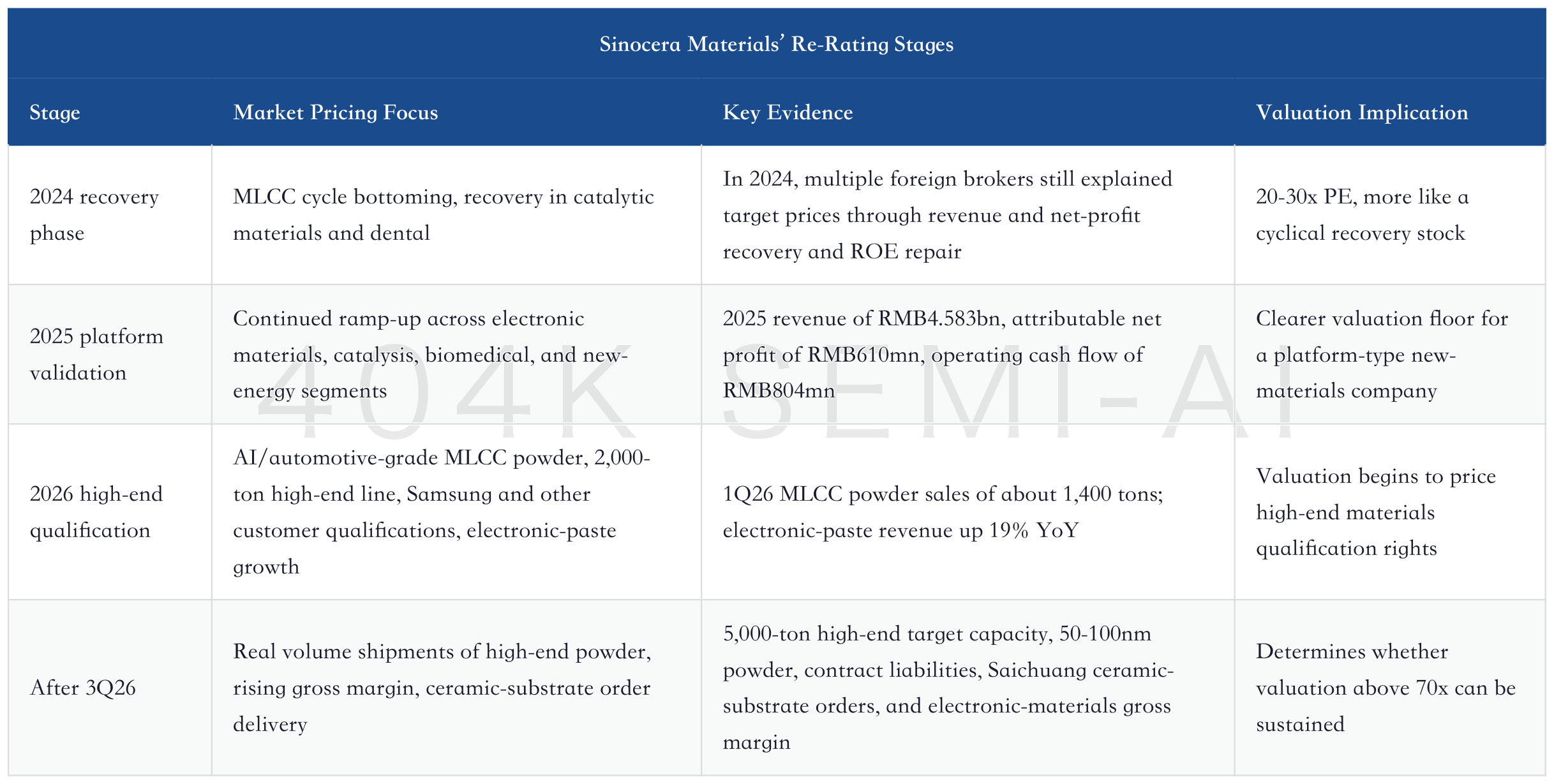
This is also the difference between Sinocera Materials and downstream MLCC manufacturers. Downstream manufacturers are investments in pricing cycles, inventory cycles, and capacity utilization. Sinocera Materials is an investment in materials qualification, formulation stickiness, and per-ton value. Downstream price increases can show up quickly in the income statement. Upstream high-end powders typically lag by half a beat, but once they enter customers’ materials systems, replacement costs and qualification cycles provide longer-tailed profit protection.
II. From 2024 to 2026: The Same Company’s Valuation Anchor Changed Three Times
In early 2024, when HSBC initiated coverage on Sinocera Materials with a RMB29.60 target price, the core logic was a bottoming rebound in a ceramic-materials platform. That report emphasized the company’s domestic leadership in MLCC raw materials and its horizontal expansion into medical, semiconductor, new-energy, and automotive materials. The valuation method was still traditional: HSBC forecast 2023-2025 revenue and attributable net-profit CAGRs of 17% and 31%, respectively, applying about 34x 2024E PE to reach a RMB29.60 target price.
In March of the same year, UBS placed Sinocera Materials within the framework of China’s chemical new-materials sector. Its main thread was not a single-company technology breakthrough, but renewed opportunities in new-materials segments such as electronic chemicals, fine fluorochemicals, and synthetic biology after valuation compression. Sinocera Materials was still rated Buy in this framework, with the target price cut from RMB39 to RMB28, but the logic had become more granular: 2024 MLCC powder sales were expected to reach 7,000-8,000 tons, with catalytic materials, precision ceramics, and dental materials jointly contributing growth.
By July 2024, Morgan Stanley’s title had become “Growth Drivers Aligning.” It focused on several drivers converging at the same time: the MLCC upcycle, import substitution, catalytic materials, precision ceramics, and dental improvement. The target price was cut to RMB24, but the Overweight rating was maintained because 2024-2026 revenue and profit CAGRs could still approach 30%, and ROE was expected to recover from the 2023 trough to above 15% by 2026.
By 2026, the debate among foreign brokers had shifted to an entirely different question. Goldman Sachs did not deny the value of the materials platform, but downgraded Sinocera Materials to Neutral with a RMB33 target price. The rationale was clear: the share price had already risen sharply over the previous 12 months, and the market had already priced in the option value of new products. Beyond AI-server MLCC materials, products such as solid-state batteries, spherical silica, and commercial aerospace still required more customer validation and mass-production cadence. UBS, after the 1Q26 results, raised its target price to RMB49.50, arguing that delivery was improving in high-end MLCC powder, new energy, dental, and several new materials in 2026. JPMorgan first raised its target price from RMB28.55 to RMB60.40 in May, then lifted it again to RMB136 in July, directly pushing the valuation anchor toward the upper end of AI-related high-growth materials platforms.
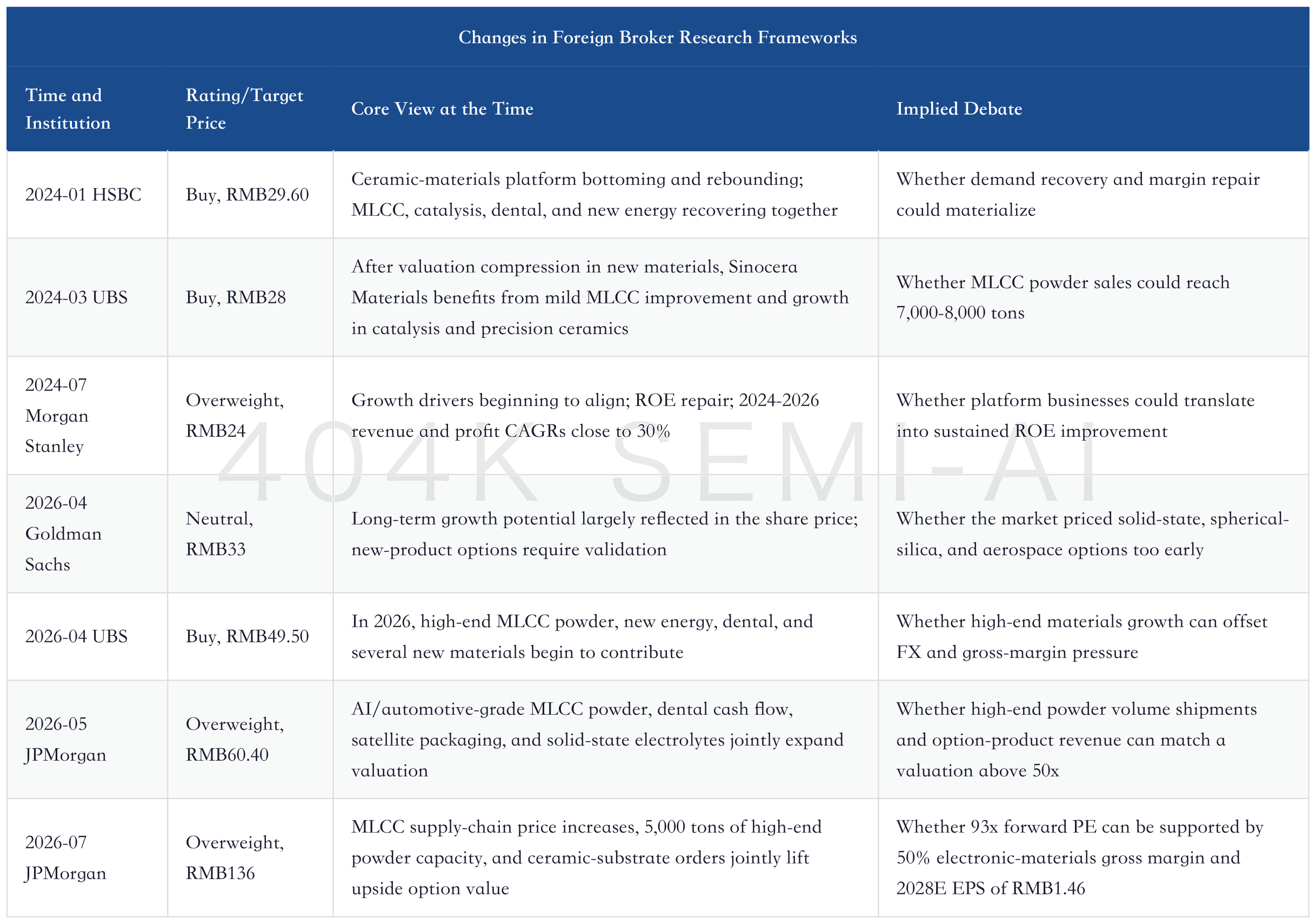
The most important point in this table is not the level of target prices, but the migration of the valuation anchor from “recovery” to “qualification.” For Sinocera Materials in 2024, the buying point was the cycle bottom and multi-business recovery. For Sinocera Materials in 2026, the buying point has become “who can obtain qualification slots for high-end MLCC powder and high-reliability ceramic materials.” If qualification materializes, valuation can stay elevated. If it is merely a revenue recovery, valuation will return to the normal range for a materials platform.
III. AI and Automotive-Grade MLCC Powders: The Real Acceleration Point Comes After 3Q26
Sinocera’s strongest line is high-end MLCC powder. Standard MLCC powder is no longer a new story, and Sinocera’s domestic position has long been recognized by the market. The change is that AI servers and automotive electronics have pushed MLCCs from “mobile-phone and consumer-electronics cycle components” back into “foundational materials for compute-power delivery and high-reliability electronics,” changing the pricing logic for powder suppliers.
A standard server uses about 1,500-2,000 MLCCs, while a single AI server can use 25,000 units, and even more on high-end platforms. The automotive side is similarly clear: ICE vehicles, plug-in hybrids, and BEVs differ significantly in MLCC content, and electrification plus intelligence will continue to raise the per-vehicle value of automotive-grade MLCCs. As MLCC manufacturers increase the share of high-capacitance, high-reliability, and high-temperature-resistant products for AI and automotive applications, upstream powders no longer track only aggregate volume; they track product-mix upgrades.
MLCCs from Passive Components to AI Density Monetizers: A 10,000-Word Cross-Transcript of Goldman Sachs, JPMorgan, and HSBC Views
The company’s 2025 annual report already states the positioning directly: the electronic materials segment is conducting product development and capacity expansion around AI-server and automotive-grade MLCC dielectric powders, with some new products making breakthroughs at core customers and both supply volume and mix continuing to rise. JPMorgan’s July report gives a more detailed timeline: Sinocera currently has 10,000 tonnes of standard MLCC powder capacity, with a high-end target capacity of 5,000 tonnes for AI-server and automotive applications. Of that, 2,000 tonnes had entered production by end-2025, and the remaining 3,000 tonnes are expected to be in place by end-2026. In 2025, the company’s MLCC powder output was about 7,000 tonnes. The next stage is not simply expanding aggregate volume, but increasing the share of high-end powder.
“Some new products achieved breakthrough progress at core customers.”
More importantly, the technology, pricing, and gross-margin ladder are all clear at the same time. JPMorgan explicitly wrote that Sinocera is one of the few domestic companies that has mastered the core technology for hydrothermal barium titanate and can mass-produce high-end 50-100 nm powders. On pricing, from consumer grade to automotive grade and then to high-capacitance AI-server powder, per-tonne value and margins rise step by step. If this set of data holds, Sinocera’s electronic materials segment is not merely a volume-growth story; per-tonne profit, customer structure, and valuation multiple are all improving at the same time.
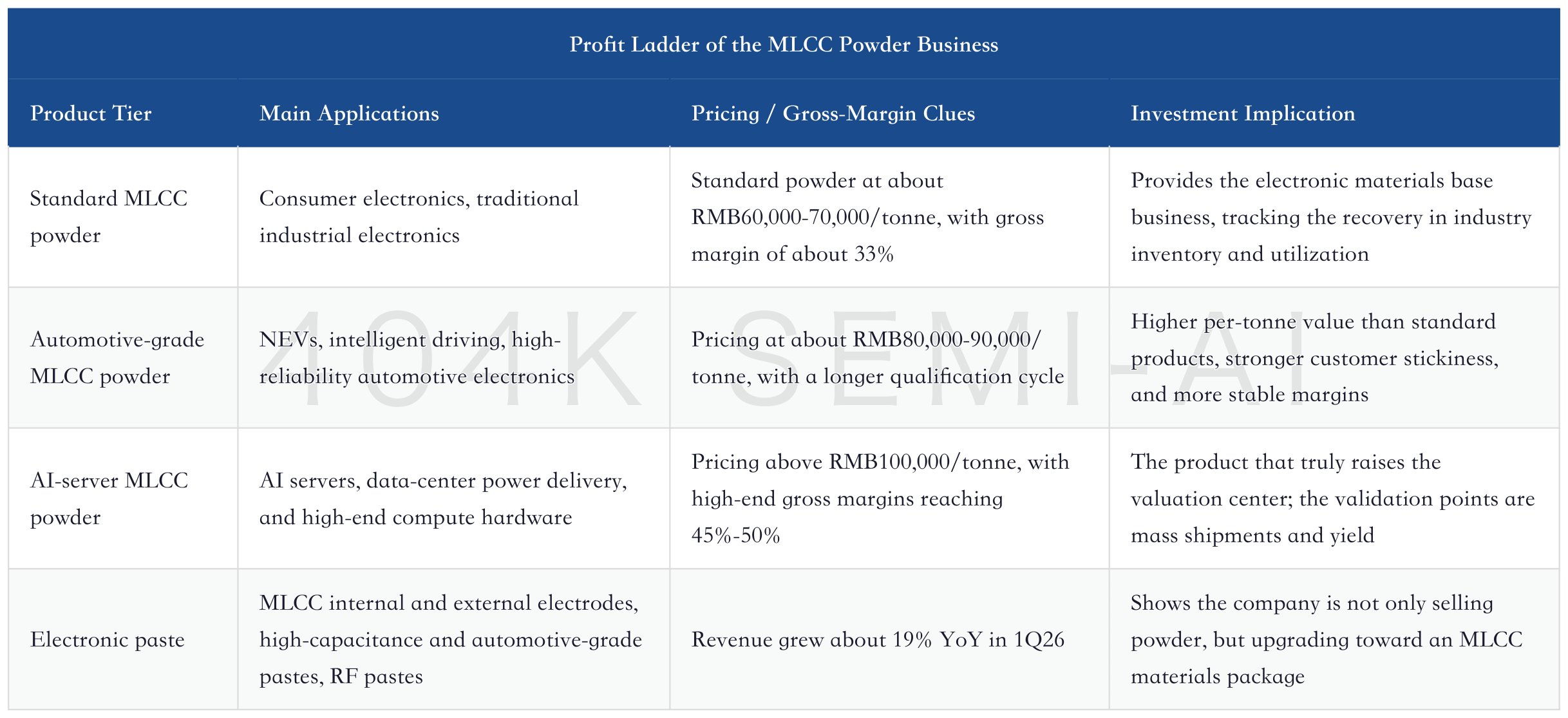
The barrier in high-end powder is not just “whether it can be made.” AI customers require finer particle sizes, higher uniformity, and better dispersion, while yields for high-end products are also lower than for traditional products. Profit realization therefore goes through two stages: first obtaining qualification and small-batch orders, then turning gross margin into reality through yield, production-line cadence, and customer adoption. If the market only looks at “qualification passed,” it may become too optimistic; if it only looks at 1Q gross margin, it may underestimate subsequent mix improvement.
“High-end powder has both higher selling prices and higher gross margins.”
Sinocera has three layers of advantage on this line. The first is capacity: with about 10,000 tonnes of standard MLCC powder capacity and a 5,000-tonne high-end target capacity for AI and automotive applications, the company will move from a standard powder supplier toward a qualified high-end materials asset. The second is customers: the company is advancing stable, scaled supply to customers including Samsung, Fenghua Advanced Technology, and Yageo, benefiting from both domestic substitution in high-reliability MLCCs and international customers’ migration toward high-end products. The third is upstream resources and process capability: hydrothermal barium titanate, particle-size control, dispersion systems, and batch stability jointly determine product consistency.
The most important period to track for this line is 2H26. JPMorgan raised its 2027/2028E EPS forecasts by 21%/29%, respectively, and assumed high-end MLCC powder would contribute more than 35% of electronic materials segment revenue by 2027. The underlying logic is that high-end powder moves from qualification to volume production. If subsequent company disclosures or channel checks show that high-end powder shipments are indeed ramping, Sinocera’s valuation anchor will continue to shift from “standard powder leader” to “qualified high-end materials asset.” If 2H remains stuck at sampling, trials, and small batches, the market will again question the pace of profit realization implied by the RMB136 target price.
Murata Manufacturing Deep Dive: AI-Server MLCCs from Small Components to Profit Gatekeepers
IV. Electronic Paste: Sinocera Is Not Just a Powder Supplier
Electronic paste is an easily underestimated line. The reason is simple: powder is easier to explain, and AI-server MLCC content is easier to link to compute hardware. Paste sounds like a supporting material, and the market often treats it merely as a small business outside powder. But in the MLCC value chain, dielectric powder, electrode paste, and sintering process jointly determine capacitor performance. If Sinocera can introduce high-capacitance paste, automotive-grade paste, and RF paste into customers together with high-end powder, both its pricing power and per-customer value will increase.
In the 2025 annual report, the electronic materials segment generated RMB693 million in revenue, up 11.17% YoY, with a gross margin of 34.49%. This gross margin does not yet show the uplift that high-end powder should bring, indicating that in 2025 electronic materials were still in the first half of a mix transition: traditional MLCC powder, standard electronic paste, and new-product development were mixed together, and the profitability of AI and automotive products had not yet been fully reflected. In 1Q26, UBS tracked MLCC powder sales volume up about 10% YoY to 1,400 tonnes, while electronic paste revenue grew about 19% YoY. This combination is more important than powder volume alone, because it shows Sinocera’s electronic materials business is expanding from a single-powder logic to a “powder + paste” materials package.
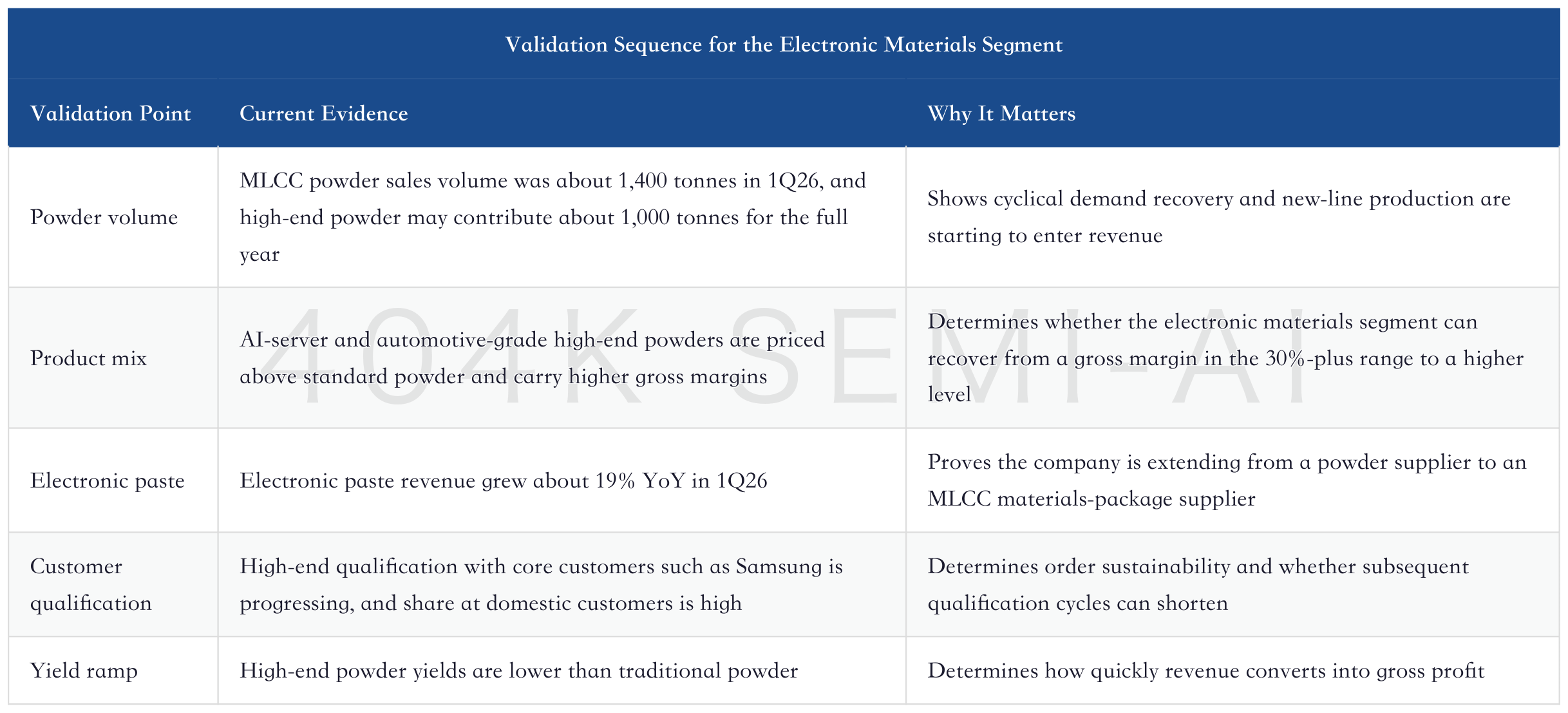
The investment significance of electronic paste is not “one more product line,” but a change in the materials-platform business model. A pure powder supplier facing downstream customers often has pricing power constrained by the MLCC cycle. A supplier that can provide dielectric powder, electrode paste, and dispersion systems becomes closer to part of the customer’s process formula. If Sinocera can introduce paste at the same time it introduces high-end powder, customer switching costs and order stickiness will be stronger.
This also explains why Goldman Sachs and JPMorgan assign different valuations to the same company. Goldman Sachs places more weight on currently visible profit and the certainty of new-product revenue, so after seeing pressure on gross margin and net margin in 1Q26, it maintained a neutral rating. JPMorgan places more weight on the growth curve formed after the materials system is introduced, so it is willing to capitalize the high-end powder and paste combination in advance. The real financial validation will occur in 2H26: whether electronic materials revenue growth can exceed the company average, whether gross margin can rise against the trend, and whether paste growth can appear together with high-end powder.
V. Dental, Catalysts, New Energy, and Precision Ceramics: They Determine the Valuation Floor, Not the Ceiling
Sinocera’s base is not a single MLCC line, but six materials segments. In 2025, the company generated RMB4.583 billion in revenue, up 13.24% YoY; net profit attributable to shareholders was RMB610 million, up 0.91% YoY; and operating cash flow was RMB804 million, up 6.72% YoY. Profit growth lagged revenue growth, indicating that the company is still experiencing pressure from product mix, FX, expenses, and gross margins in several businesses, but cash-flow quality is not poor. The role of this base is to provide R&D; and capacity-investment capability for AI powder and new-materials options.
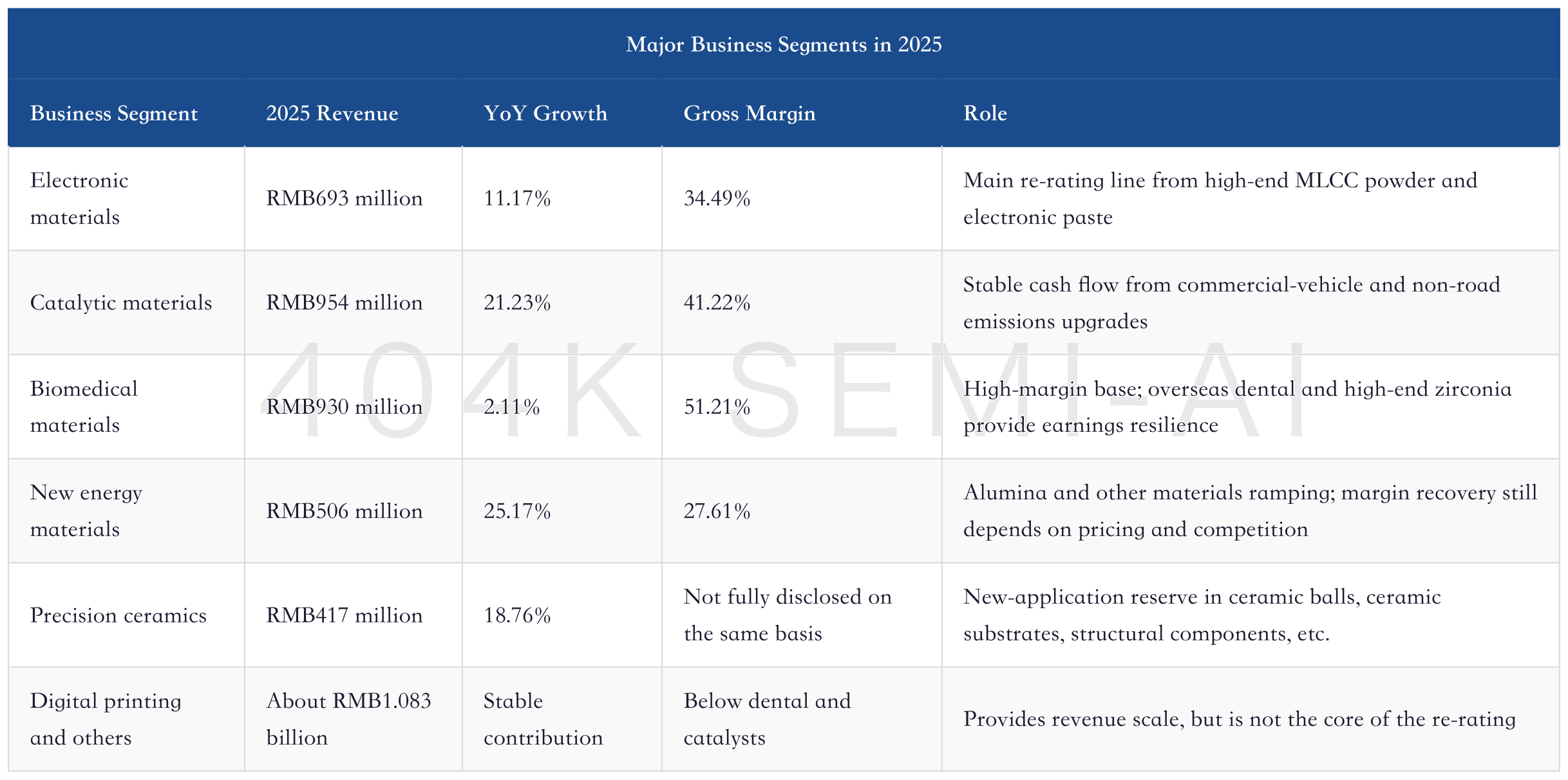
The dental business is the most important part of the valuation floor. The company has a leading domestic share in dental zirconia materials, and dental materials’ gross margin has long been higher than most segments. In 1Q26, UBS tracked dental materials revenue up about 25% YoY, with sales volume of blocks and powders up about 20% and 30%, respectively. JPMorgan emphasized that domestic dental zirconia powder market share exceeds 30%, high-end zirconia powder pricing can exceed RMB300,000/tonne, and overseas brand acquisitions help the company enter high-end European and US markets.
The value of the dental business lies in cash flow and earnings quality. AI powder and solid-state electrolytes require R&D;, qualification, and production-line investment, while commercial aerospace packaging and spherical silica also require customer validation. If dental and catalysts can continue to contribute high-margin cash flow, Sinocera does not need to rely entirely on external financing or sacrifice profit to pursue new materials. Conversely, if overseas dental recovery is slow, price competition intensifies, or acquired-brand integration falls short of expectations, the tolerance for error in the new-materials options will decline.
Catalytic materials are another cash-flow line. In 2025, catalytic materials revenue was RMB954 million, up 21.23% YoY, with a gross margin of 41.22%. In 1Q26, honeycomb ceramic shipments were about 5 million liters, up about 10% YoY. This business cannot lift the valuation multiple like AI powder, but it is an income-statement stabilizer: emissions-standard upgrades, domestic substitution, and the recovery of the commercial-vehicle chain determine whether catalytic materials can continue to contribute a gross margin of around 40%.
New energy materials and precision ceramics are more like “platform proof points.” In 1Q26, new energy materials revenue was about RMB150 million, with alumina shipments of about 15,000 tonnes, up about 80% YoY. Precision ceramics were dragged by downstream destocking in ceramic balls, but ceramic substrates still grew YoY. New energy materials’ per-tonne profit is not as high as dental or high-end powder, but it proves Sinocera’s horizontal migration capability in high-purity oxides and inorganic powder processes. Precision ceramics are volatile in the short term, but they are the industrial foundation for satellite ceramic packaging, ceramic substrates, and high-reliability structural components.
Fenghua Advanced Technology Deep Dive: MLCCs, Automotive-Grade Chip Resistors, and Electronic Materials Advancing on Three Fronts; The Re-Rating Logic for a Domestic High-Reliability Passive Components Platform
The valuation layers need to be separated here. Dental, catalysts, new energy, and precision ceramics can prove Sinocera is not a single-product company and can support the valuation floor. But they are unlikely to independently justify a valuation above 70x. What truly determines the valuation ceiling remains whether high-end MLCC powder, electronic paste, and ceramic substrates can lift revenue, gross margin, and customer stickiness together.
VI. Ceramic Substrates and the Option Layer: Sinocera Creation Orders Make the Second Growth Curve More Concrete
JPMorgan’s July report singles out ceramic substrates, which is an important change. In the past, Sinocera’s high-end options were mostly framed as long-duration narratives such as satellite ceramic packaging, spherical silica, and solid-state electrolytes. Now, through Sinocera Creation, ceramic substrates and metallization capabilities are starting to translate into more concrete orders and customer validation. The core of Sinocera Creation is not a single substrate product, but the integration of Sinocera’s existing powder, ceramic sintering, and metallization capabilities into an integrated “powder + ceramic + metallization” supply model.
Sinocera Creation already has several verifiable lines of progress. LED ceramic substrates are already being supplied in stable volume to global tier-one customers; communications RF microsystem chip package housings have become a mainstream packaging solution for low-orbit satellite RF chips, with revenue growing rapidly in 2025, and a RMB100mn order signed in June 2025 expected to be completed in 1H26; in optical-module ceramic substrates, TEC products have already achieved small-batch sales to some customers, while new-customer qualification remains underway; PCB ceramic substrates are still in the testing stage with major customers, and the company expects substantive progress and new orders in 2027. This mix moves ceramic substrates from a “long-dated option” closer to “near- to medium-term order validation.”
Sinocera still has many option products: commercial-space ceramic packaging, spherical silica powder, solid-state electrolytes, ceramic substrates, TEC, and AR optical dispersions. They all exist in real product form and all map to large addressable markets. But the easiest investment mistake is to fully capitalize all options at once. Materials is not software. For a product to move from sample delivery to validation and then volume shipment, customer qualification, production-line yield, supply stability, and the cost curve all need to clear the bar.
Goldman Sachs’ cautious view is useful here. It believes that among new products, AI server MLCC materials are the most likely to become a meaningful growth driver over the next few years; the commercialization pace of spherical silica, solid-state batteries, and commercial space remains uncertain. This does not deny Sinocera’s technology reserves. Rather, it is a reminder that materials options should be recognized gradually based on revenue and orders, not fully priced in upfront based on ultimate market size.
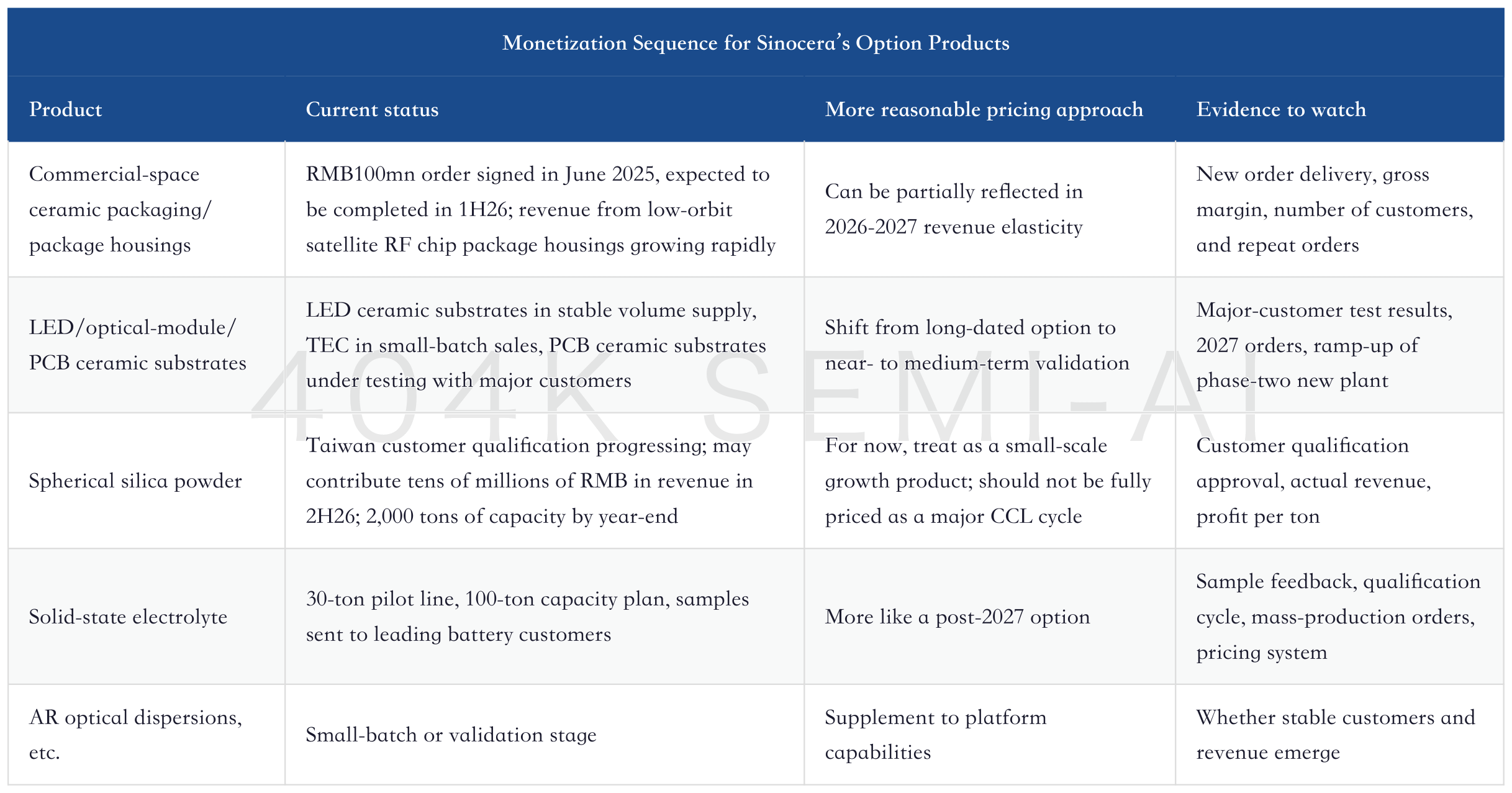
Commercial-space ceramic packaging and ceramic substrates are the option line closest to order conversion. Their value is not in single-year revenue scale, but in proving Sinocera’s “high-reliability inorganic materials platform” as high-reliability ceramic packaging enters commercial space, low-orbit satellite RF chips, optical modules, and PCB thermal-management applications. If Sinocera Creation can subsequently convert the RMB100mn order, TEC small-batch sales, and PCB major-customer testing into recurring revenue, Sinocera’s valuation will no longer rely only on the MLCC powder line.
The logic for spherical silica powder lies in CCL and advanced packaging, but the pace is slower. If Sinocera passes Taiwan customer qualification, it may first contribute tens of millions of RMB in revenue in 2H26; only if volume begins to scale in 2027 will it enter more visible P&L; validation. Solid-state electrolytes are further out. JPMorgan is positive on the sulfide route and mentions the company’s 30-ton pilot line, 100-ton plan, and sample delivery to leading battery customers, but also acknowledges that 2027 will most likely only see modest pilot revenue. At this stage, investors should treat solid-state electrolytes as a technology and customer-validation option, not a 2026 profit source.
“Most new products still depend on customer validation and the pace of mass production.”
This attitude matters. The more Sinocera looks like a platform company, the more stories it can support; the more stories there are, the more important evidence-based layering becomes. AI/auto-grade MLCC powder is the current re-rating main line; dental and catalysts are the cash-flow base; commercial-space ceramic packaging and spherical silica are near- to medium-term options; solid-state electrolytes are long-dated options. Different layers can coexist, but they cannot all be bought upfront at the same valuation multiple.
VII. Financial Model: Revenue Recovery Does Not Equal Profit Conversion
Sinocera’s recent financials show a clear tension: revenue has already resumed growth, but profit elasticity has not fully opened up. The first-quarter report itself was not poor, but it did not immediately prove the high-end powder re-rating thesis either. In particular, financial expenses were affected by FX losses caused by RMB appreciation, with around RMB20mn of FX losses in 1Q dragging on net profit.
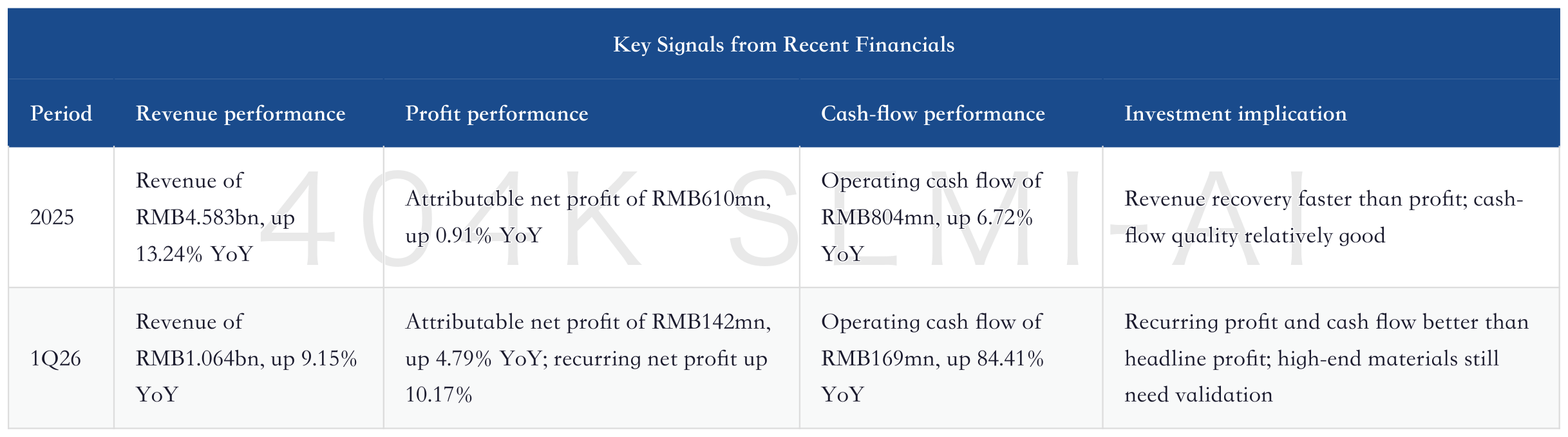
The model cannot focus only on revenue growth. Three things matter more: whether electronic-materials gross margin can re-accelerate; whether the revenue mix from high-end powder and electronic paste can rise; and whether dental, catalysts, and new-energy materials can stabilize cash flow without allowing new-material investment to erode net margin.
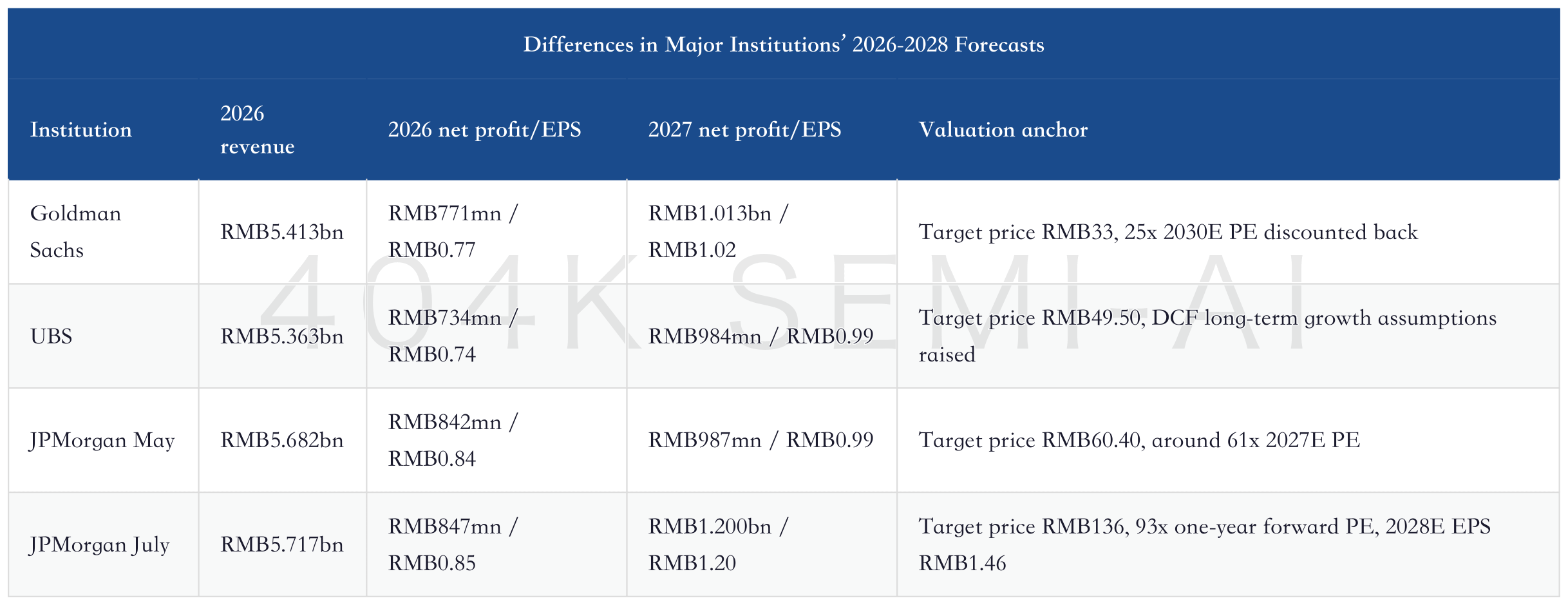
The key change in this table is that JPMorgan’s July report not only raises the valuation multiple, but also materially lifts its 2027/2028 earnings model. Goldman Sachs, UBS, and JPMorgan’s May report all had similar 2027 net-profit estimates, while JPMorgan’s July report lifts 2027 adjusted net profit to a higher level. Behind this are upgraded assumptions for high-end MLCC powder pricing, gross margin, and the AI-grade product mix.
Goldman Sachs’ valuation discipline is that 2026-2028 EPS CAGR is around 28%, while many new-product options have not yet been realized, making it more appropriate to discount long-term target profit. JPMorgan’s July valuation discipline is more aggressive: AI server demand, MLCC price increases, 5,000 tons of high-end powder, and ceramic-substrate orders together lift the company’s product mix over the next two years, giving the electronic-materials segment an opportunity to return to its historical high gross margin of 50%, thereby supporting a 93x one-year forward PE. The disagreement between the two is not whether 1Q profit was tens of millions higher or lower, but whether Sinocera should be viewed as an “asset with high-reliability materials qualification rights.”
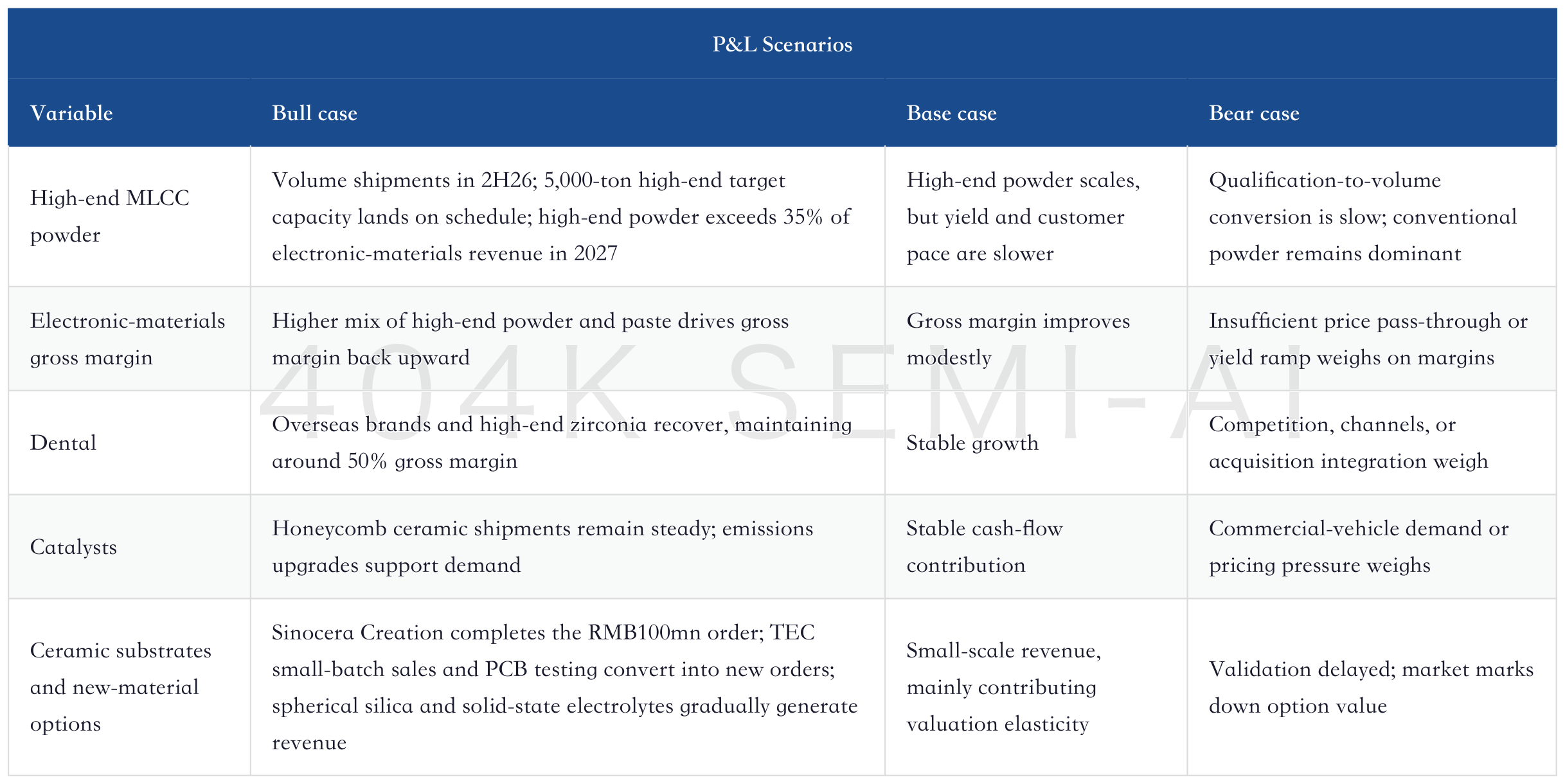
For Sinocera, the key to 2026 earnings forecasts is not whether revenue can reach around RMB5.5bn, but the structure within that RMB5.5bn. If each segment merely grows organically by single digits to low teens, profit elasticity will be limited. Only if high-end MLCC powder, electronic paste, and high-margin dental together increase their revenue share can net margin enter an upward channel.
VIII. Valuation Discipline: RMB136 Is Not the Conclusion; It Represents a Higher Evidence Threshold
The most important pricing question for Sinocera now is not a simple bullish or bearish call, but which layer of evidence the valuation should be allowed to capture. RMB33 corresponds to a disciplined valuation in which “growth is already fairly well reflected”; RMB60.40 corresponds to the May version of the “high-end materials qualification rights” valuation; RMB136 corresponds to the July version of an upper-end valuation where “AI-grade powder + ceramic substrates + high-margin electronic materials” are realized at the same time. All three can be internally consistent. The difference is how much future validation investors are willing to buy in advance.
JPMorgan’s July target price of RMB136 raises the valuation multiple to 93x one-year forward PE, corresponding to around 88x/72x 2027/2028E PE, which is no longer an ordinary new-materials platform valuation. Its logic is that high-end AI server powder raises profit per ton, auto-grade products improve customer stickiness, electronic-materials gross margin returns to around 50%, dental maintains high-margin cash flow, and Sinocera Creation’s ceramic-substrate orders plus subsequent PCB ceramic-substrate progress provide a second growth curve. The reasonable precondition for this valuation is that 2H26 must show simultaneous improvement in high-end powder volume, contract liabilities, and electronic-materials gross margin.
Goldman Sachs’ RMB33 target price represents another discipline: the share price already reflects substantial long-term growth, while the products that can genuinely contribute meaningful profit over the next few years remain mainly AI server MLCC materials; solid-state, spherical silica, commercial space, and others still need customer validation and mass production. This valuation does not deny the company. It refuses to discount every option into current market value ahead of time.
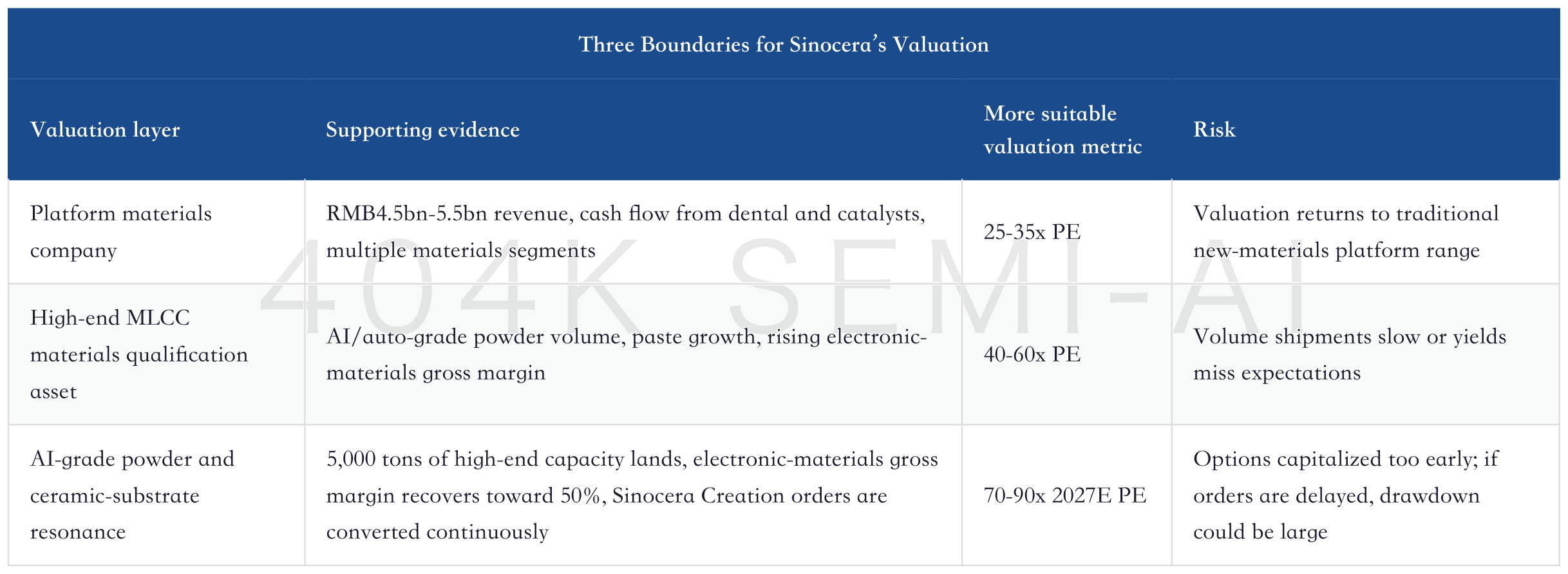
The more prudent current view is that Sinocera has moved beyond a pure cyclical-recovery valuation, but has not yet fully proven all the evidence required for a RMB136 target price. It should at least be viewed as a “high-end MLCC materials qualification asset.” Whether it can further become a multi-option platform driven by “AI-grade powder and ceramic-substrate resonance” depends on orders and the P&L; in 2H26 and 2027.
This is also the difference between a buy point and a sell point. If the share price falls back to a valuation that only reflects a platform materials company, while evidence for high-end powder qualification and shipments continues to improve, the risk-reward becomes better. If the share price is already fully pricing a multi-option platform, but electronic-materials gross margin, shipment volume, and order revenue fail to keep up, risk will accumulate quickly. Sinocera cannot be judged only by stories; it must be judged by quarterly data and the pace of customer adoption.
IX. Capability Transfer: From Oxide Powders to a High-Reliability Materials Platform
The long-term value of Sinocera Materials does not lie in any single product, but in the transferability of its materials capabilities. The company has expanded from MLCC dielectric powders, zirconia dental materials, honeycomb ceramics, alumina, new energy materials, and precision ceramics. At its core, this expansion relies on several shared capabilities: high-purity powder preparation, particle-size and dispersion control, formulation development, understanding of sintering processes, customer certification management, and stable scaled manufacturing.
This type of capability transfer has two characteristics. First, it is slow. Materials customers will not switch suppliers immediately just because a supplier “has technical reserves.” The process must go through sample delivery, validation, small-batch production, volume production, quality tracking, and price negotiation. Second, once a supplier enters a customer’s system, replacement costs are also high. Downstream customers care more about stability, batch consistency, and long-term supply, and will not easily replace a critical materials supplier for a small price difference.
This is exactly the difference between Sinocera Materials and many “theme-driven new materials companies.” Theme-driven companies often have only one product story; if product validation fails, they lose their valuation anchor. Sinocera Materials’ advantage is that multiple segments already contribute revenue and cash flow. Its drawback is that it has many segments, long validation cycles, and a less pure P&L.; When the market gives it a high valuation, it can easily treat all options as if they will be exercised on the same day. When the market is disappointed, it can also easily overlook the materials processes and customer base the company already has.
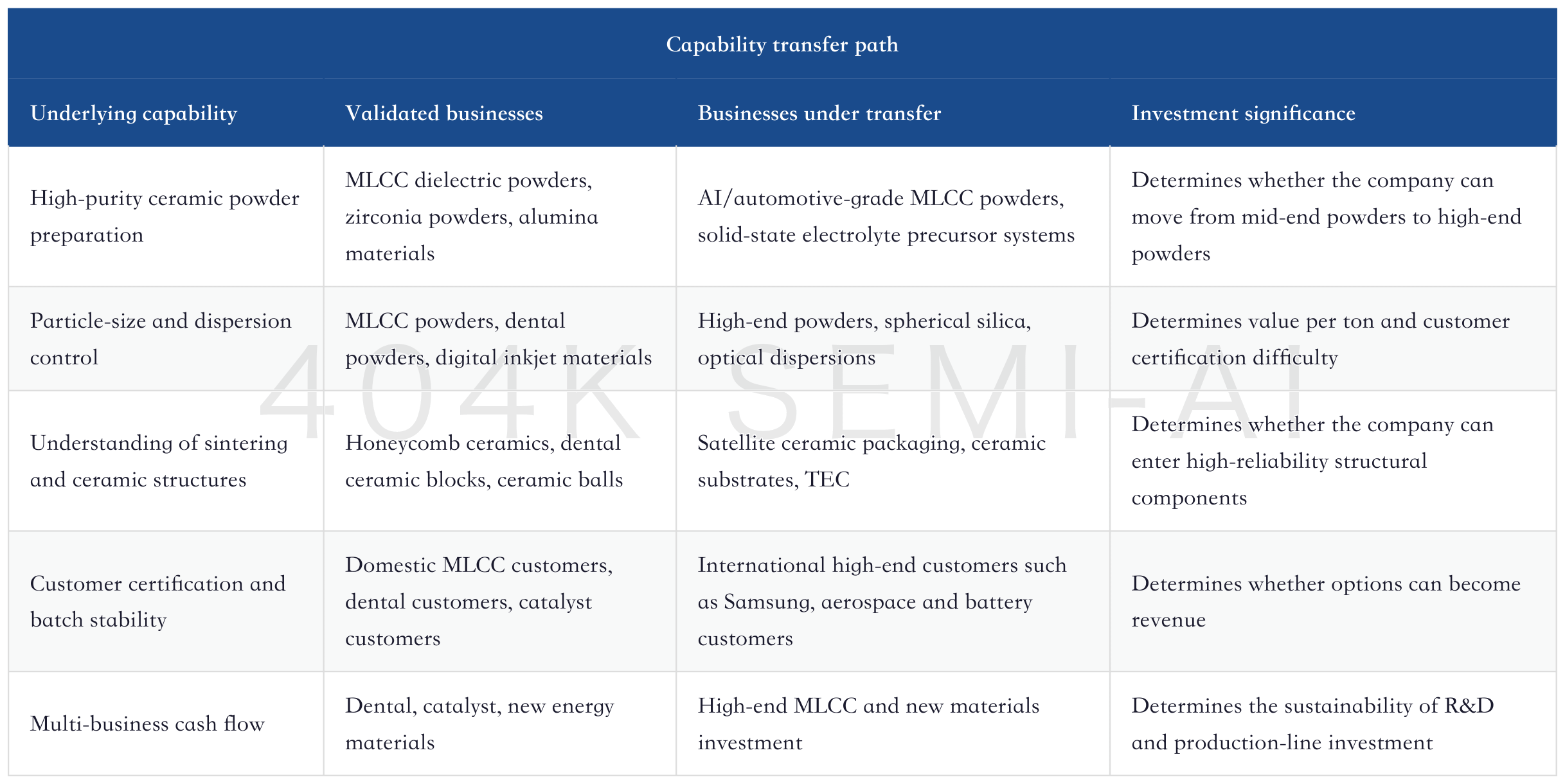
This migration path does not guarantee that every product will succeed, but it explains why Sinocera Materials deserves continuous tracking. For a company with only a solid-state electrolyte story, if battery customer validation is delayed, the valuation anchor becomes fragile. Even if Sinocera Materials’ solid-state electrolyte business is delayed, MLCC powders, electronic pastes, dental materials, catalysts, and satellite ceramic packaging can still continue to be validated. Platform value comes from “failure does not mean going to zero, while success can stack.”
However, platform value cannot be a reason for arbitrary valuation expansion. The biggest risks for a materials platform are twofold: too many R&D; projects, causing expenses to erode profits; and too many production lines, raising capex and depreciation pressure. Sinocera Materials’ R&D; expense ratio was about 6.93% in 2025, a high but understandable range. If new materials investment continues to rise while electronic materials gross margin and high-end powder shipments fail to keep pace, the market will reassess the return on platform expansion.
X. Official A-Share Abbreviation and Overseas Aliases: Investment Language Should Be Standardized Around Sinocera Materials
Overseas reports often use names such as Sinocera, Shandong Sinocera Functional Material, and Shandong Sinocera - A, but Chinese investment language must be standardized around the official A-share securities abbreviation “Sinocera Materials.” This may appear to be merely a naming issue, but it directly affects the clarity of research expression. Sinocera Materials is not simply a local Shandong materials company, nor is it the abstract Sinocera in English-language reports. It is an A-share-listed materials platform company with multi-business disclosures that can be cross-checked through annual and quarterly reports.
Once the naming is standardized, the materials clues become clearer: Sinocera Materials’ electronic materials are not generic “chemical new materials,” but MLCC dielectric powders, electronic pastes, and high-end ceramic powders; its biomedical business is not medical services, but dental zirconia materials; its catalyst materials are not traditional chemical catalysts, but emission aftertreatment materials such as honeycomb ceramics; its precision ceramics are not ordinary structural components, but an extension into high-reliability applications such as ceramic balls, ceramic substrates, and satellite tube shells.
This framing helps avoid two misjudgments. First, Sinocera Materials cannot simply be treated as an MLCC stock. It is not a downstream MLCC manufacturer; profit realization depends more on materials certification, yield, and customer introduction. Second, it cannot simply be treated as a “multi-concept new materials company.” If all products are only concepts, the valuation should be discounted. If multiple segments already have evidence of revenue, gross margin, and customer certification, the valuation should be layered by evidence.
XI. Differences Versus Peers: Reference Points From Chaozhou Three-Circle, Fenghua Advanced Technology, and Overseas MLCC Manufacturers
Sinocera Materials’ peer reference set cannot consist only of powder companies, because there are very few pure comparable A-share targets. A more reasonable comparison has three layers: downstream MLCC and electronic ceramics manufacturers, domestic passive component platforms, and overseas MLCC leaders.
Chaozhou Three-Circle represents a vertically integrated path in electronic ceramics and high-end MLCCs. It is closer to ceramic components, ceramic substrates, and high-end passive components, benefiting from upgrades in AI servers, automotive electronics, and high-reliability electronic ceramics. Sinocera Materials sits further upstream in materials. Its revenue scale and earnings elasticity are not fully synchronized with downstream manufacturers, but once high-end powder certification stabilizes, its gross margin and customer stickiness should look more like a materials bottleneck position than a capacity cycle.
Chaozhou Three-Circle deep dive: from electronic ceramics platform to high-end MLCCs, how AI servers revalue domestic ceramic component capabilities
Fenghua Advanced Technology represents the domestic MLCC and chip resistor platform. It is one of Sinocera Materials’ important downstream application scenarios and also reflects the progress of domestic substitution in high-reliability passive components. If Fenghua Advanced Technology continues to make breakthroughs in automotive-grade products, high-end MLCCs, and electronic materials, Sinocera Materials should benefit as an upstream powder and paste supplier. However, downstream customer capacity expansion and price competition will also feed back into upstream materials pricing.
Overseas MLCC leaders, including Murata, Taiyo Yuden, Samsung Electro-Mechanics, and Yageo, provide the reference points for global demand and product mix. AI servers increase MLCC usage, automotive-grade and high-capacitance products raise ASPs, international manufacturers are migrating capacity toward high-end products, and supply of commodity products is passively tightening. Sinocera Materials’ opportunity comes from this structural change spreading upstream: high-end demand increases, customers need stable high-end powders and pastes, and once domestic suppliers pass certification, they have the opportunity to capture higher value per ton.
Japan electronic components deep dive: AI servers are pushing MLCCs from cyclical products toward compute infrastructure
Downstream peers also offer another insight: AI server demand does not only change usage per machine; it also changes product reliability requirements and supply-chain security preferences. The higher-end the MLCC, the more customers care about dielectric powder purity, particle size, batch stability, and long-term supply capability. The more customers shift capacity toward high-end products, the more upstream materials must maintain stability in yield and delivery. This is where Sinocera Materials’ research value lies: it does not directly sell finished MLCCs, but it may become a repeatedly validated materials link in the high-endization cycle. Once this position is secured, earnings sustainability should be better than ordinary cyclical materials, valuation should be more resilient, and medium-term pricing should become more stable.
The most important conclusion from the peer comparison is this: Sinocera Materials is not trying to compete with downstream manufacturers for the same profit pool, but to embed itself into the materials system of downstream high-endization. If the downstream high-end MLCC cycle holds, powders and pastes may not immediately see price increases, but customer certification and order continuity should improve meaningfully. If downstream high-endization falls short of expectations, Sinocera Materials will not automatically receive a high valuation simply because the volume of ordinary MLCCs recovers.
XII. Data Scope: Which Numbers Belong in the Model, and Which Should Only Go on the Watchlist
Sinocera Materials has a large amount of data, but different figures have different levels of reliability and different uses. Company-disclosed revenue, net profit, cash flow, segment revenue, and gross margins are the foundation of the model. Powder prices, gross margins, and high-end capacity from institutional research are key to judging structural change, but they require subsequent financial statement validation. Orders and capacity for new products such as solid-state electrolytes, spherical silica, and satellite packaging belong on the watchlist and should not be fully converted into profit forecasts upfront.
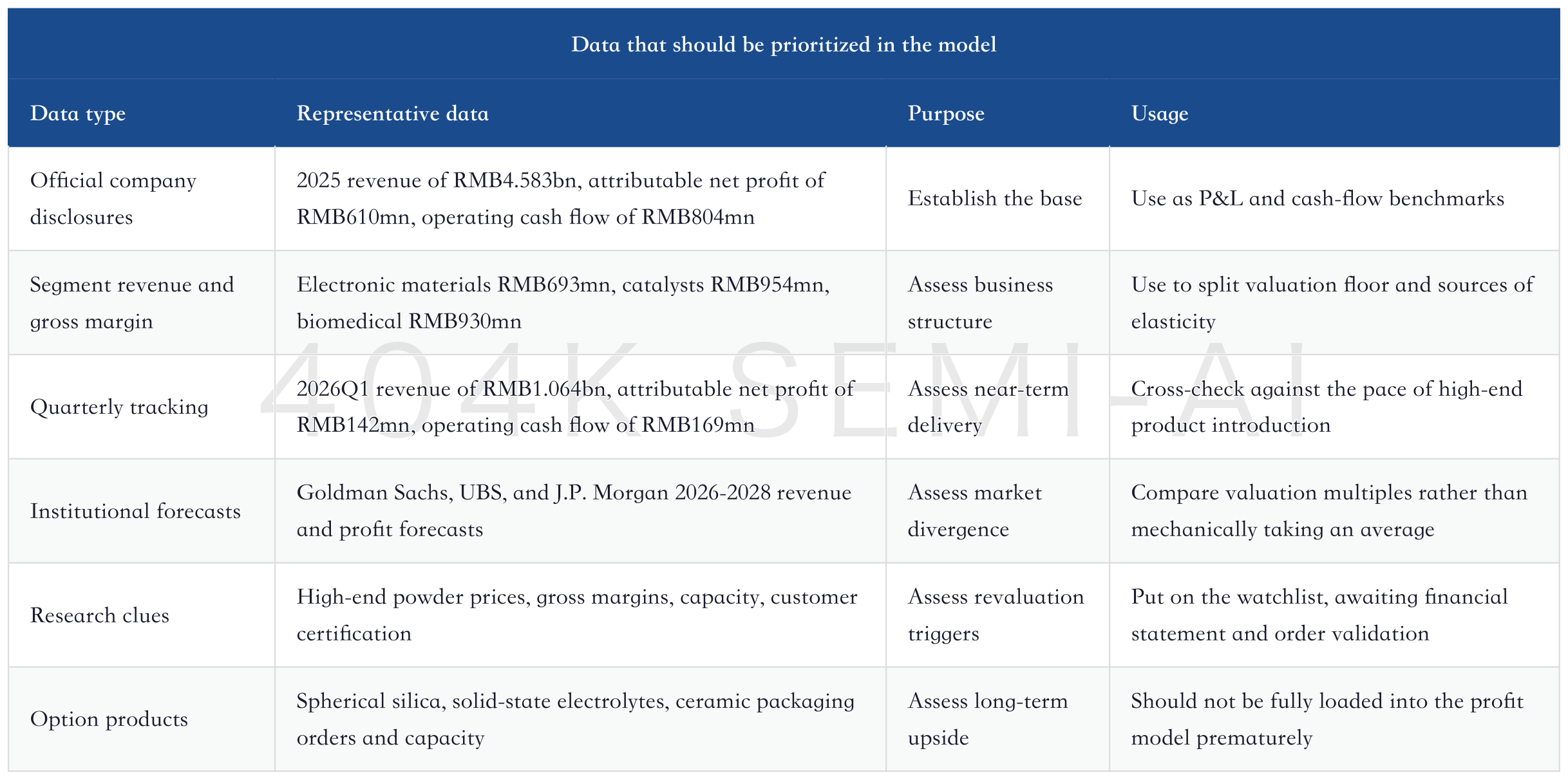
This approach can avoid two extremes. Being too conservative means looking only at RMB610mn of net profit in 2025 and ignoring the structural changes that high-end powders and pastes may bring after 2026. Being too optimistic means valuing every new materials line as a mature product and ignoring customer certification and mass-production yield. A reasonable model for Sinocera Materials should be: “core businesses provide profits, revaluation businesses provide valuation elasticity, and option businesses go on the watchlist.”
“The shipment pace of high-end powders in 2026 is the key evidence for revaluing electronic materials.”
XIII. Falsification Checklist: The Most Important Things to Track Are Not News Items, but Four Quarters of Hard Data
Research on Sinocera Materials cannot stop at thematic keywords. The real focus should be four types of hard indicators: shipments, gross margin, orders, and cash flow.
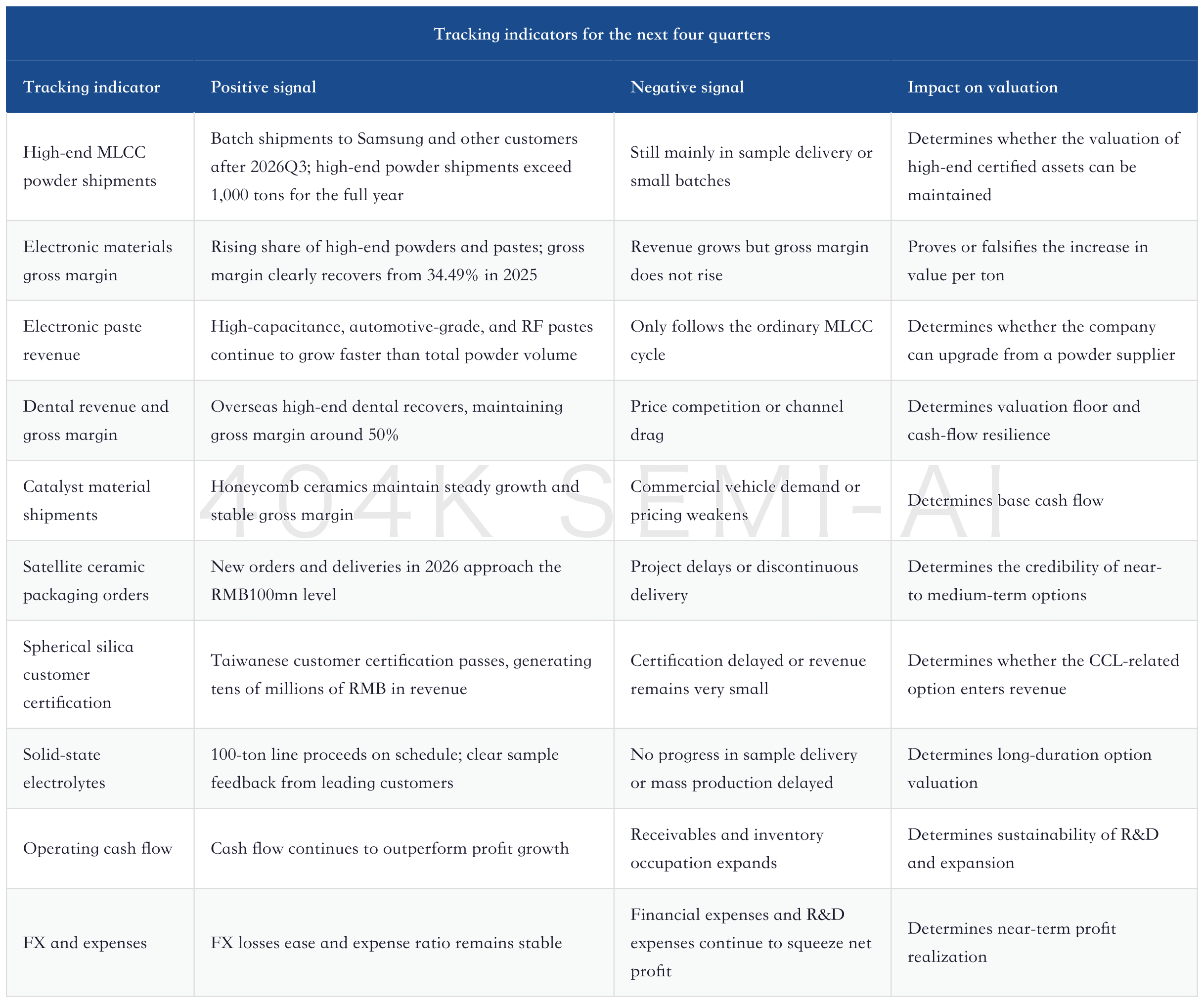
This falsification checklist is more useful than simply looking at target prices. J.P. Morgan raising its target price does not mean every quarter must beat expectations by a wide margin, but there should at least be visible structural improvement in high-end powders and electronic materials. Goldman Sachs being neutral does not mean Sinocera Materials has no opportunity; as long as high-end powders begin real batch shipments from 2026Q3, the market will revise its judgment that “the options are too early.”
The risks should also be stated clearly. First, although the MLCC industry is strengthening in AI and automotive-grade applications, if the recovery in ordinary consumer electronics is slow, downstream utilization and pricing will still affect powder demand. Second, if customer certification and yield ramp-up for high-end powders fall short of expectations, revenue and gross margin delivery will lag valuation. Third, if dental and catalyst businesses face pricing pressure, the cash-flow base will weaken. Fourth, orders for solid-state electrolytes, spherical silica, and commercial aerospace have project-timing risks and should not be valued on full-capacity, full-sales assumptions. Fifth, FX volatility already showed up as financial expense pressure in 2026Q1 and may continue to disrupt net profit.
XIV. Three Worldviews: Platform Materials Stock, Certification-Right Asset, Multi-Option Platform
Sinocera Materials is easily misjudged because it fits into three worldviews at the same time. The first treats it as a platform-type materials stock, with profit mainly coming from the organic growth of dental, catalyst, electronic materials, and new-energy materials. The second treats it as a high-end MLCC materials certification-right asset, with earnings leverage coming from AI and automotive-grade powders, electronic pastes, and penetration of core customers. The third treats it as a multi-option materials platform, bringing products such as satellite ceramic packaging, spherical silica, solid-state electrolytes, and ceramic substrates into long-term valuation.
These three worldviews are not mutually exclusive, but their buying conditions are entirely different. A platform-type materials stock is judged by cash flow and ROE recovery; a certification-right asset by high-end powder shipments and gross margin; a multi-option platform by whether multiple new products move from validation into orders and revenue. Sinocera Materials currently sits closer to the second: the platform base is already fairly clear, the certification rights for high-end MLCC powders are beginning to monetize, but the multi-option platform still needs further proof from orders and revenue.
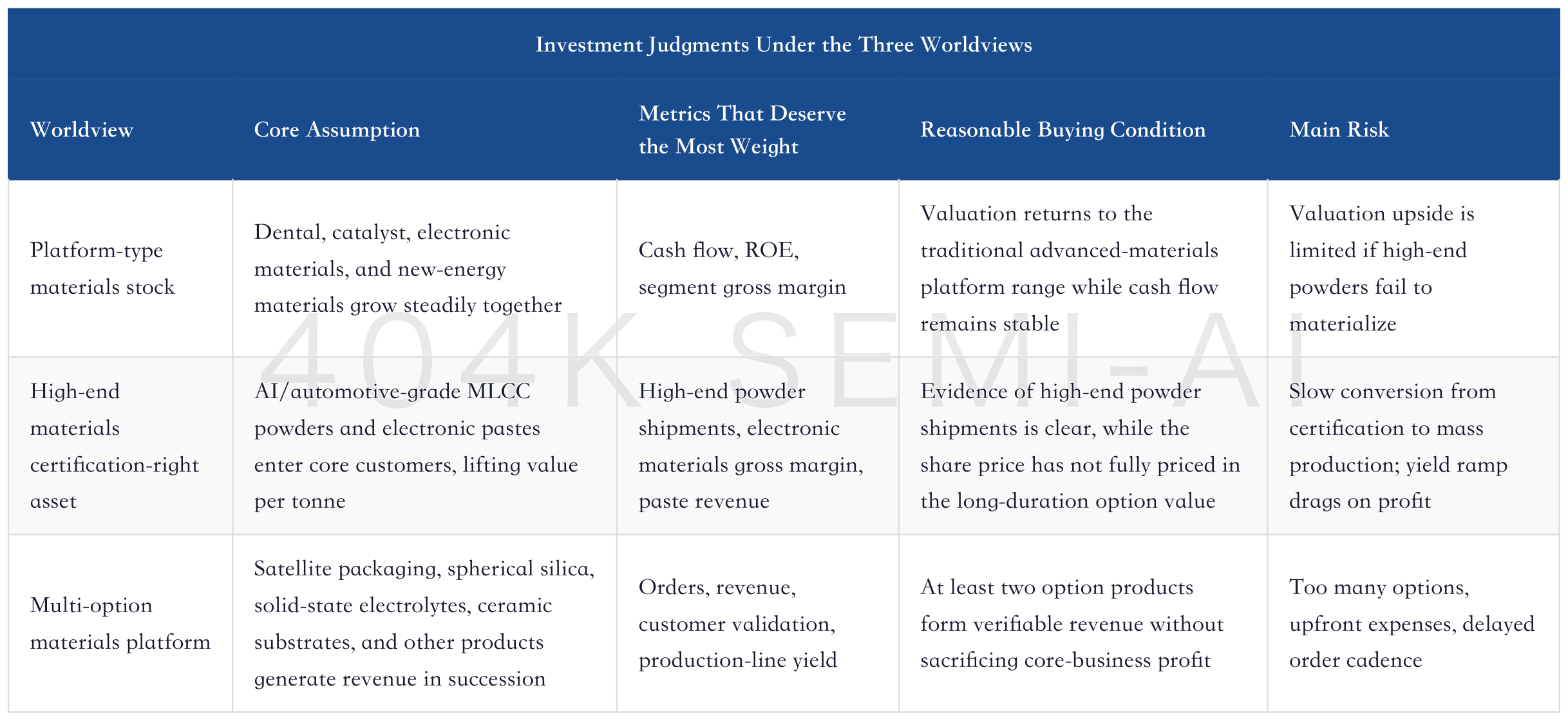
A more robust framework is to use the platform-type materials stock to judge the downside, the high-end materials certification right to judge the current main line, and the multi-option platform to judge the upside. Using only the first layer would underestimate the valuation migration brought by AI and automotive-grade MLCC powders; jumping directly to the third would mean paying upfront for products that have not yet generated revenue. Sinocera Materials’ truly sustainable excess return is more likely to come from a gradual lift from the second layer to the third, rather than a full re-rating overnight.
XV. How to Use Sell-Side Divergence: The Target Price Is Not the Conclusion; the Validation Points Are
Goldman Sachs, UBS, and JPMorgan have very different target prices, but what they really provide are three validation paths. Goldman’s Neutral rating pulls investors back to valuation discipline: the share price has already reflected growth potential in advance, and new products deserve further valuation upgrades only after mass production and profit delivery are realized. UBS’s target-price increase offers a middle path: although the first quarter saw FX and gross-margin pressure, high-end MLCC, dental, and new-energy materials were still improving, supporting an upward revision to medium- and long-term DCF growth assumptions. JPMorgan’s aggressive upgrade offers the optimistic path: AI/automotive-grade powders, dental, satellite packaging, and solid-state electrolytes jointly lift the valuation center.
The best way to use these three paths is not to simply average the target prices, but to extract the trigger conditions behind each.
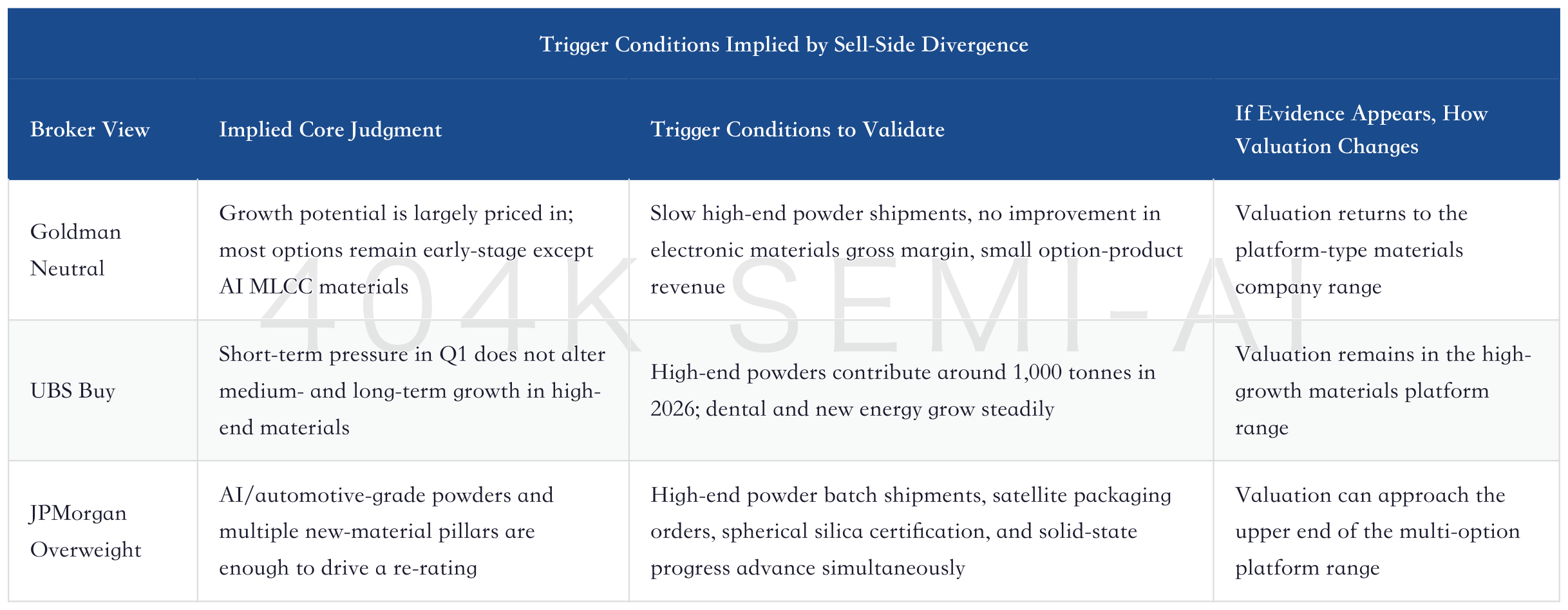
At present, investors should use “stepwise validation” rather than “target-price voting.” The first step is electronic materials revenue and gross margin in Q2 and Q3 2026; the second is batch shipments to high-end powder customers and full-year 2026 high-end powder tonnage; the third is whether satellite ceramic packaging, spherical silica, and solid-state electrolytes have clear revenue or order receipts. As long as the first and second steps hold, Sinocera Materials has reason to maintain a high-end materials certification-right valuation. Only if the third step also holds should it receive the high multiple of a multi-option platform.
This also explains why quarterly tracking is more important than news flow for Sinocera Materials. News flow can continuously produce new customers, new materials, and new production lines, but valuation will ultimately land on financial statements and orders. Electronic materials gross margin, powder tonnage, paste revenue, dental gross margin, and operating cash flow are the indicators that can turn the story into profit.
XVI. Roadmap for the Next Four Quarters: Focus on a Few Hard Metrics Each Quarter
Sinocera Materials has many product lines, so tracking must be disciplined. Each quarter does not require reopening every new-material clue. The key is whether the company is moving along the path of “certification to batch volume, revenue to gross margin, option to order.”
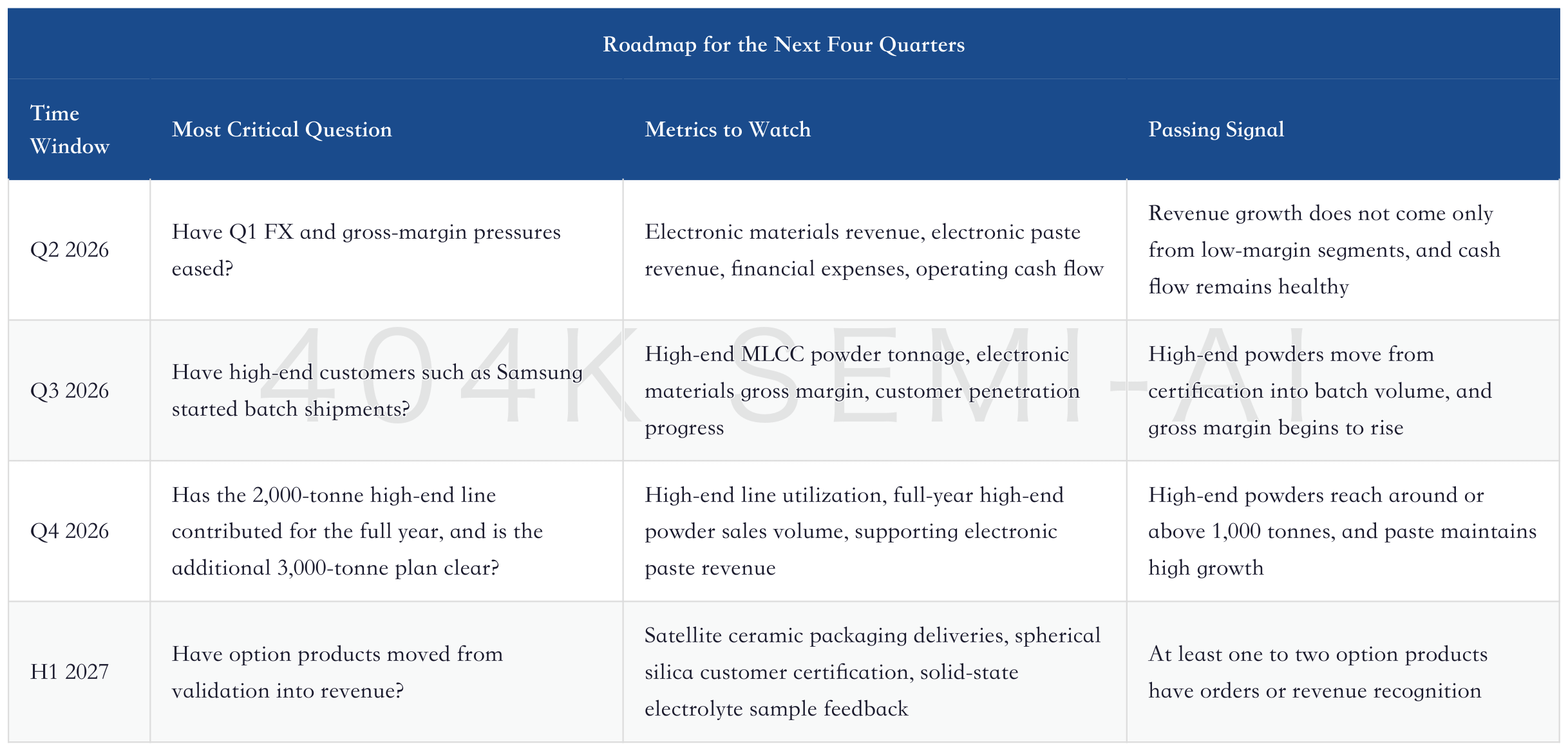
The most important point in this roadmap is Q3 2026. The reason is not that profit must necessarily explode in a single quarter, but that evidence of high-end powders moving from certification to batch volume will become clearer at this stage. If high-end powder volume is still not visible after Q3, the logic behind the RMB136 target price will be questioned by the market. If batch shipments are confirmed in Q3, the market will be more willing to assign a high multiple to 2027 even if the income statement has not yet fully reflected it.
The second key window is H1 2027. By then, spherical silica, satellite ceramic packaging, and solid-state electrolytes cannot all still remain in the “under validation” stage. They do not need to contribute large profits simultaneously, but they must at least have verifiable orders, deliveries, or revenue. If only high-end MLCC powders materialize, Sinocera Materials is still a good company, but valuation should mainly revolve around the certification-right asset. If option products begin to generate revenue continuously, the platform re-rating will be more solid.
XVII. Cash Flow and R&D; Investment: Platform Expansion Cannot Rely on Slogans
Expansion for materials platform companies ultimately returns to two constraints: whether R&D; investment can be sustained, and whether cash flow can bear it. Sinocera Materials’ advantage is that it already has a revenue base in dental, catalyst, electronic materials, and new-energy materials, rather than relying on a single laboratory project to tell a story. The pressure is that there are many new-material projects, certification and mass-production cycles are long, and expenses and depreciation may arrive before revenue recognition.
In 2025, the company’s operating cash flow was RMB804 million, higher than RMB610 million in net profit attributable to shareholders, indicating solid cash collection quality in the core business. In Q1 2026, operating cash flow was RMB169 million, up 84.41% YoY, also suggesting no obvious short-term deterioration in working capital. This indicator is highly important. High-end powders, spherical silica, solid-state electrolytes, and ceramic packaging all require production lines, R&D;, and customer validation. If operating cash flow cannot keep pace, platform expansion will become pressure on margins and the balance sheet. If cash flow remains stable, Sinocera Materials has the ability to advance multiple projects in parallel.
R&D; investment also needs to be viewed by structure. The company’s R&D; expense ratio was about 6.93% in 2025, lower than 7.25% in 2024, but still above most traditional materials companies. For Sinocera Materials, R&D; expense is not merely a cost, but the entry ticket for customer certification and product migration. High-end MLCC powders need to address particle size, dispersibility, finished-product yield, and batch stability; electronic pastes need to support downstream high-capacitance, automotive-grade, and RF products; solid-state electrolytes and spherical silica require continuous sampling and customer feedback. As long as the R&D; expense ratio moves in tandem with the revenue share of high-end products, the market can accept it. If the expense ratio rises while new-product revenue shows no progress, it will become a valuation penalty.
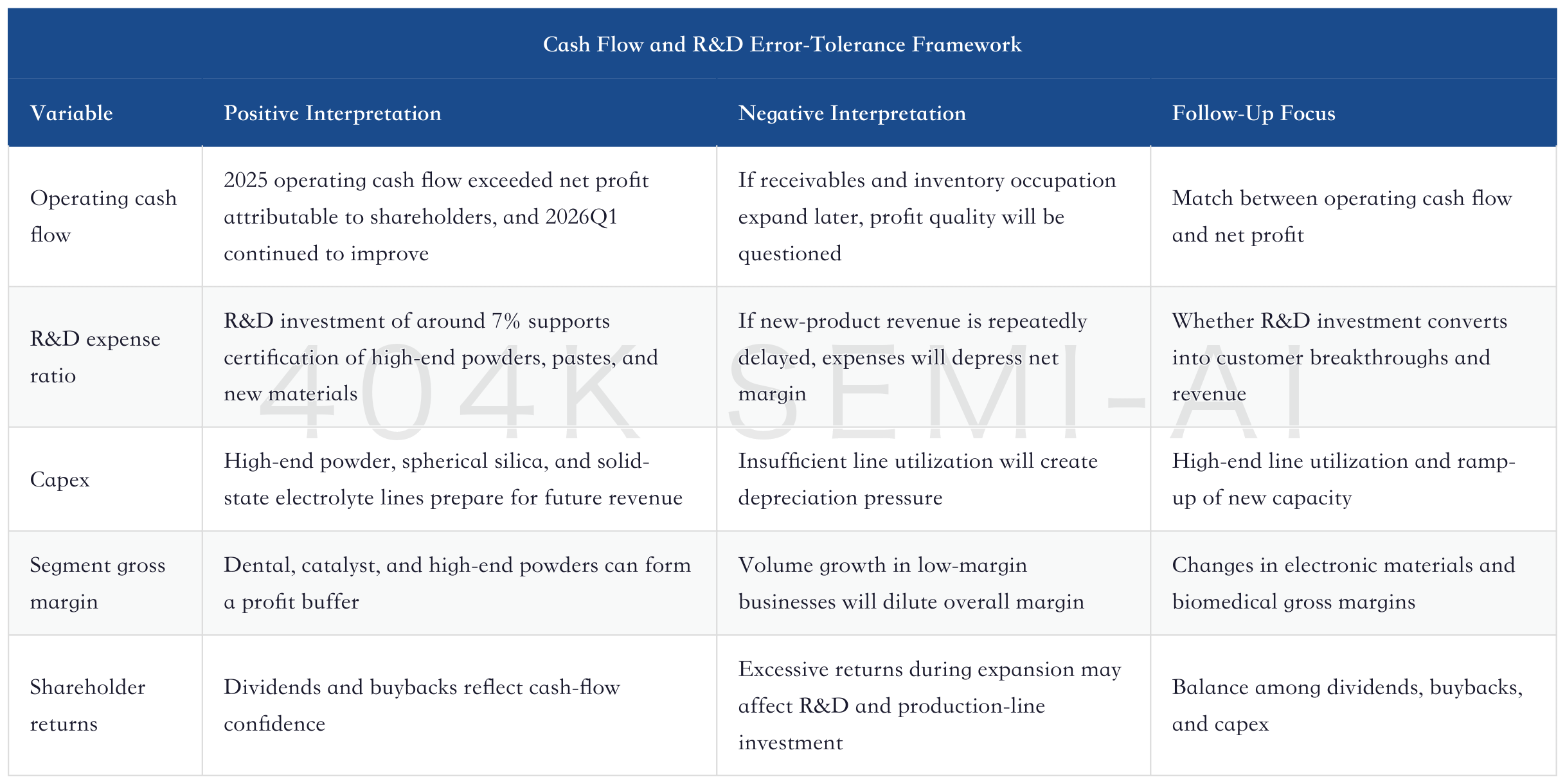
High valuation for a materials company cannot be supported by market size alone. The market space for high-end MLCC powders is large, but line utilization, yield, and customer certification determine the pace of profitability. The space for solid-state electrolytes is large, but mass-production cadence and customer feedback determine its position in the financial statements. Commercial aerospace ceramic packaging has high gross margins, but order continuity is more important than a single year’s orders. If Sinocera Materials can use cash flow to support these projects while preventing expenses from consuming profits, platform expansion creates value. If projects multiply but each line remains stuck in early-stage investment, platform expansion will drag down ROE.
This is also the true meaning of ROE. In 2024, Morgan Stanley was positive on Sinocera Materials’ ROE recovering from its 2023 trough to above 15% by 2026, backed by revenue recovery, gross-margin improvement, and higher asset utilization. After 2026, whether ROE can continue rising will depend on whether high-end powders and pastes bring higher gross margins, rather than simply relying on revenue scale expansion. If revenue growth mainly comes from low-margin new-energy materials and ordinary products, ROE improvement will be limited. Only if electronic materials mix upgrades and dental high-margin recovery appear simultaneously can ROE support a high valuation.
XVIII. Formal Disclosures and Research Clues: What Is Already in the Financials, and What Is Still on the Way
Research on Sinocera Materials must separate “facts already in the financial statements” from “future variables in research clues.” 2025 revenue, segment gross margins, cash flow, R&D; expense ratio, and Q1 2026 revenue and net profit are facts already in the financial statements. High-end powder pricing, Samsung high-end certification, high-end powder volume exceeding 1,000 tonnes in 2026, spherical silica passing certification with Taiwanese customers, and solid-state electrolyte sampling to leading customers are research and institutional clues that require subsequent financial-statement validation.
The facts already in the financial statements show that Sinocera Materials’ base is not weak. Revenue was RMB4.583 billion, and among its six segments, electronic materials, catalyst, biomedical, new energy, and precision ceramics all have clear business foundations. Operating cash flow exceeded profit, showing the company is not relying only on accounting profit to support expansion. Q1 recurring net profit grew faster than net profit attributable to shareholders, indicating FX factors disrupted reported profit. The data already in the financial statements are enough to support the valuation floor of a platform-type materials company.
The clues not yet fully reflected in the financial statements determine whether Sinocera Materials can move beyond the valuation floor. If clues such as high-end powder prices above RMB100,000 per tonne, high-end gross margins of 45%-50%, and batch shipments to Samsung after Q3 2026 are validated in electronic materials revenue and gross margin, Sinocera Materials’ valuation anchor will move clearly higher. Conversely, if these clues cannot convert into segment revenue and gross margin, the market will reclassify them as long-term options.
Formal disclosures and future clues can be viewed in six layers. Disclosed facts include 2025 revenue, net profit attributable to shareholders, operating cash flow, and 2026Q1 financials; they have the highest credibility and support the valuation floor of a platform-type materials company. Disclosed segments include revenue and gross margins for electronic materials, catalyst, biomedical, new energy, and precision ceramics, used to judge the profit base and business structure. Quarterly clues include MLCC powder sales volume, electronic pastes, dental, and new-energy materials growth, used to judge the direction of structural change in 2026. Customer and capacity clues include the new high-end powder line, Samsung certification, and high-end tonnage, used to judge monetization of high-end materials certification rights. Option-product clues include spherical silica, solid-state electrolytes, ceramic packaging orders, and certifications, which can only be gradually weighted as a watchlist. Market-space narratives include AI server MLCC usage, solid-state battery space, and commercial aerospace space; these need to be discounted and cannot be directly converted into profit and target prices.
This layering can make the investment judgment on Sinocera Materials cleaner: disclosed facts determine “how bad the downside can be,” customer and capacity clues determine “whether re-rating can continue,” and option-product clues determine “whether the upside can open.” The report cannot put all clues in the same evidence tier. High-end powders are already close to financial-statement validation and deserve the highest weight; electronic pastes have revenue growth and deserve the next-highest weight; commercial aerospace ceramic packaging already has order clues, but continuous delivery still needs to be observed; spherical silica and solid-state electrolytes still require stronger revenue evidence.
19. Differences versus the Prior View on Sinocera Materials: From “Materials Ticket” to “Monetization Checklist”
The prior core view on Sinocera Materials was that the company sits upstream of AI MLCCs and holds a materials ticket through ceramic powders and electronic pastes. That view still holds, but the focus now needs to move from “ticket” to “monetization checklist.” The ticket proves the company is qualified to enter high-end customer systems; the monetization checklist proves whether that qualification can become revenue, gross profit, and cash flow.
There are three most important pieces of incremental evidence. First, capacity and customer timing for high-end MLCC powder are clearer: the 2,000-ton high-end line has been completed, around 1,000 tons of high-end powder may contribute in 2026, and certification by customers such as Samsung is approaching the eve of volume production. Second, electronic paste revenue has begun to follow the upgrade in electronic materials, growing about 19% YoY in the first quarter, bringing Sinocera Materials closer to a materials portfolio supplier rather than a single powder supplier. Third, sell-side divergence has widened, showing that the market has shifted from “is there a re-rating logic?” to “can the high valuation be delivered?”
The relationship between incremental evidence and the prior view is clear. The prior view was that Sinocera Materials held an upstream AI MLCC materials ticket; now, the high-end powder new line, Samsung certification, and clues around 2026Q3 volume shipments are clearer, meaning the ticket is entering the revenue-verification stage. The prior view was that electronic pastes could raise the value of the materials portfolio; now, 2026Q1 electronic paste revenue grew about 19% YoY, showing the company is not only following powder volume but also increasing value per customer. The prior view was that dental and catalytic materials provide the cash-flow base; now, 2025 operating cash flow exceeded net profit attributable to shareholders, dental and catalytic gross margins remain high, and new-materials investment has a cash-flow buffer. The prior view was that new-material options provide upside; now, the timing for satellite ceramic packaging, spherical silicon, and solid-state electrolytes is more specific, but they still warrant observation rather than full upfront pricing. The prior view was that valuation should be layered; now, Goldman Sachs’ RMB33 target and JPMorgan’s July RMB136 target show stark divergence, with the target-price gap essentially reflecting differences in delivery stage.
From this perspective, the research focus on Sinocera Materials has shifted from “does this company have an AI MLCC materials logic?” to “can this logic enter the financial statements in 2H26?” The former has largely been accepted by the market; the latter is where excess return will be determined. If high-end powder, electronic paste, and gross margin are verified at the same time, Sinocera Materials’ re-rating will be more solid. If there is only logic but no financial-statement delivery, the valuation after the prior share-price rally will face pressure.
20. Weighting Adjustment Framework: When to Raise the Tracking Level and When to Cool Down
Sinocera Materials is not well suited to a research loop built around a single target price. It is better suited to adjusting the tracking level through evidence accumulation. The company is in an intermediate stage where “the platform base has been confirmed, the re-rating main line is being delivered, and option products are being gradually verified,” so any single quarter is unlikely to provide the final answer. A more effective approach is to classify new information into three categories: raise weighting, maintain observation, and reduce weighting.
Signals to raise the tracking level must come from financial statements or verifiable orders. Examples include high-end MLCC powder indeed entering volume shipments after 2026Q3, electronic-materials gross margin beginning to recover clearly from 34.49% in 2025, electronic paste revenue continuing to grow faster than total powder volume, dental and catalytic materials maintaining high-margin cash flow, and satellite ceramic packaging or spherical silicon seeing repeated orders. As long as two to three of these signals appear at the same time, Sinocera Materials is no longer just seeing concept-driven re-rating, but forming an income-statement re-rating.
Signals to maintain observation mean the logic remains but the evidence is not strong enough. For example, the company continues to disclose high-end powder certification, customer validation, sample delivery, and capacity construction, but segment revenue and gross margin have not changed meaningfully; or electronic-materials revenue grows, but FX, expenses, yield, and low-margin products drag it down, leaving net-profit elasticity muted. In this state, the company remains worth tracking, but it is not appropriate to price in all options ahead of time.
Signals to reduce the tracking level should be assessed across three areas. First, the timeline from certification to volume production for high-end MLCC powder is pushed out materially, with no visibility on high-end tonnage or gross-margin improvement in 2H26. Second, dental, catalytic, or new-energy materials see gross-margin pressure, and the platform base is no longer stable. Third, solid-state electrolytes, spherical silicon, and commercial aerospace ceramic packaging continue to see progress descriptions but still lack orders, revenue, or delivery evidence. If these three types of signals appear at the same time, Sinocera Materials should be downgraded from a high-end materials certification asset back to the valuation of a platform-style materials company.
The weighting adjustment can be handled with three triggers. If high-end powder reaches volume shipment, electronic-materials gross margin rises, paste maintains high growth, and dental plus catalytic cash flow remains stable, the tracking level can be raised, valuation can continue to follow the framework for a high-end materials certification asset, and option products can be weighted up gradually. If customer validation and capacity clues remain, but the financial statements show only mild improvement, maintain observation and place valuation between the upper end of a platform-style materials company and the lower end of a certification-rights asset. If high-end powder ramp-up is delayed, electronic-materials gross margin does not rise, cash flow or gross margin deteriorates, and option products have no orders, the tracking level should be reduced, valuation should return to that of a platform-style new-materials company, and long-dated options should be discounted.
The benefit of this framework is that it avoids repeatedly changing the core view amid share-price volatility. Sinocera Materials’ industrial logic will not change because of a single day’s move, but evidence strength will change with quarterly reports and customer orders. If the evidence strengthens, the view can be revised upward along the high-end materials certification-rights framework. If the evidence remains absent, then even if the long-term opportunity is still there, the current valuation weighting should be reduced.
21. Conclusion: Buying Materials Certification Rights, Not Full Delivery of Every Option
The core view after this deep update on Sinocera Materials is clear: the company should no longer be priced only as a traditional platform-style new-materials company, but it also cannot be given full upfront value for all new-material options. The part most worth buying is the materials certification right formed by AI and automotive-grade MLCC high-end powder and electronic pastes. The part that provides the strongest downside support is the revenue and cash flow from dental, catalytic, and new-energy materials. The part that requires the most restraint is option products such as solid-state electrolytes, spherical silicon, and commercial aerospace ceramic packaging.
If high-end powder volume shipments, rising electronic-materials gross margin, and continued electronic paste growth are visible in 2H26, Sinocera Materials can remain within the valuation framework for a high-end materials certification asset. If satellite ceramic packaging order delivery, spherical silicon customer certification, and progress in solid-state electrolyte sample delivery are also seen, the market will be willing to assign a higher premium to the multi-option platform. Conversely, if high-end powder remains a certification story, electronic-materials gross margin does not improve, and option-product orders are delayed, the high valuation will first be compressed back into the platform-style materials-company range.
More specifically, the next key variable for Sinocera Materials is not “whether it has new-material reserves,” but “whether high-end products can become high-quality profit.” High-end powder needs to prove itself through tonnage, price, and gross margin. Electronic paste needs to prove itself through revenue growth and customer bundling. Dental and catalytic materials need to prove themselves through cash flow. Satellite packaging, spherical silicon, and solid-state electrolytes need to prove themselves through orders and revenue. Only when this evidence accumulates in the same direction will Sinocera Materials be doing more than passively enjoying thematic valuation; it will be converting platform capability into a sustainable profit structure.
The company’s most attractive feature is that its valuation is not supported by a single concept. The biggest risk is also that when there are too many stories, valuation can easily run ahead of evidence. For Sinocera Materials, the next question is not whether there are new concepts, but whether each materials line can move from samples, certification, and orders to revenue, gross margin, and cash flow. Only then will AI ceramic powder, electronic paste, and dental cash flow be part of the same materials-platform re-rating logic rather than three separate narratives.
Compressed into one sentence: Sinocera Materials has already obtained the entry ticket for a high-end materials re-rating, but it still needs to use the financial statements of 2H26 and 2027 to turn the ticket stub into a seat. High-end powder is the first ticket, electronic paste is the second ticket, dental and catalytic cash flow is the safety cushion, and satellite packaging, spherical silicon, and solid-state electrolytes are upside options. The tickets are all there, but each one needs to be verified.
As long as the verification sequence remains intact, research on Sinocera Materials will not be pulled off course by single-quarter volatility. If the evidence remains absent for too long, even the most attractive materials-platform narrative must be discounted again.Sinocera Materials Deep Dive Update: 5,000 Tons of AI-Grade MLCC Powder, a RMB136 Target Price, and New Ceramic Substrate Orders as Validation
目录
Too Long; Didn’t Read
I. The Conclusion First: The Re-Rating Has Happened; Delivery Has Just Begun
II. From 2024 to 2026: The Same Company’s Valuation Anchor Changed Three Times
III. AI and Automotive-Grade MLCC Powders: The Real Acceleration Point Comes After 3Q26
IV. Electronic Paste: Sinocera Is Not Just a Powder Supplier
V. Dental, Catalysts, New Energy, and Precision Ceramics: They Determine the Valuation Floor, Not the Ceiling
VI. Ceramic Substrates and the Option Layer: Sinocera Creation Orders Make the Second Growth Curve More Concrete
VII. Financial Model: Revenue Recovery Does Not Equal Profit Conversion
VIII. Valuation Discipline: RMB136 Is Not the Conclusion; It Represents a Higher Evidence Threshold
IX. Capability Transfer: From Oxide Powders to a High-Reliability Materials Platform
X. Official A-Share Abbreviation and Overseas Aliases: Investment Language Should Be Standardized Around Sinocera Materials
XI. Differences Versus Peers: Reference Points From Chaozhou Three-Circle, Fenghua Advanced Technology, and Overseas MLCC Manufacturers
XII. Data Scope: Which Numbers Belong in the Model, and Which Should Only Go on the Watchlist
XIII. Falsification Checklist: The Most Important Things to Track Are Not News Items, but Four Quarters of Hard Data
XIV. Three Worldviews: Platform Materials Stock, Certification-Right Asset, Multi-Option Platform
XV. How to Use Sell-Side Divergence: The Target Price Is Not the Conclusion; the Validation Points Are
XVI. Roadmap for the Next Four Quarters: Focus on a Few Hard Metrics Each Quarter
XVII. Cash Flow and R&D Investment: Platform Expansion Cannot Rely on Slogans
XVIII. Formal Disclosures and Research Clues: What Is Already in the Financials, and What Is Still on the Way
19. Differences versus the Prior View on Sinocera Materials: From “Materials Ticket” to “Monetization Checklist”
20. Weighting Adjustment Framework: When to Raise the Tracking Level and When to Cool Down
21. Conclusion: Buying Materials Certification Rights, Not Full Delivery of Every Option
本内容基于公开资料和研报数据整理,不构成任何投资建议,不代表任何个人观点,仅供学习参考,请理性阅读
The key point in this update on Sinocera Materials is not how much the share price has already risen, but the evidentiary bar behind JPMorgan’s increase in its target price from RMB60.40 to RMB136: whether AI-grade MLCC powder can ramp in volume, whether ceramic substrates can absorb new orders, whether electronic-materials gross margin can return to historical highs, and whether that ultimately flows through to cash flow and ROE.
Too Long; Didn’t Read
Sinocera Materials’ valuation anchor has shifted to high-end powders. JPMorgan raised its target price in July from RMB60.40 to RMB136. The core is not simply higher revenue forecasts, but applying a 93x one-year forward PE to 2028E EPS of RMB1.46, while assuming high-end MLCC powder revenue accounts for more than 35% of the electronic-materials segment in 2027. This means market pricing has moved from “MLCC cycle recovery” to “AI and automotive-grade materials qualification rights.” Subsequent validation must come from high-end powder tonnage, electronic-materials gross margin, and customer adoption, rather than piling on more new-materials narratives.
5,000 tons of high-end capacity is the main thread of the report. Sinocera Materials already has 10,000 tons of standard MLCC powder capacity. Its high-end target capacity for AI servers and automotive applications is 5,000 tons, of which 2,000 tons came online by end-2025, with the remaining 3,000 tons expected by end-2026. The company has hydrothermal barium titanate technology and can mass-produce 50-100nm high-end powders. Customer leads include Samsung, Fenghua Advanced Technology, and Yageo. If volume supply materializes in 2H26, the electronic-materials segment will shift from volume recovery to mix-driven price uplift.
Powder price increases have more elasticity than the market expects. From March to May 2026, Murata and Samsung Electro-Mechanics already raised prices for high-end MLCCs, with upstream dielectric powders following. The real issue is the pricing ladder: consumer-grade, automotive-grade, and AI-server high-capacitance powders are clearly tiered by per-ton value, gross margin, and qualification difficulty. Contract liabilities have also begun to show order momentum, indicating that price increases and demand are not merely industry rumors.
Ceramic substrates are the second incremental growth line. Through Sinocera Saichuang, Sinocera Materials has built integrated capabilities in “powder + ceramics + metallization.” LED ceramic substrates are already supplied steadily to global customers. Revenue from low-orbit satellite RF microsystem chip packaging housings grew rapidly in 2025, and a RMB100mn order signed in June 2025 is expected to be completed in 1H26. Optical-module TEC has achieved small-batch sales, while PCB ceramic substrates remain under testing by major customers. The company expects substantive progress and new orders in 2027, making Sinocera Materials more than an MLCC powder asset.
A RMB136 target price requires stricter evidence. JPMorgan’s new model raises both 2027-2028 earnings and valuation multiples. The core assumption is that after high-end MLCC powder ramps, electronic-materials gross margin can return close to historical highs. This target price is already near the upper end for AI-related high-growth materials platforms. Whether it can hold depends on shipments, gross margin, orders, and cash flow, not on the target price itself persuading the market.
The investment view should be split into three valuation layers. Dental, catalytic, and new-energy materials determine the platform downside; AI/automotive-grade MLCC powder and electronic paste determine the current re-rating thesis; ceramic substrates, spherical silica, solid-state electrolytes, and satellite packaging determine long-dated options. The most compelling thing to buy in Sinocera Materials is high-end materials qualification rights; the key discipline is not to fully capitalize all options at once. Over the next four quarters, only hard metrics matter: high-end powder shipments, electronic-materials gross margin, contract liabilities, ceramic-substrate orders, and operating cash flow.
I. The Conclusion First: The Re-Rating Has Happened; Delivery Has Just Begun
Sinocera Materials is not simply an “upstream passive-component beta stock.” If one only looks at MLCC powder shipments, it resembles a cyclical commodity name. If one only looks at dental zirconia and honeycomb ceramics, it resembles a platform-type new-materials company. If AI servers, automotive-grade MLCCs, electronic paste, ceramic packaging, spherical silica, and solid-state electrolytes are viewed together, it looks like a high-reliability inorganic-materials supplier being redefined. The real investment question is which valuation layer these assets should sit in.
The old valuation anchor was 20-30x PE. It corresponded to consumer-electronics recovery, localization of catalytic materials, dental recovery, and new-energy materials ramp-up. In 2024, HSBC, UBS, and Morgan Stanley broadly assessed Sinocera Materials within this framework: revenue recovery, margin repair, an ROE inflection point, import substitution, and a multi-business platform. The question at this stage was whether demand had bottomed and whether capacity utilization could recover.
The new valuation anchor has moved close to 70-90x 2027E PE. It corresponds to high-end MLCC powder and electronic paste no longer being ordinary ceramic powders, but materials qualification rights for AI servers and automotive electronics. JPMorgan raised its target price further from RMB60.40 in June to RMB136 in July, pricing 2028E EPS of RMB1.46 at 93x one-year forward PE. The core reason is not that 2026 profit has already surged, but that it places high-end powder, ceramic substrates, dental cash flow, and several new-materials options into one high-end materials platform framework. Goldman Sachs’ neutral view remains valuable: valuation has already moved ahead. If high-end powder mass production, gross margin, and new-product revenue materialize more slowly than expected, the market will compress Sinocera Materials back from a “qualification-rights asset” to a “platform-type materials company.”
This is also the difference between Sinocera Materials and downstream MLCC manufacturers. Downstream manufacturers are investments in pricing cycles, inventory cycles, and capacity utilization. Sinocera Materials is an investment in materials qualification, formulation stickiness, and per-ton value. Downstream price increases can show up quickly in the income statement. Upstream high-end powders typically lag by half a beat, but once they enter customers’ materials systems, replacement costs and qualification cycles provide longer-tailed profit protection.
II. From 2024 to 2026: The Same Company’s Valuation Anchor Changed Three Times
In early 2024, when HSBC initiated coverage on Sinocera Materials with a RMB29.60 target price, the core logic was a bottoming rebound in a ceramic-materials platform. That report emphasized the company’s domestic leadership in MLCC raw materials and its horizontal expansion into medical, semiconductor, new-energy, and automotive materials. The valuation method was still traditional: HSBC forecast 2023-2025 revenue and attributable net-profit CAGRs of 17% and 31%, respectively, applying about 34x 2024E PE to reach a RMB29.60 target price.
In March of the same year, UBS placed Sinocera Materials within the framework of China’s chemical new-materials sector. Its main thread was not a single-company technology breakthrough, but renewed opportunities in new-materials segments such as electronic chemicals, fine fluorochemicals, and synthetic biology after valuation compression. Sinocera Materials was still rated Buy in this framework, with the target price cut from RMB39 to RMB28, but the logic had become more granular: 2024 MLCC powder sales were expected to reach 7,000-8,000 tons, with catalytic materials, precision ceramics, and dental materials jointly contributing growth.
By July 2024, Morgan Stanley’s title had become “Growth Drivers Aligning.” It focused on several drivers converging at the same time: the MLCC upcycle, import substitution, catalytic materials, precision ceramics, and dental improvement. The target price was cut to RMB24, but the Overweight rating was maintained because 2024-2026 revenue and profit CAGRs could still approach 30%, and ROE was expected to recover from the 2023 trough to above 15% by 2026.
By 2026, the debate among foreign brokers had shifted to an entirely different question. Goldman Sachs did not deny the value of the materials platform, but downgraded Sinocera Materials to Neutral with a RMB33 target price. The rationale was clear: the share price had already risen sharply over the previous 12 months, and the market had already priced in the option value of new products. Beyond AI-server MLCC materials, products such as solid-state batteries, spherical silica, and commercial aerospace still required more customer validation and mass-production cadence. UBS, after the 1Q26 results, raised its target price to RMB49.50, arguing that delivery was improving in high-end MLCC powder, new energy, dental, and several new materials in 2026. JPMorgan first raised its target price from RMB28.55 to RMB60.40 in May, then lifted it again to RMB136 in July, directly pushing the valuation anchor toward the upper end of AI-related high-growth materials platforms.
The most important point in this table is not the level of target prices, but the migration of the valuation anchor from “recovery” to “qualification.” For Sinocera Materials in 2024, the buying point was the cycle bottom and multi-business recovery. For Sinocera Materials in 2026, the buying point has become “who can obtain qualification slots for high-end MLCC powder and high-reliability ceramic materials.” If qualification materializes, valuation can stay elevated. If it is merely a revenue recovery, valuation will return to the normal range for a materials platform.
III. AI and Automotive-Grade MLCC Powders: The Real Acceleration Point Comes After 3Q26
Sinocera’s strongest line is high-end MLCC powder. Standard MLCC powder is no longer a new story, and Sinocera’s domestic position has long been recognized by the market. The change is that AI servers and automotive electronics have pushed MLCCs from “mobile-phone and consumer-electronics cycle components” back into “foundational materials for compute-power delivery and high-reliability electronics,” changing the pricing logic for powder suppliers.
A standard server uses about 1,500-2,000 MLCCs, while a single AI server can use 25,000 units, and even more on high-end platforms. The automotive side is similarly clear: ICE vehicles, plug-in hybrids, and BEVs differ significantly in MLCC content, and electrification plus intelligence will continue to raise the per-vehicle value of automotive-grade MLCCs. As MLCC manufacturers increase the share of high-capacitance, high-reliability, and high-temperature-resistant products for AI and automotive applications, upstream powders no longer track only aggregate volume; they track product-mix upgrades.
MLCCs from Passive Components to AI Density Monetizers: A 10,000-Word Cross-Transcript of Goldman Sachs, JPMorgan, and HSBC Views
The company’s 2025 annual report already states the positioning directly: the electronic materials segment is conducting product development and capacity expansion around AI-server and automotive-grade MLCC dielectric powders, with some new products making breakthroughs at core customers and both supply volume and mix continuing to rise. JPMorgan’s July report gives a more detailed timeline: Sinocera currently has 10,000 tonnes of standard MLCC powder capacity, with a high-end target capacity of 5,000 tonnes for AI-server and automotive applications. Of that, 2,000 tonnes had entered production by end-2025, and the remaining 3,000 tonnes are expected to be in place by end-2026. In 2025, the company’s MLCC powder output was about 7,000 tonnes. The next stage is not simply expanding aggregate volume, but increasing the share of high-end powder.
“Some new products achieved breakthrough progress at core customers.”
More importantly, the technology, pricing, and gross-margin ladder are all clear at the same time. JPMorgan explicitly wrote that Sinocera is one of the few domestic companies that has mastered the core technology for hydrothermal barium titanate and can mass-produce high-end 50-100 nm powders. On pricing, from consumer grade to automotive grade and then to high-capacitance AI-server powder, per-tonne value and margins rise step by step. If this set of data holds, Sinocera’s electronic materials segment is not merely a volume-growth story; per-tonne profit, customer structure, and valuation multiple are all improving at the same time.
The barrier in high-end powder is not just “whether it can be made.” AI customers require finer particle sizes, higher uniformity, and better dispersion, while yields for high-end products are also lower than for traditional products. Profit realization therefore goes through two stages: first obtaining qualification and small-batch orders, then turning gross margin into reality through yield, production-line cadence, and customer adoption. If the market only looks at “qualification passed,” it may become too optimistic; if it only looks at 1Q gross margin, it may underestimate subsequent mix improvement.
“High-end powder has both higher selling prices and higher gross margins.”
Sinocera has three layers of advantage on this line. The first is capacity: with about 10,000 tonnes of standard MLCC powder capacity and a 5,000-tonne high-end target capacity for AI and automotive applications, the company will move from a standard powder supplier toward a qualified high-end materials asset. The second is customers: the company is advancing stable, scaled supply to customers including Samsung, Fenghua Advanced Technology, and Yageo, benefiting from both domestic substitution in high-reliability MLCCs and international customers’ migration toward high-end products. The third is upstream resources and process capability: hydrothermal barium titanate, particle-size control, dispersion systems, and batch stability jointly determine product consistency.
The most important period to track for this line is 2H26. JPMorgan raised its 2027/2028E EPS forecasts by 21%/29%, respectively, and assumed high-end MLCC powder would contribute more than 35% of electronic materials segment revenue by 2027. The underlying logic is that high-end powder moves from qualification to volume production. If subsequent company disclosures or channel checks show that high-end powder shipments are indeed ramping, Sinocera’s valuation anchor will continue to shift from “standard powder leader” to “qualified high-end materials asset.” If 2H remains stuck at sampling, trials, and small batches, the market will again question the pace of profit realization implied by the RMB136 target price.
Murata Manufacturing Deep Dive: AI-Server MLCCs from Small Components to Profit Gatekeepers
IV. Electronic Paste: Sinocera Is Not Just a Powder Supplier
Electronic paste is an easily underestimated line. The reason is simple: powder is easier to explain, and AI-server MLCC content is easier to link to compute hardware. Paste sounds like a supporting material, and the market often treats it merely as a small business outside powder. But in the MLCC value chain, dielectric powder, electrode paste, and sintering process jointly determine capacitor performance. If Sinocera can introduce high-capacitance paste, automotive-grade paste, and RF paste into customers together with high-end powder, both its pricing power and per-customer value will increase.
In the 2025 annual report, the electronic materials segment generated RMB693 million in revenue, up 11.17% YoY, with a gross margin of 34.49%. This gross margin does not yet show the uplift that high-end powder should bring, indicating that in 2025 electronic materials were still in the first half of a mix transition: traditional MLCC powder, standard electronic paste, and new-product development were mixed together, and the profitability of AI and automotive products had not yet been fully reflected. In 1Q26, UBS tracked MLCC powder sales volume up about 10% YoY to 1,400 tonnes, while electronic paste revenue grew about 19% YoY. This combination is more important than powder volume alone, because it shows Sinocera’s electronic materials business is expanding from a single-powder logic to a “powder + paste” materials package.
The investment significance of electronic paste is not “one more product line,” but a change in the materials-platform business model. A pure powder supplier facing downstream customers often has pricing power constrained by the MLCC cycle. A supplier that can provide dielectric powder, electrode paste, and dispersion systems becomes closer to part of the customer’s process formula. If Sinocera can introduce paste at the same time it introduces high-end powder, customer switching costs and order stickiness will be stronger.
This also explains why Goldman Sachs and JPMorgan assign different valuations to the same company. Goldman Sachs places more weight on currently visible profit and the certainty of new-product revenue, so after seeing pressure on gross margin and net margin in 1Q26, it maintained a neutral rating. JPMorgan places more weight on the growth curve formed after the materials system is introduced, so it is willing to capitalize the high-end powder and paste combination in advance. The real financial validation will occur in 2H26: whether electronic materials revenue growth can exceed the company average, whether gross margin can rise against the trend, and whether paste growth can appear together with high-end powder.
V. Dental, Catalysts, New Energy, and Precision Ceramics: They Determine the Valuation Floor, Not the Ceiling
Sinocera’s base is not a single MLCC line, but six materials segments. In 2025, the company generated RMB4.583 billion in revenue, up 13.24% YoY; net profit attributable to shareholders was RMB610 million, up 0.91% YoY; and operating cash flow was RMB804 million, up 6.72% YoY. Profit growth lagged revenue growth, indicating that the company is still experiencing pressure from product mix, FX, expenses, and gross margins in several businesses, but cash-flow quality is not poor. The role of this base is to provide R&D; and capacity-investment capability for AI powder and new-materials options.
The dental business is the most important part of the valuation floor. The company has a leading domestic share in dental zirconia materials, and dental materials’ gross margin has long been higher than most segments. In 1Q26, UBS tracked dental materials revenue up about 25% YoY, with sales volume of blocks and powders up about 20% and 30%, respectively. JPMorgan emphasized that domestic dental zirconia powder market share exceeds 30%, high-end zirconia powder pricing can exceed RMB300,000/tonne, and overseas brand acquisitions help the company enter high-end European and US markets.
The value of the dental business lies in cash flow and earnings quality. AI powder and solid-state electrolytes require R&D;, qualification, and production-line investment, while commercial aerospace packaging and spherical silica also require customer validation. If dental and catalysts can continue to contribute high-margin cash flow, Sinocera does not need to rely entirely on external financing or sacrifice profit to pursue new materials. Conversely, if overseas dental recovery is slow, price competition intensifies, or acquired-brand integration falls short of expectations, the tolerance for error in the new-materials options will decline.
Catalytic materials are another cash-flow line. In 2025, catalytic materials revenue was RMB954 million, up 21.23% YoY, with a gross margin of 41.22%. In 1Q26, honeycomb ceramic shipments were about 5 million liters, up about 10% YoY. This business cannot lift the valuation multiple like AI powder, but it is an income-statement stabilizer: emissions-standard upgrades, domestic substitution, and the recovery of the commercial-vehicle chain determine whether catalytic materials can continue to contribute a gross margin of around 40%.
New energy materials and precision ceramics are more like “platform proof points.” In 1Q26, new energy materials revenue was about RMB150 million, with alumina shipments of about 15,000 tonnes, up about 80% YoY. Precision ceramics were dragged by downstream destocking in ceramic balls, but ceramic substrates still grew YoY. New energy materials’ per-tonne profit is not as high as dental or high-end powder, but it proves Sinocera’s horizontal migration capability in high-purity oxides and inorganic powder processes. Precision ceramics are volatile in the short term, but they are the industrial foundation for satellite ceramic packaging, ceramic substrates, and high-reliability structural components.
Fenghua Advanced Technology Deep Dive: MLCCs, Automotive-Grade Chip Resistors, and Electronic Materials Advancing on Three Fronts; The Re-Rating Logic for a Domestic High-Reliability Passive Components Platform
The valuation layers need to be separated here. Dental, catalysts, new energy, and precision ceramics can prove Sinocera is not a single-product company and can support the valuation floor. But they are unlikely to independently justify a valuation above 70x. What truly determines the valuation ceiling remains whether high-end MLCC powder, electronic paste, and ceramic substrates can lift revenue, gross margin, and customer stickiness together.
VI. Ceramic Substrates and the Option Layer: Sinocera Creation Orders Make the Second Growth Curve More Concrete
JPMorgan’s July report singles out ceramic substrates, which is an important change. In the past, Sinocera’s high-end options were mostly framed as long-duration narratives such as satellite ceramic packaging, spherical silica, and solid-state electrolytes. Now, through Sinocera Creation, ceramic substrates and metallization capabilities are starting to translate into more concrete orders and customer validation. The core of Sinocera Creation is not a single substrate product, but the integration of Sinocera’s existing powder, ceramic sintering, and metallization capabilities into an integrated “powder + ceramic + metallization” supply model.
Sinocera Creation already has several verifiable lines of progress. LED ceramic substrates are already being supplied in stable volume to global tier-one customers; communications RF microsystem chip package housings have become a mainstream packaging solution for low-orbit satellite RF chips, with revenue growing rapidly in 2025, and a RMB100mn order signed in June 2025 expected to be completed in 1H26; in optical-module ceramic substrates, TEC products have already achieved small-batch sales to some customers, while new-customer qualification remains underway; PCB ceramic substrates are still in the testing stage with major customers, and the company expects substantive progress and new orders in 2027. This mix moves ceramic substrates from a “long-dated option” closer to “near- to medium-term order validation.”
Sinocera still has many option products: commercial-space ceramic packaging, spherical silica powder, solid-state electrolytes, ceramic substrates, TEC, and AR optical dispersions. They all exist in real product form and all map to large addressable markets. But the easiest investment mistake is to fully capitalize all options at once. Materials is not software. For a product to move from sample delivery to validation and then volume shipment, customer qualification, production-line yield, supply stability, and the cost curve all need to clear the bar.
Goldman Sachs’ cautious view is useful here. It believes that among new products, AI server MLCC materials are the most likely to become a meaningful growth driver over the next few years; the commercialization pace of spherical silica, solid-state batteries, and commercial space remains uncertain. This does not deny Sinocera’s technology reserves. Rather, it is a reminder that materials options should be recognized gradually based on revenue and orders, not fully priced in upfront based on ultimate market size.
Commercial-space ceramic packaging and ceramic substrates are the option line closest to order conversion. Their value is not in single-year revenue scale, but in proving Sinocera’s “high-reliability inorganic materials platform” as high-reliability ceramic packaging enters commercial space, low-orbit satellite RF chips, optical modules, and PCB thermal-management applications. If Sinocera Creation can subsequently convert the RMB100mn order, TEC small-batch sales, and PCB major-customer testing into recurring revenue, Sinocera’s valuation will no longer rely only on the MLCC powder line.
The logic for spherical silica powder lies in CCL and advanced packaging, but the pace is slower. If Sinocera passes Taiwan customer qualification, it may first contribute tens of millions of RMB in revenue in 2H26; only if volume begins to scale in 2027 will it enter more visible P&L; validation. Solid-state electrolytes are further out. JPMorgan is positive on the sulfide route and mentions the company’s 30-ton pilot line, 100-ton plan, and sample delivery to leading battery customers, but also acknowledges that 2027 will most likely only see modest pilot revenue. At this stage, investors should treat solid-state electrolytes as a technology and customer-validation option, not a 2026 profit source.
“Most new products still depend on customer validation and the pace of mass production.”
This attitude matters. The more Sinocera looks like a platform company, the more stories it can support; the more stories there are, the more important evidence-based layering becomes. AI/auto-grade MLCC powder is the current re-rating main line; dental and catalysts are the cash-flow base; commercial-space ceramic packaging and spherical silica are near- to medium-term options; solid-state electrolytes are long-dated options. Different layers can coexist, but they cannot all be bought upfront at the same valuation multiple.
VII. Financial Model: Revenue Recovery Does Not Equal Profit Conversion
Sinocera’s recent financials show a clear tension: revenue has already resumed growth, but profit elasticity has not fully opened up. The first-quarter report itself was not poor, but it did not immediately prove the high-end powder re-rating thesis either. In particular, financial expenses were affected by FX losses caused by RMB appreciation, with around RMB20mn of FX losses in 1Q dragging on net profit.
The model cannot focus only on revenue growth. Three things matter more: whether electronic-materials gross margin can re-accelerate; whether the revenue mix from high-end powder and electronic paste can rise; and whether dental, catalysts, and new-energy materials can stabilize cash flow without allowing new-material investment to erode net margin.
The key change in this table is that JPMorgan’s July report not only raises the valuation multiple, but also materially lifts its 2027/2028 earnings model. Goldman Sachs, UBS, and JPMorgan’s May report all had similar 2027 net-profit estimates, while JPMorgan’s July report lifts 2027 adjusted net profit to a higher level. Behind this are upgraded assumptions for high-end MLCC powder pricing, gross margin, and the AI-grade product mix.
Goldman Sachs’ valuation discipline is that 2026-2028 EPS CAGR is around 28%, while many new-product options have not yet been realized, making it more appropriate to discount long-term target profit. JPMorgan’s July valuation discipline is more aggressive: AI server demand, MLCC price increases, 5,000 tons of high-end powder, and ceramic-substrate orders together lift the company’s product mix over the next two years, giving the electronic-materials segment an opportunity to return to its historical high gross margin of 50%, thereby supporting a 93x one-year forward PE. The disagreement between the two is not whether 1Q profit was tens of millions higher or lower, but whether Sinocera should be viewed as an “asset with high-reliability materials qualification rights.”
For Sinocera, the key to 2026 earnings forecasts is not whether revenue can reach around RMB5.5bn, but the structure within that RMB5.5bn. If each segment merely grows organically by single digits to low teens, profit elasticity will be limited. Only if high-end MLCC powder, electronic paste, and high-margin dental together increase their revenue share can net margin enter an upward channel.
VIII. Valuation Discipline: RMB136 Is Not the Conclusion; It Represents a Higher Evidence Threshold
The most important pricing question for Sinocera now is not a simple bullish or bearish call, but which layer of evidence the valuation should be allowed to capture. RMB33 corresponds to a disciplined valuation in which “growth is already fairly well reflected”; RMB60.40 corresponds to the May version of the “high-end materials qualification rights” valuation; RMB136 corresponds to the July version of an upper-end valuation where “AI-grade powder + ceramic substrates + high-margin electronic materials” are realized at the same time. All three can be internally consistent. The difference is how much future validation investors are willing to buy in advance.
JPMorgan’s July target price of RMB136 raises the valuation multiple to 93x one-year forward PE, corresponding to around 88x/72x 2027/2028E PE, which is no longer an ordinary new-materials platform valuation. Its logic is that high-end AI server powder raises profit per ton, auto-grade products improve customer stickiness, electronic-materials gross margin returns to around 50%, dental maintains high-margin cash flow, and Sinocera Creation’s ceramic-substrate orders plus subsequent PCB ceramic-substrate progress provide a second growth curve. The reasonable precondition for this valuation is that 2H26 must show simultaneous improvement in high-end powder volume, contract liabilities, and electronic-materials gross margin.
Goldman Sachs’ RMB33 target price represents another discipline: the share price already reflects substantial long-term growth, while the products that can genuinely contribute meaningful profit over the next few years remain mainly AI server MLCC materials; solid-state, spherical silica, commercial space, and others still need customer validation and mass production. This valuation does not deny the company. It refuses to discount every option into current market value ahead of time.
The more prudent current view is that Sinocera has moved beyond a pure cyclical-recovery valuation, but has not yet fully proven all the evidence required for a RMB136 target price. It should at least be viewed as a “high-end MLCC materials qualification asset.” Whether it can further become a multi-option platform driven by “AI-grade powder and ceramic-substrate resonance” depends on orders and the P&L; in 2H26 and 2027.
This is also the difference between a buy point and a sell point. If the share price falls back to a valuation that only reflects a platform materials company, while evidence for high-end powder qualification and shipments continues to improve, the risk-reward becomes better. If the share price is already fully pricing a multi-option platform, but electronic-materials gross margin, shipment volume, and order revenue fail to keep up, risk will accumulate quickly. Sinocera cannot be judged only by stories; it must be judged by quarterly data and the pace of customer adoption.
IX. Capability Transfer: From Oxide Powders to a High-Reliability Materials Platform
The long-term value of Sinocera Materials does not lie in any single product, but in the transferability of its materials capabilities. The company has expanded from MLCC dielectric powders, zirconia dental materials, honeycomb ceramics, alumina, new energy materials, and precision ceramics. At its core, this expansion relies on several shared capabilities: high-purity powder preparation, particle-size and dispersion control, formulation development, understanding of sintering processes, customer certification management, and stable scaled manufacturing.
This type of capability transfer has two characteristics. First, it is slow. Materials customers will not switch suppliers immediately just because a supplier “has technical reserves.” The process must go through sample delivery, validation, small-batch production, volume production, quality tracking, and price negotiation. Second, once a supplier enters a customer’s system, replacement costs are also high. Downstream customers care more about stability, batch consistency, and long-term supply, and will not easily replace a critical materials supplier for a small price difference.
This is exactly the difference between Sinocera Materials and many “theme-driven new materials companies.” Theme-driven companies often have only one product story; if product validation fails, they lose their valuation anchor. Sinocera Materials’ advantage is that multiple segments already contribute revenue and cash flow. Its drawback is that it has many segments, long validation cycles, and a less pure P&L.; When the market gives it a high valuation, it can easily treat all options as if they will be exercised on the same day. When the market is disappointed, it can also easily overlook the materials processes and customer base the company already has.
This migration path does not guarantee that every product will succeed, but it explains why Sinocera Materials deserves continuous tracking. For a company with only a solid-state electrolyte story, if battery customer validation is delayed, the valuation anchor becomes fragile. Even if Sinocera Materials’ solid-state electrolyte business is delayed, MLCC powders, electronic pastes, dental materials, catalysts, and satellite ceramic packaging can still continue to be validated. Platform value comes from “failure does not mean going to zero, while success can stack.”
However, platform value cannot be a reason for arbitrary valuation expansion. The biggest risks for a materials platform are twofold: too many R&D; projects, causing expenses to erode profits; and too many production lines, raising capex and depreciation pressure. Sinocera Materials’ R&D; expense ratio was about 6.93% in 2025, a high but understandable range. If new materials investment continues to rise while electronic materials gross margin and high-end powder shipments fail to keep pace, the market will reassess the return on platform expansion.
X. Official A-Share Abbreviation and Overseas Aliases: Investment Language Should Be Standardized Around Sinocera Materials
Overseas reports often use names such as Sinocera, Shandong Sinocera Functional Material, and Shandong Sinocera - A, but Chinese investment language must be standardized around the official A-share securities abbreviation “Sinocera Materials.” This may appear to be merely a naming issue, but it directly affects the clarity of research expression. Sinocera Materials is not simply a local Shandong materials company, nor is it the abstract Sinocera in English-language reports. It is an A-share-listed materials platform company with multi-business disclosures that can be cross-checked through annual and quarterly reports.
Once the naming is standardized, the materials clues become clearer: Sinocera Materials’ electronic materials are not generic “chemical new materials,” but MLCC dielectric powders, electronic pastes, and high-end ceramic powders; its biomedical business is not medical services, but dental zirconia materials; its catalyst materials are not traditional chemical catalysts, but emission aftertreatment materials such as honeycomb ceramics; its precision ceramics are not ordinary structural components, but an extension into high-reliability applications such as ceramic balls, ceramic substrates, and satellite tube shells.
This framing helps avoid two misjudgments. First, Sinocera Materials cannot simply be treated as an MLCC stock. It is not a downstream MLCC manufacturer; profit realization depends more on materials certification, yield, and customer introduction. Second, it cannot simply be treated as a “multi-concept new materials company.” If all products are only concepts, the valuation should be discounted. If multiple segments already have evidence of revenue, gross margin, and customer certification, the valuation should be layered by evidence.
XI. Differences Versus Peers: Reference Points From Chaozhou Three-Circle, Fenghua Advanced Technology, and Overseas MLCC Manufacturers
Sinocera Materials’ peer reference set cannot consist only of powder companies, because there are very few pure comparable A-share targets. A more reasonable comparison has three layers: downstream MLCC and electronic ceramics manufacturers, domestic passive component platforms, and overseas MLCC leaders.
Chaozhou Three-Circle represents a vertically integrated path in electronic ceramics and high-end MLCCs. It is closer to ceramic components, ceramic substrates, and high-end passive components, benefiting from upgrades in AI servers, automotive electronics, and high-reliability electronic ceramics. Sinocera Materials sits further upstream in materials. Its revenue scale and earnings elasticity are not fully synchronized with downstream manufacturers, but once high-end powder certification stabilizes, its gross margin and customer stickiness should look more like a materials bottleneck position than a capacity cycle.
Chaozhou Three-Circle deep dive: from electronic ceramics platform to high-end MLCCs, how AI servers revalue domestic ceramic component capabilities
Fenghua Advanced Technology represents the domestic MLCC and chip resistor platform. It is one of Sinocera Materials’ important downstream application scenarios and also reflects the progress of domestic substitution in high-reliability passive components. If Fenghua Advanced Technology continues to make breakthroughs in automotive-grade products, high-end MLCCs, and electronic materials, Sinocera Materials should benefit as an upstream powder and paste supplier. However, downstream customer capacity expansion and price competition will also feed back into upstream materials pricing.
Overseas MLCC leaders, including Murata, Taiyo Yuden, Samsung Electro-Mechanics, and Yageo, provide the reference points for global demand and product mix. AI servers increase MLCC usage, automotive-grade and high-capacitance products raise ASPs, international manufacturers are migrating capacity toward high-end products, and supply of commodity products is passively tightening. Sinocera Materials’ opportunity comes from this structural change spreading upstream: high-end demand increases, customers need stable high-end powders and pastes, and once domestic suppliers pass certification, they have the opportunity to capture higher value per ton.
Japan electronic components deep dive: AI servers are pushing MLCCs from cyclical products toward compute infrastructure
Downstream peers also offer another insight: AI server demand does not only change usage per machine; it also changes product reliability requirements and supply-chain security preferences. The higher-end the MLCC, the more customers care about dielectric powder purity, particle size, batch stability, and long-term supply capability. The more customers shift capacity toward high-end products, the more upstream materials must maintain stability in yield and delivery. This is where Sinocera Materials’ research value lies: it does not directly sell finished MLCCs, but it may become a repeatedly validated materials link in the high-endization cycle. Once this position is secured, earnings sustainability should be better than ordinary cyclical materials, valuation should be more resilient, and medium-term pricing should become more stable.
The most important conclusion from the peer comparison is this: Sinocera Materials is not trying to compete with downstream manufacturers for the same profit pool, but to embed itself into the materials system of downstream high-endization. If the downstream high-end MLCC cycle holds, powders and pastes may not immediately see price increases, but customer certification and order continuity should improve meaningfully. If downstream high-endization falls short of expectations, Sinocera Materials will not automatically receive a high valuation simply because the volume of ordinary MLCCs recovers.
XII. Data Scope: Which Numbers Belong in the Model, and Which Should Only Go on the Watchlist
Sinocera Materials has a large amount of data, but different figures have different levels of reliability and different uses. Company-disclosed revenue, net profit, cash flow, segment revenue, and gross margins are the foundation of the model. Powder prices, gross margins, and high-end capacity from institutional research are key to judging structural change, but they require subsequent financial statement validation. Orders and capacity for new products such as solid-state electrolytes, spherical silica, and satellite packaging belong on the watchlist and should not be fully converted into profit forecasts upfront.
This approach can avoid two extremes. Being too conservative means looking only at RMB610mn of net profit in 2025 and ignoring the structural changes that high-end powders and pastes may bring after 2026. Being too optimistic means valuing every new materials line as a mature product and ignoring customer certification and mass-production yield. A reasonable model for Sinocera Materials should be: “core businesses provide profits, revaluation businesses provide valuation elasticity, and option businesses go on the watchlist.”
“The shipment pace of high-end powders in 2026 is the key evidence for revaluing electronic materials.”
XIII. Falsification Checklist: The Most Important Things to Track Are Not News Items, but Four Quarters of Hard Data
Research on Sinocera Materials cannot stop at thematic keywords. The real focus should be four types of hard indicators: shipments, gross margin, orders, and cash flow.
This falsification checklist is more useful than simply looking at target prices. J.P. Morgan raising its target price does not mean every quarter must beat expectations by a wide margin, but there should at least be visible structural improvement in high-end powders and electronic materials. Goldman Sachs being neutral does not mean Sinocera Materials has no opportunity; as long as high-end powders begin real batch shipments from 2026Q3, the market will revise its judgment that “the options are too early.”
The risks should also be stated clearly. First, although the MLCC industry is strengthening in AI and automotive-grade applications, if the recovery in ordinary consumer electronics is slow, downstream utilization and pricing will still affect powder demand. Second, if customer certification and yield ramp-up for high-end powders fall short of expectations, revenue and gross margin delivery will lag valuation. Third, if dental and catalyst businesses face pricing pressure, the cash-flow base will weaken. Fourth, orders for solid-state electrolytes, spherical silica, and commercial aerospace have project-timing risks and should not be valued on full-capacity, full-sales assumptions. Fifth, FX volatility already showed up as financial expense pressure in 2026Q1 and may continue to disrupt net profit.
XIV. Three Worldviews: Platform Materials Stock, Certification-Right Asset, Multi-Option Platform
Sinocera Materials is easily misjudged because it fits into three worldviews at the same time. The first treats it as a platform-type materials stock, with profit mainly coming from the organic growth of dental, catalyst, electronic materials, and new-energy materials. The second treats it as a high-end MLCC materials certification-right asset, with earnings leverage coming from AI and automotive-grade powders, electronic pastes, and penetration of core customers. The third treats it as a multi-option materials platform, bringing products such as satellite ceramic packaging, spherical silica, solid-state electrolytes, and ceramic substrates into long-term valuation.
These three worldviews are not mutually exclusive, but their buying conditions are entirely different. A platform-type materials stock is judged by cash flow and ROE recovery; a certification-right asset by high-end powder shipments and gross margin; a multi-option platform by whether multiple new products move from validation into orders and revenue. Sinocera Materials currently sits closer to the second: the platform base is already fairly clear, the certification rights for high-end MLCC powders are beginning to monetize, but the multi-option platform still needs further proof from orders and revenue.
A more robust framework is to use the platform-type materials stock to judge the downside, the high-end materials certification right to judge the current main line, and the multi-option platform to judge the upside. Using only the first layer would underestimate the valuation migration brought by AI and automotive-grade MLCC powders; jumping directly to the third would mean paying upfront for products that have not yet generated revenue. Sinocera Materials’ truly sustainable excess return is more likely to come from a gradual lift from the second layer to the third, rather than a full re-rating overnight.
XV. How to Use Sell-Side Divergence: The Target Price Is Not the Conclusion; the Validation Points Are
Goldman Sachs, UBS, and JPMorgan have very different target prices, but what they really provide are three validation paths. Goldman’s Neutral rating pulls investors back to valuation discipline: the share price has already reflected growth potential in advance, and new products deserve further valuation upgrades only after mass production and profit delivery are realized. UBS’s target-price increase offers a middle path: although the first quarter saw FX and gross-margin pressure, high-end MLCC, dental, and new-energy materials were still improving, supporting an upward revision to medium- and long-term DCF growth assumptions. JPMorgan’s aggressive upgrade offers the optimistic path: AI/automotive-grade powders, dental, satellite packaging, and solid-state electrolytes jointly lift the valuation center.
The best way to use these three paths is not to simply average the target prices, but to extract the trigger conditions behind each.
At present, investors should use “stepwise validation” rather than “target-price voting.” The first step is electronic materials revenue and gross margin in Q2 and Q3 2026; the second is batch shipments to high-end powder customers and full-year 2026 high-end powder tonnage; the third is whether satellite ceramic packaging, spherical silica, and solid-state electrolytes have clear revenue or order receipts. As long as the first and second steps hold, Sinocera Materials has reason to maintain a high-end materials certification-right valuation. Only if the third step also holds should it receive the high multiple of a multi-option platform.
This also explains why quarterly tracking is more important than news flow for Sinocera Materials. News flow can continuously produce new customers, new materials, and new production lines, but valuation will ultimately land on financial statements and orders. Electronic materials gross margin, powder tonnage, paste revenue, dental gross margin, and operating cash flow are the indicators that can turn the story into profit.
XVI. Roadmap for the Next Four Quarters: Focus on a Few Hard Metrics Each Quarter
Sinocera Materials has many product lines, so tracking must be disciplined. Each quarter does not require reopening every new-material clue. The key is whether the company is moving along the path of “certification to batch volume, revenue to gross margin, option to order.”
The most important point in this roadmap is Q3 2026. The reason is not that profit must necessarily explode in a single quarter, but that evidence of high-end powders moving from certification to batch volume will become clearer at this stage. If high-end powder volume is still not visible after Q3, the logic behind the RMB136 target price will be questioned by the market. If batch shipments are confirmed in Q3, the market will be more willing to assign a high multiple to 2027 even if the income statement has not yet fully reflected it.
The second key window is H1 2027. By then, spherical silica, satellite ceramic packaging, and solid-state electrolytes cannot all still remain in the “under validation” stage. They do not need to contribute large profits simultaneously, but they must at least have verifiable orders, deliveries, or revenue. If only high-end MLCC powders materialize, Sinocera Materials is still a good company, but valuation should mainly revolve around the certification-right asset. If option products begin to generate revenue continuously, the platform re-rating will be more solid.
XVII. Cash Flow and R&D; Investment: Platform Expansion Cannot Rely on Slogans
Expansion for materials platform companies ultimately returns to two constraints: whether R&D; investment can be sustained, and whether cash flow can bear it. Sinocera Materials’ advantage is that it already has a revenue base in dental, catalyst, electronic materials, and new-energy materials, rather than relying on a single laboratory project to tell a story. The pressure is that there are many new-material projects, certification and mass-production cycles are long, and expenses and depreciation may arrive before revenue recognition.
In 2025, the company’s operating cash flow was RMB804 million, higher than RMB610 million in net profit attributable to shareholders, indicating solid cash collection quality in the core business. In Q1 2026, operating cash flow was RMB169 million, up 84.41% YoY, also suggesting no obvious short-term deterioration in working capital. This indicator is highly important. High-end powders, spherical silica, solid-state electrolytes, and ceramic packaging all require production lines, R&D;, and customer validation. If operating cash flow cannot keep pace, platform expansion will become pressure on margins and the balance sheet. If cash flow remains stable, Sinocera Materials has the ability to advance multiple projects in parallel.
R&D; investment also needs to be viewed by structure. The company’s R&D; expense ratio was about 6.93% in 2025, lower than 7.25% in 2024, but still above most traditional materials companies. For Sinocera Materials, R&D; expense is not merely a cost, but the entry ticket for customer certification and product migration. High-end MLCC powders need to address particle size, dispersibility, finished-product yield, and batch stability; electronic pastes need to support downstream high-capacitance, automotive-grade, and RF products; solid-state electrolytes and spherical silica require continuous sampling and customer feedback. As long as the R&D; expense ratio moves in tandem with the revenue share of high-end products, the market can accept it. If the expense ratio rises while new-product revenue shows no progress, it will become a valuation penalty.
High valuation for a materials company cannot be supported by market size alone. The market space for high-end MLCC powders is large, but line utilization, yield, and customer certification determine the pace of profitability. The space for solid-state electrolytes is large, but mass-production cadence and customer feedback determine its position in the financial statements. Commercial aerospace ceramic packaging has high gross margins, but order continuity is more important than a single year’s orders. If Sinocera Materials can use cash flow to support these projects while preventing expenses from consuming profits, platform expansion creates value. If projects multiply but each line remains stuck in early-stage investment, platform expansion will drag down ROE.
This is also the true meaning of ROE. In 2024, Morgan Stanley was positive on Sinocera Materials’ ROE recovering from its 2023 trough to above 15% by 2026, backed by revenue recovery, gross-margin improvement, and higher asset utilization. After 2026, whether ROE can continue rising will depend on whether high-end powders and pastes bring higher gross margins, rather than simply relying on revenue scale expansion. If revenue growth mainly comes from low-margin new-energy materials and ordinary products, ROE improvement will be limited. Only if electronic materials mix upgrades and dental high-margin recovery appear simultaneously can ROE support a high valuation.
XVIII. Formal Disclosures and Research Clues: What Is Already in the Financials, and What Is Still on the Way
Research on Sinocera Materials must separate “facts already in the financial statements” from “future variables in research clues.” 2025 revenue, segment gross margins, cash flow, R&D; expense ratio, and Q1 2026 revenue and net profit are facts already in the financial statements. High-end powder pricing, Samsung high-end certification, high-end powder volume exceeding 1,000 tonnes in 2026, spherical silica passing certification with Taiwanese customers, and solid-state electrolyte sampling to leading customers are research and institutional clues that require subsequent financial-statement validation.
The facts already in the financial statements show that Sinocera Materials’ base is not weak. Revenue was RMB4.583 billion, and among its six segments, electronic materials, catalyst, biomedical, new energy, and precision ceramics all have clear business foundations. Operating cash flow exceeded profit, showing the company is not relying only on accounting profit to support expansion. Q1 recurring net profit grew faster than net profit attributable to shareholders, indicating FX factors disrupted reported profit. The data already in the financial statements are enough to support the valuation floor of a platform-type materials company.
The clues not yet fully reflected in the financial statements determine whether Sinocera Materials can move beyond the valuation floor. If clues such as high-end powder prices above RMB100,000 per tonne, high-end gross margins of 45%-50%, and batch shipments to Samsung after Q3 2026 are validated in electronic materials revenue and gross margin, Sinocera Materials’ valuation anchor will move clearly higher. Conversely, if these clues cannot convert into segment revenue and gross margin, the market will reclassify them as long-term options.
Formal disclosures and future clues can be viewed in six layers. Disclosed facts include 2025 revenue, net profit attributable to shareholders, operating cash flow, and 2026Q1 financials; they have the highest credibility and support the valuation floor of a platform-type materials company. Disclosed segments include revenue and gross margins for electronic materials, catalyst, biomedical, new energy, and precision ceramics, used to judge the profit base and business structure. Quarterly clues include MLCC powder sales volume, electronic pastes, dental, and new-energy materials growth, used to judge the direction of structural change in 2026. Customer and capacity clues include the new high-end powder line, Samsung certification, and high-end tonnage, used to judge monetization of high-end materials certification rights. Option-product clues include spherical silica, solid-state electrolytes, ceramic packaging orders, and certifications, which can only be gradually weighted as a watchlist. Market-space narratives include AI server MLCC usage, solid-state battery space, and commercial aerospace space; these need to be discounted and cannot be directly converted into profit and target prices.
This layering can make the investment judgment on Sinocera Materials cleaner: disclosed facts determine “how bad the downside can be,” customer and capacity clues determine “whether re-rating can continue,” and option-product clues determine “whether the upside can open.” The report cannot put all clues in the same evidence tier. High-end powders are already close to financial-statement validation and deserve the highest weight; electronic pastes have revenue growth and deserve the next-highest weight; commercial aerospace ceramic packaging already has order clues, but continuous delivery still needs to be observed; spherical silica and solid-state electrolytes still require stronger revenue evidence.
19. Differences versus the Prior View on Sinocera Materials: From “Materials Ticket” to “Monetization Checklist”
The prior core view on Sinocera Materials was that the company sits upstream of AI MLCCs and holds a materials ticket through ceramic powders and electronic pastes. That view still holds, but the focus now needs to move from “ticket” to “monetization checklist.” The ticket proves the company is qualified to enter high-end customer systems; the monetization checklist proves whether that qualification can become revenue, gross profit, and cash flow.
There are three most important pieces of incremental evidence. First, capacity and customer timing for high-end MLCC powder are clearer: the 2,000-ton high-end line has been completed, around 1,000 tons of high-end powder may contribute in 2026, and certification by customers such as Samsung is approaching the eve of volume production. Second, electronic paste revenue has begun to follow the upgrade in electronic materials, growing about 19% YoY in the first quarter, bringing Sinocera Materials closer to a materials portfolio supplier rather than a single powder supplier. Third, sell-side divergence has widened, showing that the market has shifted from “is there a re-rating logic?” to “can the high valuation be delivered?”
The relationship between incremental evidence and the prior view is clear. The prior view was that Sinocera Materials held an upstream AI MLCC materials ticket; now, the high-end powder new line, Samsung certification, and clues around 2026Q3 volume shipments are clearer, meaning the ticket is entering the revenue-verification stage. The prior view was that electronic pastes could raise the value of the materials portfolio; now, 2026Q1 electronic paste revenue grew about 19% YoY, showing the company is not only following powder volume but also increasing value per customer. The prior view was that dental and catalytic materials provide the cash-flow base; now, 2025 operating cash flow exceeded net profit attributable to shareholders, dental and catalytic gross margins remain high, and new-materials investment has a cash-flow buffer. The prior view was that new-material options provide upside; now, the timing for satellite ceramic packaging, spherical silicon, and solid-state electrolytes is more specific, but they still warrant observation rather than full upfront pricing. The prior view was that valuation should be layered; now, Goldman Sachs’ RMB33 target and JPMorgan’s July RMB136 target show stark divergence, with the target-price gap essentially reflecting differences in delivery stage.
From this perspective, the research focus on Sinocera Materials has shifted from “does this company have an AI MLCC materials logic?” to “can this logic enter the financial statements in 2H26?” The former has largely been accepted by the market; the latter is where excess return will be determined. If high-end powder, electronic paste, and gross margin are verified at the same time, Sinocera Materials’ re-rating will be more solid. If there is only logic but no financial-statement delivery, the valuation after the prior share-price rally will face pressure.
20. Weighting Adjustment Framework: When to Raise the Tracking Level and When to Cool Down
Sinocera Materials is not well suited to a research loop built around a single target price. It is better suited to adjusting the tracking level through evidence accumulation. The company is in an intermediate stage where “the platform base has been confirmed, the re-rating main line is being delivered, and option products are being gradually verified,” so any single quarter is unlikely to provide the final answer. A more effective approach is to classify new information into three categories: raise weighting, maintain observation, and reduce weighting.
Signals to raise the tracking level must come from financial statements or verifiable orders. Examples include high-end MLCC powder indeed entering volume shipments after 2026Q3, electronic-materials gross margin beginning to recover clearly from 34.49% in 2025, electronic paste revenue continuing to grow faster than total powder volume, dental and catalytic materials maintaining high-margin cash flow, and satellite ceramic packaging or spherical silicon seeing repeated orders. As long as two to three of these signals appear at the same time, Sinocera Materials is no longer just seeing concept-driven re-rating, but forming an income-statement re-rating.
Signals to maintain observation mean the logic remains but the evidence is not strong enough. For example, the company continues to disclose high-end powder certification, customer validation, sample delivery, and capacity construction, but segment revenue and gross margin have not changed meaningfully; or electronic-materials revenue grows, but FX, expenses, yield, and low-margin products drag it down, leaving net-profit elasticity muted. In this state, the company remains worth tracking, but it is not appropriate to price in all options ahead of time.
Signals to reduce the tracking level should be assessed across three areas. First, the timeline from certification to volume production for high-end MLCC powder is pushed out materially, with no visibility on high-end tonnage or gross-margin improvement in 2H26. Second, dental, catalytic, or new-energy materials see gross-margin pressure, and the platform base is no longer stable. Third, solid-state electrolytes, spherical silicon, and commercial aerospace ceramic packaging continue to see progress descriptions but still lack orders, revenue, or delivery evidence. If these three types of signals appear at the same time, Sinocera Materials should be downgraded from a high-end materials certification asset back to the valuation of a platform-style materials company.
The weighting adjustment can be handled with three triggers. If high-end powder reaches volume shipment, electronic-materials gross margin rises, paste maintains high growth, and dental plus catalytic cash flow remains stable, the tracking level can be raised, valuation can continue to follow the framework for a high-end materials certification asset, and option products can be weighted up gradually. If customer validation and capacity clues remain, but the financial statements show only mild improvement, maintain observation and place valuation between the upper end of a platform-style materials company and the lower end of a certification-rights asset. If high-end powder ramp-up is delayed, electronic-materials gross margin does not rise, cash flow or gross margin deteriorates, and option products have no orders, the tracking level should be reduced, valuation should return to that of a platform-style new-materials company, and long-dated options should be discounted.
The benefit of this framework is that it avoids repeatedly changing the core view amid share-price volatility. Sinocera Materials’ industrial logic will not change because of a single day’s move, but evidence strength will change with quarterly reports and customer orders. If the evidence strengthens, the view can be revised upward along the high-end materials certification-rights framework. If the evidence remains absent, then even if the long-term opportunity is still there, the current valuation weighting should be reduced.
21. Conclusion: Buying Materials Certification Rights, Not Full Delivery of Every Option
The core view after this deep update on Sinocera Materials is clear: the company should no longer be priced only as a traditional platform-style new-materials company, but it also cannot be given full upfront value for all new-material options. The part most worth buying is the materials certification right formed by AI and automotive-grade MLCC high-end powder and electronic pastes. The part that provides the strongest downside support is the revenue and cash flow from dental, catalytic, and new-energy materials. The part that requires the most restraint is option products such as solid-state electrolytes, spherical silicon, and commercial aerospace ceramic packaging.
If high-end powder volume shipments, rising electronic-materials gross margin, and continued electronic paste growth are visible in 2H26, Sinocera Materials can remain within the valuation framework for a high-end materials certification asset. If satellite ceramic packaging order delivery, spherical silicon customer certification, and progress in solid-state electrolyte sample delivery are also seen, the market will be willing to assign a higher premium to the multi-option platform. Conversely, if high-end powder remains a certification story, electronic-materials gross margin does not improve, and option-product orders are delayed, the high valuation will first be compressed back into the platform-style materials-company range.
More specifically, the next key variable for Sinocera Materials is not “whether it has new-material reserves,” but “whether high-end products can become high-quality profit.” High-end powder needs to prove itself through tonnage, price, and gross margin. Electronic paste needs to prove itself through revenue growth and customer bundling. Dental and catalytic materials need to prove themselves through cash flow. Satellite packaging, spherical silicon, and solid-state electrolytes need to prove themselves through orders and revenue. Only when this evidence accumulates in the same direction will Sinocera Materials be doing more than passively enjoying thematic valuation; it will be converting platform capability into a sustainable profit structure.
The company’s most attractive feature is that its valuation is not supported by a single concept. The biggest risk is also that when there are too many stories, valuation can easily run ahead of evidence. For Sinocera Materials, the next question is not whether there are new concepts, but whether each materials line can move from samples, certification, and orders to revenue, gross margin, and cash flow. Only then will AI ceramic powder, electronic paste, and dental cash flow be part of the same materials-platform re-rating logic rather than three separate narratives.
Compressed into one sentence: Sinocera Materials has already obtained the entry ticket for a high-end materials re-rating, but it still needs to use the financial statements of 2H26 and 2027 to turn the ticket stub into a seat. High-end powder is the first ticket, electronic paste is the second ticket, dental and catalytic cash flow is the safety cushion, and satellite packaging, spherical silicon, and solid-state electrolytes are upside options. The tickets are all there, but each one needs to be verified.
As long as the verification sequence remains intact, research on Sinocera Materials will not be pulled off course by single-quarter volatility. If the evidence remains absent for too long, even the most attractive materials-platform narrative must be discounted again.