
Contents
Morgan Stanley’s Baseline Has Changed; Policy Remains Contested
Disinflation Is Too Slow, Not a Reacceleration
How Energy, AI Investment and Credibility Shift the Policy Trade-off
The Dot Plot May Reveal a Higher Cost of Fighting Inflation
The Market Is Already Hawkish; a Hike Need Not Be Another Shock
What Data Could Change the Path Ahead
This content is compiled from publicly available information and research reports. It does not constitute investment advice or represent any individual's views. For educational reference only; please read critically.
Inflation is still cooling, yet the Fed may hike again. The tension: disinflation is too slow to reassure policymakers, while the economy does not clearly call for easing. Morgan Stanley has shifted to expecting hikes, but the market prices even more tightening ahead—and the real disagreement is moving to the rate path.
Morgan Stanley’s Baseline Has Changed; Policy Remains Contested
In its September 14 pre-meeting forecast, Morgan Stanley expected the Fed to hike 25 bp in September and another 25 bp in December. From the 3.50%–3.75% target range at the time of the report, two hikes would take the year-end range to 4.00%–4.25%. A 25 bp move equals 0.25 percentage point; this is a call for a cumulative 50 bp of tightening.
This shift follows the policy question left by the late-August Jackson Hole speech: if the economy remains resilient and underlying inflation is not returning to target quickly enough, what justifies waiting? The prior framework preserved flexibility to decide on hikes based on data. Morgan Stanley now makes action its baseline, but it does not treat continued tightening as a foregone conclusion.
The case for patience remains. Morgan Stanley cites August wage growth of 3.1% y/y and argues that inflation expectations remain broadly anchored. Its estimates suggest that the tightening in financial conditions since the Middle East conflict is equivalent to roughly 50 bp of policy-rate hikes. That is a model estimate of pass-through, not an actual 50 bp increase in the fed funds rate.
So the decision is not simply whether inflation is above 2%. The Fed must also judge whether the financial tightening already in place is sufficient, whether its effects have yet to fully show up, and whether additional hikes would cause overtightening. Morgan Stanley’s shift reflects a change in the weight given to these arguments—not the disappearance of all evidence against hiking.
Disinflation Is Too Slow, Not a Reacceleration
August core CPI rose 0.29% m/m, a published figure Morgan Stanley cites; core PCE at +0.25% m/m remains its forecast. The latter was revised slightly up from 0.24% and incorporates estimated methodological adjustments. The two measures have different coverage and weights, so the CPI print cannot be treated as the not-yet-released PCE result.
The trend matters more. Morgan Stanley expects three-month annualized core PCE to slow from 3.6% in May to 2.7% in August, while the six-month annualized rate falls from 4.0% to 3.2%. The three-month measure is more volatile; the six-month measure retains more of the earlier price pressure. Both are cooling, but inflation has not yet settled at a low enough and stable enough pace.
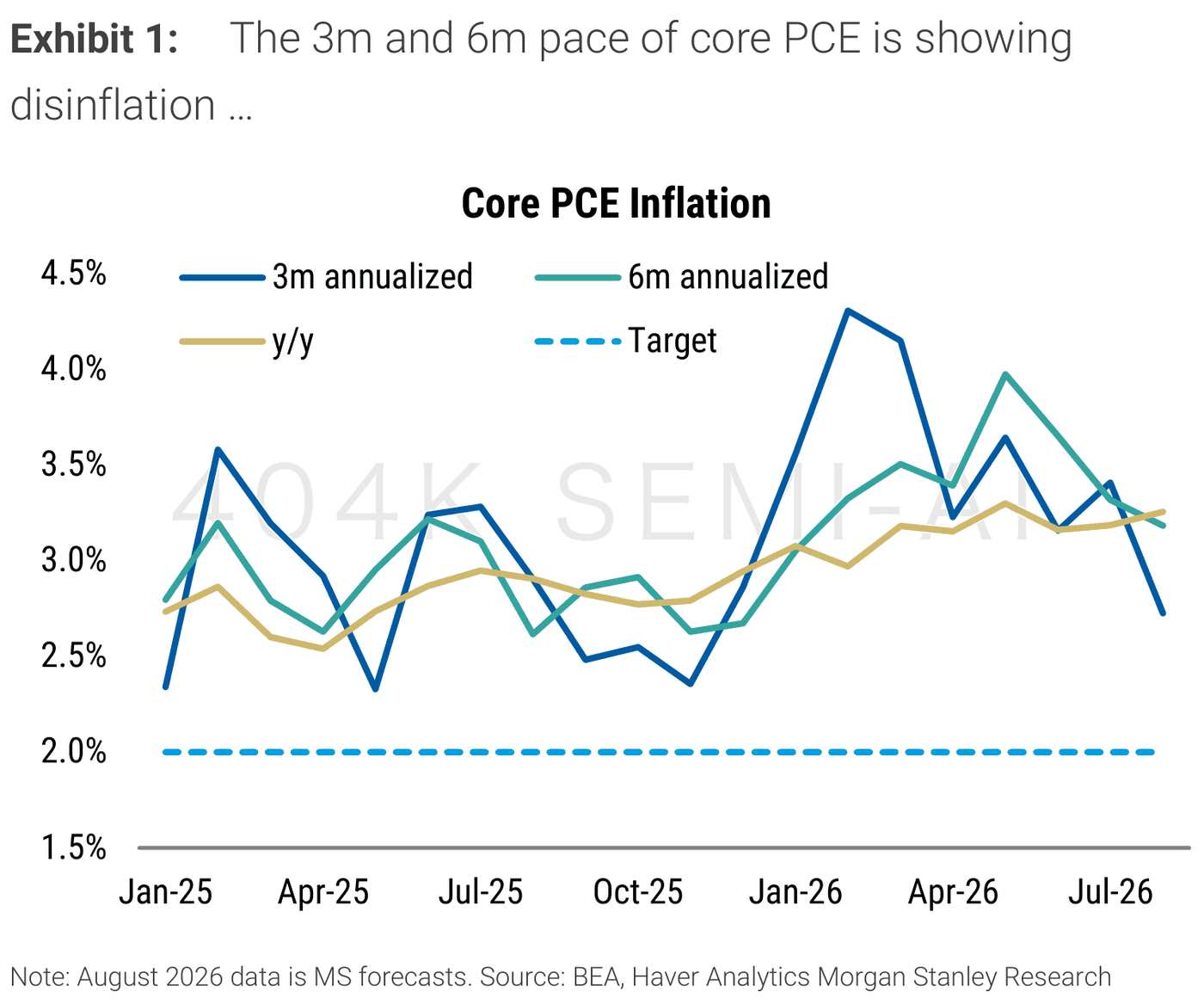
This means “sticky inflation” here mainly refers to a return to normal taking too long. Interpreting it as a broad reacceleration of inflation overstates what the current data support. The Fed’s 2% target corresponds to headline PCE over the longer run; core PCE and short-term annualized measures are tools for gauging the trend, not mechanical triggers that alone determine a given meeting’s action.
