
Samsung Electronics Deep Update: 64GB DDR5 RDIMM, a KRW 530,000 Target Price, and HBM Qualification: How Much Longer Can Breadth in Memory Assets Be Re-Rated?
目录
Too Long; Didn’t Read
I. What Is Actually New in This Citi Update?
II. Samsung’s Own Official Messaging Has Already Made the Direction Clear
3. Why 64GB DDR5 RDIMM Has Become the New Valuation Anchor
4. NAND and SSD Are the Most Easily Underestimated Second Curve This Time
5. Where the KRW 530,000 Target Price Comes From
VI. How Samsung Compares with SK Hynix, Micron, and SanDisk
VII. From Old Asset to New Asset: What Exactly Is Being Repriced in Samsung
VIII. Why the Balance Sheet Matters: High Profit Must Be Retained
IX. Three Worldviews: Is KRW 530,000 Conservative, Base Case, or Bullish?
X. How This Update Relates to the Prior Samsung Deep Dive
XI. HBM Qualification Remains the Key to the Valuation Multiple
XII. Capex: One Step Between Moat and Risk
XIII. Second-Quarter Results: The Most Important Near-Term Reality Check
XIV. The Bear Case: Why the KRW 530,000 Target Price Could Still Be Wrong
XV. Investment Dashboard for the Next Four Quarters
XVI. Conclusion: Samsung’s Update Validates the Continued Case for “Memory Breadth”
References
本内容基于公开资料和研报数据整理,不构成任何投资建议,不代表任何个人观点,仅供学习参考,请理性阅读
Citi raised its target price for Samsung Electronics to KRW 530,000. The core debate has shifted from HBM catch-up alone to whether 64GB DDR5 RDIMM, SSD, and NAND pricing can turn cyclical profits into AI server profits; the sustainability of the valuation will need to be tested by HBM qualification and capex discipline.
Too Long; Didn’t Read
The core of this Samsung update is that server DRAM has become the profit anchor again. Citi raised its 4Q26 price assumption for 64GB DDR5 RDIMM to US$1,805 and lifted its 2026 global DRAM ASP growth forecast to 234%; this means Samsung’s near-term earnings leverage is not coming only from HBM. Standard server memory is also being repriced by AI CPU demand.
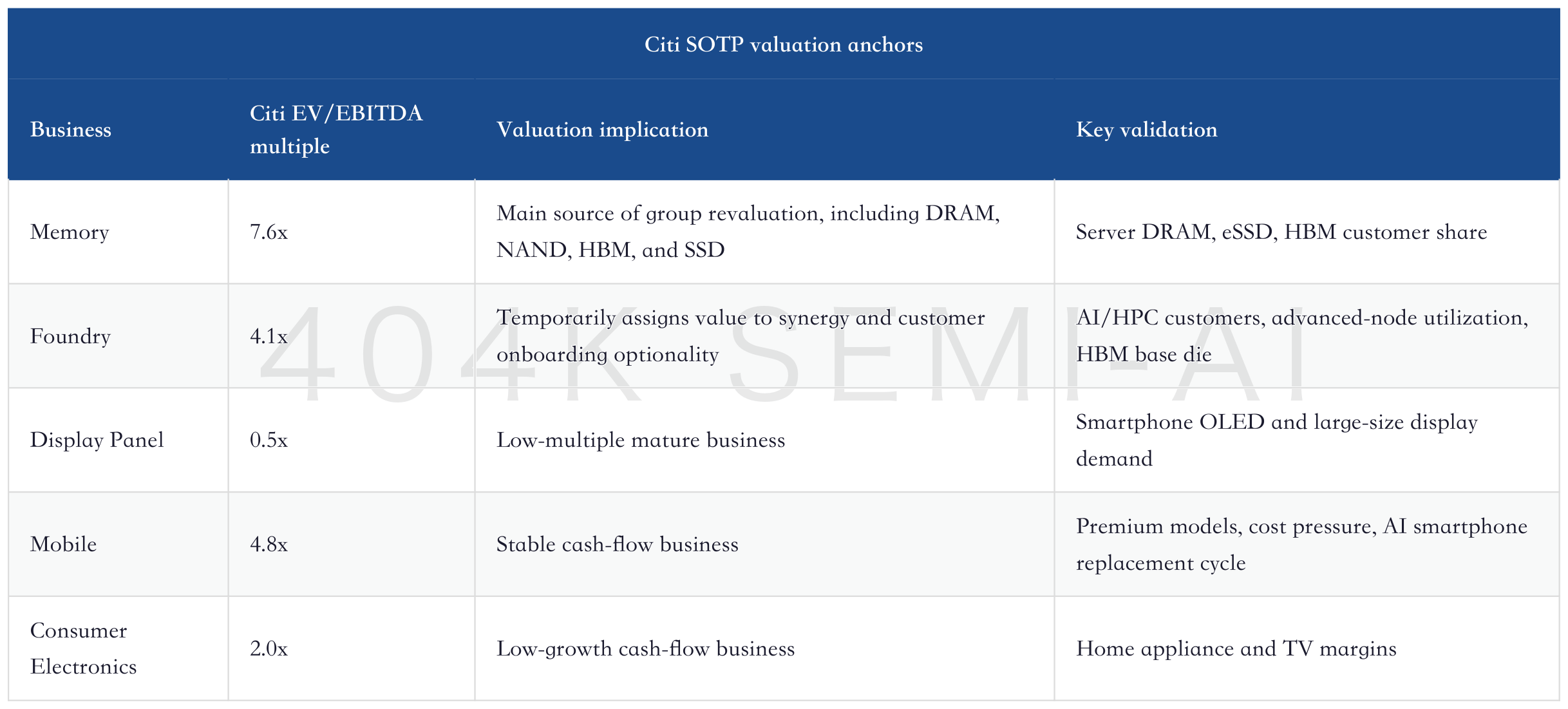
The target price increase to KRW 530,000 is essentially about putting part of the cyclical profit into SOTP upfront. Citi values the segments on 2026 EBITDA, assigns the memory business 7.6x EV/EBITDA, and raises its 2026/2027 operating profit forecasts to KRW 401tr/KRW 517tr. Whether the valuation holds depends on how much of these profits can move from price-cycle highs into AI product profits and customer supply-lock profits.
Samsung’s differentiation remains “breadth,” not single-point purity. SK hynix is more concentrated on the HBM quality premium, SanDisk is more concentrated on NAND leverage, while Samsung covers DRAM, HBM, NAND/eSSD, SOCAMM2, PCIe Gen6 eSSD, and foundry synergies at the same time. Breadth improves fault tolerance, but also requires more validation points to be delivered simultaneously.
The NAND and SSD line can no longer be treated as a consumer-electronics cycle. Citi raised its 2026 NAND ASP growth forecast to 236% and expects SSD prices to rise 330% YoY. Samsung has also officially identified PCIe Gen6 eSSD and KV cache as AI storage priorities, turning NAND from a “weak-cycle catch-up” asset into a second profit curve for inference servers.
The most important disconfirming points remain HBM qualification and capex discipline. If qualification at key HBM customers is delayed, server DRAM contract prices start to cool, eSSD orders are not continuous, or long-term investment first turns into ordinary supply, Samsung will again be discounted by the market as a cyclical stock. The KRW 530,000 target price is not unconditional upside; it is the outcome after validation.
The follow-up validation window has narrowed to two quarters. Four numbers matter next: 2Q26 operating profit, 64GB DDR5 RDIMM contract prices, SSD/eSSD orders, and HBM4/HBM4E customer feedback. These four numbers correspond to near-term profits, system-memory pricing power, NAND’s second curve, and valuation multiple repair. If even two of them fall behind, Samsung’s “breadth asset” narrative will cool meaningfully.
I. What Is Actually New in This Citi Update?
The previous deep dive on Samsung Electronics already resolved the company-profile question: it is not simply a diversified electronics company, nor is it a weaker version of SK hynix. It is the company with the broadest coverage in the AI memory chain. The new variable in this Citi report is that Samsung’s near-term profit anchor has been expanded further from “HBM catch-up” to “server DRAM and SSD ASPs continuing to beat expectations.”
This point is critical. In the past, when the market looked at Samsung, the first question was often when its HBM would catch up with SK hynix. That question remains important, but it narrows the Samsung story. What Citi is really emphasizing this time is 64GB DDR5 RDIMM, or mainstream server DRAM. If this price anchor continues to rise, Samsung’s earnings leverage will enter the financial statements faster than simply waiting for HBM qualification.
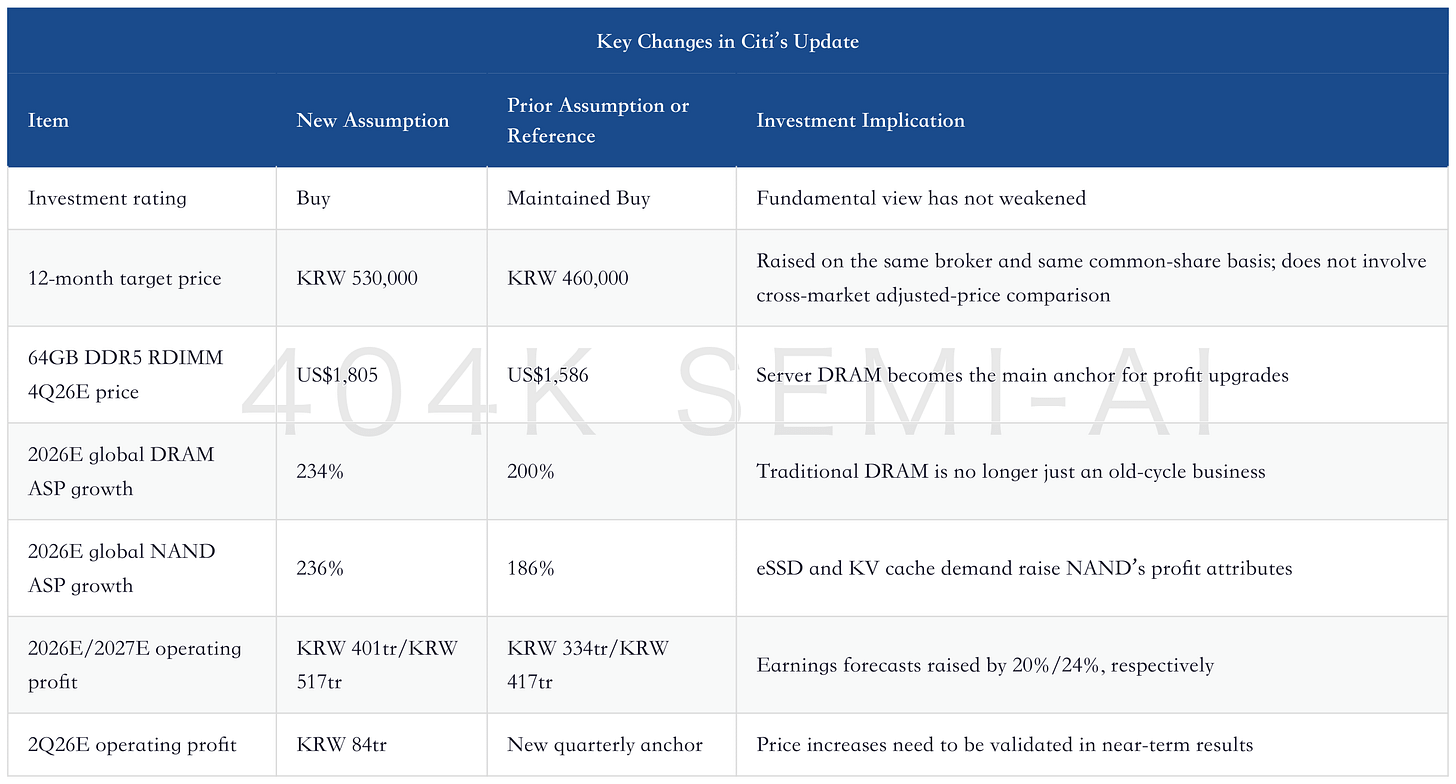
In its July 2 report, Citi maintained its Buy rating and raised its 12-month target price from KRW 460,000 to KRW 530,000. The upgrade was not simply because the stock had become cheaper after a pullback, but because three assumptions changed together: higher 64GB DDR5 RDIMM prices, higher full-year DRAM/NAND ASPs, and higher 2026/2027 operating profit forecasts. The report also treats the recent pullback triggered by concerns over Meta capex as a technical correction, with the core judgment that memory fundamentals have not been damaged.
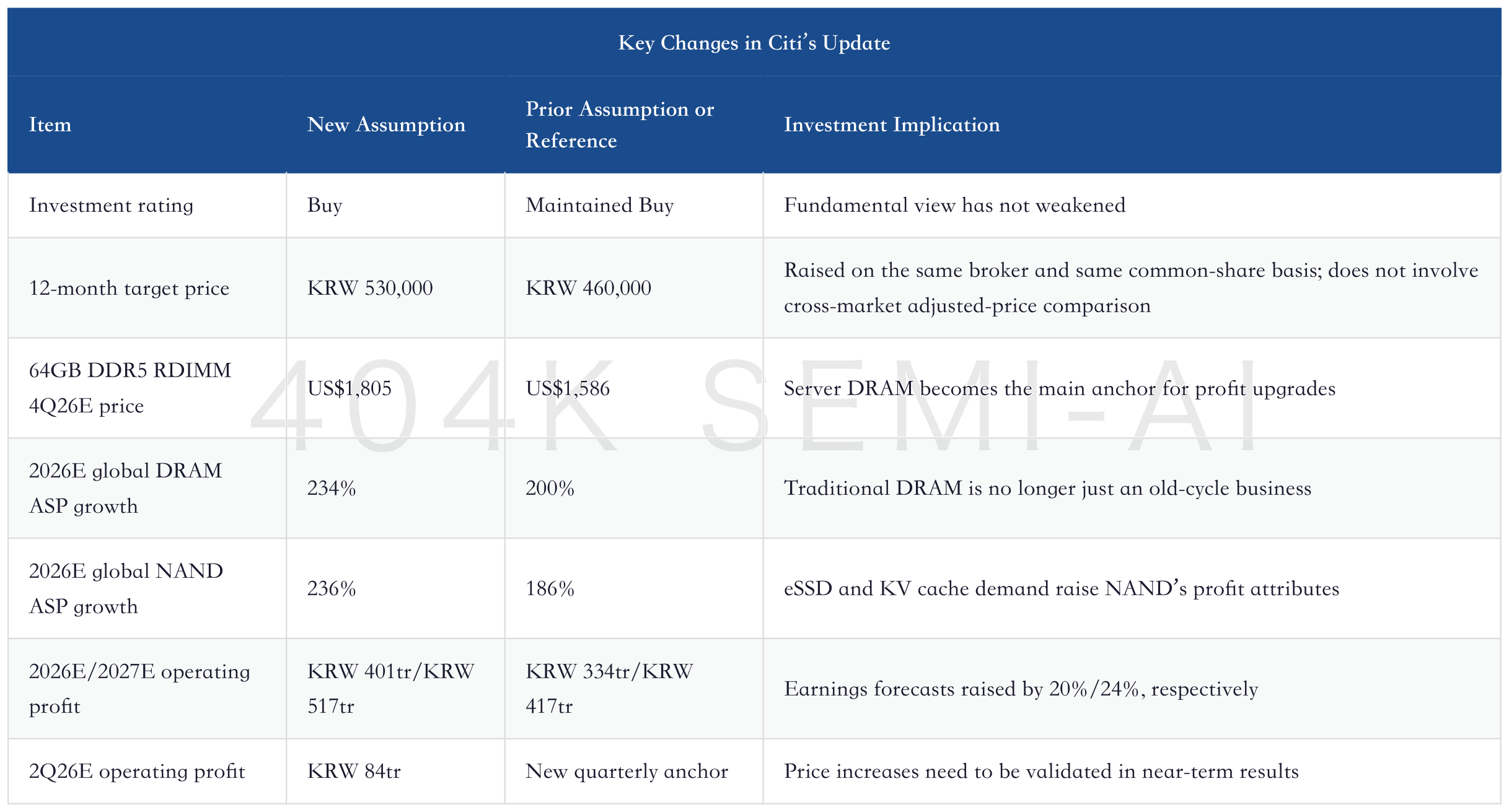
This table compresses the main thread of the update clearly: Samsung is no longer just about “whether HBM can repair the discount,” but about “whether server DRAM and SSD price increases can first push up the income statement, before HBM and customer supply locks determine the multiple.”
Memory Is No Longer Just a Cyclical Stock: JPM LTA Breakdown, Agentic AI Memory Multipliers, and the Valuation Rewrite for Samsung and SK hynix
This is also consistent with the previous memory framework: the second phase of the AI memory trade is no longer just buying the HBM leader, but buying HBM spillover into system memory, enterprise SSDs, and long-term supply contracts. Samsung’s advantage is precisely that it is present across all these links.
II. Samsung’s Own Official Messaging Has Already Made the Direction Clear
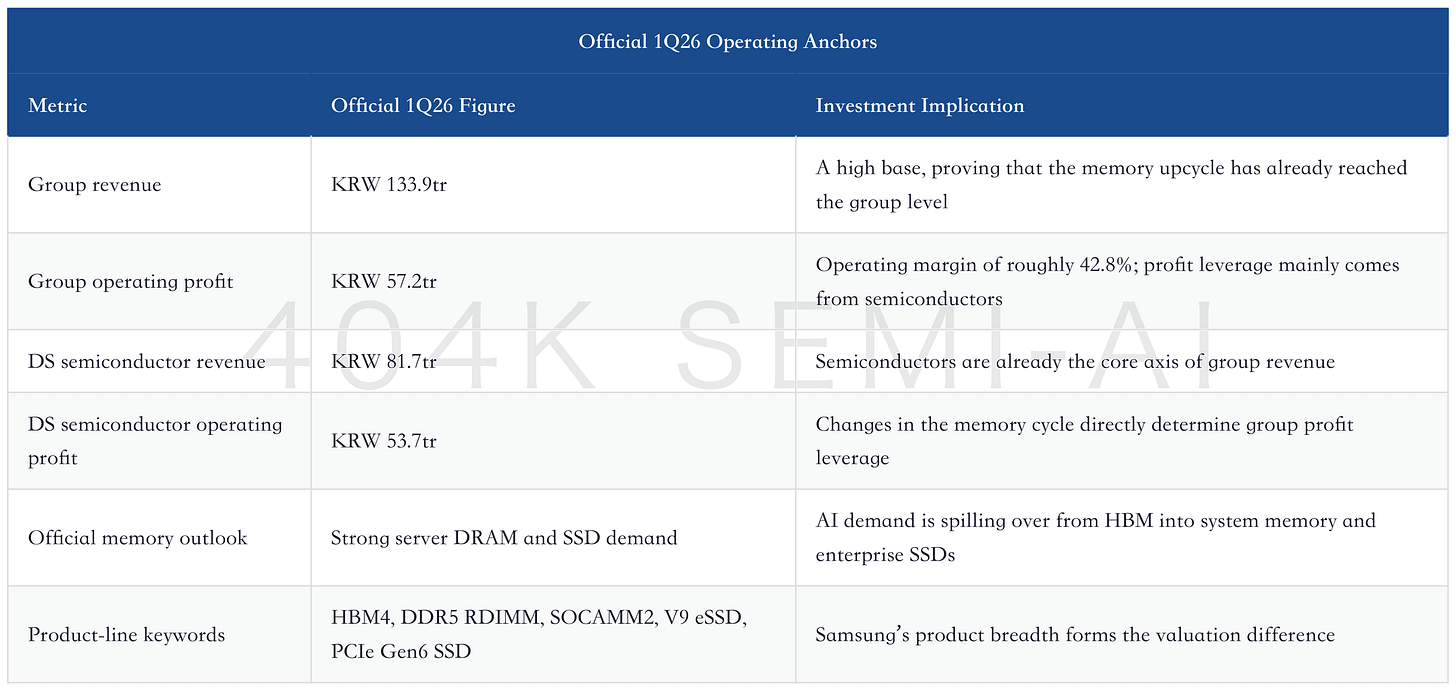
Citi’s upgrades are not an isolated judgment. Samsung’s official 1Q26 presentation already confirmed group revenue of KRW 133.9tr and operating profit of KRW 57.2tr in the quarter; the DS semiconductor division recorded revenue of KRW 81.7tr and operating profit of KRW 53.7tr. In other words, group profit is almost entirely driven by semiconductors. Smartphones, displays, and home appliances remain important, but they are not the primary driver of this re-rating cycle.
Samsung’s official commentary on the memory business is also direct: demand for server DRAM and SSDs remains strong, driven by hyperscale cloud providers’ AI service expansion, enterprise LLM adoption, and accelerating demand growth from Agentic AI. The company also emphasized increasing the share of high-value-added AI products such as DDR5 and SOCAMM2, and entering the PCIe Gen6 eSSD market with high-performance products for KV cache.
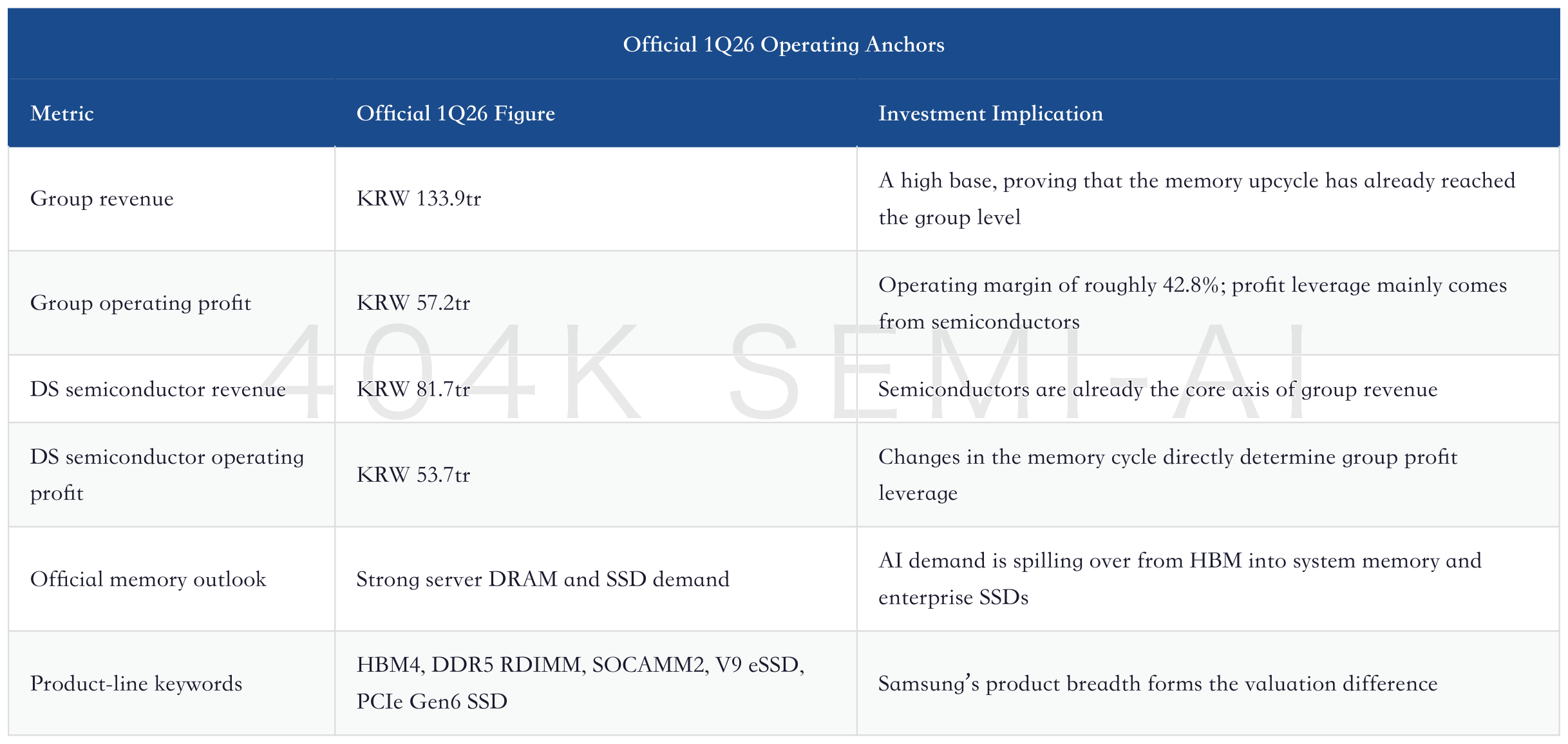
For investors, the significance of these numbers is that they first clarify what the company actually sells. Samsung still sells smartphones, screens, TVs, and home appliances, but this report does not need to frame it as a diversified electronics story. What deserves pricing now is its ability to sell three types of memory into AI servers at the same time: HBM on the training side, DDR5 RDIMM/SOCAMM2 on the CPU side, and enterprise SSDs on the inference side.
This is also why Citi focuses on 64GB DDR5 RDIMM. HBM is closest to GPUs and has the sharpest narrative; but system memory on the server CPU side is the larger, more durable, and more easily underestimated configuration change after the adoption of AI inference and Agentic AI. As cloud vendors shift more workloads from training to inference, servers do not only add GPUs; they also add CPU memory, cache layers, SSDs, and networking. Samsung does not need to be the purest name in every line. As long as these lines thicken at the same time, its breadth turns into profit.
3. Why 64GB DDR5 RDIMM Has Become the New Valuation Anchor
64GB DDR5 RDIMM looks less compelling than HBM, but it may be the most important price anchor to watch for Samsung over the next two quarters. There are three reasons.
First, AI CPU demand is lifting server memory configurations again. During the training phase, the market focused on GPUs and HBM. In the inference phase, the importance of CPUs, memory capacity, data caching, and retrieval chains is rising. Agentic AI will cause applications to call models, read context, and write intermediate states more frequently. Server memory is no longer just a traditional IT procurement item; it is infrastructure for AI service availability.
Second, HBM will crowd out advanced DRAM resources. The stronger HBM becomes, the tighter advanced DRAM wafer and packaging resources become, making ordinary server DRAM supply less likely to loosen. Investors used to view HBM and traditional DRAM separately. Now the logic should be reversed: HBM drains supply, AI CPUs increase demand, and server DRAM gains pricing power that differs from the old cycle.
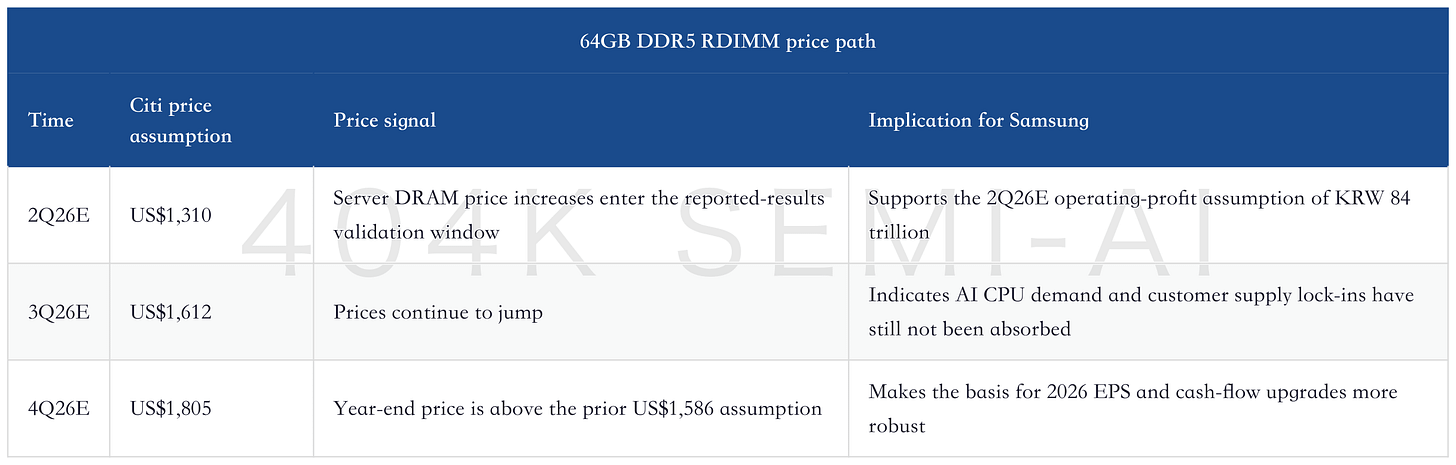
Third, server DRAM price pass-through is faster than many long-term frameworks assume. HBM is often priced annually or by customer project, so short-term upward revisions may not flow fully into reported numbers immediately. Server DRAM contract prices are updated quarterly, making price increases more likely to show up in 2Q, 3Q, and 4Q. Citi raised its 2Q/3Q/4Q26E global DRAM ASP QoQ growth estimates to 44%, 20%, and 13%, respectively. That pace explains why it is willing to forecast 2Q26E operating profit at KRW 84 trillion.
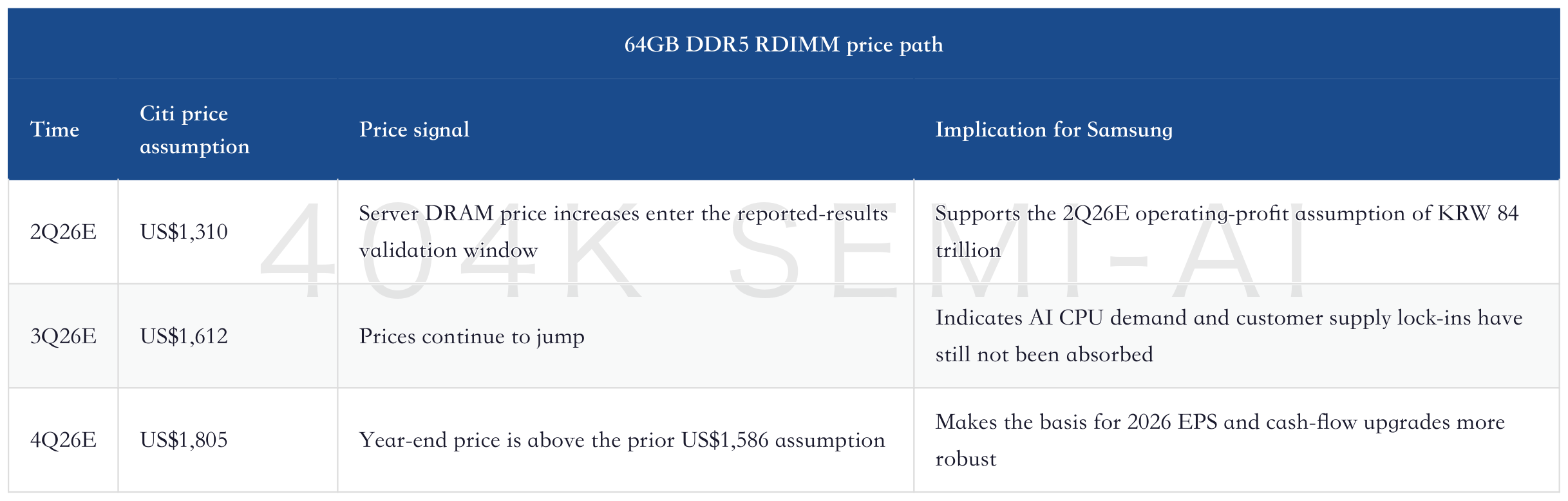
This table should not be read as a simple price list. The real focus is the slope: from 2Q to 4Q, Citi believes server DRAM prices can continue to rise. As long as that slope materializes, Samsung’s near-term earnings will have sufficiently strong reported support even before HBM qualification is fully completed.
Rubin Will Consume Smartphone Memory in 2027: Why Nvidia Is Taking Smartphone Memory — How Vera Rubin Rewrites DRAM Capacity Prioritization
This follows the same logic as the memory crowding-out effect created by the Rubin platform: advanced DRAM resources are being absorbed jointly by HBM, SOCAMM, and server memory, while consumer electronics memory can no longer assume natural priority access to capacity. If Samsung can supply HBM, SOCAMM2, and server RDIMM at the same time, it will be better positioned than single-category companies to capture the upside from “supply reallocation.”
4. NAND and SSD Are the Most Easily Underestimated Second Curve This Time
The market tends to treat Samsung’s NAND business as a supplementary segment, because past NAND price wars were painful and the business is more cyclical. But Citi has now raised its 2026 NAND ASP YoY growth estimate to 236%, while also expecting SSD prices to rise 330% YoY. This magnitude can no longer be explained solely by consumer electronics inventory restocking.
The key term here is KV cache. Large-model inference does not end once the GPU completes computation. The system needs to store context, retrieve vectors, read and write intermediate states, and move large volumes of data between memory and storage. In this setting, high-performance enterprise SSDs are not ordinary HDD replacements, but the cache and data layer in the AI inference chain. Samsung’s official 1Q26 presentation also explicitly placed PCIe Gen6 eSSD and KV cache within its memory outlook, cross-validating Citi’s upward revisions to NAND/SSD pricing.
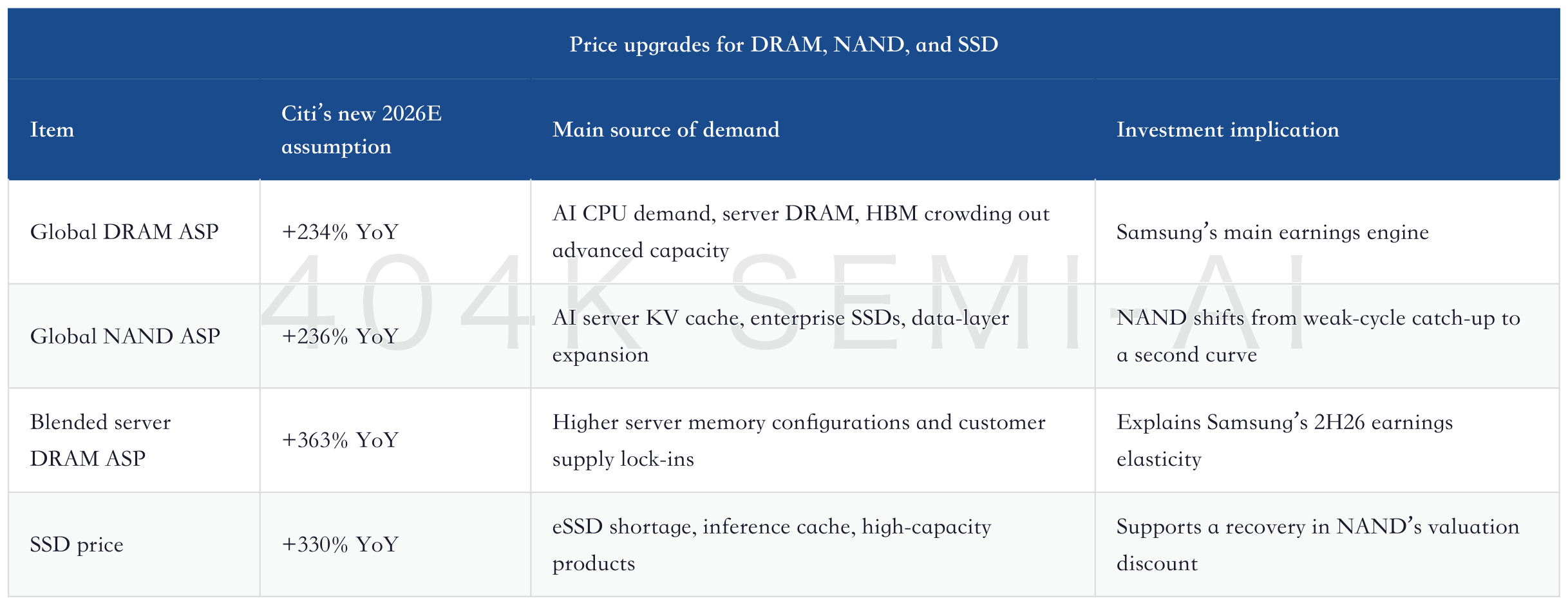
The key point in this table is that DRAM and NAND are strengthening simultaneously for the first time under the same AI server logic. In past memory upcycles, DRAM and NAND could be out of phase, and NAND was often seen as a drag. Now, if AI inference turns enterprise SSDs into a critical resource, the valuation implication of NAND will change.
Samsung has an advantage over pure-play DRAM companies on this point. It does not need to prove that NAND will become a high-multiple asset like HBM. It only needs to prove that eSSD profits are not a one-off inventory restocking cycle, and the market will reduce the drag NAND applies to the group’s valuation. Especially when DRAM profits are already high, the NAND second curve can broaden group earnings and prevent investors from concentrating the entire bet on HBM qualification.
AI Drives an Industry-Wide Revaluation of Storage: Who Has the Most Pricing Power Across DRAM, NAND, SSD, and HDD, as Samsung, SK Hynix, SanDisk, Western Digital, and Seagate Results Cross-Validate One Another
From an industry-wide perspective, the revaluation of NAND/eSSD marks the spread of the storage trade from the “training bottleneck” to the “inference data layer.” Samsung is one of the few companies spanning HBM, server DRAM, and enterprise SSDs at the same time. That is where its breadth shows up.
5. Where the KRW 530,000 Target Price Comes From
Citi’s KRW 530,000 target price comes from SOTP, or sum-of-the-parts valuation. This method is more suitable for Samsung than a single P/E multiple, because the group includes both high-elasticity memory and lower-multiple consumer electronics and display businesses. The real question is not the multiple itself, but whether memory profits can be classified into a higher-quality earnings pool.
The key to SOTP is not filling in multiples, but judging the nature of the profits. If the memory business is only at a price peak, 7.6x may already be not low. If part of the profit comes from AI products, customer supply lock-ins, and more durable server memory configurations, then 7.6x may still be conservative. Whether the target price holds depends on how much profit the market is willing to move from “peak-price profit” to “capitalizable profit.”
If one only looks at forward P/E, Samsung appears exceptionally cheap. But low P/E multiples in memory stocks often occur at earnings peaks, so a low multiple cannot be treated directly as a margin of safety. The more robust approach is to break earnings forecasts into a table and then judge which profits can survive the cycle.
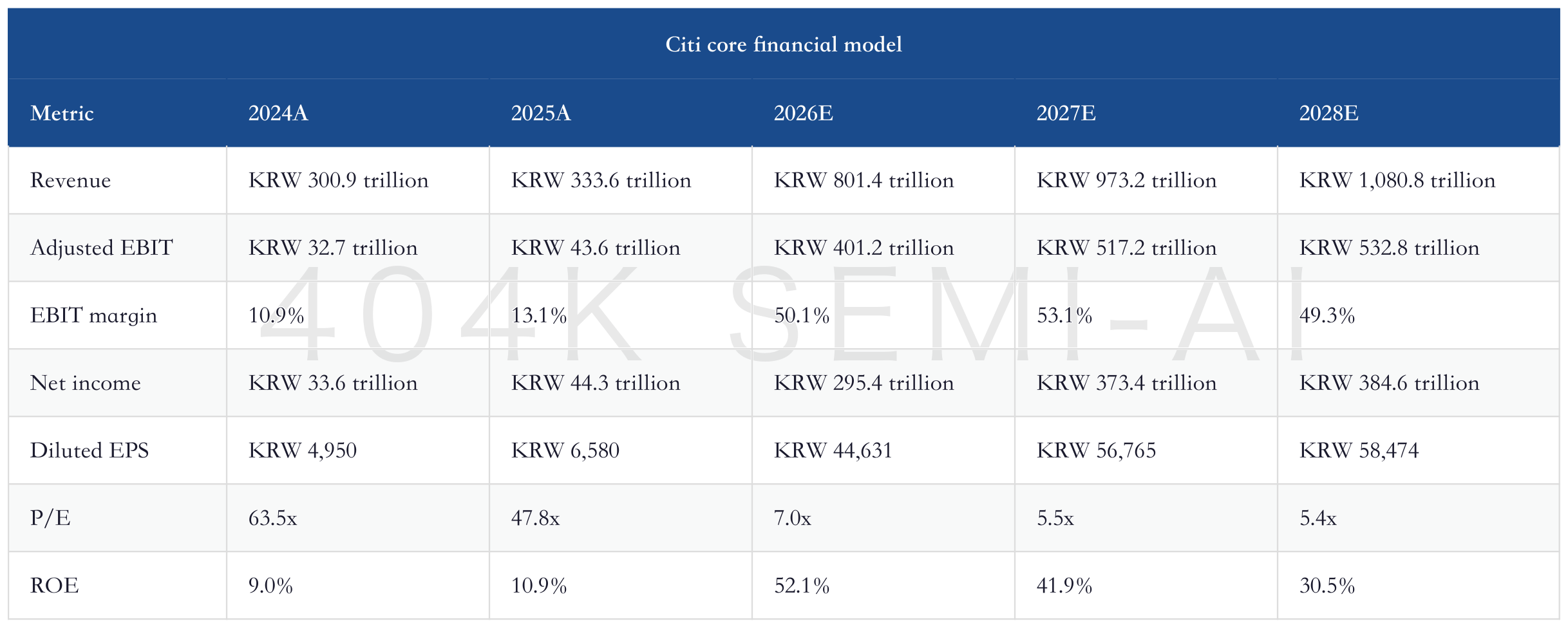
This table is attractive, and also dangerous. It is attractive because the income-statement slope is very steep, and the 2026/2027 P/E is indeed very low. It is dangerous because memory margins enter an extremely high range after 2026, and the market will certainly question sustainability. In other words, the Samsung trade is not “7x P/E is cheap,” but rather “which profits can the market capitalize at a multiple above that of a cyclical stock.”
My judgment is that Samsung’s profits should be divided into three categories.
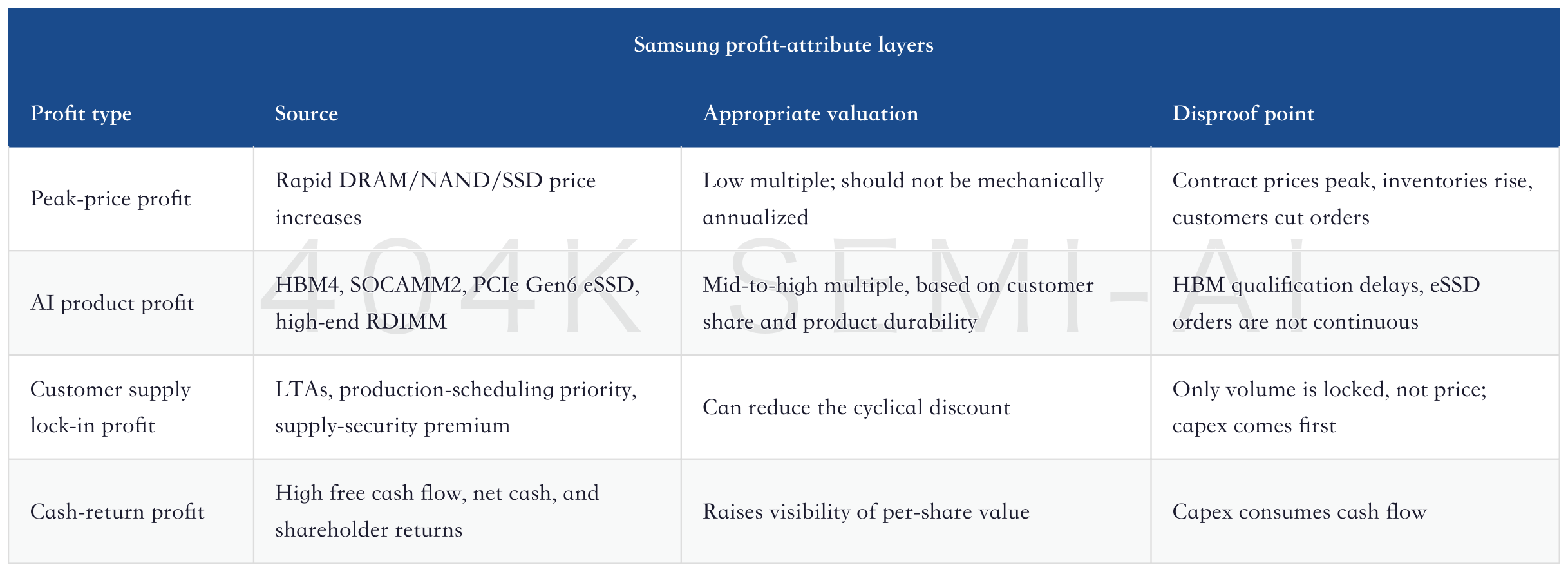
This table is more important than a single target price. Citi’s KRW 530,000 target reflects the valuation impact of near-term earnings upgrades first. Whether the share price can be revised up further depends on whether the second and third categories of profit can be confirmed. If only the first category remains, a low P/E will not protect the share price. If the second and third categories continue to materialize, Samsung will move from a strong cyclical trade into an asset-quality revaluation.
VI. How Samsung Compares with SK Hynix, Micron, and SanDisk
This memory cycle has moved beyond single-point price increases into a re-segmentation of company attributes. Samsung’s position cannot be ranked only by HBM share, nor only by NAND torque. Its investment value comes from breadth, but breadth is valuable only when multiple lines deliver at the same time.
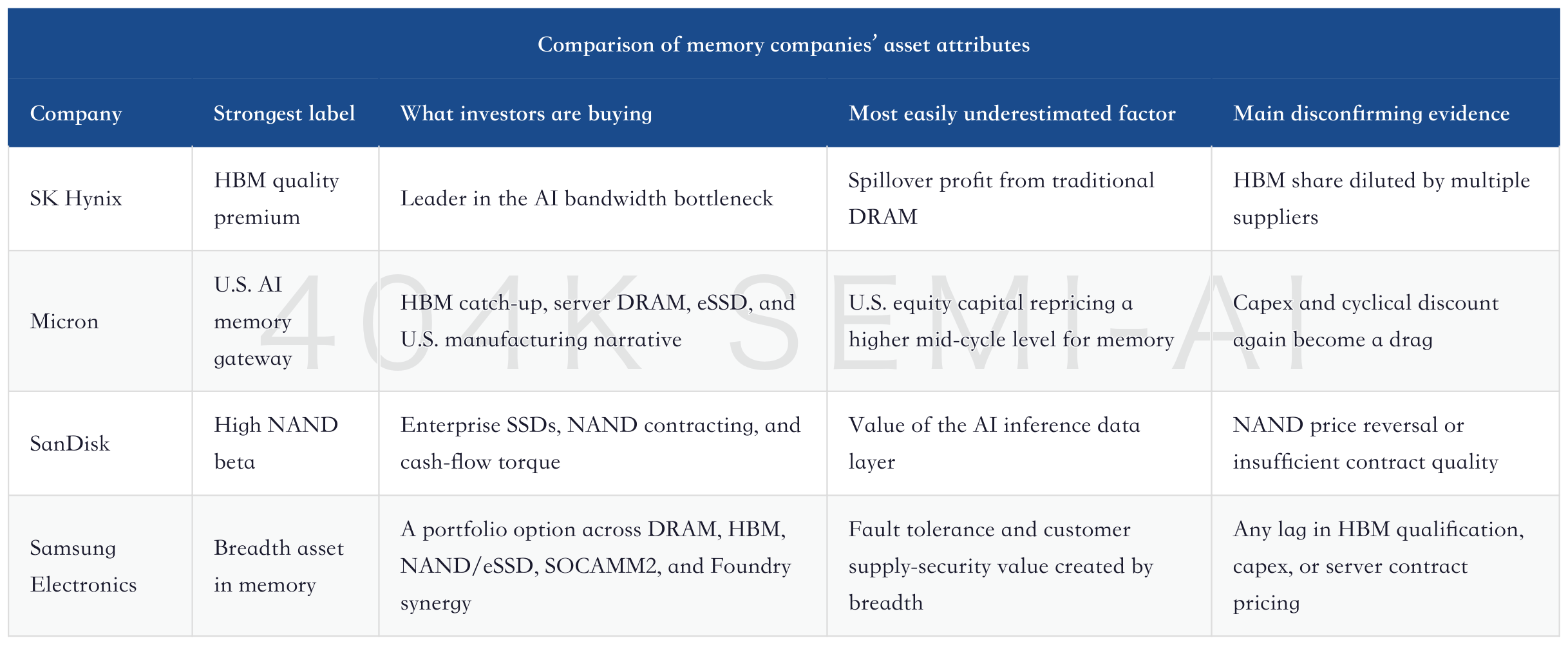
This table shows that Samsung cannot be simply categorized as “slightly worse than Hynix.” Hynix is sharper; Samsung is broader. Micron is more easily repriced by U.S. equity capital, while Samsung’s discount repair requires both customer qualification and Korean market liquidity. SanDisk’s NAND torque is purer; Samsung’s NAND is only the second curve within a broader portfolio.
Korea Tech Deep Dive: How HBM, MLCC, FC-BGA, TCB, and Enterprise AI Are Being Revalued Under the AI Compute and Memory Supercycle
The best positioning for Samsung is as an “AI memory breadth asset.” It does not need to be number one in every category, but it must prove it is not absent from any key category. HBM4/HBM4E determines whether it can repair its past discount; DDR5 RDIMM and SOCAMM2 determine whether it can capture AI CPU demand; PCIe Gen6 eSSD and KV cache determine whether NAND has a second curve; Foundry and base dies determine whether it has a higher-level synergy option; cash flow and shareholder returns determine whether high profit ultimately becomes per-share value.
This is also why Samsung is more complex than a pure cyclical stock. For a pure cyclical, the key judgment is price; for Samsung, the sequence of price, product, customer, capex, and cash returns must all be judged. The best sequence is: customers first lock supply, products then get validated, prices continue to be revised up, capex follows customer orders, and cash finally returns to shareholders. The worst sequence is: capex rises first, HBM qualification is slow, LTAs lock volume but not price, and supply starts to release after prices peak.
VII. From Old Asset to New Asset: What Exactly Is Being Repriced in Samsung
The valuation challenge for Samsung is that it previously carried three labels at the same time: a conglomerate electronics discount, a strong memory-cycle discount, and an HBM execution discount. The conglomerate electronics discount comes from business complexity: smartphones, displays, home appliances, and semiconductors all sit within one group, making it hard for investors to value the strongest business independently. The strong memory-cycle discount comes from profit volatility: P/E is lowest when prices are highest, and the market is naturally reluctant to annualize peak profits. The HBM execution discount comes from lagging customer qualifications and share in past cycles, which has made Samsung a less clean AI memory asset than Hynix for a long time.
The significance of Citi’s latest update is that it does not directly claim all three discounts have disappeared. Instead, it offers a more realistic revaluation path: first let server DRAM and SSD generate the profit, then use HBM qualification and customer supply locks to repair the multiple. This path is more tradable than “waiting for Samsung to fully overtake in HBM,” and it better fits the company’s own breadth.
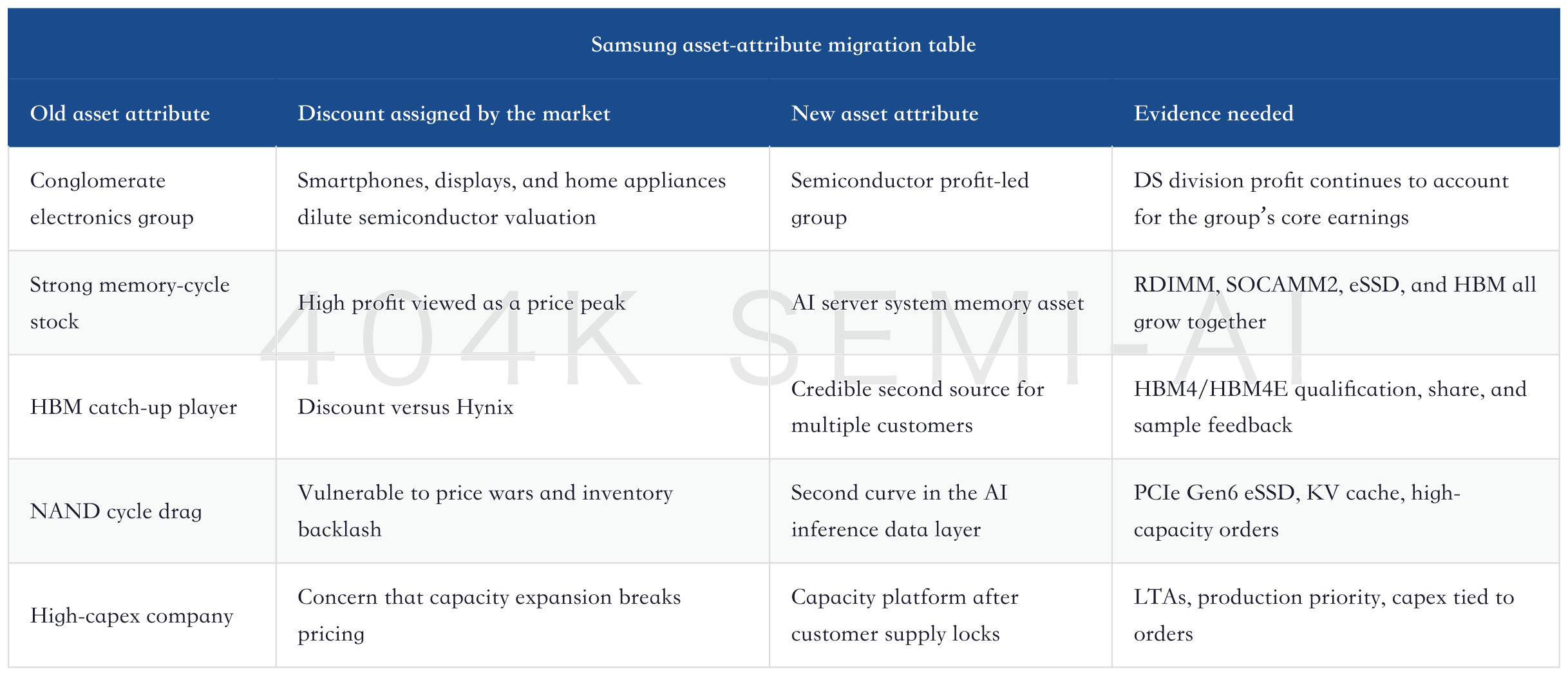
This table explains why the same price increases cannot be viewed through only the old cyclical framework this time. In the old cyclical framework, the faster prices rise, the more investors worry about a cycle peak. In the new asset framework, price increases are only the first step; the next question is whether customers are willing to lock Samsung supply through longer contracts, higher-spec products, and stricter production-allocation terms.
If Samsung completes only the first step, it is a very strong cyclical stock. Strong cyclical stocks can also rise a lot, but what rises is earnings forecasts and risk appetite. Only when the second and third steps happen together can it move from “earnings upgrades” into a “valuation identity change.” This is also why I do not simply interpret this Citi report as a target-price increase, but as the latest evidence of Samsung’s asset-attribute migration.
Samsung’s corporate characteristics also mean it is better described by “migration” rather than “reversal.” Hynix’s narrative is more like a reversal in quality premium, Micron’s more like the diffusion of U.S. AI hardware, and SanDisk’s more like a reversal in NAND profit torque. Samsung is not a single-point reversal. It is the gradual removal of discounts attached to multiple old labels: the conglomerate electronics discount is removed by DS profit contribution, the cyclical discount by server DRAM and eSSD, the HBM discount by customer qualification, and the capex discount by customer supply locks.
VIII. Why the Balance Sheet Matters: High Profit Must Be Retained
One point the market most easily overlooks in memory stocks is that a strong income statement is not the same as strong shareholder value. A truly good cycle must satisfy three conditions at the same time: high margins, controlled capex, and cash retention. Samsung’s official reviewed first-quarter financial statements provide a base anchor: as of March 31, 2026, the company had cash and cash equivalents of about KRW 73.3 trillion, inventories of about KRW 58.3 trillion, property, plant and equipment of about KRW 217.8 trillion, total assets of about KRW 633.3 trillion, and equity of about KRW 486.6 trillion.
These numbers do not directly produce an investment conclusion, but they remind investors that Samsung is not an asset-light AI company. It is an extremely asset-heavy memory and manufacturing platform. It can generate astonishing operating cash flow in an upcycle, but in a wrong capacity expansion it can also quickly turn cash flow into depreciation and inventory. In Citi’s model, free cash flow to shareholders in 2026/2027 is about KRW 227.8 trillion/342.4 trillion, respectively. Whether the market can capitalize this number depends on whether it becomes shareholder returns, net cash, and high-end capacity, or becomes the next round of ordinary supply.
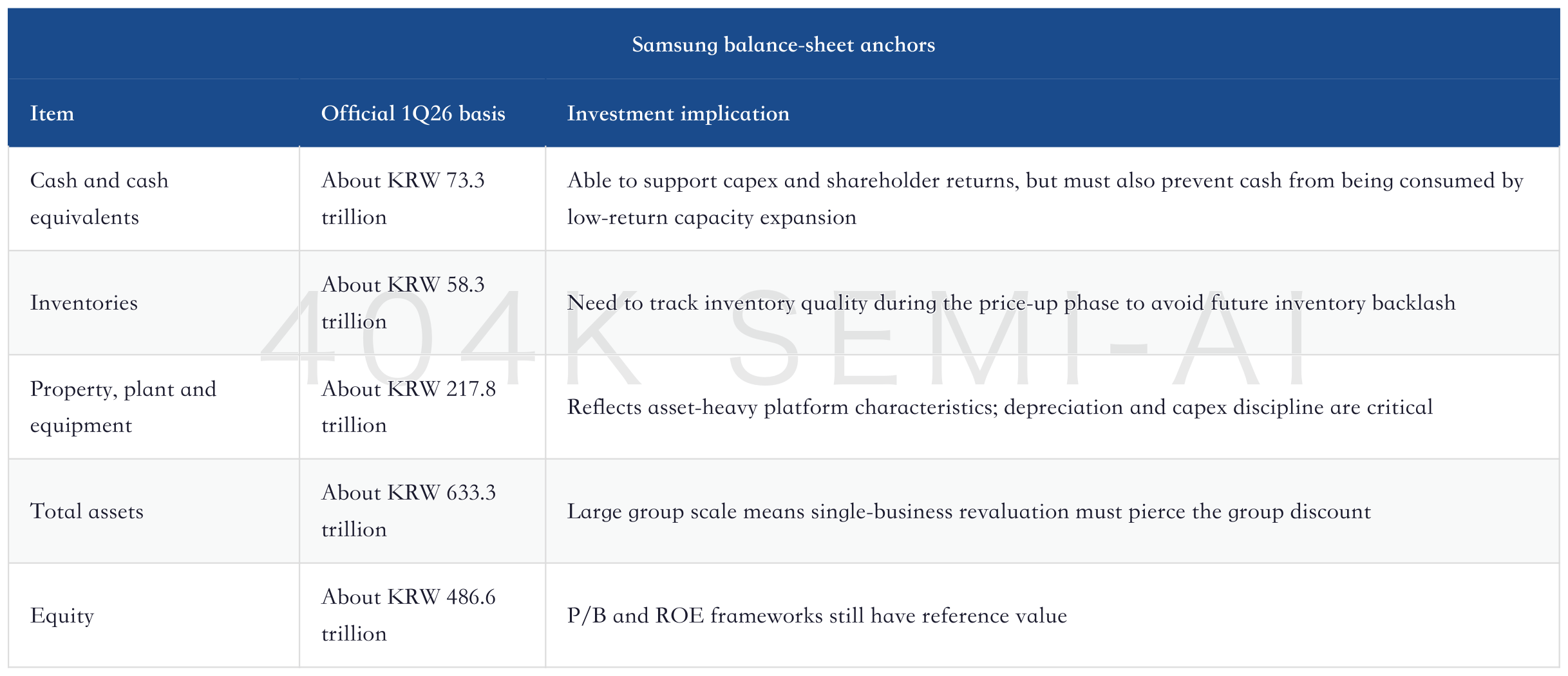
This table should be read together with Citi’s ROE forecast. Citi expects Samsung’s ROE to jump from 10.9% in 2025 to 52.1% in 2026, and remain at 41.9% in 2027. If this ROE is only a price peak, the market will not assign a high multiple. If it corresponds to a higher mix of AI products, tougher contracts, and stronger cash returns, Samsung can qualify to move out of the ordinary memory-cycle stock category.
Cash flow has another function: it affects the market’s tolerance for capex. When high profit, high cash, and strong customer supply locks coexist, investors are willing to accept Samsung’s investment in HBM, SOCAMM2, eSSD, and advanced nodes. When high profit, high capex, and insufficiently firm contracts coexist, investors will immediately worry about supply backlash after 2028. Samsung is not unable to invest; it must prove that every key investment corresponds to higher-quality customer demand.
IX. Three Worldviews: Is KRW 530,000 Conservative, Base Case, or Bullish?
Citi assigns a KRW 530,000 target price, but that target means very different things under different worldviews. In a strong-cycle worldview, it is a peak target after earnings upgrades. In a discount-repair worldview, it is a reasonable target after both HBM and server DRAM are validated. In a breadth-asset worldview, it may only be an interim target, because the market has not yet fully capitalized Samsung’s eSSD, SOCAMM2, Foundry synergies, and cash returns.
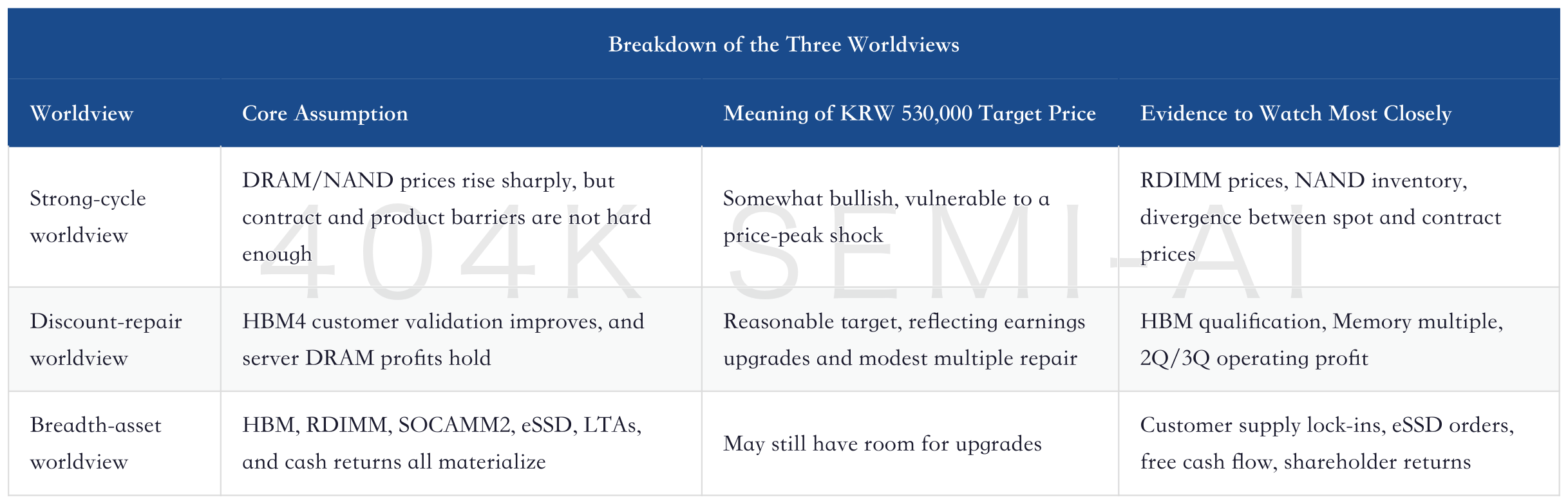
The difference among these three worldviews is not whether one is bullish on AI demand. All three acknowledge strong AI demand. The difference is whether the market is willing to extend AI demand from near-term pricing into product mix, contract quality, and asset attributes. The strong-cycle worldview looks at price. The discount-repair worldview looks at HBM. The breadth-asset worldview looks at whether Samsung can turn multiple product lines into part of customers’ supply security.
I am more inclined to place Samsung today in a “transition from discount repair toward breadth asset” position. The reason is that server DRAM and NAND/eSSD have already been materially upgraded in Citi’s model, and official commentary also confirms that server DRAM, SSD, HBM4, and SOCAMM2 all sit on the same AI memory line. But HBM qualification, LTA firmness, capex sequencing, and cash returns are not yet sufficient to treat Samsung directly as a long-duration breadth asset.
This judgment makes trading discipline clearer. At the current stage, an earnings-upgrade trade is acceptable, but one cannot annualize 2026 earnings unconditionally. As long as server DRAM prices continue to rise along Citi’s path, Samsung still has near-term earnings leverage. As long as HBM4/HBM4E customer feedback improves, the valuation multiple still has room to repair. Only when eSSD orders and customer supply lock-ins become more binding will the breadth-asset thesis truly hold.
X. How This Update Relates to the Prior Samsung Deep Dive
The core conclusion of the prior Samsung deep dive was that Samsung is not a weakened version of SK hynix, but a full-category memory breadth asset. This update does not overturn that earlier conclusion. Instead, it gives it a harder near-term financial handle.
The prior view emphasized four lines: DRAM repricing, HBM4 catch-up, NAND/eSSD reversal, and capex discipline. What Citi adds this time is the slope of price and earnings forecasts: the 4Q price assumption for 64GB DDR5 RDIMM is revised upward, 2026 DRAM/NAND ASP growth is revised upward, 2026/2027 operating profit is revised upward, and the target price is raised to KRW 530,000. In other words, the prior deep dive explained “why Samsung deserves to be reframed”; this update explains “how that framework is starting to be validated by new forecast numbers.”
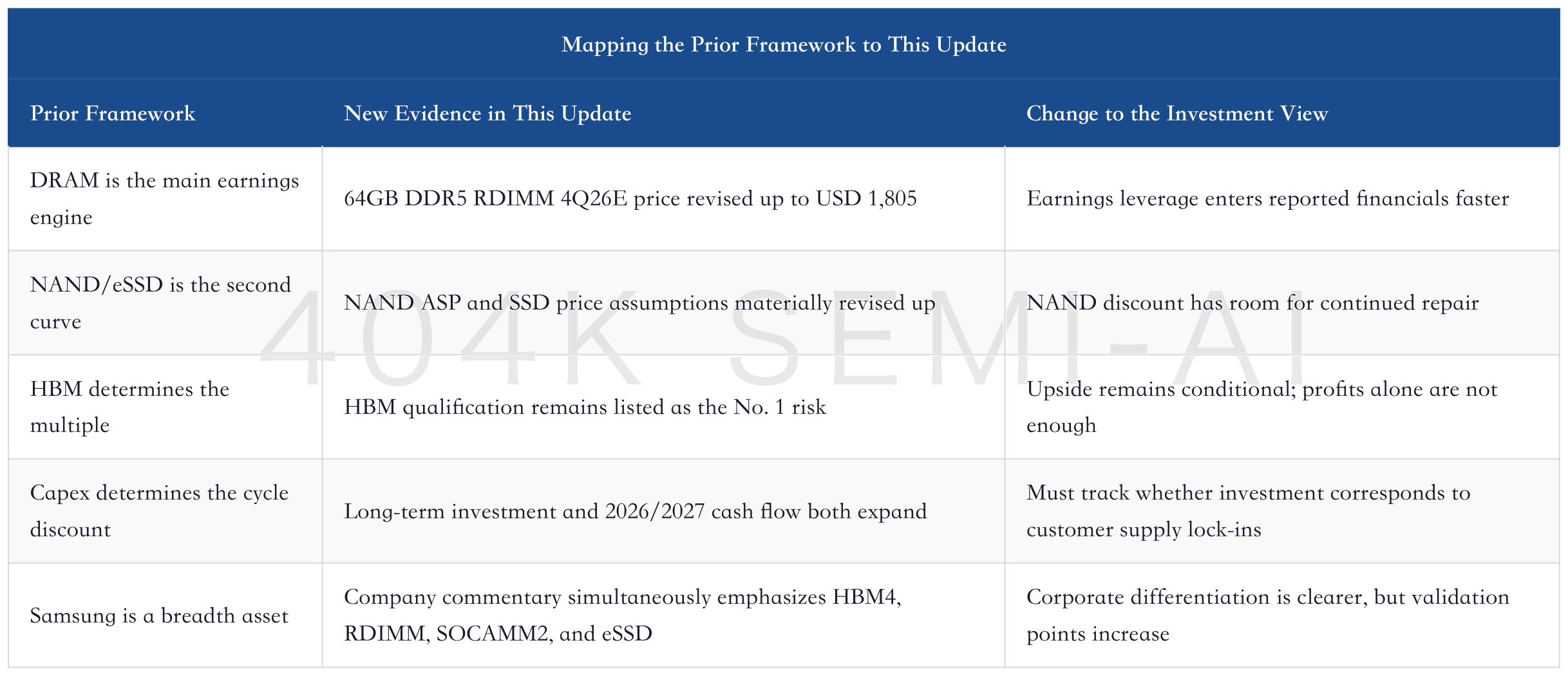
This is also why this article does not repeat Samsung’s full corporate history or expand on every business. The most important task of the update is to connect the new report with the prior framework: Citi’s new forecasts make the near-term earnings handle very clear, but whether Samsung moves from discount repair into breadth asset still depends on validation over the next two quarters.
XI. HBM Qualification Remains the Key to the Valuation Multiple
Citi’s report brings server DRAM and SSD to the front of the stage, but HBM remains the key to whether Samsung’s valuation multiple can move higher. The reason is simple: the market already knows traditional DRAM and NAND prices are strong. What really determines whether Samsung can escape its discount is whether key customers treat it as a reliable source of supply.
Samsung has already emphasized HBM4, SOCAMM2, and products related to Nvidia’s Vera Rubin platform in its 1Q26 presentation, and also mentioned that in H2 it will continue executing an AI product sales strategy around new GPU/CPU demand. This gives the market a positive signal. But Citi still lists “delayed HBM shipment approval for key customers” as the first risk item. Viewed together, the conclusion is: the direction is very strong, but validation is not yet complete.
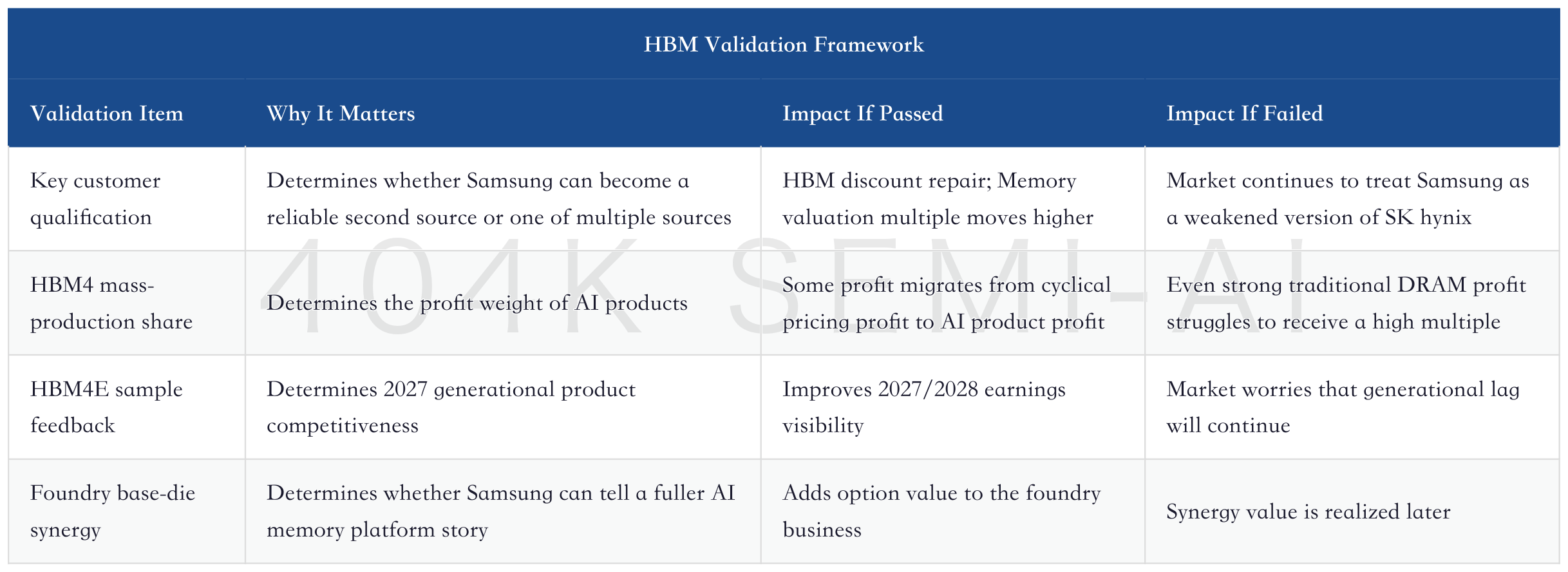
HBM is not the only source of profit, but it is the source of the multiple. Citi’s sharp upgrades to 2026/2027 operating profit are mainly driven by DRAM/NAND and SSD pricing. But if HBM qualification does not deliver sustained positive feedback, the market will treat most of those profits as pricing profits. Conversely, if HBM4/HBM4E continue to pass key customer validation, Samsung can reclassify part of its memory profit as AI product profit.
Goldman Sachs DRAM Deep-Dive Update: DDR5 Price Increases, 2027 HBM Repricing, and Samsung’s KRW 2,450 Trillion Investment
Goldman Sachs’ earlier framework on DRAM, HBM repricing, and Samsung’s long-term investment can corroborate this Citi report: DRAM provides profit, HBM provides the multiple, and long-term investment provides either supply security or supply backlash. The difference between the two depends on customer orders and capex sequencing.
XII. Capex: One Step Between Moat and Risk
Samsung’s long-term investment scale is large, and the market can easily interpret it as supply risk. But during an AI memory shortage, simply saying “less investment is better” is not accurate. The real judgment is where capex goes, whether there are customer lock-in orders, and whether commodity capacity will be released too quickly.
If capex goes into HBM, advanced DRAM, SOCAMM2, eSSD, high-end packaging, and capacity already locked in by customers, it is a moat. Customers’ willingness to lock supply in advance means they are buying not low prices, but availability and delivery certainty. Samsung’s breadth becomes strategic value here.
If capex turns too early into commodity DRAM or commodity NAND supply, it becomes the backlash in the next cycle. The most dangerous moment in memory is often not when prices are low, but when prices are high enough for everyone to believe the shortage will not end. The larger Samsung’s long-term investment becomes, the more it needs contracts and customer structure to prove it is not blind capacity expansion.
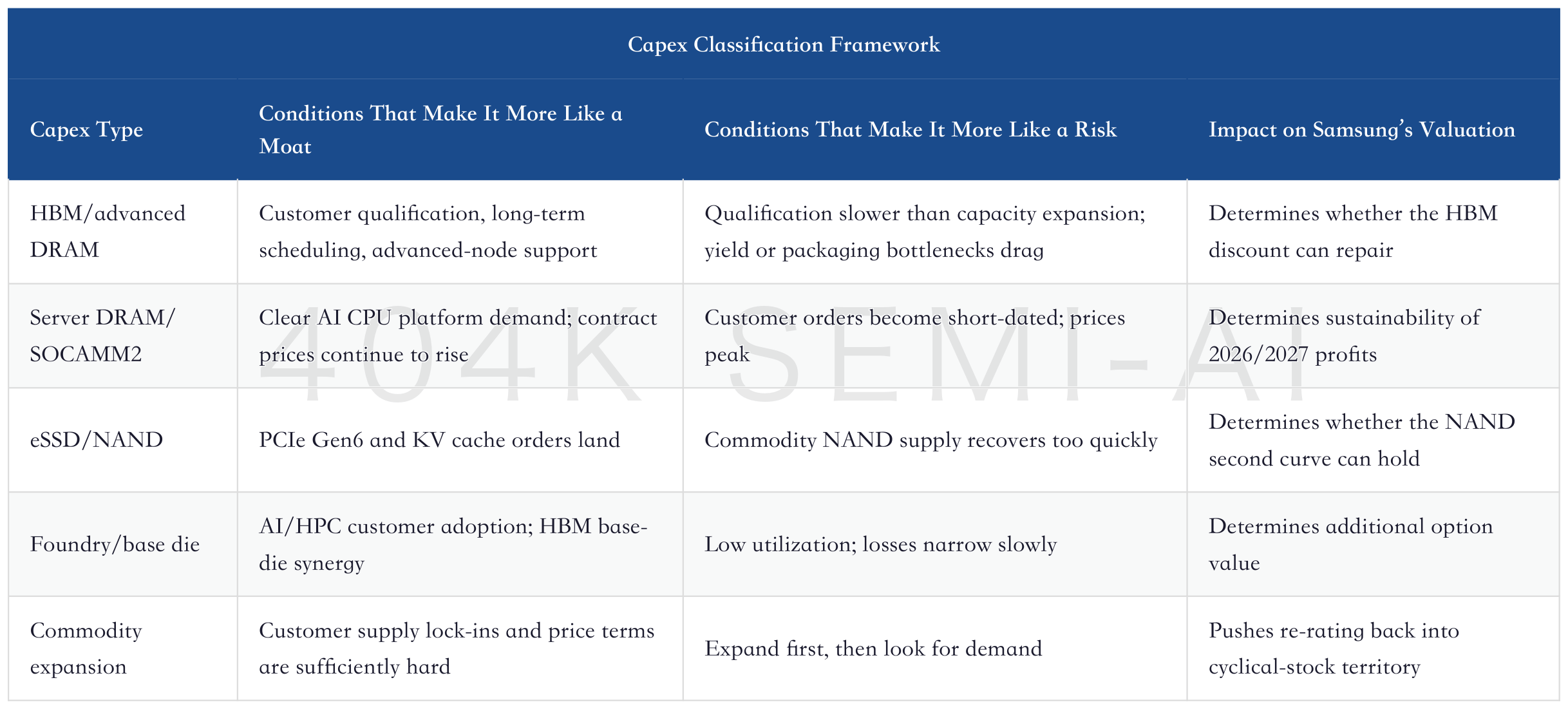
This table is the core of Samsung’s medium-term risk. Citi’s KRW 530,000 target price implies that the market is willing to believe some capex will serve high-end products and customer supply lock-ins. But that assumption must be validated by subsequent orders, not just by the company’s vision.
XIII. Second-Quarter Results: The Most Important Near-Term Reality Check
Citi forecasts Samsung’s 2Q26E operating profit at KRW 84 trillion, and expects 2Q26E DRAM/NAND ASP to rise 44%/57% QoQ. This quarter matters because it verifies three things at once: whether server DRAM price increases have flowed into the income statement, whether NAND/eSSD price increases have exceeded market expectations, and whether one-off factors such as bonuses and labor negotiations have masked the operating trend.
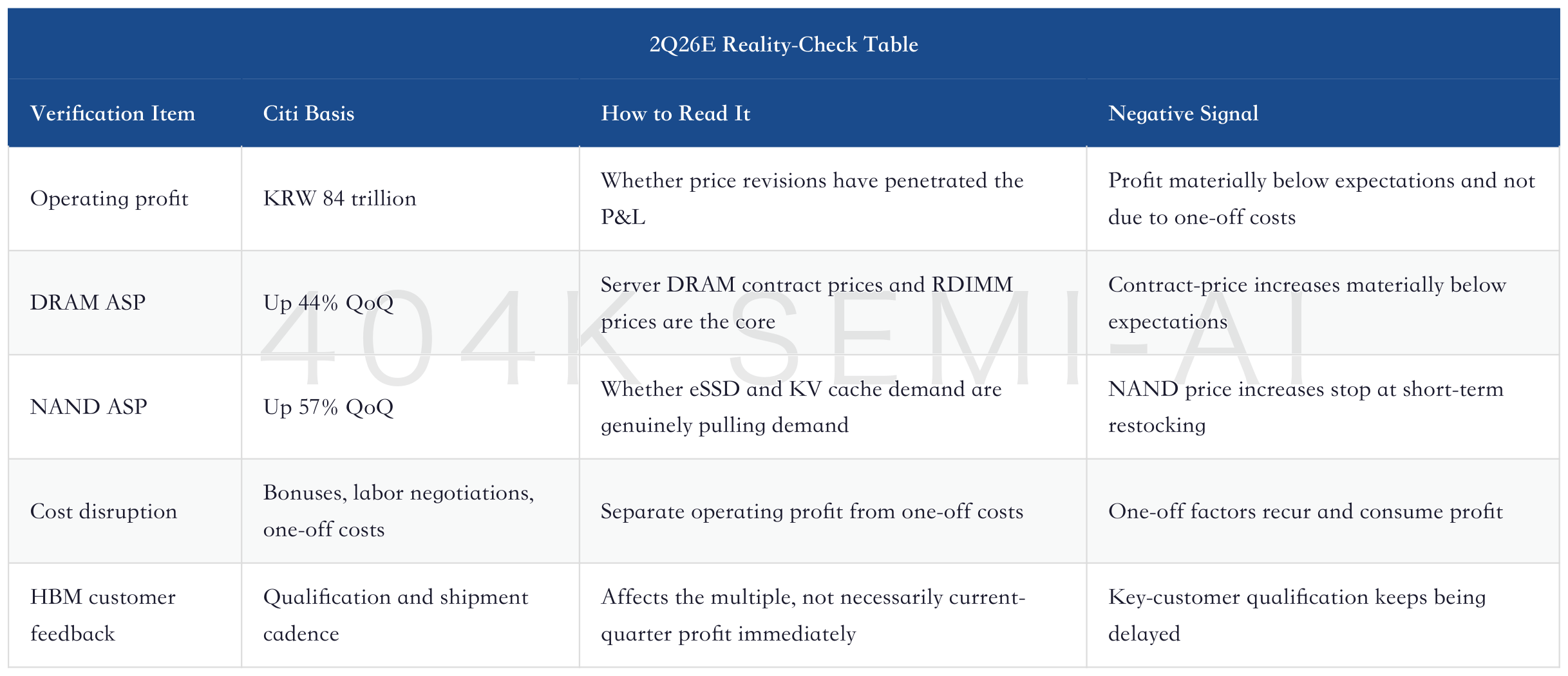
If second-quarter profit is merely strong, the market will continue to trade earnings upgrades. If profit is strong and the server DRAM and eSSD price slopes are also revised up further, Samsung will start moving closer to the “breadth asset” framework. If profit is strong but there is no progress in HBM qualification or customer supply lock-ins, the stock may rise more like a cyclical stock rather than because its valuation identity has changed.
Memory Deep Dive: AI Servers, LTA Contracts, and DRAM/NAND/HBM Margin Re-Rating
This is also the significance of LTAs and customer supply lock-ins. Short-term price increases can explain one quarter; contract quality explains the valuation center. If Samsung later discloses more customer advance supply commitments, long-term production scheduling, and price constraints, the market will be willing to extend part of 2026’s high profit into 2027.
XIV. The Bear Case: Why the KRW 530,000 Target Price Could Still Be Wrong
The strongest bear case is not that AI demand disappears. The stronger bear case is this: AI demand is very strong, but the market has already embedded extreme 2026/2027 profits into the valuation. If the verification sequence goes wrong, Samsung will revert to the cyclical-stock framework.
The first risk is delayed HBM qualification. Citi lists this as a major downside risk, which shows that even very strong server DRAM price increases cannot fully substitute for HBM’s role in the valuation multiple. If customers continue to treat Samsung as supplementary supply rather than a credible primary source, the market will compress high profits back into a cyclical discount.
The second risk is drag from PCs, smartphones, and conventional NAND demand. AI servers are very strong, but Samsung still has consumer-electronics exposure. If end demand weakens, inventories rise, or NAND prices peak, the market will question the eSSD second curve.
The third risk is heavier investment by competitors. Every memory supercycle stimulates capacity expansion. Once high profits ultimately turn into ordinary capacity, the market will view 2026/2027 earnings upgrades as peak earnings.
The fourth risk is FX and non-memory businesses. Korean won appreciation would reduce translated earnings, while smartphone competition and the display cycle could also affect group margins. Samsung’s breadth is an advantage, but it also means the company is never a pure single-factor asset.
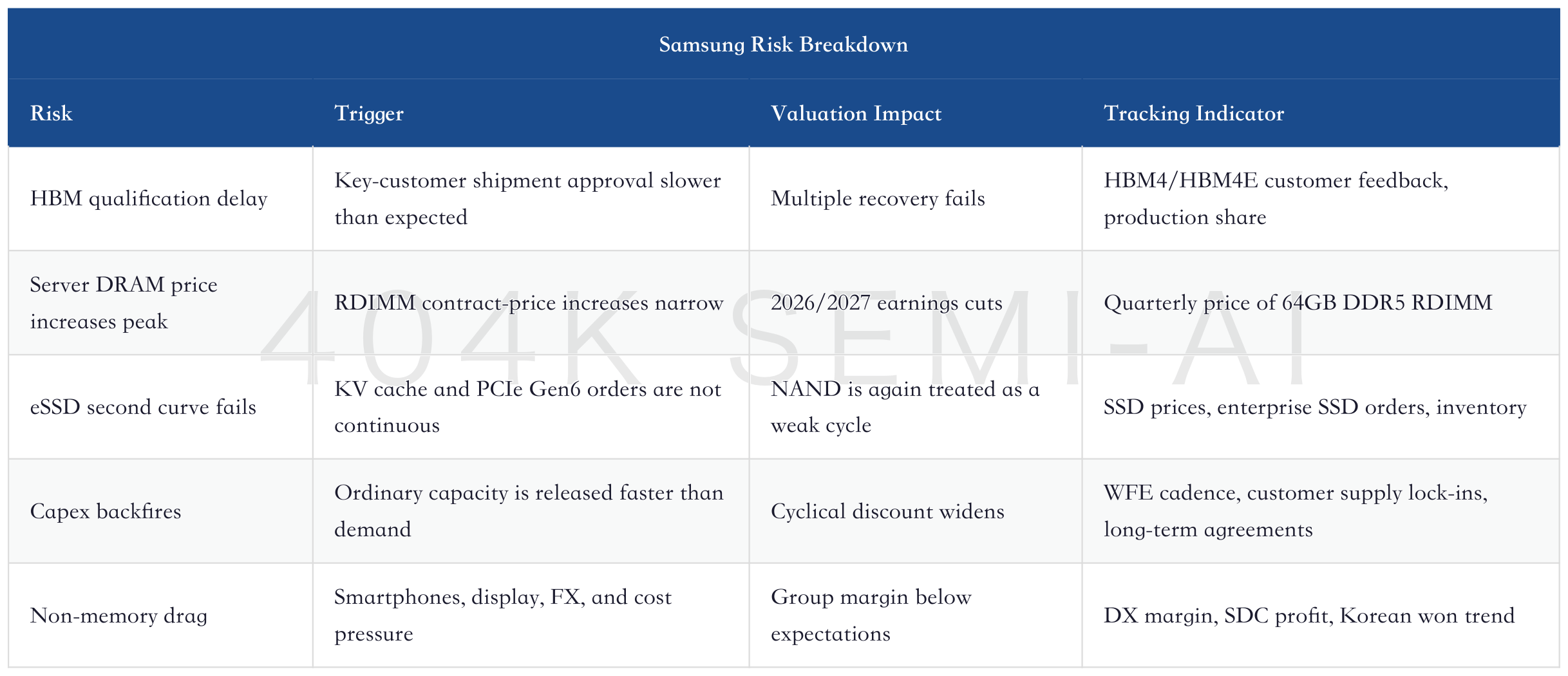
This table is also the discipline required to buy Samsung. A bullish view on Samsung cannot simply annualize every piece of good news; a bearish view cannot ignore the profit elasticity from server DRAM and eSSD just because Samsung is not the pure HBM leader. The real dividing line is whether verification can occur consecutively.
XV. Investment Dashboard for the Next Four Quarters
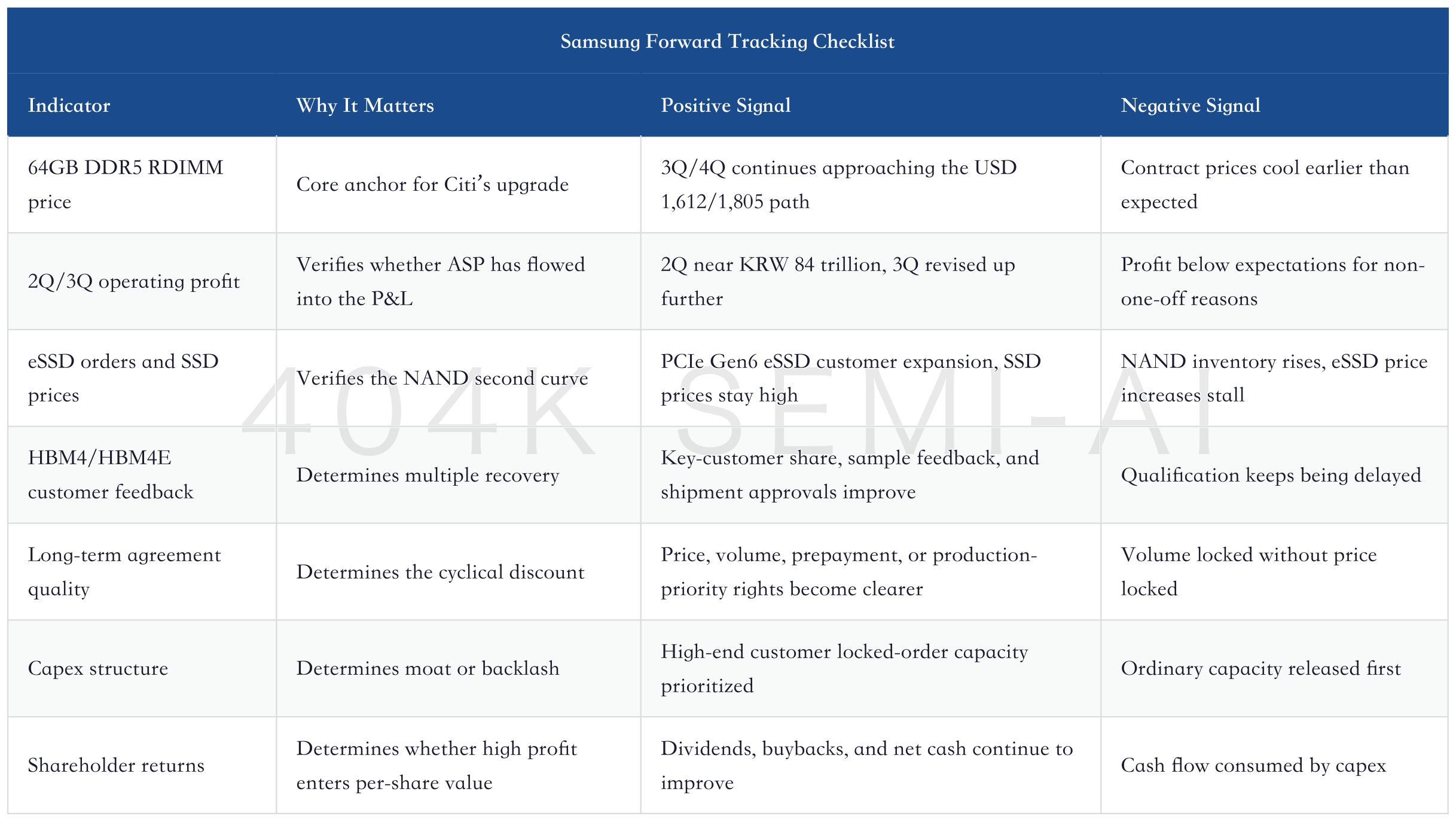
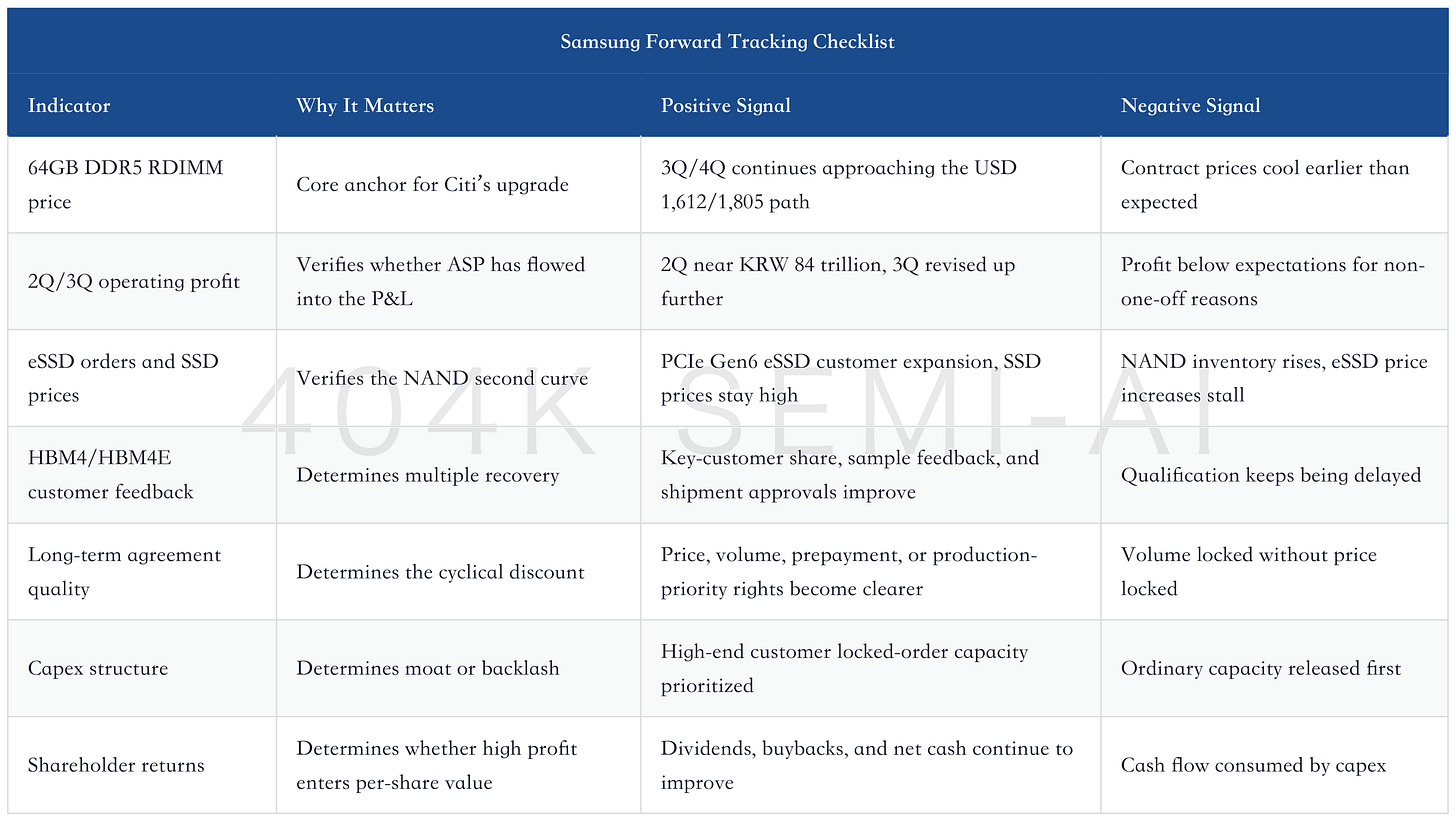
For Samsung, the most important things to watch next are not headlines, but four categories of indicators.
The first is server DRAM pricing. The quarterly price of 64GB DDR5 RDIMM is the central variable in Citi’s report. As long as it continues to move toward the USD 1,805 path, Samsung’s earnings upgrades will have financial-statement support. If the price slope suddenly slows, the profit assumptions embedded in the KRW 530,000 target price need to be discounted first.
The second is eSSD and NAND orders. For NAND to move from restocking into the AI inference data layer, the market must see enterprise SSD prices, PCIe Gen6 products, KV cache-related customer demand, and high-capacity product volume. If prices rise but orders do not appear, the second curve is unstable.
The third is HBM4/HBM4E customer feedback. This variable determines the multiple, not necessarily current-quarter profit. The market will accept Samsung’s near-term profit coming mainly from DRAM/NAND, but it will not accept Samsung being unable to prove long-term HBM customer share.
The fourth is capex and cash flow. In Citi’s model, 2026E free cash flow to shareholders is about KRW 228 trillion, and 2027E is about KRW 342 trillion. Cash flow this high has valuation value only if capex is disciplined, prices do not reverse, and customer supply lock-ins are sufficiently firm.
The Second Engine of the Memory Supercycle: CPU Return, HBM Spillover, and USD 1.7 Trillion TAM Re-Rating
This dashboard corresponds not to a one-off trade, but to a change in asset attributes. Server DRAM pricing determines near-term earnings, eSSD orders determine the NAND discount, HBM qualification determines the multiple, LTAs and capex determine the cycle center, and cash returns determine ultimate per-share value.
XVI. Conclusion: Samsung’s Update Validates the Continued Case for “Memory Breadth”
Samsung Electronics’ deep-dive update can be summarized in one sentence: Citi raised its target price to KRW 530,000 because it sees server DRAM and SSD pricing proving firmer than expected; what I care more about is whether that pricing resilience can continue to move Samsung from a “memory cycle stock” toward an “AI memory breadth asset.”
In the short term, 64GB DDR5 RDIMM, NAND ASP, SSD pricing, and 2Q26 operating profit matter most. They determine whether earnings forecasts can continue to be revised up, and whether the share price can first trade on profit elasticity.
In the medium term, HBM4/HBM4E qualification, SOCAMM2, PCIe Gen6 eSSD, and customer-linked supply commitments matter more. They determine whether the market is willing to shift part of Samsung’s earnings from cyclical peak profit to AI product profit and contracted profit.
In the long term, capital expenditure and cash returns matter most. The larger Samsung’s long-term investment scale becomes, the more it needs to prove that capital is being deployed into high-end capacity already locked in by customers, rather than ordinary supply expansion. The higher cash flow rises, the more it needs to prove that cash can translate into per-share value, rather than being absorbed by the next expansion cycle.
Samsung’s strongest investment scenario is one in which four things happen at the same time: server DRAM prices continue rising along Citi’s path, eSSD orders validate NAND’s second growth curve, HBM4/HBM4E qualification improves, and capital expenditure follows customer-locked orders. At that point, Samsung would not just be a low-P/E memory stock, but the broadest repricing asset in the AI memory chain.
Samsung’s weakest investment scenario is also clear: near-term pricing is strong, but HBM qualification is slow, eSSD orders are weak, long-term agreements lack firmness, and capital expenditure moves ahead first. In that case, the KRW 530,000 target price would become a peak-profit trade rather than a re-rating of asset attributes.
So the final conclusion of this update is not simply “bullish on memory.” A more precise investment conclusion is: Samsung is still not the purest HBM asset, but it may be the breadth asset most worth tracking in AI memory. By putting 64GB DDR5 RDIMM and SSD pricing at the center of valuation, Citi is giving the market a new angle: Samsung’s re-rating first comes from server DRAM and NAND pushing up the income statement, and then from HBM qualification, customer-linked supply commitments, and cash returns determining how much valuation those profits can retain.
References
Citi: Samsung Electronics (005930.KS): Resilient Memory ASP Uptrend to Support Sustained Earnings Growth, 2026-07-02.
Samsung Electronics: 1Q 2026 Earnings Presentation.
Samsung Electronics: 1Q 2026 reviewed financial statements, 2025 consolidated financial statements, and 2024 consolidated financial statements.
Multiple investment-bank research reports on Samsung Electronics’ 1Q26, 2Q26E, AI CPU demand, ASP upward revisions, long-term investment, and HBM validation.Samsung Electronics Deep Update: 64GB DDR5 RDIMM, a KRW 530,000 Target Price, and HBM Qualification: How Much Longer Can Breadth in Memory Assets Be Re-Rated?
目录
Too Long; Didn’t Read
I. What Is Actually New in This Citi Update?
II. Samsung’s Own Official Messaging Has Already Made the Direction Clear
3. Why 64GB DDR5 RDIMM Has Become the New Valuation Anchor
4. NAND and SSD Are the Most Easily Underestimated Second Curve This Time
5. Where the KRW 530,000 Target Price Comes From
VI. How Samsung Compares with SK Hynix, Micron, and SanDisk
VII. From Old Asset to New Asset: What Exactly Is Being Repriced in Samsung
VIII. Why the Balance Sheet Matters: High Profit Must Be Retained
IX. Three Worldviews: Is KRW 530,000 Conservative, Base Case, or Bullish?
X. How This Update Relates to the Prior Samsung Deep Dive
XI. HBM Qualification Remains the Key to the Valuation Multiple
XII. Capex: One Step Between Moat and Risk
XIII. Second-Quarter Results: The Most Important Near-Term Reality Check
XIV. The Bear Case: Why the KRW 530,000 Target Price Could Still Be Wrong
XV. Investment Dashboard for the Next Four Quarters
XVI. Conclusion: Samsung’s Update Validates the Continued Case for “Memory Breadth”
References
本内容基于公开资料和研报数据整理,不构成任何投资建议,不代表任何个人观点,仅供学习参考,请理性阅读
Citi raised its target price for Samsung Electronics to KRW 530,000. The core debate has shifted from HBM catch-up alone to whether 64GB DDR5 RDIMM, SSD, and NAND pricing can turn cyclical profits into AI server profits; the sustainability of the valuation will need to be tested by HBM qualification and capex discipline.
Too Long; Didn’t Read
The core of this Samsung update is that server DRAM has become the profit anchor again. Citi raised its 4Q26 price assumption for 64GB DDR5 RDIMM to US$1,805 and lifted its 2026 global DRAM ASP growth forecast to 234%; this means Samsung’s near-term earnings leverage is not coming only from HBM. Standard server memory is also being repriced by AI CPU demand.
The target price increase to KRW 530,000 is essentially about putting part of the cyclical profit into SOTP upfront. Citi values the segments on 2026 EBITDA, assigns the memory business 7.6x EV/EBITDA, and raises its 2026/2027 operating profit forecasts to KRW 401tr/KRW 517tr. Whether the valuation holds depends on how much of these profits can move from price-cycle highs into AI product profits and customer supply-lock profits.
Samsung’s differentiation remains “breadth,” not single-point purity. SK hynix is more concentrated on the HBM quality premium, SanDisk is more concentrated on NAND leverage, while Samsung covers DRAM, HBM, NAND/eSSD, SOCAMM2, PCIe Gen6 eSSD, and foundry synergies at the same time. Breadth improves fault tolerance, but also requires more validation points to be delivered simultaneously.
The NAND and SSD line can no longer be treated as a consumer-electronics cycle. Citi raised its 2026 NAND ASP growth forecast to 236% and expects SSD prices to rise 330% YoY. Samsung has also officially identified PCIe Gen6 eSSD and KV cache as AI storage priorities, turning NAND from a “weak-cycle catch-up” asset into a second profit curve for inference servers.
The most important disconfirming points remain HBM qualification and capex discipline. If qualification at key HBM customers is delayed, server DRAM contract prices start to cool, eSSD orders are not continuous, or long-term investment first turns into ordinary supply, Samsung will again be discounted by the market as a cyclical stock. The KRW 530,000 target price is not unconditional upside; it is the outcome after validation.
The follow-up validation window has narrowed to two quarters. Four numbers matter next: 2Q26 operating profit, 64GB DDR5 RDIMM contract prices, SSD/eSSD orders, and HBM4/HBM4E customer feedback. These four numbers correspond to near-term profits, system-memory pricing power, NAND’s second curve, and valuation multiple repair. If even two of them fall behind, Samsung’s “breadth asset” narrative will cool meaningfully.
I. What Is Actually New in This Citi Update?
The previous deep dive on Samsung Electronics already resolved the company-profile question: it is not simply a diversified electronics company, nor is it a weaker version of SK hynix. It is the company with the broadest coverage in the AI memory chain. The new variable in this Citi report is that Samsung’s near-term profit anchor has been expanded further from “HBM catch-up” to “server DRAM and SSD ASPs continuing to beat expectations.”
This point is critical. In the past, when the market looked at Samsung, the first question was often when its HBM would catch up with SK hynix. That question remains important, but it narrows the Samsung story. What Citi is really emphasizing this time is 64GB DDR5 RDIMM, or mainstream server DRAM. If this price anchor continues to rise, Samsung’s earnings leverage will enter the financial statements faster than simply waiting for HBM qualification.
In its July 2 report, Citi maintained its Buy rating and raised its 12-month target price from KRW 460,000 to KRW 530,000. The upgrade was not simply because the stock had become cheaper after a pullback, but because three assumptions changed together: higher 64GB DDR5 RDIMM prices, higher full-year DRAM/NAND ASPs, and higher 2026/2027 operating profit forecasts. The report also treats the recent pullback triggered by concerns over Meta capex as a technical correction, with the core judgment that memory fundamentals have not been damaged.
This table compresses the main thread of the update clearly: Samsung is no longer just about “whether HBM can repair the discount,” but about “whether server DRAM and SSD price increases can first push up the income statement, before HBM and customer supply locks determine the multiple.”
Memory Is No Longer Just a Cyclical Stock: JPM LTA Breakdown, Agentic AI Memory Multipliers, and the Valuation Rewrite for Samsung and SK hynix
This is also consistent with the previous memory framework: the second phase of the AI memory trade is no longer just buying the HBM leader, but buying HBM spillover into system memory, enterprise SSDs, and long-term supply contracts. Samsung’s advantage is precisely that it is present across all these links.
II. Samsung’s Own Official Messaging Has Already Made the Direction Clear
Citi’s upgrades are not an isolated judgment. Samsung’s official 1Q26 presentation already confirmed group revenue of KRW 133.9tr and operating profit of KRW 57.2tr in the quarter; the DS semiconductor division recorded revenue of KRW 81.7tr and operating profit of KRW 53.7tr. In other words, group profit is almost entirely driven by semiconductors. Smartphones, displays, and home appliances remain important, but they are not the primary driver of this re-rating cycle.
Samsung’s official commentary on the memory business is also direct: demand for server DRAM and SSDs remains strong, driven by hyperscale cloud providers’ AI service expansion, enterprise LLM adoption, and accelerating demand growth from Agentic AI. The company also emphasized increasing the share of high-value-added AI products such as DDR5 and SOCAMM2, and entering the PCIe Gen6 eSSD market with high-performance products for KV cache.
For investors, the significance of these numbers is that they first clarify what the company actually sells. Samsung still sells smartphones, screens, TVs, and home appliances, but this report does not need to frame it as a diversified electronics story. What deserves pricing now is its ability to sell three types of memory into AI servers at the same time: HBM on the training side, DDR5 RDIMM/SOCAMM2 on the CPU side, and enterprise SSDs on the inference side.
This is also why Citi focuses on 64GB DDR5 RDIMM. HBM is closest to GPUs and has the sharpest narrative; but system memory on the server CPU side is the larger, more durable, and more easily underestimated configuration change after the adoption of AI inference and Agentic AI. As cloud vendors shift more workloads from training to inference, servers do not only add GPUs; they also add CPU memory, cache layers, SSDs, and networking. Samsung does not need to be the purest name in every line. As long as these lines thicken at the same time, its breadth turns into profit.
3. Why 64GB DDR5 RDIMM Has Become the New Valuation Anchor
64GB DDR5 RDIMM looks less compelling than HBM, but it may be the most important price anchor to watch for Samsung over the next two quarters. There are three reasons.
First, AI CPU demand is lifting server memory configurations again. During the training phase, the market focused on GPUs and HBM. In the inference phase, the importance of CPUs, memory capacity, data caching, and retrieval chains is rising. Agentic AI will cause applications to call models, read context, and write intermediate states more frequently. Server memory is no longer just a traditional IT procurement item; it is infrastructure for AI service availability.
Second, HBM will crowd out advanced DRAM resources. The stronger HBM becomes, the tighter advanced DRAM wafer and packaging resources become, making ordinary server DRAM supply less likely to loosen. Investors used to view HBM and traditional DRAM separately. Now the logic should be reversed: HBM drains supply, AI CPUs increase demand, and server DRAM gains pricing power that differs from the old cycle.
Third, server DRAM price pass-through is faster than many long-term frameworks assume. HBM is often priced annually or by customer project, so short-term upward revisions may not flow fully into reported numbers immediately. Server DRAM contract prices are updated quarterly, making price increases more likely to show up in 2Q, 3Q, and 4Q. Citi raised its 2Q/3Q/4Q26E global DRAM ASP QoQ growth estimates to 44%, 20%, and 13%, respectively. That pace explains why it is willing to forecast 2Q26E operating profit at KRW 84 trillion.
This table should not be read as a simple price list. The real focus is the slope: from 2Q to 4Q, Citi believes server DRAM prices can continue to rise. As long as that slope materializes, Samsung’s near-term earnings will have sufficiently strong reported support even before HBM qualification is fully completed.
Rubin Will Consume Smartphone Memory in 2027: Why Nvidia Is Taking Smartphone Memory — How Vera Rubin Rewrites DRAM Capacity Prioritization
This follows the same logic as the memory crowding-out effect created by the Rubin platform: advanced DRAM resources are being absorbed jointly by HBM, SOCAMM, and server memory, while consumer electronics memory can no longer assume natural priority access to capacity. If Samsung can supply HBM, SOCAMM2, and server RDIMM at the same time, it will be better positioned than single-category companies to capture the upside from “supply reallocation.”
4. NAND and SSD Are the Most Easily Underestimated Second Curve This Time
The market tends to treat Samsung’s NAND business as a supplementary segment, because past NAND price wars were painful and the business is more cyclical. But Citi has now raised its 2026 NAND ASP YoY growth estimate to 236%, while also expecting SSD prices to rise 330% YoY. This magnitude can no longer be explained solely by consumer electronics inventory restocking.
The key term here is KV cache. Large-model inference does not end once the GPU completes computation. The system needs to store context, retrieve vectors, read and write intermediate states, and move large volumes of data between memory and storage. In this setting, high-performance enterprise SSDs are not ordinary HDD replacements, but the cache and data layer in the AI inference chain. Samsung’s official 1Q26 presentation also explicitly placed PCIe Gen6 eSSD and KV cache within its memory outlook, cross-validating Citi’s upward revisions to NAND/SSD pricing.
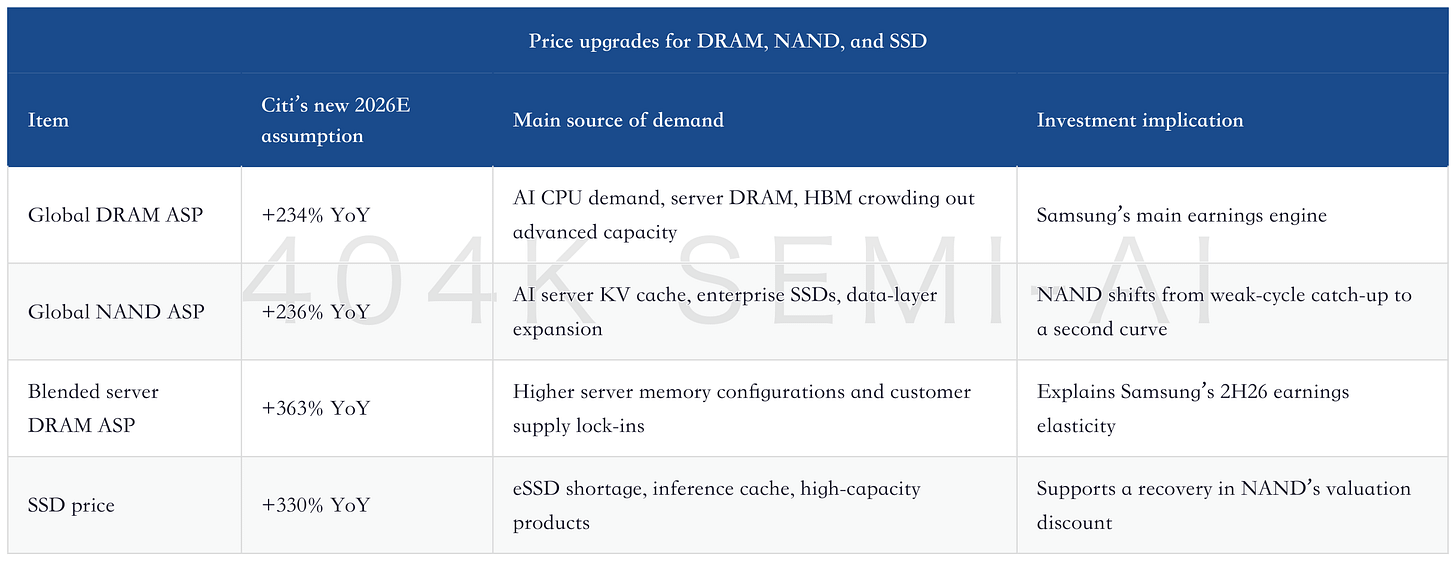
The key point in this table is that DRAM and NAND are strengthening simultaneously for the first time under the same AI server logic. In past memory upcycles, DRAM and NAND could be out of phase, and NAND was often seen as a drag. Now, if AI inference turns enterprise SSDs into a critical resource, the valuation implication of NAND will change.
Samsung has an advantage over pure-play DRAM companies on this point. It does not need to prove that NAND will become a high-multiple asset like HBM. It only needs to prove that eSSD profits are not a one-off inventory restocking cycle, and the market will reduce the drag NAND applies to the group’s valuation. Especially when DRAM profits are already high, the NAND second curve can broaden group earnings and prevent investors from concentrating the entire bet on HBM qualification.
AI Drives an Industry-Wide Revaluation of Storage: Who Has the Most Pricing Power Across DRAM, NAND, SSD, and HDD, as Samsung, SK Hynix, SanDisk, Western Digital, and Seagate Results Cross-Validate One Another
From an industry-wide perspective, the revaluation of NAND/eSSD marks the spread of the storage trade from the “training bottleneck” to the “inference data layer.” Samsung is one of the few companies spanning HBM, server DRAM, and enterprise SSDs at the same time. That is where its breadth shows up.
5. Where the KRW 530,000 Target Price Comes From
Citi’s KRW 530,000 target price comes from SOTP, or sum-of-the-parts valuation. This method is more suitable for Samsung than a single P/E multiple, because the group includes both high-elasticity memory and lower-multiple consumer electronics and display businesses. The real question is not the multiple itself, but whether memory profits can be classified into a higher-quality earnings pool.
The key to SOTP is not filling in multiples, but judging the nature of the profits. If the memory business is only at a price peak, 7.6x may already be not low. If part of the profit comes from AI products, customer supply lock-ins, and more durable server memory configurations, then 7.6x may still be conservative. Whether the target price holds depends on how much profit the market is willing to move from “peak-price profit” to “capitalizable profit.”
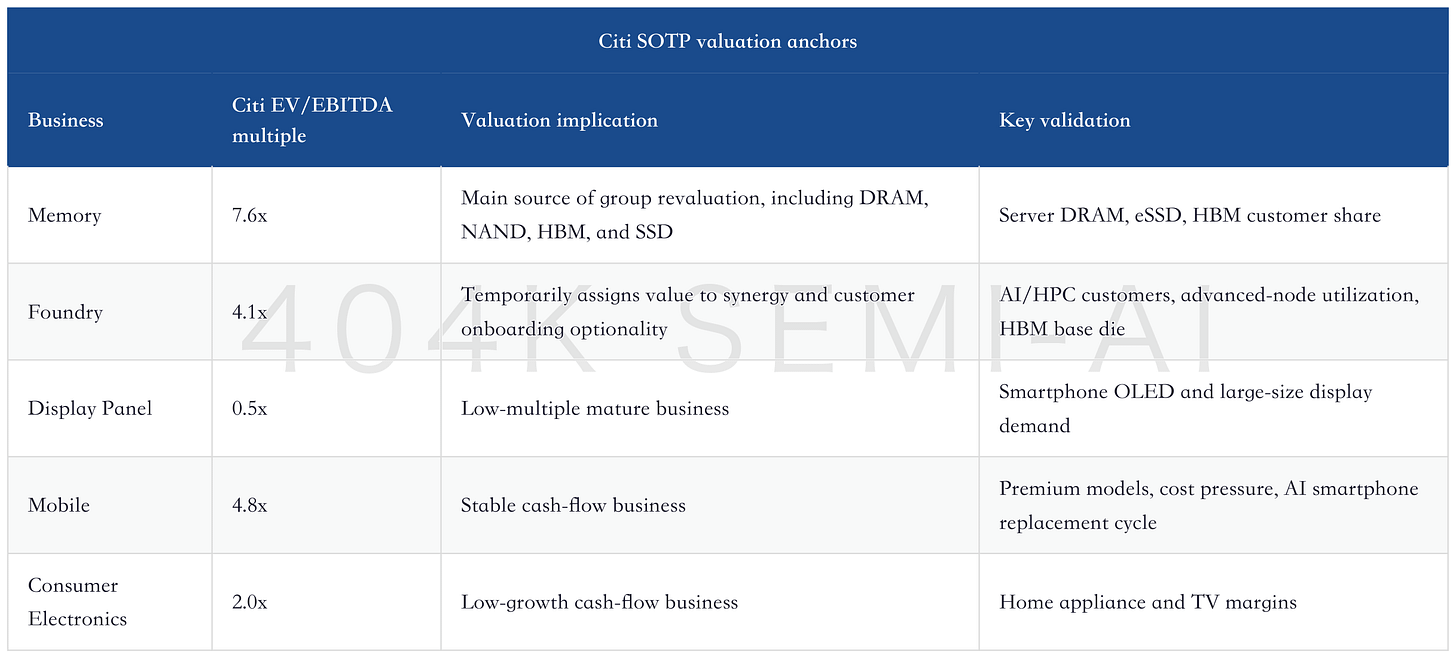
If one only looks at forward P/E, Samsung appears exceptionally cheap. But low P/E multiples in memory stocks often occur at earnings peaks, so a low multiple cannot be treated directly as a margin of safety. The more robust approach is to break earnings forecasts into a table and then judge which profits can survive the cycle.
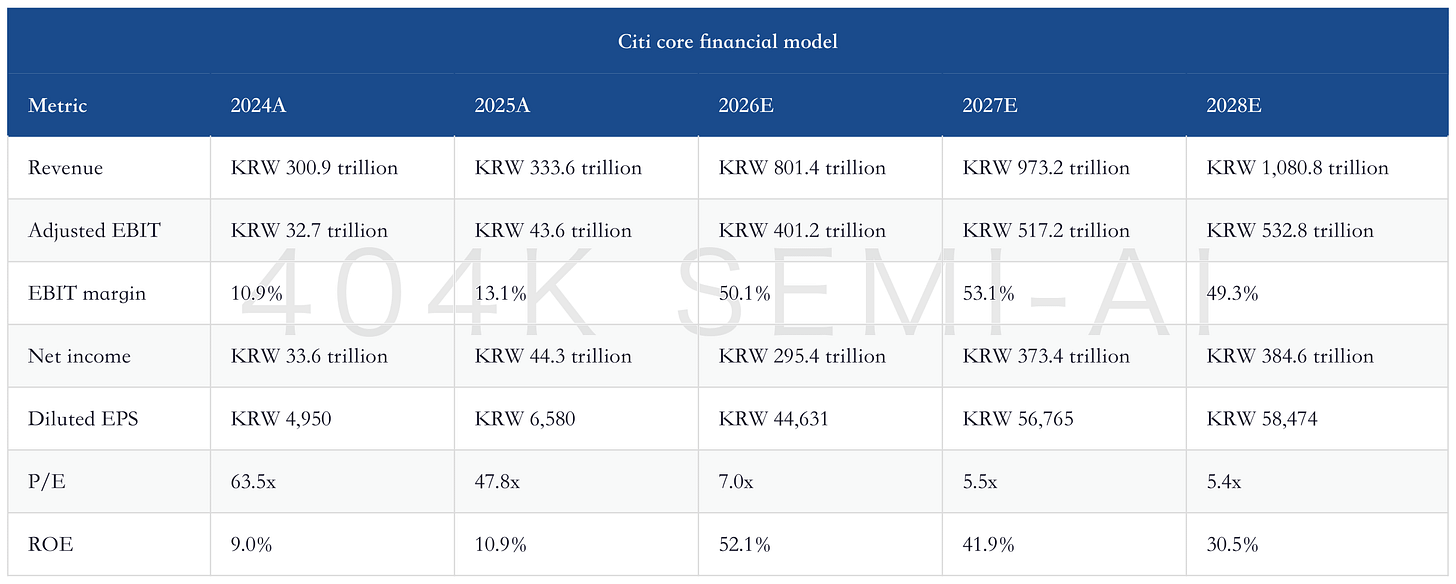
This table is attractive, and also dangerous. It is attractive because the income-statement slope is very steep, and the 2026/2027 P/E is indeed very low. It is dangerous because memory margins enter an extremely high range after 2026, and the market will certainly question sustainability. In other words, the Samsung trade is not “7x P/E is cheap,” but rather “which profits can the market capitalize at a multiple above that of a cyclical stock.”
My judgment is that Samsung’s profits should be divided into three categories.
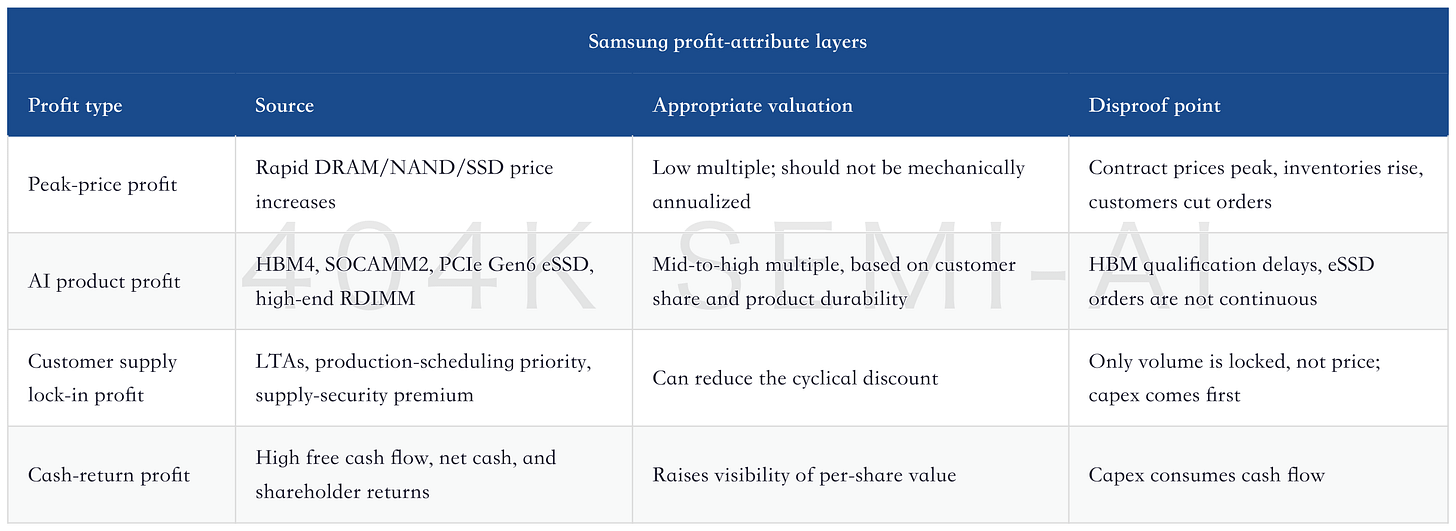
This table is more important than a single target price. Citi’s KRW 530,000 target reflects the valuation impact of near-term earnings upgrades first. Whether the share price can be revised up further depends on whether the second and third categories of profit can be confirmed. If only the first category remains, a low P/E will not protect the share price. If the second and third categories continue to materialize, Samsung will move from a strong cyclical trade into an asset-quality revaluation.
VI. How Samsung Compares with SK Hynix, Micron, and SanDisk
This memory cycle has moved beyond single-point price increases into a re-segmentation of company attributes. Samsung’s position cannot be ranked only by HBM share, nor only by NAND torque. Its investment value comes from breadth, but breadth is valuable only when multiple lines deliver at the same time.
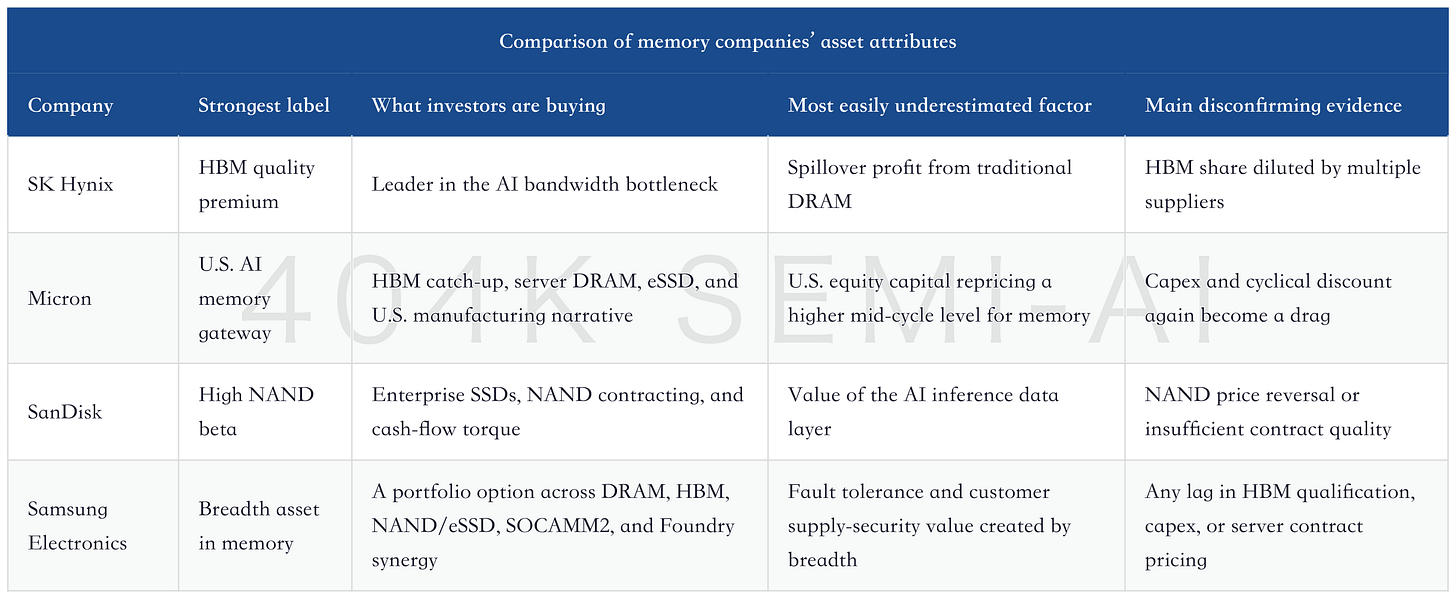
This table shows that Samsung cannot be simply categorized as “slightly worse than Hynix.” Hynix is sharper; Samsung is broader. Micron is more easily repriced by U.S. equity capital, while Samsung’s discount repair requires both customer qualification and Korean market liquidity. SanDisk’s NAND torque is purer; Samsung’s NAND is only the second curve within a broader portfolio.
Korea Tech Deep Dive: How HBM, MLCC, FC-BGA, TCB, and Enterprise AI Are Being Revalued Under the AI Compute and Memory Supercycle
The best positioning for Samsung is as an “AI memory breadth asset.” It does not need to be number one in every category, but it must prove it is not absent from any key category. HBM4/HBM4E determines whether it can repair its past discount; DDR5 RDIMM and SOCAMM2 determine whether it can capture AI CPU demand; PCIe Gen6 eSSD and KV cache determine whether NAND has a second curve; Foundry and base dies determine whether it has a higher-level synergy option; cash flow and shareholder returns determine whether high profit ultimately becomes per-share value.
This is also why Samsung is more complex than a pure cyclical stock. For a pure cyclical, the key judgment is price; for Samsung, the sequence of price, product, customer, capex, and cash returns must all be judged. The best sequence is: customers first lock supply, products then get validated, prices continue to be revised up, capex follows customer orders, and cash finally returns to shareholders. The worst sequence is: capex rises first, HBM qualification is slow, LTAs lock volume but not price, and supply starts to release after prices peak.
VII. From Old Asset to New Asset: What Exactly Is Being Repriced in Samsung
The valuation challenge for Samsung is that it previously carried three labels at the same time: a conglomerate electronics discount, a strong memory-cycle discount, and an HBM execution discount. The conglomerate electronics discount comes from business complexity: smartphones, displays, home appliances, and semiconductors all sit within one group, making it hard for investors to value the strongest business independently. The strong memory-cycle discount comes from profit volatility: P/E is lowest when prices are highest, and the market is naturally reluctant to annualize peak profits. The HBM execution discount comes from lagging customer qualifications and share in past cycles, which has made Samsung a less clean AI memory asset than Hynix for a long time.
The significance of Citi’s latest update is that it does not directly claim all three discounts have disappeared. Instead, it offers a more realistic revaluation path: first let server DRAM and SSD generate the profit, then use HBM qualification and customer supply locks to repair the multiple. This path is more tradable than “waiting for Samsung to fully overtake in HBM,” and it better fits the company’s own breadth.
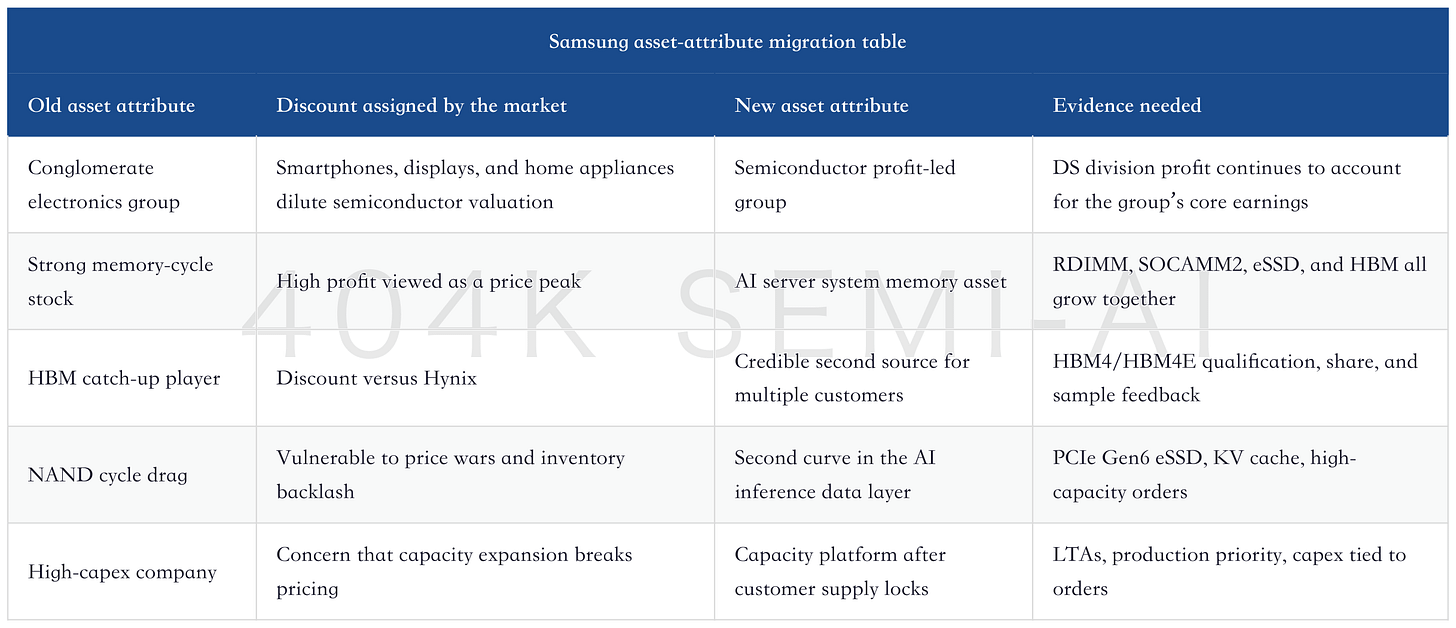
This table explains why the same price increases cannot be viewed through only the old cyclical framework this time. In the old cyclical framework, the faster prices rise, the more investors worry about a cycle peak. In the new asset framework, price increases are only the first step; the next question is whether customers are willing to lock Samsung supply through longer contracts, higher-spec products, and stricter production-allocation terms.
If Samsung completes only the first step, it is a very strong cyclical stock. Strong cyclical stocks can also rise a lot, but what rises is earnings forecasts and risk appetite. Only when the second and third steps happen together can it move from “earnings upgrades” into a “valuation identity change.” This is also why I do not simply interpret this Citi report as a target-price increase, but as the latest evidence of Samsung’s asset-attribute migration.
Samsung’s corporate characteristics also mean it is better described by “migration” rather than “reversal.” Hynix’s narrative is more like a reversal in quality premium, Micron’s more like the diffusion of U.S. AI hardware, and SanDisk’s more like a reversal in NAND profit torque. Samsung is not a single-point reversal. It is the gradual removal of discounts attached to multiple old labels: the conglomerate electronics discount is removed by DS profit contribution, the cyclical discount by server DRAM and eSSD, the HBM discount by customer qualification, and the capex discount by customer supply locks.
VIII. Why the Balance Sheet Matters: High Profit Must Be Retained
One point the market most easily overlooks in memory stocks is that a strong income statement is not the same as strong shareholder value. A truly good cycle must satisfy three conditions at the same time: high margins, controlled capex, and cash retention. Samsung’s official reviewed first-quarter financial statements provide a base anchor: as of March 31, 2026, the company had cash and cash equivalents of about KRW 73.3 trillion, inventories of about KRW 58.3 trillion, property, plant and equipment of about KRW 217.8 trillion, total assets of about KRW 633.3 trillion, and equity of about KRW 486.6 trillion.
These numbers do not directly produce an investment conclusion, but they remind investors that Samsung is not an asset-light AI company. It is an extremely asset-heavy memory and manufacturing platform. It can generate astonishing operating cash flow in an upcycle, but in a wrong capacity expansion it can also quickly turn cash flow into depreciation and inventory. In Citi’s model, free cash flow to shareholders in 2026/2027 is about KRW 227.8 trillion/342.4 trillion, respectively. Whether the market can capitalize this number depends on whether it becomes shareholder returns, net cash, and high-end capacity, or becomes the next round of ordinary supply.
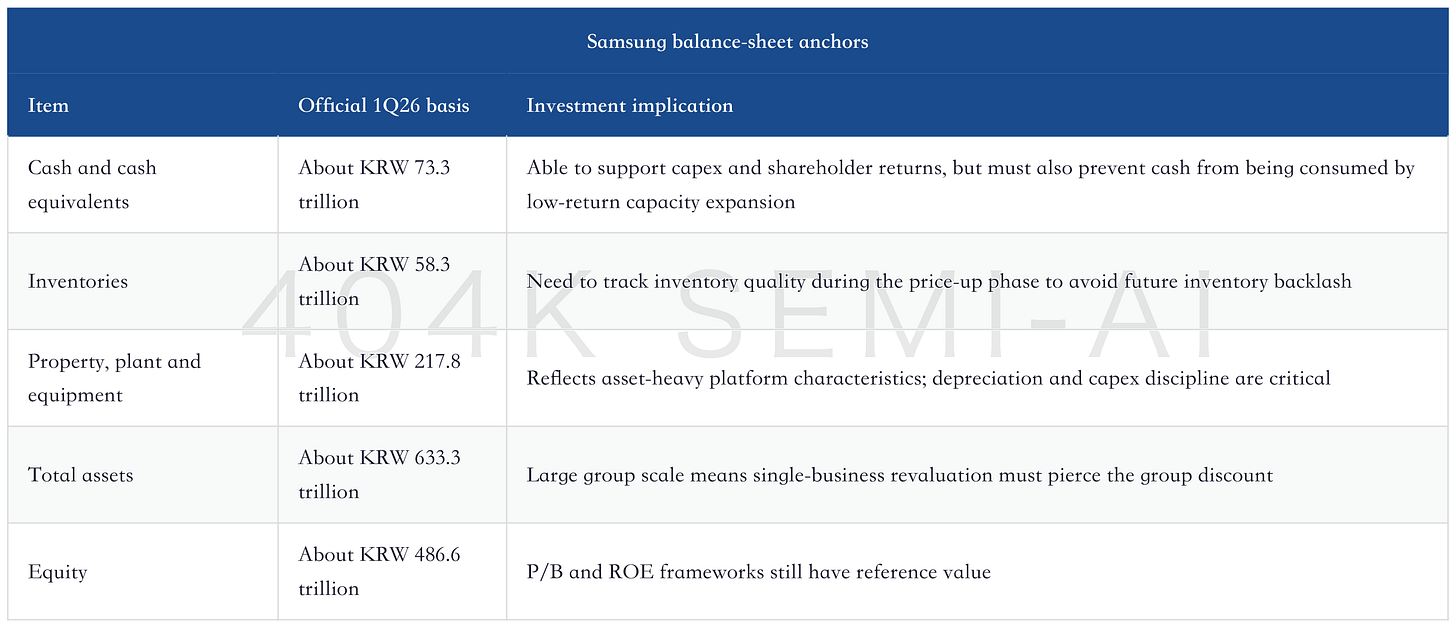
This table should be read together with Citi’s ROE forecast. Citi expects Samsung’s ROE to jump from 10.9% in 2025 to 52.1% in 2026, and remain at 41.9% in 2027. If this ROE is only a price peak, the market will not assign a high multiple. If it corresponds to a higher mix of AI products, tougher contracts, and stronger cash returns, Samsung can qualify to move out of the ordinary memory-cycle stock category.
Cash flow has another function: it affects the market’s tolerance for capex. When high profit, high cash, and strong customer supply locks coexist, investors are willing to accept Samsung’s investment in HBM, SOCAMM2, eSSD, and advanced nodes. When high profit, high capex, and insufficiently firm contracts coexist, investors will immediately worry about supply backlash after 2028. Samsung is not unable to invest; it must prove that every key investment corresponds to higher-quality customer demand.
IX. Three Worldviews: Is KRW 530,000 Conservative, Base Case, or Bullish?
Citi assigns a KRW 530,000 target price, but that target means very different things under different worldviews. In a strong-cycle worldview, it is a peak target after earnings upgrades. In a discount-repair worldview, it is a reasonable target after both HBM and server DRAM are validated. In a breadth-asset worldview, it may only be an interim target, because the market has not yet fully capitalized Samsung’s eSSD, SOCAMM2, Foundry synergies, and cash returns.
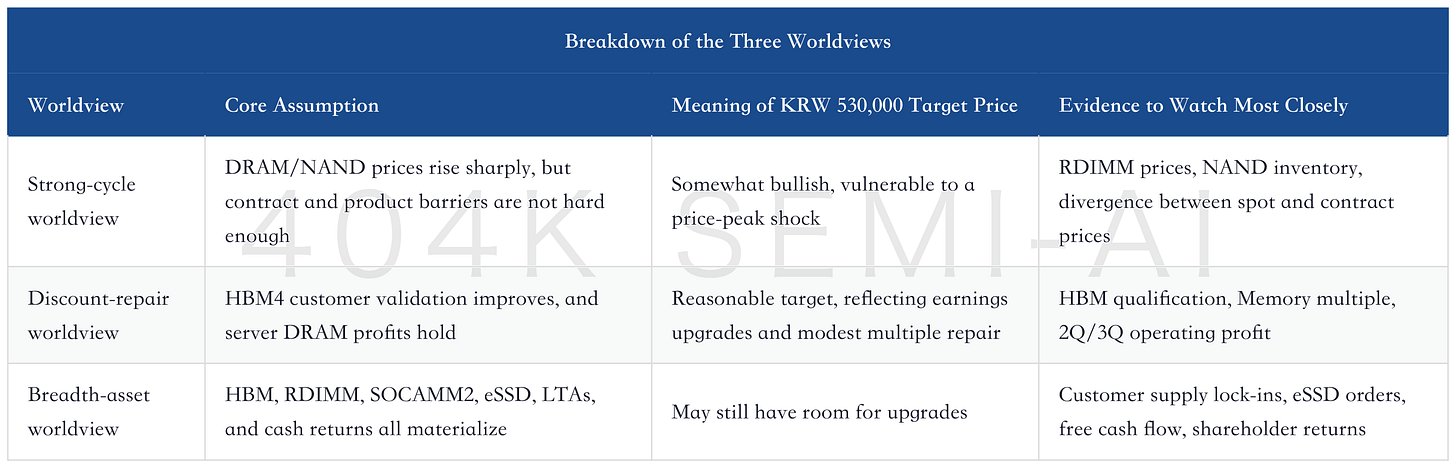
The difference among these three worldviews is not whether one is bullish on AI demand. All three acknowledge strong AI demand. The difference is whether the market is willing to extend AI demand from near-term pricing into product mix, contract quality, and asset attributes. The strong-cycle worldview looks at price. The discount-repair worldview looks at HBM. The breadth-asset worldview looks at whether Samsung can turn multiple product lines into part of customers’ supply security.
I am more inclined to place Samsung today in a “transition from discount repair toward breadth asset” position. The reason is that server DRAM and NAND/eSSD have already been materially upgraded in Citi’s model, and official commentary also confirms that server DRAM, SSD, HBM4, and SOCAMM2 all sit on the same AI memory line. But HBM qualification, LTA firmness, capex sequencing, and cash returns are not yet sufficient to treat Samsung directly as a long-duration breadth asset.
This judgment makes trading discipline clearer. At the current stage, an earnings-upgrade trade is acceptable, but one cannot annualize 2026 earnings unconditionally. As long as server DRAM prices continue to rise along Citi’s path, Samsung still has near-term earnings leverage. As long as HBM4/HBM4E customer feedback improves, the valuation multiple still has room to repair. Only when eSSD orders and customer supply lock-ins become more binding will the breadth-asset thesis truly hold.
X. How This Update Relates to the Prior Samsung Deep Dive
The core conclusion of the prior Samsung deep dive was that Samsung is not a weakened version of SK hynix, but a full-category memory breadth asset. This update does not overturn that earlier conclusion. Instead, it gives it a harder near-term financial handle.
The prior view emphasized four lines: DRAM repricing, HBM4 catch-up, NAND/eSSD reversal, and capex discipline. What Citi adds this time is the slope of price and earnings forecasts: the 4Q price assumption for 64GB DDR5 RDIMM is revised upward, 2026 DRAM/NAND ASP growth is revised upward, 2026/2027 operating profit is revised upward, and the target price is raised to KRW 530,000. In other words, the prior deep dive explained “why Samsung deserves to be reframed”; this update explains “how that framework is starting to be validated by new forecast numbers.”
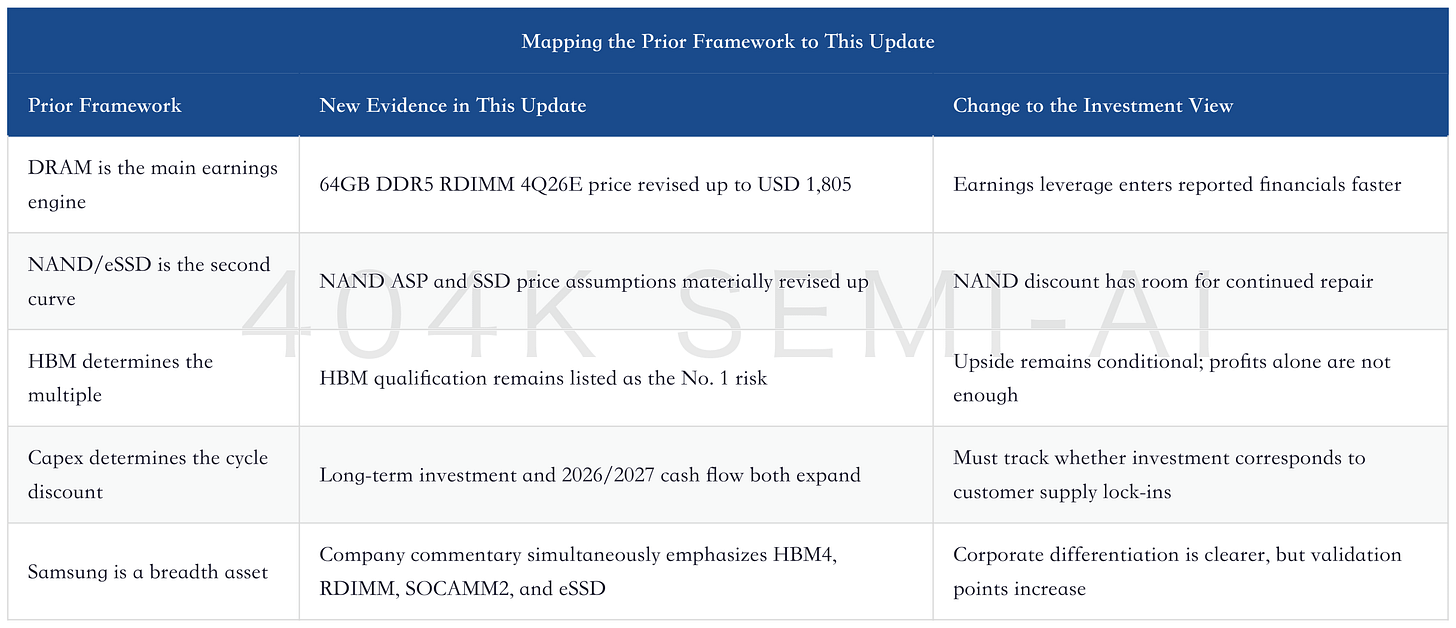
This is also why this article does not repeat Samsung’s full corporate history or expand on every business. The most important task of the update is to connect the new report with the prior framework: Citi’s new forecasts make the near-term earnings handle very clear, but whether Samsung moves from discount repair into breadth asset still depends on validation over the next two quarters.
XI. HBM Qualification Remains the Key to the Valuation Multiple
Citi’s report brings server DRAM and SSD to the front of the stage, but HBM remains the key to whether Samsung’s valuation multiple can move higher. The reason is simple: the market already knows traditional DRAM and NAND prices are strong. What really determines whether Samsung can escape its discount is whether key customers treat it as a reliable source of supply.
Samsung has already emphasized HBM4, SOCAMM2, and products related to Nvidia’s Vera Rubin platform in its 1Q26 presentation, and also mentioned that in H2 it will continue executing an AI product sales strategy around new GPU/CPU demand. This gives the market a positive signal. But Citi still lists “delayed HBM shipment approval for key customers” as the first risk item. Viewed together, the conclusion is: the direction is very strong, but validation is not yet complete.
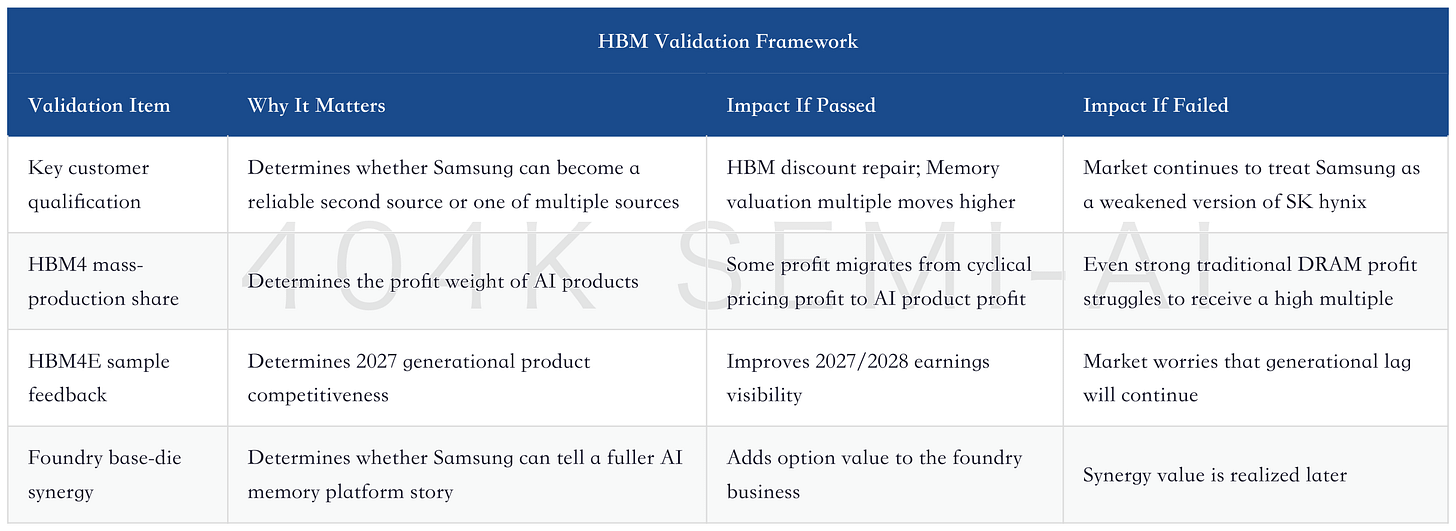
HBM is not the only source of profit, but it is the source of the multiple. Citi’s sharp upgrades to 2026/2027 operating profit are mainly driven by DRAM/NAND and SSD pricing. But if HBM qualification does not deliver sustained positive feedback, the market will treat most of those profits as pricing profits. Conversely, if HBM4/HBM4E continue to pass key customer validation, Samsung can reclassify part of its memory profit as AI product profit.
Goldman Sachs DRAM Deep-Dive Update: DDR5 Price Increases, 2027 HBM Repricing, and Samsung’s KRW 2,450 Trillion Investment
Goldman Sachs’ earlier framework on DRAM, HBM repricing, and Samsung’s long-term investment can corroborate this Citi report: DRAM provides profit, HBM provides the multiple, and long-term investment provides either supply security or supply backlash. The difference between the two depends on customer orders and capex sequencing.
XII. Capex: One Step Between Moat and Risk
Samsung’s long-term investment scale is large, and the market can easily interpret it as supply risk. But during an AI memory shortage, simply saying “less investment is better” is not accurate. The real judgment is where capex goes, whether there are customer lock-in orders, and whether commodity capacity will be released too quickly.
If capex goes into HBM, advanced DRAM, SOCAMM2, eSSD, high-end packaging, and capacity already locked in by customers, it is a moat. Customers’ willingness to lock supply in advance means they are buying not low prices, but availability and delivery certainty. Samsung’s breadth becomes strategic value here.
If capex turns too early into commodity DRAM or commodity NAND supply, it becomes the backlash in the next cycle. The most dangerous moment in memory is often not when prices are low, but when prices are high enough for everyone to believe the shortage will not end. The larger Samsung’s long-term investment becomes, the more it needs contracts and customer structure to prove it is not blind capacity expansion.
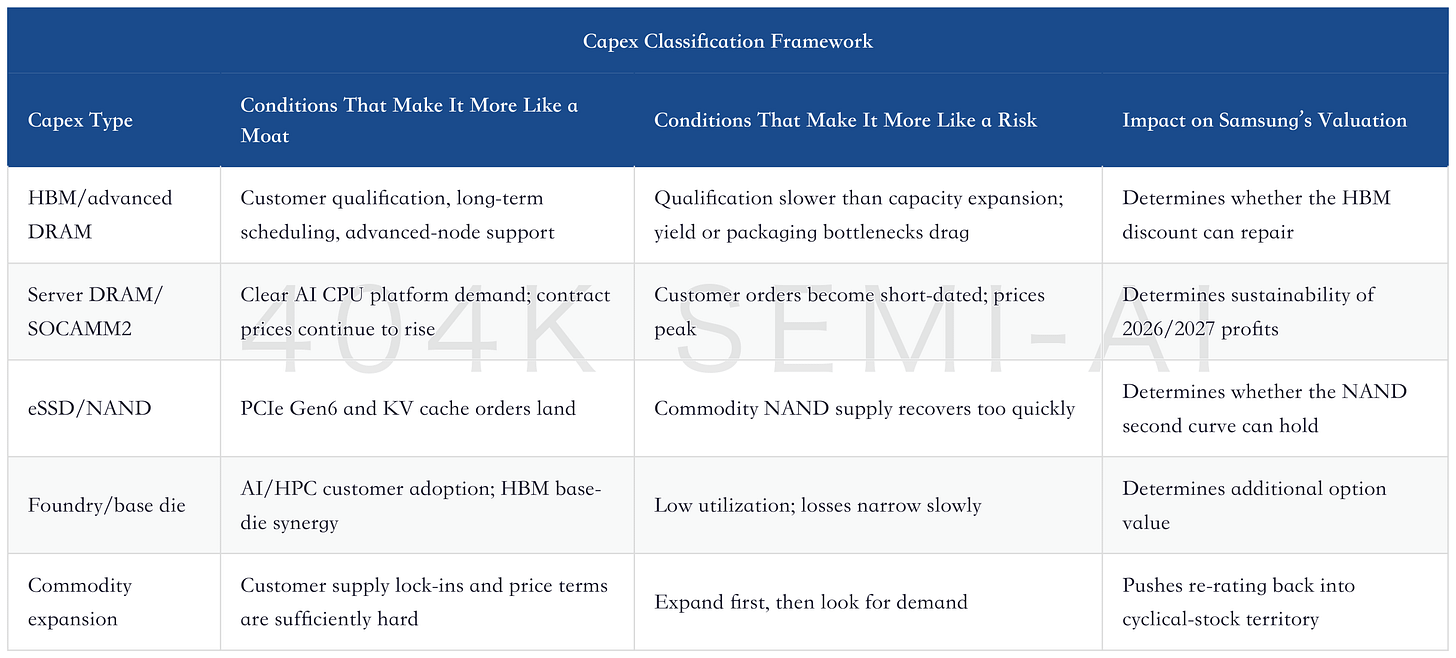
This table is the core of Samsung’s medium-term risk. Citi’s KRW 530,000 target price implies that the market is willing to believe some capex will serve high-end products and customer supply lock-ins. But that assumption must be validated by subsequent orders, not just by the company’s vision.
XIII. Second-Quarter Results: The Most Important Near-Term Reality Check
Citi forecasts Samsung’s 2Q26E operating profit at KRW 84 trillion, and expects 2Q26E DRAM/NAND ASP to rise 44%/57% QoQ. This quarter matters because it verifies three things at once: whether server DRAM price increases have flowed into the income statement, whether NAND/eSSD price increases have exceeded market expectations, and whether one-off factors such as bonuses and labor negotiations have masked the operating trend.
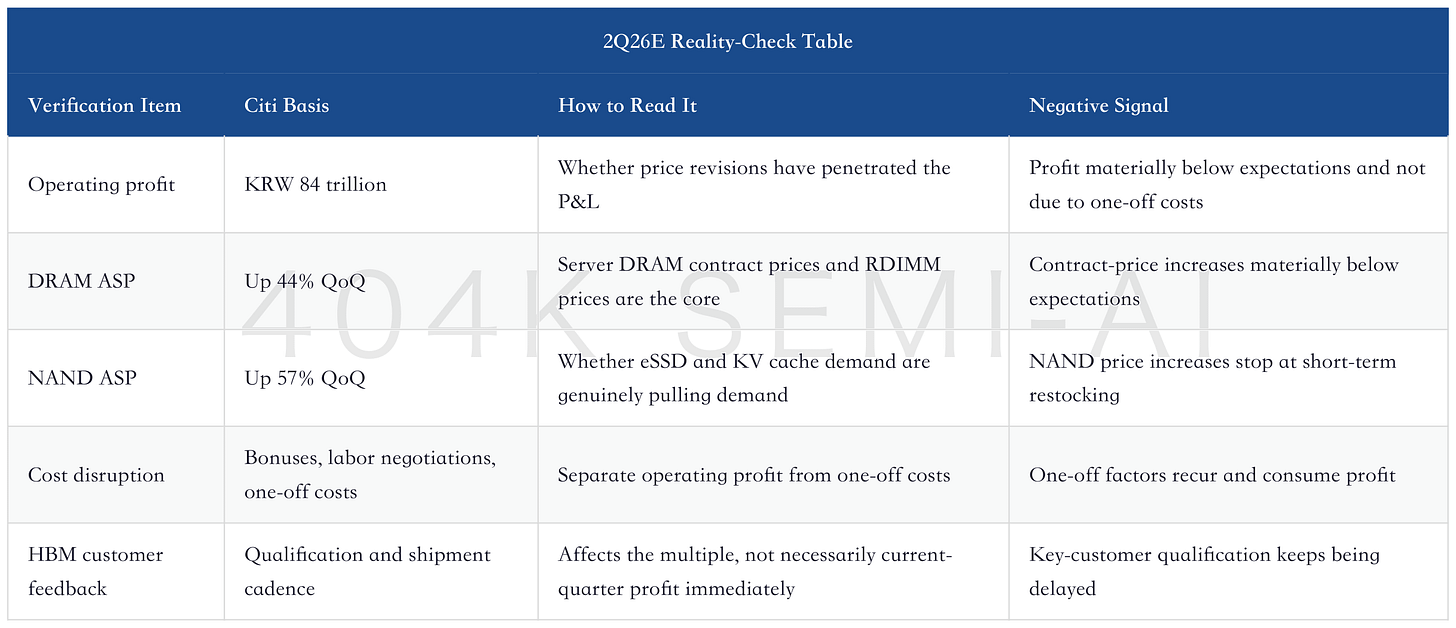
If second-quarter profit is merely strong, the market will continue to trade earnings upgrades. If profit is strong and the server DRAM and eSSD price slopes are also revised up further, Samsung will start moving closer to the “breadth asset” framework. If profit is strong but there is no progress in HBM qualification or customer supply lock-ins, the stock may rise more like a cyclical stock rather than because its valuation identity has changed.
Memory Deep Dive: AI Servers, LTA Contracts, and DRAM/NAND/HBM Margin Re-Rating
This is also the significance of LTAs and customer supply lock-ins. Short-term price increases can explain one quarter; contract quality explains the valuation center. If Samsung later discloses more customer advance supply commitments, long-term production scheduling, and price constraints, the market will be willing to extend part of 2026’s high profit into 2027.
XIV. The Bear Case: Why the KRW 530,000 Target Price Could Still Be Wrong
The strongest bear case is not that AI demand disappears. The stronger bear case is this: AI demand is very strong, but the market has already embedded extreme 2026/2027 profits into the valuation. If the verification sequence goes wrong, Samsung will revert to the cyclical-stock framework.
The first risk is delayed HBM qualification. Citi lists this as a major downside risk, which shows that even very strong server DRAM price increases cannot fully substitute for HBM’s role in the valuation multiple. If customers continue to treat Samsung as supplementary supply rather than a credible primary source, the market will compress high profits back into a cyclical discount.
The second risk is drag from PCs, smartphones, and conventional NAND demand. AI servers are very strong, but Samsung still has consumer-electronics exposure. If end demand weakens, inventories rise, or NAND prices peak, the market will question the eSSD second curve.
The third risk is heavier investment by competitors. Every memory supercycle stimulates capacity expansion. Once high profits ultimately turn into ordinary capacity, the market will view 2026/2027 earnings upgrades as peak earnings.
The fourth risk is FX and non-memory businesses. Korean won appreciation would reduce translated earnings, while smartphone competition and the display cycle could also affect group margins. Samsung’s breadth is an advantage, but it also means the company is never a pure single-factor asset.
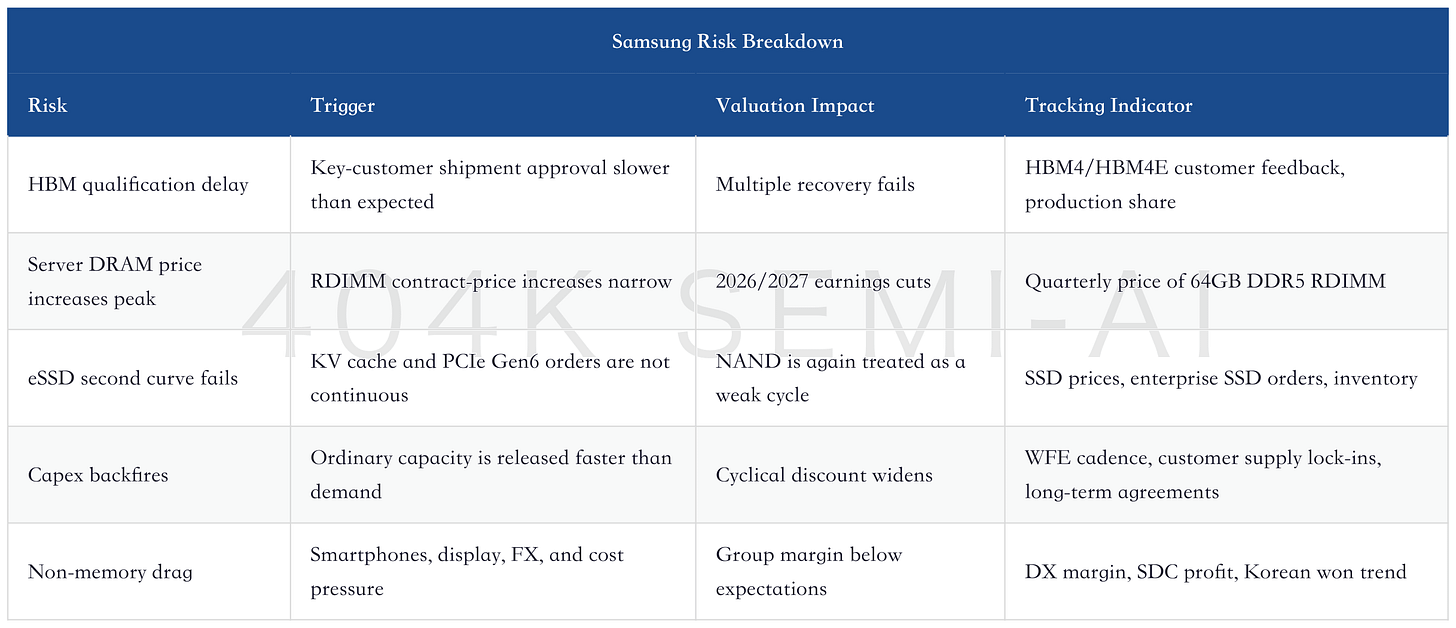
This table is also the discipline required to buy Samsung. A bullish view on Samsung cannot simply annualize every piece of good news; a bearish view cannot ignore the profit elasticity from server DRAM and eSSD just because Samsung is not the pure HBM leader. The real dividing line is whether verification can occur consecutively.
XV. Investment Dashboard for the Next Four Quarters
For Samsung, the most important things to watch next are not headlines, but four categories of indicators.
The first is server DRAM pricing. The quarterly price of 64GB DDR5 RDIMM is the central variable in Citi’s report. As long as it continues to move toward the USD 1,805 path, Samsung’s earnings upgrades will have financial-statement support. If the price slope suddenly slows, the profit assumptions embedded in the KRW 530,000 target price need to be discounted first.
The second is eSSD and NAND orders. For NAND to move from restocking into the AI inference data layer, the market must see enterprise SSD prices, PCIe Gen6 products, KV cache-related customer demand, and high-capacity product volume. If prices rise but orders do not appear, the second curve is unstable.
The third is HBM4/HBM4E customer feedback. This variable determines the multiple, not necessarily current-quarter profit. The market will accept Samsung’s near-term profit coming mainly from DRAM/NAND, but it will not accept Samsung being unable to prove long-term HBM customer share.
The fourth is capex and cash flow. In Citi’s model, 2026E free cash flow to shareholders is about KRW 228 trillion, and 2027E is about KRW 342 trillion. Cash flow this high has valuation value only if capex is disciplined, prices do not reverse, and customer supply lock-ins are sufficiently firm.
The Second Engine of the Memory Supercycle: CPU Return, HBM Spillover, and USD 1.7 Trillion TAM Re-Rating
This dashboard corresponds not to a one-off trade, but to a change in asset attributes. Server DRAM pricing determines near-term earnings, eSSD orders determine the NAND discount, HBM qualification determines the multiple, LTAs and capex determine the cycle center, and cash returns determine ultimate per-share value.
XVI. Conclusion: Samsung’s Update Validates the Continued Case for “Memory Breadth”
Samsung Electronics’ deep-dive update can be summarized in one sentence: Citi raised its target price to KRW 530,000 because it sees server DRAM and SSD pricing proving firmer than expected; what I care more about is whether that pricing resilience can continue to move Samsung from a “memory cycle stock” toward an “AI memory breadth asset.”
In the short term, 64GB DDR5 RDIMM, NAND ASP, SSD pricing, and 2Q26 operating profit matter most. They determine whether earnings forecasts can continue to be revised up, and whether the share price can first trade on profit elasticity.
In the medium term, HBM4/HBM4E qualification, SOCAMM2, PCIe Gen6 eSSD, and customer-linked supply commitments matter more. They determine whether the market is willing to shift part of Samsung’s earnings from cyclical peak profit to AI product profit and contracted profit.
In the long term, capital expenditure and cash returns matter most. The larger Samsung’s long-term investment scale becomes, the more it needs to prove that capital is being deployed into high-end capacity already locked in by customers, rather than ordinary supply expansion. The higher cash flow rises, the more it needs to prove that cash can translate into per-share value, rather than being absorbed by the next expansion cycle.
Samsung’s strongest investment scenario is one in which four things happen at the same time: server DRAM prices continue rising along Citi’s path, eSSD orders validate NAND’s second growth curve, HBM4/HBM4E qualification improves, and capital expenditure follows customer-locked orders. At that point, Samsung would not just be a low-P/E memory stock, but the broadest repricing asset in the AI memory chain.
Samsung’s weakest investment scenario is also clear: near-term pricing is strong, but HBM qualification is slow, eSSD orders are weak, long-term agreements lack firmness, and capital expenditure moves ahead first. In that case, the KRW 530,000 target price would become a peak-profit trade rather than a re-rating of asset attributes.
So the final conclusion of this update is not simply “bullish on memory.” A more precise investment conclusion is: Samsung is still not the purest HBM asset, but it may be the breadth asset most worth tracking in AI memory. By putting 64GB DDR5 RDIMM and SSD pricing at the center of valuation, Citi is giving the market a new angle: Samsung’s re-rating first comes from server DRAM and NAND pushing up the income statement, and then from HBM qualification, customer-linked supply commitments, and cash returns determining how much valuation those profits can retain.
References
Citi: Samsung Electronics (005930.KS): Resilient Memory ASP Uptrend to Support Sustained Earnings Growth, 2026-07-02.
Samsung Electronics: 1Q 2026 Earnings Presentation.
Samsung Electronics: 1Q 2026 reviewed financial statements, 2025 consolidated financial statements, and 2024 consolidated financial statements.
Multiple investment-bank research reports on Samsung Electronics’ 1Q26, 2Q26E, AI CPU demand, ASP upward revisions, long-term investment, and HBM validation.