
Contents
1. Topping the Charts in Two Weeks: Product Strength Amplified by Meta's Distribution
2. Post-Connect: Transforming Muse from a Standalone App into an Omnipresent Gateway
3. Connectors: Onboarding Merchants First, Keeping Take Rates Low
4. Three Monetization Paths: Material Revenue Pushed to 2027 and Beyond
5. Re-Routing Traffic: Travel, Grocery, Classifieds, and CPUs
Companies Impacted by Muse and Wall Street Views
6. Valuation: Target Price Discrepancies Driven by Multiples, Not Earnings
Meta Institutional Ratings and Valuation Methodologies
7. The Core Constraint: User Scale Inflates the Compute Bill
8. Key Metrics and Catalysts to Watch
This content is compiled from publicly available information and research reports. It does not constitute investment advice or represent any individual's views. For educational reference only; please read critically.
Muse topped the US app download charts within two weeks of launch, prompting four Wall Street firms to establish price targets between $775 and $920 around Meta Connect. While early download velocity and an expanding merchant roster validate its potential as a prime gateway, monetizing transactions via commissions will depend on user retention, partnership terms, and infrastructure compute costs.
1. Topping the Charts in Two Weeks: Product Strength Amplified by Meta's Distribution
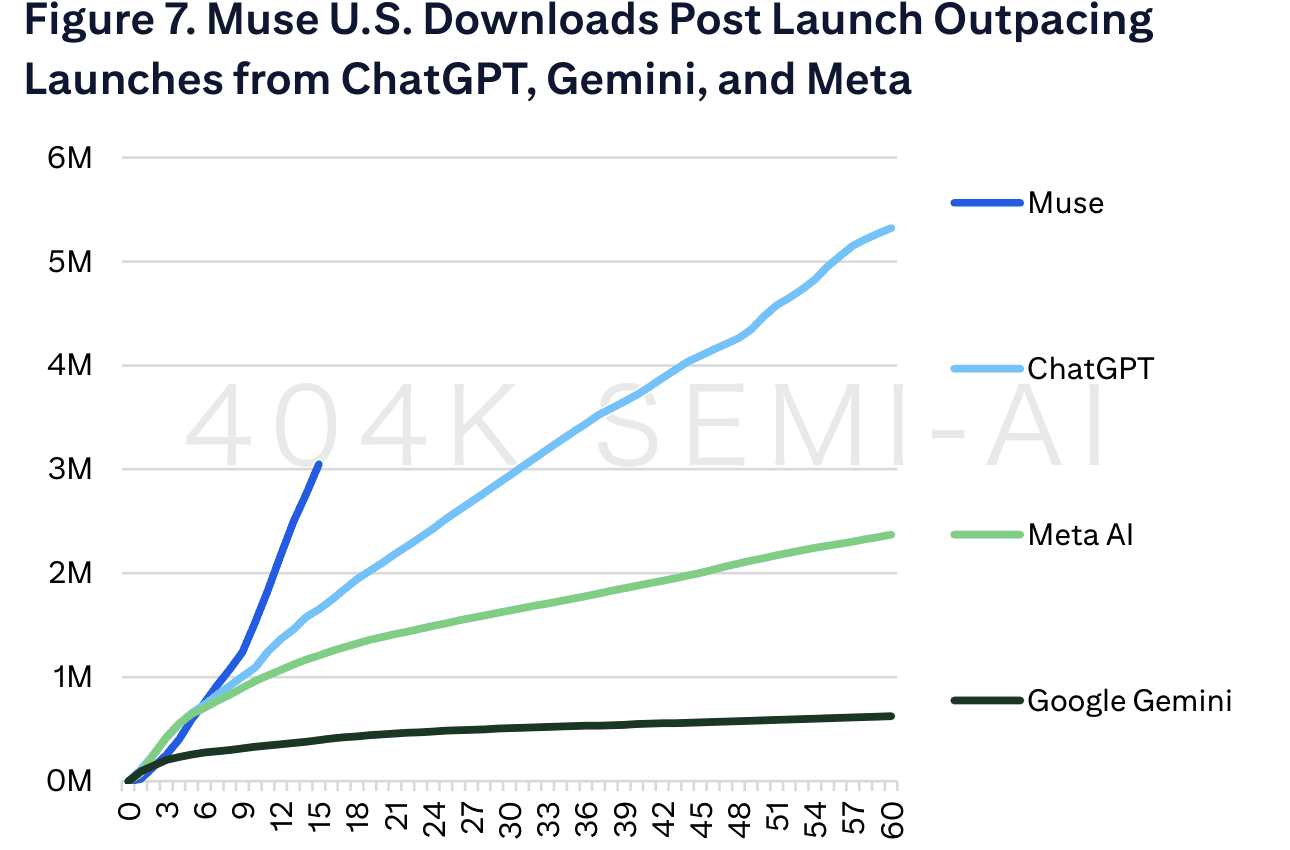
On September 8, Meta launched Muse, a personal AI agent. Unlike conversational Q&A; chatbots, Muse focuses on task execution: users delegate real-world workflows—such as booking restaurant tables, comparing prices and checking out, booking flights, or managing emails—and Muse executes them end-to-end within isolated cloud virtual machines by navigating web pages and applications. Within 10 days of launch, Muse surged to the top of the US App Store download rankings, overtaking ChatGPT on September 17. Citing Sensor Tower data, Citi noted that Muse generated roughly 3.1 million downloads and nearly 725,000 daily active users (DAUs) in the US during its first 15 days, with recent single-day US downloads outpacing those of Facebook, Instagram, WhatsApp, and Threads individually.
Capital markets responded swiftly. J.P. Morgan calculated that Meta shares rallied 21% in the two weeks following Muse's release, compared to a mere 1% gain for the S&P; 500. Around the Connect conference, several sell-side firms revised their views: J.P. Morgan reiterated its Overweight rating and $820 price target on September 22 before lifting it to $920 two days later; Morgan Stanley maintained its Overweight rating, Top Pick designation, and $775 price target; Citi reaffirmed its Buy rating and $800 price target; and Bernstein maintained an Outperform rating and $800 price target in its quarterly consumer AI tracker.
J.P. Morgan attributes this rapid ramp to three drivers:
First, product quality: Muse ranks among the best-in-class for autonomous agent task execution, offers intuitive onboarding, and emphasizes user privacy and security.
Second, a generous free tier: 100 million free tokens per week provides everyday users ample room for repeated experimentation. In contrast, SpaceXAI's Grok Bot charges over $30 per month, Google's Gemini Spark costs $20 per month, and Instinct, while free, remains waitlisted due to compute capacity limits.
Third, Meta's unmatched proprietary distribution: Meta heavily promoted Muse across ad inventory on Instagram and Facebook, offered 1 billion bonus tokens for friend referrals, and ran a nationwide US television ad campaign. Bernstein's checks corroborated this dynamic, noting that Muse's rapid customer acquisition was substantially fueled by Family of Apps cross-promotion and referral incentives.
Among these three factors, distribution is the hardest for competitors to replicate. Meta AI was already integrated across WhatsApp, Instagram, Facebook, and Messenger, boasting over 1 billion monthly active users (MAUs). Muse, by contrast, is a standalone app download. Meta can redirect billions of users toward a new portal primarily at the opportunity cost of its own internal ad inventory, whereas early-stage startups must spend substantial cash to acquire equivalent reach.
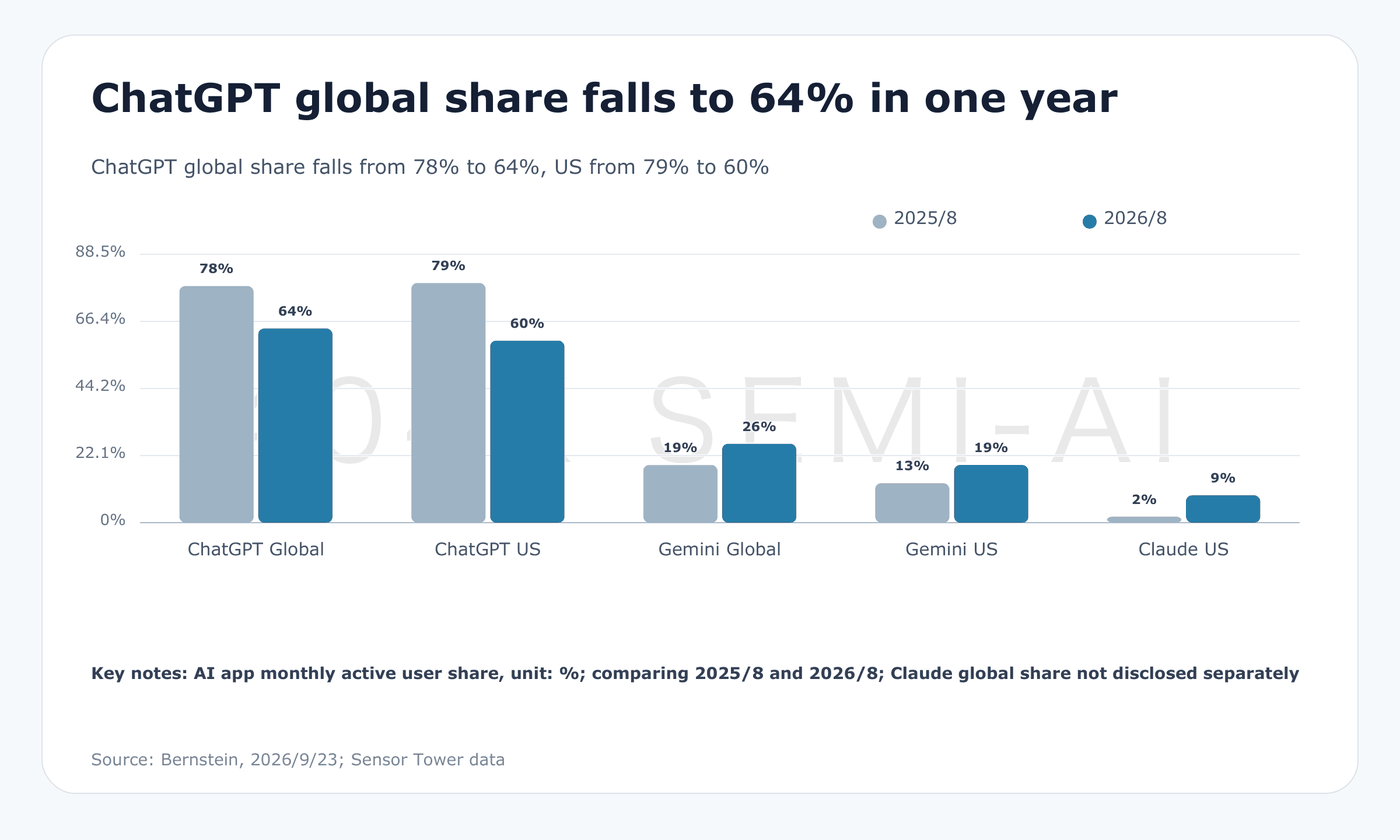
Muse is also entering a market that is far from locked up. Bernstein's tracking indicates that ChatGPT remains the undisputed leader in consumer AI, with over 1 billion weekly active users (WAUs) and an annualized ad run-rate of roughly $1 billion. However, from August 2025 to August 2026, ChatGPT's global MAU share among consumer AI apps declined from 78% to 64%, and its US share dropped from 79% to 60%, with year-over-year downloads turning negative beginning in April 2026. Over the same timeframe, Google Gemini's global market share rose from 19% to 26%, while Claude's US market share expanded from 2% to 9%. Users have not developed unshakeable loyalty to the first mover, creating a substantial opening for Meta to leverage its massive distribution flywheel.
While download velocity validates top-of-funnel appeal, it does not yet prove sustained habituation. The aforementioned download and DAU figures reflect third-party estimates rather than official company disclosures. Bernstein observes that engagement patterns across leading AI chat apps have stabilized at 14 to 17 minutes per day across 8 to 9 daily sessions, averaging 1.5 to 2 minutes per session. ChatGPT maintains a peer-leading DAU/MAU ratio of 40% to 45% and a 7-day retention rate of 25% to 30%. With Muse yet to disclose retention or engagement figures, Bernstein believes investor attention will rapidly rotate from raw app downloads toward 7-day and 28-day retention curves, WAU/MAU expansion, and the DAU/MAU ratio.
Bernstein's hands-on testing also highlighted functional limitations. Muse delivered inconsistent results on seemingly routine tasks like hotel reservations. Furthermore, user privacy concerns regarding Meta's data harvesting have led some users to withhold deep system permissions, substantially curtailing agent capabilities. Finally, users already accustomed to ChatGPT, Claude, or Gemini may hesitate to adopt another assistant. Once the initial novelty fades, these friction points will directly manifest in retention metrics.
2. Post-Connect: Transforming Muse from a Standalone App into an Omnipresent Gateway
The clearest signal from Meta Connect was the elevation of Muse to the core of Meta's entire AI portfolio. Citi noted that the most significant takeaway from the conference was Meta's ambition to position Muse at the center of daily life as a "Personal Super Agent." J.P. Morgan highlighted five newly unveiled capabilities for Muse: voice and real-time video, seamless integration with Meta smart glasses, native execution on Mac desktop environments, dedicated Muse email addresses, and an upcoming confidential virtual machine architecture with enhanced privacy safeguards. Citi added that Muse can now place real-time outbound voice calls to US merchants using personalized voices, with Meta also testing a "human concierge" service. Morgan Stanley highlighted that Muse voice capabilities are slated to roll out within weeks, with geographic expansion beyond the US and Canada coming shortly; over the long run, dedicated Muse email addresses could begin diverting user workflows away from Gmail.
Hardware represents the second pillar of this gateway strategy. According to J.P. Morgan, Reality Labs has pivoted toward engineering wearable form factors purpose-built for Muse and personal superintelligence. Smart eyewear remains the single largest opportunity, addressing a global population of more than 2 billion people who wear corrective lenses. By year-end, Meta will offer more than 100 styles across the Ray-Ban, Oakley, and Meta Glasses brands. New hardware includes:
Ray-Ban Meta Audio: 43 grams, priced at $349, shipping October 13 (Meta's first eyewear without a built-in camera).
Third-generation Ray-Ban Meta: Battery life extended from 8 to 9 hours, priced at $449.
Meta Adventurer: An entry-level model priced at $249.
Muse Charm: A palm-sized device featuring an approximately 2-inch display and integrated 5G connectivity, scheduled to launch ahead of the December holiday shopping season.
The biggest surprise was the announcement of the Meta VR Glasses. Weighing roughly 100 grams—just one-fifth the weight of the Quest 3—the device offloads processing and battery power to an external puck that clips to the user's waistband. Muse is natively integrated into the operating system, with over 75 launch games and certification as the first IMAX Enhanced VR device. The headset is scheduled to ship in spring 2027 at a retail price of $1,299. Morgan Stanley conceded that while it and most institutional investors have historically been skeptical of Meta's AR/VR initiatives, the substantial leaps in form factor and functionality position this product as a potential upside catalyst for 2027 that is completely unpriced in current equity valuations.
