
目录
1. The Market Recognizes the High Profits; the Debate Is How Many Years They Can Last
2. Lower Memory Configurations May Signal Either Shortages or Demand Destruction
Token Growth Still Requires a Procurement Conversion
Cloud Capital Expenditure Must Be Supported by Revenue
III. Supply Expansion Must Be Assessed in Effective Bits, Not Capex Alone
The Impact of Chinese Supply Must Be Assessed Market by Market
IV. Long-Term Contracts Can Reduce Volatility, but Protection Depends on Pricing and Exit Terms
5. Conventional DRAM Price Increases Are Critical to Earnings Forecasts for Both Companies
The Same Price Increase Benefits the Two Companies Differently
Won Appreciation Will Offset Part of the Benefit from Higher Prices
VI. Earnings Must Pass the Cash Test to Support Shareholder Returns
Cash Available for Distribution Is Not the Same as Cash Ultimately Distributed
VII. Price Targets Depend on Both Sustained High Earnings and Multiple Expansion
First Determine What the Current Price Already Assumes
Three Operating Paths Will Determine How Valuations Evolve
Update Six Sets of Operating Data First After the Next Release
本内容基于公开资料和研报数据整理,不构成任何投资建议,不代表任何个人观点,仅供学习参考,请理性阅读
Samsung and SK hynix’s low valuations reflect doubts over how long elevated profits can last. Memory shortages, long-term contracts, and cash returns could extend the boom, but conventional DRAM pricing, the Korean won, and the pace of capacity expansion will determine how long Nomura’s bullish forecasts hold.
1. The Market Recognizes the High Profits; the Debate Is How Many Years They Can Last
Nomura’s disagreement with the market centers on the durability of memory manufacturers’ future earnings. Its September 3, 2026 global memory research remained bullish on Samsung and SK hynix, arguing that shortages could persist through 2028. At the same time, Nomura cut its target price-to-book multiples for both companies, acknowledging that higher interest rates and declining returns on equity would reduce fair valuations. An optimistic earnings outlook and multiple compression can occur simultaneously.
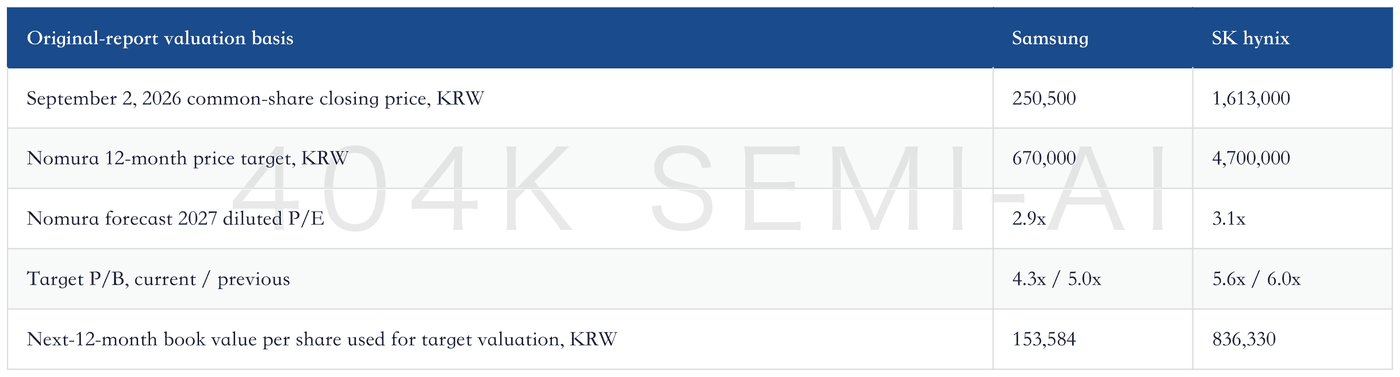
The original report used the September 2 closing prices of the companies’ Korean common shares as its baseline: KRW250,500 for Samsung and KRW1,613,000 for SK hynix. Its 12-month price targets were KRW670,000 and KRW4,700,000, respectively, implying upside of 167.5% and 191.4%. These are model-derived targets and differentials, not realized returns or September 7 real-time market prices.
Such large gaps require exceptionally strong assumptions. Samsung trades at just 2.9x Nomura’s forecast 2027 diluted earnings, while SK hynix trades at 3.1x, but both multiples use Nomura’s exceptionally high full-year profit estimates. The SK hynix discussion separately cites a 2.8x next-12-month P/E, which covers a rolling period rather than calendar 2027. Before calling either stock cheap, investors must identify exactly which earnings period forms the denominator.
A low P/E can mean two entirely different things. If elevated profits persist for several years and the companies return a substantial portion to shareholders, current prices may undervalue their cash-generation capacity. If earnings quickly normalize at much lower levels, the low multiples merely reflect the market discounting the post-boom decline in profits. Next year’s P/E alone cannot distinguish between these scenarios.
Nomura’s argument has three steps. AI infrastructure procurement continues to expand while capacity cannot respond quickly, keeping prices strong. Long-term purchase agreements improve visibility into future orders and pricing, making elevated profitability more sustainable. Finally, accumulated cash, dividends, and buybacks deliver returns to shareholders, giving the market reason to accept higher valuations. If any of these three links weakens materially, the price targets must be recalculated.
The market’s concerns also have operational foundations. Chip customers can reduce specifications, software can become more efficient, new capacity will eventually enter production, and excessive pricing can suppress end demand. Even if these developments have not yet reduced current-quarter earnings, they can affect how much investors are willing to pay today for profits three years from now. Share prices need not wait for year-over-year earnings declines before adjusting.
The key test for the report is therefore where profits settle after growth slows. Operating-profit growth decelerating to 10%—20% would produce a very different outcome from operating-profit growth turning negative. The former could still support sustained cash accumulation; under the latter, capacity expansion, depreciation, and inventory could amplify the downturn. Treating both scenarios simply as a “cycle peak” obscures the most valuable point of disagreement.
The evidence in this research should also be weighted according to its quality. Reported quarterly results can be verified; product shipment and pricing forecasts require confirmation from subsequent deliveries; and the binding force of long-term contracts depends on their specific terms. Their inclusion in the same report does not make them equally certain. The analysis below therefore proceeds through procurement, supply, contracts, profits, and cash, identifying the conditions required at each step.
2. Lower Memory Configurations May Signal Either Shortages or Demand Destruction
The effect of a configuration reduction on industry demand depends on whether the freed memory is used in additional devices. Nomura interprets lower HBM stack specifications in some AI hardware as a reallocation of scarce supply. HBM is memory positioned close to compute chips to provide high bandwidth; its capacity, speed, and available supply all constrain computing-system configurations. Reducing memory per system can sometimes allow more systems to ship on schedule.
Pages 1—2 of the original report estimate that approximately 70%—80% of data-center customer demand is being fulfilled, versus roughly 50% for other customers. This is Nomura’s estimate of supply-demand tightness, not an industry-wide, officially reported order-fulfillment rate. It supports the directional conclusion that customers may be competing for limited supply, but it does not prove that every unfulfilled order will eventually be recovered in full.
A simple volume calculation illustrates why lower configurations can have different consequences. Assume that 100 servers were originally scheduled for delivery, each with 10 standardized units of memory, implying total demand of 1,000 units. If the configuration falls to 8 units and deliveries remain at 100 servers, total demand declines by 20%. If deliveries increase to 125 servers, total demand remains at 1,000 units. This is only an illustration: the critical variable is the actual number of systems delivered, and no conclusion can be drawn from per-system specifications alone.
Whether demand is deferred also depends on whether the underlying work must be completed. If a cloud provider already serves paying customers and insufficient compute capacity would sacrifice revenue, it has an incentive to postpone rather than cancel procurement that cannot currently be fulfilled. If an application lacks stable paid demand, expensive hardware or extended lead times may cause the project to be canceled. The former creates a backlog; the latter is a permanent loss. They cannot be combined into a single “potential demand” figure.
Consumer electronics face more direct constraints. Smartphones and PCs must fit within consumers’ total device budgets, so manufacturers may absorb higher memory costs or pass them through through price increases or reduced specifications. If consumers extend replacement cycles, each lost device sale eliminates not only memory capacity but also every other component that would have been installed in the device. AI customers’ willingness to raise procurement budgets does not prove that non-AI customers have the same capacity to absorb higher costs.
Assessing whether the shortage is healthy therefore requires monitoring two sets of signals. Longer supply lead times and higher contract prices indicate that deliveries remain constrained. End-market shipments, cloud revenue, and equipment utilization show whether these higher-priced products are creating sufficient value. If only upstream quotations rise while downstream volumes and actual usage weaken, the shortage may be consuming future demand.
Token Growth Still Requires a Procurement Conversion
Growth in model usage can support the case for rising memory demand, but it cannot independently justify higher procurement spending. The original report notes that complex tasks consume more tokens than simple queries, illustrating how AI usage could become more compute-intensive. A token is a unit used by models to process text and other information, but translating token volume into memory procurement still requires assumptions about model size, concurrency, processing speed, caching, and system utilization.
A doubling of token volume could be handled by adding servers or by raising utilization on the existing installed base. Model compression and improved scheduling can reduce resource consumption per task, while longer contexts, more complex reasoning, and higher concurrency increase it. Actual procurement depends on the net effect of these opposing forces and the remaining headroom in existing equipment.
A more defensible conversion begins by estimating paid workloads and peak concurrency, then calculating the capacity and bandwidth required per unit of work, and finally subtracting available capacity in the installed base. Once incremental hardware demand is established, it must still be multiplied by actual configurations, procurement prices, and supplier market shares. Skipping any step risks turning excitement about technology usage into an exaggerated estimate of supplier revenue.
This also limits claims about an efficiency rebound. Lower costs per task may encourage additional usage, but that incremental usage must have customers and budgets—and ultimately exceed the per-unit savings—to increase total procurement. “Higher efficiency may create more demand” cannot be treated as a self-validating rule. The most valuable evidence for memory suppliers would be customers raising procurement volumes even after optimization, or choosing higher configurations within unchanged budgets.
Cloud Capital Expenditure Must Be Supported by Revenue
The durability of AI investment ultimately depends on whether customers can generate returns from the equipment. Page 4 of Nomura’s report cites a consensus forecast of 30%—40% growth in cloud-provider capital expenditure in 2027 and also discusses faster growth in new hardware orders. These figures measure different things: total capital expenditure includes land, buildings, and supporting infrastructure, while new hardware orders may not be paid for or delivered in the same period. They cannot simply be multiplied to derive memory-market growth.
The composition of capital expenditure can also shift. Customers may cut other projects and allocate more capital to servers, or rising spending on power and buildings may crowd out hardware budgets. Higher memory prices can increase suppliers’ revenue per unit while reducing the capacity customers can purchase with the same budget. The report’s optimism about pricing must therefore be tested against customers’ budget constraints.
Nomura expects subsequent results from major cloud providers to demonstrate that AI investment is converting into revenue and profit. This is a reasonable test, but revenue growth must still be assessed against depreciation, energy costs, and incremental investment. If higher cloud-service revenue depends on higher capital expenditure to be sustained, long-term purchasing power may not improve proportionately. More compelling evidence would combine greater paid usage, stronger cash generation, and continued management confirmation of equipment demand.
The earliest potential counter-signal would be a widening gap between procurement commitments and actual usage. Equipment remaining idle for extended periods after delivery, lower renewal pricing, or customers delaying acceptance would indicate demand problems more directly than a single product configuration reduction. Conversely, if specifications decline but total system deliveries, paid usage, and next-period procurement all increase, the evidence would more closely support Nomura’s shortage-driven reallocation thesis.
