
Kingboard Laminates Deep-Dive Update: Citi Raises Target Price 7 Times in Two Months; July CCL Up Another 15%, Copper Foil Profit Expands
目录
Too Long; Didn’t Read
I. Core of the July Update: Seven Target-Price Hikes in Two Months, With Price Increases Covering Electronic Fabric, Copper-Clad Laminate, Prepreg, and Copper Foil
II. From HK$120 to HK$130: The Difference Is Not the Multiple, but Further 2026-2028E Earnings Upgrades
III. The 1H26E Positive Profit Alert Is the First Checkpoint: Not Whether There Is a Profit Alert, but How Steep the Price Curve Is
IV. The Real Bottleneck in Electronic Fiberglass Fabric Shortage Is Looms and Customer Qualification
V. The Real Meaning of the T-Glass Delay: Prioritizing Core CCL, Not Chasing the Loudest AI-Fabric Label
VI. Copper Foil Profit Expansion Is the Second Curve: HVLP3 Delivers Real Profit, HVLP4 Provides a 2027 Option
VII. The Baseline From the Official Annual Report: Integration Already Appeared in the 2025 Financials
VIII. Peer and Prior-Article Comparison: Kingboard Is Buying an Integrated Bottleneck, Not a Pure AI Label
IX. Valuation Scenarios: HK$130 Is Anchored by Earnings, Not Unlimited Multiple Expansion
10. Falsification Checklist: Watch These 10 Numbers Over the Next Four Quarters
11. Profit Bridge: From the 2025 Double Tailwind to a High-Gross-Margin Cash-Flow Platform in 2028
XII. Three Misreadings: Treating Kingboard as a Pure Cyclical, Pure AI-Fabric, or Pure Target-Price Trade Will Distort the View
XIII. Conclusion: July Price Hikes Are Not the End Point, but Kingboard’s Second Test in Moving from Cyclical Recovery to Cash-Flow Re-Rating
本内容基于公开资料和研报数据整理,不构成任何投资建议,不代表任何个人观点,仅供学习参考,请理性阅读
Citi has raised its target price for Kingboard Laminates seven times in two months, with the latest anchor moving from HK$43 to HK$130. In July, profit assumptions for copper-clad laminate, prepreg, and copper foil processing were all revised upward. The real test is whether price hikes can settle into gross margin and cash flow in 2026-2028. The 1H26 positive profit alert and August interim results will provide the answer.
Too Long; Didn’t Read
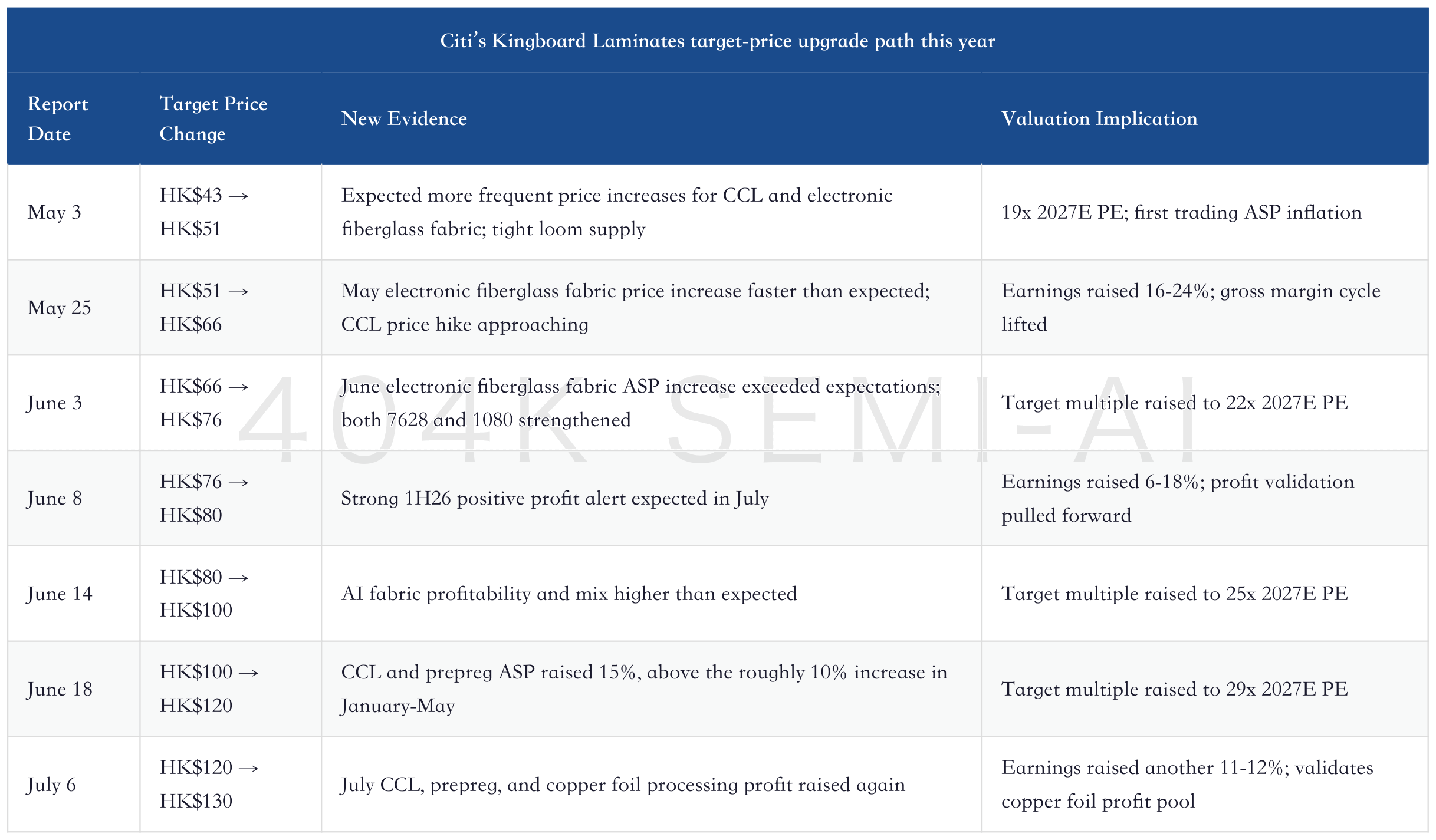
Seven target-price hikes in two months are not simply price chasing. Citi lifted its Kingboard Laminates target price from HK$43 in early May to HK$130, via HK$51, HK$66, HK$76, HK$80, HK$100, HK$120, and HK$130. Each revision corresponded to a new layer of evidence, expanding from electronic fiberglass fabric and CCL to AI fabric, prepreg, and copper foil processing profit.
This model upgrade is concentrated in margins. Citi raised 2026-2028E net profit again by about 11-12%, lifting 2026E revenue to HK$40.803 billion, net profit to HK$9.607 billion, and the gross margin assumption to 36.3%. The implication is not merely slightly higher revenue, but that annual average CCL ASP has been pushed to HK$250 per sheet, with material price increases potentially retained at the profit line.
Copper foil is shifting from a supporting material to a profit pool. Kingboard’s current copper foil monthly output is about 9,000 tons. Citi estimates monthly net profit from copper foil could reach HK$230-250 million, contributing 20-25% of 2026E profit for the full year. HVLP3 has already become real profit within the AI server materials narrative. HVLP4 and Vera Rubin certification are still not in the model, making them the most important upside options after 2027.
Looms look more like the near-term bottleneck than furnaces. The bottleneck for electronic fiberglass fabric and AI fabric is not only glass yarn furnaces. The real constraint on effective supply is the looms that weave fiberglass yarn into fabric. Kingboard, China Jushi, Grace Fabric, and other manufacturers mainly rely on Toyota automatic looms, while second source Tsudakoma is weaker in efficiency and scale. Kingboard’s plan to allocate more of the 400 additional Toyota looms in 2026 to e-glass fabric shows the company is prioritizing core CCL supply rather than blindly chasing the AI fabric story.
The T-glass delay is not bad news. The new T-glass furnace has been delayed by about two months to August. On the surface, this slows the pace of high-end AI fabric. In substance, the company is prioritizing resources for the core CCL chain, where absolute gross profit is higher and the cost of customer supply disruption is greater. E-glass fabric gross margin is above 50%, while AI fabric gross margin can reach above 50-70%. But fabric ASP is far below CCL, so maximizing group profit does not necessarily mean expanding AI fabric first.
The valuation validation window has compressed to six weeks. A potential 1H26E positive profit alert in mid-July, interim results in mid-August, the spread between F139 and market transaction prices in July-August, the pace of Toyota loom arrivals, and copper foil processing profit will all directly test the HK$130 target price. If 1H26E net profit approaches HK$4.02 billion and full-year gross margin moves toward 36.3%, the market will continue to price against the 2027 profit anchor. If prices rise but profit does not, the trade will revert to a highly volatile cyclical-stock framework.
I. Core of the July Update: Seven Target-Price Hikes in Two Months, With Price Increases Covering Electronic Fabric, Copper-Clad Laminate, Prepreg, and Copper Foil
Kingboard Laminates is not simply repeating the June price increase. From May 3 to July 6, Citi published seven consecutive single-stock updates, raising its target price from HK$43 to HK$130. The core in June was CCL and prepreg rising alongside electronic fiberglass fabric. The new information in July is that price increases have spread from FR4, CEM, and prepreg to copper foil processing profit. Citi therefore raised 2026-2028E earnings again by 11-12% and lifted its target price from HK$120 to HK$130.
The market can easily read this kind of report as “another target-price hike.” More important is that the source of the upgrade has changed. The early-May upgrade mainly bet on more frequent ASP inflation. By late May, electronic fiberglass fabric and CCL profit improvement began to be confirmed. In June, AI fabric, a positive profit alert, and a second CCL price increase were incorporated into the model. In July, copper foil processing profit and 1H26E profit validation were brought in together. In other words, price increases have moved from localized pricing actions into the validation stage of whether they can form a 2027 profit anchor.
Breaking down the July pricing actions, there are at least three implications. First, FR4 CCL ASP rose another 15%, showing that mainstream core copper-clad laminate remains in an upward repricing phase. Second, CEM CCL rose 10% and prepreg rose 15%, showing that price increases are not a localized event in a single high-end product, but a sign of broad tightness across the materials chain. Third, unit processing profit for 1.5oz and 2oz copper foil was raised, meaning upstream material profit is beginning to enter the model directly, rather than merely serving as a rationale for CCL price increases.
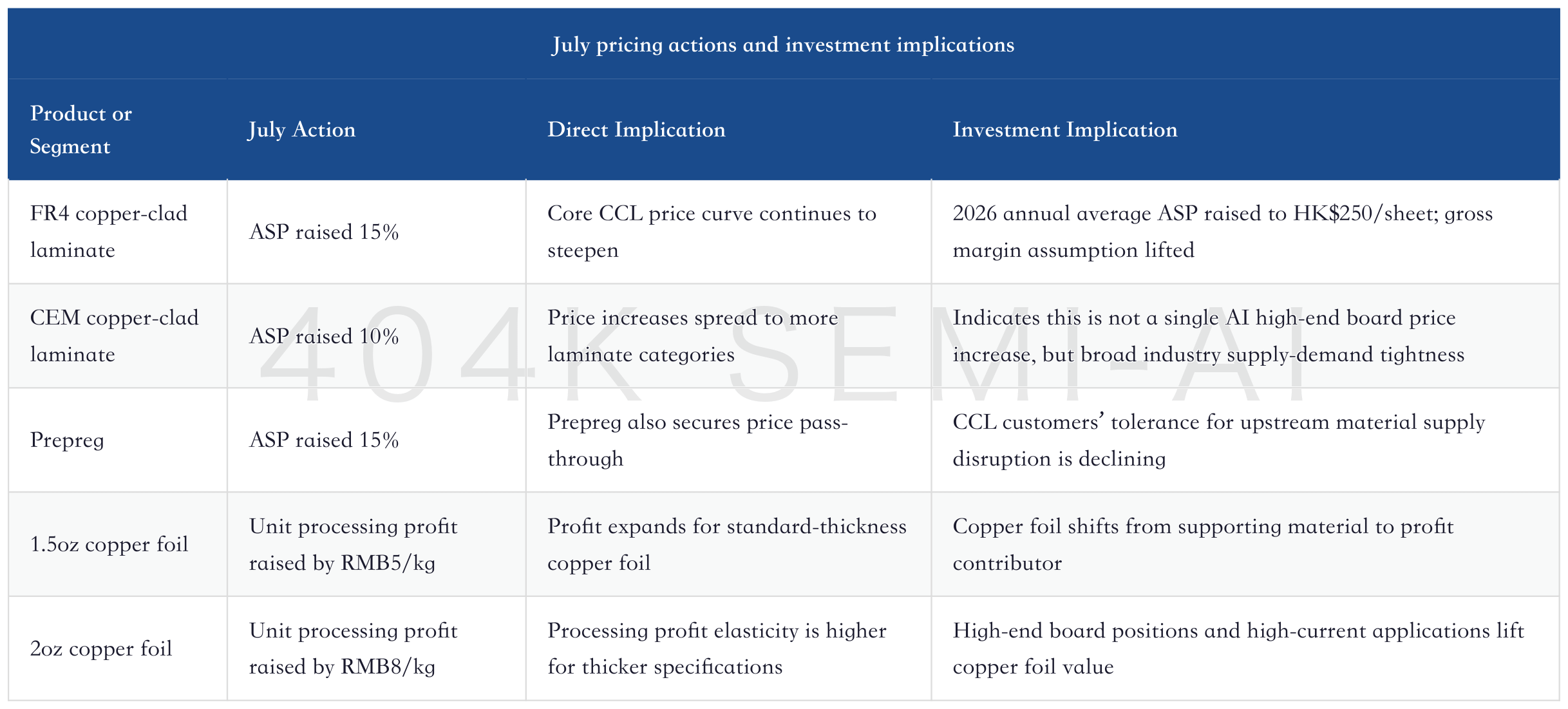
The key point in this table is not how much each category increased, but the horizontal coverage of the price increases. If only electronic fiberglass fabric rises, Kingboard earns upstream bottleneck profit. If only CCL rises, Kingboard earns cyclical pricing. Now that fabric, laminate, prepreg, and copper foil are all moving together, Kingboard is earning the supply-security premium of the AI server materials chain.
This is also why a share-price pullback cannot simply be equated with deteriorating fundamentals. Citi attributes the recent pullback to crowded AI hardware trades, sentiment around delays in Nvidia-related new platforms, rumors of Meta selling surplus compute capacity, and Hallgain’s stake reduction. For trading prices, all of these affect risk appetite. For medium-term value, the more important question is whether prices, gross margin, and cash flow continue to materialize according to the model. What Kingboard most needs to prove now is not “whether the market is still willing to chase AI hardware,” but “whether customers remain willing to embed material price increases into delivery costs.”
II. From HK$120 to HK$130: The Difference Is Not the Multiple, but Further 2026-2028E Earnings Upgrades
The same broker raised its target price for Kingboard Laminates from HK$120 to HK$130 in less than three weeks. On the surface, that is only HK$10 higher; in substance, the model anchor has extended from “June CCL price hikes” to “July price hikes across the full chain and copper-foil profit expansion.” This is not the right place to rank target prices across institutions, because different dates, price bases, and share-count assumptions create comparability issues. But for the same broker, the same security, and a short-cycle model update, the changes are enough to show where assumptions have shifted.
Between June 18 and July 6, Citi raised its three-year revenue and net-profit baselines, with net profit revised up by much more than revenue. This shows that the core model change is not “selling more,” but prices and product mix allowing more revenue to flow through into gross profit.
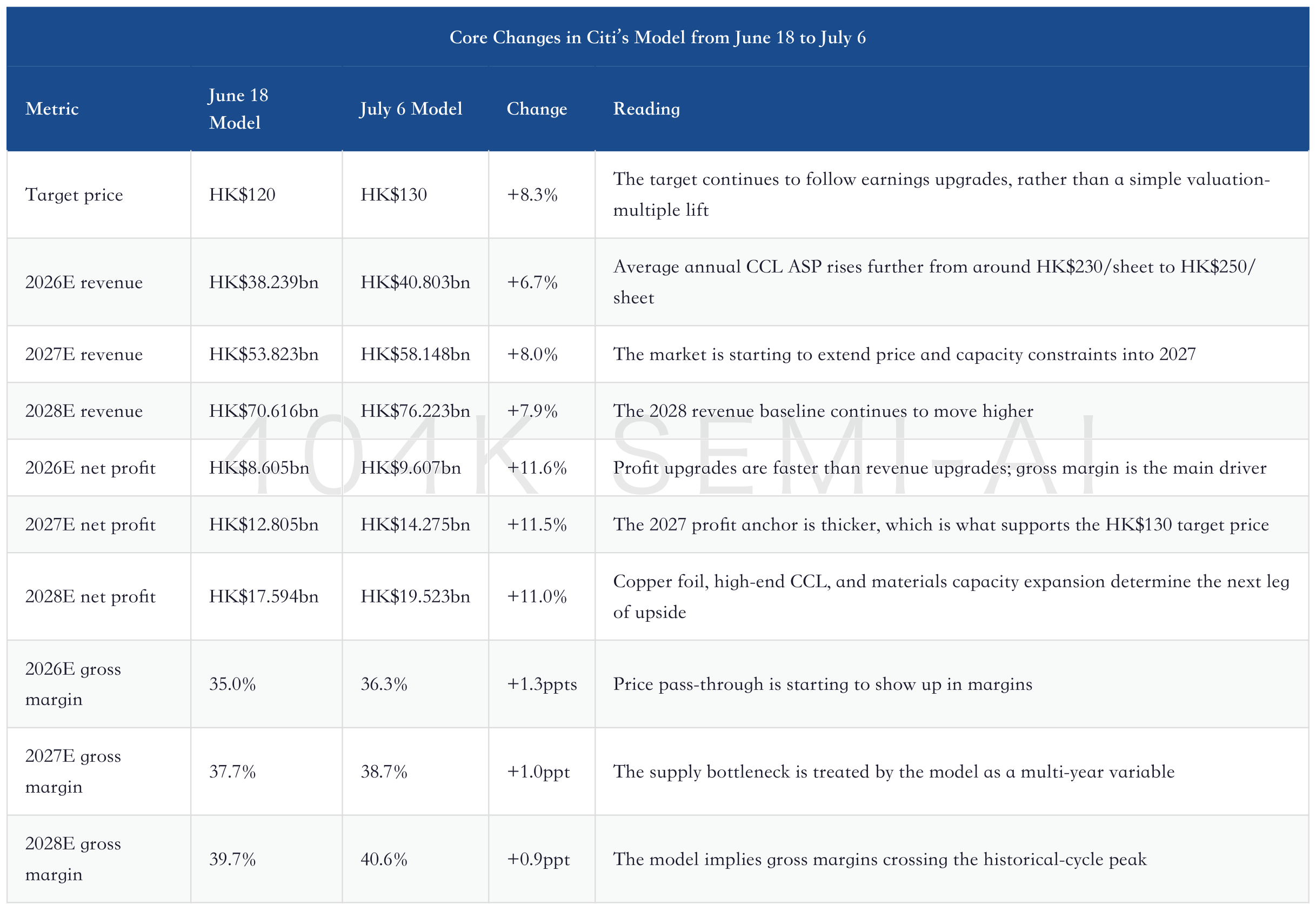
The conclusion from this table is straightforward: Kingboard Laminates’ re-rating is not being driven by forcibly lifting the PE multiple, but by the denominator in the income statement continuing to expand. Based on prices near the July 6 close, Citi’s model implies that valuation should be significantly absorbed over the next few years as earnings are released. If 2027E net profit materializes, the market will reclassify Kingboard Laminates from an ordinary cyclical stock into an AI materials cash-flow asset.
Kingboard Laminates Deep-Dive Update: AI Fabric Pushes CCL Cyclicals Toward a Materials Bottleneck, and the Earnings Re-Rating Behind the HK$100 Target Price
The real risk is that continued target-price upgrades have compressed the time window for subsequent validation. 2026E gross margin of 36.3%, 2027E gross margin of 38.7%, and 2028E gross margin of 40.6% are not mild recovery assumptions. They are a combined assumption that the materials bottleneck persists, customers accept price hikes, and capacity releases do not break pricing. If any one of these is contradicted, valuation will correct before earnings do.
III. The 1H26E Positive Profit Alert Is the First Checkpoint: Not Whether There Is a Profit Alert, but How Steep the Price Curve Is
Kingboard Laminates’ possible 1H26E positive profit alert in mid-July is the nearest validation point for this trade. Citi expects the company’s first-half revenue to nearly double and net profit to surge, and has slightly raised its earnings forecast. This upgrade comes from actual transaction prices for electronic fiberglass fabric remaining above public data points, driven by severe shortages and genuine transaction pressure after channel inventory depletion.
If the positive profit alert is close to these figures, the market will receive two signals. First, the July price hikes are not paper quotations, but have already entered 1H26 profit through the 2Q price curve. Second, after channel inventory began to deplete rapidly in December 2025 and essentially bottomed by early 2Q26, the price-hike slope has become much steeper, with customers no longer having sufficient inventory buffers.
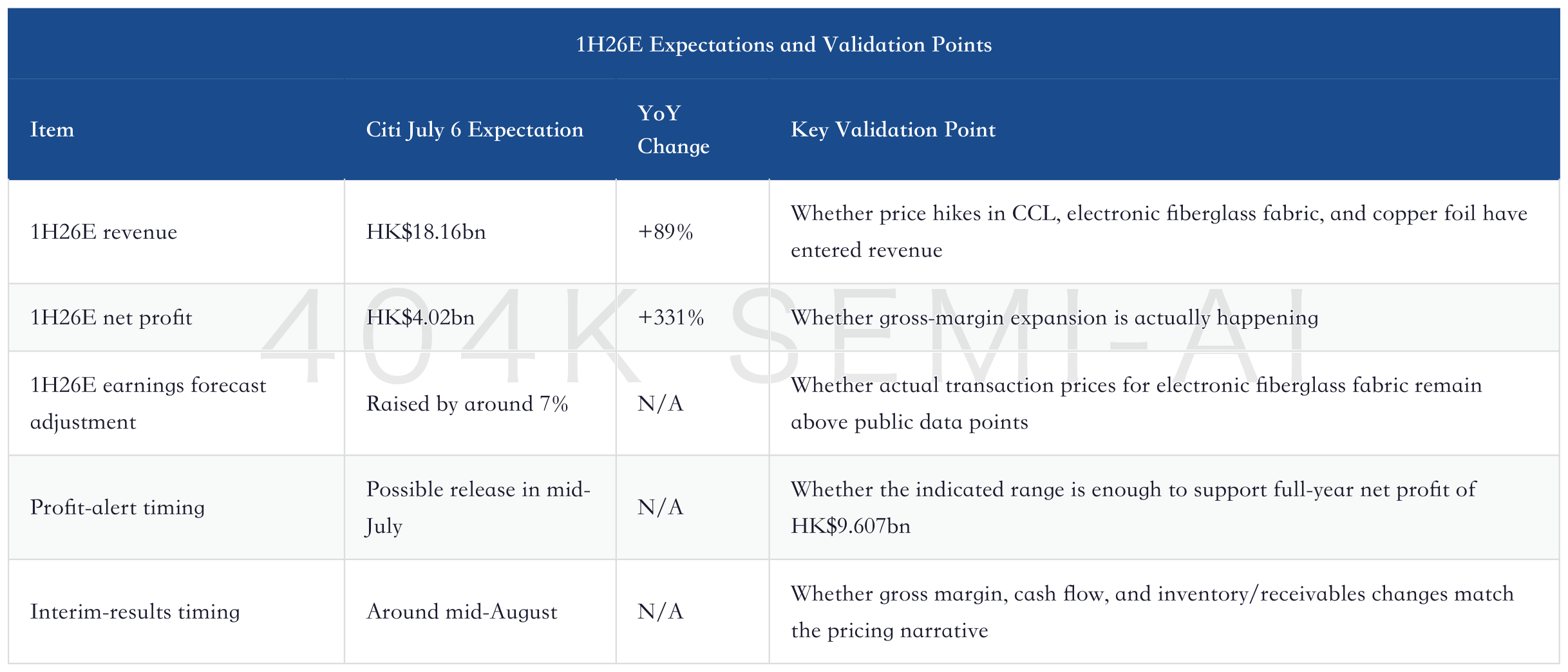
It is important to note that the positive profit alert itself is not the endpoint. If the alert shows high net profit but deterioration in receivables, inventory, and cash flow, the market will worry about earnings quality. Only if the alert shows high profit, high gross margin, and operating cash flow keeping pace will it indicate that price hikes are not accounting quotations, but real customer acceptance. Kingboard’s 2025 annual report already showed that demand from AI data centers, robotics, computing power, and other areas drove demand for copper-clad laminates and upstream materials, with both product ASPs and sales volumes rising. If 1H26 continues along this path, high profit growth will be sustainable.
This is also the biggest difference from ordinary cyclical stocks. A positive profit alert from an ordinary cyclical often comes from the inventory cycle and price elasticity, and may turn into a high-level pullback in the next quarter. If Kingboard can show spread expansion in electronic fiberglass fabric, CCL, and copper foil at the same time in its 1H26 interim report, the market will read the positive profit alert as the beginning of a new materials constraint, not the end of the cycle.
IV. The Real Bottleneck in Electronic Fiberglass Fabric Shortage Is Looms and Customer Qualification
Electronic fiberglass fabric remains the first layer with the greatest earnings upside for Kingboard Laminates in 2026. In 2025, profit from Kingboard’s electronic fiberglass yarn and fabric business exceeded HK$600mn, up 70% YoY. The company’s annual report explicitly disclosed that high-end applications such as AI servers, 5G/5.5G, and IC package substrates drove a sharp increase in demand for specialty electronic fiberglass yarn and fabric. Some traditional capacity shifted toward AI-related products, creating tight supply of traditional electronic fiberglass yarn and fabric. This logic has not ended in 2026; it has become steeper as inventory has bottomed.
But interpreting electronic fiberglass fabric as a problem that can be solved simply by “building more furnaces” underestimates the near-term bottleneck. Glass yarn is only the first step. Weaving yarn into different specifications of electronic fabric, with stable quality and meeting low-Dk/low-CTE and AI board requirements, depends on looms, process know-how, yield, and customer qualification. Citi specifically emphasized this time that one of the key bottlenecks in electronic fiberglass fabric and AI fabric is insufficient loom supply. Companies such as Kingboard, China Jushi, and Grace Fabric mainly rely on Toyota automatic looms. A second source, Tsudakoma, can be explored, but its efficiency and scale are below Toyota’s.
Kingboard Laminates Deep-Dive Update: July Electronic Fiberglass Fabric Prices Rise by up to Another RMB1.5, and Why It Still Looks Better Than Kingboard Holdings
This explains why electronic fiberglass fabric prices can keep rising despite nominal capacity-expansion expectations. What customers lack is not “any meter of fabric,” but effective fabric that can be used in high-layer-count boards, high-frequency and high-speed applications, low-loss applications, and low-thermal-expansion scenarios. If looms are unavailable, fabric-type conversion is not smooth, or customer qualification has not passed, nominal capacity will not immediately become effective supply.
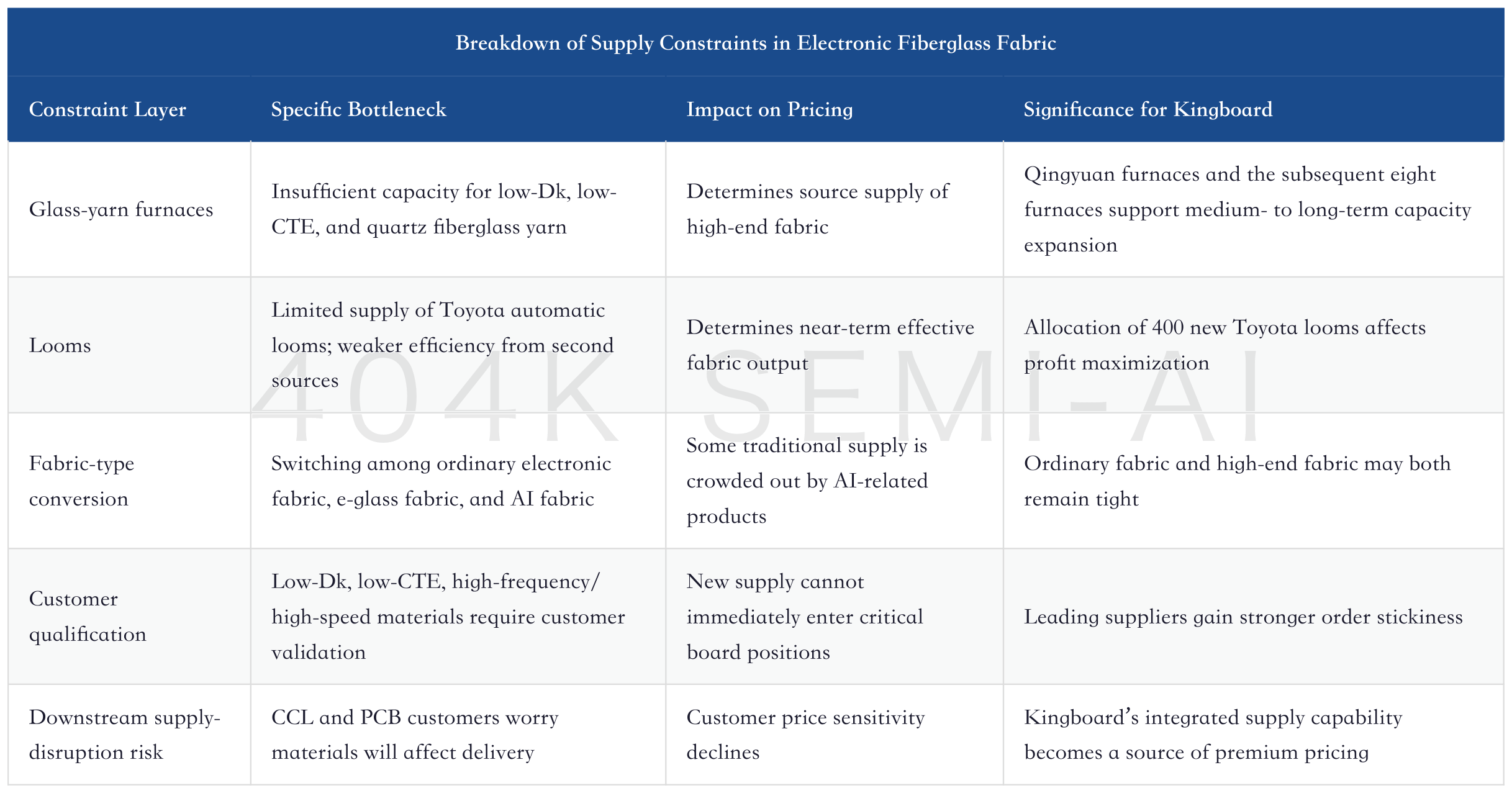
Kingboard’s capacity-expansion path in its annual report also looks more like “high-end materials capability building” than traditional cyclical expansion. The first Qingyuan furnace, with annual capacity of 500 tonnes of low-Dk electronic fiberglass yarn, came online in 1H25. In 1H26, three more 500-tonne furnaces will be added to produce second-generation low-Dk and low-CTE electronic fiberglass yarn. After that, the company plans to build another eight 500-tonne furnaces covering low-Dk, low-CTE, and quartz electronic fiberglass yarn. The Shaoguan project, with annual capacity of 70,000 tonnes of electronic fiberglass yarn and 96mn meters of electronic fiberglass fabric, is scheduled to come online in 2H26.
These expansions create two opposing questions. In the bullish scenario, Kingboard secures stronger qualification and share while customers are short of materials, turning capacity expansion into high-margin revenue. In the bearish scenario, the industry expands together and prices peak before capacity is released. Over the next two quarters, the key question is not “whether there is capacity expansion,” but which customers, which specifications, and which price bands the new fabric and yarn actually flow into.
V. The Real Meaning of the T-Glass Delay: Prioritizing Core CCL, Not Chasing the Loudest AI-Fabric Label
Citi noted this time that Kingboard is allocating more of the 400 additional Toyota looms in 2026 to e-glass fabric rather than AI-fabric, so the new T-glass furnace has been delayed by about two months to August. This point can easily be misread as a weaker-than-expected pace for high-end AI materials. A more reasonable interpretation is that the company has ranked priorities between profit maximization and delivery security: first secure the e-glass fabric needed for core CCL, then advance AI-fabric.
The reason is very practical. E-glass fabric gross margin can exceed 50%, while AI-fabric gross margin can be above 50-70%, making AI-fabric look more attractive. But the absolute price of fabric is far below that of CCL, and looking only at gross margin is not the same as looking at the group’s total gross profit. If core CCL cannot raise prices or deliver because of an e-glass fabric shortage, the company loses a much larger absolute profit pool. Prioritizing looms for e-glass fabric is essentially protecting CCL gross margin and customer supply, not sacrificing premiumization.
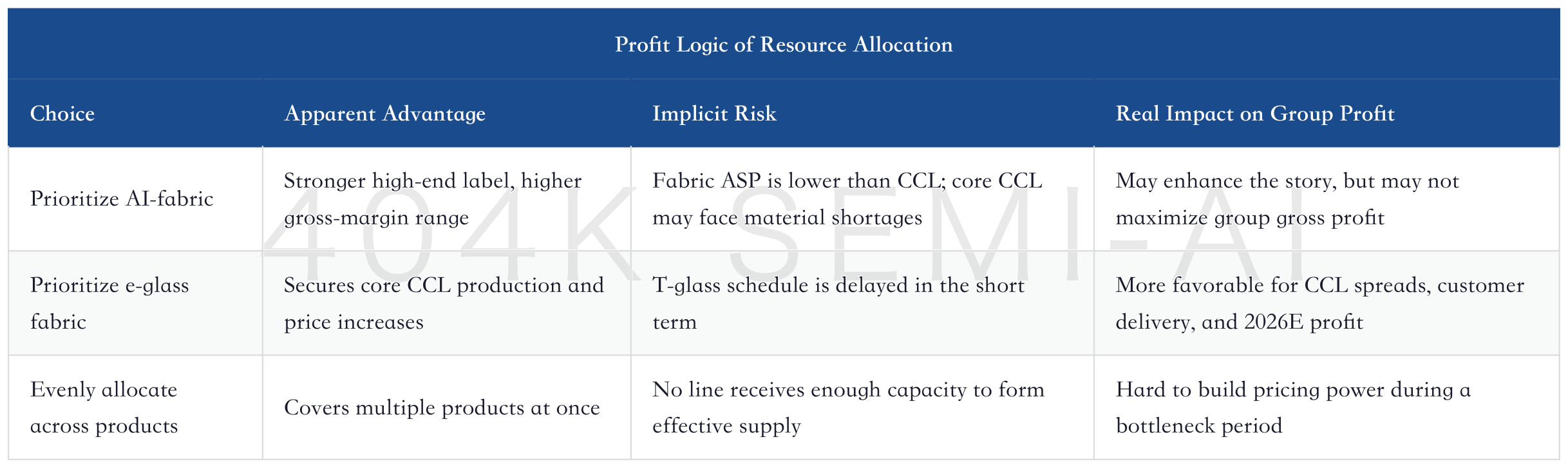
This choice also explains the difference between Kingboard and some pure-play AI materials companies. Pure AI-fabric companies may find it easier to obtain a market narrative premium, but Kingboard’s value lies in its integrated profit pool: electronic glass fabric is not an isolated product, but part of copper-clad laminates, prepreg, copper foil, and customer delivery. By prioritizing scarce looms for core CCL, the company is keeping bottleneck profit inside the larger laminate value chain.
This also provides a valuation boundary. If the market only rewards the product name that sounds most “AI,” the T-glass delay will pressure valuation. If the market rewards actual profit delivery, prioritizing e-glass fabric is instead better. In the short term, the 1H26E positive profit alert and the August interim results will provide the answer: if T-glass is delayed but profit, gross margin, and cash flow continue to beat expectations, it means the company’s prioritization is correct; if T-glass is delayed while CCL spreads do not expand, then execution pace becomes a concern.
VI. Copper Foil Profit Expansion Is the Second Curve: HVLP3 Delivers Real Profit, HVLP4 Provides a 2027 Option
In the Kingboard Laminates narrative, copper foil is shifting from “upstream support” to an “independent profit pool.” Citi estimates that the company’s current copper foil monthly output is about 9,000 tons, with monthly net profit from copper foil reaching HK$230-250 million. Including both internal consumption and external sales, copper foil can contribute 20-25% of 2026E profit. This is no longer peripheral; it is a business large enough to change the net profit structure.
More importantly, this round of copper foil price increases is showing up as processing-profit expansion. The unit processing profit for 1.5oz and 2oz copper foil has been raised, meaning the company is not merely passing through copper cost to customers; high-end copper foil supply itself has become scarcer. For AI server and high-speed networking boards, copper foil roughness, signal loss, and stability directly affect high-frequency, high-speed performance. The value of HVLP3 and HVLP4 comes precisely from this performance constraint.
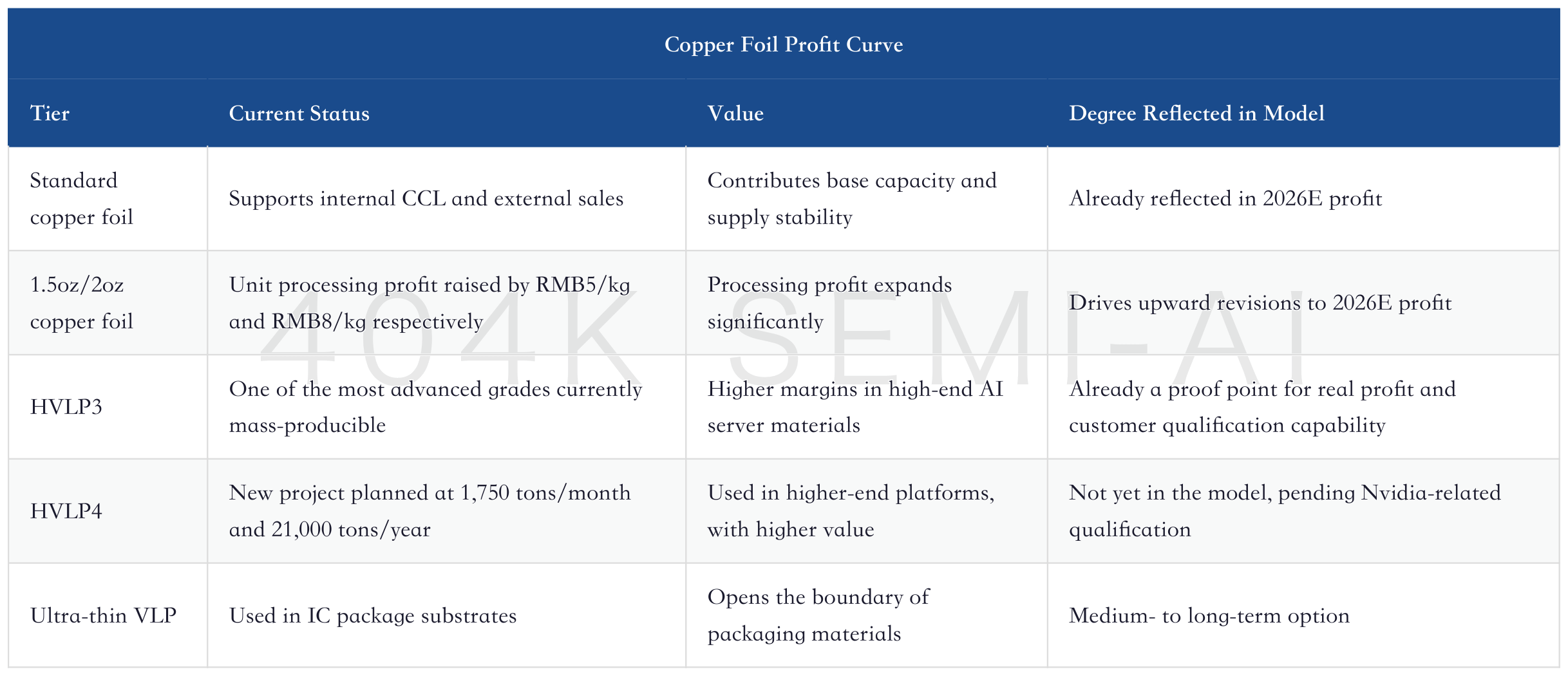
The company’s annual report has disclosed that Kingboard successfully developed HVLP3 copper foil for AI servers and ultra-thin VLP copper foil for IC package substrates. It is also building a new copper foil plant in Guangdong with annual capacity of 21,000 tons, focused on producing high-frequency, high-speed, low-signal-loss RTF and HVLP copper foil, with production planned for mid-2027. Citi further noted that the most advanced grade in the new copper foil project can correspond to HVLP4 and is related to the Vera Rubin platform. HVLP3 value-added profit can reach RMB110,000/ton, while HVLP4 can further rise to RMB200,000/ton, but it has not yet been included in the model before obtaining Nvidia-related qualification.
AI PCB and CCL Deep Dive: From GB300 to Rubin Ultra, Which Runs Short First: High-Layer Boards, M9 Materials, or Electronic Fabric
This gives Kingboard a very good valuation structure: 2026 profit is mainly explained by electronic glass fabric, CCL, and existing copper foil processing profit; after 2027, HVLP4 qualification and the new 21,000-ton copper foil plant determine whether there is a second upward revision curve. If HVLP4 successfully enters the customer system, Kingboard is not merely an upstream materials price-hike stock, but an integrated supplier of high-speed interconnect materials for AI servers.
The risks must also be stated upfront. HVLP4 has not entered the model because qualification, yield, customer adoption, and platform timing all remain uncertain. If Vera Rubin-related material qualification is delayed, or if customer switching paths are slower than expected, the 2027 copper foil option cannot be capitalized in advance. A more prudent pricing approach is to first use 2026 electronic glass fabric and CCL profit to prove the base, then use HVLP4 qualification to add an option to 2027 valuation.
VII. The Baseline From the Official Annual Report: Integration Already Appeared in the 2025 Financials
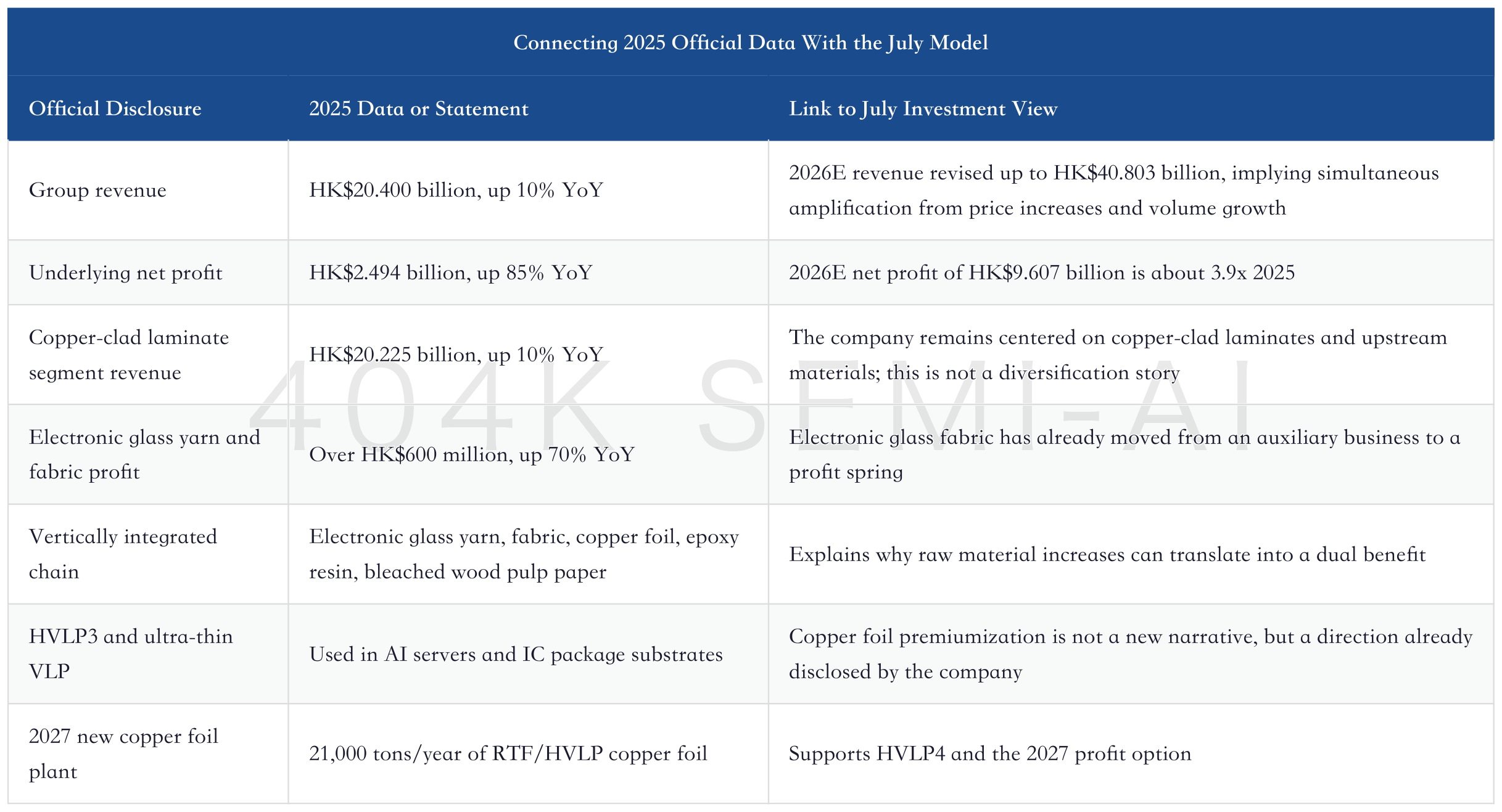
The most easily underestimated point about Kingboard Laminates is that it did not begin telling an integration story only in 2026. The 2025 annual report already shows simultaneous improvement in revenue, underlying net profit, and copper-clad laminate segment revenue, with underlying net profit growth significantly higher than revenue growth. On the demand side, AI data centers, robotics, and compute power are driving demand for high-performance, high-reliability, high-stability copper-clad laminates. On the supply side, electronic glass yarn, electronic glass fabric, copper foil, epoxy resin, and bleached wood pulp paper together form a vertically integrated chain.
The most important statement in the 2025 annual report is that upstream materials and copper-clad laminate price increases brought the company a “dual benefit.” This sentence explains the difference between Kingboard and ordinary downstream materials manufacturers: rising copper prices and glass fabric prices are costs for ordinary manufacturers; for an integrated supplier, as long as prices can be passed through, they may simultaneously bring upstream profit and downstream price increases.
The financial structure also needs to be considered. At end-2025, the company had net current assets of about HK$7.430 billion, a current ratio of 1.92x, a net gearing ratio of 16%, and about 10,800 employees. In 2025, it invested about HK$1.3 billion in new capacity. For a company in a phase of capacity expansion and materials upgrading, the net gearing ratio is not high, indicating the company still has the ability to fund electronic glass fabric, low-Dk/low-CTE, and copper foil capacity expansion in 2026-2027.
The risk here is not that the balance sheet cannot support expansion, but whether capacity expansion mismatches the pricing cycle. If the Shaoguan electronic glass yarn and fabric project comes online in 2H26, the Qingyuan low-Dk/low-CTE furnaces continue to release capacity, and other industry players also expand capacity, the price curve will be tested. Kingboard’s ideal scenario is that new capacity is first absorbed by high-end customer qualification, with prices not quickly broken down. The least favorable scenario is that nominal capacity is released in a concentrated manner and customers regain bargaining power.
VIII. Peer and Prior-Article Comparison: Kingboard Is Buying an Integrated Bottleneck, Not a Pure AI Label
Kingboard Laminates should not be viewed in isolation. In the AI PCB chain, WUS Printed Circuit, Victory Giant, Shennan Circuits, Shengyi Technology, Elite Material, TUC, Gold Circuit, Unimicron, Ibiden and others each occupy different positions. Downstream board makers benefit from high-layer-count boards, switches, and ASIC/GPU platform transitions; upstream CCL and glass-fiber cloth benefit from material-grade upgrades; copper foil and glass-fiber yarn further constrain the supply source.
Kingboard’s position is relatively special. It is neither the purest high-end CCL technology-premium company, nor the most direct downstream AI PCB shipment-beta company. It is more like supply insurance for the materials chain. What customers worry about is whether high-end board capacity can be delivered on time. Kingboard provides integrated material assurance from electronic glass-fiber yarn, glass-fiber cloth, copper foil, and resin to copper-clad laminate. This position looks cumbersome in a normal cycle, but becomes valuable in a material-shortage cycle.
AI Interconnect Enters Board-Level Revaluation: 1.6T, mSAP and New Growth in High-End CCL, with Three-Year TAM Expanding 6x
Compared with Shengyi Technology, Kingboard’s advantage lies in upstream material integration and earnings leverage from electronic glass-fiber cloth; Shengyi Technology’s advantages are more about its high-end CCL share in China A-shares, customer qualification, and expectations for domestic substitution in AI server materials. Compared with Kingboard Holdings, Kingboard Laminates is purer: AI CCL and electronic glass-fiber cloth earnings are more direct, with less discount from other businesses. Compared with downstream PCB makers, Kingboard does not directly enjoy the full order beta of board makers, but it is more like an upstream “gate” when materials are in shortage.
Shengyi Technology Deep-Dive Update: AI CCL Enters Nvidia Share Monetization Phase, High-End Copper-Clad Laminate Moves from Price Hikes to Delivery
Kingboard Holdings Deep Dive: From Chemical Cyclical to AI CCL Cash-Flow Platform, and the Revaluation Behind the HK$202 Target Price
This position defines the investment debate around Kingboard. Bulls are buying the AI materials bottleneck and integrated profit pool; bears worry about peak-cycle valuation, overly rapid capitalization of price increases, industry capacity expansion, and a pullback in downstream AI hardware sentiment. Neither side is necessarily wrong; the difference is the time horizon. If one looks only at one month of share price performance, crowded AI hardware trades and major-shareholder selling can both cap valuation. If one looks over four quarters, the core questions are still whether pricing can flow into margins, and whether capacity can translate into customer lock-in.
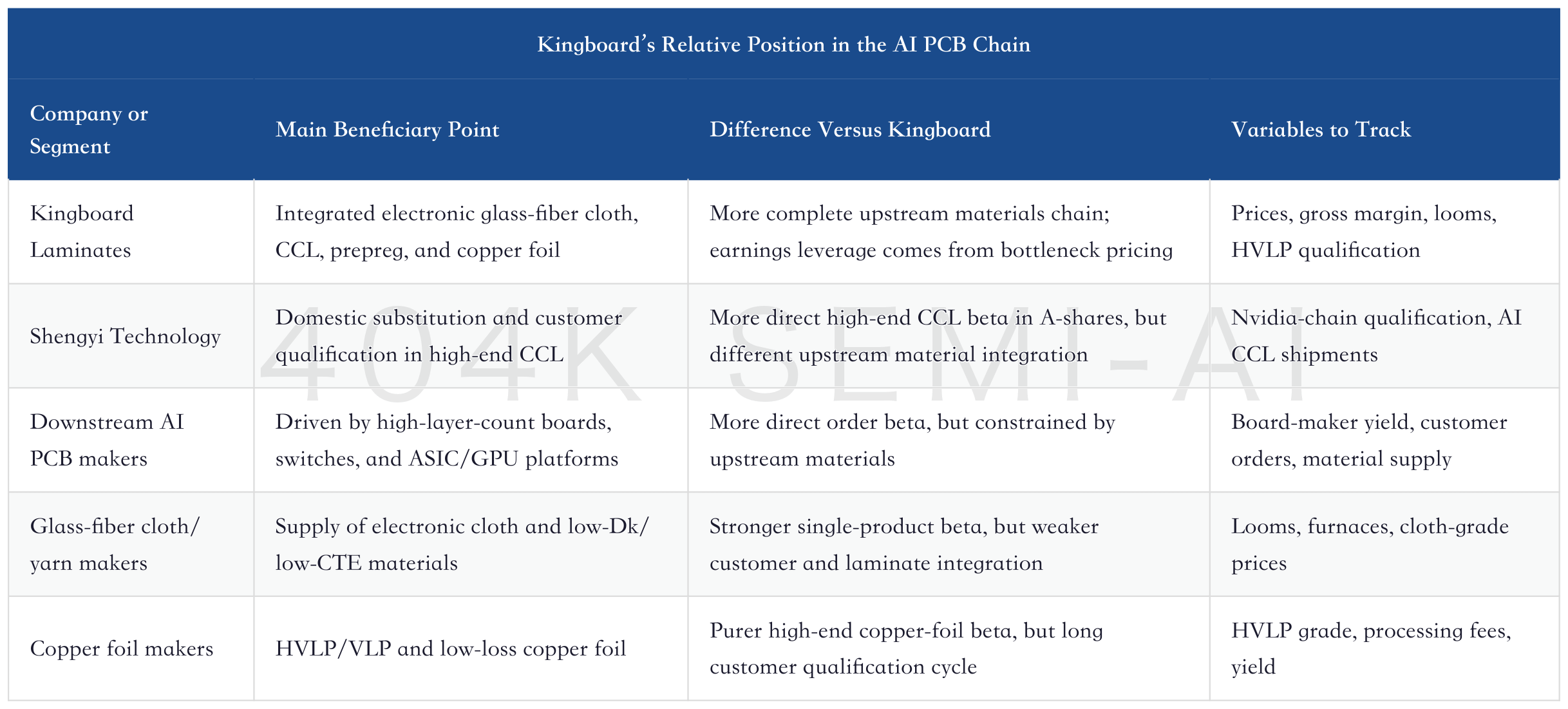
Kingboard’s appropriate positioning now is as a combined “supply constraint + profit realization” asset in the AI PCB materials chain. It is not a materials company that can only tell a story, because profits already emerged in 2025. Nor is it a mature cyclical stock with no remaining beta, because the July model is still being revised upward and HVLP4 has not yet been modeled. This middle state is the most comfortable and the most dangerous: comfortable because earnings validation is dense, dangerous because expectations are already high.
IX. Valuation Scenarios: HK$130 Is Anchored by Earnings, Not Unlimited Multiple Expansion
The underlying logic of the HK$130 target price is to use 2027E earnings as the main anchor, while assuming high growth can absorb a valuation multiple that appears elevated. This valuation framework sounds attractive, but it depends on one premise: 2027E net profit cannot merely be a cyclical peak; it must have the persistence of a high-end materials supply constraint.
Therefore, valuation should not be judged only by target-price upside, but through three scenarios.
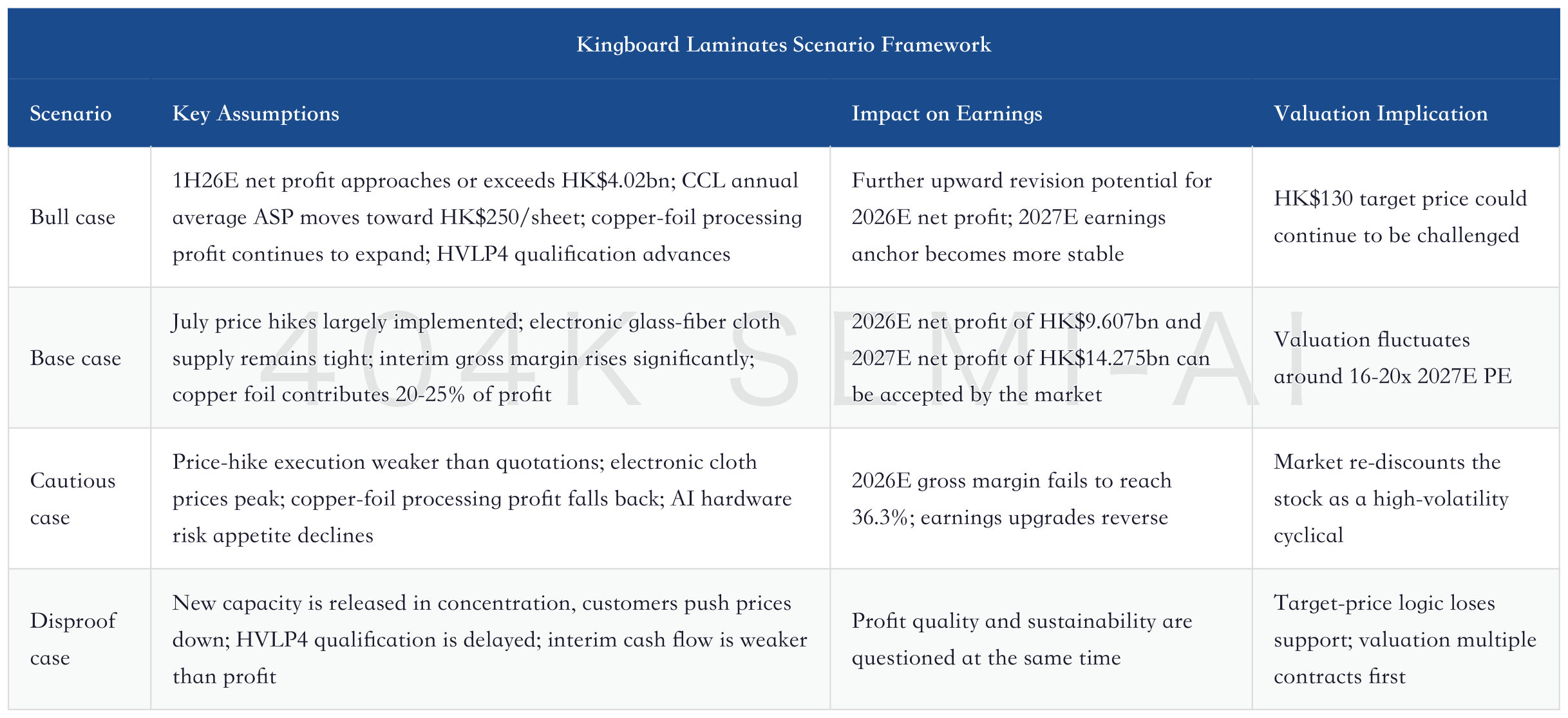
The most important point is that Kingboard’s valuation upside should not mainly come from “assigning an even higher multiple.” If 2027E net profit continues to be revised upward, there is room above HK$130. If earnings are not upgraded and the multiple is pushed up only by trading heat, the risk-reward worsens. In other words, the best way for Kingboard to rise from here is for each earnings report to lift the profit baseline, not for each report to lift the PE multiple.
This also explains why, after the share price pulled back from the highs, fundamentals need to be examined even more seriously. If the correction is merely a change in risk appetite caused by crowded AI hardware trading and shareholder selling, while July and August data continue to beat expectations, then the pullback is a point for reassessment. If the pullback is accompanied by weaker pricing execution and deteriorating profit quality, then the market is sensing the cyclical inflection point in advance.
The valuation formula can be broken down more directly: share-price upside is jointly determined by 2027E net profit, a reasonable PE, and the share-count basis. The worst thing to do now is to treat the HK$130 target price as a static anchor, because any change in one of these variables requires the target price to be recalculated. If 2027E net profit is further revised up from HK$14.275bn to HK$16.0bn, the target price naturally rises even if the PE is unchanged. If 2027E net profit is revised down to HK$12.0bn, the target price falls even if the PE is maintained.
