
Contents
I. Regulatory Framework: The Covered List, 3.2T, and the 65% Threshold
II. Timeline: Potential October Action, but 3.2T Ramp Not Expected Until 2028
III. Meeting the 65% Threshold: DSP + Lasers Keep Chinese Vendors at the Module Layer
IV. Why US Optical Firms Shun Module Assembly: The Margin Gap
V. US Domestic Capacity: Only AAOI at Scale, Outmatched by Over 8x
VI. Indium Phosphide (InP) Substrates: The Wildcard Outside the Rulebook
VII. Value Chain Impact Matrix and Key Watch Items
Ticker Reference Table
This content is compiled from publicly available information and research reports. It does not constitute investment advice or represent any individual's views. For educational reference only; please read critically.
Recent intelligence gathered by Morgan Stanley in Washington suggests that potential FCC restrictions on Chinese-manufactured optical transceivers are most likely to be phased in starting with the 3.2T generation, while carving out import eligibility for products with at least 65% US content by bill-of-materials (BOM) value. The real bottleneck is tightening around optical lasers rather than overall module market share.
I. Regulatory Framework: The Covered List, 3.2T, and the 65% Threshold
Morgan Stanley’s strategy team recently met in Washington with senior telecom, FCC, and export-control legal experts who maintain direct dialogues with both the White House and the FCC. The discussions focused on US policy initiatives aimed at reducing reliance on Chinese technology. In the optical transceiver space, three key elements have become notably clearer:
Policy Tool: The FCC’s Covered List is viewed as the most probable mechanism for near-term implementation in optical communications. Inclusion on the Covered List restricts equipment authorization, making it extraordinarily difficult for listed hardware to obtain new regulatory approvals or enter the US market. Morgan Stanley initially highlighted this mechanism in its recent Washington AI security trip recap, and the latest meetings reaffirm this trajectory.
Generational Scope: Restrictions are expected to be phased in starting with 3.2T optical transceivers, potentially surfacing as early as October. Industry participants have recently been asked to present credible domestic or friendshored manufacturing roadmaps ahead of large-scale 3.2T rollouts.
Exemption Threshold: Discussions pointed to a specific safe-harbor metric: even at the 3.2T node, Chinese-manufactured transceivers could still be imported provided that at least 65% of their BOM value originates from US companies. In Morgan Stanley's assessment, pairing a US-sourced DSP with US-sourced lasers would already bring a module close to this threshold.
All three elements remain under policy deliberation and have not yet been codified into published regulatory text. The threshold percentage, the formal legal definition of a "US company," and the phase-in schedule could all evolve before final promulgation. Crucially, however, this regulatory posture departs from the immediate, blanket decoupling previously feared by the market: rather than cutting off existing supply, the framework aims to dictate where the next generation of hardware is built and who supplies its core components.
II. Timeline: Potential October Action, but 3.2T Ramp Not Expected Until 2028
Anchoring restrictions at 3.2T effectively insulates today's volume drivers. AI data centers are currently in the midst of massive 800G and 1.6T deployments. Morgan Stanley forecasts that 3.2T will not begin ramping until 2028, with broader adoption following around 2029 and meaningful volume scaling occurring later that year. Even if Covered List designations land in October, the supply chain would still have roughly two years to adjust before meaningful 3.2T commercial shipments commence.
Near-term revenue exposure is therefore minimal. Even if regulatory actions emerge ahead of schedule, the targeted 3.2T transceivers will register virtually zero volume before 2028, leaving optical module vendors to derive the vast majority of their 2026 and 2027 revenues from 800G and 1.6T. In Morgan Stanley's view, policy goals are pivoting from immediately displacing Chinese supply to deciding where the next generation is manufactured. Cloud hyperscalers are already preparing compliance documentation to prove higher proportions of domestic or friendshored manufacturing across their supply chains.
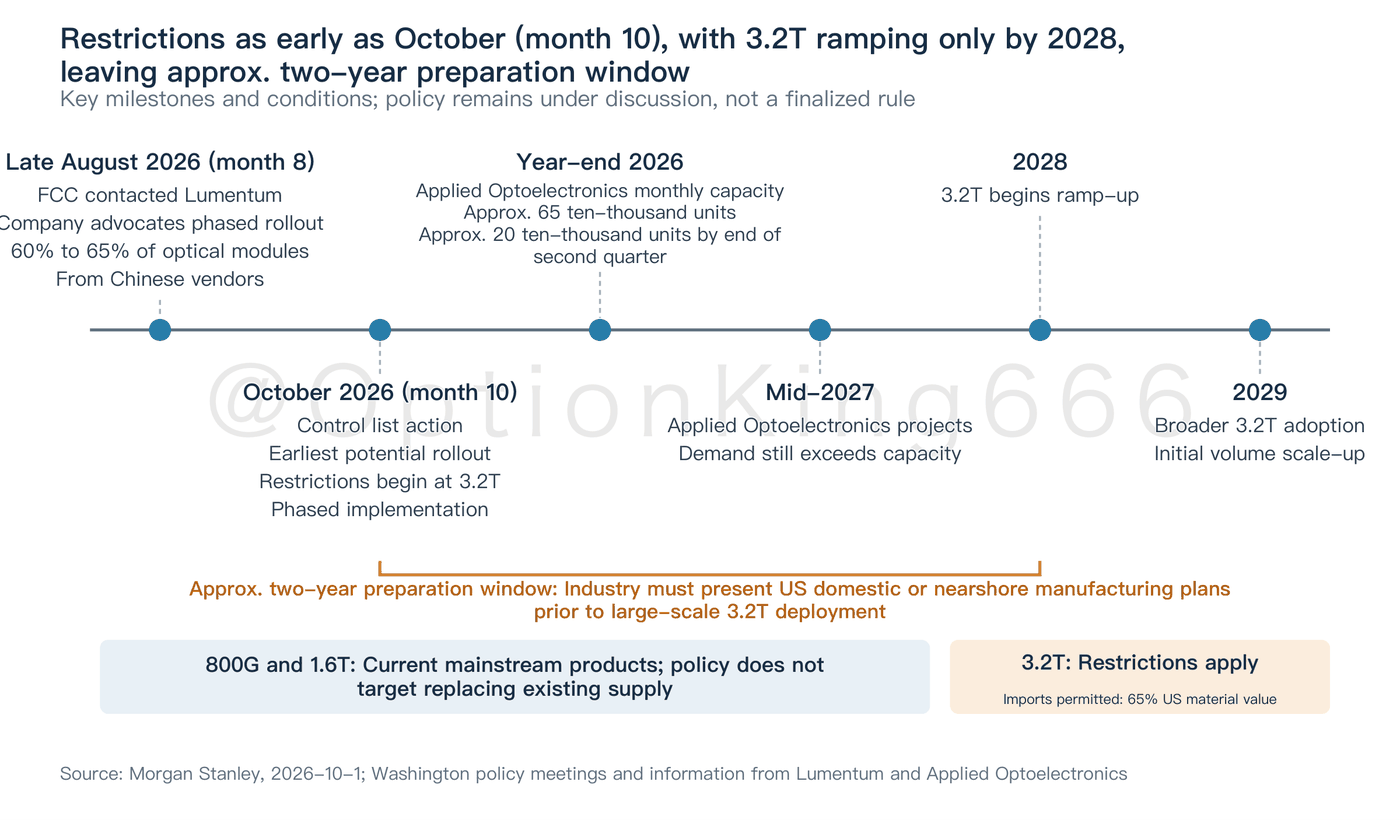
This phased approach aligns closely with earlier commentary from Lumentum. During a late-August Nasdaq Asia investor event hosted by Morgan Stanley, Lumentum indicated that the FCC had contacted the company regarding prospective rules. Lumentum advised regulators that policy should be phased in over time, warning that an abrupt cutoff would trigger severe supply-demand dislocation given that Chinese vendors currently supply 60% to 65% of global optical transceivers. Lumentum also noted that, under prevailing pricing structures, taking on pure module assembly volume is not an economically attractive business.
