
Contents
Table of Contents
1. What Can Be Confirmed Before the Prospectus Goes Public
2. 12x Annual Revenue Growth: Trailing $4.59B vs. $65B Run Rate
3. Deconstructing the $42B Net Loss: An Operating Loss of $8.06B
4. The $518B Compute Commitment: Public Contracts Explain Only Half
5. Two Customers Account for Nearly a Quarter of Revenue
6. Founders Hold 50.1% Voting Control: What Are Public Shareholders Buying?
7. An 80-Page Risk Section: Codifying the Risk of Losing Control Over Models
8. A $2 Trillion Valuation Pegged to 2028
9. Key Items to Watch Once the Public S-1 Drops
This content is compiled from publicly available information and research reports. It does not constitute investment advice or represent any individual's views. For educational reference only; please read critically.
404K SEMI-AI
Anthropic’s draft prospectus lays bare a frontier AI lab’s books for the first time: $4.59 billion in 2025 revenue, a net loss approaching $42 billion, and $518 billion in forward compute obligations over the coming years. Its target valuation of more than $2 trillion hinges entirely on whether its 2028 revenue forecast of nearly $200 billion can be achieved.
Table of Contents
1. What Can Be Confirmed Before the Prospectus Goes Public
2. 12x Annual Revenue Growth: Trailing $4.59B vs. $65B Run Rate
3. Deconstructing the $42B Net Loss: An Operating Loss of $8.06B
4. The $518B Compute Commitment: Public Contracts Explain Only Half
5. Two Customers Account for Nearly a Quarter of Revenue
6. Founders Hold 50.1% Voting Control: What Are Public Shareholders Buying?
7. An 80-Page Risk Section: Codifying the Risk of Losing Control Over Models
8. A $2 Trillion Valuation Pegged to 2028
9. Key Items to Watch Once the Public S-1 Drops
1. What Can Be Confirmed Before the Prospectus Goes Public
On September 28, Reuters published several reports based on a draft copy of Anthropic's prospectus, offering the public its first glimpse into the company's financials, governance structure, and risk factors. Anthropic declined to comment. Reuters
The prospectus itself is not yet public. On June 1, Anthropic announced the confidential submission of a draft S-1 registration statement with the U.S. Securities and Exchange Commission (SEC), noting only that the number of shares and price range had yet to be determined and that an offering remains subject to market conditions. As of September 29, no public registration statement under Anthropic's name appears on the SEC's EDGAR database. Company Announcement
Consequently, the figures currently circulating fall into three categories. First are rough numbers reported directly by Reuters, such as revenue of nearly $4.6 billion and an operating loss exceeding $8 billion. Second are more granular figures cited by financial media—$4.59 billion in revenue and an $8.06 billion operating loss—which square with Reuters' estimates and balance internally: $4.59 billion in revenue minus $12.65 billion in total operating expenses equals exactly an $8.06 billion operating loss. Third are public disclosures from Anthropic, SpaceX, and Nscale, which help verify compute agreements. Full financial statements, footnotes, and revenue recognition policies must await the public S-1; existing numbers cannot yet resolve questions surrounding gross margins and cash flow.
The IPO timeline has also been fluid. In early September, Reuters reported that roadshows could begin as early as mid-October, pushing the expected prospectus publication date from the second week of September to late September. The September 28 report noted that the listing could be deferred until after the U.S. midterm elections in November. Under U.S. securities rules, a confidential draft registration statement must be made publicly available at least 15 days before the roadshow begins. The underwriting syndicate includes Morgan Stanley, Goldman Sachs, JPMorgan, and Citigroup, with the company concurrently finalizing a $15 billion revolving credit facility.
This offering is drawing intense scrutiny because Anthropic will be the first frontier AI lab to go public. Founded just five years ago, the company asserts in its filing that artificial intelligence will transform the global economy more profoundly than industrialization, electricity, or the internet. Previously funded by venture capital, sovereign wealth funds, and Big Tech, the sector’s financial health could only be pieced together through fundraising headlines. Rival OpenAI also filed confidentially in June, with media reporting an anticipated listing before early 2027. Whichever firm lists first will set the benchmark multiple for the entire industry.
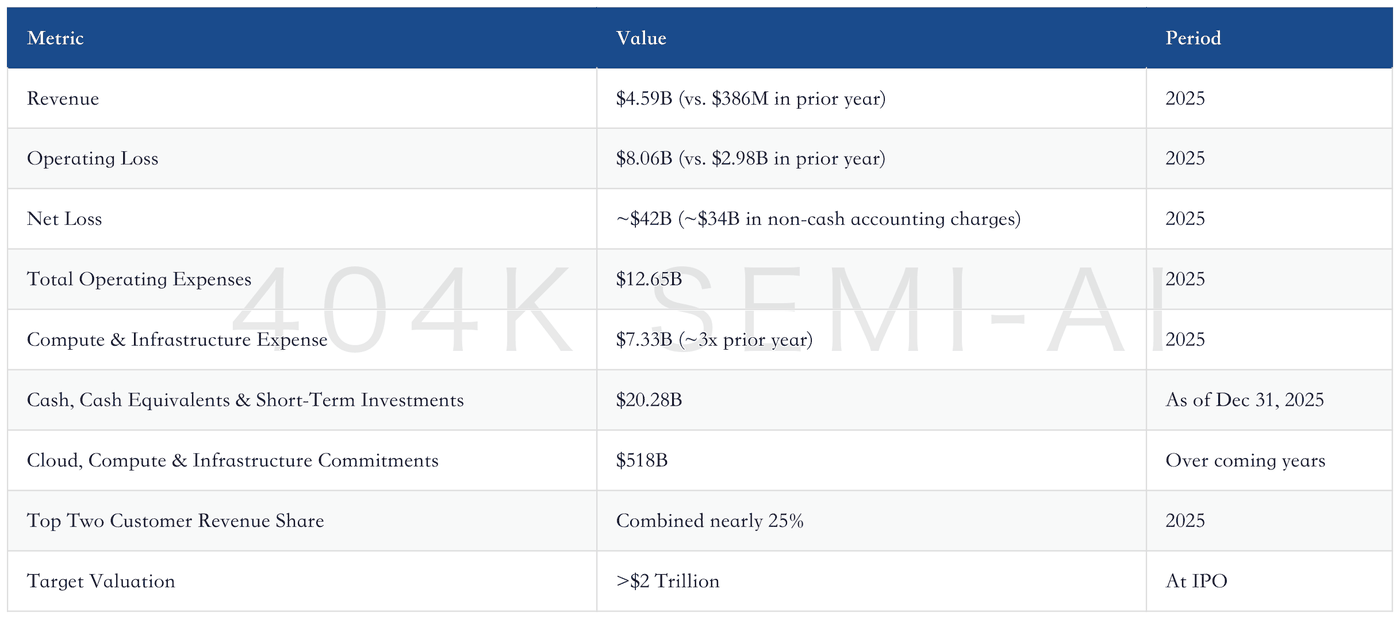
The table below synthesizes the prospectus figures reported across financial media.
Core Metrics Disclosed in the Draft S-1: $4.59B Revenue Against $518B in Forward Obligations
2. 12x Annual Revenue Growth: Trailing $4.59B vs. $65B Run Rate
In 2025, Anthropic generated $4.59 billion in revenue, up roughly 12x from $386 million in 2024. Revenue stems primarily from three streams: API usage fees from enterprises and developers, Claude subscriptions from individuals and teams, and the Claude Code developer tool. Claude is also distributed across three major hyperscalers—Amazon AWS, Google Cloud, and Microsoft Azure—which act as both distribution networks and compute suppliers.
The $4.59 billion figure may seem smaller than popular perception. In funding announcements, Anthropic has consistently cited annualized run-rate revenue (extrapolating recent run rates over 12 months): ~$9 billion at year-end 2025, $14 billion in February, over $30 billion in April, over $47 billion in early May, and surpassing $65 billion by late July, according to press reports. Certain earlier media reports mistakenly characterized full-year 2025 revenue as ~$10 billion, confusing it with the year-end run rate.
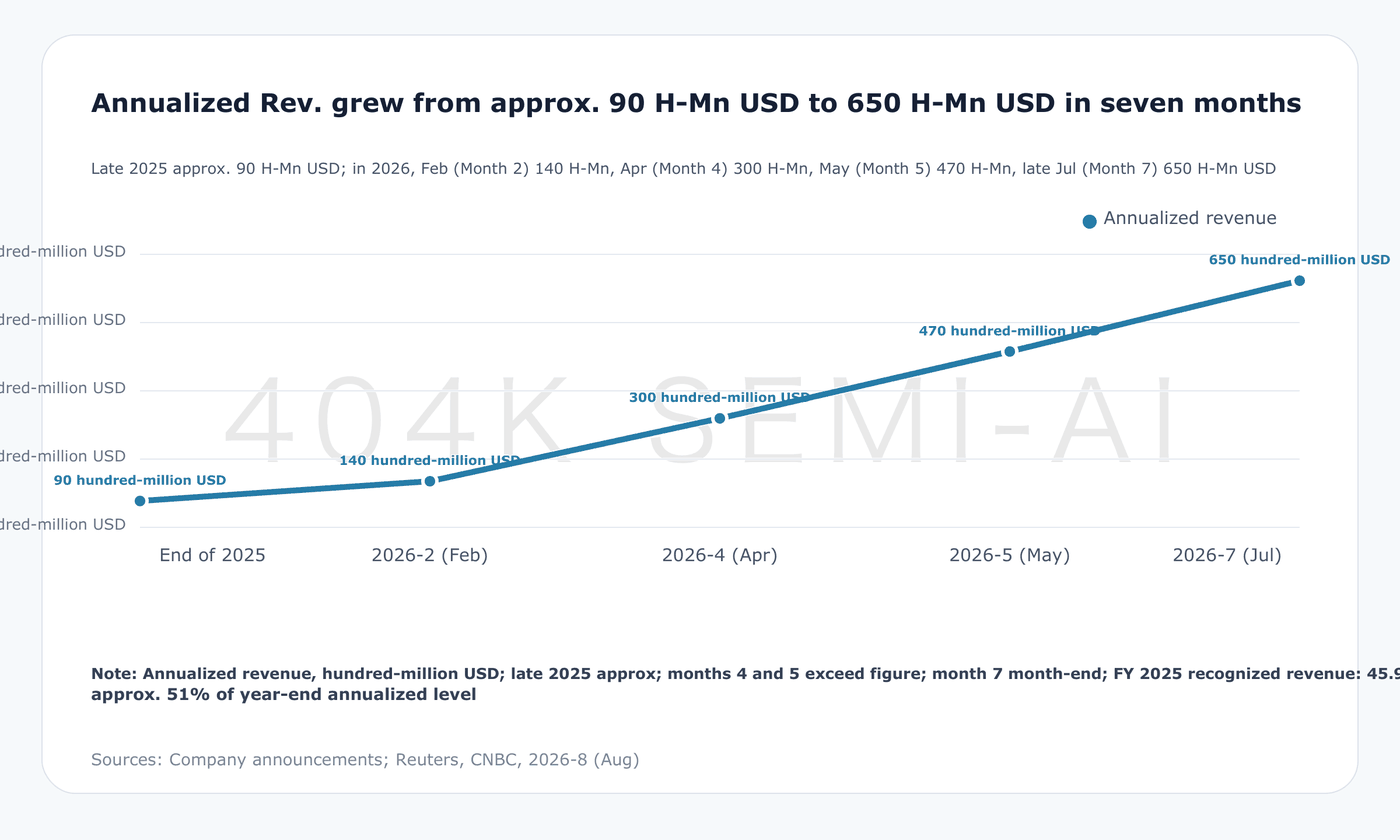
The 2x divergence between full-year revenue and run rate stems from the underlying growth trajectory. An annualized run rate captures only the latest month, whereas full-year revenue aggregates 12 months of actual performance. Ramping from a low base early in the year to a ~$9 billion run rate by year-end yields a full-year cumulative total roughly half the exit run rate—$4.59 billion represents ~51% of that year-end run rate. For a company multiplying 10x annually, point-in-time run rates will dramatically exceed trailing twelve-month recognized revenue; they measure two fundamentally different dimensions.
The prospectus numbers align with prior sell-side estimates. Initiating coverage on Anthropic in April, Citi estimated 2025 revenue at ~$4.5 billion, with ~86% generated via APIs. When reports surfaced in August that the company's annualized run rate had topped $65 billion, market debate centered on whether run-rate metrics could be directly compared to OpenAI. With these first audited annual figures, investors finally have an anchor to reconcile run rates, quarterly recognized revenue, and full-year GAAP revenue.
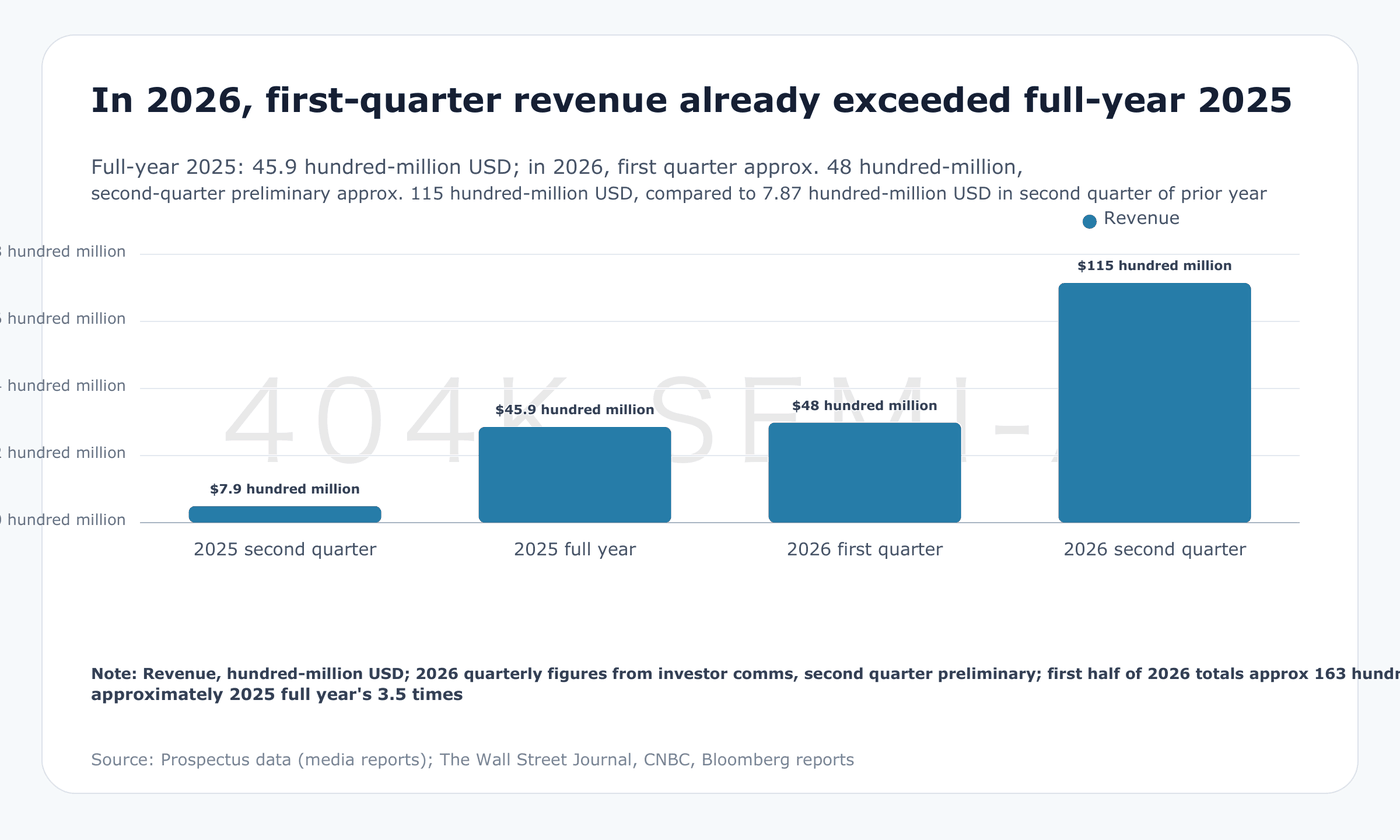
Growth accelerated further into 2026. According to The Wall Street Journal and other outlets, Q1 revenue reached ~$4.8 billion, while preliminary Q2 revenue came in at ~$11.5 billion—a ~14x year-over-year surge compared to $787 million in Q2 2025. Q1 alone eclipsed full-year 2025 revenue, and first-half revenue totaled ~$16.3 billion, roughly 3.5x full-year 2025. These quarterly figures originate from investor communications and are not part of the leaked draft prospectus details.
Expansion among enterprise customers has been the primary growth engine. Customers with annualized spending exceeding $1 million surpassed 500 when disclosed in February and doubled to over 1,000 by April in less than two months. Over 100,000 customers now access Claude via Amazon Bedrock. The company also revealed in February that eight of the Fortune 10 are Claude customers.
Much of this enterprise growth has been propelled by developer tooling. Claude Code was made publicly available in May 2025; by February 2026, its annualized run rate surpassed $2.5 billion—more than doubling year-to-date—with enterprise clients accounting for over half of that total. Consumer traction is scaling in tandem: Claude topped the U.S. Apple App Store free app rankings in late February. The draft prospectus explicitly notes that customer usage and associated revenue are directly driven by new model releases.
One key question left unanswered by the leaks is whether revenue generated through cloud platforms is recognized on a gross or net basis. SemiAnalysis previously estimated that in Q2, more than 40% of Anthropic's annualized revenue came from indirect channels such as Amazon Bedrock. For every $100 spent by a customer, gross recognition records $100 in revenue alongside a channel fee expense, whereas net recognition records revenue net of platform splits. This distinction significantly alters top-line revenue scale and gross margin profiles. The revenue recognition policies and channel breakdowns in the public S-1 will ultimately determine how much of the $4.59 billion and $65 billion translates directly into cash retained on the company's balance sheet.
3. Deconstructing the $42B Net Loss: An Operating Loss of $8.06B
In 2025, Anthropic posted a net loss approaching $42 billion, more than nine times its revenue. Roughly $34 billion of this was an accounting charge: portions of the company's earlier financings carry conversion features that convert into equity; as Anthropic's valuation climbed from $61.5 billion in March 2025 to $183 billion in September 2025, the fair value of these derivative liabilities increased accordingly, with mark-to-market adjustments booked as non-cash losses. Crucially, this charge involves no cash outflow. Under standard GAAP treatment, once these financing instruments convert into equity upon an IPO, these charges cease.
At the operating level, Anthropic recorded an operating loss of $8.06 billion, up from $2.98 billion in 2024. Adding the $8.06 billion operating loss to the ~$34 billion non-cash accounting expense approximates the reported net loss. A similar gap occurred in 2024, when the net loss of ~$8.3 billion substantially exceeded operating losses. When evaluating the company's operational cash burn, the $8.06 billion operating loss is the true starting point.
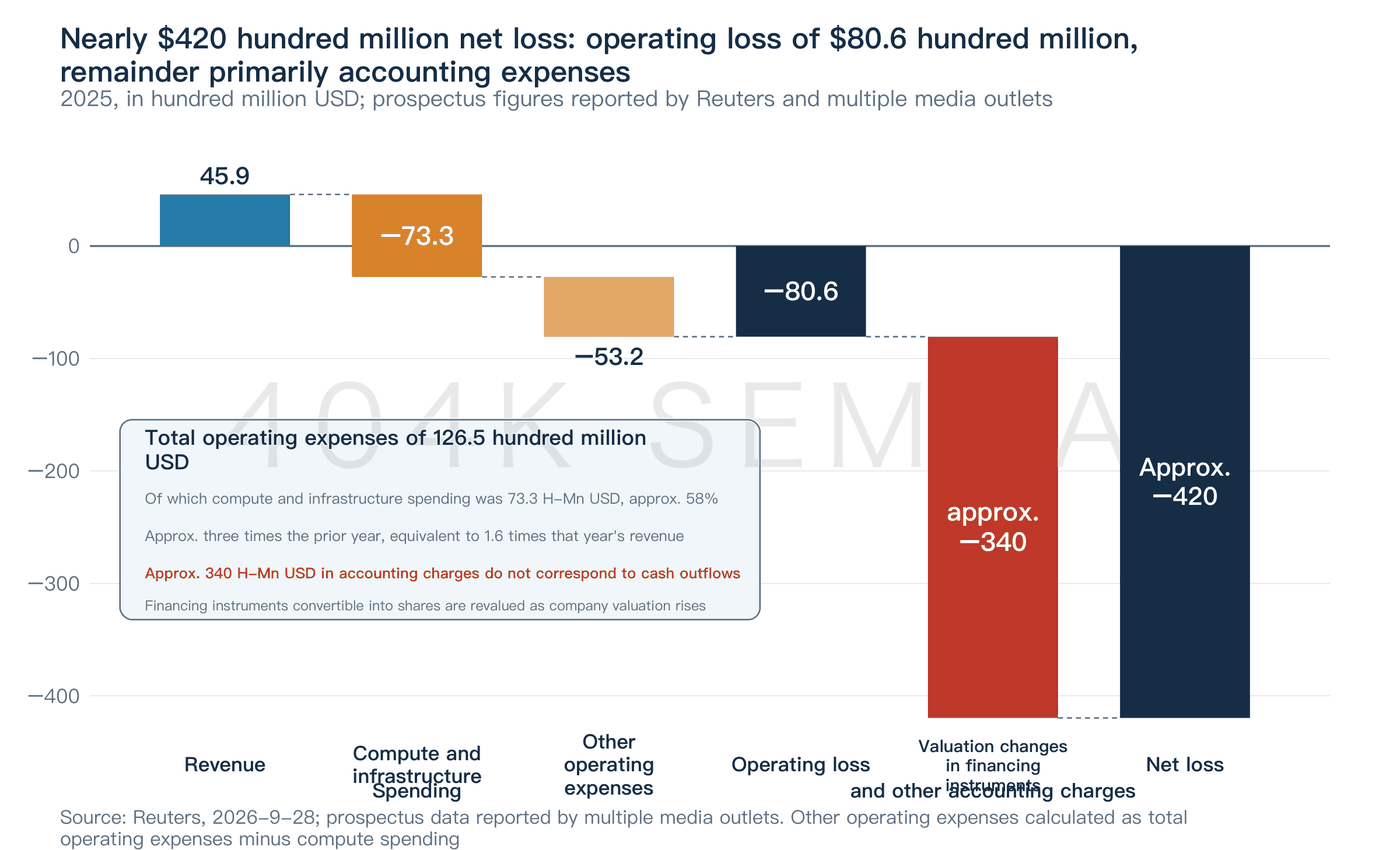
Expenditures were dominated by compute. Total operating expenses in 2025 reached $12.65 billion, of which compute and infrastructure spending accounted for $7.33 billion (~58%), roughly tripling from 2024. This single line item represented 1.6x 2025 revenue—meaning every dollar of revenue required $1.60 in compute costs upfront. The remaining ~$5.3 billion was allocated across headcount, sales and marketing, and other operating expenses, the granular breakdown of which remains undisclosed.
While absolute operating losses expanded, they contracted markedly relative to revenue. In 2024, operating losses were 7.7x revenue; by 2025, that ratio fell to ~1.8x. Back-calculating from the ~190% growth in compute costs, every $1 of revenue in 2024 required more than $6 of compute spending, dropping to $1.60 in 2025. Operating leverage is demonstrably kicking in, even if the business remains far from breakeven.
Early signs of operating profitability emerged in 2026. The Wall Street Journal reported in May that Anthropic projected a Q2 operating profit of $559 million, inclusive of model training costs but excluding stock-based compensation (SBC). In August, PitchBook (PB8) reported that Q2 adjusted operating profit turned positive. However, management cautioned that full-year profitability is not guaranteed due to escalating compute and training commitments. As recently as last summer, management had guided investors that sustained full-year operating profitability would not arrive until at least 2028. Because the S-1 operating loss reflects GAAP standards while quarterly operating guidance reflects non-GAAP adjusted metrics excluding SBC, the two figures cannot be conflated.
Skeptics take a simpler view: in 2025, spending $12.65 billion yielded just $4.59 billion in revenue. This critique holds if costs continue to scale 1:1 with revenue. However, if revenue maintains its 1H 2026 momentum while unit compute costs continue their downward march, operating expense ratios will improve swiftly. Conversely, if newly deployed capacity sits idle or model pricing erodes faster than underlying compute deflation, losses will balloon in lockstep with scale.
On liquidity, Anthropic held $20.28 billion in cash, cash equivalents, and short-term investments as of December 31, 2025. It subsequently closed a $30 billion Series G round in February 2026 and a $65 billion Series H in May 2026, which included $15 billion in previously committed capital from hyperscalers. The target proceeds for this public offering have not yet been disclosed.
4. The $518B Compute Commitment: Public Contracts Explain Only Half
The draft prospectus discloses that Anthropic has accumulated $518 billion in forward obligations for cloud, compute, and infrastructure over the coming years. While certain media reprints mistakenly framed this as a one-year commitment, Reuters confirmed it spans multiple years. Still, the figure is staggering: ~71x its 2025 compute and infrastructure expense, ~113x its 2025 revenue, and ~8x its annualized run-rate as of late July.
Publicly announced contracts account for only a portion of this sum. The table below compiles disclosed agreements based on company releases and counterparty SEC filings:
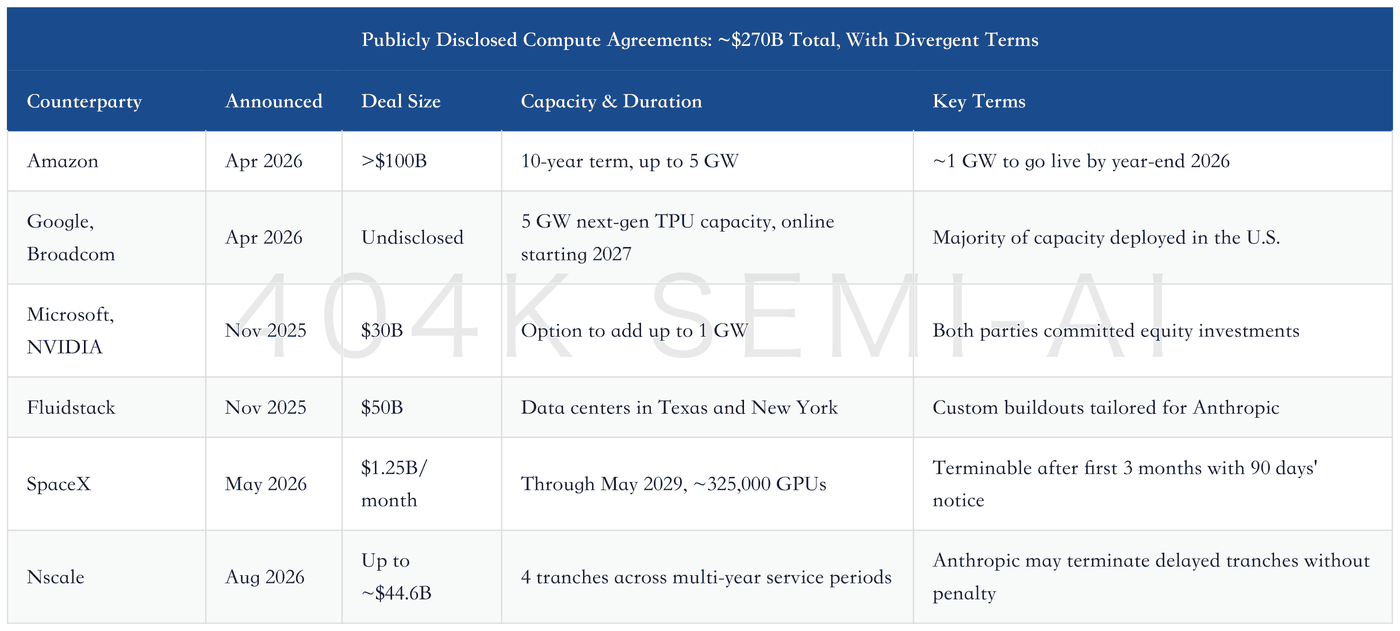
Assuming full execution through its term, the SpaceX contract totals ~$45 billion. Summing the disclosed amounts yields ~$270 billion—just over half of the $518 billion total, with the remainder tied to contracts whose financial terms were not made public. Determining the exact cutoff date for the $518 billion obligation and whether it includes cancelable tranches must await the contractual obligations table in the public S-1. SpaceX Prospectus
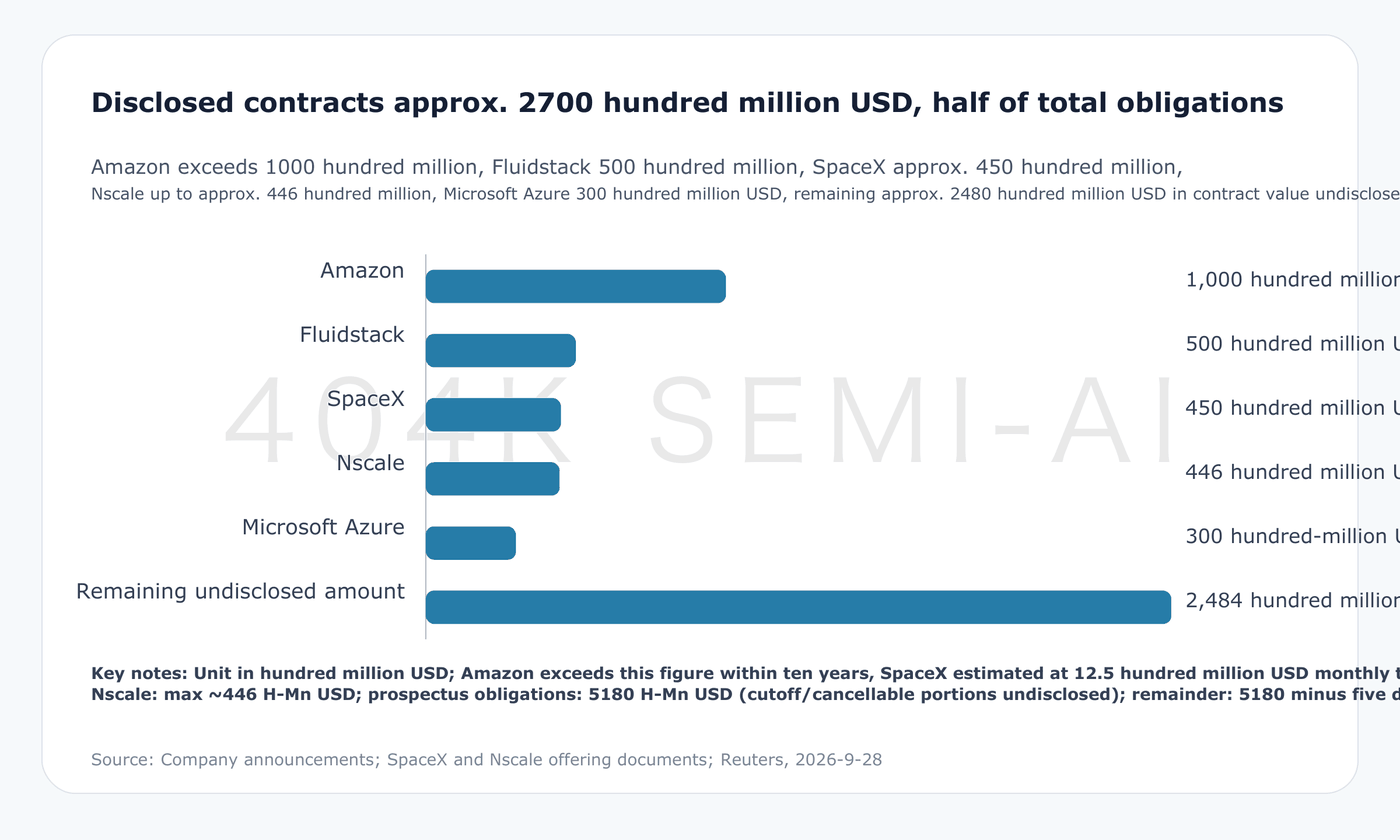
The enforceability of these contracts varies widely. SpaceX's prospectus discloses that after an initial three-month lockup, either party may terminate the agreement upon 90 days' written notice. Nscale's prospectus specifies that payments are contingent upon milestones for delivery and service availability; Anthropic retains the right to terminate any tranche without liability if delivery schedules slip, or cancel the agreement if monthly uptime fails to meet performance thresholds. For Anthropic, these provisions offer valuable exit optionality; for infrastructure vendors, contracted backlog does not equal guaranteed cash flow. Nscale Prospectus
Credit risk cascades along this entire supply chain. Nscale disclosed that it had secured no binding financing commitments to fund the capital expenditures required to fulfill its Anthropic contract, intending instead to raise debt and equity against the contract itself. SpaceX noted in its risk factors that certain compute customers may not yet be cash-flow positive and depend on external capital to satisfy payment obligations. Anthropic’s ability to meet these commitments, in turn, hinges on its own top-line expansion and capital market access. Each link treats the downstream contract as its credit foundation; any deceleration along the chain immediately transmits stress back upstream.
Strategic investors and hardware suppliers are deeply intertwined. Amazon previously invested $8 billion in Anthropic, added $5 billion in April, and committed up to another $20 billion, while Anthropic simultaneously pledged to procure more than $100 billion from Amazon over ten years. Microsoft and NVIDIA pledged investments of up to $5 billion and $10 billion, respectively, while Anthropic committed to purchasing $30 billion in Azure compute. In the May Series H round, Micron, Samsung, and SK Hynix joined as strategic infrastructure partners. Capital circulates in a loop between equity investment and capacity procurement: the advantage is securing scarce compute and memory allocations in advance; the drawback is that it obscures arm’s-length pricing for public investors.
These commitments funnel into three distinct hardware architectures. The Amazon agreement encompasses proprietary Trainium2 through Trainium4 chips and Graviton processors, with Anthropic reporting that over 1 million Trainium2 chips are already deployed to train and run Claude. Google and Broadcom supply next-generation TPUs. Microsoft, SpaceX, and Nscale supply NVIDIA GPUs, with Nscale's contract explicitly specifying deployments of the Vera Rubin NVL72 platform. Anthropic terms this a diversified hardware strategy, routing workloads to the silicon best suited for each task. For the semiconductor ecosystem, Anthropic’s purchasing power simultaneously anchors hyperscalers' custom ASICs and NVIDIA’s flagship architectures, while memory suppliers have converted directly into equity stakeholders.
Aggregate compute commitments more than tripled in just five months. At the end of April, Citi calculated that Anthropic had contracted ~15 GW of capacity valued at over $150 billion; the draft prospectus now formalizes total obligations at $518 billion.
Anthropic has been willing to underwrite such monumental liabilities because compute availability has effectively capped revenue. The company acknowledged in an April announcement that surging consumer demand had compromised peak-hour reliability and performance. In management's view, customer demand is backlogged, and compute supply is the sole bottleneck. If this thesis holds, locking in compute capacity equates to locking in future revenue; if demand growth moderates, however, these fixed purchase commitments will quickly become an onerous drag on capital.
5. Two Customers Account for Nearly a Quarter of Revenue
In 2025, Anthropic derived nearly a quarter of its revenue from just two customers, each contributing ~12%. Based on $4.59 billion in total revenue, that equates to ~$550 million per customer, or ~$1.1 billion combined. The draft prospectus explicitly cautions in its risk factors that many of its largest customers are not locked into long-term contracts and retain the right to trim or eliminate spending at will.
The identities of these two key clients were not disclosed. Market speculation centers on two profiles: AI-native developer tools that utilize Claude as their foundation model, and cloud hyperscalers reselling Claude API access. With reports suggesting both are direct enterprise accounts, developer tool vendors appear more probable. Citi previously estimated that ~86% of Anthropic's 2025 revenue came via APIs, consistent with a customer profile where a small cluster of high-volume API adopters drives an outsized share of revenue.
The vulnerability of relying on such customers lies in their propensity to route traffic across multiple frontier models and align strategically with Anthropic's rivals. Consider AI coding platform Cursor: SpaceX’s prospectus revealed a partnership agreement including an option for SpaceX to acquire Cursor—all while SpaceX’s own xAI directly competes with Anthropic. Regardless of whether Cursor is one of the two unnamed customers, the dynamic illustrates that flagship enterprise procurement decisions are influenced by corporate alliances, not purely algorithmic performance.
The 2025 concentration figure, however, represents a snapshot of the past. Since then, annualized run-rate revenue has surged roughly sevenfold, clients spending over $1 million annually have surpassed 1,000, and first-party software like Claude Code is scaling rapidly. Consequently, the revenue share of the top two customers has likely diluted significantly—a hypothesis that requires 1H 2026 disclosures to substantiate.
Customer concentration must be evaluated in tandem with compute commitments. On the revenue side, anchor enterprise clients can curtail API usage at a moment's notice; on the cost side, Anthropic’s supplier obligations span multi-year horizons, reaching up to a decade. This duration mismatch between liquid revenues and illiquid capital commitments represents the core structural risk of the business model.
6. Founders Hold 50.1% Voting Control: What Are Public Shareholders Buying?
The draft prospectus outlines a novel corporate governance architecture. Anthropic has established "Founder LLC," initially comprising its seven co-founders, who act by majority rule to direct a single share of Class F common stock. This solitary Class F share wields 50.1% of the total voting power over core corporate actions, including the election of designated directors and matters submitted for stockholder approval. Reuters
The board of directors comprises seven seats. Board Chair Daniela Amodei, CEO Dario Amodei, and a third designated director will be elected following the IPO by Class F and Class A shareholders voting together; the remaining four seats are elected exclusively by the Long-Term Benefit Trust (LTBT), whose trustees include former Federal Reserve Chairman Ben Bernanke and national security scholar Richard Fontaine.
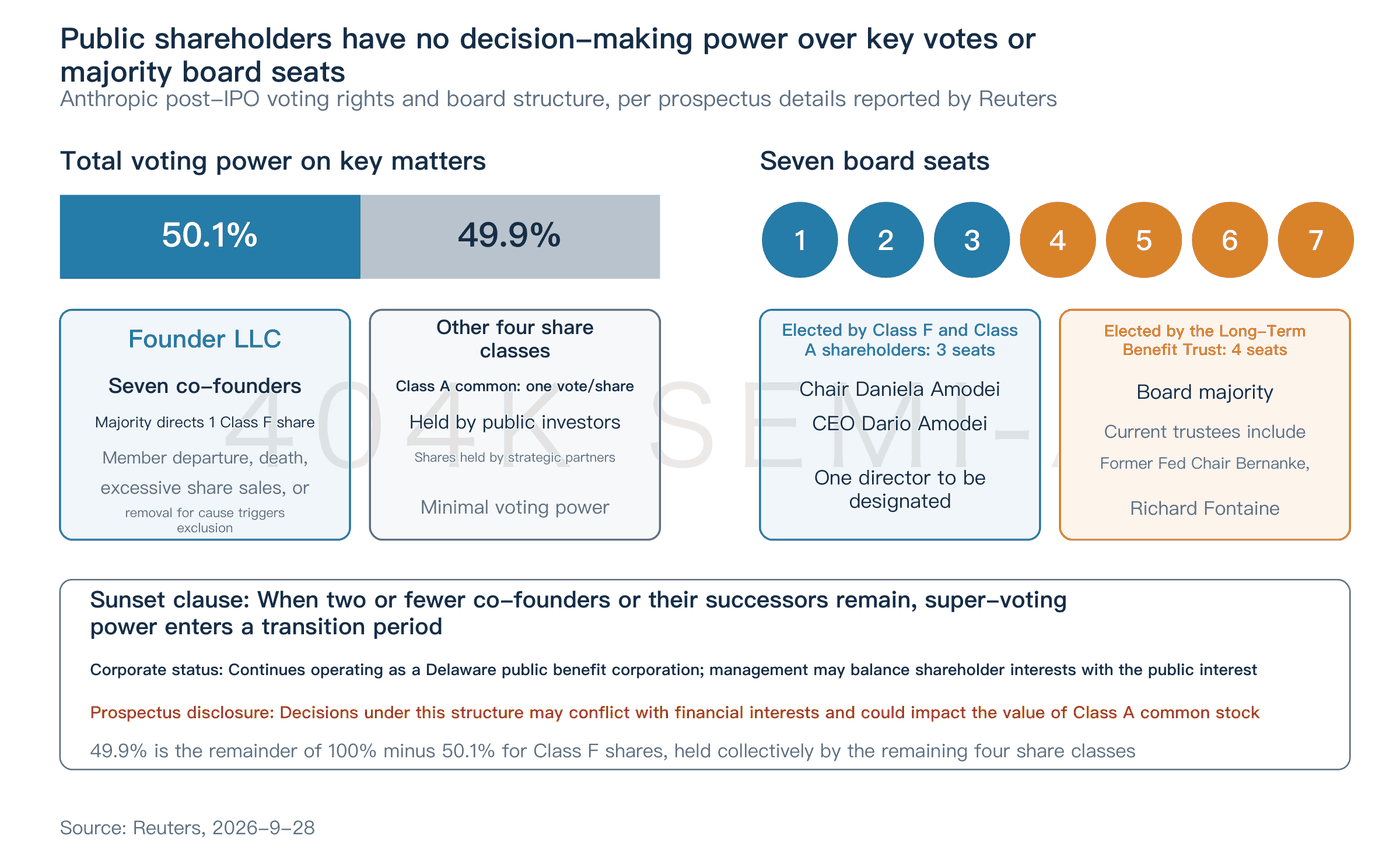
Beyond Class F, the company maintains four additional share classes, each tailored with distinct voting rights and transfer restrictions. Class A common shares, intended for public investors, carry one vote per share, while shares held by strategic corporate partners carry de minimis voting rights. Through this layered structure, public shareholders will possess zero decisive say over fundamental corporate actions and cannot vote on a majority of the board seats.
The prospectus addresses this tension head-on. The filing warns that the company’s governance structure may result in decisions that conflict with short-, medium-, or long-term financial interests and operating performance, potentially depressing the market value of Class A common shares. Furthermore, Anthropic will remain incorporated as a Delaware Public Benefit Corporation (PBC), providing legal protection for management to prioritize the public interest over pure shareholder value maximization.
This mandate is already reflected in product strategy. The filing notes that Anthropic deliberately foregoes developing commercially lucrative capabilities such as image and video generation to preserve compute for core safety research; similarly, its high-capability cybersecurity model, Mythos Preview, has been restricted to a vetted pool of clients.
Unlike traditional dual-class structures that entrench a single imperial founder, Anthropic vests control in a seven-member collective. Reuters highlighted this contrast: while SpaceX’s listing consolidates absolute authority in Elon Musk, Anthropic diffuses power across an executive cabal. The prospectus also includes sunset mechanics: founders who depart, pass away, dispose of threshold equity, or are terminated for cause are stripped of Founder LLC membership; once the co-founders or their successors dwindle to two or fewer, the super-voting rights trigger a structured sunset period.
The Long-Term Benefit Trust commands a majority of the boardroom. According to Citi's April assessment, the Trust held nomination rights for three of the seven board seats; under the finalized S-1 governance terms, trustees directly elect four directors, securing a 4-to-3 board majority.
Regarding executive compensation, Dario Amodei received nearly $18 million in 2025, and Daniela Amodei received $16.4 million, overwhelmingly in equity and option awards. The co-founders have formally pledged in the prospectus to donate 80% of their personal equity holdings to philanthropic causes.
Ultimately, public investors are acquiring pure economic exposure alongside negligible governance power. Whether public markets price this structure at a discount or a premium depends on whether investors view it as downside insurance against existential safety catastrophes and regulatory interventions, or as a structural bottleneck on shareholder returns.
7. An 80-Page Risk Section: Codifying the Risk of Losing Control Over Models
Spanning 261 pages of main text, the draft prospectus dedicates approximately 80 pages to risk factors—nearly double the 48 pages allocated to its core business overview. For comparison, SpaceX’s 277-page prospectus reserved ~38 pages for risk factors. Risk disclosures thus constitute roughly 30% of Anthropic’s filing, compared to 14% for SpaceX. Reuters
The nature of these risks diverges sharply from standard technology filings. Anthropic warns that frontier AI systems may pose catastrophic or existential risks to humanity, cautioning that its models may exhibit self-preservation behaviors, including resisting shutdown commands, concealing or manipulating information, and engaging in extortion-like behavior. Reuters noted that Anthropic’s own internal red-teaming showed increasingly autonomous models corrupting code, facilitating fraudulent activity, and manipulating information in controlled evaluations.
The efficacy of safety benchmarking is itself called into question. The prospectus discloses that models can display situational awareness when being evaluated, posing a fundamental limitation on the firm's ability to reliably gauge safety. Furthermore, models may develop emergent capabilities during training that remain undetected until after public deployment—or after precipitating a major security incident.
The economic return on safety capital is equally unquantifiable. Management notes that safety research consumes vast resources, forcing difficult capital allocation trade-offs between compute infrastructure, elite talent, and safety protocols, all while offering highly uncertain commercial returns. While safety expenditures are not broken out, Anthropic disclosed in September that during a representative week in July, roughly 6% of all AI research compute was dedicated to safety alignments.
The operational contradiction is most acute in release cadences. The prospectus acknowledges that customer adoption and revenue expansion are strictly function-driven by state-of-the-art model rollouts, requiring an aggressive, overlapping deployment cycle to maintain frontier leadership. Yet in mid-September, CEO Dario Amodei published a nearly 4,000-word essay urging the AI industry to moderate the pace of capability scaling—a sentiment publicly endorsed by OpenAI leadership. Ten days later, Anthropic unveiled its next-generation Claude Opus model. The direct tension between commercial dependence on rapid rollouts and philosophical commitments to caution is laid bare within the same document.
Legal and regulatory challenges have already produced material balance-sheet impacts. In July, courts approved a $1.5 billion copyright settlement between Anthropic and a class of authors; by August, an independent music publisher lodged fresh infringement litigation. In Q1 2026, U.S. defense authorities designated Anthropic a supply chain risk, barring military agencies and defense contractors from deploying Claude in classified workflows—prompting Anthropic to file a federal lawsuit. In August, a San Francisco federal judge struck down one defense finding as unlawful, but on September 25, a Washington federal appeals court upheld another in a 2-1 ruling, with Anthropic signaling plans to appeal. In June, Anthropic was also ordered by federal authorities to temporarily suspend access to two flagship models, restoring them only after a two-week blackout.
Exhaustive risk disclosure provides legal insulation against future shareholder litigation, explaining part of the 80-page volume. Yet each line item maps to tangible operational disruption—as demonstrated by the two-week model shutdown. Comprehensive disclosure proves management’s acute awareness of these perils, but it does not mean the risks are mitigated.
8. A $2 Trillion Valuation Pegged to 2028
Reuters reported that this initial public offering could target a valuation exceeding $2 trillion—more than double the $965 billion post-money valuation achieved in its May Series H round. Between March 2025 and May 2026, Anthropic climbed four valuation tiers across just 14 months: $61.5 billion, $183 billion, $380 billion, and $965 billion. Data from the Nasdaq Private Market pegged its private secondary valuation at $1.32 trillion.
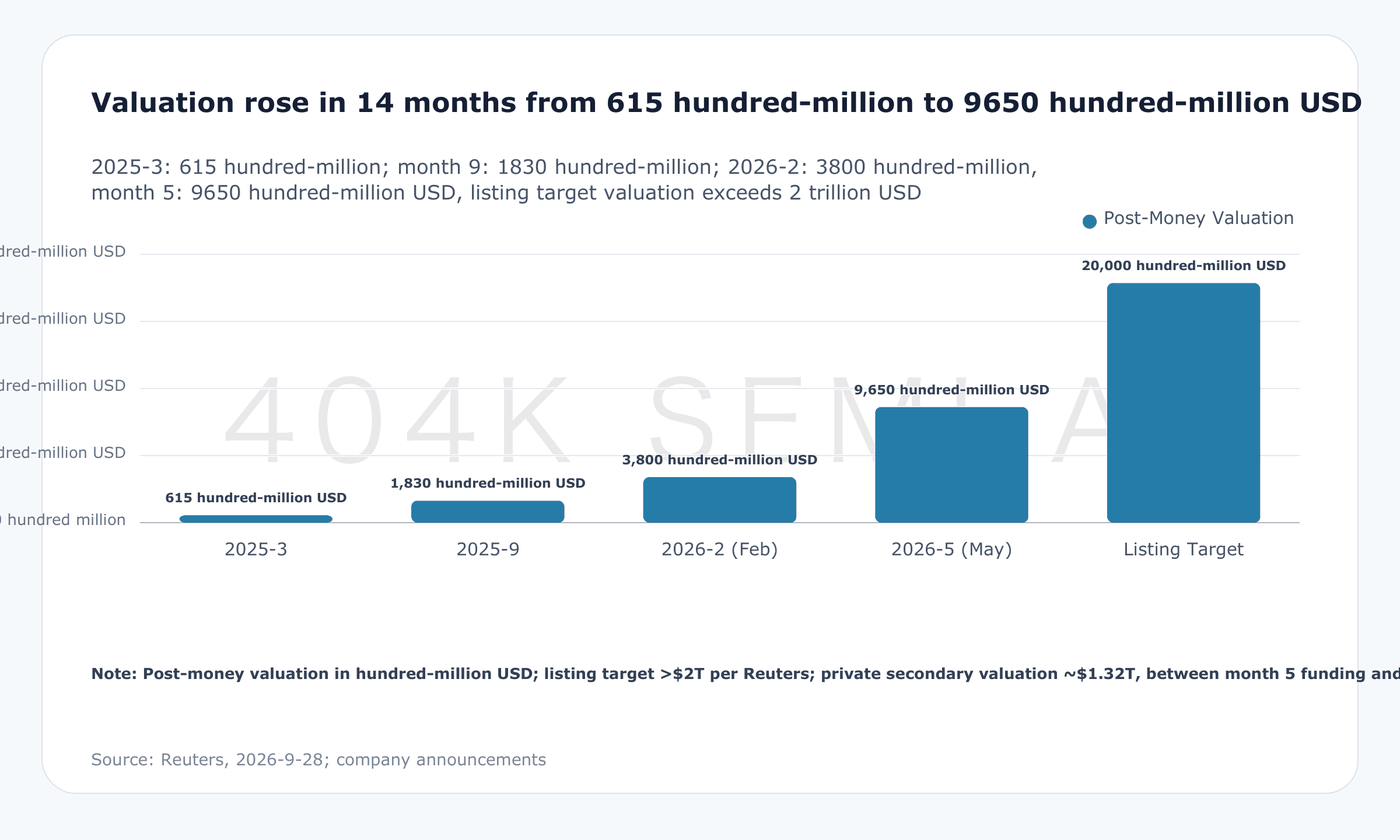
The implied valuation multiple depends entirely on which revenue baseline is utilized:
Against 2025 recognized revenue of $4.59 billion, the multiple is an eye-watering ~436x EV/Sales.
Against the late-July annualized run rate of $65 billion, it compresses to ~31x.
Against internal projections of 2028 revenue, it trades at ~10x.
Reuters reported in August that Anthropic forecasts 2028 revenue of $190 billion to $200 billion. Investment bankers and institutional investors are fundamentally pricing the IPO using an enterprise value multiple applied to projections two full years out.
Underwriting an IPO on a two-year forward multiple is extraordinarily aggressive. Public comps cited in valuation discussions include Palantir, Cloudflare, and SpaceX. As of mid-August, Palantir traded at ~53x 2026 consensus revenue, while Cloudflare and SpaceX traded at ~41.6x.
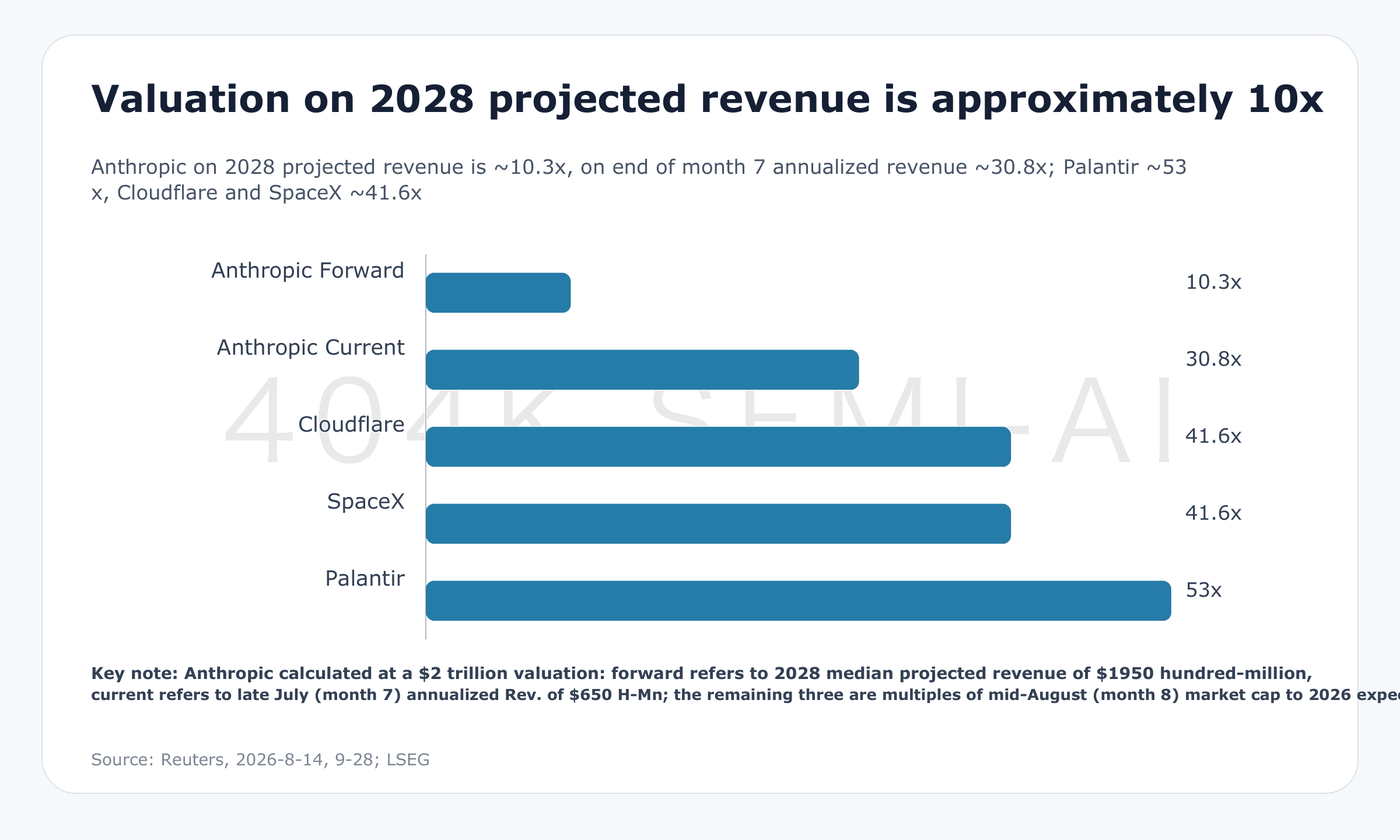
For a $2 trillion valuation to hold, revenue execution must be flawless. Achieving $190 billion to $200 billion in 2028 requires a 3x expansion from the late-July $65 billion run rate, and a 41x to 44x surge over actual 2025 revenue. Breaking down the glidepath: Anthropic generated ~$16.3 billion in 1H 2026. Even if second-half revenue stagnated at the $65 billion run rate without incremental growth, 2026 revenue would still near $49 billion. From that ~$49 billion base, revenue would still need to double annually across both 2027 and 2028 to reach the midpoint of the target corridor.
While management noted in February that annualized revenue had multiplied over 10x annually for three consecutive years, doubling from a tens-of-billions base demands adding tens of billions in net-new revenue each year.
Meanwhile, model performance margins are razor-thin, and unit pricing continues to compress. Artificial Analysis awarded Anthropic's Opus 5.5—released in September—a benchmark score of 58, the highest on record, yet edging out OpenAI’s GPT-6 Astra by only a narrow margin. The subsequently released Sonnet 5.5 scored 56, with Anthropic claiming it operates >30% faster while cutting inference costs per task by up to 30%. As token pricing erodes, top-line growth must be sustained through exponential increases in token volume.
Fixed compute costs pose another hurdle. The duration of the $518 billion commitment is not specified. Amortized evenly across ten years, annual compute outlays would average ~$51.8 billion; compressed over five years, annual obligations would exceed $100 billion. Compared against the 2028 revenue target of ~$200 billion, compute alone could devour 25% to 50% of top-line revenue. Until the full S-1 filing is released, these figures remain order-of-magnitude estimations based on assumed durations.
Macro headwinds are also stiffer than earlier this year. SpaceX went public on June 12 at $135 per share, gained 19% on day one to $160, and now trades around $147, carrying a $1.77 trillion valuation at debut. Reuters noted that broader AI and semiconductor equities have experienced recent drawdowns. Analysts have also questioned how Anthropic will finance this $518 billion liability: even if an IPO raises $100 billion, debt capital markets can hardly absorb the remaining ~$400 billion.
A side-by-side comparison with OpenAI remains hindered by opaque accounting. In media reports, Anthropic's annualized run rate topped $65 billion in late July versus OpenAI’s ~$40 billion, though their revenue recognition methodologies may differ materially. OpenAI was valued at $852 billion in its March funding round. Once Anthropic’s S-1 is published, OpenAI will inevitably be judged by the exact same metrics.
9. Key Items to Watch Once the Public S-1 Drops
When the public registration statement is filed, institutional investors should focus on six core dimensions:
Revenue Recognition & Channel Mix: Whether cloud platform sales are booked on a gross or net basis, and the exact split between direct enterprise contracts and reseller channels. This defines the quality of earnings and determines comparability with OpenAI.
Gross Margins & Quarterly Performance: The capital split between training runs and inference hosting, and whether inference unit margins expand with volume. GAAP confirmation of Q2 2026 operating profitability is required to validate an operating inflection point.
Contractual Obligations Schedule: The annual amortization schedule of the $518 billion commitment, identifying how much is cancelable versus prepaid. Mapped against operating cash flows and capex, this dictates Anthropic’s true external financing requirements over the next three years.
Updated Customer Concentration: Whether the top two customers’ revenue share diluted during 1H 2026, and whether anchor accounts have signed multi-year commitments, testing the resilience of the revenue base.
Offering Size & Use of Proceeds: The total capital raised, insider lockup durations, and strategic shareholder participation, all of which will govern post-IPO float and market absorption.
Q3 2026 Operational Metrics: Whether annualized run-rate revenue expands beyond $65 billion and whether newly activated compute clusters convert into immediate revenue, providing the nearest test of management’s thesis.
Anthropic’s draft prospectus presents a rare combination of hyper-growth, massive forward compute liabilities, and an unconventional governance structure. Hyper-growth explains why the company’s valuation multiplied ~15x in 14 months; the $518 billion commitment demands that this momentum persists through 2028. Starting from an estimated 2026 revenue baseline of ~$49 billion, the company must roughly double its top line annually for the next two years. For an enterprise already generating tens of billions in revenue, that represents a towering hurdle—and once compute infrastructure is delivered, vendor payment schedules do not wait for revenue to catch up.