Contents
1. Nomura’s Shift: Move Beyond Fears of AI Disruption and Assess Its Actual Impact
2. Memory: Margins Move from 75% Toward 80%, While Long-Term Agreements Extend the Cycle Beyond 2028
3. CPUs Become the Next Bottleneck: AI Agents Lift Server Demand and Crowd Out PCs
4. Cloud Capex Rises Again, with Amazon Explicitly Citing Memory Costs
5. Power Grids and Industrial Electronics: Shortages Persist into 2027 as the Five Major Electrical Groups Post Record Quarterly Profits
6. Equipment and Materials: Growth Accelerates, but Shares Sell Off
7. B2C Bears the Other Side: Smartphones, PCs and Consumer Electronics Are Crowded Out
8. Monthly Data: Evidence from WSTS, Taiwan and Japan
9. Preferred Stocks and What Would Invalidate the Thesis
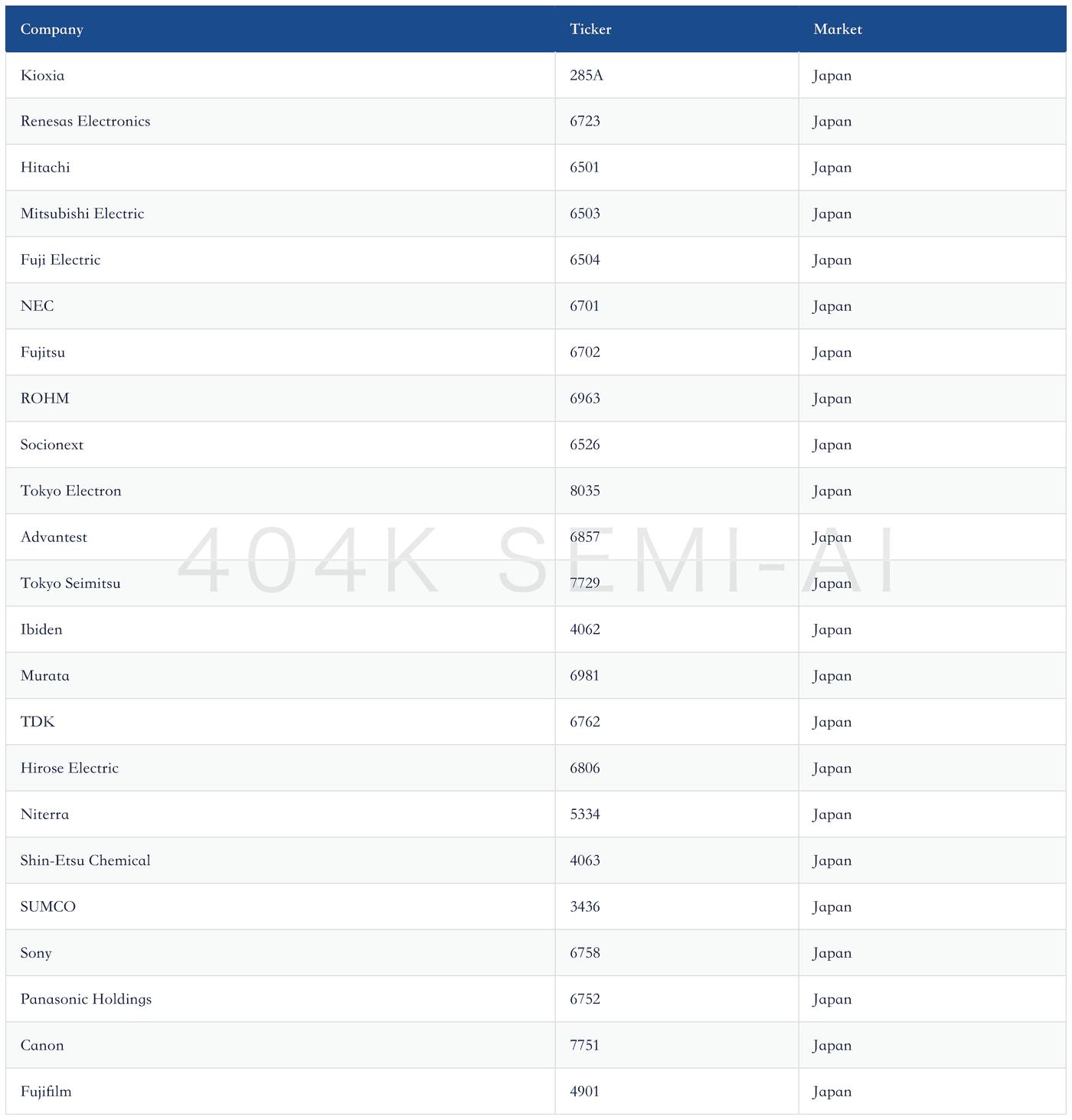
Key Stock Tickers
This content is compiled from publicly available information and research reports. It does not constitute investment advice or represent any individual's views. For educational reference only; please read critically.
Nomura’s August technology monthly makes one central point: AI investment is spilling over into power infrastructure, CPUs, equipment and materials, creating shortages that are lasting longer than in any previous cycle. Outside memory, however, most companies are raising prices only enough to cover higher costs.
1. Nomura’s Shift: Move Beyond Fears of AI Disruption and Assess Its Actual Impact
Following the fiscal 2026 first-quarter earnings season, Nomura draws three conclusions about Japan’s technology sector. First, AI-driven demand for power infrastructure and data centers has strengthened further since the previous quarter, exceeding its expectations. Second, supply constraints have broadened from memory to server CPUs, large transformers, semiconductor equipment and materials. Bottlenecks keep emerging, and Nomura describes the supply-demand imbalance as more persistent than at any previous point. Third—and most distinctive—most companies are raising prices only enough to offset cost inflation, without generating excessive inflation. So far, memory is the only segment where AI-driven shortages have translated into excess profits; elsewhere, price increases are protecting margins rather than expanding them.
That distinction shapes Nomura’s stance: investors should focus on AI’s tangible effects rather than continue worrying about which businesses it might disrupt. July’s report centered on AI agents pushing the server CPU-to-GPU ratio toward 1:1 and higher memory prices crowding out consumer electronics. Those arguments relied on preliminary data and projections. August replaces them with earnings reports and industry statistics: the crowding-out effect appears in IDC’s PC and smartphone shipment data, server CPU shortages in Intel’s and AMD’s guidance, and grid-equipment lead times exceeding two years in Hitachi Energy’s backlog.
A new demand variable has also emerged. Following Moonshot AI’s release of Kimi K3, Nomura believes Chinese open-weight models still lag Anthropic and OpenAI, but the gap has narrowed materially. This should drive additional compute demand, even as it has weighed on sentiment toward semiconductor equipment stocks. On the B2C side, Nomura identifies three specific risks: fading advance purchases, price increases hurting the mass market, and reduced PC supply because of CPU shortages. These form the downside counterpart to its sector outlook.
2. Memory: Margins Move from 75% Toward 80%, While Long-Term Agreements Extend the Cycle Beyond 2028
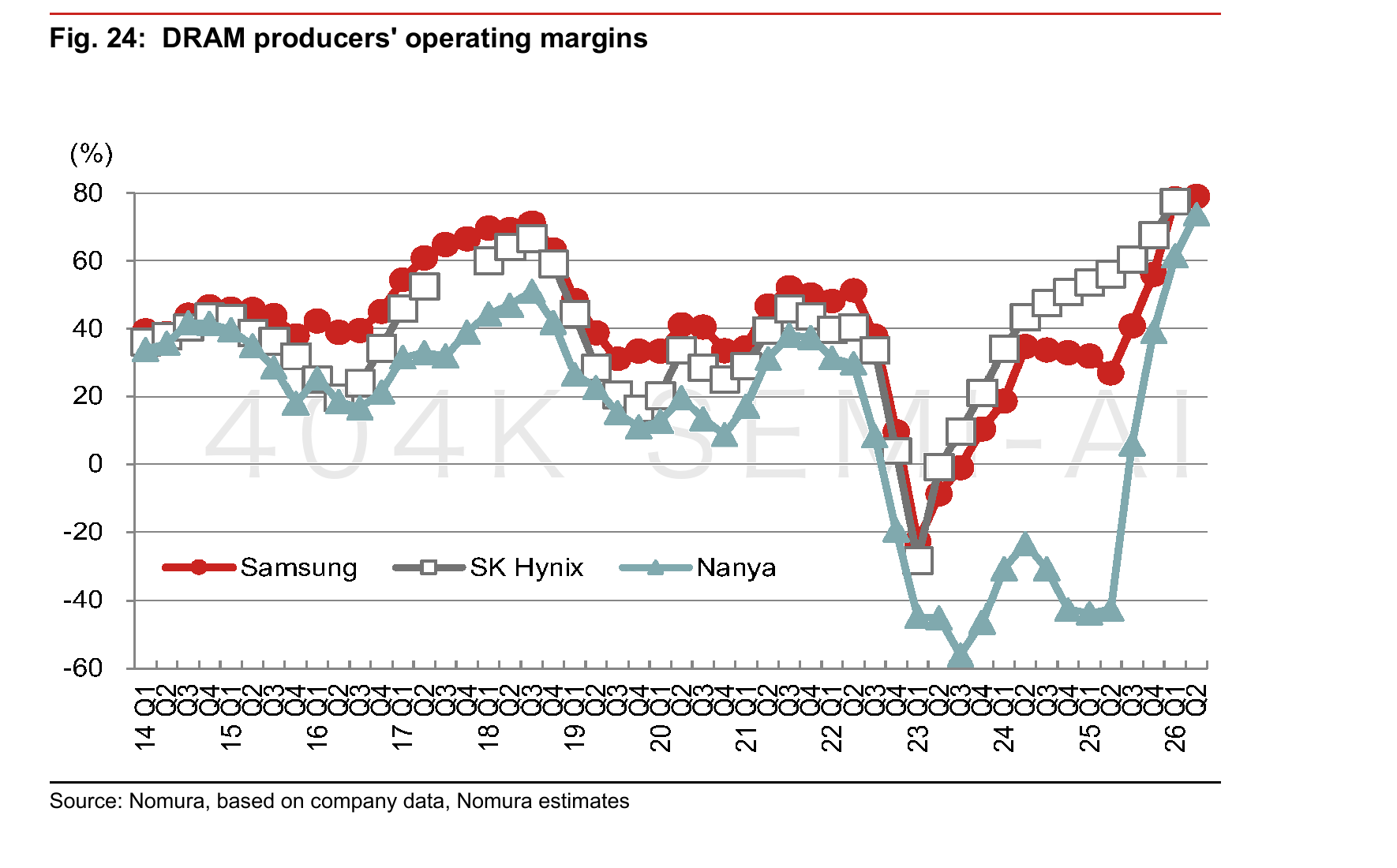
Memory is the only segment fully capturing the excess profits generated by this shortage cycle. In Q2 2026, operating margins at Samsung’s memory division, SK Hynix and Micron all exceeded 76%, while Micron’s Q3 guidance reached 82.7%. Nomura’s memory analysts expect Samsung’s and SK Hynix’s DRAM operating margins to rise from 79% in Q2 to 81% in Q3. They forecast Samsung’s NAND margin increasing from 70% to 74%, and SK Hynix’s from 66% to 72%. Nomura sees no catalyst for prices to peak in 2026–2027; instead, it expects shortages to intensify and procurement difficulties to persist.
The table below summarizes major memory suppliers’ Q2 2026 results. Financial amounts are in US$ millions. Samsung figures cover its memory division; Kioxia figures are converted into dollars. Q3 figures, where provided, represent company guidance for Micron and SanDisk and Nomura estimates for Kioxia.
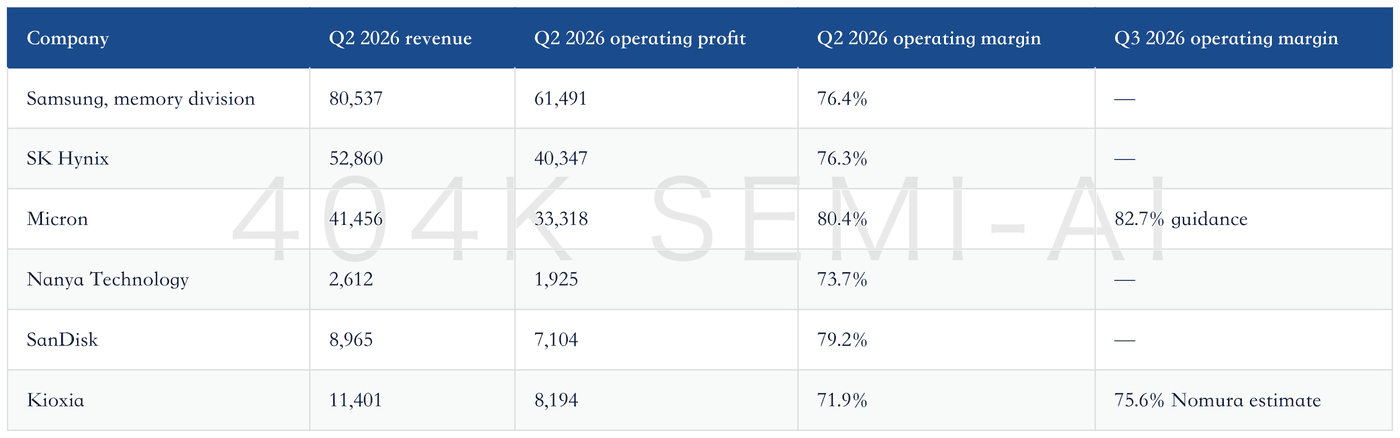
Kioxia offers direct exposure to this thesis in the Japanese market. On the company’s reporting basis, fiscal Q1 operating profit reached ¥1.3 trillion, up 121% sequentially, with a 75.0% operating margin and an approximately 70% increase in average selling price per bit. Fiscal Q2 guidance calls for revenue of ¥2.4 trillion, up 35% sequentially, operating profit of ¥1.9 trillion, up 43%, and a 79.5% margin. Nomura believes the guidance is achievable, assuming 13% growth in bit shipments and a 25% price increase. Kioxia authorized repurchases of up to 30 million shares or ¥800 billion between August 3 and October 30; by August 10, approximately ¥800 billion had already been executed. The early-August Kioxia deep dive used the 75% margin and ¥800 billion buyback as valuation anchors. The monthly report adds two developments: fiscal Q2 guidance raises the margin by another 4.5 percentage points, and the buyback was essentially completed within a week.
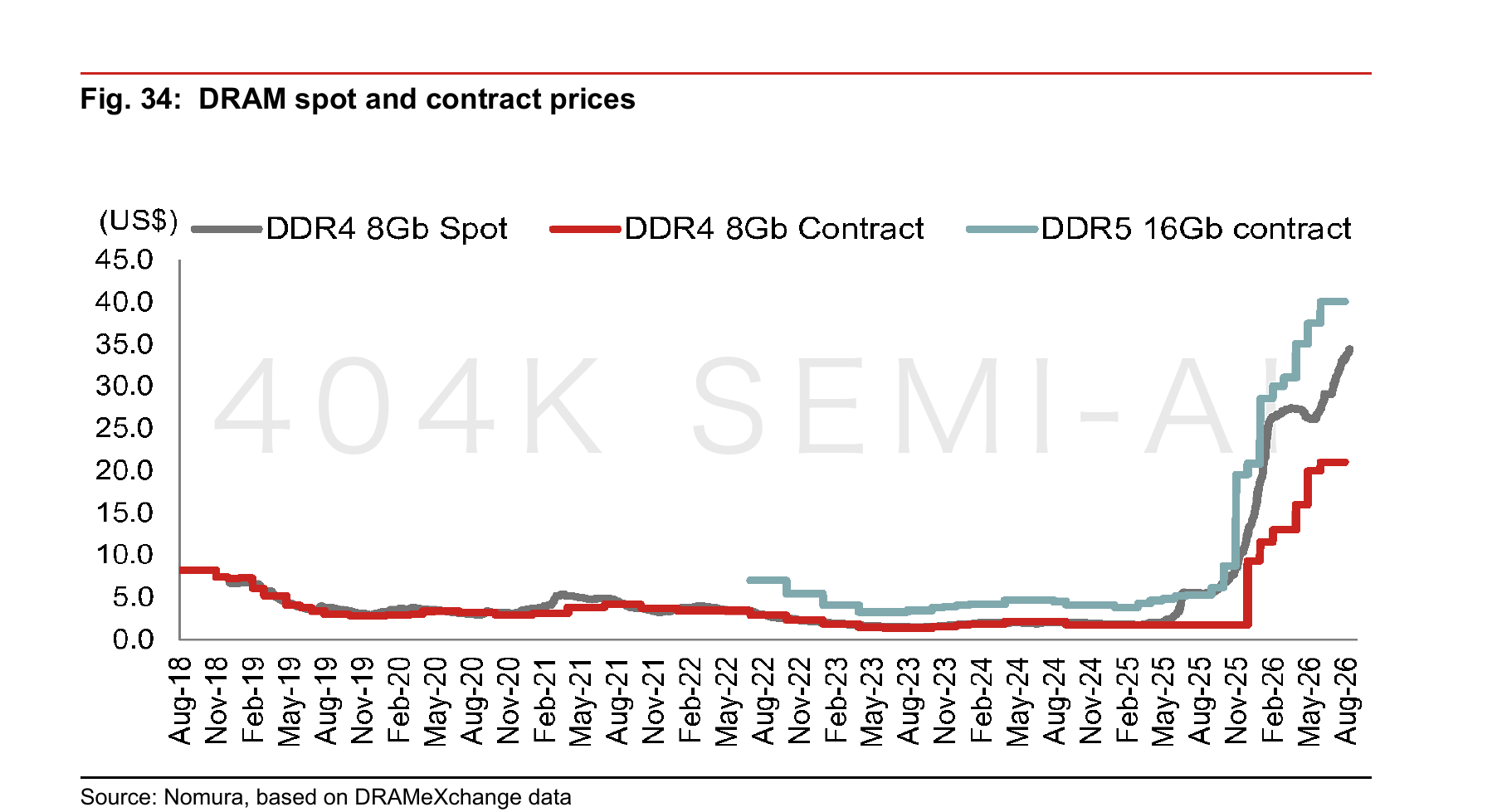
Both spot and contract prices corroborate the strength. At the end of July, DDR5 spot prices were US$33.5/GB, up 9.8% month over month, while contract prices were US$14.9/GB, up 13.9%. The 125% spot premium over contract prices indicates that shortages remain severe, in Nomura’s view. NAND spot prices were flat at US$0.35/GB. Nomura expects DRAM and NAND contract prices to rise another 15%–20% sequentially in July–September. Channel data are diverging: ADATA’s July DRAM sales rose 42% month over month, while SSD sales fell 14%, suggesting that price increases are reaching DRAM first while the NAND channel continues to digest inventory.
Long-term agreements are reshaping the cycle. Samsung’s agreements already cover 60%–70% of shipments, run for five years and include prepayments; the 25% prepayment has already been received. SanDisk’s new commercial-model contracts with eight data-center and edge customers have a weighted term exceeding four years. They are expected to cover at least half of fiscal 2027 bit shipments and at least two-thirds in fiscal 2028. Minimum contracted revenue at floor prices is US$93.9 billion—equivalent to sustaining one quarter’s revenue run rate for four years at a 78% gross margin. Western Digital was discussing agreements through 2029 last quarter and is now discussing terms through 2031. Seagate says its 2028 nearline HDD supply is almost fully allocated; Q2 nearline shipments were 195 EB at Seagate and 209 EB at Western Digital. Kioxia’s ultra-high-IOPS SSDs and SanDisk’s high-bandwidth flash will not make a meaningful contribution until after 2028. Supply growth in 2026–2028 therefore depends primarily on existing capacity, while long-term agreements lock in prices and volumes over that period.
The market has responded poorly. Kioxia closed at ¥57,150 on August 18, underperforming TOPIX by 9.2 percentage points over one month and 41.8 points over two months, although it still outperformed by 1,639.6 points over one year. Nomura attributes the correction to AI sentiment rather than memory fundamentals, citing the margins and long-term agreements above.
3. CPUs Become the Next Bottleneck: AI Agents Lift Server Demand and Crowd Out PCs
July’s central argument was that AI agents would push the server CPU-to-GPU ratio toward 1:1. August’s earnings reports put numbers behind that thesis. Intel reported Q2 non-GAAP revenue of US$16.1 billion, up 25% year over year and US$1.8 billion above the midpoint of guidance. Gross margin reached 41.8%, up 12.1 percentage points. Data Center and AI revenue grew 59%, while Client revenue rose 13%. Q3 guidance calls for US$16.3 billion in revenue and a 42.0% gross margin. Intel raised 2026 capital expenditure by US$3 billion to US$20 billion, representing 40% growth. AMD’s Q2 revenue was US$11.5 billion, up 50% year over year and 13% sequentially, with a 56% gross margin. Data Center revenue grew 107% year over year and 16% sequentially, and Q3 revenue guidance is US$12.7 billion–US$13.3 billion. AMD expects server CPU revenue to grow more than 80% year over year in the second half of 2026 and more than 70% in 2027.
AMD’s three successive market estimates best illustrate the shift. At the end of 2025, it estimated the 2030 server CPU market at at least US$60 billion. In May 2026, it raised that estimate to at least US$120 billion, and this quarter to at least US$220 billion. The projected market has expanded nearly fourfold in roughly six months—direct evidence of AI-agent inference workloads spilling over from GPUs to CPUs.
PCs bear the cost. In its analysis of June WSTS data, Nomura explicitly traces the chain: wider adoption of AI agents drives a surge in AI server CPU demand, creating shortages of CPUs for PCs. IDC reports global PC shipments of 64.7 million units in Q2 2026, down 3.7% year over year—the first decline in seven months. Desktop shipments fell 3.0% and notebooks 4.0%. July’s report attributed the decline to fading advance purchases; August shifts the explanation to reduced CPU supply. Shipment value still grew year over year because unit prices increased. Nomura warns that PC price increases will continue into 2027 and could suppress demand. Apart from memory suppliers and some channel participants, PC companies are merely passing through costs.
NVIDIA provides a useful reference point. Fiscal Q1 2026 revenue was US$81.615 billion, up 85.2% year over year, including US$75.246 billion from data centers. Q2 guidance was US$91 billion, plus or minus 2%. GPU demand has not weakened; CPUs have added a second growth driver. Within industrial electronics, Nomura recommends Renesas for its digital power devices serving ASICs, CPUs and GPUs—the most direct way to translate incremental CPU demand into a Japanese equity exposure.
4. Cloud Capex Rises Again, with Amazon Explicitly Citing Memory Costs
The table summarizes Q2 capital expenditure and full-year guidance for the four major cloud companies. Amounts are in US$ billions.

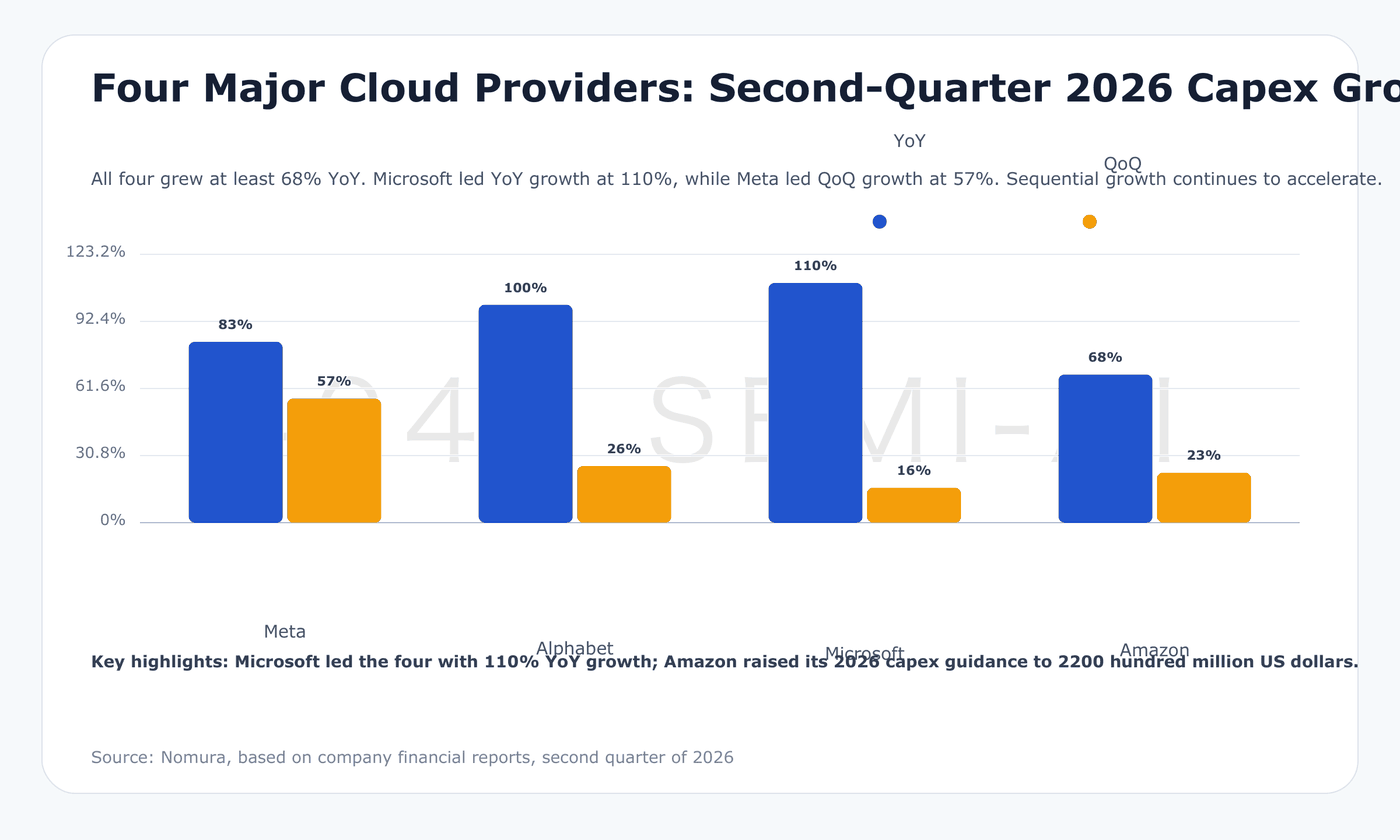
Three companies raised guidance and one lowered it, but Microsoft’s reduction reflects an accounting change. The company emphasized that its underlying investment plan is unchanged, with two-thirds directed toward shorter-lived assets such as GPUs and CPUs. Amazon raised its 2026 guidance from US$200 billion to US$220 billion, citing higher memory costs, and said it has visibility into AWS demand through 2028. The implication is significant: some cloud capex increases reflect higher equipment prices rather than additional equipment purchases. At ¥160 per US dollar, Nomura estimates combined 2026 capex for the four companies at approximately ¥120 trillion.
This also explains why a cloud spending “ceiling” is unlikely to end the memory shortage. Budgets are rising, but memory inflation absorbs part of the increase first, forcing cloud companies to add further spending to maintain compute deployment schedules. July’s report presented this as a projection; Amazon’s August guidance substantiates it.
5. Power Grids and Industrial Electronics: Shortages Persist into 2027 as the Five Major Electrical Groups Post Record Quarterly Profits
Japan’s five major electrical equipment groups reported combined fiscal Q1 revenue of ¥6.0791 trillion, up 15.0% year over year, and operating profit of ¥570.1 billion, up 39.1%—a record for the period. Nomura raised its combined revenue forecast for the year ending March 2027 to ¥26.91 trillion, up 8.5%, and its operating profit forecast from ¥2.94 trillion to ¥3.118 trillion, up 25.9%.
Power grids sit at the center of this growth. Nomura estimates that grid upgrades, electrification and renewable energy account for more than 90% of social infrastructure demand. Labor shortages constrain large-transformer production, capacity expansion takes more than two years, and shortages are expected to persist through 2026–2027. Hitachi Energy’s orders rose 94% year over year to ¥1.8716 trillion, while its backlog reached ¥10.3 trillion, up 12% from the end of March 2026. Hitachi’s grid business revenue grew 35% to ¥867.8 billion, and adjusted operating profit rose 67% to ¥112.4 billion, producing a 13.0% margin. Hitachi targets approximately 15% compound annual growth at Hitachi Energy through fiscal 2030 and an increase in EBITA margin from 12.9% to 16%–20%.
Orders at overseas peers further illustrate the shortage. The table summarizes the latest quarterly orders and margins for three grid-equipment businesses.

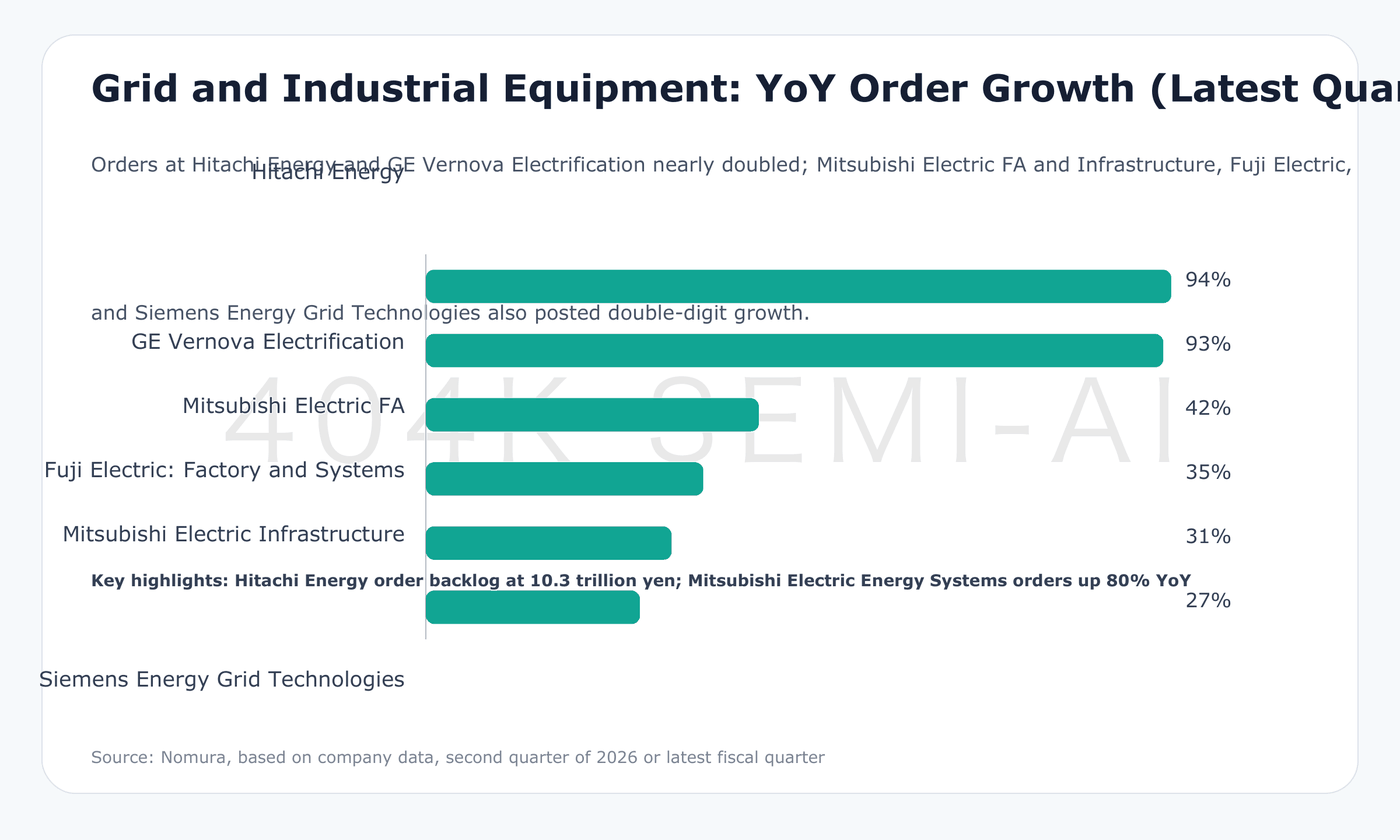
Mitsubishi Electric offers the clearest illustration of prices merely covering costs. Fiscal Q1 revenue rose 14%, while adjusted operating profit increased by ¥50.4 billion to ¥144.3 billion. Excluding currency effects, revenue rose 8% and profit 30%. Price increases contributed ¥8 billion against ¥11 billion of cost inflation, leaving costs only partly covered; volume drove profit growth. Infrastructure orders rose 31%, utility orders 37%, energy systems orders 80%, and factory automation orders 42% to a record ¥287 billion. The company raised adjusted operating profit guidance for the year ending March 2027 from ¥590 billion to ¥620 billion, while Nomura raised its forecast from ¥610 billion to ¥670 billion. Factory automation systems profit guidance increased by ¥18 billion to ¥120 billion, compared with Nomura’s ¥152 billion estimate. The gap reflects Nomura’s stronger view of AI-related factory automation demand.
Fuji Electric’s fiscal Q1 operating profit reached ¥25 billion, up ¥6.9 billion year over year and above Nomura’s ¥19 billion estimate. Revenue rose 10%, with a 9.2% operating margin. Plant and systems orders increased 35% to ¥283.8 billion, factory automation component orders rose 19%, and ED&C; component orders grew 46%. Nomura recommends Fuji Electric for its data-center power exposure.
NEC’s non-GAAP operating profit was ¥74.7 billion, up ¥34.7 billion year over year and well above Nomura’s ¥43 billion estimate. Full-year guidance increased from ¥420 billion to ¥430 billion, although the company retained a ¥30 billion risk buffer, including ¥20 billion for component shortages.
Fujitsu’s operating profit was ¥52.5 billion, up ¥19 billion year over year, including more than ¥10 billion of real estate gains. Memory costs created a headwind exceeding ¥2 billion. Service Solutions adjusted operating profit reached ¥62.8 billion, with an 11.4% margin; Uvance orders grew 51% and revenue 31%. Across the five groups, the combined IT services operating margin increased 1.4 percentage points to 10.9%, with revenue growth of 6% in Japan and 15% overseas.
Currency provides potential upside to forecasts. Nomura changed its exchange-rate assumption from ¥155 to ¥160 per US dollar, while most companies still assume around ¥150 in their guidance. Hitachi’s 82% local procurement ratio makes it relatively less sensitive to exchange rates. Most component and equipment companies, however, continue to concentrate production investment in Japan, so a weaker yen directly lifts profits.
6. Equipment and Materials: Growth Accelerates, but Shares Sell Off
Monthly equipment data are accelerating. SEAJ reported a June three-month moving average of ¥513.6 billion for Japanese-made semiconductor equipment sales, up 27% year over year and down 2% sequentially. Nomura estimates standalone June growth at 40% year over year. The three-month average growth rate rose roughly 9 percentage points from May’s 17.9%. By export category, assembly equipment grew 8%, wafer-processing equipment 22%, and inspection equipment 40%. Front-end equipment companies broadly raised their 2026 wafer fab equipment forecasts, expecting industry growth of at least 20%; Lam Research projected approximately 35%. TSMC raised 2026 capex guidance from US$52 billion–US$56 billion to US$60 billion–US$64 billion. Intel has shifted toward proactive investment, memory companies are bringing forward DRAM spending, and Chinese wafer fab equipment demand has become clearer.
TSMC’s investment in AI packaging is driving back-end demand. Advantest is seeing rising ASIC and CPU demand alongside GPU testers, while Tokyo Seimitsu is seeing Chinese demand for HPC wafer probers. Display equipment is the only declining segment: the June three-month moving average for flat-panel display equipment was ¥23.2 billion, down 34% year over year.
Materials companies broadly beat earnings expectations, and several raised full-year guidance, citing AI and data-center demand alongside pass-through of higher raw-material costs. Resonac raised core operating profit guidance for the year ending December 2026 above Nomura’s forecast. Sumitomo Bakelite reported strong demand for power-semiconductor packaging materials used in AI data centers. JX Advanced Metals and Mitsubishi Gas Chemical substantially exceeded operating profit expectations and raised guidance. Shin-Etsu Chemical’s operating profit guidance for the year ending March 2027 fell short of Nomura’s estimate because of weak PVC, but electronic materials exceeded expectations, with silicon wafers and rare-earth magnets standing out. Tokyo Ohka Kogyo reported strong photoresist demand.
SUMCO said silicon wafer demand was stronger than expected but stressed that future long-term agreements must deliver adequate returns. Its 2025 operating margin was only 0.4%, falling to negative 4.3% in Q4, compared with a 33.2% full-year 2025 operating margin for Shin-Etsu’s electronic materials business. Silicon wafers remain the last materials segment where shortages have yet to translate into profits.
The market nevertheless sold first. Nomura described the share-price response to earnings beats as “harsh,” attributing it to elevated expectations and inventory concerns. Tokyo Electron closed at ¥56,380 on August 18, underperforming TOPIX by 17.9 percentage points over one month but still outperforming by 100.0 points over one year. Advantest closed at ¥35,860, with one-year outperformance of 136.6 points. Ibiden closed at ¥20,875, outperforming by 348.0 points over one year, and Murata at ¥7,496, outperforming by 132.7 points. Disco underperformed by 26.3 points over two months.
The late-July Japanese electronic components deep dive argued that AI orders were beginning to translate into profits. August’s monthly report confirms that earnings are materializing, but stocks that had more than doubled over a year had already priced in that progression. Together with the sentiment shock from Chinese open-weight models, earnings delivery became a selling opportunity. Nomura remains bullish over the medium term, recommending Advantest, Tokyo Seimitsu and Tokyo Electron. Its component picks include TDK for 800V DC lithium iron phosphate batteries and high-voltage components; Ibiden for EMIB-T organic package substrates; Murata for next-generation MLCCs for AI servers; Hirose Electric for probe cards; and Niterra.
ROHM illustrates the cost pressure. Fiscal Q1 operating profit was ¥9.6 billion, up ¥8.5 billion sequentially, while revenue rose 21.6% to ¥135.7 billion. Raw-material costs, including gold, increased by ¥12 billion, inventory reductions imposed a ¥10.1 billion burden, and utilization was only slightly above 60%. AI servers accounted for 5% of revenue. Profit improvement depends on the end of destocking rather than price increases; its 75.8-percentage-point one-year outperformance more closely reflects recovery from the cyclical trough.
7. B2C Bears the Other Side: Smartphones, PCs and Consumer Electronics Are Crowded Out
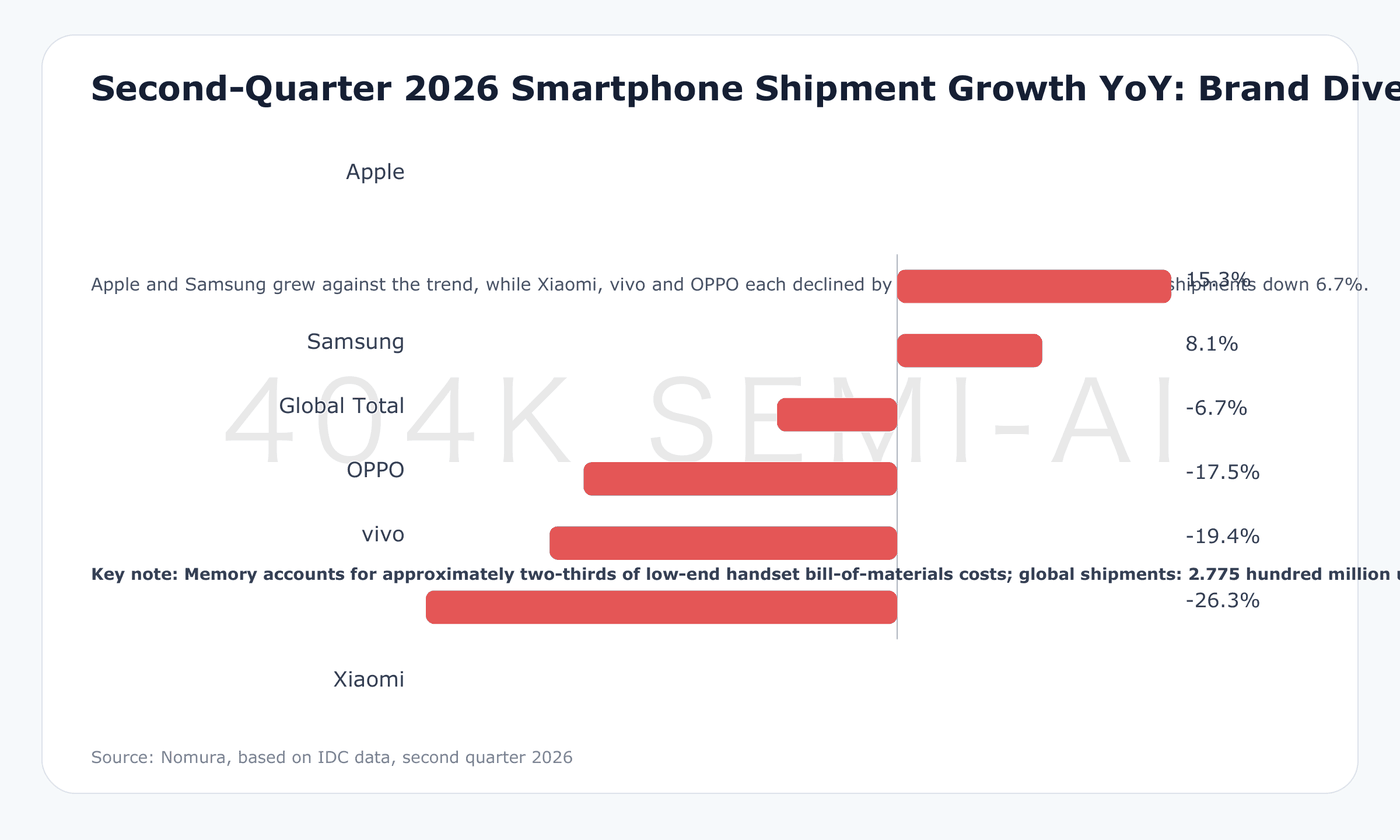
End markets bear the other side of memory inflation. IDC reports global smartphone shipments of 277.5 million units in Q2 2026, down 6.7% year over year. The divergence is stark: Xiaomi fell 26.3%, OPPO 17.5% and vivo 19.4%, while Apple grew 15.3% and Samsung 8.1%. Nomura’s explanation is that memory represents approximately two-thirds of the bill of materials for low-end smartphones. Higher prices directly undermine their economics, while premium-device buyers are less price-sensitive. Q2 iPhone shipments were 55.8 million units at an average selling price of US$972, compared with Samsung’s 62.7 million units at US$306. Samsung’s relative cost burden is more than three times Apple’s.
Qualcomm’s QCT revenue was US$8.5 billion, down 4% year over year: handset revenue fell 20%, automotive grew 61%, and IoT rose 9%. Handset revenue declined from US$7.8 billion in fiscal Q1 to US$6 billion in Q2 and US$5.1 billion in Q3. The company expects it to bottom at US$5.2 billion in Q4. Falling Android handset production has already reached chip suppliers.
The timing of the impact on consumer electronics companies matters. Fujifilm, Panasonic Holdings, Sony and Canon benefited from US tariff refunds in April–June, but higher costs, including memory, begin to show up in July–September. Fujitsu has already disclosed a memory-cost headwind exceeding ¥2 billion. Approximately ¥10 billion of Socionext’s China automotive-related sales were deferred to fiscal Q2, leaving product revenue at ¥27.4 billion, well below Nomura’s ¥39 billion forecast. Sony closed at ¥3,718 on August 18, underperforming TOPIX by 30.6 percentage points over one year; Socionext underperformed by 49.6 points. They were the two weakest performers among the companies covered that month.
Nomura adds a stronger warning in its WSTS analysis: beyond procurement difficulties, companies increasingly struggle to pass costs on to consumers, potentially creating a broader impact than the tariff concerns of 2025. Meanwhile, business customers are placing orders early because of memory inflation and shortage fears, and demand for networking equipment and conventional servers is already showing signs of overheating. B2B customers are bringing purchases forward while B2C demand contracts—opposite responses to the same memory-price shock. This underpins Nomura’s view that non-AI markets are also recovering, but the gap with AI is widening.
8. Monthly Data: Evidence from WSTS, Taiwan and Japan
June WSTS data provide the strongest global evidence. Worldwide semiconductor shipment value rose 134.3% year over year, with the three-month moving average up 124.4%. The Americas grew 162.5% and Europe 74.3%. Memory price increases and AI chips drove most of the growth, but Nomura also notes that inventory corrections in non-AI segments have ended and that their recovery is real.
Taiwan’s July data show growth stabilizing at a high level. Revenue at 265 Taiwanese electronics companies increased 58.4% year over year and 1.9% month over month. Hon Hai reported NT$947 billion in revenue, up 54.2% year over year and 15.2% sequentially, contributing 13.2 percentage points to aggregate growth. Quanta contributed 8.3 points. ASPEED grew 98% and Wiwynn 39%, indicating no weakening in AI server demand. TSMC’s July revenue reached NT$468 billion, up 45% year over year and 6% sequentially, marking 31 consecutive months of year-over-year growth. Q2 revenue was US$40.2 billion, and Q3 guidance was US$45.2 billion. TSMC raised its 2026 growth guidance from at least 30% to at least 40% and is considering a US$100 billion investment in four to five new US fabs.
Japan’s domestic semiconductor data moved in the opposite direction. METI reported June shipment value down 4.2% year over year and production down 21.8%, reflecting the continued cyclical trough in power and analog devices, which dominate Japanese suppliers’ output. Memory inventory days, however, fell from 26.5 in May to 18.5 in June, the fastest inventory drawdown of any category.
Together, the three datasets show global AI and memory accelerating, Taiwanese foundry and assembly activity sustaining high growth, and Japanese domestic devices recovering from the bottom. This is the basis for Nomura’s conclusion that non-AI markets are recovering even as the gap widens.
9. Preferred Stocks and What Would Invalidate the Thesis
Nomura’s recommendations fall into four groups. In industrial electronics, it favors Kioxia, Renesas Electronics, Hitachi, Mitsubishi Electric, Fujitsu, Fuji Electric and NEC, based respectively on memory margins, digital power, HMAX physical AI, defense, Uvance, data-center power, and defense plus BluStellar. Its electronic component picks are TDK, Ibiden, Murata, Hirose Electric and Niterra. In consumer electronics, it recommends Fujifilm, Panasonic Holdings, Sony and Canon. Equipment picks are Advantest, Tokyo Seimitsu and Tokyo Electron.
The table shows August 18 share prices in yen and performance relative to TOPIX in percentage points.
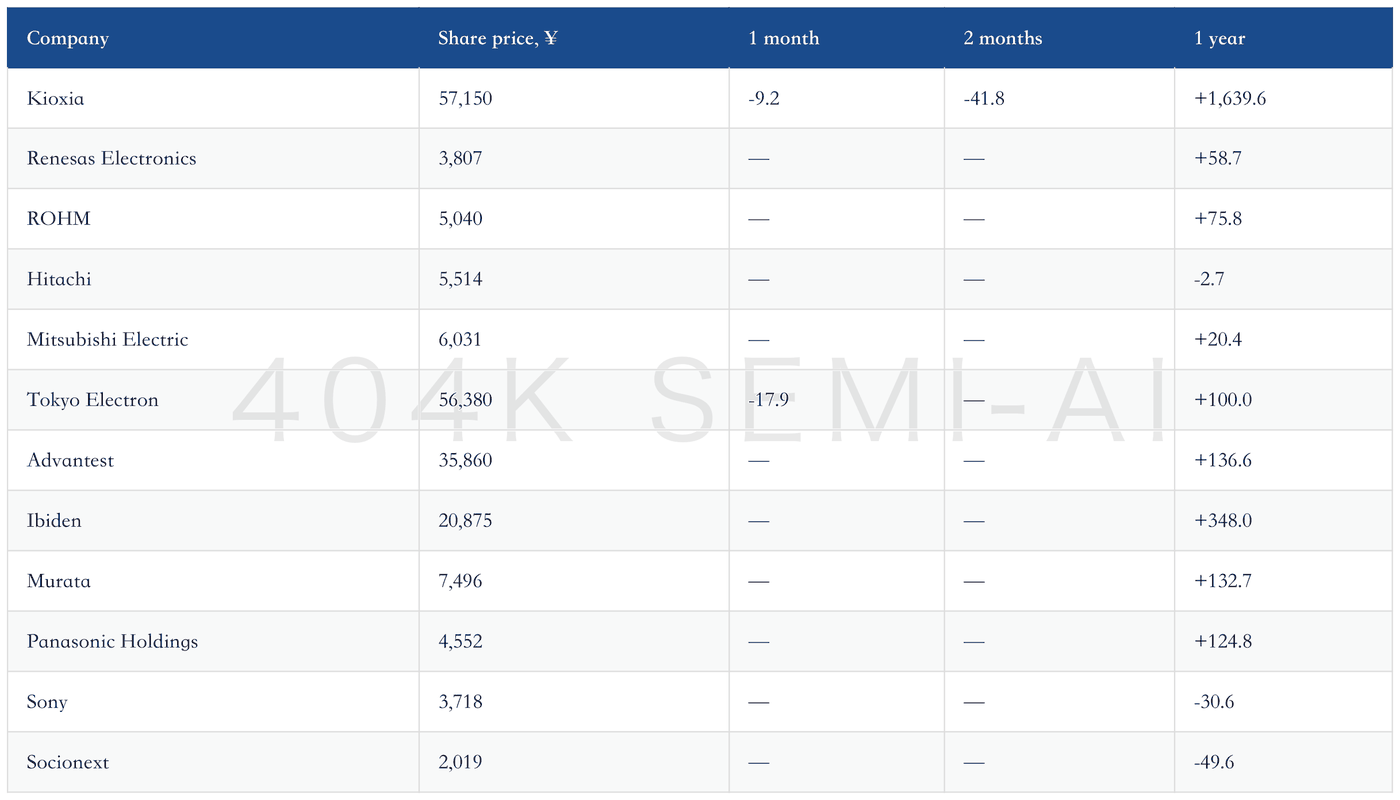
Among Nomura’s recommended companies, memory and AI hardware have delivered the strongest stock performance. Hitachi underperformed by 2.7 percentage points over one year, while Mitsubishi Electric outperformed by only 20.4 points. Record profits in grids and industrial electronics have yet to be fully reflected in share prices. This explains both companies’ inclusion among Nomura’s picks and the report’s greater emphasis on grid shortages than on memory.
There are six clear conditions that could invalidate or materially alter Nomura’s view:
Memory pricing disappoints. If July–September DRAM and NAND contract price increases fall short of the projected 15%–20%, or long-term contract floors are renegotiated, the path toward 80% operating margins breaks down. Micron’s 82.7% Q3 margin guidance and Kioxia’s 79.5% fiscal Q2 guidance are the nearest tests.
End-market weakness deepens and advance orders unwind. If PC and smartphone shipment declines exceed Q2’s 3.7% and 6.7%, respectively, while networking and server demand falls as early corporate purchases reverse, WSTS growth could shift from acceleration to a peak.
Cloud capex is genuinely cut. A substantive reduction in the next round of guidance, rather than an accounting adjustment such as Microsoft’s, would require a reassessment of the demand base for memory and CPUs.
Pricing outside memory begins to exceed cost inflation. If Mitsubishi Electric’s ¥8 billion pricing benefit versus ¥11 billion cost increase reverses, Nomura’s conclusion that inflation is not excessive would be wrong. That would imply upside to margins but downside to end demand.
The yen strengthens toward ¥150 per US dollar. The potential currency-driven forecast upside for the five major electrical groups would disappear.
Unquantifiable risks materialize. Nomura flags the Kumamoto earthquake risk cited by ROHM and the continued pressure on equipment-sector sentiment from Chinese open-weight models, but cannot quantify either.
Nomura’s conclusion is that AI’s actual impact is already visible in earnings, making the debate over whether it will disrupt businesses less useful. As July’s projections turn into August’s evidence, the two most important metrics remain quarterly memory contract price increases and the gap between price increases and cost inflation outside memory.
Key Stock Tickers