
Contents
Contents
From making money by selling compute to making money after buying compute
Demand evidence remains strong, but orders are not cash
Inference gross margins are high; why returns still need proof
Which timeline safety requirements change
There is still financing capacity, but the cost is rising
Why the same investment cycle produces different supply-chain outcomes
Rising material value content also means rising customer costs
A valuation pullback does not make the whole industry cheap
Stress-testing the capex forecast
This content is compiled from publicly available information and research reports. It does not constitute investment advice or represent any individual's views. For educational reference only; please read critically.
AI infrastructure demand is still growing, but the market is starting to ask what that growth costs. Whether suppliers can make money, whether customers can earn a return, and whether the next investment round can be financed are three distinct questions. Opportunities across the supply chain are diverging, and even strong orders must now pass a joint test of profits, cash flow, and valuation.
Contents
From making money by selling compute to making money after buying compute
Demand evidence remains strong, but orders are not cash
Inference gross margins are high; why returns still need proof
Which timeline safety requirements change
There is still financing capacity, but the cost is rising
Why the same investment cycle produces different supply-chain outcomes
Rising material value content also means rising customer costs
A valuation pullback does not make the whole industry cheap
Stress-testing the capex forecast
From making money by selling compute to making money after buying compute
In its September 16, 2026 Asia Technology Strategy, J.P. Morgan grouped the questions facing the AI infrastructure trade into three categories: whether purchased compute can be monetized on a sustained basis, whether safety and regulatory requirements will limit demand, and who will fund the next construction round once free cash flow comes under pressure.
These three questions explain why the industry is still expanding while the stock market may hesitate. Chip, equipment, and materials suppliers can recognize revenue once they deliver products to customers; after customers buy compute, they must still go through model development, product deployment, user acquisition, and monetization before turning the outlay into revenue. The two ends face different profit and cash-recovery cycles.
J.P. Morgan’s base case remains constructive: current unit economics and financing capacity can support growth over the next two years, and it does not yet see the near-term capex downturn that hardware stocks have begun to fear. But it also places an important source of confidence in continued monetization by models and applications. More orders can prove that construction is continuing, but they cannot by themselves prove final returns.
Accordingly, industry research needs to separate four levels: whether end usage is growing, how much revenue suppliers can capture, whether customer spending can generate cash, and how much the market has already paid for those outcomes. Good news at one level can be offset by costs, timing, or expectations at another.
For the Asian supply chain, this means the analytical focus shifts from “Is it AI-related?” to specific orders, technical barriers, and delivery position. Whether a supply bottleneck can persist, how long capacity expansion takes, and how product specifications change explain profit dispersion better than a broad industry-growth label.
Demand evidence remains strong, but orders are not cash
J.P. Morgan’s aggregation of public cloud data from Google, Microsoft, Amazon, and Oracle shows acceleration: combined revenue growth rose from 23% year over year in Q2 2025 to 26%, 30%, and 36% in sequence, reaching 43% in Q2 2026. This goes further than looking only at capex announcements, because revenue growth already reflects some demand entering commercialization.
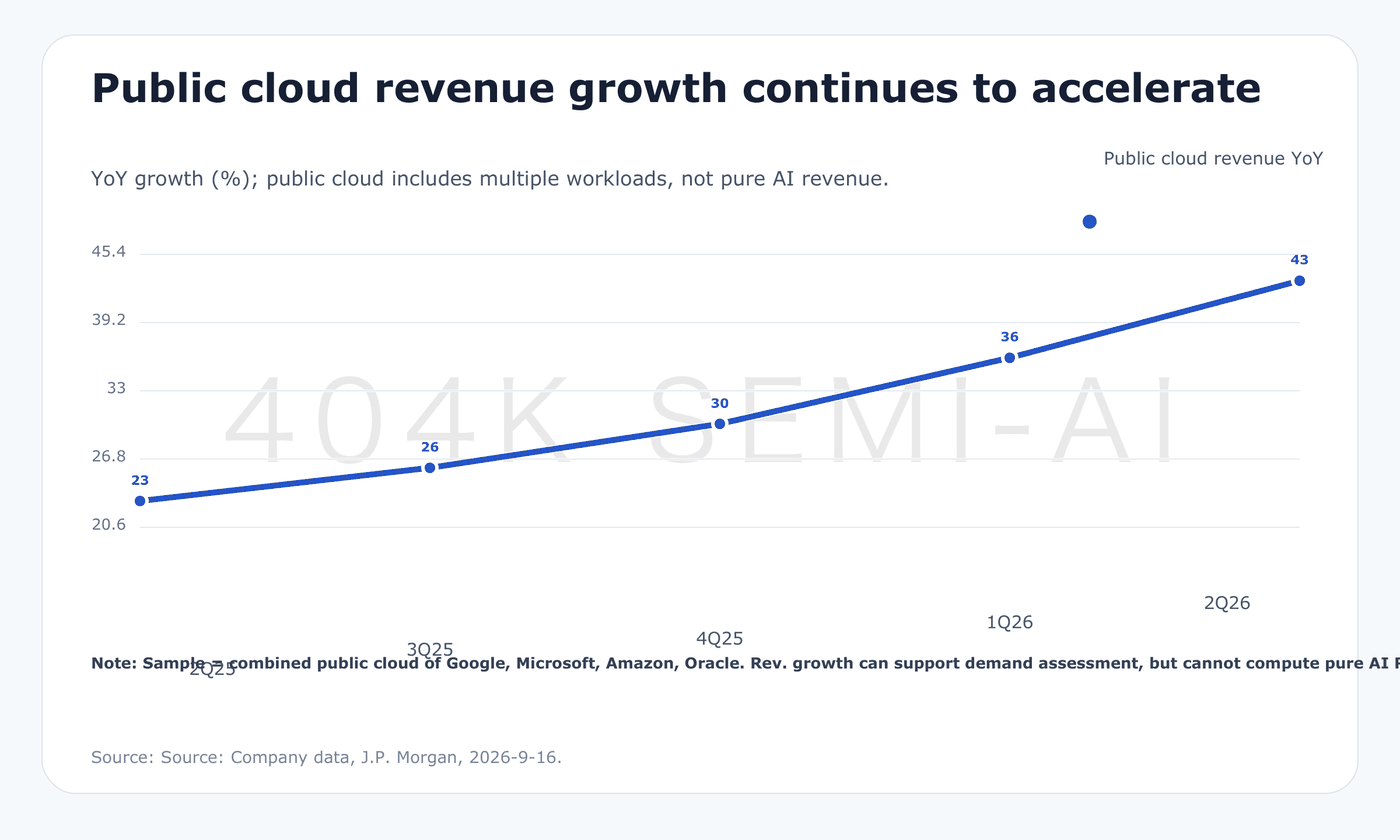
However, public cloud includes multiple workloads. This growth rate is not pure AI revenue growth, nor is it total revenue growth for the four companies. It supports the view that cloud demand is strengthening, but it cannot be used to calculate the standalone revenue scale or margin of AI businesses. Traditional workload migration, pricing, product mix, and AI demand can all affect the aggregate result.
Contracted backlog is also expanding. Google Cloud’s backlog increased from $155 billion in Q3 2025 to $514 billion in Q2 2026; Microsoft’s commercial remaining performance obligations rose from $392 billion to $678 billion over the same period. The latter metric covers Microsoft’s commercial business as a whole, cannot be fully interpreted as Azure cloud orders, and different definitions should not be added together as current cloud revenue.
These metrics improve visibility into future business, but order conversion still requires deployment capacity, contract fulfillment, and actual customer usage. If equipment deliveries, data-center energization, and application launches are misaligned, revenue and cash recovery will be delayed. Judging order quality requires looking at contract size and fulfillment speed together.
Capex forecasts show the scale of construction. J.P. Morgan estimates that calendar-year capex for seven companies—Amazon, Microsoft, Google, Meta, Oracle, CoreWeave, and SpaceX—will rise from $443 billion in 2025 to $933 billion in 2026 and then to $1.577 trillion in 2027. The latter two years are forecasts, not completed investments.
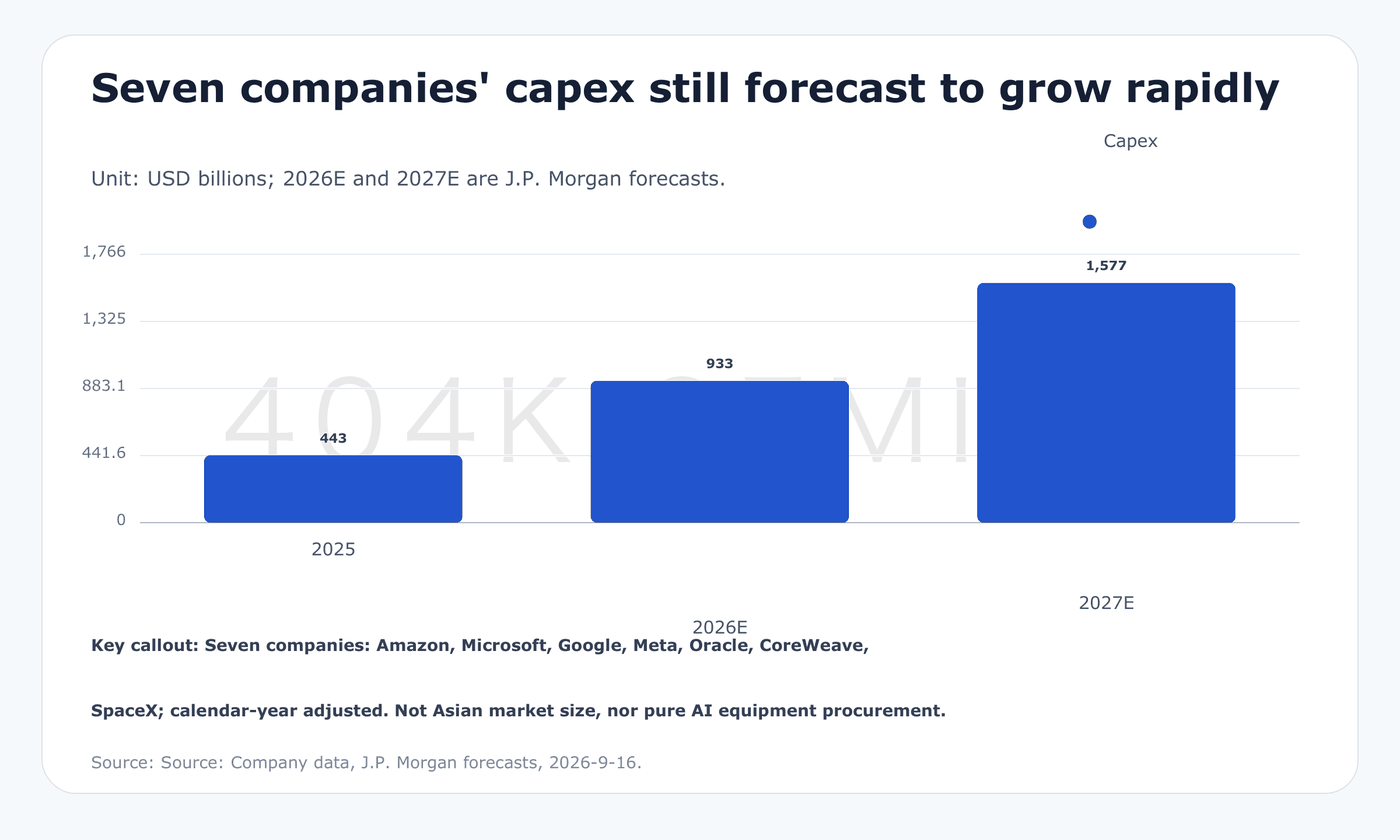
This both provides important support for hardware demand and magnifies the return-on-investment question. The seven companies’ capex is not the Asian market size, and it will not all convert into revenue for one type of semiconductor or equipment. Land, buildings, power, networking, computing equipment, and allocation across workloads will affect what suppliers ultimately capture.
