Contents
Weekly Thesis
Cloud Revenue & AI Capex
Akamai’s Anthropic Deal: Concrete Demand Signal vs. Front-Loaded Capex Pressure
Data Centers, Compute Sourcing, and Custom Silicon
Models, Software, and Application Monetization
M7 vs. Neo-Cloud Divergence
Divergent AI Monetization and Cost Profiles Across Hyperscalers
Market Debates, Counter-Evidence, and Next Week's Catalysts
Key Monitoring Priorities and Falsification Signals for Next Week
While AI compute demand continues to surge, the profitability retained by cloud service providers (CSPs) is increasingly dictated by power energization, physical deployment schedules, and balance-sheet financing structures. This week saw a multi-billion-dollar CPU contract, broader commercial deployment of custom silicon, and a high-profile data center payment dispute unfold simultaneously. Investment scrutiny must now advance beyond headline contract backlogs to revenue realization, testing whether capital expansion is truly generating accretive cash returns.
Weekly Thesis
Across the Magnificent Seven (M7) and cloud providers, market dynamics shifted along two dimensions this week: enterprise customers began funding more comprehensive, end-to-end AI runtime environments, while infrastructure providers restructured how delivery and financing risks are allocated. Akamai’s multi-year CPU deal with Anthropic indicates that agentic AI spending has expanded into general-purpose compute for pre- and post-inference orchestration. Meanwhile, Oracle’s effort to secure payment deferrals over data center delays underscores the operational mismatch hyperscalers face between signing anchor tenants and synchronizing site readiness, grid interconnects, and lease liabilities.
These two trends coexist without contradiction: robust underlying compute demand can run in parallel with mounting pressure on project-level cash returns. Demand is underpinned by committed customer procurement; cash returns, however, depend on when clusters are energized, when commercial billing starts, and who absorbs the costs of delay. Equating large contract announcements directly with high margins ignores the drag of capital tied up during prolonged construction. Conversely, misinterpreting a site-specific payment dispute as an industry-wide demand retreat overlooks ongoing long-term capacity bookings.
Pricing updates this week also point toward finer market segmentation. Nebius announced a revamped pricing mechanism for preemptible virtual machines (VMs), establishing distinct fee structures for long-term guaranteed capacity versus opportunistic spot availability. For cloud providers, operational excellence requires not merely securing hardware allocations, but dynamically assigning capacity to optimal workloads. Pricing power, utilization rates, and customer retention must be evaluated in tandem; isolated improvements in any single metric do not prove higher return on invested capital.
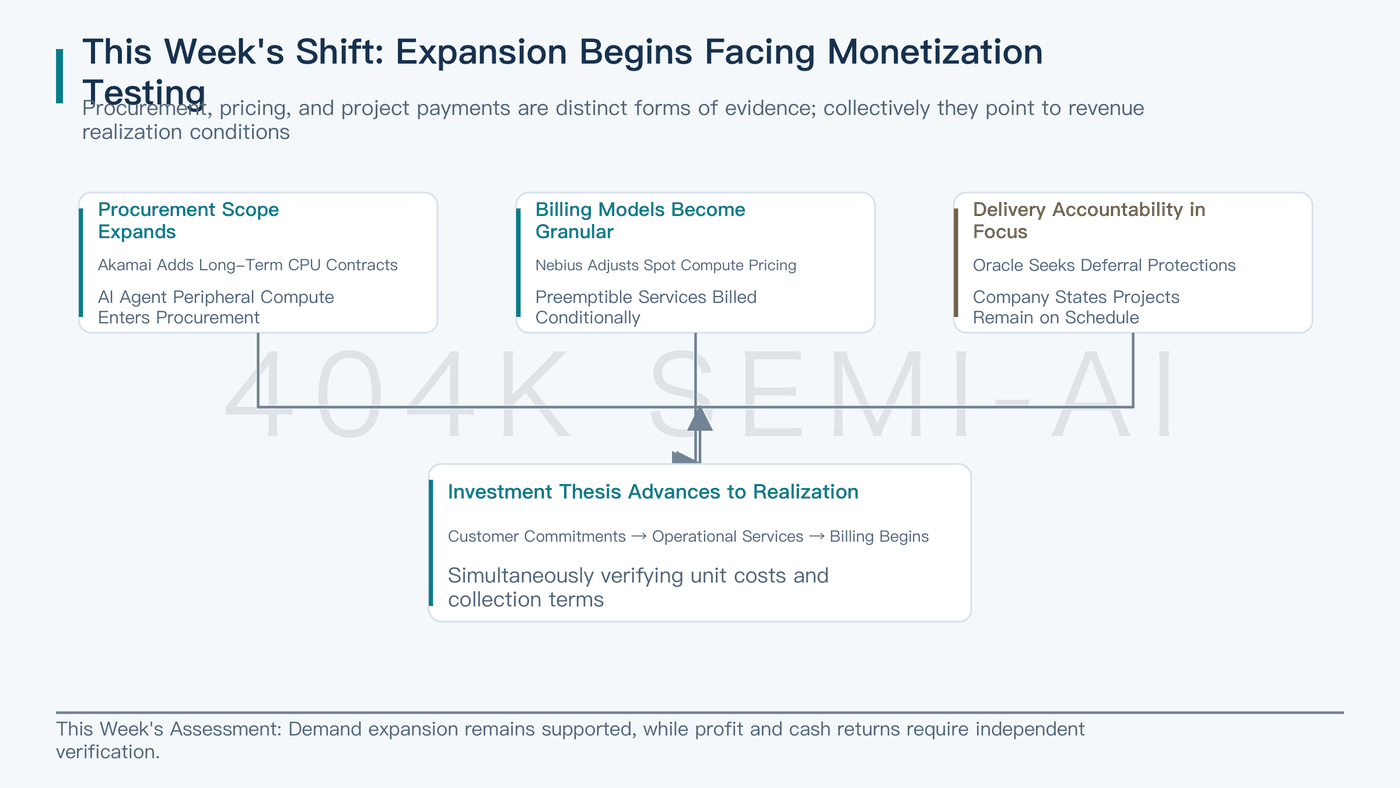
From an investment perspective, priority should be given to platforms capable of converting underlying demand into billable, cash-generative services rather than those merely announcing expansive capex footprints. Microsoft is advancing proprietary inference silicon while forging cooling and power distribution partnerships; Google continues to scale external merchant demand for TPUs; and Amazon is migrating production workloads to its custom chips. Each strategy attacks the identical economic question: how much additional capital equipment and operating cost is required for every incremental dollar of AI revenue?
Growth opportunities remain compelling for emerging neo-clouds, but underwriting requires business-level scrutiny. Multi-year capacity commitments for anchor tenants, preemptible instances for developers, and software stacks deployed on customer-owned infrastructure exhibit vastly different cash-flow dynamics. Customer waitlists demonstrate supply tightness but do not substitute for GAAP revenue recognition; initial software traction improves long-term margin mix, but cannot instantly re-rate capital-intensive hardware leasing to software-like multiples.
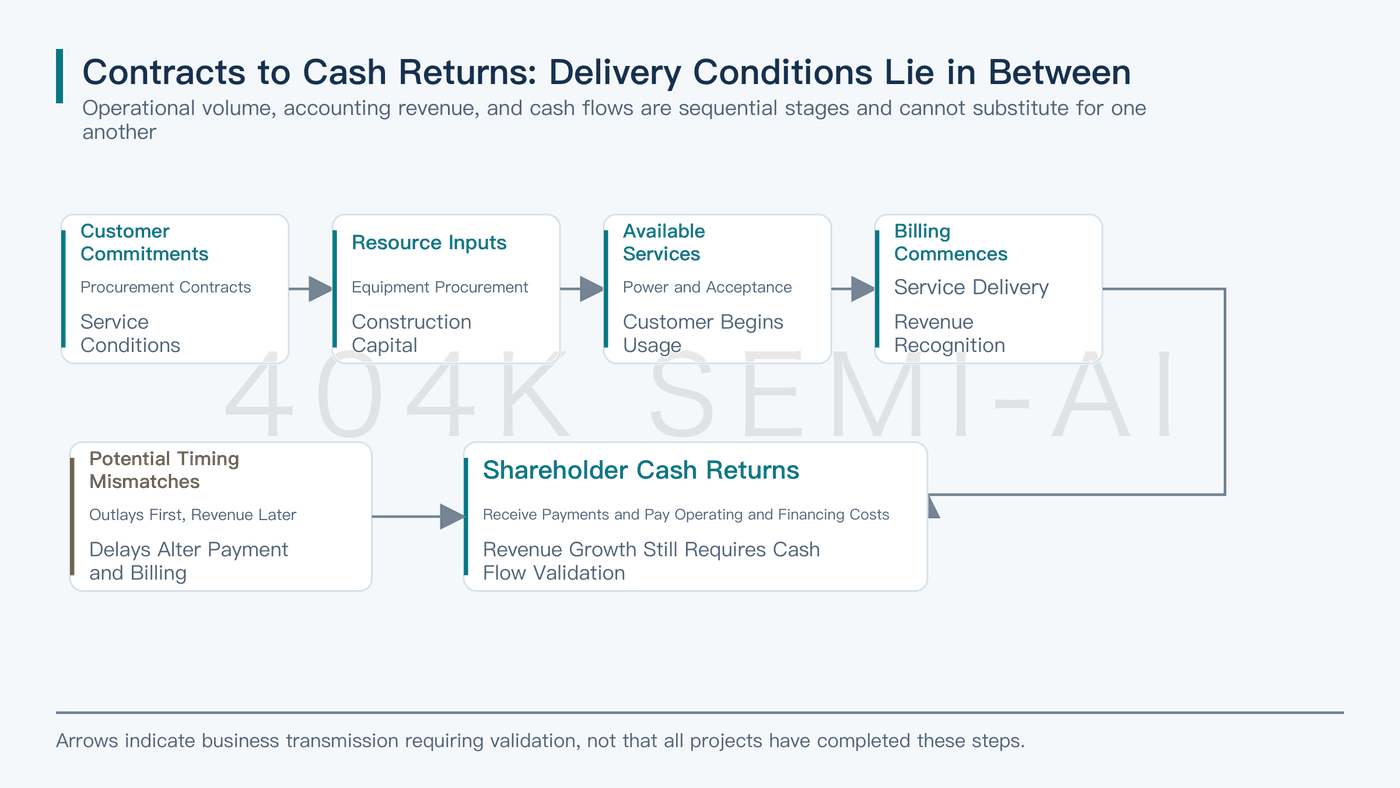
We therefore maintain our constructive view on AI cloud demand expansion while tightening the hurdle rates for operational execution. Over the coming quarters, the highest-conviction signals will be: newly signed contracts reaching billing milestones, definitive energization of power feeds, receipt of upfront customer deposits, and reductions in unit serving costs. If contract backlogs expand while these execution metrics stall, growth remains largely an uncollateralized forward promise, raising the financing burden and capital risks borne by equity holders.
Cloud Revenue & AI Capex
Street capex estimates continue to trend upward, but capital outlays and recognized revenues cannot simply be netted out within the same calendar period. Goldman Sachs reportedly projects aggregate AI infrastructure spend among five major US hyperscalers (Amazon, Google, Microsoft, Oracle, and Meta) to reach $1.2 trillion by 2027. This is a sell-side forecast reflecting anticipated buildout intensity; it should not be treated as a confirmed, synchronized corporate budget, nor can it be mechanically allocated across individual company revenue streams.
The investment takeaway is that the downstream drag from depreciation, financing charges, and project management will continue to widen. Whether top-line growth outpaces investment hinges on sustained utilization rates and realized pricing once new capacity goes live. Even if reported cloud operating income climbs, free cash flow during peak construction phases can tighten sharply; conversely, a single-quarter dip in capex may merely reflect deferred equipment milestones rather than softer structural demand. Assessing underlying demand requires cross-referencing customer procurement pace against physical project timelines.
Akamai’s landmark agreement exemplifies this temporal lag. The company announced a 7-year, $11.6 billion CPU infrastructure contract with Anthropic, backed by an initial capex commitment of approximately $5.5 billion. Around $1.7 billion of incremental spend is earmarked for 2026 to secure long-lead components such as memory, representing an upfront portion of the total buildout. Crucially, Akamai noted that this arrangement does not alter its 2026 revenue guidance. Contracts are locked and procurement capital flows out first; revenue must await cluster deployment.
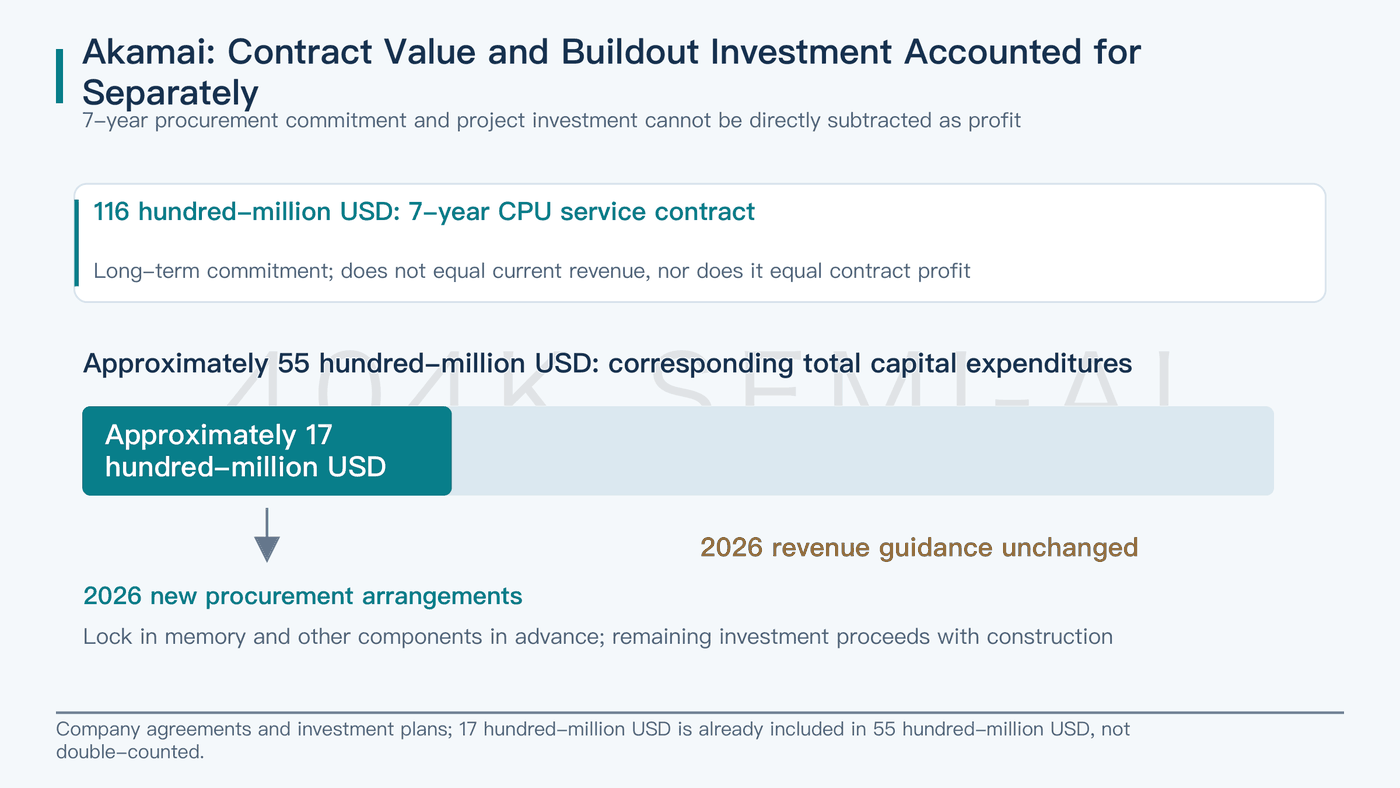
Akamai’s revenue trajectory warrants careful dissection: headline total contract value (TCV) cannot be straight-lined across the contract duration. The agreement is reportedly slated to begin contributing in 2H27, generating roughly $150 million to $300 million in FY27, before ramping to an annualized run rate of approximately $1.7 billion over the course of 2028. This $1.7 billion figure reflects the targeted exit run-rate velocity, not full-year recognized 2028 revenue, and should not be used to calculate a misleading year-over-year growth rate against FY27 totals.
Akamai’s Anthropic Deal: Concrete Demand Signal vs. Front-Loaded Capex Pressure
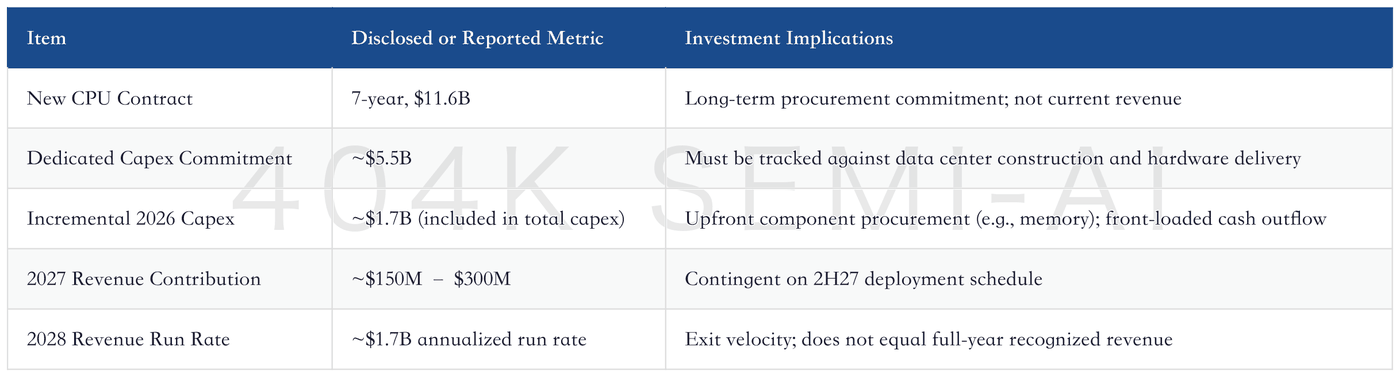
For competing CSPs, this transaction confirms that leading frontier-model developers are disaggregating diverse compute workloads across multiple specialized vendors, proving that general-purpose computing can also command long-term multi-billion-dollar commitments. However, it does not demonstrate that Anthropic has cancelled or reallocated equivalent capacity from existing tier-1 hyperscalers. Share loss can only be confirmed upon observing displaced workloads, modified legacy contracts, and active workload migrations; for now, the more defensible interpretation is a net expansion of the customer's total addressable compute envelope.
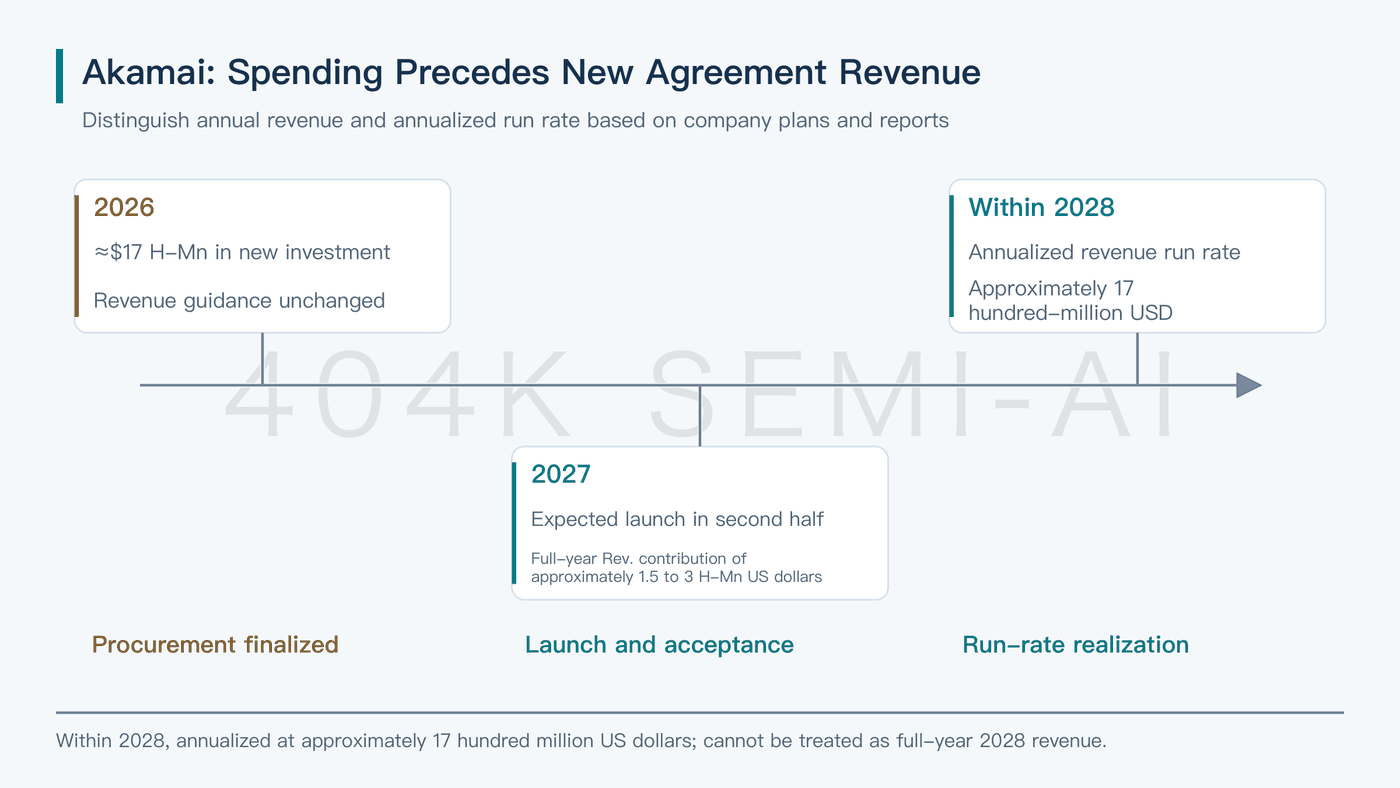
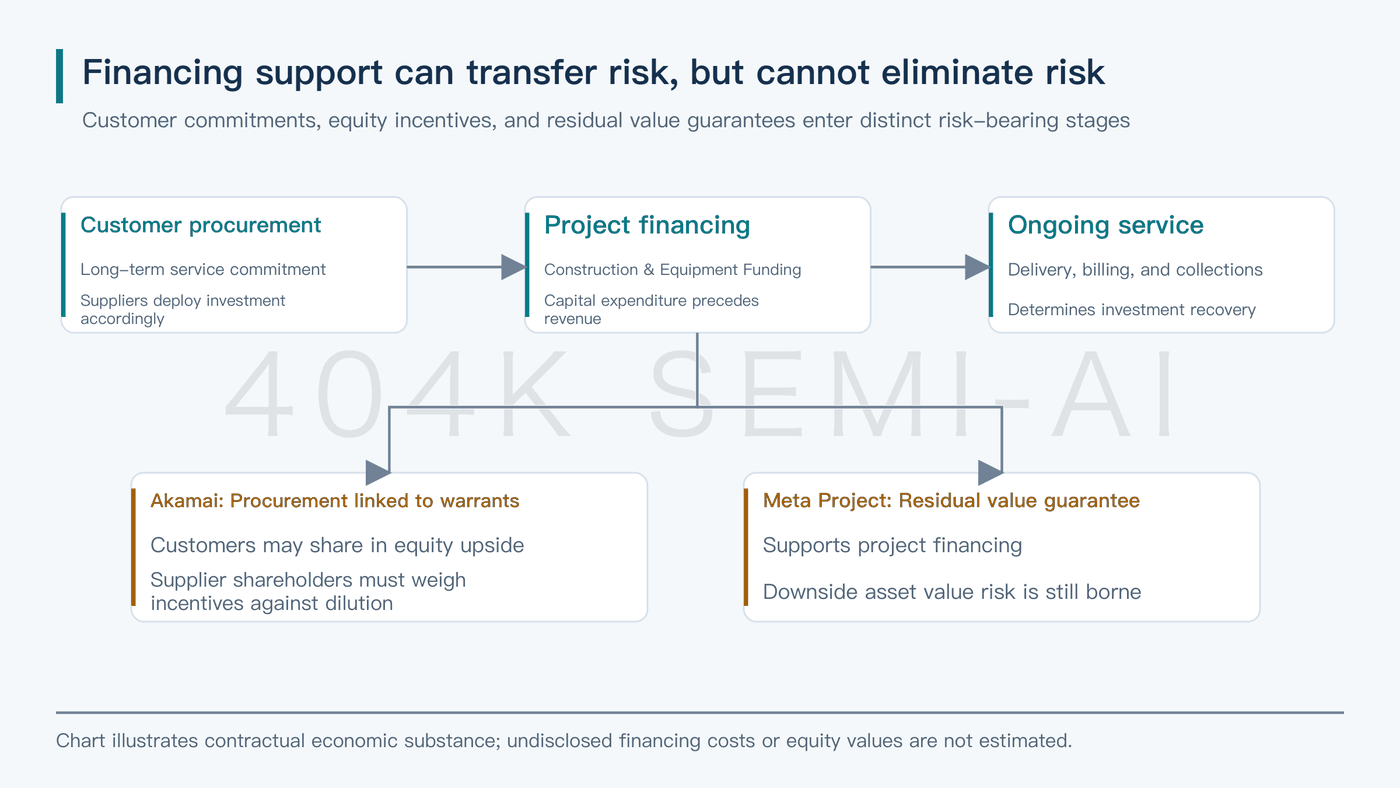
Financing structures ultimately dictate who captures the economic value of mega-contracts. Akamai granted Anthropic equity warrants tied to procurement milestones, featuring staggered vesting schedules linked to baseline commitments and future expansions. The customer is not merely an infrastructure buyer, but shares in the supplier’s equity upside. Underwriting contract profitability therefore requires evaluating headline contract value net of financing costs, equity dilution, and the economic burden of customer warrants.
Financing structures tied to Meta data centers highlight an alternative risk-sharing playbook. Meta has reportedly utilized residual value guarantees (RVGs) on select large-scale projects to underwrite minimum future asset values. While this eases upfront debt financing for project developers, it does not eliminate the underlying risk of technological obsolescence or asset repricing. Analysts must jointly assess direct capex, off-balance-sheet lease obligations, and contingent guarantee liabilities rather than focusing solely on current cash outlays.
Conversely, debt capital markets remain receptive for premier sponsors: a bond offering funding a Georgia data center leased to Meta reportedly saw strong investor demand. This confirms that projects backed by investment-grade anchor tenants can secure institutional debt, but it does not imply that speculative or sub-scale builds enjoy identical credit spreads. Underwriting must differentiate between counterparty credit quality, collateral backing, payment seniority, and ultimate recourse terms. Similarly, low cash coupons on convertible debt cannot be viewed as cheap capital if offset by substantial equity dilution.
Data Centers, Compute Sourcing, and Custom Silicon
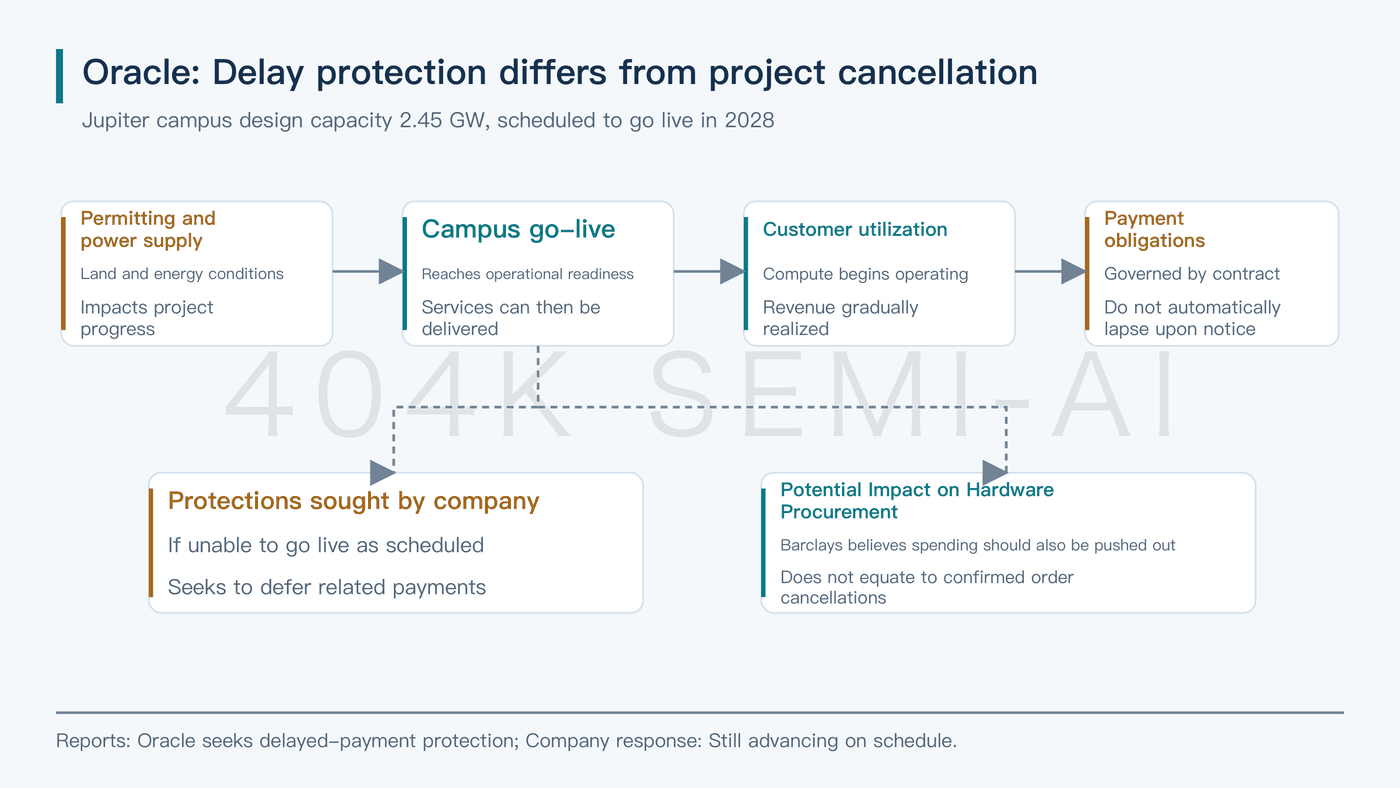
Oracle’s Project Jupiter brought infrastructure delivery risks into sharp contractual focus. The company reportedly issued a force majeure notice to a project entity affiliated with developer Blue Owl, seeking payment deferrals should its 2.45 GW planned campus in New Mexico fail to energize as scheduled by 2028. Reports emphasized that Oracle has not relinquished its anchor tenant position; Oracle officially maintained that the project remains on track with established timelines.
The verifiable takeaway is that Oracle is positioning for financial shielding against potential grid connection delays, which should not be conflated with project cancellation or legal exoneration. Complexities surrounding permitting, natural gas pipeline interconnects, and local community pushback present execution hurdles, but a force majeure notice does not dictate the ultimate contractual outcome. Critical follow-ups include Blue Owl’s formal response, substation/pipeline construction milestones, and whether lease payment schedules are formally amended.
Hardware procurement cycles naturally adjust to physical construction delays. Barclays noted that Oracle’s associated IT hardware capex would likely be deferred in tandem. This represents a sell-side adjustment to capex timing rather than a company-announced order reduction. For NVIDIA and server ODMs, near-term delivery push-outs can shift revenue recognition across fiscal quarters, but deferral is fundamentally distinct from cancellation. Investors must distinguish between schedule re-alignments and order de-commitments rather than projecting a site-specific dispute into broad sector order cuts.
Hyperscalers are actively shoring up end-to-end integration to ensure servers land in fully operational facilities. Microsoft entered a strategic partnership with LG to explore supply opportunities in cooling and power distribution equipment, designating prefabricated modular data centers as a mid-to-long-term collaboration area. This demonstrates that scaling strategies now encompass physical operational prerequisites; however, a strategic MOU should not be modeled as committed purchase volume or a blanket architectural standard across all future campuses.
The efficacy of such alliances must be judged by commissioning lead times and ongoing thermal/power reliability. Pre-integrating mechanical, electrical, and plumbing (MEP) infrastructure with IT hardware reduces onsite integration bottlenecks, but deployment acceleration ultimately depends on regional permitting, commissioning, and grid interconnect approvals. Microsoft’s operational progress should be benchmarked against net energizable MW capacity, using vendor partnerships merely as leading operational indicators.
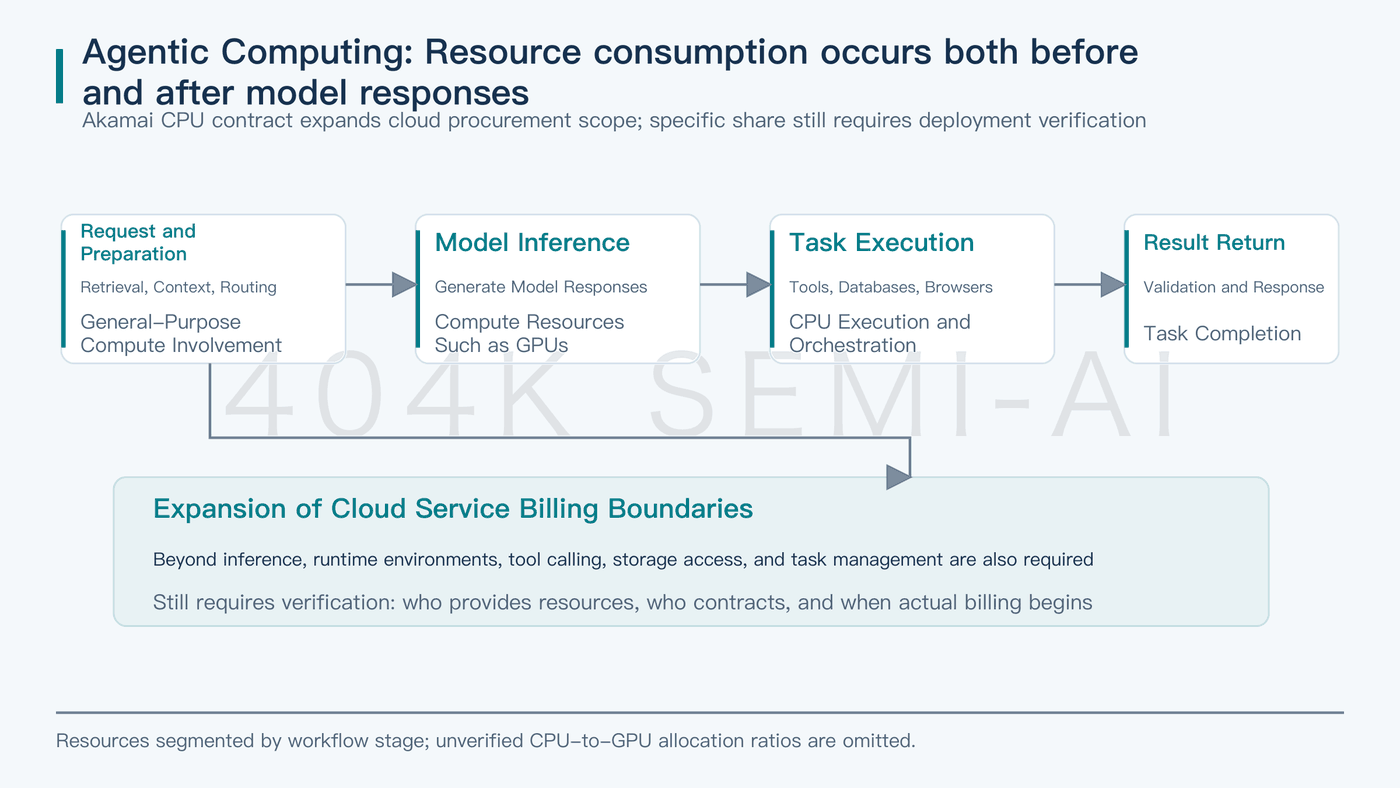
The compute procurement mix is broadening materially. Akamai’s large-scale CPU deal and NVIDIA’s rollout of Vera into the standalone server CPU market both highlight compute demand extending well beyond core matrix multiplication. Autonomous agents heavily rely on retrieval-augmented generation (RAG), context orchestration, database queries, and deterministic tool execution—tasks that run on general-purpose CPUs. Higher CPU demand, however, does not imply monopolistic gains for any single vendor; market share realization depends on instance availability, software stack optimization, and enterprise adoption.
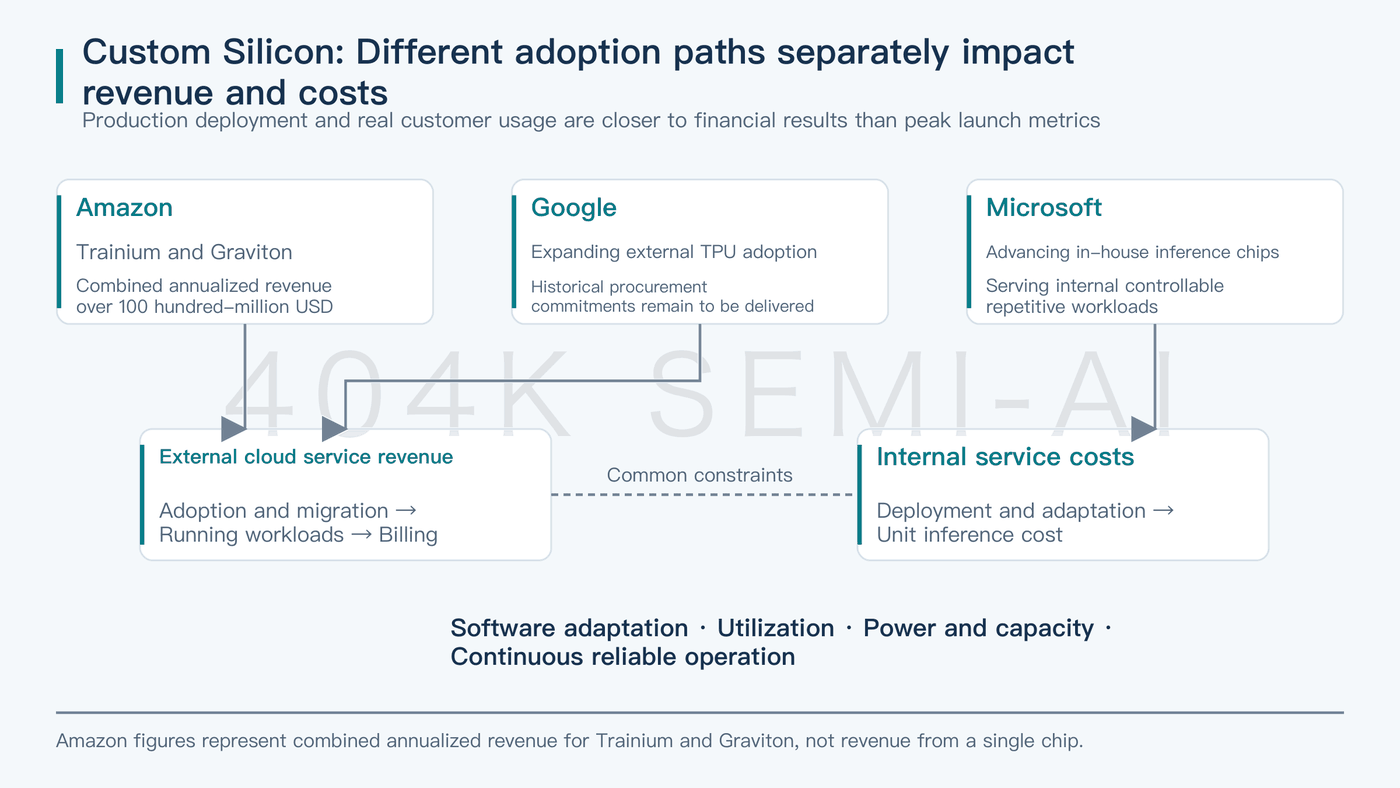
Custom silicon serves as a primary lever for hyperscalers to manage unit costs and defend gross margins. Amazon’s Trainium and Graviton reportedly surpassed a combined annualized revenue run rate of $10 billion, with TRAINIUM3 now deployed in production workloads. This $10 billion milestone combines both general-purpose ARM CPUs (Graviton) and AI accelerators (Trainium); it is not a standalone AI training silicon run rate, nor is it additive to reported AWS cloud revenue. The real test is customer retention on proprietary silicon and whether internal compute efficiencies translate into defensible cloud operating margins.
Google continues to commercialize its TPU fleet, expanding external allocations to frontier labs. Discussions this week around Anthropic’s TPU capacity encompass previously established contractual allocations; while confirming strong foundational adoption, they should not be counted as wholly new bookings. Furthermore, TPU cost efficiencies rely heavily on model architecture compatibility and JAX/XLA software optimization. Google’s concurrent expansion of NVIDIA GPU clusters confirms that merchant accelerators and internal ASICs will co-exist for the foreseeable future. Assessing workload substitution requires monitoring actual model migrations and post-deployment total cost of ownership (TCO).
Microsoft is directing custom silicon primarily toward high-volume, highly deterministic first-party inference workloads, linking silicon development directly to serving costs for Copilot and Microsoft 365. Reported next-generation volume allocations remain forward plans rather than finalized hardware deployments. Across all three hyperscalers, the definitive benchmark is sustained production utilization rather than theoretical peak FLOPS. Low nominal silicon cost achieves little if software porting friction and cluster underutilization impair unit economics.
Models, Software, and Application Monetization
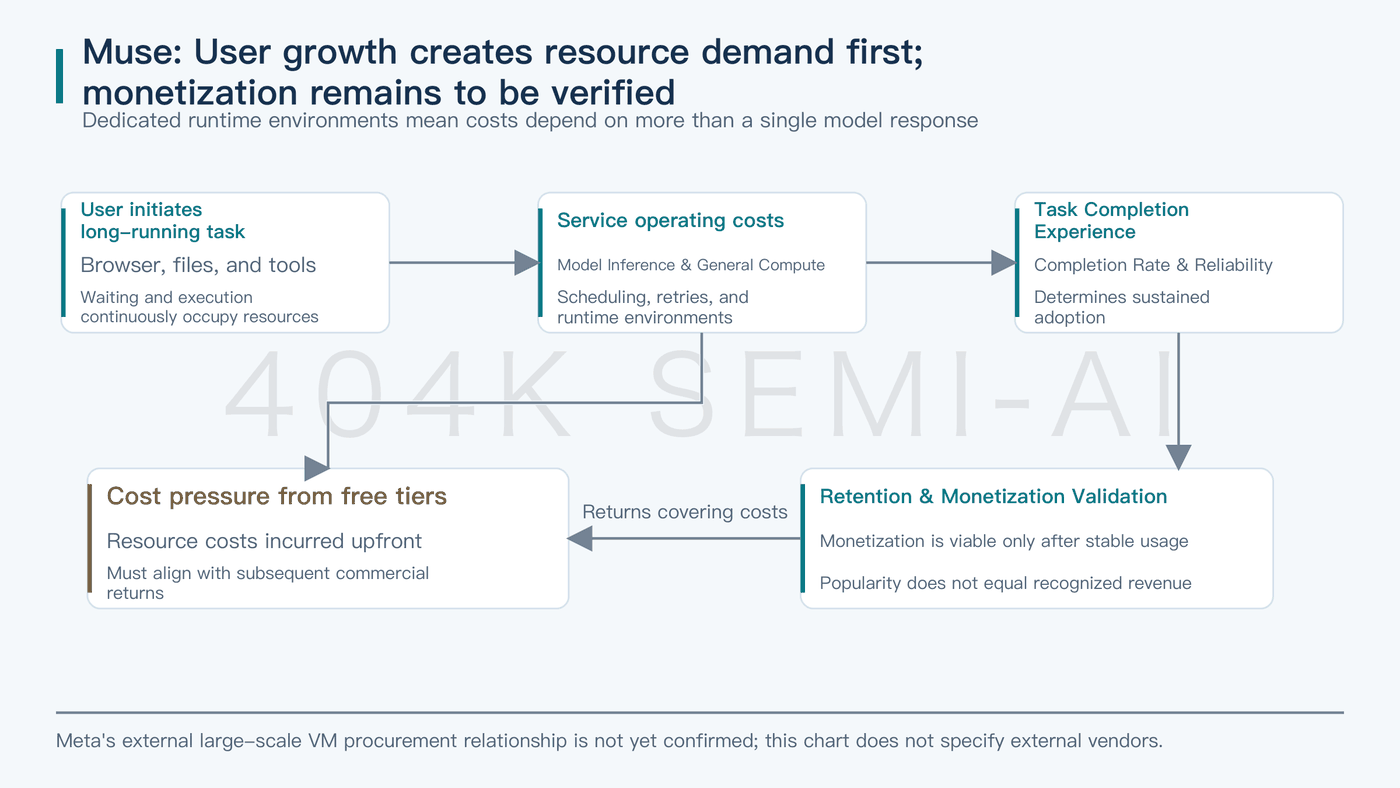
Meta’s Muse is shifting consumer agent competition toward sustained, stateful cloud resource consumption. Product documentation indicates that Muse operates within dedicated VM sandbox environments to manage web browsers, file systems, user credentials, and long-horizon tasks. Consequently, compute consumption per completed user workflow extends beyond input/output token counts to include persistent container runtime, API orchestration overhead, and idle dwell time. As free usage tiers gain traction, the pressure on instance scheduling density and unit serving economics intensifies.
For Meta, expanding application usage initially acts as a cost burden; converting activity into accretive monetization requires separate validation. Daily active users (DAUs), session length, and willingness to pay are fundamentally distinct variables. If casual adoption leads to high task failure rates, inference and hosting costs escalate without commercial return; only if task completion rates improve to drive durable user retention can Meta underwrite subscription tiers or sponsored agentic commerce. Engagement buzz cannot be straight-lined into advertising or subscription earnings.
For third-party CSPs, Muse’s architecture showcases a compelling vector for persistent cloud demand, but does not prove Meta has awarded large-scale third-party VM contracts. Meta will likely prioritize internal data center infrastructure, leaving external capacity offloading contingent on formal vendor agreements. Analysts must logically deduce required resource footprints from software architectures while waiting for disclosed supplier contracts, avoiding speculative leaps from product demos to vendor revenue.
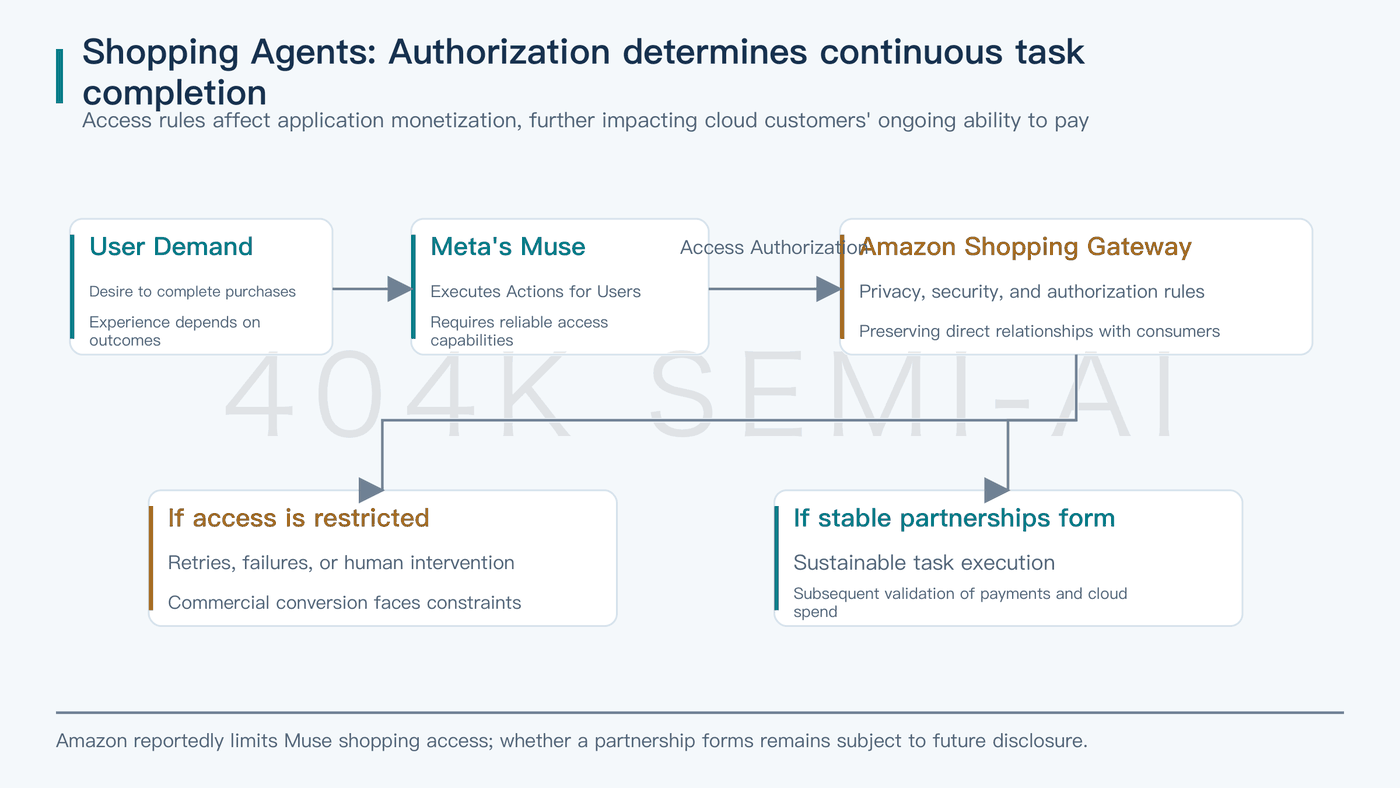
Agentic monetization also hinges on whether retail platforms permit bots to act on behalf of end users. Discussions this week regarding Amazon restricting Muse’s automated shopping capabilities bring platform gatekeeping and access authorization to the fore. Amazon reportedly cited security, privacy, and unauthorized crawling concerns, highlighting that external agents bypass personalized discovery, retail media ads, and checkout funnels. For Meta, technical feasibility is meaningless without merchant compliance and API access rights.
This friction directly impacts the commercial viability of agentic compute demand. Demonstrating autonomous checkout in a controlled demo does not guarantee scalable production execution. If host platforms block bot traffic, frequent retries, manual interventions, and task failures will degrade user trust. Conversely, if commercial bilateral agreements and authorized protocols are established, bot traffic can transition into high-margin, repeatable transactions. For CSPs, compute demand is only as durable as the application vendor's ability to maintain paying customers.
Amazon faces a delicate tension between expanding AWS infrastructure demand and defending its high-margin retail gateway. Third-party agents generate cloud compute tailwinds for AWS, but disintermediating customer relationships threatens Amazon's consumer marketplace and advertising flywheel. Google faces analogous traffic disintermediation risks, though this provides zero evidence of an immediate drop in core Search revenue this week. Investors should track authorized API partnerships, conversion metrics, and unit fees rather than declaring winners based on prototype demonstrations.
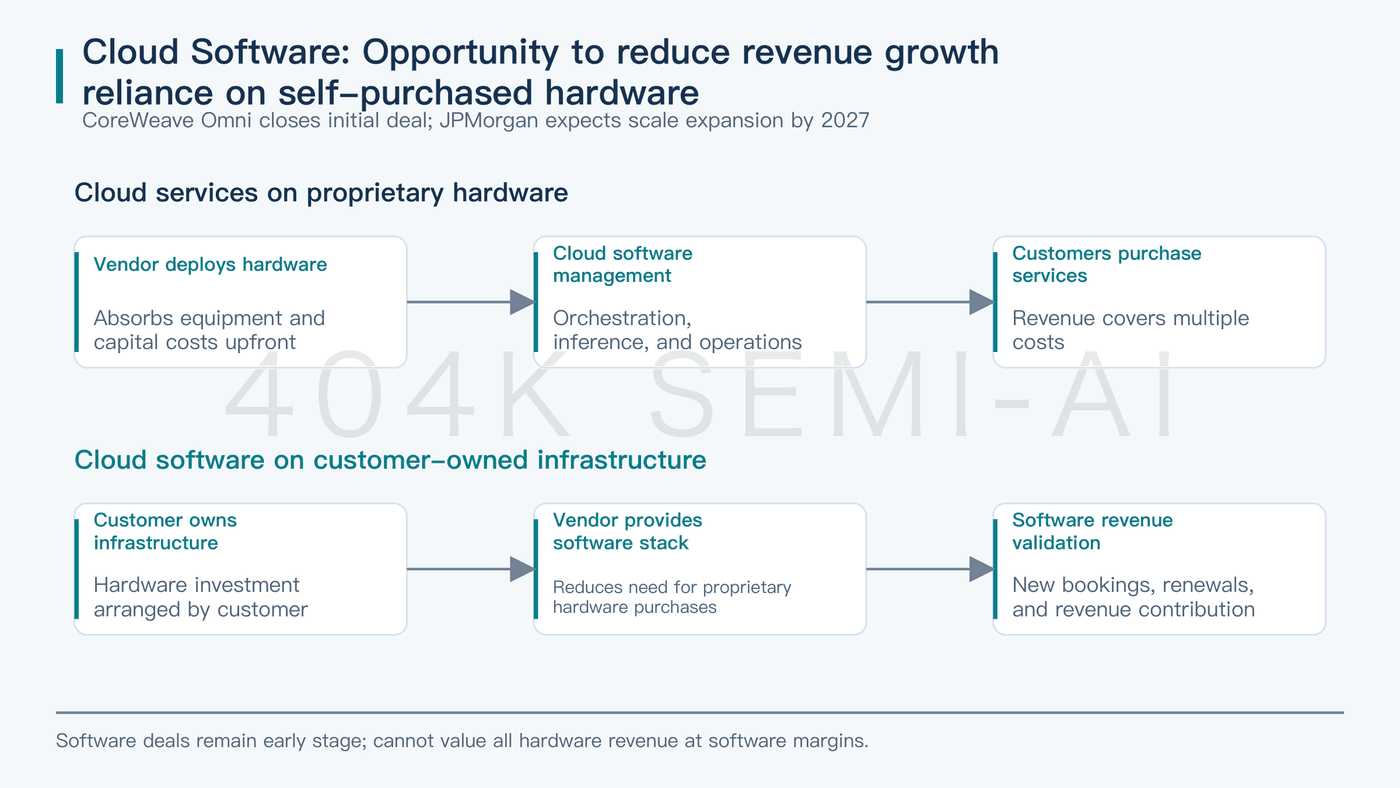
Software offers a pathway to re-rate cloud multiples, but investors must separate genuine high-margin software licensing from repackaged hardware leasing. J.P. Morgan highlighted that CoreWeave Omni—which deploys CoreWeave's orchestration and cloud software stack atop customer-owned infrastructure—inked its inaugural commercial deal, with scale anticipated in 2027. Crucially, this software-driven model decouples top-line expansion from upfront capex outlays. However, Omni remains nascent; its contribution to margin expansion requires validation via subsequent enterprise bookings.
Nebius’s competitive wedge lies in streamlining compute onboarding and management. Sell-side commentary highlights its platform usability, cluster stability, workload orchestration, and multi-region inference routing. While reducing customer deployment friction supports retention and pricing stability, developer praise does not automatically establish standalone pricing power for software tooling. A well-engineered developer platform must not be mistaken for realized high-margin software profitability.
Declining token serving prices do not signal contracting aggregate cloud demand. Industry token price indices indicate that as workload mixes shift toward smaller, cost-optimized models, blended average token prices decline even as aggregate volume and net customer spend climb. For CSPs, the crucial variable is whether revenue realization stays ahead of incremental serving costs. If pricing deflation outpaces hardware efficiency gains, fully utilized clusters can paradoxically compress margins; conversely, if elasticity drives greater paying transaction volume, total cloud gross profit expands.
M7 vs. Neo-Cloud Divergence
Mega-cap cloud moats must be defended through tangible execution. Microsoft’s in-house inference silicon and infrastructure partnerships, Google’s external TPU commercialization, and Amazon’s production deployment of proprietary silicon target distinct strategic objectives: unit cost reduction, platform differentiation, and enterprise workload lock-in, respectively. Meta must prove that expanding agent engagement generates sufficient monetization to offset mounting hosting overhead. NVIDIA enjoys a broadening compute TAM across GPUs and standalone CPUs, even as it manages encroaching internal ASICs on select customer workloads.
Divergent AI Monetization and Cost Profiles Across Hyperscalers
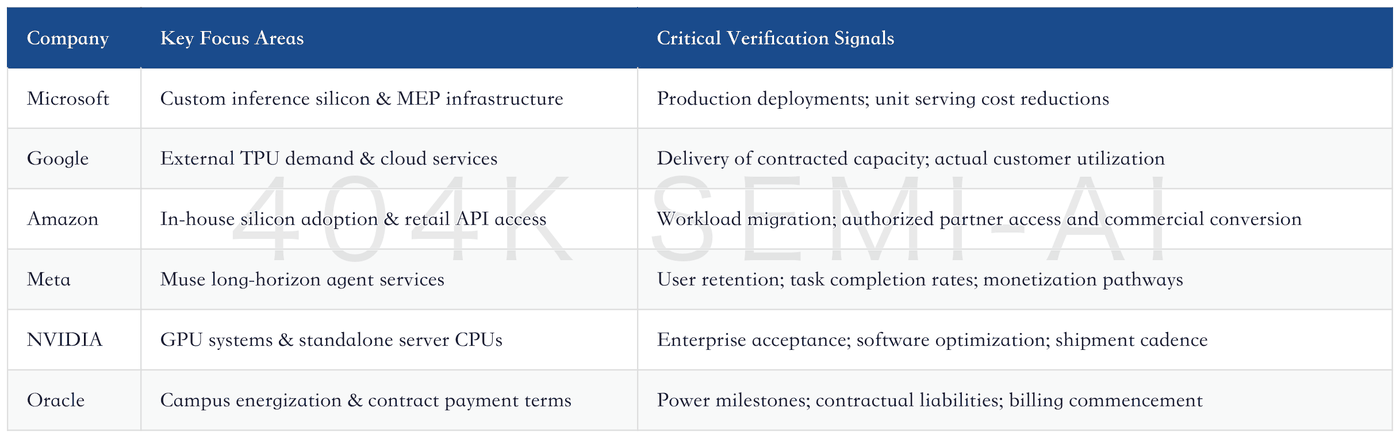
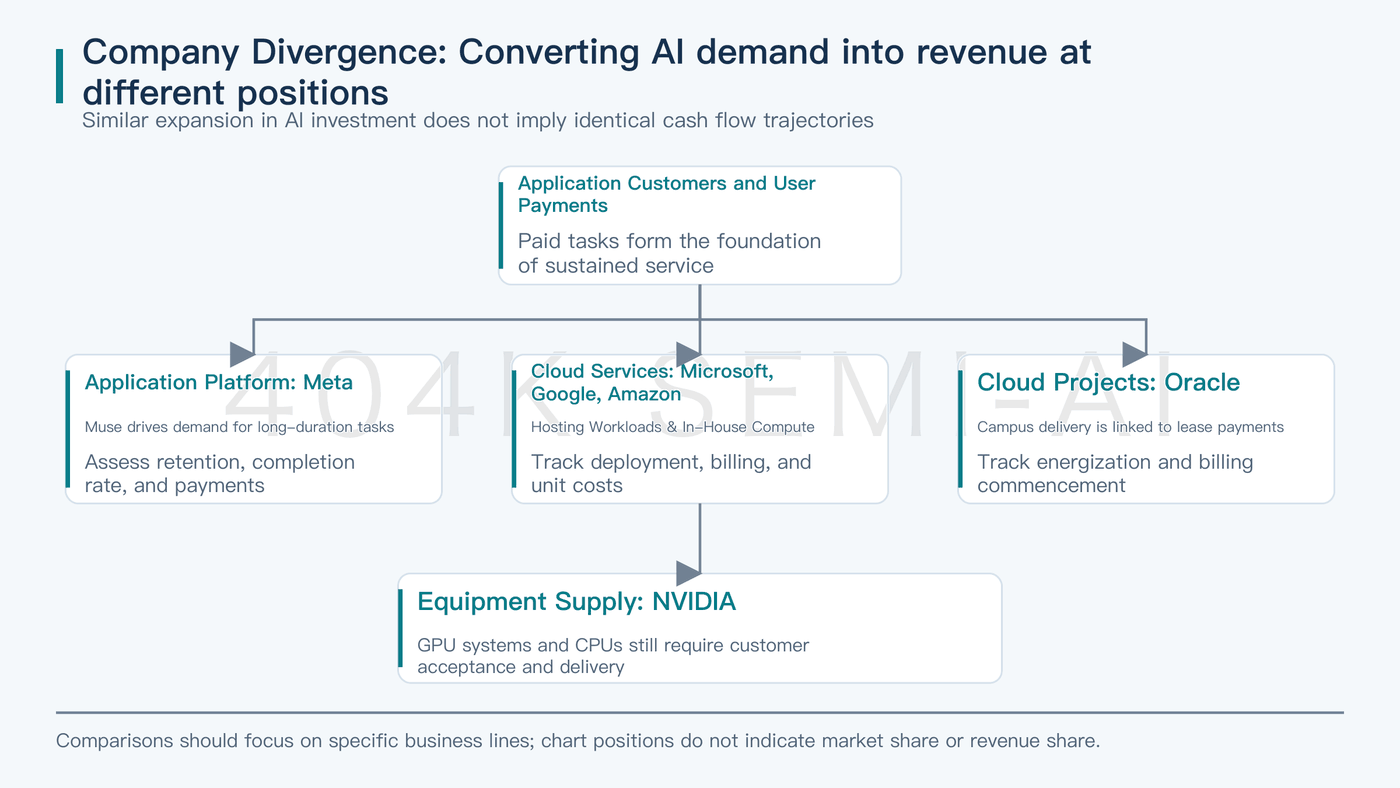
This divergence dictates analytical rigor: hyperscalers cannot be ranked simply by capex growth rates, nor should internal compute consumption, merchant cloud revenue, and merchant semiconductor sales be blended indiscriminately. Investors must interrogate which customer tier incremental hardware serves, at what software/hardware layer monetization occurs, and who absorbs the financial risk of idle capacity or delayed energization. Depending on value-chain positioning, identical demand tailwinds yield vastly different operating margins and free cash flows.
The primary opportunity for neo-clouds stems from lead-time bottlenecks at tier-1 hyperscalers. Commentary surrounding CoreWeave and Nebius suggests that deployment schedules and cluster availability have pushed select customers toward secondary compute providers. While this confirms spillover demand, isolated customer anecdotes do not confirm structural market share shifts. Inbound inquiries, signed master services agreements (MSAs), and active billing clusters must be verified independently.
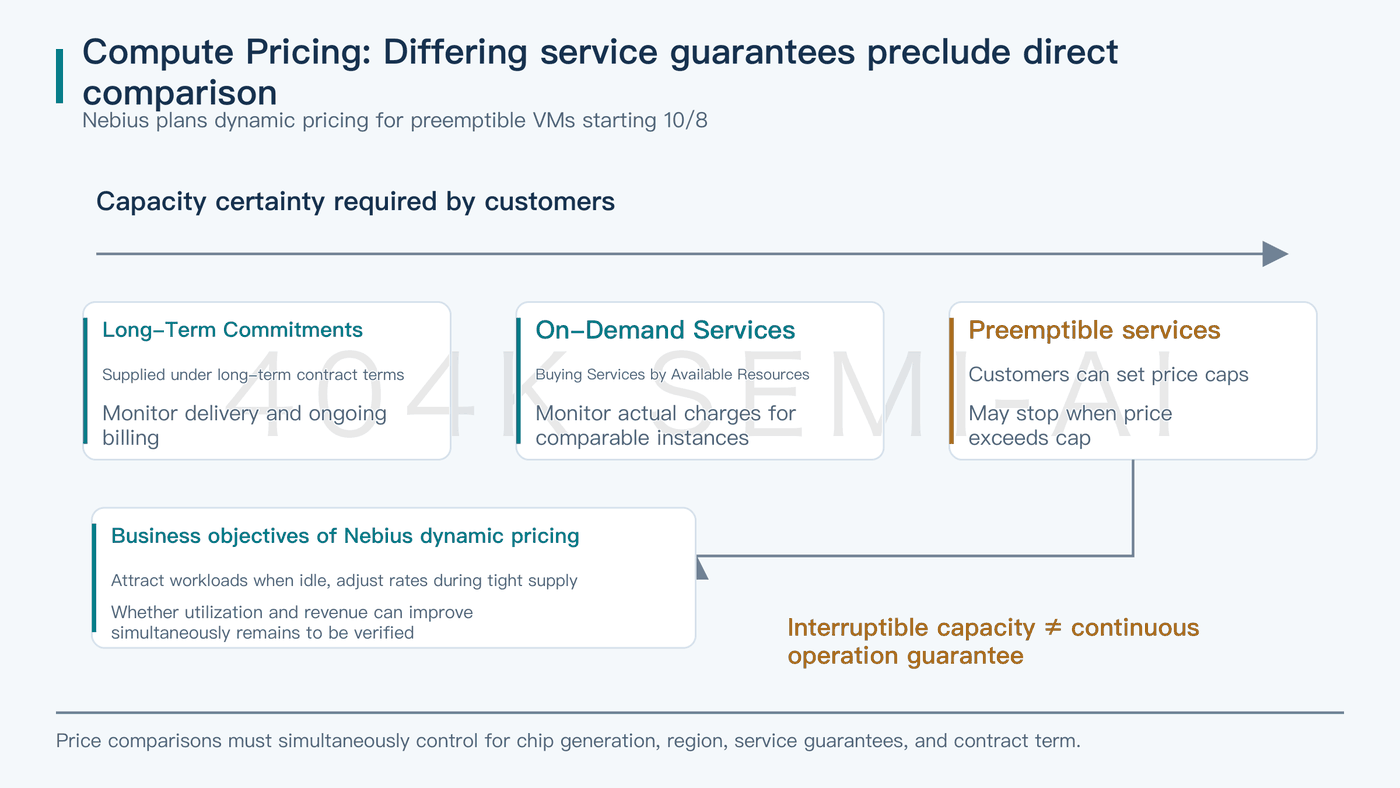
Nebius’s pricing update provides a concrete operational case study: effective October 8, preemptible VM pricing will fluctuate dynamically based on regional demand, available capacity, and GPU architecture. Customers can accept floating spot rates or set a bid ceiling; if the clearing price exceeds their threshold, instances are terminated. This structure commercializes interruptible spot capacity and should not be compared directly against non-preemptible reserved instances with strict SLAs.
Dynamic spot pricing helps monetize idle troughs while capturing upside during demand spikes, but its net profitability depends on whether incremental revenue outweighs developer friction caused by instance preemption. Analysis must isolate GPU generation, data center geography, SLA guarantees, and contract duration. Discounted rates on preemptible instances do not signify price degradation in reserved capacity; similarly, spot price spikes in capacity-constrained zones cannot be extrapolated across multi-year enterprise contracts.
Market debates surrounding neo-clouds center on the durability of scarcity pricing and capital financing models. The bull case assumes continuous capacity absorption, software abstraction easing developer onboarding, and customer prepayments de-risking project debt. The bear case cautions that once supply catches up, spot rental rates will normalize, leaving providers saddled with heavy depreciation and debt service. Scrutinizing these underlying balance-sheet mechanics is far more informative than comparing headline target prices.
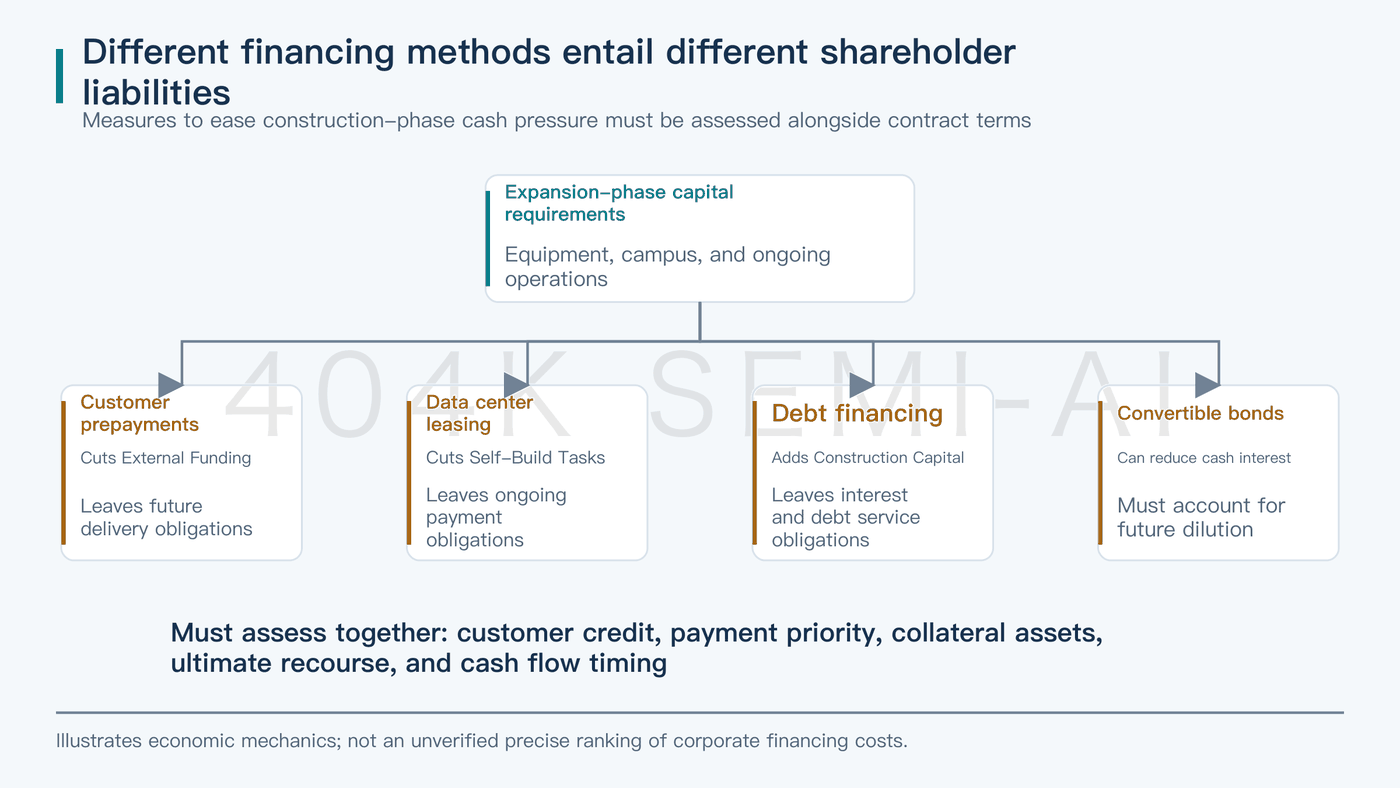
Customer prepayments reduce reliance on debt markets but represent unearned revenue with strict future delivery milestones. Leasing powered shell data centers minimizes greenfield construction execution but creates long-term operating lease liabilities. Convertible bonds lower near-term cash interest expenses at the expense of potential equity dilution. Examining coupon rates, gross debt, or pipeline MW in isolation fails to capture the true cost of capital; investors must model contract tenors against cash flow schedules.
Akamai’s emergence as a multi-billion-dollar CPU provider reinforces that competitive boundaries expand as workload requirements evolve. Incumbent edge networks can direct capital toward purpose-built compute facilities for anchor AI clients. However, reliance on a single mega-customer concentrates capital recovery risk. Sustainable multiple expansion demands a broadening, diversified enterprise base and reusable platform infrastructure, rather than treating follow-on bookings from an existing anchor client as evidence of structural de-risking.
Market Debates, Counter-Evidence, and Next Week's Catalysts
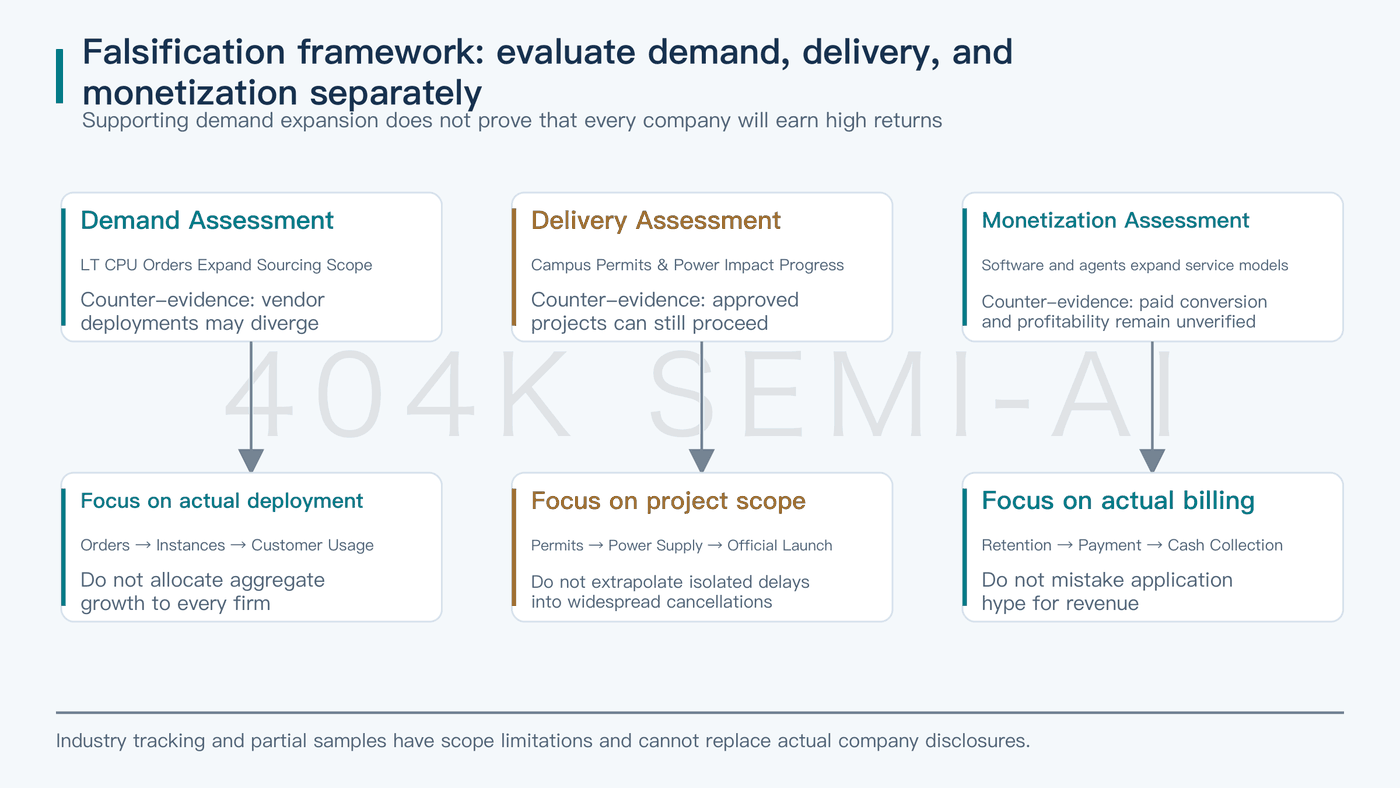
The central market debate is whether data center delivery bottlenecks remain isolated to specific sites or represent systemic industry gridlock. While Oracle’s Project Jupiter rightfully elevates scrutiny on permitting and substation queues, industry channel checks indicate that local moratoriums primarily restrict new grid interconnection filings, whereas grandfathered or actively under-construction campuses continue to advance. This counter-evidence demonstrates that the raw tally of municipal restrictions does not equal total stranded MW capacity; pipeline gigawatts should not be written off as broad-based delays.
CPU demand also reflects supplier-level divergence. Third-party cloud tracking data reportedly indicates decelerating deployment momentum for AMD server CPUs in recent cloud instances. While this does not refute growing agentic demand for general-purpose compute, it cautions that market expansion does not translate into uniform gains across all silicon vendors. Cloud telemetry samples are influenced by anchor tenant mix, server deployment batches, and CPU generation transitions; investors should await broad financial prints and hyperscaler disclosures rather than prematurely extrapolating channel samples.
Software and application monetization provide another critical test of counter-evidence. CoreWeave’s software licensing is in its infancy, Muse’s viral engagement has yet to prove unit-level monetization, and custom silicon margins remain constrained by software porting barriers. If software revenue fails to scale independently and drive sticky customer retention, the capital-intensive nature of hardware leasing remains unmitigated. Conversely, if enterprises demonstrate recurring willingness to pay for orchestrators, inference routing, and deterministic agent execution, CSPs can legitimately claim a structural upgrade in earnings quality.
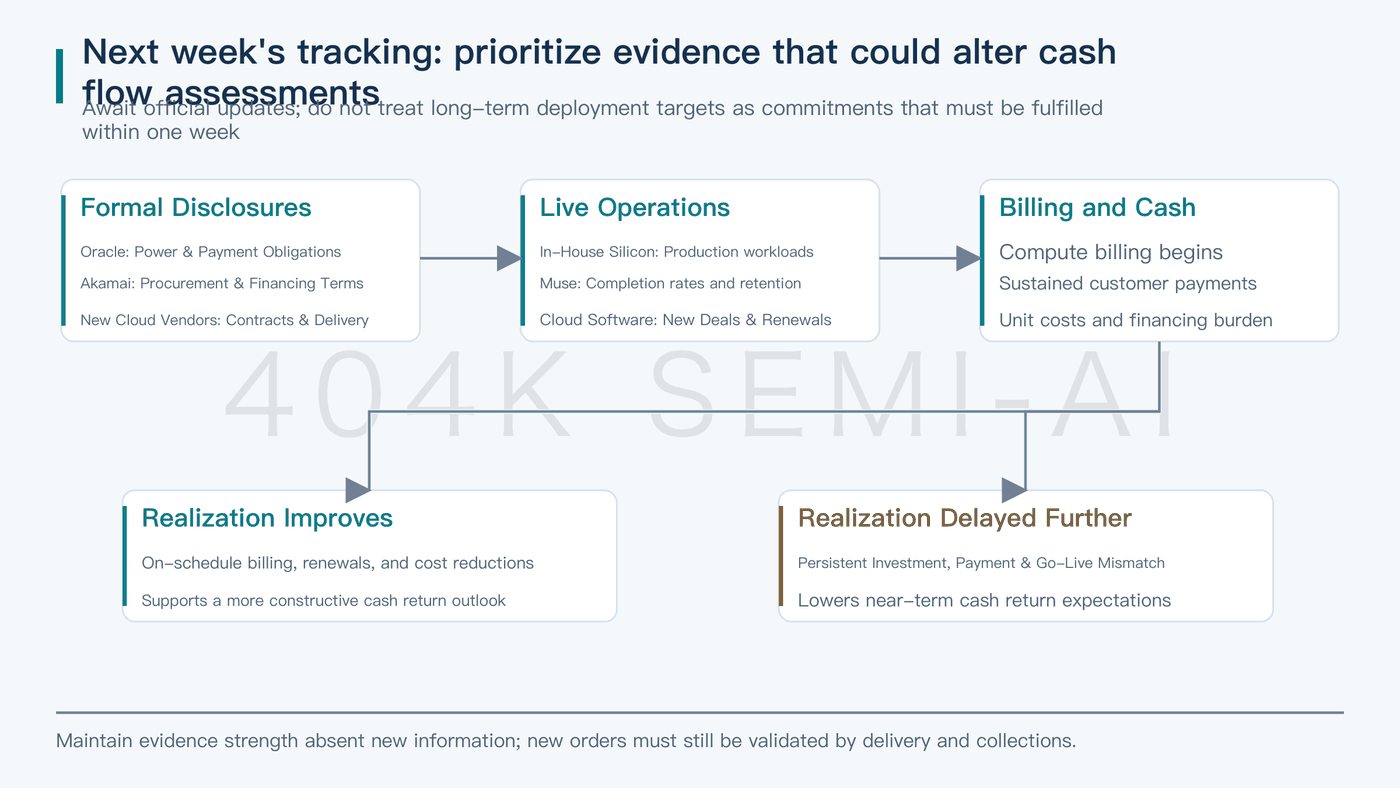
Looking ahead to next week, priority should be given to catalysts that directly alter cash-flow visibility, avoiding the temptation to treat multi-year milestones as weekly deadlines. For Oracle, monitor formal filings regarding power permits, construction progress, and lease payment obligations. For Akamai, track subsequent disclosures regarding component capex, debt/equity warrant structures, and customer cash advances. For Microsoft, Google, and Amazon, verify incremental production deployments and third-party adoption of custom silicon. In the absence of material updates, baseline thesis conviction should remain unchanged.
Key Monitoring Priorities and Falsification Signals for Next Week
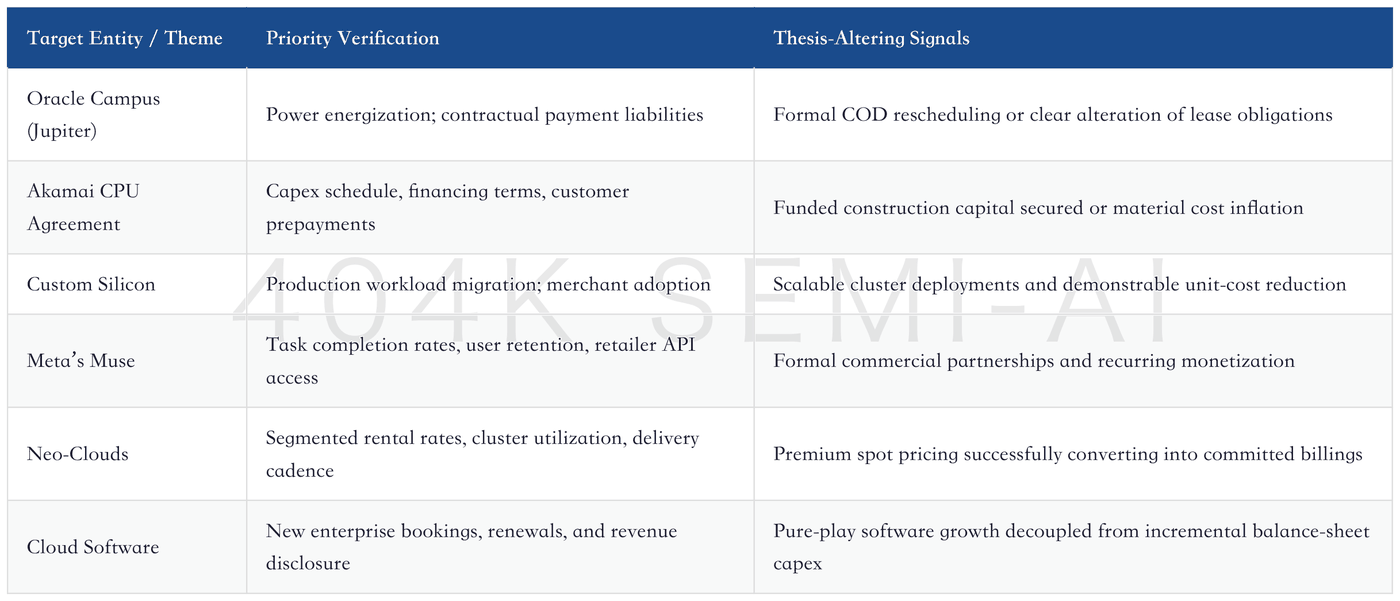
The critical analytical risk to guard against is extrapolating demand signals into premature margin assumptions. Multi-year CPU contracts expand the addressable scope of AI cloud infrastructure, while proprietary silicon and orchestration software provide pathways to lower unit serving costs. However, shareholder returns still depend on physical delivery, energization, and cash collection. If new capacity begins billing on schedule, customer retention holds firm, and unit costs decline, the capex cycle remains value-accretive. But if construction delays and cash realization continue to diverge, even the largest contract backlogs warrant a downward revision in near-term free cash flow expectations.