
Contents
Core Weekly Thesis
AI Accelerators, Advanced Packaging, and Servers
Optical Communications, CPO, PCBs, and High-Speed Interconnects
Data Center Thermal Management, Power Systems, and Utilities
Robotics, Edge AI, and Physical Hardware Applications
Space, Quantum Computing, and AI Software Applications
Core Debates, Disconfirming Signals, and Next Week's Catalysts
AI supply chain demand remains resilient this week, but the investment framework must shift from acquiring silicon to delivering usable compute capacity. Price increases in cloud leasing, capacity expansion in optical interconnects, and power infrastructure retrofits provide fundamental support; however, contract duration, system yields, and utility interconnection timelines will determine whether accounting revenue converts into cash profit. Next week's research focus centers on closed transactions, customer qualifications, and grid energization milestones.
Core Weekly Thesis
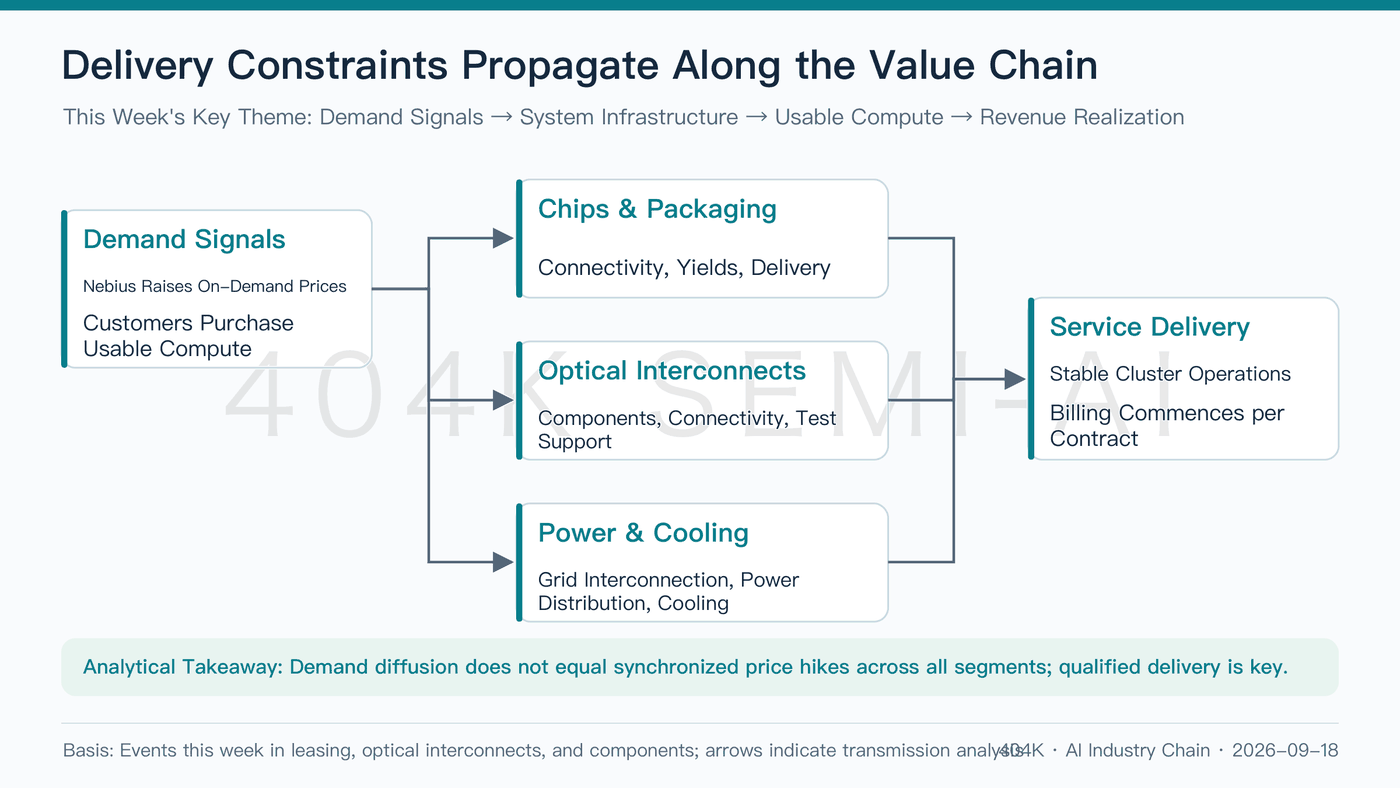
The critical shift this week is that compute demand is pushing order flow deeper into peripheral supply chain components. Nebius raised on-demand pricing across major Nvidia GPUs, GlobalFoundries expanded its optical interconnect capacity agreement with Marvell Technology, and Murata planned capacity additions for AI server capacitors. Spanning cloud leasing, networking, and power components, these developments point to a single operational bottleneck: while end-customers are eager to procure compute, suppliers must deliver stable, operating systems on schedule.
Robust demand does not imply synchronized pricing power across all nodes. Even if chip shipments clear on time, packaging, networking, or power delivery can still stall commercial deployment; similarly, completed data halls often sit idle awaiting utility grid interconnection. Investors should prioritize tracking procurement orders, qualifications, and capacity additions directly tied to delivery before assuming supply tightness converts into earnings. Technology roadmaps, nameplate capacity, and long-term TAM forecasts alone are insufficient to justify near-term earnings upgrades.
This dynamic explains why divergent signals coexist across the supply chain: next-generation architectures boost power efficiency while legacy GPUs secure lease renewals, and traditional power distribution equipment wins orders alongside liquid cooling retrofits. Customers prioritize completing workloads by agreed deadlines; their procurement mix shifts dynamically with workload profiles, lead times, and cost structures. Viewing the entire supply chain as a synchronized, monolithic upgrade cycle risks overlooking secondary bottlenecks and overestimating the replacement velocity of new architectures.
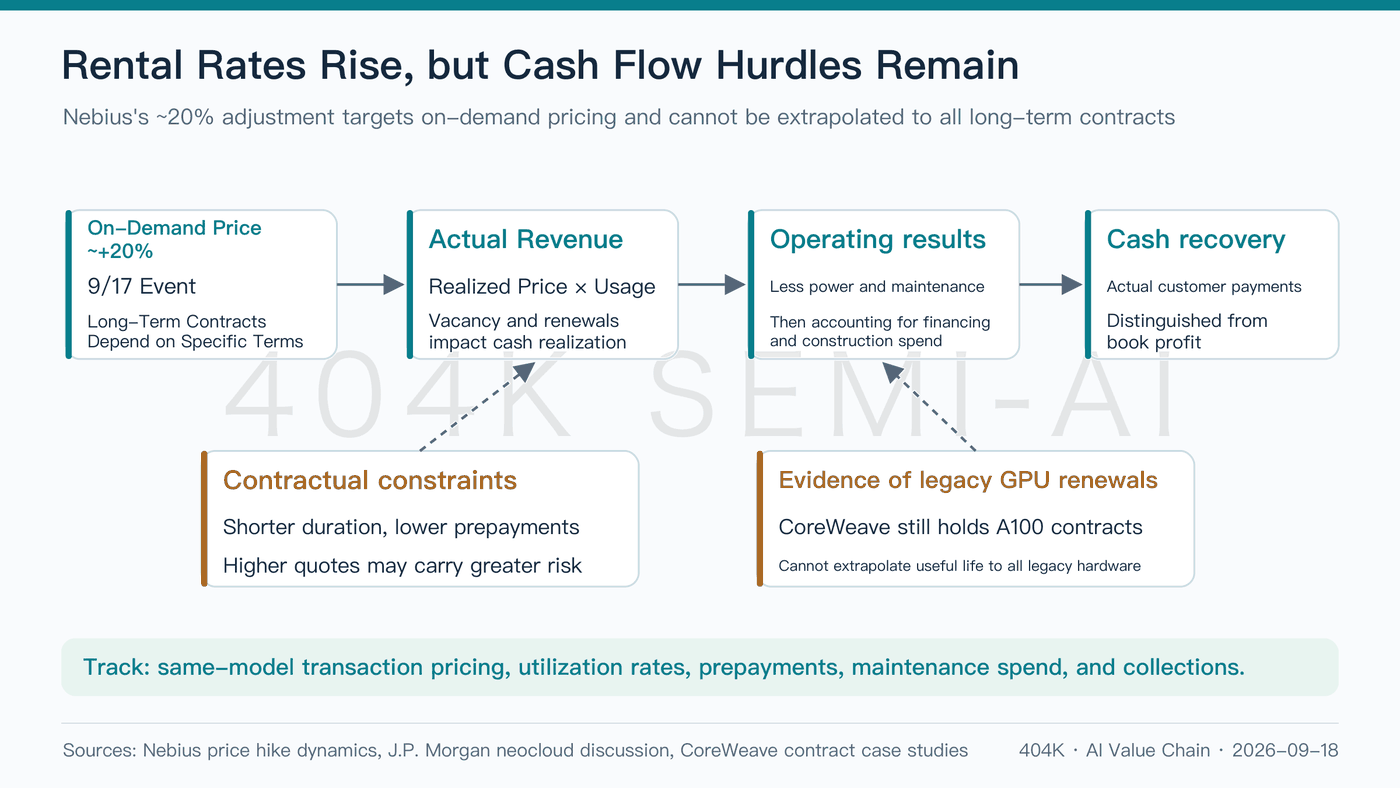
Compute price hikes signal demand, but cash realization is the true measure of operational performance. On September 17, Nebius adjusted on-demand prices upward by ~20%, but spot rates cannot be directly extrapolated to long-term reserved instances. A JPMorgan note on neoclouds this week emphasized that delivery schedules, contract duration, and upfront prepayments dramatically alter realized contract values. Higher headline rates coupled with shorter commitments and lower prepayments force operators to shoulder heightened re-leasing and refinancing risks.
CoreWeave continues to sign A100 contracts, proving that legacy GPUs can sustain revenue generation. However, operational longevity does not equal full capital recovery: electricity, ongoing maintenance, financing overhead, and actual utilization must all be accounted for. Extending depreciation schedules may boost accounting margins, but it does not generate cash; nor does a single renewal contract prove uniform economic lifespans across all legacy GPU fleets.
Investment exposure should be categorized by near-term deliverable demand, engineering bottlenecks, and long-term real options. Deliverable demand should be validated by closed transaction volumes and actual consumption; engineering bottlenecks by qualified capacity; and real options by technical milestones. While optics, robotics, and orbital compute warrant close research, technical progress translates into revenue only after customers, delivery schedules, and monetization models are clearly defined. This hierarchy reflects evidence maturity rather than long-term terminal value.
AI Accelerators, Advanced Packaging, and Servers
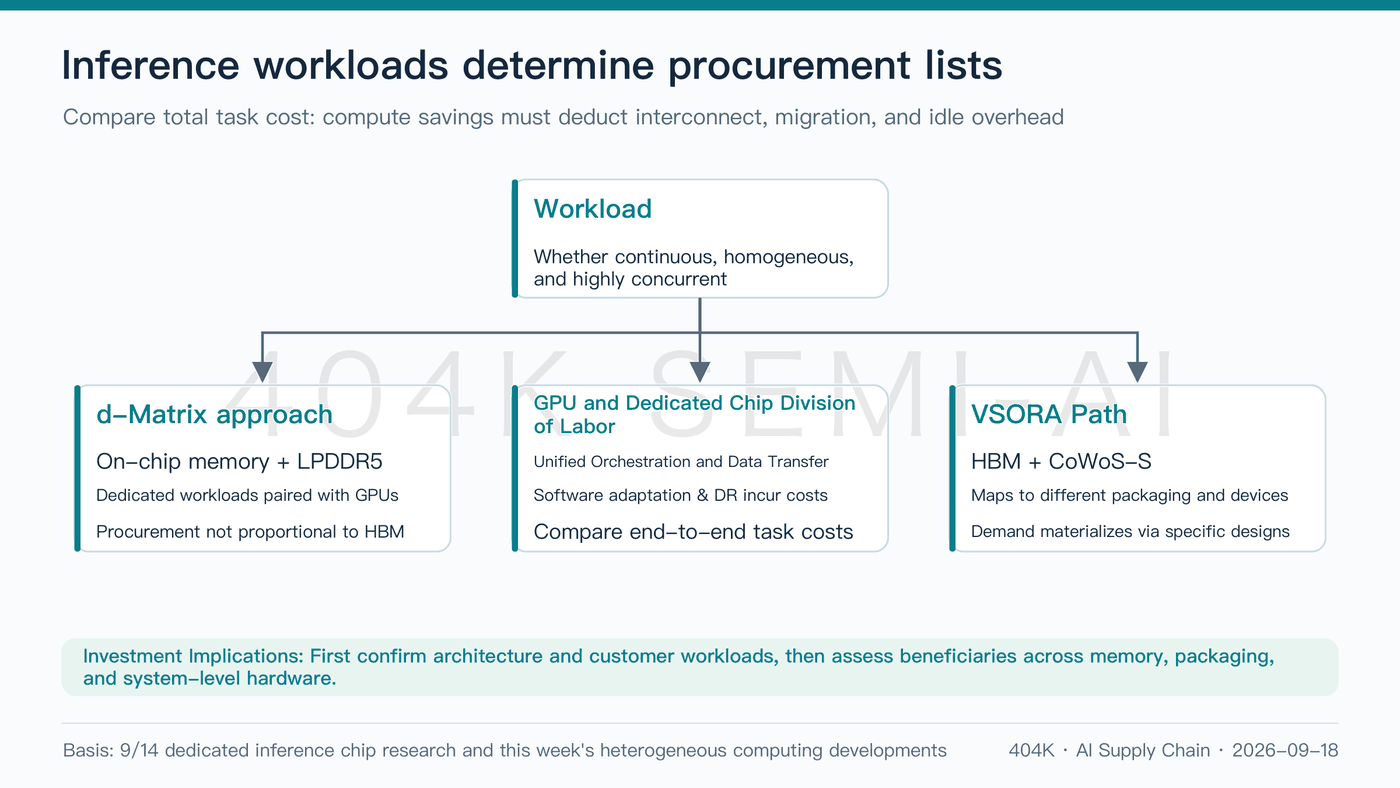
Competition in AI silicon is shifting toward the total system cost of completing specific workloads. A September 14 study on dedicated inference ASICs highlighted that specialized chips can capture market share by tackling targeted workloads alongside GPUs, rather than attempting full model coverage. However, raw compute savings can easily be eroded by data retrieval overhead, interconnect latencies, software migration friction, and idle capacity. Ultimately, customers evaluate total cost and time-to-completion for a given task.
Different architectures drive divergent upstream bill-of-materials (BOM). For instance, the study contrasted d-Matrix's architecture—leveraging on-chip SRAM paired with off-chip LPDDR5—against VSORA's design utilizing HBM and CoWoS-S packaging. The investment takeaway is clear: ASIC volume growth does not translate linearly into demand for HBM, advanced packaging, or high-density substrates. Investors must identify the winning architecture before modeling component demand.
Intel proposed unifying Xeon CPUs, GPUs, and SambaNova dataflow units under a common orchestration layer this week, underscoring that heterogeneous computing hinges on workload partitioning. Orchestration and data preprocessing handled by CPUs, parallel compute executed by GPUs, and specialized kernels offloaded to ASICs all dictate cluster-level efficiency. For server OEMs, the upside lies in reliable heterogeneous integration; the risk stems from rising qualification and delivery costs as customization increases.
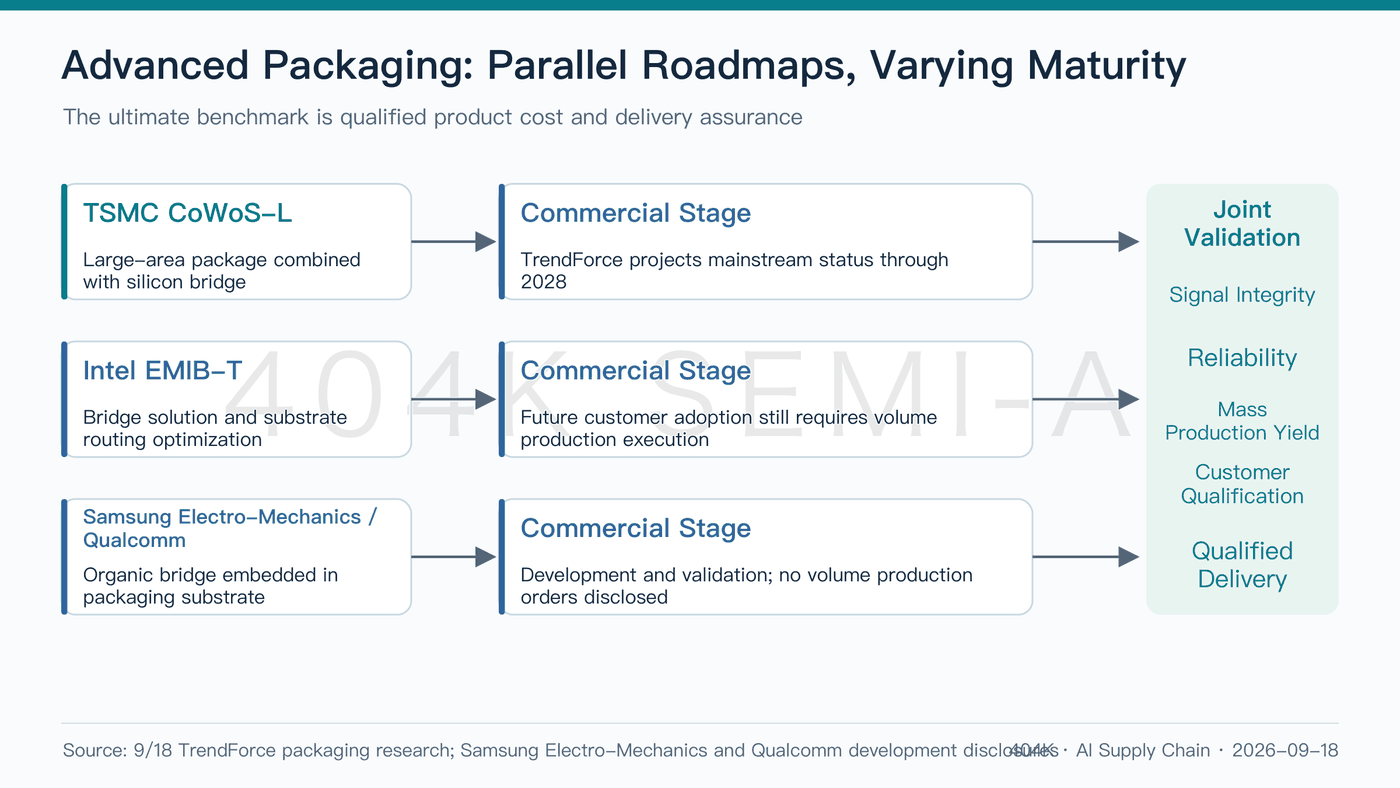
In advanced packaging, evaluating competitive positioning requires balancing interconnect density, packaging yields, and commercial delivery reliability. In a September 18 report, TrendForce projected that TSMC's CoWoS-L will remain the mainstream AI packaging solution through 2028 due to its process maturity and superior yields. As compute die and HBM integration scales, package size and substrate routing density become hard constraints; producing test samples is merely a prerequisite, while consistent, high-yield mass production dictates customer adoption.
Intel's EMIB-T provides an alternative silicon bridge architecture. However, eliminating large-area interposers does not automatically guarantee a lower total cost. Substrate routing, packaging yields, final test complexity, and customer migration overhead can significantly alter realized pricing. TrendForce's projection of potential adoption by Google represents a forward expectation rather than commercialized revenue. For cloud customers, qualifying an alternative supplier primarily serves to hedge single-source delivery risk.
Samsung Electro-Mechanics and Qualcomm are co-developing an organic bridge that embeds fine-pitch interconnect structures directly into the packaging substrate—another effort to reduce interconnect costs. Disclosures this week indicate the technology remains in the R&D; and qualification phase, with no confirmed mass-production orders or commercial delivery schedules. For substrate manufacturers, key tracking indicators are customer qualifications, signal integrity, reliability, and production yields; joint development agreements should not be mistaken for confirmed production volume.
While the efficiency gains of next-generation platforms stimulate procurement, benchmark claims must be assessed alongside specific test conditions. A September 15 SemiAnalysis report on AgentX estimated that, on a self-built TCO basis, Vera Rubin NVL72 achieves 1.4x to 3x higher throughput per dollar than a GB300 TRTLLM configuration within an interactive serving window of 60–100 tokens per second. This benchmark applies strictly to specific models, serving engines, and latency constraints, rather than serving as a universal multiple across all inference workloads.
