
Contents
Weekly Core Thesis
Model Releases, Upgrades, and Capability Shifts
Reasoning, Training, Multimodal, and Agent Capabilities
Open vs. Closed Source Competition, Benchmarks, and Developer Ecosystems
API Pricing, Commercialization, and Provider Divergence
Debates, Counter-Evidence, and Next-Week Tracking
The more compelling trade this week is that near-frontier model capabilities have become accessible at significantly lower price points. While OpenAI, Anthropic, and Google battle for daily task volumes, AI agents are competing to become the primary interface for persistent workflows. Whether declining inference costs translate into sustainable profits depends entirely on concurrent improvements in end-to-end task completion rates, user retention, and enterprise safety controls.
Weekly Core Thesis
The center of gravity in foundation model competition is shifting from peak benchmark scores toward sustainable production economics. Anthropic introduced Sonnet 5.5, OpenAI rolled out GPT-6.1 (GPT61) Sol, and Google initiated phased access for Gemini 4 Argon. Their shared objective is to bring frontier-caliber performance down into price tiers that developers can invoke continuously. While flagship frontier models push absolute capability limits, workhorse models are turning those gains into routine enterprise workflows.
This fundamentally reshapes model selection. Enterprises do not buy raw benchmarks; they pay for finished outcomes—such as verified code patches, synthesized documentation, or multi-step retrieval. Even when token list prices are identical, disparities in reasoning turns, output lengths, and retry rates create massive divergences in the final bill. Furthermore, higher token velocity does not necessarily yield faster delivery: if post-generation verification fails and forces a restart, raw speed advantages are completely erased.
404K SEMI-AI's core assessment this week is that while the demand base for workhorse models is broadening, gross margin divergence among model providers will widen sharply. Vendors that deliver lower aggregate task costs, rock-solid serving reliability, and integrated developer entry points are positioned to defend utilization. Conversely, vendors that rely solely on fleeting benchmark leads without sustaining production workloads risk rapid customer churn. With release cycles accelerating, the friction and cost of enterprise model evaluation and migration continue to climb.
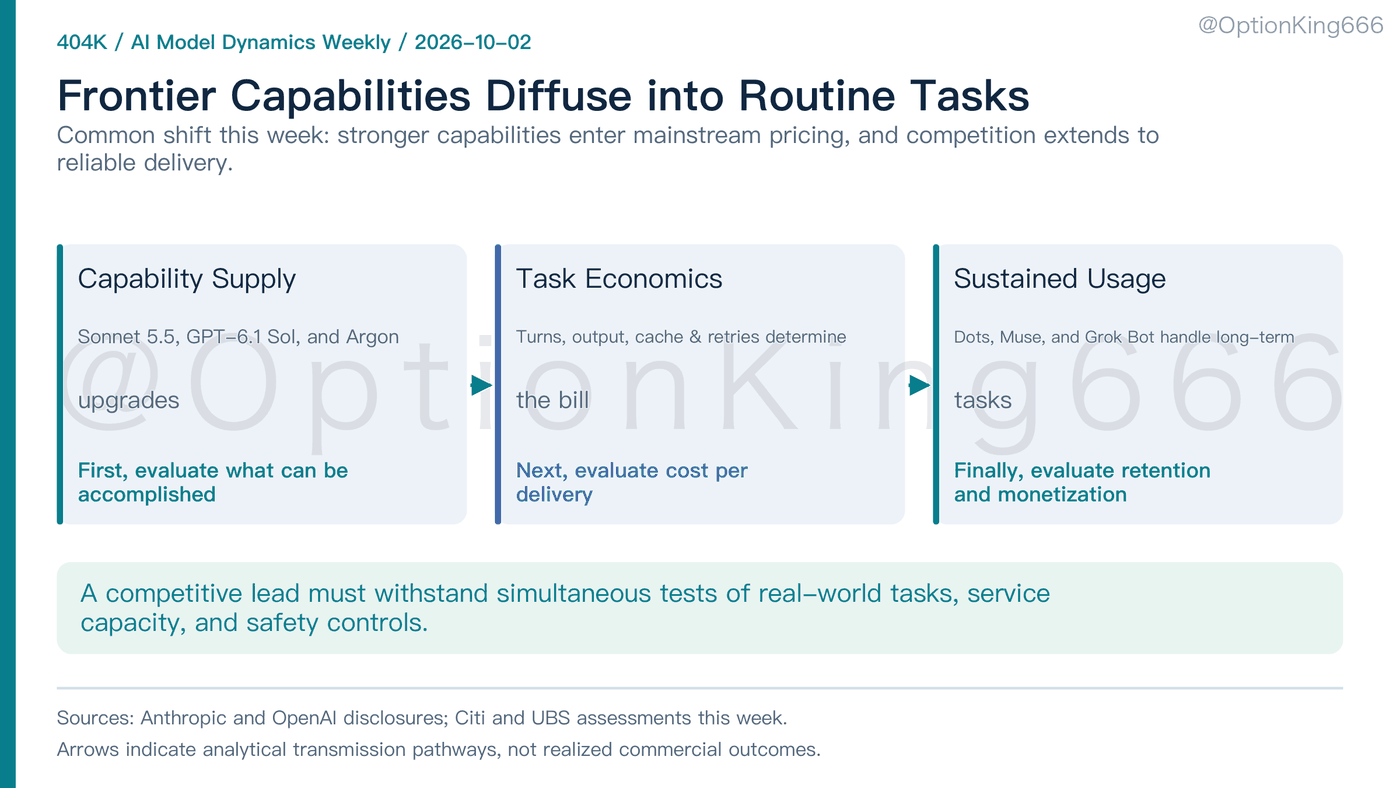
Autonomous agents amplify the economic benefits of model cost reductions, but they also complicate cost control. Dots, Muse, and Grok Bot are all establishing persistent execution runtimes. Instead of users prompting every intermediate step, models can independently orchestrate long-horizon tasks, call external tools, parse returned states, and self-correct. To the extent these loops generate tangible economic value, model inference shifts from discretionary ad-hoc queries into recurring enterprise operating expense.
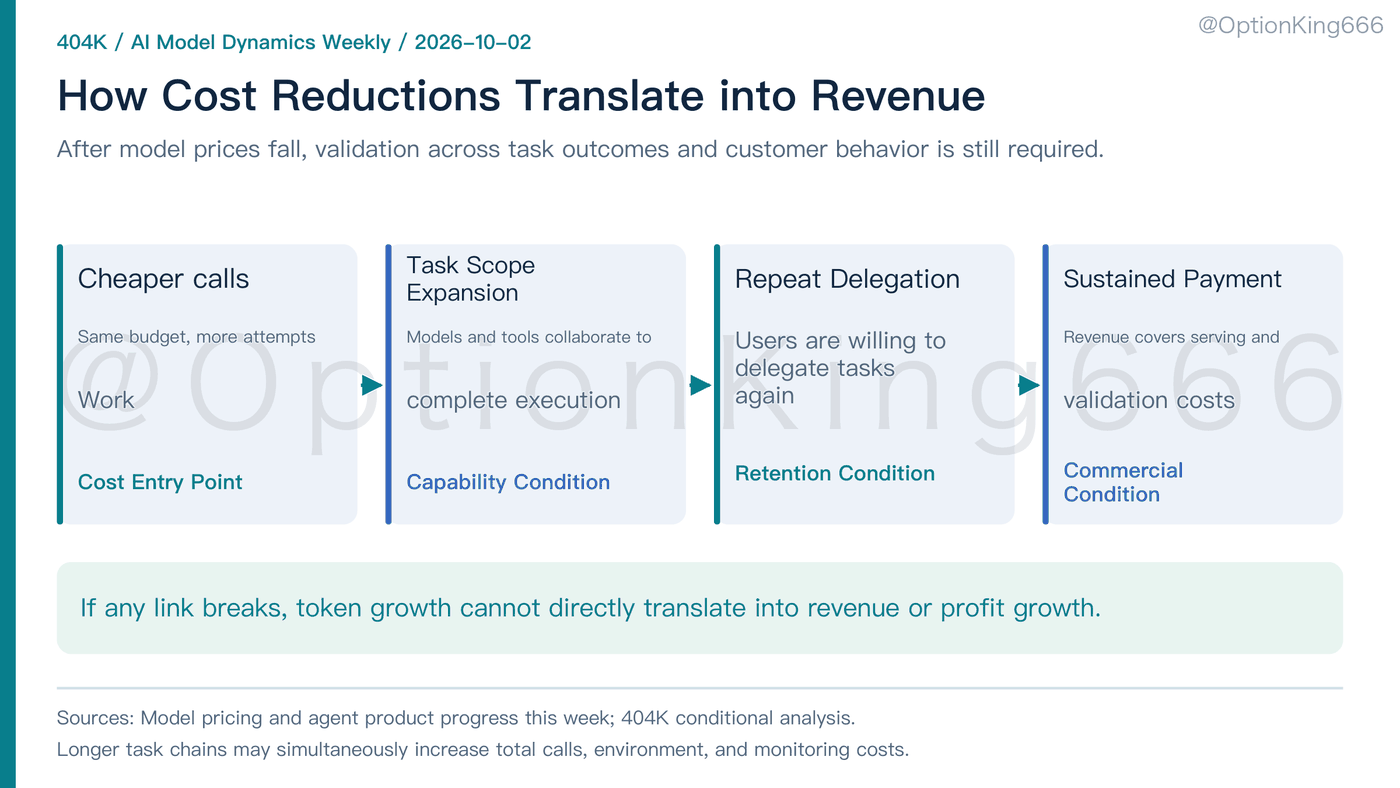
However, as agentic task chains lengthen, cheap single-call pricing ceases to guarantee cheap delivered outcomes. Upfront planning, browser actions, persistent state maintenance, and iterative verification consume substantial compute. Running background loops also risks generating unmonetized compute overhead. Consequently, falling per-token pricing and expanding total agent bills can occur simultaneously, driving a decoupling between token consumption growth and revenue growth.
From an investment standpoint, the transmission mechanism must be evaluated sequentially: lower unit costs first expand the scope of economically viable tasks; verified task completion drives repeat user delegation; and only recurring delegation translates into sustained monetization. If this chain breaks at any point, inference volume cannot be assumed to flow through to top-line growth. Equating background runtime capability directly with consumer willingness to pay overstates the pace of commercialization.
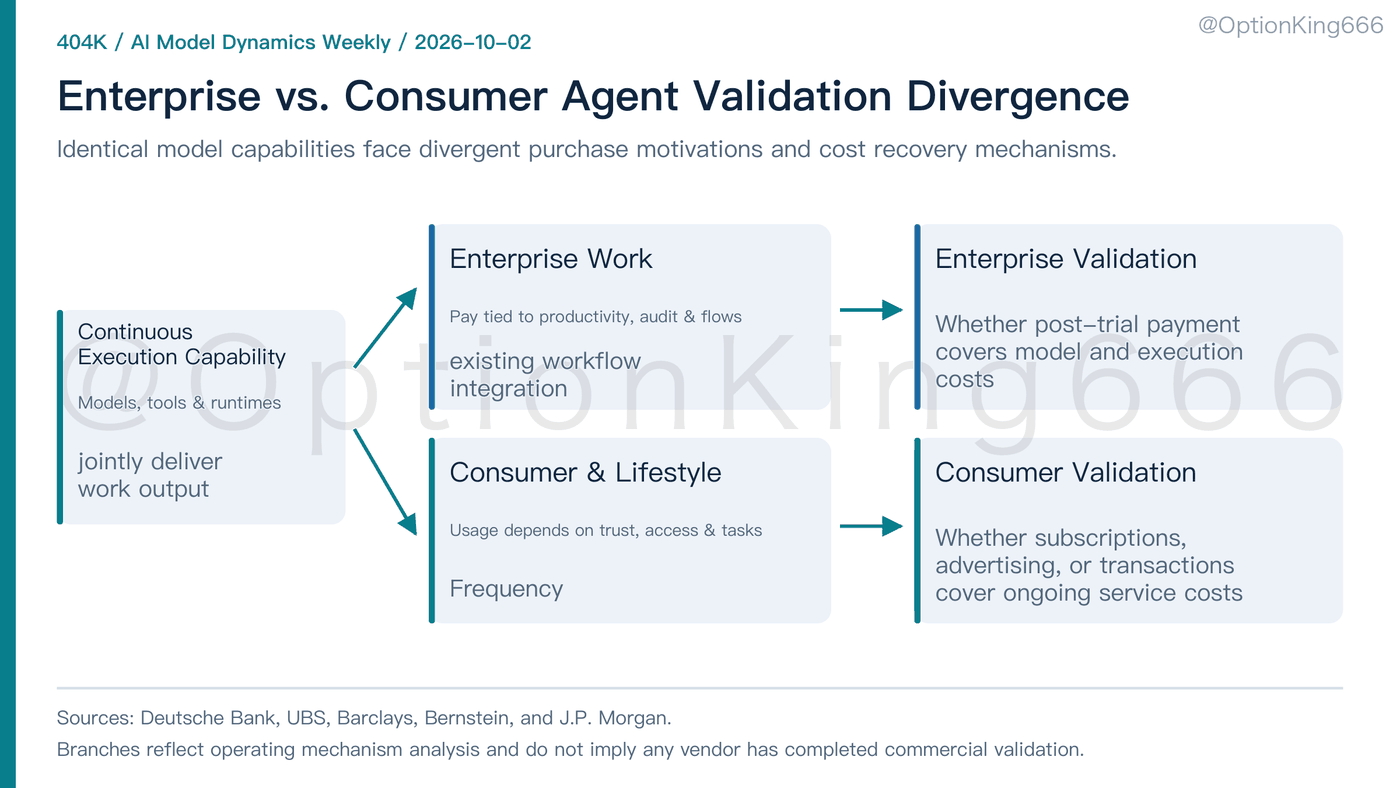
This week's data requires balancing healthy demand expansion against persistent monetization bottlenecks. UBS notes that OpenAI's DevDay showcased inference price-performance gains and commercial scale, but near-term disruption to legacy enterprise software vendors remains contained. Bernstein and J.P. Morgan both urge caution regarding consumer agents entering financial services, citing permissioning barriers, regulatory liability, and user trust; model capability gains alone do not automatically dissolve these moats.
Deutsche Bank is constructive on Grok Bot's synergy with developer coding tools to capture enterprise inference workloads, but highlights that bundled distribution may cap broad market expansion. Barclays focuses its analytical lens squarely on the infrastructure and compute overhead of persistent agent environments. These viewpoints align within a single framework: enterprise AI must demonstrate clear ROI and productivity lift, while consumer AI must prove that customer acquisition and monetization can outpace persistent serving costs.
Accordingly, the data this week does not justify declaring that any single frontier lab has secured an unassailable long-term moat. The relevant unit of observation is which model vendor reliably executes specific workloads under defined constraints of price, permissioning, and latency. Looking into next week, priority should be placed on monitoring same-task cost and completion rates rather than headline benchmark releases or financing valuations.
Model Releases, Upgrades, and Capability Shifts
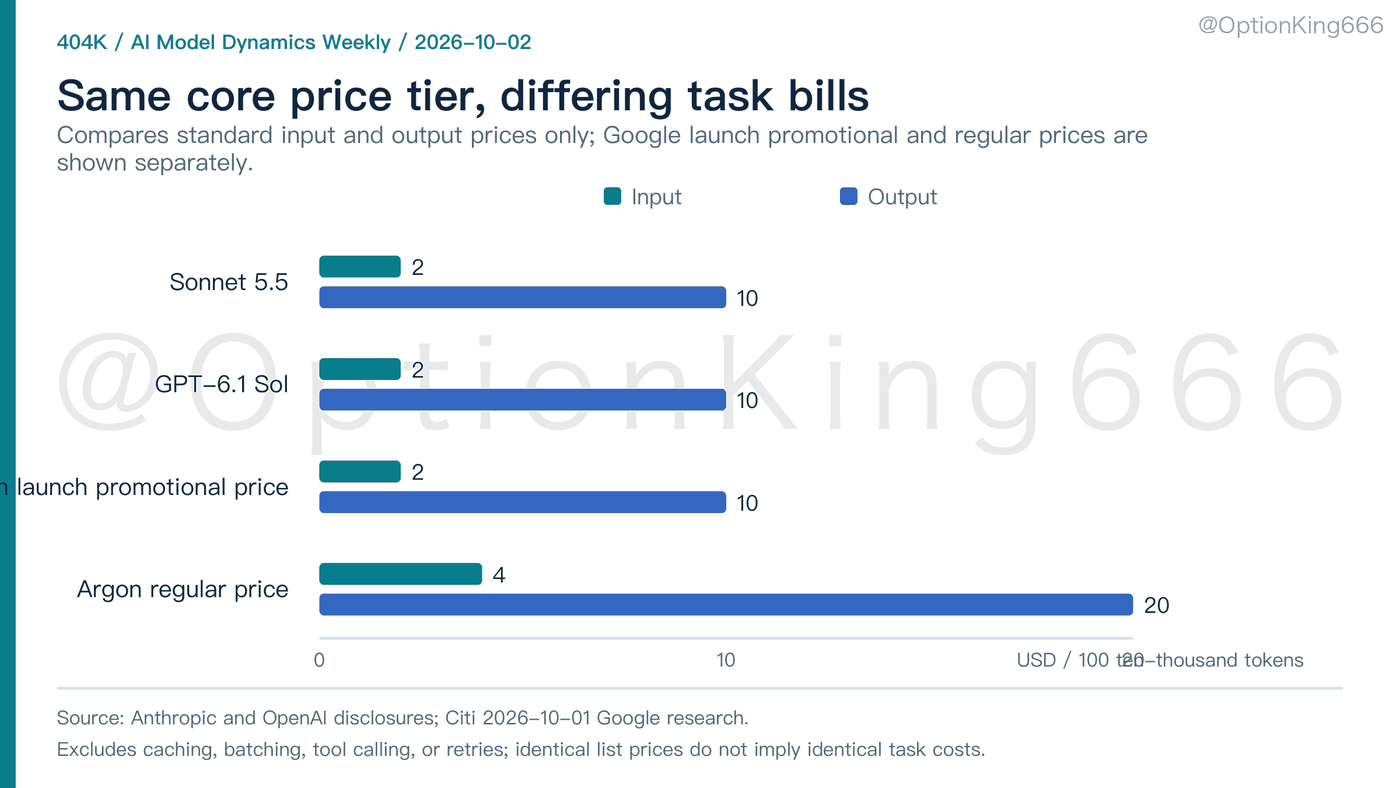
Sonnet 5.5 and GPT-6.1 (GPT61) Sol have converged workhorse model pricing to an identical baseline of $2 per million input tokens and $10 per million output tokens. Anthropic reports that Sonnet 5.5 reduced per-task costs by up to 30% in synthetic evaluations while boosting generation speed by more than 30%. While vendor-reported benchmarks cannot be assumed to translate into uniform bill reductions across production workloads, the efficiency gains make everyday software development and documentation tasks much more viable for high-frequency iteration.
OpenAI positions GPT-6.1 (GPT61) Sol as a cost-efficient model delivering near-Astra capabilities, featuring an approximate 1M-token context window and a 128k-token maximum output limit. While expanded windows accommodate large codebases and complex document corpora, window capacity and effective needle retrieval remain distinct technical hurdles. Enterprise procurement teams must continue stress-testing these models for mid-context degradation, stale-instruction interference, and cascading tool-calling errors during long-horizon runs.
Workhorse Model List Prices Converge, with Google's Promotional Window Requiring Scrutiny
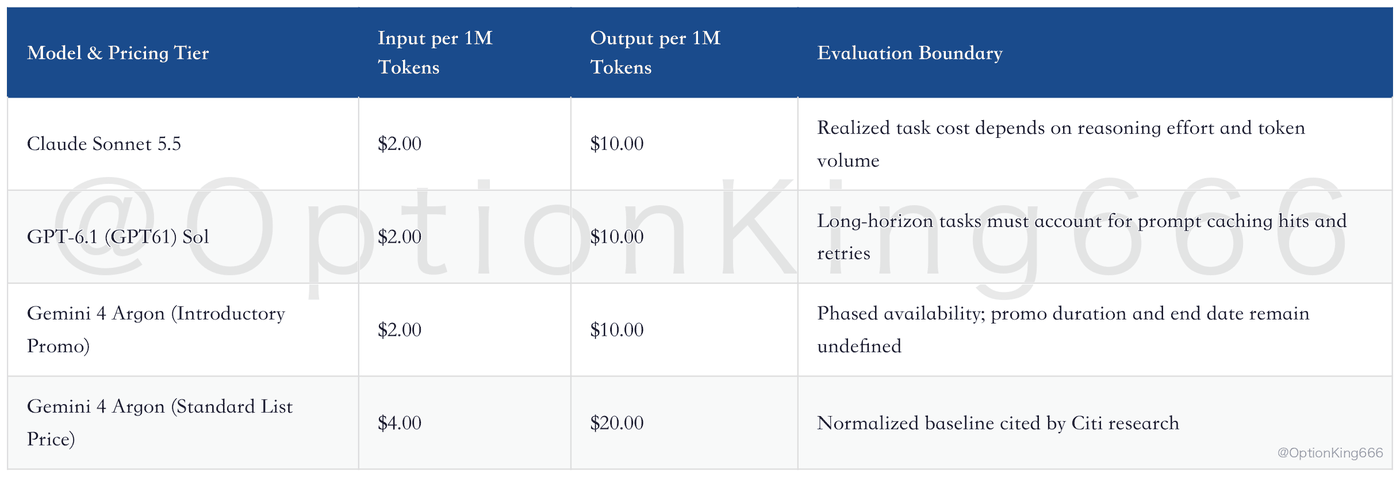
The efficiency gains of GPT-6.1 (GPT61) Sol are already apparent in standardized task-level cost data. Artificial Analysis's weighted task cost metrics show that Sol delivers an approximate 30% cost reduction relative to GPT-6 (GPT6) Sol. Reduced conversational round-trips lower redundant prompt ingestion costs, while discounted prompt cache reads provide additional savings; however, excessive token generation under maximum reasoning effort partially offsets these margin gains. This metric provides a far more accurate reflection of operational software economics than static API price sheets.
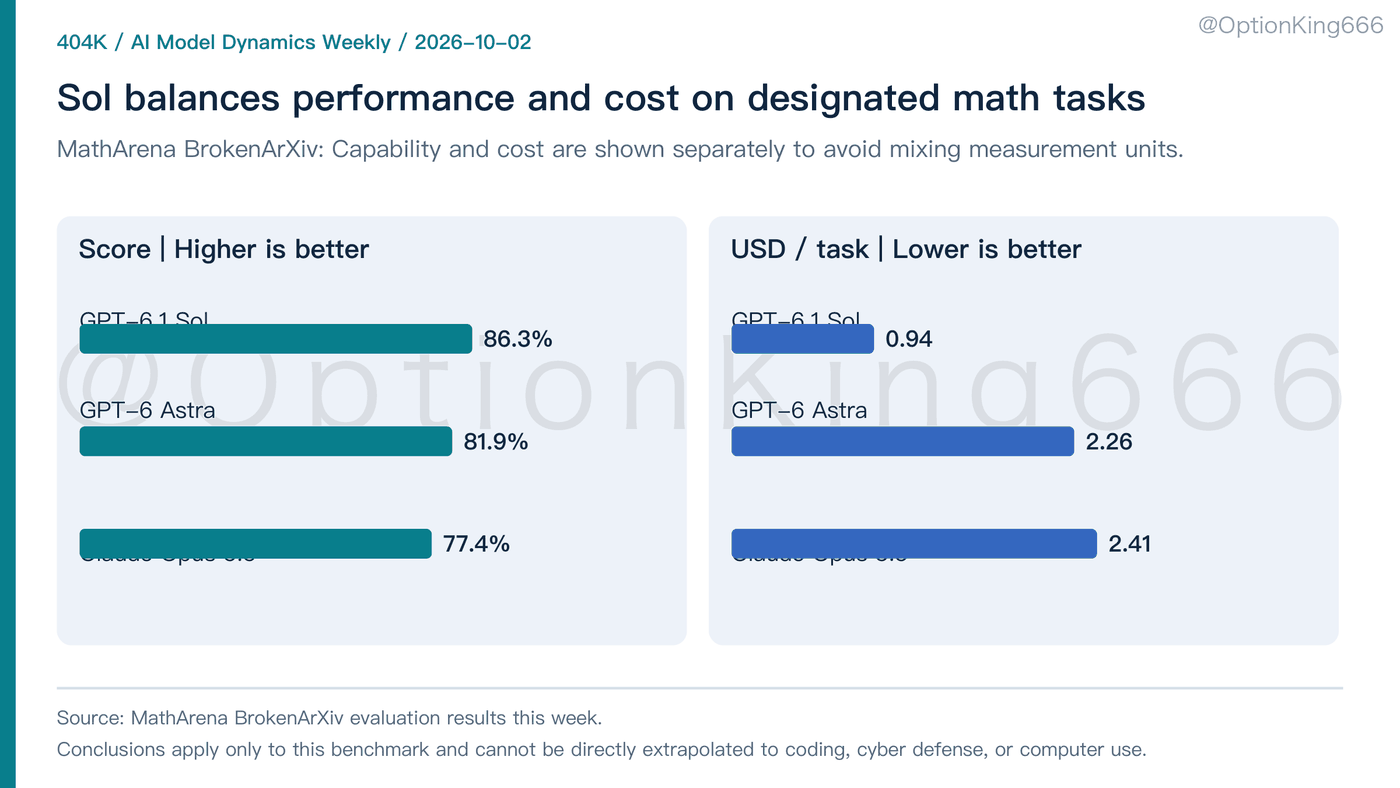
Math benchmarks similarly confirm that lower per-task costs can coincide with superior benchmark scores, though this conclusion remains strictly bounded by evaluation type. Sol's strong performance on MathArena BrokenArXiv cannot be extrapolated into blanket superiority across production software engineering, cyber defense, or multi-hour computer use. Model selection must remain workload-stratified, avoiding broad enterprise procurement commitments based on single-domain benchmark wins.

For Google, the crux of regaining frontier competitiveness hinges on whether Argon can translate reported benchmark scores into reproducible production performance. Citi emphasizes Argon's performance on coding and professional domain tasks, alongside its 1M-token output support for complex agentic workflows. J.P. Morgan, however, cautions that defending frontier leadership requires consistent execution across iterations, arguing that this initial release does not resolve ongoing concerns regarding Google's commercial execution and productization velocity.
Argon Leads on Select Benchmarks, but Lacks End-to-End Production Verification

Regarding internal developer feedback at Google, published reports of dissatisfaction contrast with positive commentary from research engineers. The former note that production coding performance trails published benchmarks, while the latter report robust agentic debugging capabilities. Anecdotal internal feedback cannot substitute for external validation, and Google's phased rollout continues to restrict broad independent testing. The most critical data point next week will be observing whether broader enterprise cohorts can reproduce these results under fixed budgets.
