
目录
This Week’s Assessment
Model Releases, Upgrades, and Capability Changes
Inference, Training, Multimodal, and Agent Capabilities
Open Versus Closed Models, Benchmarks, and the Developer Ecosystem
API Pricing, Commercialization, and Vendor Divergence
Counterevidence and Next Week’s Priorities
Models can do more, but customers may not pay more for each call. Flagship models, low-cost open models, and agent APIs all advanced this week. The investment test is the cost of successful delivery and customers’ willingness to keep paying. The principal risks are that long tasks still require human intervention and price cuts fail to generate enough incremental revenue.
This Week’s Assessment
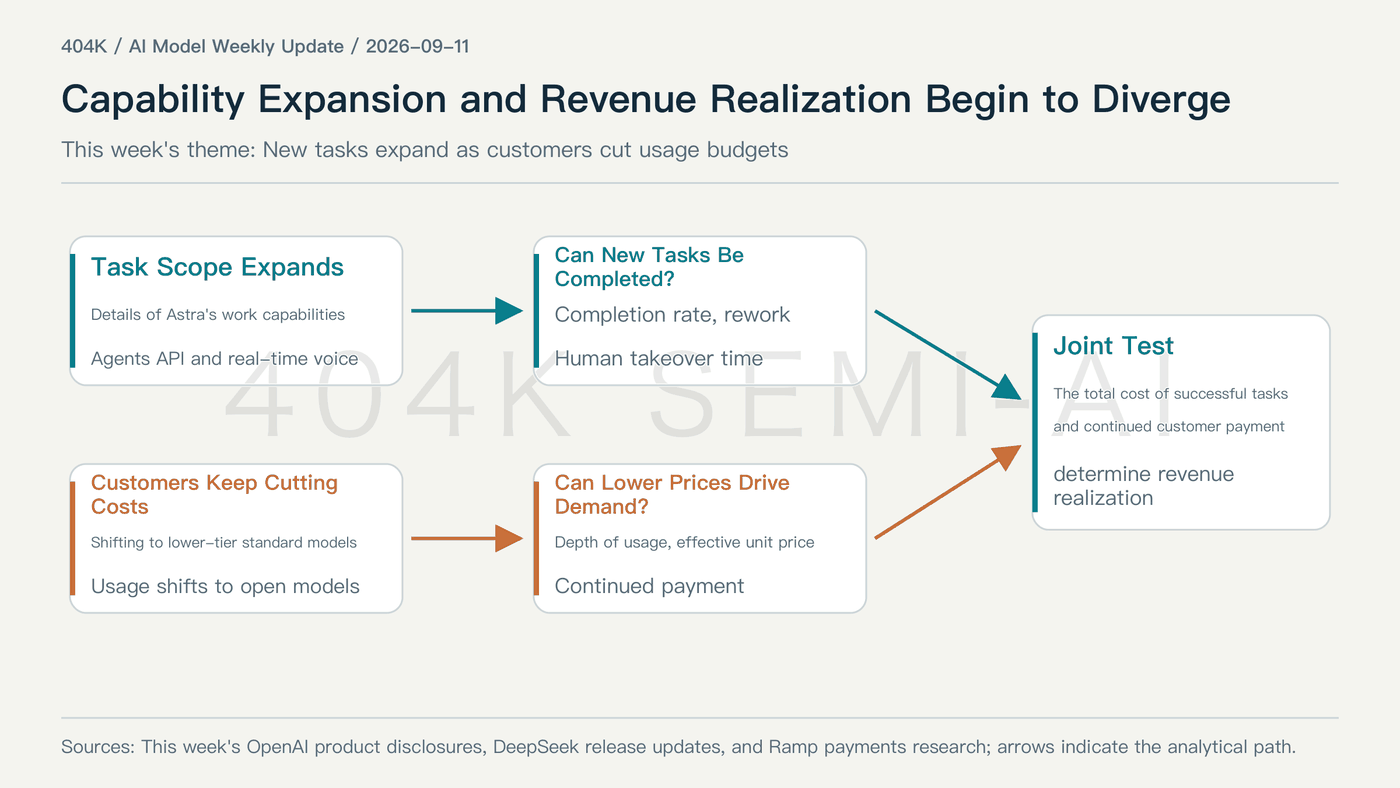
Model competition is expanding from answer quality to end-to-end task delivery. OpenAI added details on GPT-6 Astra’s workplace applications, benchmarks, and pricing, and launched the Agents API public beta and GPT-Live-1 voice API. DeepSeek’s V4.1-Flash combines low pricing, long context, and tool use. Enterprises increasingly need to compare which provider can complete the same job, at what cost, and with how much human follow-up.
Astra’s launch should be distinguished from this week’s updates. OpenAI explicitly said the model launched last week; this week’s disclosures focused on access, customer feedback, and cost performance. Counting all of these as new model launches would overstate the pace of releases. The more consequential development is that model capabilities are entering developer workflows through a managed agent framework and voice APIs, potentially extending usage beyond coding.
Revenue evidence points in the other direction. Ramp’s enterprise payments research this week showed that adoption continues to grow, but more slowly, while AI spending per employee among the leading spenders declined. Customers choosing cheaper models and eliminating unnecessary calls is entirely consistent with improving capabilities. The former tests whether vendors can retain technical gains as revenue and profit; the latter only establishes that more problems can be solved.
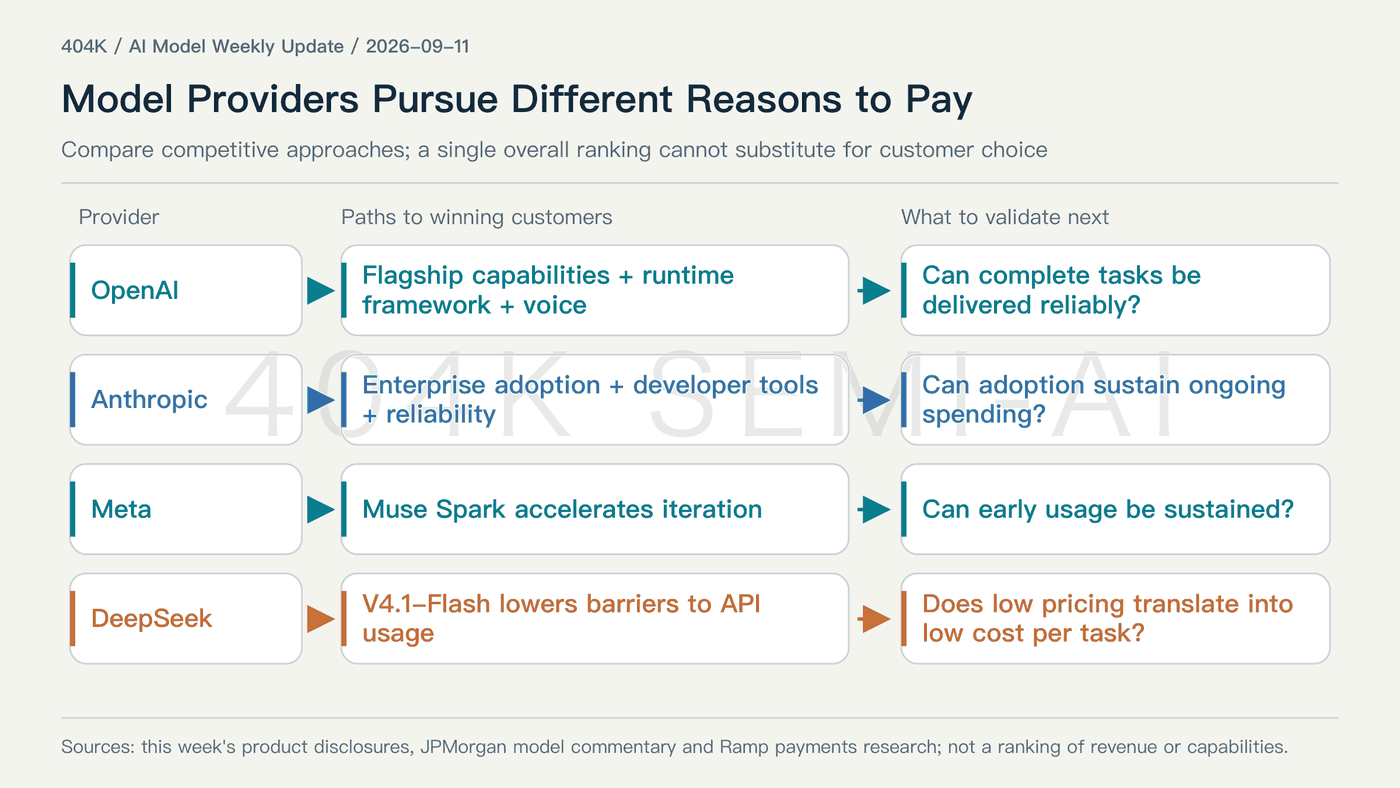
Vendors are pursuing distinct competitive strategies. OpenAI aims to offer flagship capabilities, an agent runtime framework, and real-time interaction. For Anthropic, the key areas to watch are enterprise adoption, simpler developer tooling, and reliability. Meta is accelerating Muse Spark iterations, while DeepSeek is targeting everyday tasks with lower API prices. These strategies can succeed simultaneously, but each offers a different reason to pay; a single leaderboard cannot capture their relative commercial positions.
Our view is that capabilities will spread while revenue performance diverges. Customers may accept higher prices for complex tasks that were previously impossible. Tasks that models can already complete reliably are more exposed to substitution by standard and open models. Margin retention depends on whether vendors can reduce retries and maintain service quality faster than customers cut budgets.
Next week, the priority is whether newly supported work translates into sustained usage. For Astra, watch completion rates in real workflows; for DeepSeek, compatibility and bills after model replacement; for Agents API, sustained performance among public-beta customers. Funding totals, short-lived download spikes, and individual demonstrations cannot substitute for that evidence.
Model Releases, Upgrades, and Capability Changes
Astra’s initial commercial value lies in operating software directly. OpenAI says it can write code in ChatGPT Work and Codex and operate everyday applications that lack APIs. This reduces the need for enterprises to modify software before connecting a model. If the model can use existing interfaces, tasks previously shelved because of integration costs may become viable pilots.
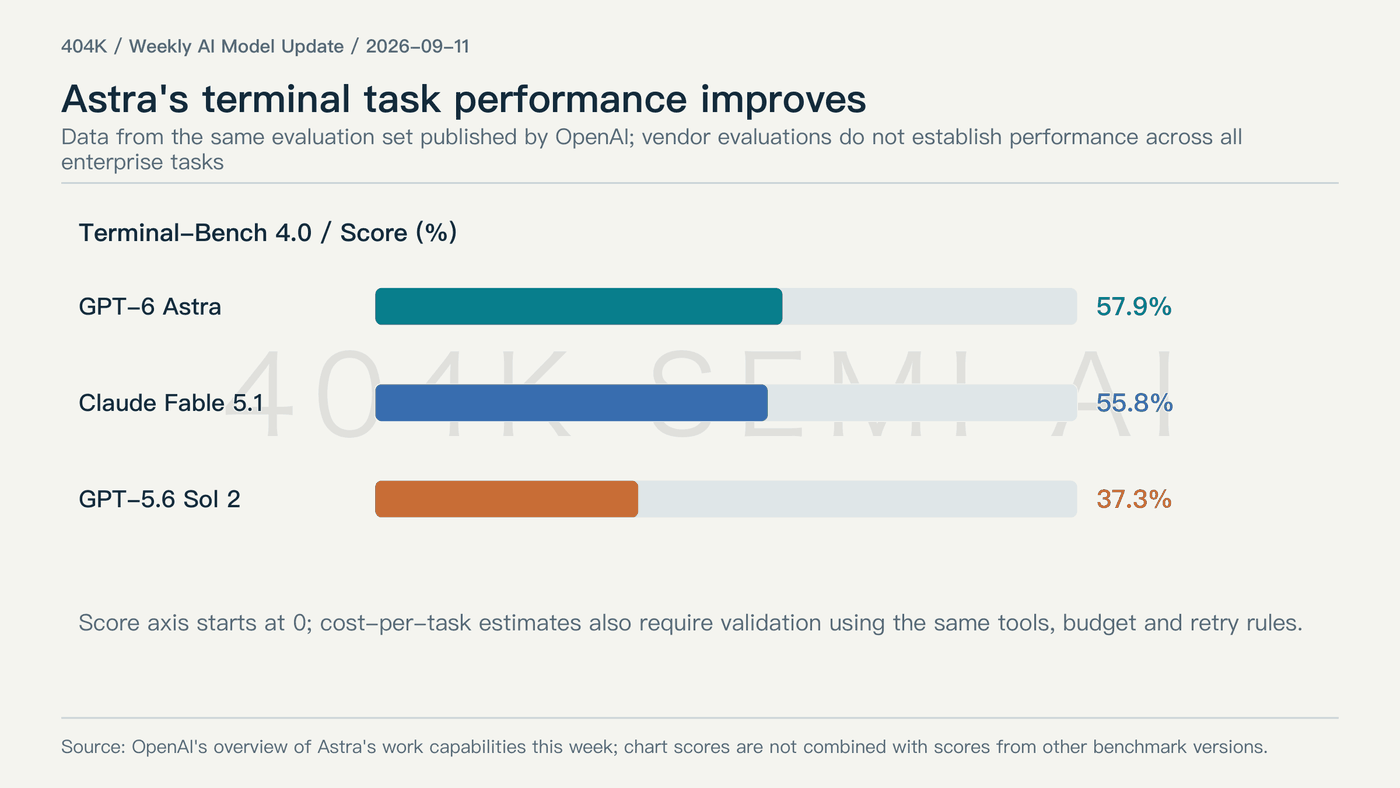
Terminal-task results support improved capabilities, but remain specific to the benchmark. OpenAI reported Terminal-Bench 4.0 scores of 57.9% for Astra, 55.8% for Claude Fable 5.1, and 37.3% for GPT-5.6 Sol 2. It estimated Astra’s API cost per task at approximately 63% below Claude Fable 5.1 and 9% below GPT-5.6 Sol 2. The results suggest that capability and efficiency can improve together; they do not establish equivalent savings across all enterprise workloads.
Customer feedback connects these benchmarks to practical tasks. OpenAI cited customer tests in which Astra improved pass rates and reduced inference calls in end-to-end workflows lasting more than five hours. The relevant measures are the steps, rework, and human intervention required to finish a task, rather than the volume of text generated. Enterprise access also initially requires administrator activation, leaving a gap between availability and broad adoption.
DeepSeek V4.1-Flash poses a more direct challenge: selling sufficiently strong task capabilities at a lower price. This week’s release updates indicate that the model is available through the API, supports text and image input, and offers a one-million-token context window. Tokens measure the text a model processes and do not correspond directly to character counts. A large window is useful for codebases, documents, and tool outputs, but fitting more information into context does not ensure accurate retrieval and use.
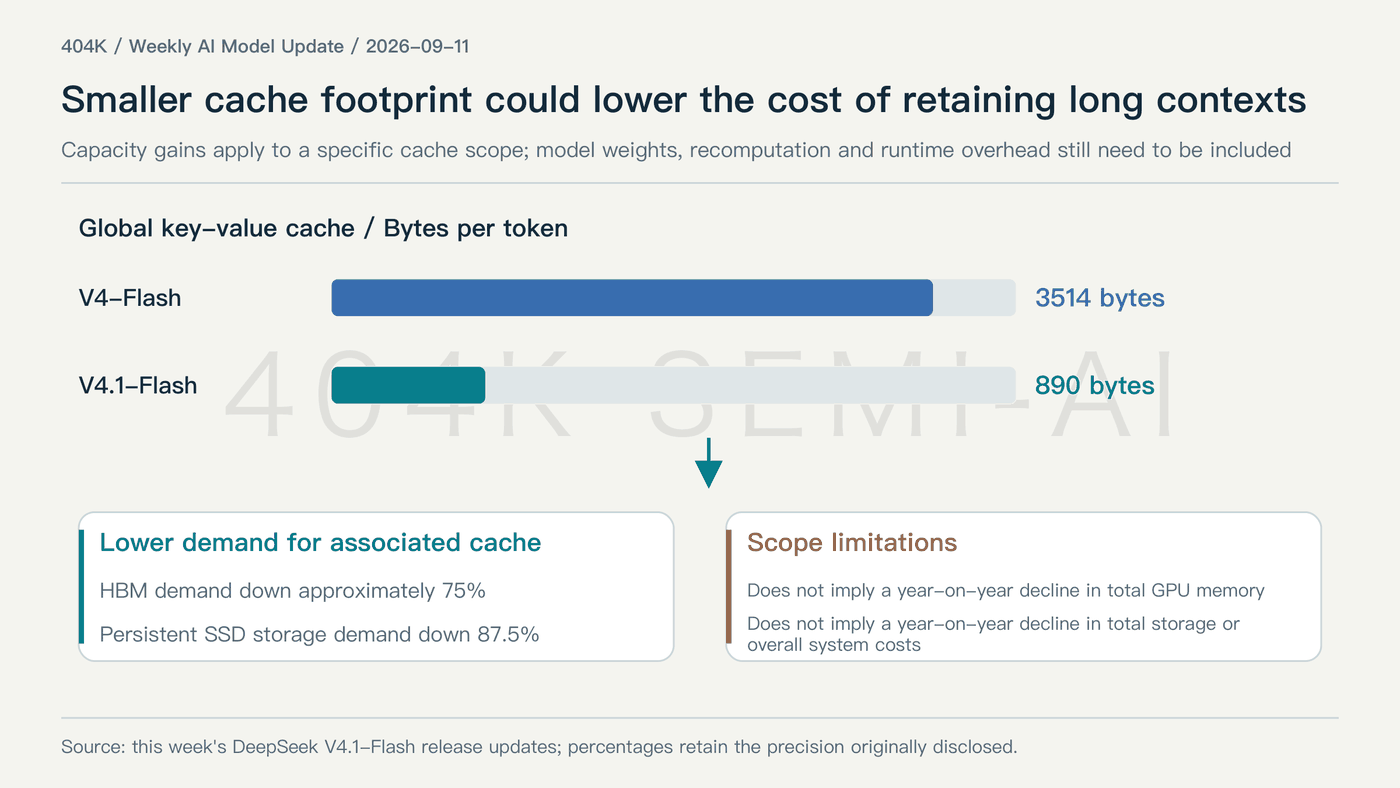
Cache optimization is a technical improvement worth tracking. According to the release updates, V4.1-Flash reduces global key-value cache usage from 3,514 bytes per token in its predecessor to 890 bytes. HBM requirements for the relevant cache fall by approximately 75%, while persistent SSD storage requirements fall by 87.5%. These reductions apply only to the specified cache components, not to total system memory or storage costs.
Cache tiering also shifts where costs arise. The release updates say short-term sliding-window data moves to a shared pool, while long-term global context remains in persistent storage. Missing short-term state is reconstructed by replaying a bounded window. This saves the cost of retaining transient data over long periods, but the benefit also depends on how often state is lost and how much recomputation replay requires. Cache capacity alone is insufficient to judge the economics.
Software engineering results also suggest progress. DeepSeek reported a DeepSWE score of 74.2% for V4.1-Flash, versus 54.4% for the preceding V4-Flash. These results cannot be ranked directly against Astra customers’ DeepSWE v1.1 results because benchmark versions and execution settings differ. A meaningful comparison requires the same tasks, tools, time budgets, and retry rules before measuring the cost of successful delivery.
Small models add value by lowering deployment requirements, rather than replacing every flagship workload. This week’s evaluation updates describe OpenBMB’s MiniCPM5 as a 2.6-billion-parameter, text-only input/output model released under the Apache 2.0 license. It scored 15 on Artificial Analysis Intelligence Index v4.2, above the 11 scored by the three-billion-parameter Granite 4.2 in the small-model comparison. This indicates further room for improvement at limited scale.
