
Contents
Key Weekly Takeaways
Model Releases, Upgrades, and Capability Shifts
Real-Time Voice Bridges Conversation and Execution
Persistent Execution and Personal Context Expand Deliverable Tasks
Distinguishing Training Milestones from Commercial Availability
Reasoning, Training, Multimodal, and Agent Capabilities
Post-Training and Software Optimizations Yield Tangible Gains
Execution Traces Provide Audit Trails for Model Self-Improvement
Context Reliability Governs Long-Horizon Task Completion
Open vs. Closed Ecosystems, Benchmarks, and Developer Adoption
Divergent Benchmarks Address Distinct Enterprise Demands
Voice Benchmarks Highlight Configuration Tradeoffs Over Flat Rankings
Open-Source Ecosystem Competes on Full-Stack Agent Frameworks
API Pricing, Commercialization, and Vendor Divergence
Voice Cost Deflation Requires Normalizing Billing Units
Specialized Models Deflate Unit Decision Costs; Frontier Models Target High-Value Workloads
Enterprise Revenue Durability Hinges on Cost Structures and Data Terms
Friction Points, Counter-Evidence, and Forward Watchlist
Safety Gates Embed Deeply into Training and Deployment Pipelines
What to Watch Next Week: Testing Hypotheses Against Real-World Delivery
This week, AI model competition shifted closer to end-to-end delivery: voice models execute tasks mid-conversation, agents run persistently in the background, and specialized models shoulder low-cost decision-making. From an investment perspective, the critical metric is net revenue retained per successful task; the primary risk remains the lingering gap between benchmark leaderboards, staged demos, and enterprise production deployments.
Key Weekly Takeaways
Frontier model developers are turning capability advantages into repeatable workflows. Between September 14 and 18, Google unveiled real-time voice models, Anthropic advanced the integration of chat and background task execution, and TypeSafe AI launched Jev, a model designed to directly output structured decision values. These releases address three operational bottlenecks: calling tools seamlessly during a conversation, running tasks asynchronously after users log off, and lowering the inference overhead of routine judgments. Together, they target the same commercial question: will customers entrust their next task to the model?
Competition has stratified into distinct layers. Frontier foundation models tackle complex reasoning and multi-step planning; specialized models handle well-bounded tasks like classification and routing; and runtime orchestration harnesses model outputs into verifiable results. Core model intelligence remains the starting point, but API call volume is increasingly governed by tool integration, execution reliability, and recovery costs after failures. Benchmarking single-turn response quality overlooks both the revenue upside and the cost burden of sustained execution.
Clear counterarguments temper this thesis. User conversational preference in voice models diverges sharply from multi-step task success rates; background agent capabilities remain in limited preview or phased rollouts; and Jev’s purported cost edge is based on vendor-disclosed, specialized workflows. While competition is unmistakably pivoting toward execution, no vendor has yet established a universally applicable cost advantage. Next week, investors should monitor rollout expansion and real-world task performance rather than new model branding.
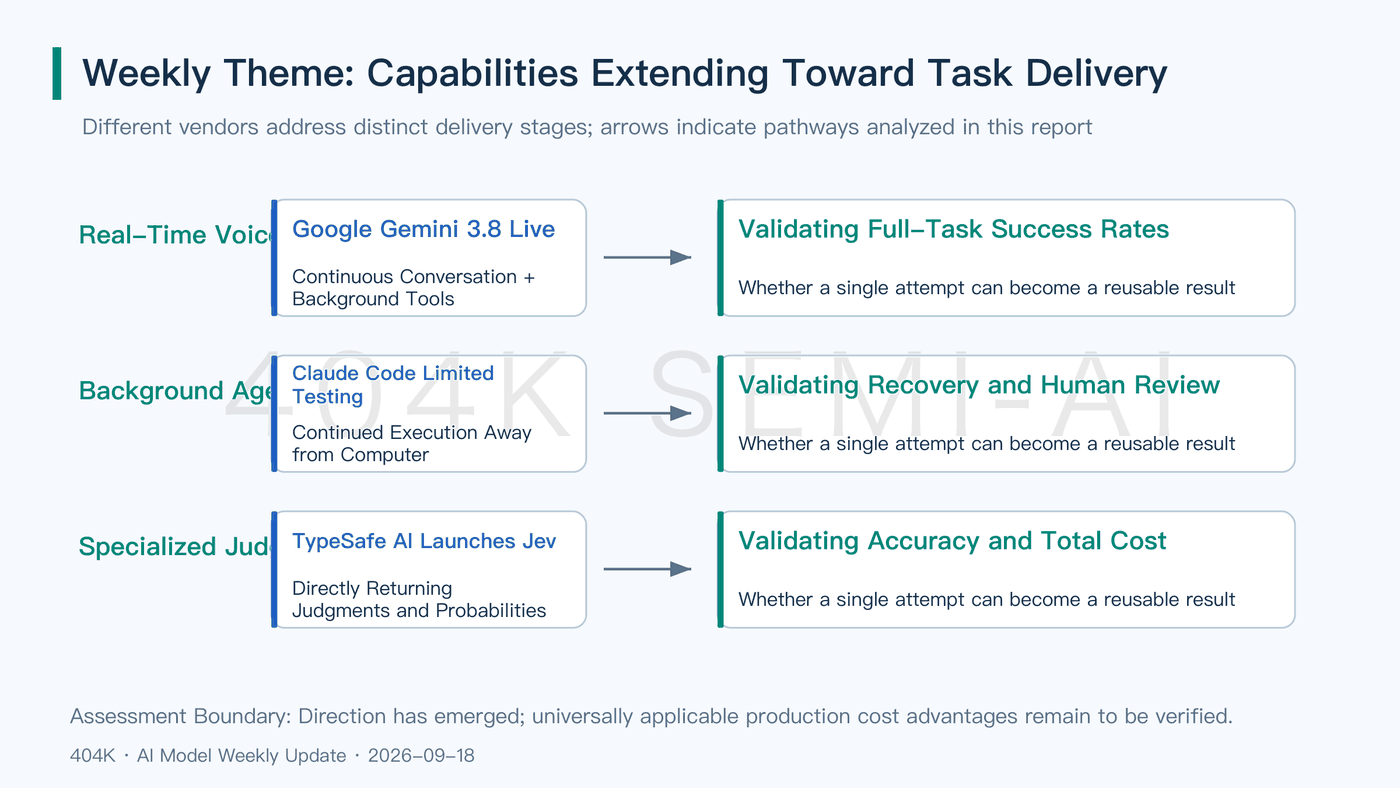
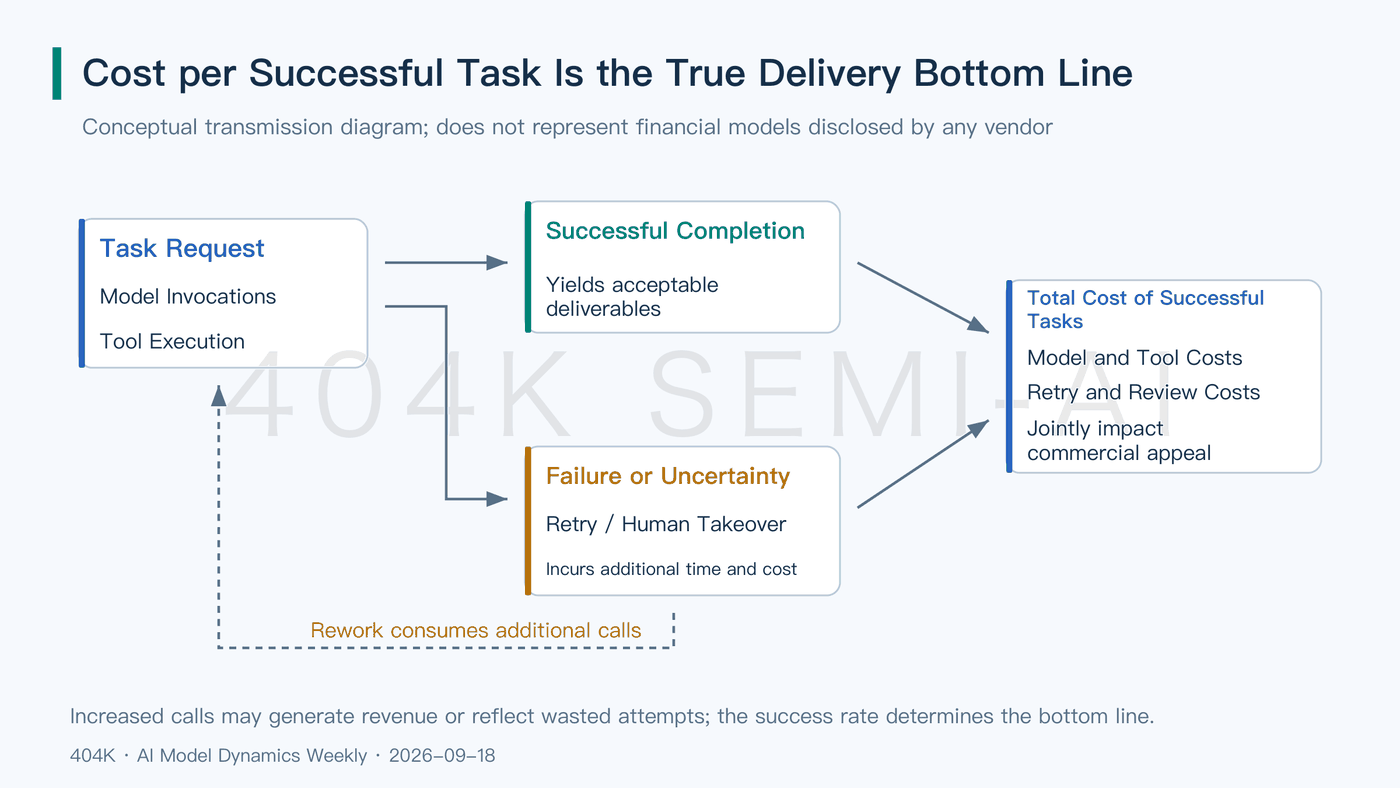
Revenue expansion and margin improvement must be evaluated separately. Longer-running background tasks can drive higher token volume, but they can also inflate invalid retries, third-party tool fees, and human review expenses. While specialized models reduce per-query pricing to attract incremental demand, they risk cannibalizing higher-margin calls on proprietary frontier models. Only when completed tasks scale while delivery costs remain constrained can vendors translate volume growth into durable earnings.
This week’s developments illustrate divergent strategic problem-solving across vendors rather than a single outright winner. Google bifurcated real-time interaction and multi-step reasoning into separate configurations; Anthropic embedded persistent execution directly into its user interface; OpenAI posted encouraging signals in composite benchmarks and developer spend share; and open-source and specialized models captured targeted workloads via post-training and optimized deployment architectures. These findings validate multi-model specialization, but do not support the narrative that general frontier models are losing value.
Assessing AI commercialization requires shifting unit economics from raw token pricing to the total cost per completed task. Tokens quantify processing throughput, but enterprise buyers pay for end outcomes. Whether generating research, resolving a customer support ticket, or modifying code, a cheaper model that requires frequent retries may incur higher total costs; conversely, a premium frontier model that minimizes human intervention can easily justify its price tag. Every new release this week faces this collective test.
Model Releases, Upgrades, and Capability Shifts
Real-Time Voice Bridges Conversation and Execution
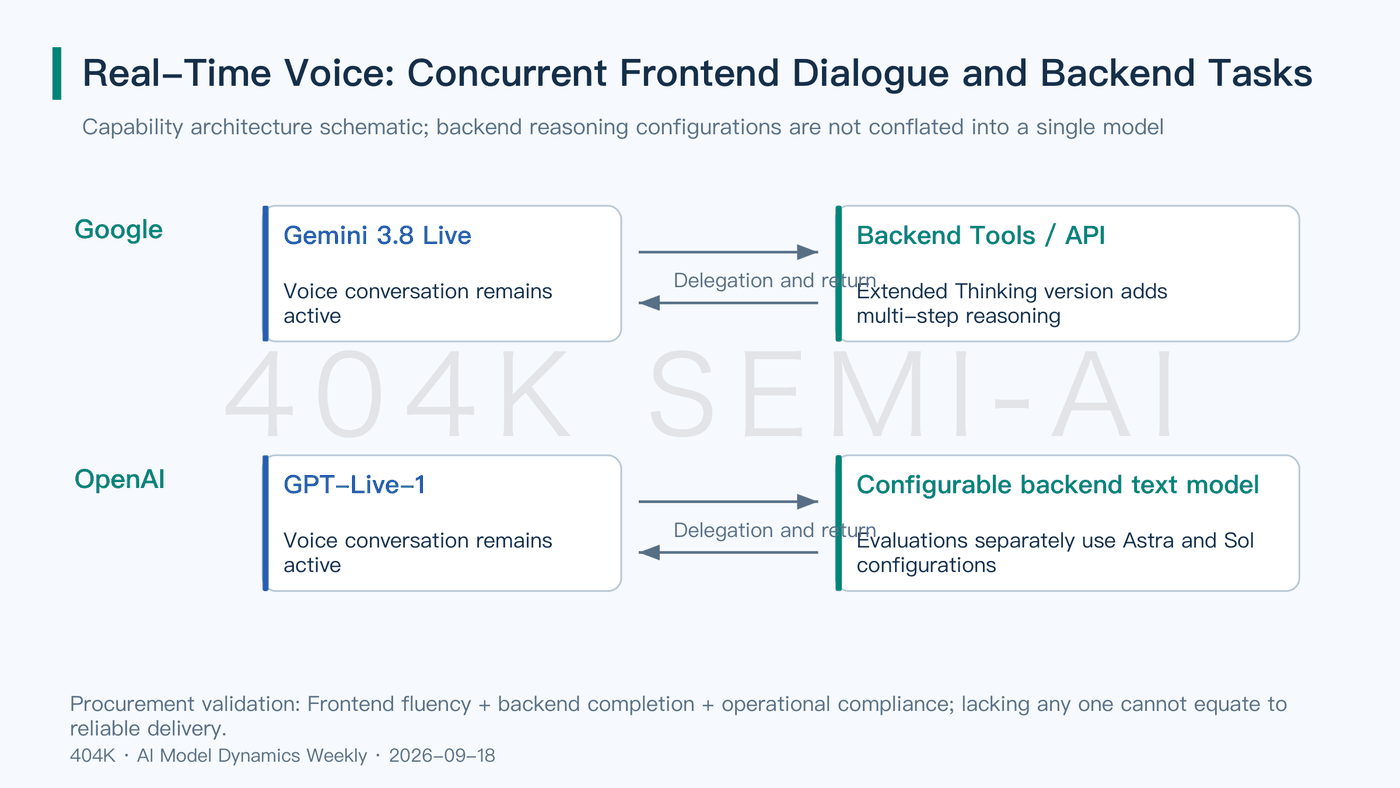
Google's latest architectural update integrates ongoing dialogue and background execution into a single, unified workflow. Gemini 3.8 Live prioritizes low latency and cost-effective scaled deployment, whereas the Extended Thinking tier incorporates multi-step reasoning. According to Google's release disclosures, both tiers support near-real-time visual understanding, automatic code-switching across 97 languages, and non-interruptive background tool execution during active conversations; the Extended Thinking tier can also provide audible progress updates during lengthy multi-step tasks.
OpenAI's GPT-Live-1 (LIVE1) similarly adopts a persistent conversational design, delegating reasoning and tool use to backend text models that developers can configure modularly. Benchmark evaluations this week tested Astra (Medium reasoning) and Sol (Low reasoning) backend configurations. Consequently, voice product performance is fundamentally tethered to backend reasoning depth; different configurations behind the same voice interface cannot be treated as a single model score.
For enterprise clients, simultaneous listening and task processing eliminates latency and repetitive user prompting. The operational risk, however, is an illusion of competence: a model that articulates smoothly while failing to complete backend operations or adhere to business logic. As voice models penetrate customer service and complex multi-step workflows, task completion rates and transactional accuracy—rather than acoustic naturalness—become the primary justification for enterprise pricing. While time-to-first-audio-response remains a hygiene metric, it alone does not drive enterprise productivity.
Persistent Execution and Personal Context Expand Deliverable Tasks
Anthropic is lowering the barrier between chat-based interaction and task execution. Claude announced the upcoming consolidation of Cowork into its primary chat interface, scheduled to roll out to Pro and Max subscribers over the coming weeks. Its September 18 Claude Code update went further: select Pro and Max users can now test cloud-hosted multithreaded tasks that persist even after closing their laptops. The former remains an upcoming rollout, while the latter is a gated pilot; neither constitutes general availability.
Apple’s English beta of Siri AI elevates personal context and on-screen awareness to core model capabilities. It cross-references messages, emails, and photos to retrieve information and execute actions across supported applications. Apple's new architecture leverages in-house foundation models developed in collaboration with Google and Gemini, dynamically routing tasks between on-device silicon and Private Cloud Compute. In terms of competitive positioning, the true moat lies in the scope of accessible user context and system-level action permissions.
