
Contents
Weekly Thesis
Verifiable Developments Across Demand, Delivery, Pricing, and Cash Collection
J.P. Morgan Firmwide ROIC Forecasts for Calendar Year 2026
Cloud Revenue and AI Capital Expenditures
Google Cloud: Reported Results vs. Brokerage Projections
J.P. Morgan Projections for Google: Phased Cash Outlays and Depreciation Drag
Datacenters, Compute Procurement, and Custom Silicon
Nvidia: Expanding Revenue Opportunity per Gigawatt Across Architecture Generations
Rising Liquid-Cooling BOM Content per Rack
Frontier Models, Software, and Application Monetization
Muse Cost of Service Projections: Sensitivity to Utilization Assumptions
Structural Divergence: M7 vs. Neoclouds
Nebius Power Capacity: Energization vs. Commercial Commissioning
Market Disagreements, Disconfirming Evidence, and Forward Catalysts
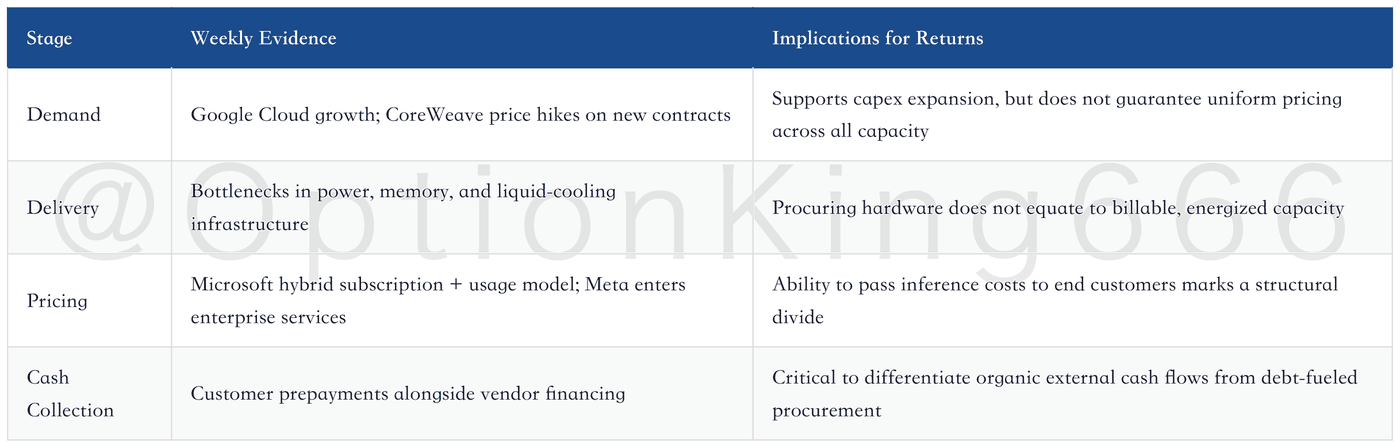
Forward Verification Matrix: Tracking Revenue, Delivery, and Cash Conversion
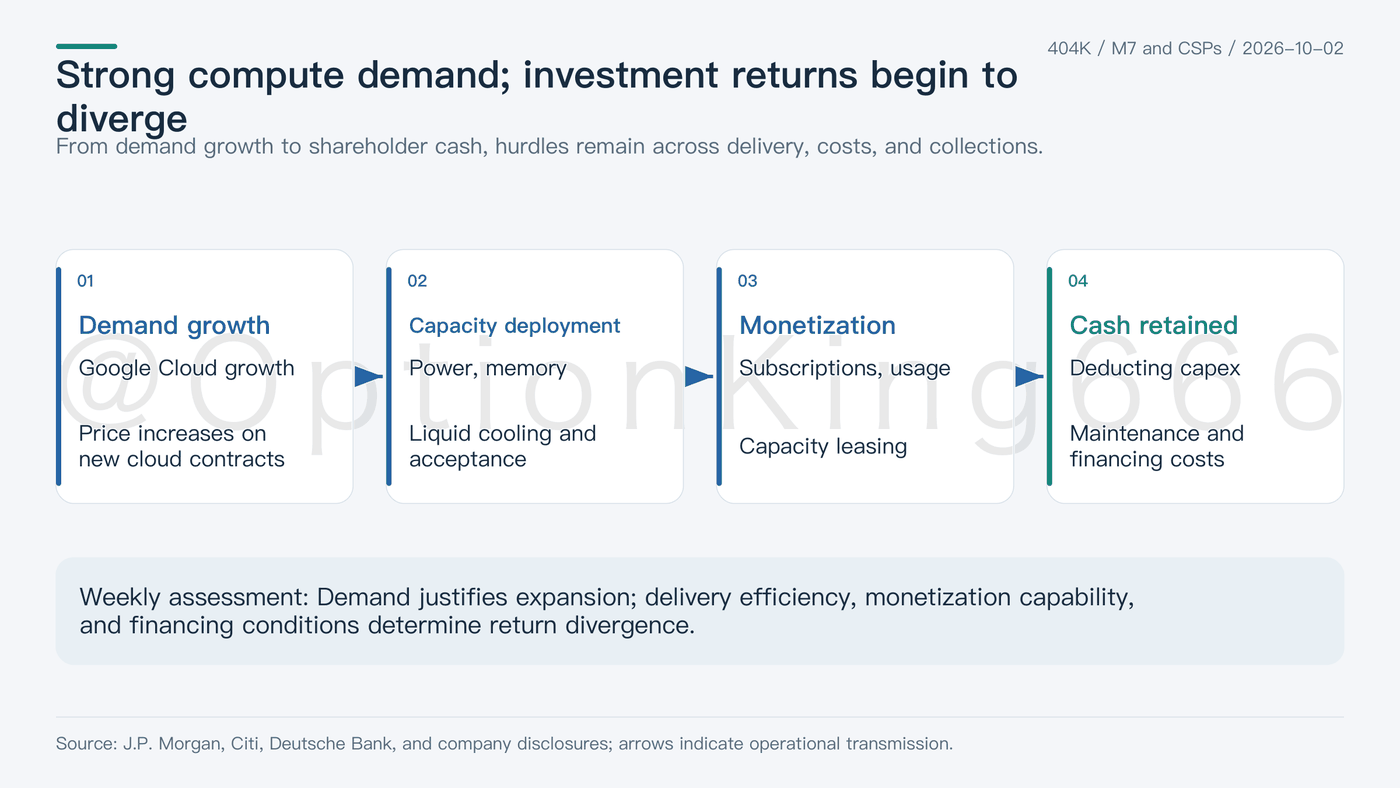
Demand for compute capacity remains robust; the crux is how much free cash flow survives the massive buildout. Microsoft leans on software subscriptions to anchor returns, Google relies on cloud top-line acceleration and external TPU sales to absorb capex, and neoclouds are raising prices to outrun escalating financing costs. Moving forward, the critical test is whether physical capacity delivery, recurring enterprise spend, and cost pass-through can materialize in tandem.
Weekly Thesis
This week, developments across the Magnificent Seven (M7) and cloud service providers (CSPs) brought both accelerating demand and funding strains into sharper focus. Google Cloud revenue expanded rapidly, CoreWeave continued raising prices on new contracts, and Meta introduced Muse to enterprise customers. While these milestones validate continued compute expansion, they do not guarantee uniform returns across every project. Prior to delivery, compute infrastructure requires heavy upfront capital outlays for hardware, real estate, and construction; post-delivery, it incurs substantial depreciation, maintenance, and interest expenses. These encumbrances stand squarely between headline revenue growth and actual cash distributed to shareholders.
Consequently, investment frameworks must drill down from headline capex totals into specific monetization mechanics. Microsoft layers workplace software subscriptions on top of cloud infrastructure; Google operates an integrated ecosystem spanning search, proprietary models, and in-house silicon; and neoclouds remain predominantly reliant on wholesale capacity leasing and spot/short-term pricing. The identical AI demand driver can translate into high-margin incremental software profit for one player, while serving merely as justification for further debt financing for an infrastructure operator. The real differentiator is whether incremental cash generation covers incremental invested capital, not who announces the largest buildout targets.
Verifiable Developments Across Demand, Delivery, Pricing, and Cash Collection
Microsoft offers a relatively transparent reference point for returns. J.P. Morgan estimates that Microsoft Cloud return on invested capital (ROIC) will stabilize at 32%–33% following its heavy expansion. This stability stems from the combined monetization of cloud infrastructure and high-margin software, rather than raw GPU rental inflation. However, this projection remains contingent on two factors: sustained enterprise willingness to pay for premium agentic workflows, and the fungible reuse of underlying compute clusters across diverse workloads.
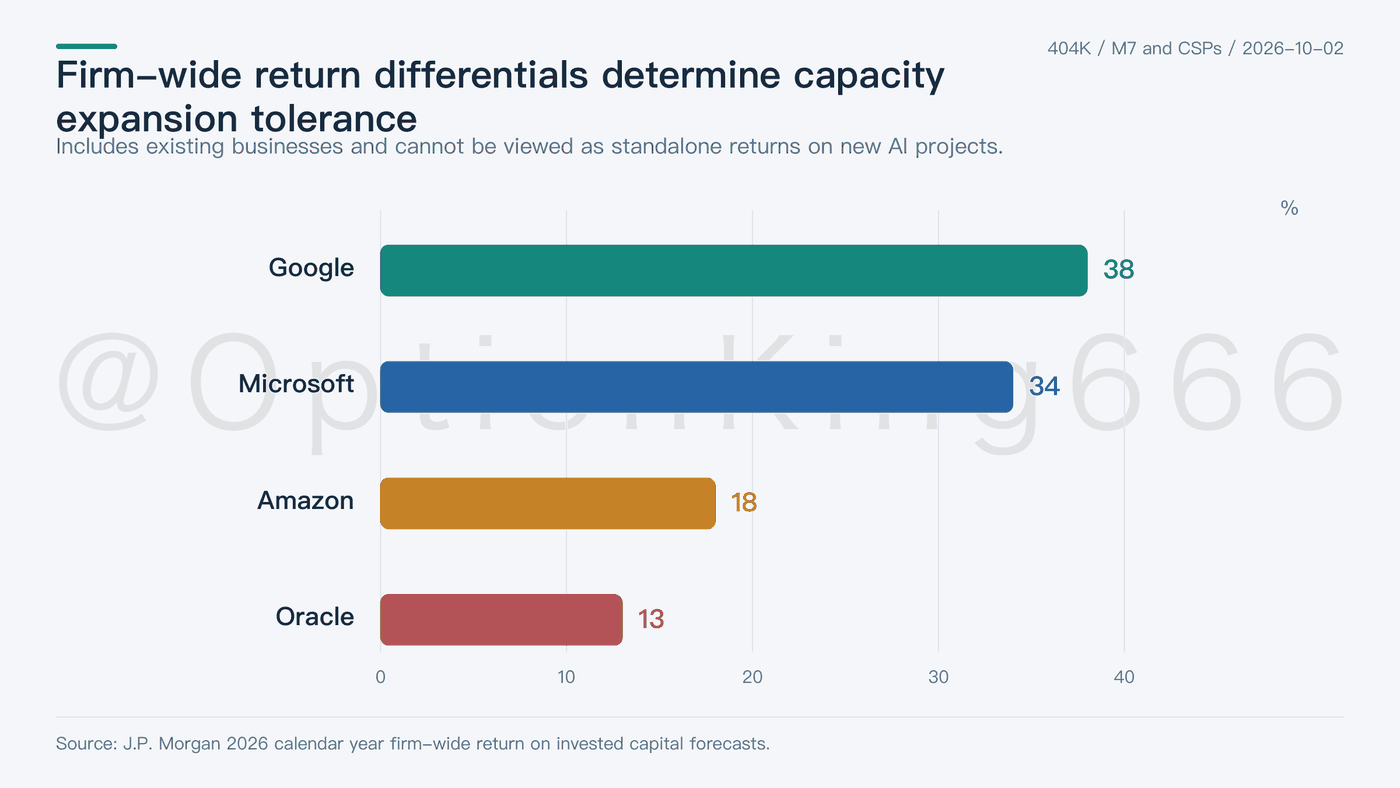
Firmwide ROIC estimates from the same institution highlight the structural divergence among Alphabet (Google), Microsoft, Amazon, and Oracle. Because these figures encompass legacy operating units, they cannot be conflated with the marginal returns of greenfield AI projects. Google benefits from established core search profitability, Amazon operates extensive retail infrastructure, and Oracle remains in a distinct phase of capital deployment. The primary utility of firmwide ROIC is gauging balance sheet capacity to absorb aggressive infrastructure buildouts, not underwriting specific datacenter campuses.
J.P. Morgan Firmwide ROIC Forecasts for Calendar Year 2026

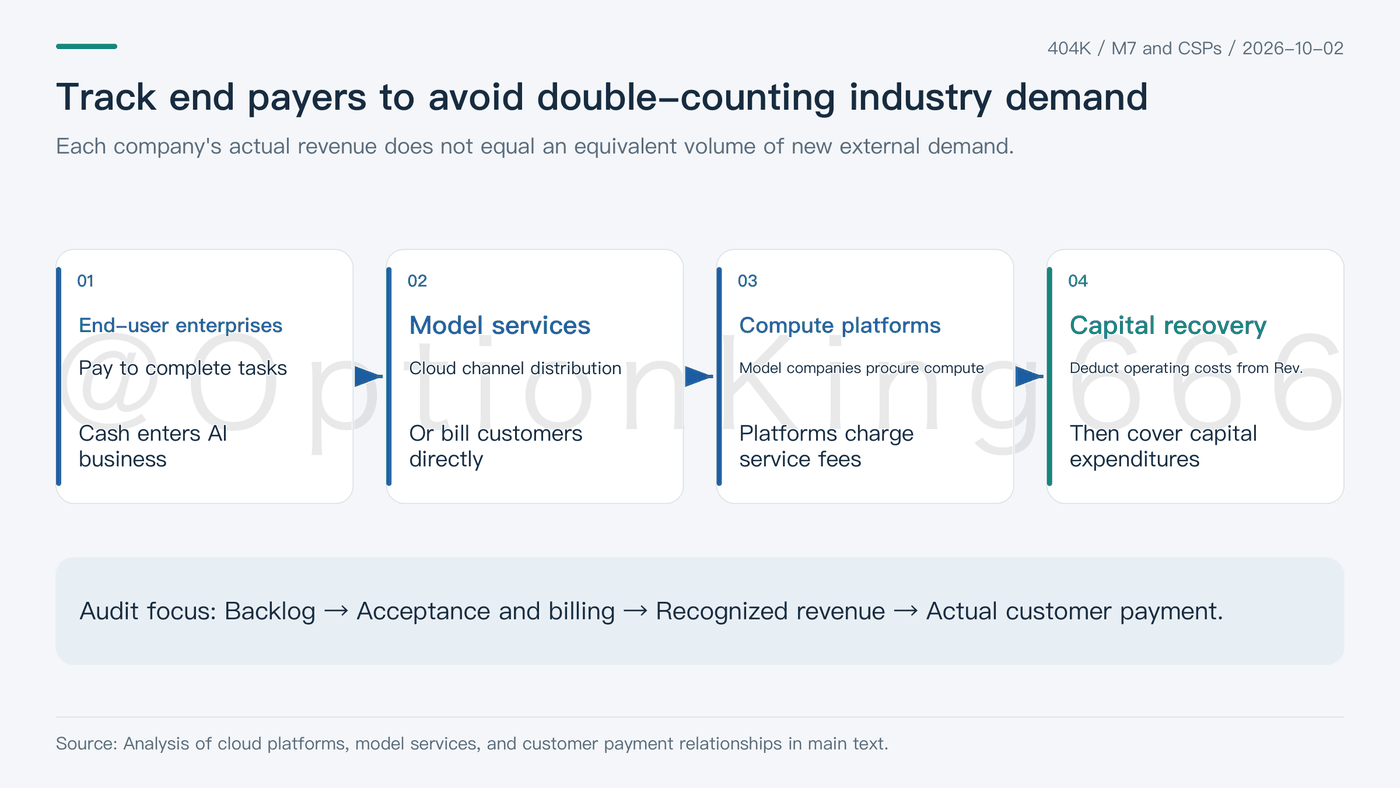
Assessing the true quality of AI revenue requires tracing cash back to the ultimate end-payer. While enterprise model consumption via cloud platforms and AI labs leasing compute from those same platforms represent legitimate standalone transactions, industry-wide ROI analysis must avoid double-counting circular revenue as organic external demand. The sole sustainable anchor for capital expenditure remains recurring cash flows from end enterprises and retail consumers, alongside the net operating margins those revenues yield.
The shift toward inference brings revenue closer to everyday operational expenditures. Every user prompt and agentic tool invocation continually consumes compute resources, shifting the demand profile away from episodic batch training. Nonetheless, surging token volumes often coincide with declining unit realization. While cheaper models catalyze broad adoption, they also compel cloud operators to maximize utilization to translate volume into margin. Highlighting gross token counts without disclosing per-task revenue and unit inference costs obscures underlying unit economics.
Contract backlogs must likewise be disaggregated. Backlog represents unearned contract commitments, Annualized Run-Rate (ARR) captures a point-in-time snapshot of scale, and recognized revenue is gated by actual delivery duration. Large clusters delivered near quarter-end can sharply inflate exit ARR while contributing negligible recognized revenue during the period. For capital-intensive cloud infrastructure operators, the only milestones that de-risk the balance sheet are formal acceptance testing, commencement of commercial billing, and cash collection.
Cloud Revenue and AI Capital Expenditures
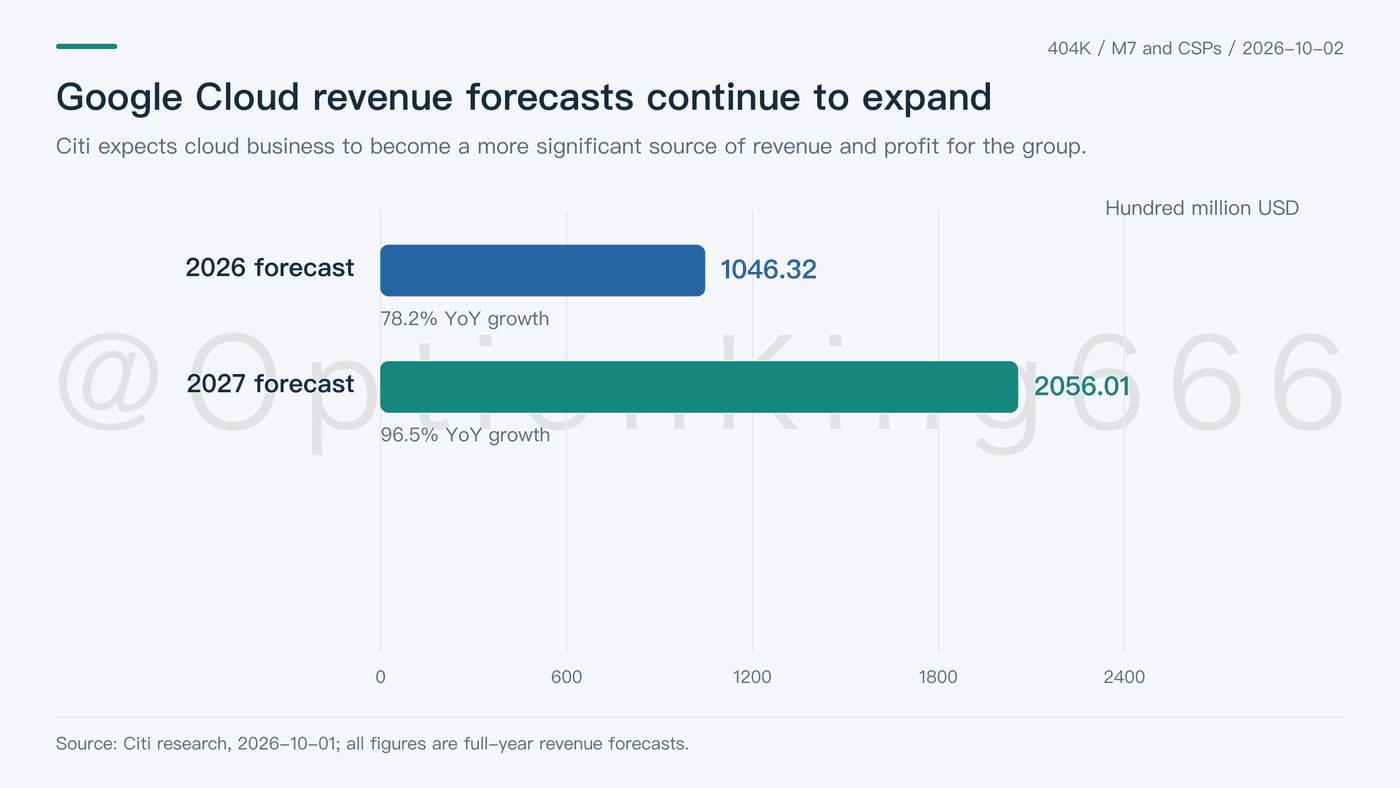
While Google has delivered robust evidence on the top line, its capital profile faces intensifying scrutiny. J.P. Morgan highlights that Google Cloud revenue surged 82% in Q2, accompanied by an expanding backlog, and projects accelerated growth in coming quarters. Citi links the resurgence of Gemini’s frontier model capabilities with dedicated TPU availability, forecasting that cloud will capture an expanding share of consolidated revenue. Both banks agree that cloud is emerging as a cornerstone of group-level top-line expansion; their disagreement centers on whether revenue trajectory can outpace the aggressive acceleration of capex and depreciation.
Google Cloud: Reported Results vs. Brokerage Projections
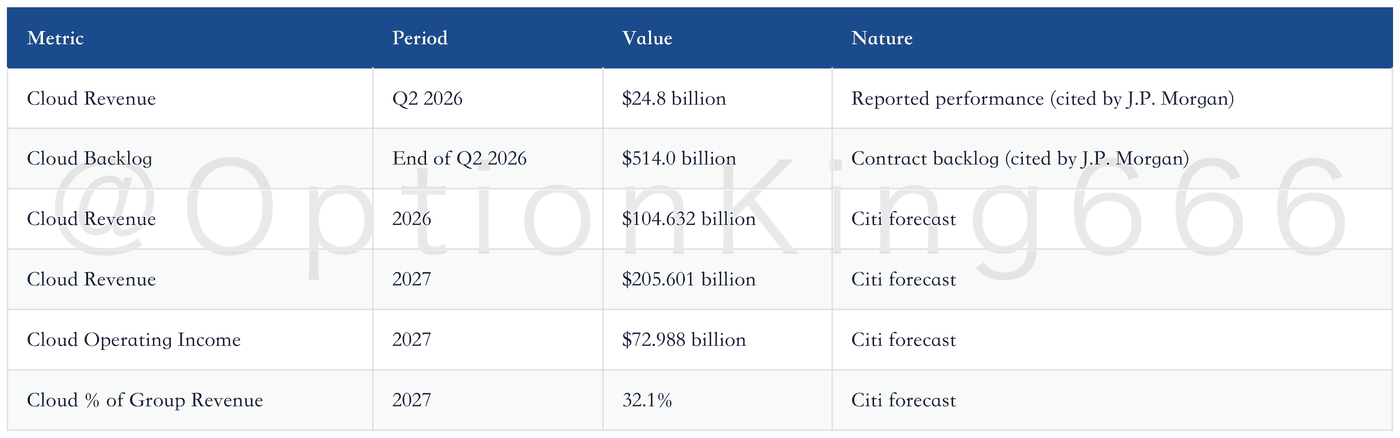
Citi’s projections imply that Alphabet's earnings narrative will increasingly hinge on cloud execution. Co-selling frontier models alongside custom silicon enhances customer acquisition and broadens the operational footprint of in-house TPU silicon. However, downside risks during this expansion include discounted pricing for enterprise capture, reliance on leased third-party compute, and escalating depreciation schedules. Even if cloud revenue hits aggressive targets, the ultimate margin contribution will depend on keeping these cost lines contained.
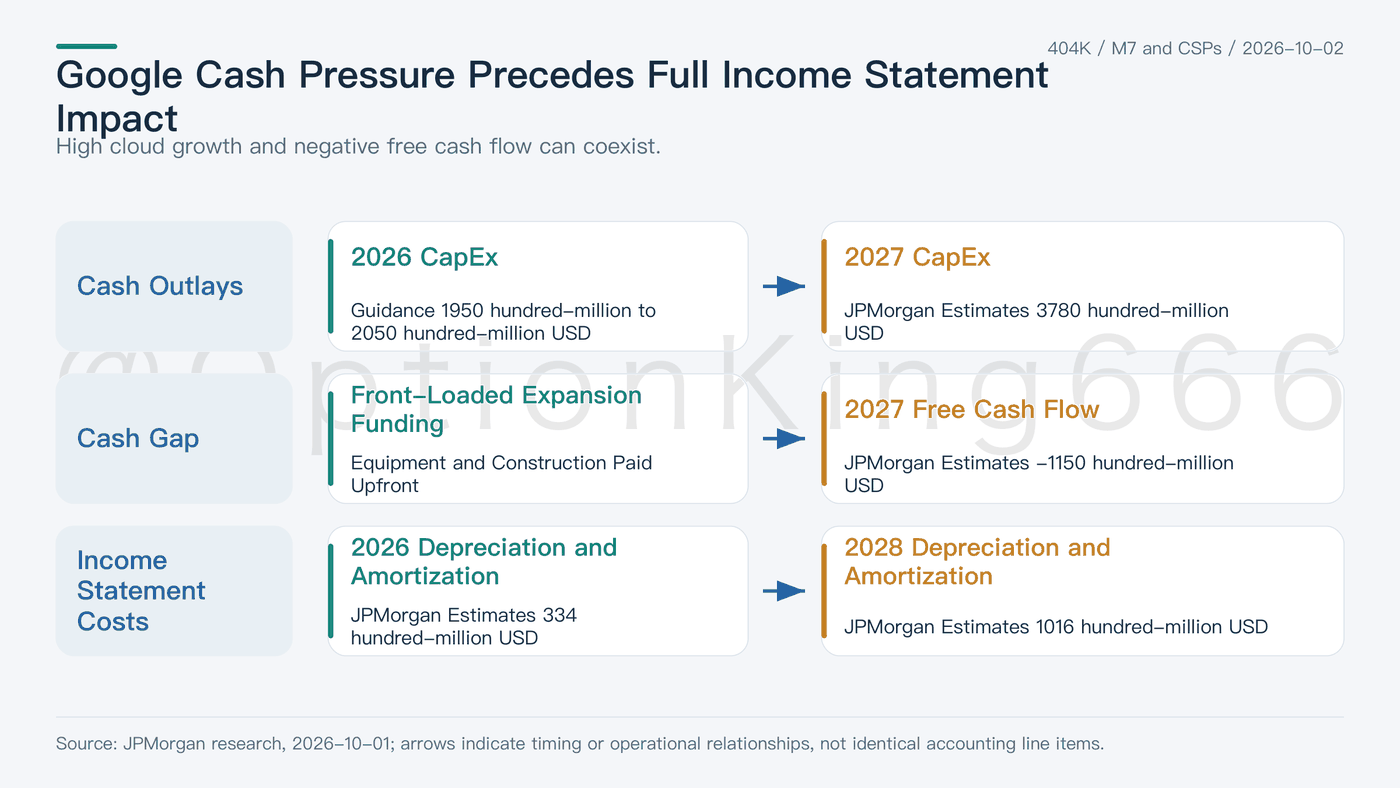
Accelerating cloud growth must not obscure Google’s looming cash flow deficit. J.P. Morgan projects a massive step-up in capex by 2027, turning consolidated free cash flow negative, followed by a steep climb in depreciation. This points to balance-sheet cash drain hitting first, with income-statement headwinds emerging in subsequent quarters. Regardless of structural enterprise demand, Google must navigate a significant working-capital gap between upfront capital deployment and deferred cash collection.
J.P. Morgan Projections for Google: Phased Cash Outlays and Depreciation Drag
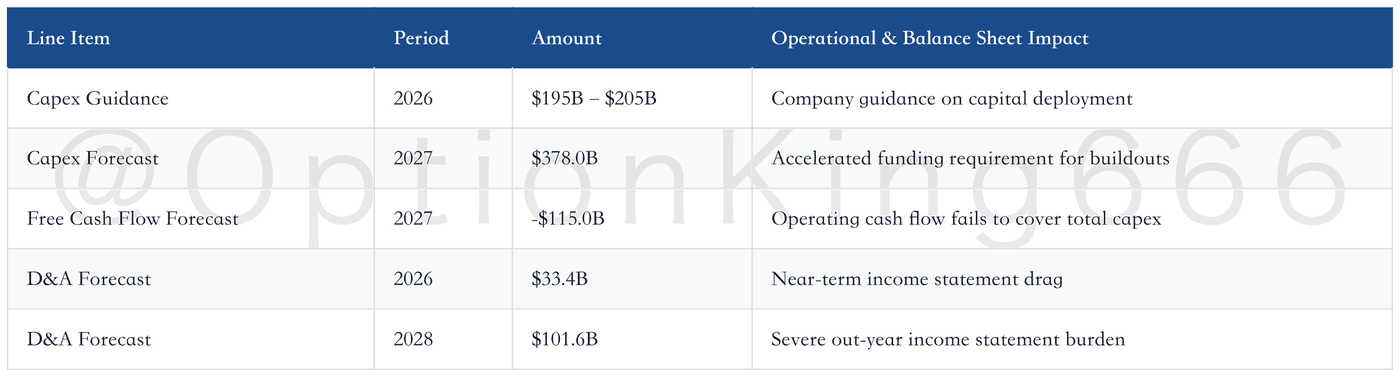
These capital burdens cannot simply be offset against high firmwide ROIC figures. Robust profitability in legacy core businesses and severe short-term cash burn in new infrastructure can coexist simultaneously. Investors should track when incremental revenue generated by newly commissioned clusters overtakes accelerating depreciation, as well as whether external compute procurement rises. If in-house datacenter delivery slips while contractual SLAs must be satisfied, leasing expensive third-party capacity will further erode incremental operating margins.
Microsoft's structural moat lies in its ability to monetize identical compute capacity across multiple layers of the software stack. J.P. Morgan notes that Microsoft utilizes a fungible, hybrid CPU-GPU compute pool serving both Azure infrastructure and Copilot applications, allowing high-margin software revenues to cushion heavy bare-metal capex. Internal reporting reclassifications—integrating GitHub and Security Copilot into Commercial Cloud while reporting Azure US dollar revenue separately—will provide clearer visibility into whether growth is driven by core IaaS or high-margin application layers.
Nonetheless, the downward trajectory of Microsoft Cloud ROIC represents a tangible economic cost. J.P. Morgan estimates that Cloud ROIC compressed from 54% in FY2024 to 37% in FY2026, before stabilizing at this lower plateau. Investors must recognize the reality of ROIC dilution induced by unprecedented capital intensity; maintaining an ROIC above the weighted average cost of capital does not mean capital intensification is cost-free.
