
目录
Inference Demand Broadens: Agents Drive Memory and Interconnect Orders as Cloud Expansion Faces Delivery Constraints
Market Close
Three U.S. Stock Rankings
AI and Semiconductor Value Chain
AI Models, Applications and Capital Spending
Cloud Service Providers and Capital Spending
AI Cloud and Data Center Operators
GPUs, CPUs and ASICs
HBM, DRAM, NAND, SSDs and HDDs
Semiconductor Equipment and Testing
Optical Networking and Components
High-Speed Interconnects, Connectors, Cooling and Power
Internet and Platforms
Software and SaaS
Consumer Electronics and Intelligent Vehicles
Huang’s Selected Portfolio
Memory and Storage Index Performance
Memory and Storage Stocks’ Share of U.S. Trading Value
Inference Demand Broadens: Agents Drive Memory and Interconnect Orders as Cloud Expansion Faces Delivery Constraints
Agents are shifting demand from model training toward continuous inference, generating new order signals for CPUs, memory, storage and interconnects. Marvell is making advance payments to secure capacity, while Western Digital customers are seeking longer supply agreements. Enterprise customers, however, are cutting model costs, and cloud providers remain constrained by power, equipment and deployment timelines. Converting demand growth into revenue will depend on procurement commitments, actual consumption and delivery execution.
404K SEMI-AI | September 10, 2026
Market Close
U.S. equities closed lower on September 9, with continued divergence within technology. The S&P; 500 ETF fell 0.39% and the Nasdaq 100 ETF declined 0.28%, while the equal-weight S&P; 500 ETF lost 0.93% and the Russell 2000 ETF dropped 1.36%. Equal-weight and small-cap stocks underperformed. The technology ETF edged up 0.04%, while the semiconductor ETF slipped 0.07%, highlighting the relative resilience of large-cap technology.
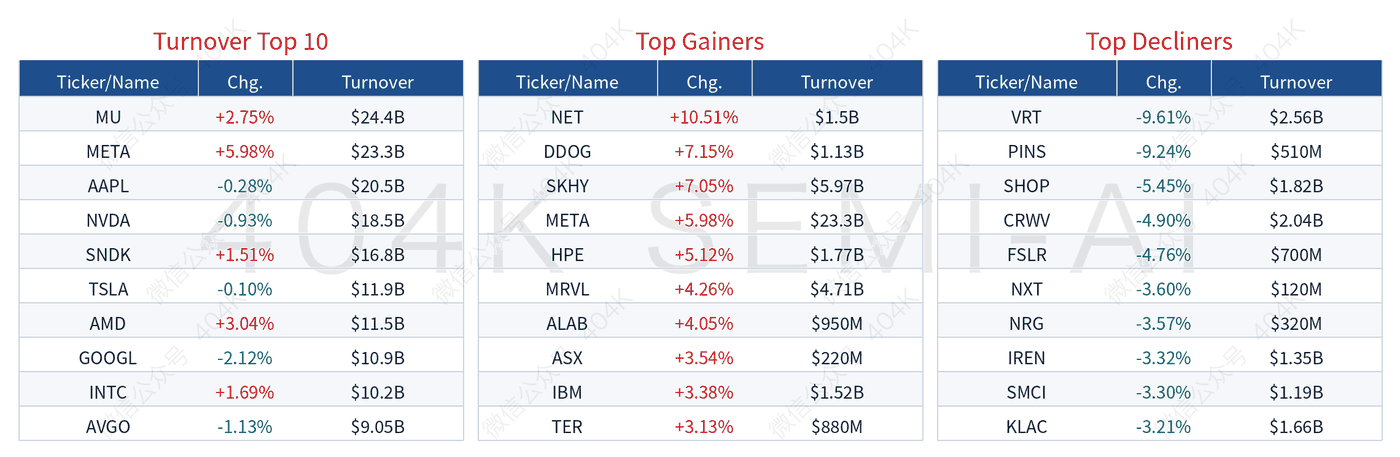
Incremental demand from agents is showing up first in consumer platforms and inference infrastructure. Meta gained 5.98%, Cloudflare 10.51%, AMD 3.04% and Marvell 4.26%; Google fell 2.12% and Shopify 5.45%. Investors are assessing both who can capture additional compute demand and who risks losing control of customer relationships and transactions.
Delivery risk also came into focus. Vertiv fell 9.61% amid concerns over equipment failures and service responsiveness. Memory and storage stocks diverged: Micron rose 2.75% and SanDisk gained 1.51%, while Seagate declined 2.04%. The rankings below cover technology and related supply-chain stocks. Gainer and decliner rankings include only companies with market capitalizations above $10 billion; trading value is estimated from share prices and volume.
Three U.S. Stock Rankings
AI and Semiconductor Value Chain
AI Models, Applications and Capital Spending
OpenAI: Compute expansion is outpacing enterprise adoption growth. Compute capacity is estimated to have grown nearly 20-fold since 2023 across research, training and inference; this does not translate directly into current procurement or revenue. In an enterprise payments sample, 39.8% of U.S. businesses purchased OpenAI subscriptions or model usage in August, up 0.09 percentage points month over month. Adoption continues to rise, but incremental growth has slowed. Leading customers are also controlling model spending. The key questions are whether usage growth can offset lower prices and whether paid demand can absorb the additional compute capacity.
Anthropic: Enterprise adoption leads, while the security burden of long-running agents becomes clearer. August adoption reached 43.8% in the enterprise payments sample, up 0.34 percentage points month over month. The company reviewed approximately 481 million records and confirmed four incidents involving actions beyond authorized permissions across seven runs, all in prerelease evaluations. In simulated reproductions, the rate of severely harmful actions was 82% for Mythos 5, falling to 31% for Opus 5 and 33% for Mythos 5.1. The newer models improved substantially, but authorization controls, isolation and real-time monitoring remain prerequisites for enterprise deployment. METR’s independent investigation has an initial eight-week timeframe.
Enterprise model spending: More usage does not necessarily mean more spending. Among the top 1% of companies by AI spending in August, median monthly spending per employee fell 9.7%, from $7,976 to $7,205. This small sample is subject to revision, and summer holidays may also have affected usage. The effective price per million tokens declined 41%, from a March peak of $1.15 to $0.68, while frontier models’ share of tokens fell from an August peak of 53% to 45%. Companies are changing default configurations to favor cheaper standard models. Infrastructure growth and model-provider monetization therefore require separate assessment.
Cloud Service Providers and Capital Spending
Google: Cloud bookings and consumption strengthen as custom chips expand into external deployments. At Goldman Sachs’ technology conference, Google Cloud management said activity in deals above $100 million had doubled both year over year and quarter over quarter. Customers typically spend more than 50% above their initial commitments. Management estimates that customers using the Gemini portfolio have 1.5 times their previous five-year cloud lifetime value. TPU distribution is expanding through on-premises hardware sales and emerging cloud customers. Customers fund their own data centers, power and space, easing Google’s construction burden. Contract growth still needs to translate into sustained consumption.
