
目录
Market Close
U.S. Stocks Reaching New Highs
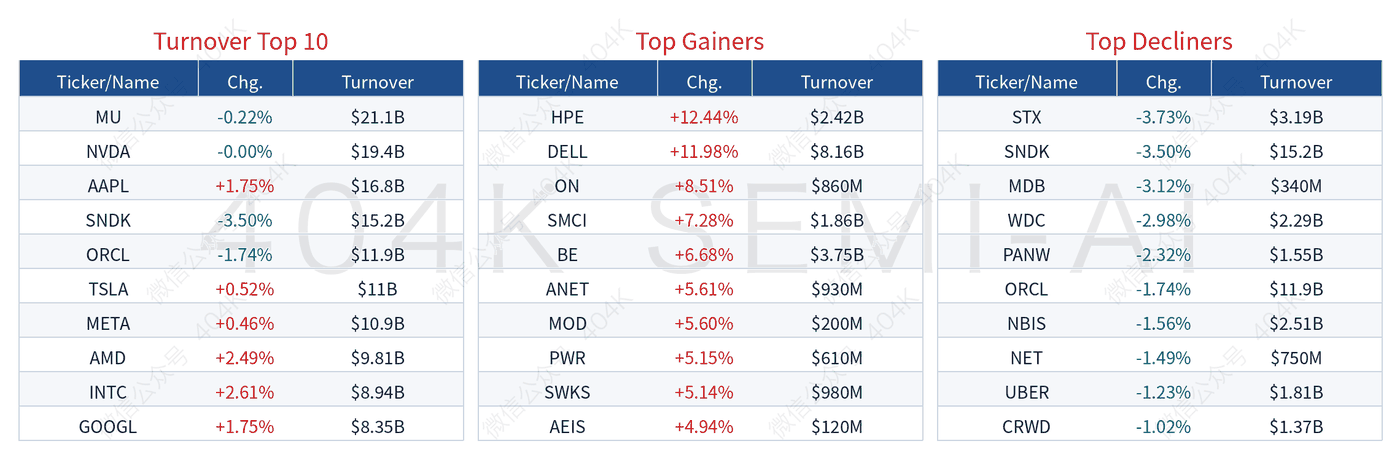
Three U.S. Stock Rankings
AI and Semiconductor Supply Chain
AI Models, Applications, and Capital Spending
Hyperscalers and Cloud Capital Spending
AI Cloud and Data-Center Operators
GPUs, CPUs, and ASICs
HBM, DRAM, NAND, SSDs, and HDDs
Foundries and Advanced Packaging
Optical Communications and Components
High-Speed Interconnects, Servers, Cooling, and Power
Internet and Platforms
Software and SaaS
Consumer Electronics and Smart Vehicles
Huang’s Selected Portfolio
Memory and Storage Index Performance
Memory and Storage Share of U.S. Equity Trading Value
AI infrastructure is entering the delivery phase, but revenue growth and cash recovery remain distinct milestones. Oracle delivered 850 MW in a single quarter, interconnect chips are moving toward rack-scale switching, and optical-component competition is shifting toward volume production and reliability. In software, investors must distinguish user growth, paid conversion, and operational capabilities that are genuinely difficult to replace.
404K SEMI-AI | September 12, 2026
Market Close
U.S. equities closed higher on September 11: the S&P; 500 ETF gained 0.88%, the Nasdaq-100 ETF 0.89%, the equal-weight S&P; 500 ETF 0.89%, and the Russell 2000 ETF 0.41%. Technology and semiconductor ETFs rose 1.35% and 1.34%, respectively. The rebound extended across both capitalization-weighted and equal-weight indices, but the Nasdaq-100 ETF remained down 2.34% over the past 20 trading sessions. One day’s recovery did not erase the earlier drawdown.
Servers outperformed storage as the AI supply chain continued to diverge. Hewlett Packard Enterprise rose 12.44%, while Dell gained 11.98% to a 52-week high. Seagate, SanDisk, and Western Digital fell 3.73%, 3.50%, and 2.98%, respectively. Oracle declined 1.74%. Deliveries and order growth can generate revenue, but capital spending, customer prepayments, and subsequent cash recovery remain central to assessing the quality of expansion.
Interconnect upgrades and software pricing power were two other key themes. Switches are becoming a larger revenue contributor for Astera Labs, while optical-component suppliers must demonstrate that capacity additions can translate into shipments on schedule. Adobe’s growth in AI users and revenue has yet to prevent a slowdown in net new recurring revenue. The rankings below cover technology-related stocks; gainers and losers are limited to companies with market capitalizations above $10 billion. Trading value is estimated using closing prices and volume.
U.S. Stocks Reaching New Highs

Three U.S. Stock Rankings
AI and Semiconductor Supply Chain
AI Models, Applications, and Capital Spending
OpenAI: Frontier research is beginning to face more explicit safety constraints. The company reportedly told employees it may slow frontier AI development and could coordinate with other major laboratories. These arrangements remain under discussion. On enterprise adoption, industry interviews suggest that accessing frontier models through major cloud platforms makes it easier to meet existing security and data-privacy review requirements, although large-scale agent deployments remain at an early stage. Model progress and enterprise production readiness may advance at different speeds.
Anthropic: Enterprise distribution and application partnerships are expanding. The company reportedly deepened its Salesforce partnership with the launch of Claudeforce. Industry interviews also noted that access to frontier models such as Claude through major cloud platforms reduces the burden of training models and deploying and maintaining clusters internally. Usage-based pricing retains a cost advantage for enterprises below exceptionally high usage levels. The key questions are how many agent pilots enter production and whether incremental usage generates sustained payments.
Hyperscalers and Cloud Capital Spending
Google
AI infrastructure investment is extending into power delivery and cooling. The OCP APAC conference discussed 800V DC power, the Project Deschutes coolant distribution system, and Project Brazos liquid-cooling sidecars. Large-scale adoption of native 800V systems is expected in 2028.
TPU competitiveness ultimately depends on total deployment cost. Inference comparisons change depending on whether multi-token prediction and disaggregated inference are enabled, and whether the comparison covers a chassis or an entire rack. Tests on a single model cannot substitute for validation against an enterprise’s own workloads.
Amazon
Trainium platform upgrades are reshaping interconnect suppliers’ revenue mix. Supply-chain analysis indicates that Trainium 3 Ultra uses Astera Labs’ Scorpio X switches, with 160-lane and 320-lane versions serving different cluster sizes.
Trainium 4 may subsequently move to NVLink Fusion, potentially changing demand for PCIe switches. Multiprotocol I/O chiplets could create a new supply opportunity. Investors need to assess both the current product ramp and the next architectural transition rather than simply extrapolating today’s content per system.
Microsoft
Planned expansion remains substantial relative to the installed base. The company reportedly intends to increase global data-center capacity from approximately 12 GW to more than 38 GW by 2032, with AI-dedicated capacity rising from roughly 2 GW to about one-third of the total. These plans still require construction and energization.
Capacity constraints have reportedly already forced Microsoft to turn away some AI and cloud business. At OCP, the company also discussed solid-state transformers and advanced cooling. Order opportunities become revenue only when power connections and infrastructure are delivered.
