
目录
Market Recap
US Equities: 52-Week Highs
US Equities: Market Leaderboards
AI & Semiconductor Value Chain
AI Models, Applications & CapEx
Hyperscalers, Cloud CapEx, AI Cloud & Datacenter Operators
GPU, CPU, ASIC, Semiconductor Capital Equipment & Advanced Packaging
Memory (HBM, DRAM, NAND, SSD, HDD) & Optical Interconnects
Internet / Platforms
Software / SaaS
Consumer Electronics / Smart Vehicles
Jensen's Selected Portfolio
Memory Index Trend
US Memory Turnover Share
Overview
404K SEMI-AI | 2026-09-04
Market Recap
On September 3, US equity risk appetite rebounded, with the S&P; 500 rising 0.95%, the Nasdaq 100 up 1.07%, the S&P; 500 Equal Weight Index gaining 0.77%, and the Russell 2000 adding 0.32%. While the technology sector rose 1.23%, the semiconductor ETF gained just 0.45%, indicating that broader index strength failed to alleviate valuation and execution pressures within hardware.
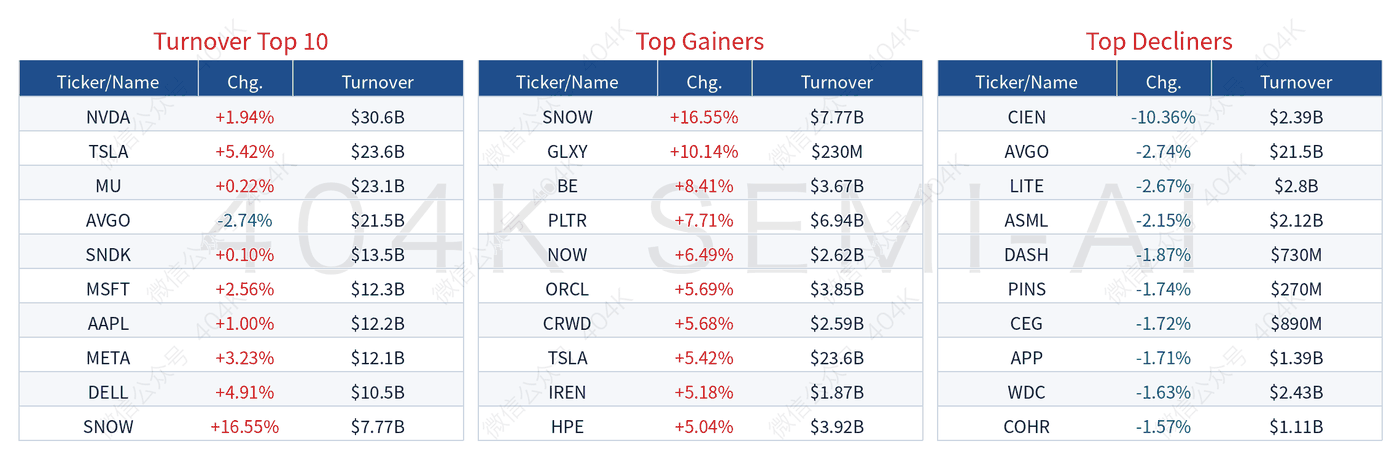
Dispersion in performance was more telling than headline index direction. Snowflake surged 16.55% to a new 52-week high, leading widespread strength across software and cloud platforms, while Broadcom fell 2.74% and Ciena plunged 10.36%. The market is actively pricing each component—order books, revenue acceleration, and margin profiles—making forward demand alone insufficient to support multiples.
At the industry level, two opposing forces remain in tension: frontier AI labs and hyperscalers continue channeling capital into compute, while supply constraints across HBM, substrates, optical components, and datacenter land/power throttle physical delivery. Meanwhile, rising memory prices are beginning to filter into smartphones and enterprise hardware. Key catalysts to watch are whether demand translates into timely shipments and whether software revenue acceleration can outpace AI inference costs.
US Equities: 52-Week Highs

US Equities: Market Leaderboards
AI & Semiconductor Value Chain
AI Models, Applications & CapEx
Anthropic: Enterprise revenue is highly concentrated, with the top 1% of customers contributing ~80% of enterprise revenue. While usage-based pricing decouples customer billing from employee seat limits, these large accounts possess substantial bargaining power and can easily shift workloads to cheaper alternative models upon renewal—amplifying both revenue growth and customer concentration risk in tandem. Going forward, the critical metric will be whether top-account usage and net retention rates (NRR) can continue to expand.
“A company running 10,000 coding agents 24/7 pays like a company with 10,000 engineers.”
Zhipu AI
1) 1H MaaS and API revenue reached RMB 825 million, accounting for 86.5% of total revenue (up from 15.2% a year prior), while overall revenue surged nearly 400% YoY over the same period.
2) API gross margin inflected from -0.4% to 24.6%, while on-premise private deployment revenue fell from RMB 148 million to RMB 67 million. Although revenue has begun scaling with token consumption, 1H net loss still stood at RMB 2.07 billion.
“API revenue is usage-based and recurring: the same model can serve thousands of customers simultaneously, with revenue scaling alongside token volume rather than headcount.”
Thinking Machines: The company is reportedly in talks to raise over $1 billion at a valuation of approximately $40 billion, with Accel intending to lead the round and Nvidia considering participation. This valuation comes in below the >$50 billion discussed late last year. Following the release of its flagship model Inkling, the company has generated hundreds of millions of dollars in annualized revenue, indicating that its funding valuation is now being benchmarked against real commercial execution.
vLLM: To solve the bottleneck of multi-turn agents repeatedly reading conversational history, the team optimized the architecture to store shared prefixes only once, write only incremental delta content in each turn, and improve cross-node state handoffs. Replaying real-world agent traffic helped boost Kimi's high-concurrency throughput by more than 6x in two weeks, demonstrating that inference software optimizations can still substantially increase existing GPU utilization.
“Offloading this cache outside the GPU was highly wasteful: every agent kept its own copy, and every turn resaved everything from scratch. Now, each shared prefix is saved only once, with only newly generated content appended in each turn.”
Apodex: The TRACES benchmark evaluates not only final answers but also tool usage, error correction, alternatives explored, coherence, grounding evidence, and scope, using hidden verifiers for independent outcome auditing. Scientific reasoning benchmarks are shifting from monolithic scalar scores to diagnostic process evaluations. Its long-term utility hinges on identifying reproducible, actionable failure modes in long-horizon workflows, while enterprise adoption will depend on how reliably the benchmark correlates with real-world task performance.
“TRACES does not merely score the final answer; it evaluates the entire AI problem-solving trajectory, including tool use, error correction, evidence, and reasoning steps.”
