
Contents
Market Wrap
US Equities: New 52-Week Highs
US Market Triptych
AI & Semiconductor Value Chain
Frontier Models, AI Applications & Capex
Hyperscalers & Cloud Capex
AI Cloud & Data Center Operators
GPU / CPU / ASIC
Memory & Storage (HBM/DRAM/NAND/SSD/HDD)
Foundry
Semiconductor Equipment & Test
Optical Communications, Optical Supply Chain & High-Speed Interconnect
Internet & Platforms
Software & SaaS
Consumer Electronics & Smart Mobility
Huang's Curated Portfolio
Memory Index Trend
US Memory Turnover Share
AI agents are expanding hardware requirements beyond model computation to task execution, network access, and data movement. CPUs and interconnects outperformed, while new optical communication products began addressing power consumption, packaging, and testing in tandem. On the platform side, competition intensified around shopping entry points. Ultimately, delivery cadence, financing costs, and sustained willingness to pay will dictate how effectively growing demand converts into bottom-line profits.
404K SEMI-AI | 2026-09-22
Market Wrap
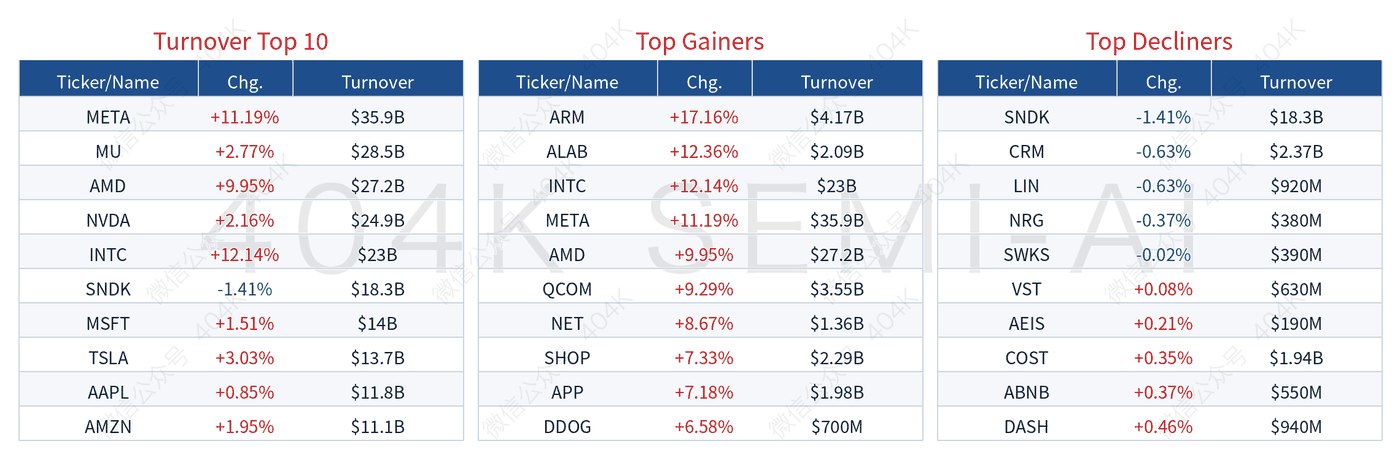
At the close on September 21, the Nasdaq 100 ETF gained 2.77%, the S&P; 500 ETF rose 1.52%, while the S&P; 500 Equal Weight ETF edged up just 0.24%. Mega-cap tech heavily outperformed, driving headline index gains that masked more muted performance across the broader market. The Semiconductor ETF climbed 4.03%, Communication Services rose 3.37%, and Technology gained 2.72%, with strength concentrated across tech and telecom/communication supply chains.
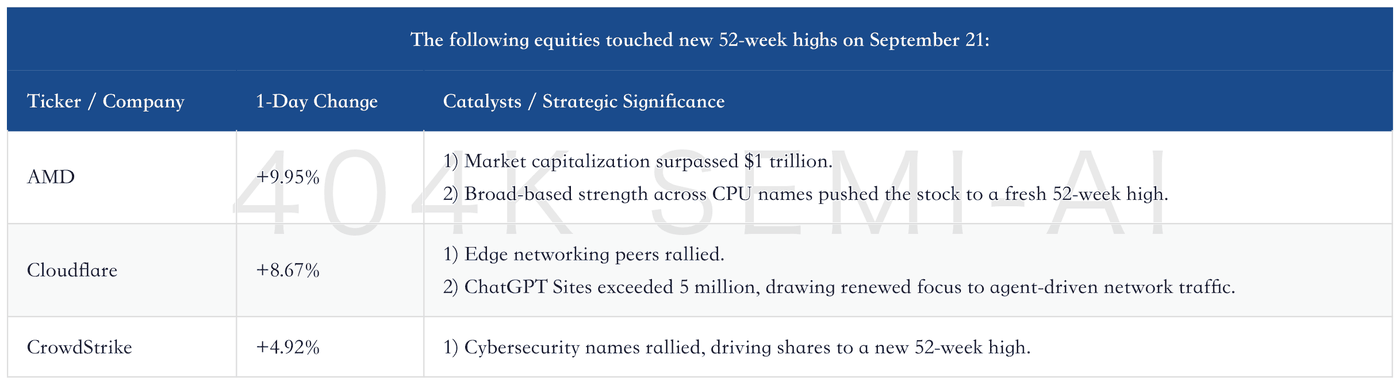
CPUs emerged as the standout trade: Arm jumped 17.16%, Intel surged 12.14%, and AMD climbed 9.95%, while Meta rallied 11.19%. Rapid user adoption of Meta's Muse prompted markets to re-evaluate the server capacity required for AI agents to run headless browsers, invoke external tools, and execute continuous workflows. In software, Cloudflare rose 8.67% and Datadog gained 6.58%, as network traffic and cloud usage plays strengthened in tandem.
Incremental industry demand is shifting toward task execution and system interconnects. At the ECOC conference, showcases centered on external laser sources (ELS), chip-to-chip optical interconnects, and co-packaged electro-optical testing. Memory pricing remained tight, though SanDisk slipped 1.41% and Micron gained 2.77%, lagging the sharp rally in CPUs. Whether agent adoption generates sustained paying demand and whether hardware can be delivered on schedule remain the critical dividing lines between product hype and bottom-line earnings realization.
US Equities: New 52-Week Highs
US Market Triptych
AI & Semiconductor Value Chain
Frontier Models, AI Applications & Capex
OpenAI
1) Commercial expansion is scaling alongside cash burn. Reports indicate its advertising business reached a $1 billion run-rate within seven months. In parallel, OpenAI is developing lower-cost custom inference silicon alongside its Luna product line to counter pricing pressure from open-weight models.
2) Projected 2026–2030 cumulative cash shortfall reaches $278 billion, against $856 billion in compute and infrastructure outlays over the same period, according to reported forecasts. Its $122 billion funding round closed in March could be depleted by 2028.
3) Revenue growth remains insufficient to self-fund planned buildouts. Monetization velocity from ads and inference products, follow-on capital raises, and compute contract fulfillment must be evaluated holistically, with a focus on when expenditure blueprints translate into committed purchase orders.
Anthropic
1) Safety evaluation scales alongside compute expansion. Reports indicate Anthropic plans to engage Accenture for safety red-teaming under a commitment of at least $1 billion. The company is reportedly targeting an IPO as early as November to raise up to $100 billion, though plans remain preliminary.
2) J.P. Morgan reports Anthropic has committed to securing an additional 15 GW of power over coming years, with estimated spending across leased cloud capacity, chips, and data centers nearing $500 billion.
3) Execution cadence and enterprise monetization remain core bottlenecks. J.P. Morgan cautions that 30% to 50% of mega-datacenter capacity slated for 2026 could face delays; contracting resources does not equate to immediate, operational compute.
"Our immediate concern is not that data center capacity growth outstrips compute demand, but rather that hyperscalers fail to build the necessary capacity to drive sufficient model improvements that incentivize enterprise spending."
Hyperscalers & Cloud Capex
Microsoft
1) Enterprise backlog provides foundational demand outside frontier AI labs. Goldman Sachs relayed management commentary noting Q4 remaining performance obligations (RPO) grew by $51 billion quarter-over-quarter, driven entirely by non-frontier lab enterprise customers. This metric helps distinguish organic corporate cloud adoption from concentrated mega-deals signed by a few AI labs.
2) Capacity expansion blends first-party builds, leases, and third-party compute rentals. Discussion around supply bottlenecks continues to focus on physical whitespace for chip deployment. Converting surging backlogs into recognized revenue depends on data hall delivery schedules and deployment velocity, as a distinct lead time separates bookings from fulfillment.
Google
1) Infrastructure power strategy extends into nuclear energy. Reports indicate Kairos Power selected Samsung C&T; to construct its 50 MW Hermes 2 reactor in Tennessee, securing up to $100 million in equity investment and engineering support.
2) Slated for commercial operation by 2030, the project's output will count toward Kairos's agreement with Google to supply approximately 500 MW of nuclear power through 2035. While nuclear deals de-risk long-term power availability, the 2030 timeline underscores the substantial multi-year gap between atomic power roadmaps and near-term data hall energization.
Meta
1) Subsea interconnect footprint expands. On September 21, Meta unveiled the Petal subsea cable project—a ~7,000 km transatlantic system targeting 1 Pb/s transmission capacity. NEC and Sumitomo Electric are partnering on construction and cable manufacturing, with Orange providing landing facilities in France.
2) The project plans to deploy multicore fiber (MCF) across full transoceanic distances, joining Meta's portfolio of over 20 global subsea cable investments. As MCF transitions from discrete optical components to end-to-end transoceanic systems, execution milestones shift to long-haul transmission fidelity, manufacturing uniformity, and landing station engineering.
Amazon
1) Proprietary silicon ramp drives higher rack-level cable density. Mizuho notes that as Trainium 3 enters volume production, associated cabling counts will surge ~50% compared to the prior generation, directly boosting shipment volumes for interconnect suppliers alongside silicon demand.
2) Grid interconnection faces local friction. Reports indicate industrial power consumers in Indiana challenged congestion pricing analyses related to 2,800 MW of planned Amazon data center load. Silicon roadmaps must advance in lockstep with utility infrastructure, as grid interconnection timelines dictate when deployed chips can actually be energized.
