
目录
Market Close
U.S. Stock Rankings: Trading Value, Gainers and Losers
AI and Semiconductor Supply Chain
AI Models, Applications and Capital Spending
Hyperscalers and Cloud Capital Spending
AI Cloud and Data Center Operators
GPUs, CPUs and ASICs
HBM, DRAM, NAND, SSDs and HDDs
Foundries, Optical Communications and Optics
Semiconductor Equipment and Testing
Servers, High-Speed Interconnects, Power and Cooling
Internet and Platforms
Software and SaaS
Consumer Electronics and Intelligent Vehicles
Huang’s Select Portfolio
Storage Index Performance
U.S. Memory and Storage Stocks’ Share of Trading Value
AI demand continues to translate into revenue, making deployment speed and cash consumption critical measures of expansion quality. Oracle’s cloud infrastructure revenue grew 121% year over year, but free cash flow remained negative. Shortages of power, memory and high-power optical sources will determine how quickly subsequent orders become revenue. Software shows a similar divergence: rapid AI product growth is not necessarily accelerating company-wide revenue.
404K SEMI-AI | September 11, 2026
Market Close
At the September 10 U.S. close, ETFs tracking the S&P; 500 and Nasdaq 100 fell 0.60% and 1.06%, respectively, while the equal-weight S&P; 500 declined 0.68%. Technology fell 1.41% and the semiconductor ETF lost 2.44%, while communication services gained 0.60%. Selling was concentrated in technology hardware, with divergent performance across platforms and consumer devices.
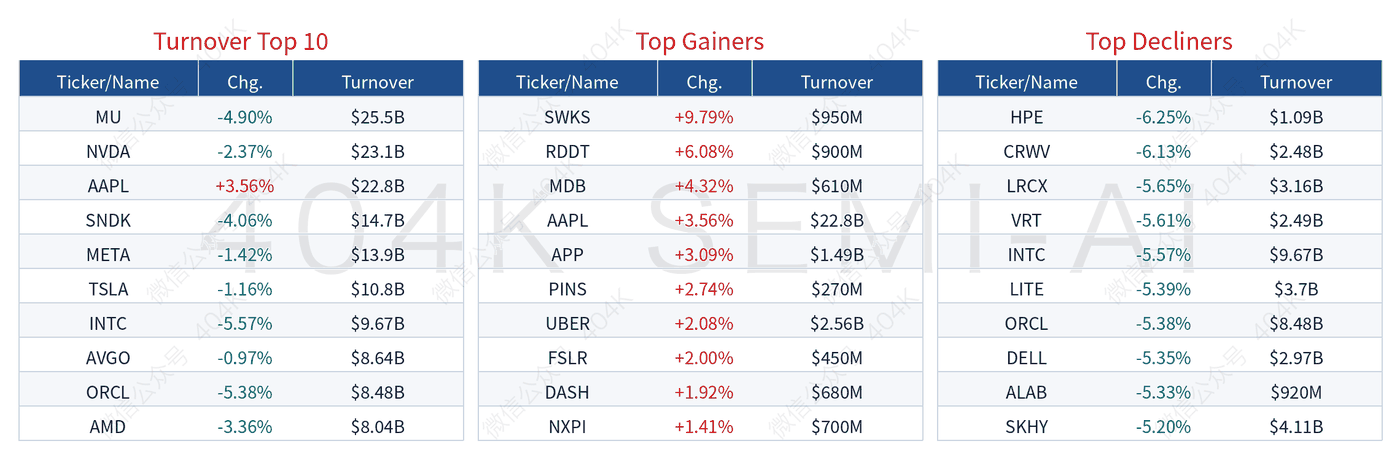
Nvidia fell 2.37%, Micron 4.90% and HPE 6.25%, while Apple rose 3.56% and Reddit gained 6.08%. The crude oil ETF climbed 5.61% and the long-duration Treasury ETF fell 1.16%, adding macro pressure on growth stocks. The software ETF declined 0.62%, outperforming semiconductors as strong hardware orders coincided with falling share prices.
Oracle delivered the most significant earnings update: 850 MW of new capacity and 121% year-over-year growth in cloud infrastructure revenue. In applications, Adobe’s AI-native annual recurring revenue grew more than 150%, yet overall growth slowed. Demand growth is evident; the next tests are timely data center delivery, narrowing cash outflows and AI features that lift growth across the business.
The following trading-value and performance rankings cover technology and the AI supply chain. Gainer and loser rankings are limited to companies with market capitalizations above $10 billion.
U.S. Stock Rankings: Trading Value, Gainers and Losers
AI and Semiconductor Supply Chain
AI Models, Applications and Capital Spending
OpenAI: Model improvements are increasingly being delivered alongside enterprise execution tools.
GPT-6 Astra (GPT6) has launched, scoring 57.9% on Terminal-Bench 4.0. API pricing starts at $10 per million input tokens and $50 per million output tokens. Enterprise access is initially disabled by default and must be enabled by an administrator.
Agents API has entered public beta, separating the runtime framework from the sandbox. Pricing is based on tokens and tools, with no additional platform fee. SafetyKit reduced cost per case by 60%, while Hypha reduced response failures by 86%.
The GPT-Live-1 (LIVE1) front-end voice layer costs $0.05 per minute and can delegate complex reasoning to a back-end model. Long-running task reliability, permission management and actual usage costs remain constraints on adoption.
“In ChatGPT Work and Codex, it can write code and directly operate the applications people use every day, even when those applications have no API.”
Hyperscalers and Cloud Capital Spending
Google: External TPU sales make the commercial opportunity for its proprietary chips more tangible, although the figures remain analyst estimates.
Oppenheimer projects cumulative external TPU sales of approximately 6.6 GW through 2028, worth roughly $170 billion. It estimates annual revenue of approximately $19 billion in 2026, $50 billion in 2027 and $101 billion in 2028.
Google is also securing power in advance. Supply-chain reports cite 930 MW of aeroderivative gas turbines, 900 MW of fuel cells and more than 1 GW of Mitsubishi J-class turbines. External chip sales, power-equipment procurement and operational capacity require separate tracking; procurement plans do not constitute revenue.
Microsoft: Expansion plans extend the power-delivery challenge well into the next decade.
The company reportedly plans to increase data center capacity from 12 GW to 38 GW by 2032.
Supply-chain sources report more than 5 GW of behind-the-meter power projects, including a 2.7 GW Chevron project and more than 2 GW with Crusoe. On-site generation can reduce dependence on public-grid expansion, but gas transportation, generation equipment and construction each have their own lead times. Meeting capacity targets depends on this infrastructure being ready alongside the data centers.
AI Cloud and Data Center Operators
Oracle: Backlog is converting into revenue, while expansion continues to consume cash.
Fiscal Q1 2027 revenue was $19.35 billion and adjusted EPS was $1.92. Cloud infrastructure revenue reached $7.4 billion, up 121% year over year; cloud applications revenue was $4.2 billion, up 10%.
Oracle delivered 850 MW of new capacity and more than 300,000 GPUs, signed over $30 billion of new AI cloud contracts and reported $664 billion in remaining performance obligations.
Capital expenditure was $28.5 billion and free cash flow was negative $5.4 billion. The company has raised $20 billion through an equity issuance program. Full-year revenue guidance is at least $90 billion, with next-quarter cloud revenue growth of 64%–70% in constant currency. Backlog conversion must be assessed alongside financing costs.
DigitalOcean: Inference is generating more revenue per unit of capacity, with further utilization gains targeted.
Management reported Q2 ARR of $22 million per MW, above its cited benchmark of $9 million–$10 million for the installed neocloud base, with incremental economics 30%–40% better.
Token-serving utilization is approximately 60%; time-zone routing and overnight batch processing are intended to lift it to 70%–80%.
The inference engine has more than 6,000 customers, 99% acquired through product-led channels. DigitalOcean has also joined the Agents API sandbox partner ecosystem. Customer additions need to sustain higher utilization so that equipment expansion does not outpace paid usage.
