
目录
This Week’s Assessment
Cloud Revenue and AI Capital Expenditure
Data Centers, Compute Procurement, and Proprietary Chips
Models, Software, and Application Monetization
Divergence Across M7 and Neocloud Providers
Debates, Counterevidence, and Next Week’s Priorities
Cloud compute demand is converting into revenue, but expansion still faces two constraints: power and funding. Oracle is accelerating delivery, Google is pursuing external chip sales, and Amazon is deepening custom procurement partnerships. Investors should focus on who can deliver on time, retain customers, and collect cash. Customer funding can ease the burden, but it does not establish profitability.
This Week’s Assessment
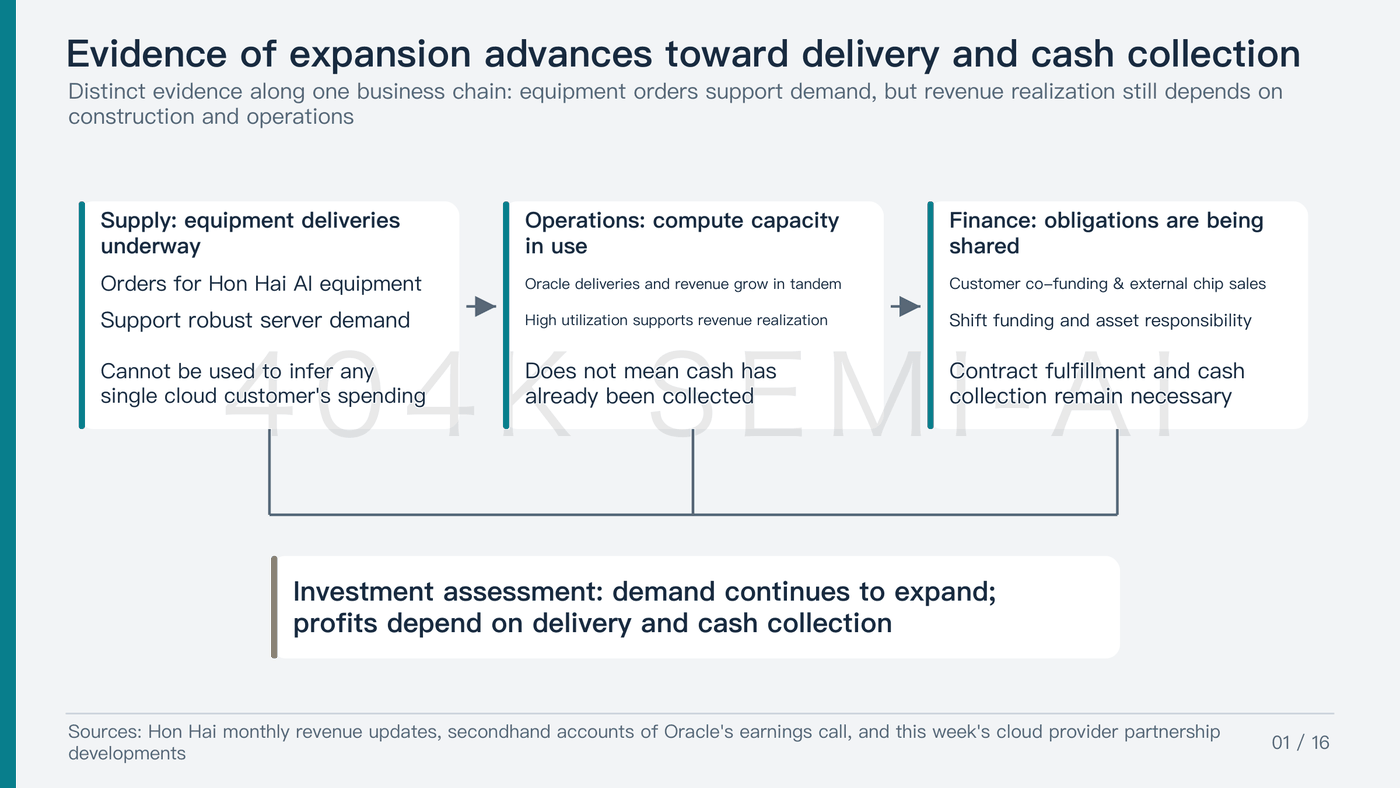
The strongest development this week was evidence of both compute delivery and a broader sharing of funding responsibilities. From September 7–11, server shipments, cloud operating updates, chip partnerships, and enterprise agent deployments formed a connected business chain. Oracle’s cloud infrastructure revenue grew alongside new capacity; Google discussed selling its proprietary tensor processing units (TPUs) outside its own cloud; and Amazon tied a long-term chip partnership to procurement incentives. Demand can increasingly be assessed through operating activity rather than planned data centers.
Oracle provides the clearest view of delivery this week. In fiscal Q1 2027, covering June–August 2026, cloud infrastructure revenue reached $7.4 billion, up 121% year over year. Accounts of the same earnings call also cited newly commissioned capacity and high utilization. Together, these support the conclusion that new compute capacity is being used, but they do not establish that every cloud provider can achieve similar growth. Differences in customer mix, existing scale, and business scope make growth rates alone an unreliable ranking of competitive strength.
The other development concerns who pays first. Customer prepayments, customer-owned hardware, external chip sales, and partners supplying sites and power can allow cloud providers to expand with less of their own capital tied up. Spreading funding responsibilities does not remove the need to install equipment, secure customer acceptance, and provide ongoing service. The investment view must accommodate both growth and constraints: demand supports further construction, while delivery and cash collection determine how much of that growth becomes profit.
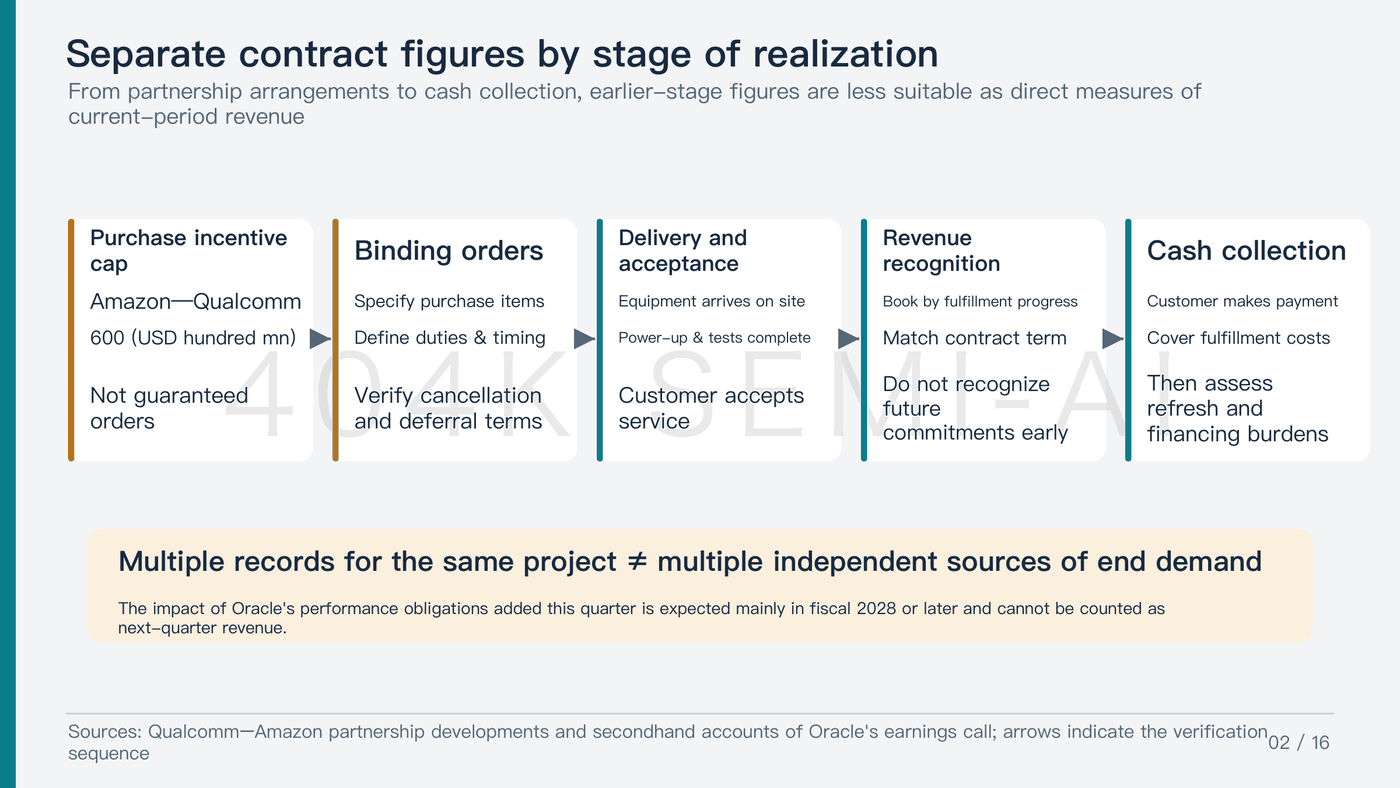
The larger the contract, the more important it is to identify its place in the business chain. Procurement incentive ceilings, customer reservations, binding orders, delivered capacity, and recognized revenue represent different stages. They can corroborate one another, but cannot be added together as incremental demand. A single project generates multiple records as chips are purchased, servers delivered, and cloud revenue recognized. These records demonstrate progress through the chain, not separate sources of end demand.
The $60 billion figure in Amazon’s partnership with Qualcomm illustrates this distinction. It is the procurement ceiling linked to warrant vesting, not realized revenue or a guaranteed minimum order. Separately, accounts of Oracle’s earnings call indicate that this quarter’s additions to remaining performance obligations are expected to affect capital expenditure and revenue primarily in fiscal 2028 or later. The former defines the scope of a procurement arrangement; the latter represents longer-term contracted business. Neither belongs directly in next quarter’s revenue forecast.
When assessing remaining performance obligations, investors should ask how long contracts take to convert, how much can be recognized within 12 months, whether customers have paid, and how delay and cancellation liabilities are allocated. For neocloud providers, financing costs and debt amortization also matter. Large customer contracts can support financing, but repayment of lenders’ principal and attractive shareholder returns are different outcomes. This week, timely energization, customer acceptance, and renewal cash flows deserve greater weight. Additional planned capacity alone warrants less conviction.
Cloud Revenue and AI Capital Expenditure
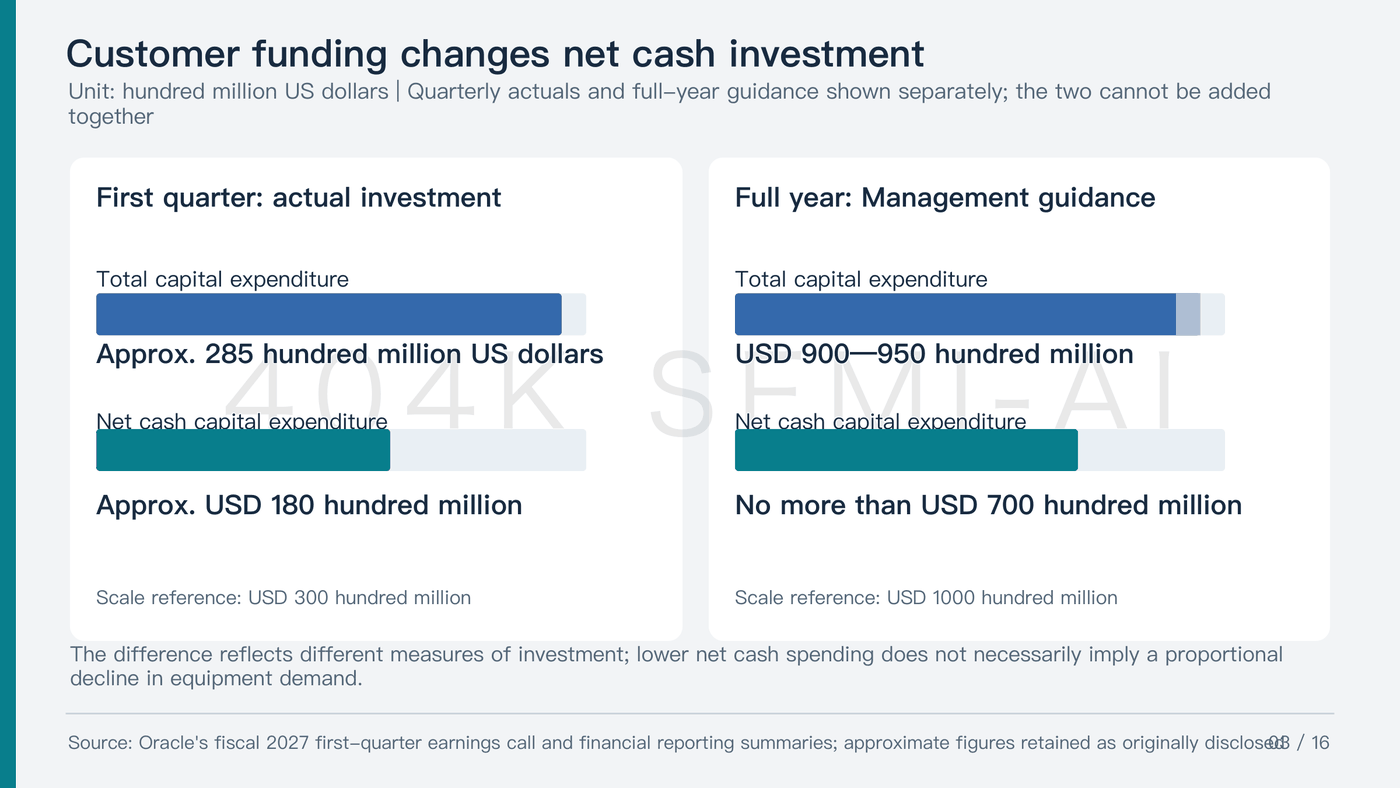
Oracle’s growth already requires substantial investment; customer funding reduces only part of the company’s burden. According to this week’s earnings call and related financial summaries, quarterly total capital expenditure was approximately $28.5 billion, versus roughly $18 billion of net cash capital expenditure. Full-year guidance also shows a substantial gap between total capital expenditure and the net cash spending ceiling. Distinguishing these measures is essential to determining whether Oracle is buying less equipment or other participants are funding part of the investment upfront.
Oracle is accelerating delivery, but total investment and net cash spending must be assessed separately.
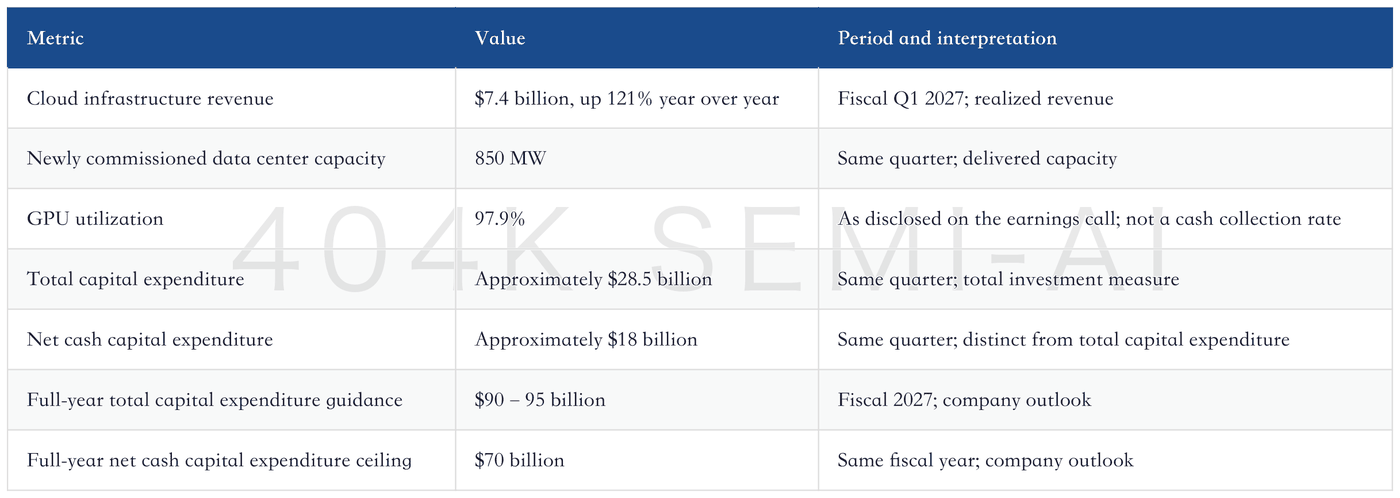
These figures support improving delivery capability, but do not answer when free cash flow will turn positive. Management declined to specify a date, leaving investors to monitor collections, construction spending, and financing over subsequent quarters. High utilization supports revenue generation, but electricity, operations, financing, and equipment replacement all absorb revenue. Cloud returns cannot be assessed solely by how busy the machines are.
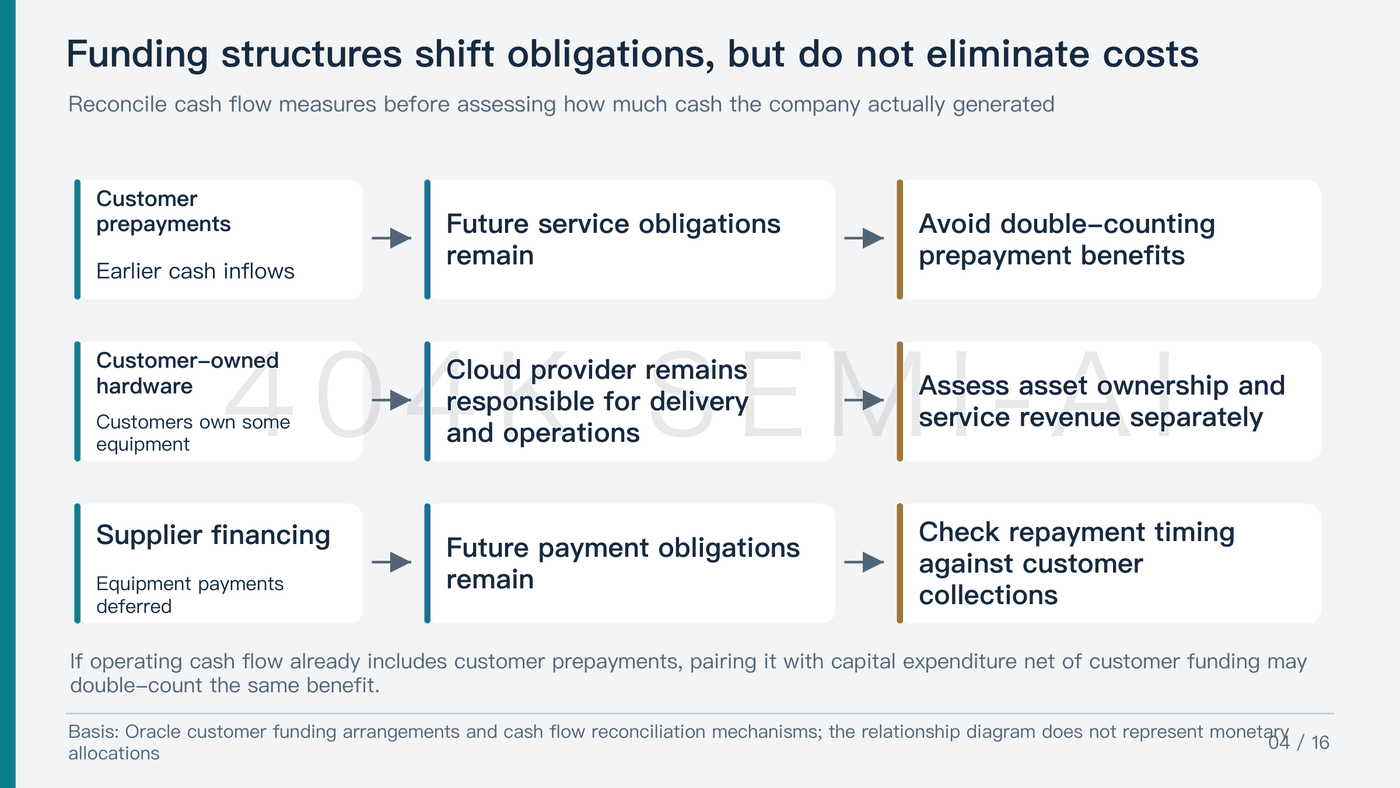
Prepayments, customer-supplied hardware, and supplier financing affect cash flow differently. Prepayments bring forward cash for future services, which the provider must still deliver. Customer-supplied hardware can transfer some equipment ownership and residual-value risk. Supplier financing primarily changes payment timing; equipment costs and future payment obligations remain. Treating all three as cost reductions overstates the economic benefit.
It is particularly important not to count the same prepayment twice. Commentary on Oracle’s earnings call noted that customer prepayments may already be included in operating cash flow. Calculating free cash flow using net cash capital expenditure that also deducts customer contributions could therefore count the same funding benefit twice. Assessing cash generation requires reconciling the measures on a consistent basis, then distinguishing advance customer payments from cash generated by current-period services. The analysis here is limited to that mechanism; it does not calculate cash returns using inconsistent denominators.
Receiving customer funds earlier does have value: financing less of the equipment purchase upfront reduces dependence on new funding. It also raises the importance of delivery. If the company cannot provide the contracted service, cash received in advance is not unconditional revenue. Management’s expectation that cash flow will improve as projects ramp is also no substitute for a full assessment of whether initial construction costs and subsequent replacement investment can be recovered.
New contracts should therefore be assessed by funding structure and actual delivery together. Rising prepayment shares alongside stable commissioning schedules would indicate that funding arrangements are supporting growth. If cash arrives earlier while customer acceptance keeps slipping, better reported operating cash flow may not reflect better business quality.
Data Centers, Compute Procurement, and Proprietary Chips
Supply-chain signals corroborate strong equipment demand, but investors still need to establish when cloud providers can turn that equipment into services. Hon Hai reported August revenue of NT$921.8 billion, up 52.0% year over year. The company linked growth to AI equipment demand within its cloud and networking products business and said third-quarter visibility had improved. This supports active server deliveries. Because revenue includes other businesses, it cannot be used to infer capital expenditure by Amazon or any other individual cloud customer.
