
Contents
Weekly Synthesis
Front-End Wafer Fabrication Equipment
Metrology, Inspection, and Testing
Advanced Packaging Equipment and Critical Materials
Corporate Progress, Order Book, and Capex Verification
Disagreements, Counter-Evidence, and Next-Week Focus
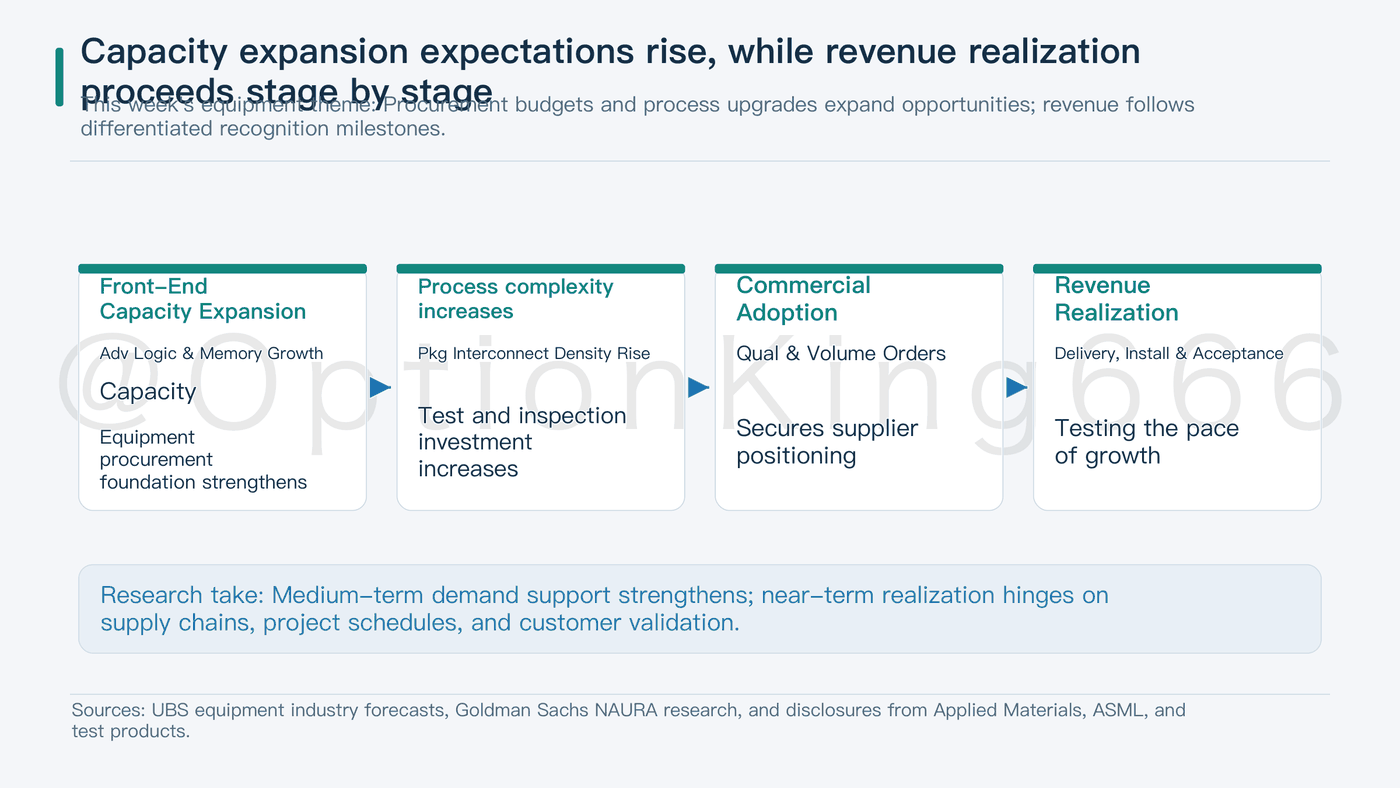
Underlying support for semiconductor equipment demand continues to firm up: aggressive expansion in leading-edge logic and memory is lifting tool procurement expectations, while advanced packaging and testing are absorbing greater process investments. From an investment perspective, the market favors companies best positioned to convert customer capex budgets into firm purchase orders, and subsequently into recognized revenue. However, supply chain lead times, customer qualifications, and greenfield fab schedules could still delay top-line realization.
Weekly Synthesis
This week’s most consequential shift is the mutual reinforcement between customer expansion plans and next-generation process requirements. UBS revised upward its global wafer fab equipment (WFE) spending forecasts; Goldman Sachs highlighted domestic memory expansion as a major catalyst for NAURA Technology; and Applied Materials expanded its advanced packaging R&D; partnership. These signals point to expanding capital budgets, accelerating tool adoption, and evolving technical roadmaps. While all support ongoing demand growth, they sit at varying distances from revenue recognition.
Front-end WFE upside stems from wafer capacity additions and higher capital intensity at advanced nodes. Back-end opportunities are driven by expanding package sizes, increasing interconnect densities, and rising test complexity. While both domains can expand concurrently, total equipment demand cannot be extrapolated linearly from wafer starts alone, nor should advanced packaging capex be attributed entirely to any single bonding technology.
Current developments warrant higher conviction in the longevity of the equipment upcycle, but not an across-the-board acceleration in short-term realization assumptions. ASML indicated that it could expand capacity by an additional 20% if supply chains permit—contingent entirely on component vendor readiness. Meanwhile, FormFactor's incremental upside hinges on customer qualification and share ramp. The former faces equipment supply constraints, while the latter is bounded by qualification and line-adoption cycle times.
Stock selection should therefore be evaluated process step by process step. Products with existing volume purchase orders sit much closer to revenue recognition than long-term roadmap milestones. Even for tools already installed on production lines, sustained utilization and follow-on orders require ongoing monitoring. Factoring all technology milestones into next-quarter growth risks prematurely discounting multi-phase earnings potential.
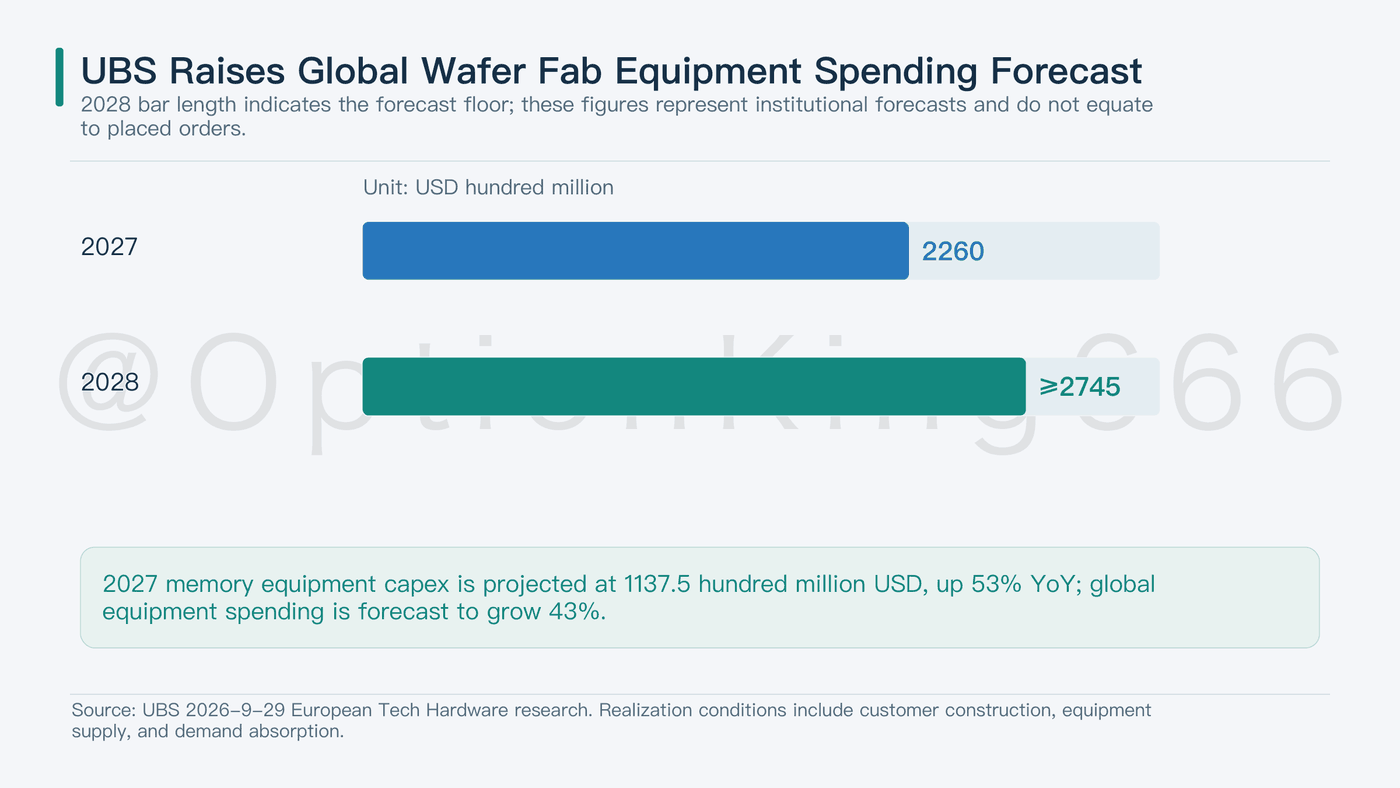
UBS’s industry projections provide the primary quantitative anchor for this week’s positive sector outlook. The bank forecasts global WFE spending to surge 43% YoY in 2027, propelled by a 53% YoY jump in memory equipment investments. This underscores that its bullish thesis relies heavily on large-scale memory expansion rather than advanced logic alone. For tool vendors, rising customer budgets expand the addressable pool, but individual product portfolios will dictate the degree of capture.

These figures represent sell-side projections rather than committed purchase orders. Realizing them requires timely fab construction, unconstrained vendor delivery, and sufficient downstream demand to absorb added capacity. If headline capex growth is weighted toward brick-and-mortar facilities and cleanroom infrastructure, near-term tool procurement growth could lag total capex expansion.
Furthermore, expanding equipment capex does not imply a synchronized recovery across all end markets. UBS noted persistent inventory digestion in legacy automotive semiconductors. Meanwhile, Texas Instruments guided 2026 capex below 2025 levels, illustrating continuing divergence across mature applications. The boom in advanced logic and leading-edge memory cannot be mapped directly onto power, analog, and mature-node equipment.
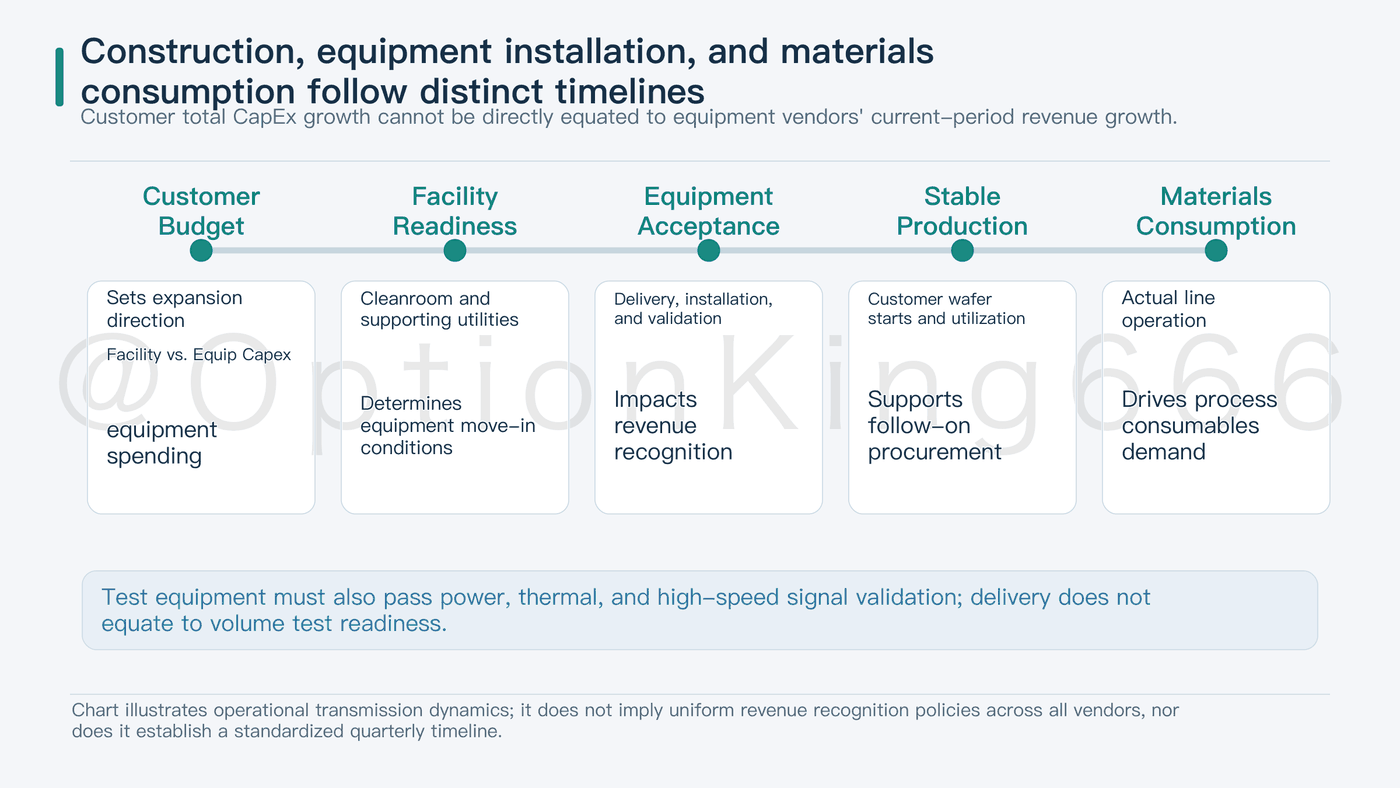
Analyzing this demand cycle requires decoupling facility construction, tool move-in/acceptance, and volume production. Customers must first secure land, power, and cleanrooms before moving in tools for installation and final sign-off, after which steady wafer starts commence. Consumables and process chemicals then ramp in proportion to cumulative fab run-hours. Consequently, while front-end WFE, back-end packaging/testing, and materials will recognize revenue in phased sequence, they cannot be modeled on an identical quarterly timeline.
The most robust tracking methodology is to cross-examine customer capex against vendor delivery performance. If customers announce aggressive capex plans without a corresponding uptick in tool orders, spending likely remains tied up in early-stage civil engineering. Conversely, if equipment backlogs expand while recognized revenue stagnates, supply chains, shipping cadences, and acceptance bottlenecks warrant scrutiny. Reconciling both ends reveals whether growth is merely deferred or fundamentally impaired.
Test equipment faces an additional process adoption hurdle. High-power devices demand integrated power delivery, advanced thermal management, and robust high-speed signal integrity; hardware delivery on site does not automatically translate into volume production testing. Investors should assign higher weight to formal qualification, high-volume manufacturing (HVM) adoption, and repeat orders—product launches and tech demonstrations merely expand the theoretical addressable market.
Our weekly stance thus maintains clear nuance: medium-term procurement fundamentals have strengthened, but revenue trajectories must be validated company by company. UBS’s coverage of ASML and European semiconductor capital equipment reflects a single research house's framework rather than independent corroboration; however, updates on NAURA's product milestones, new test platforms, and customer fab buildouts provide complementary cross-segment evidence.
Front-End Wafer Fabrication Equipment
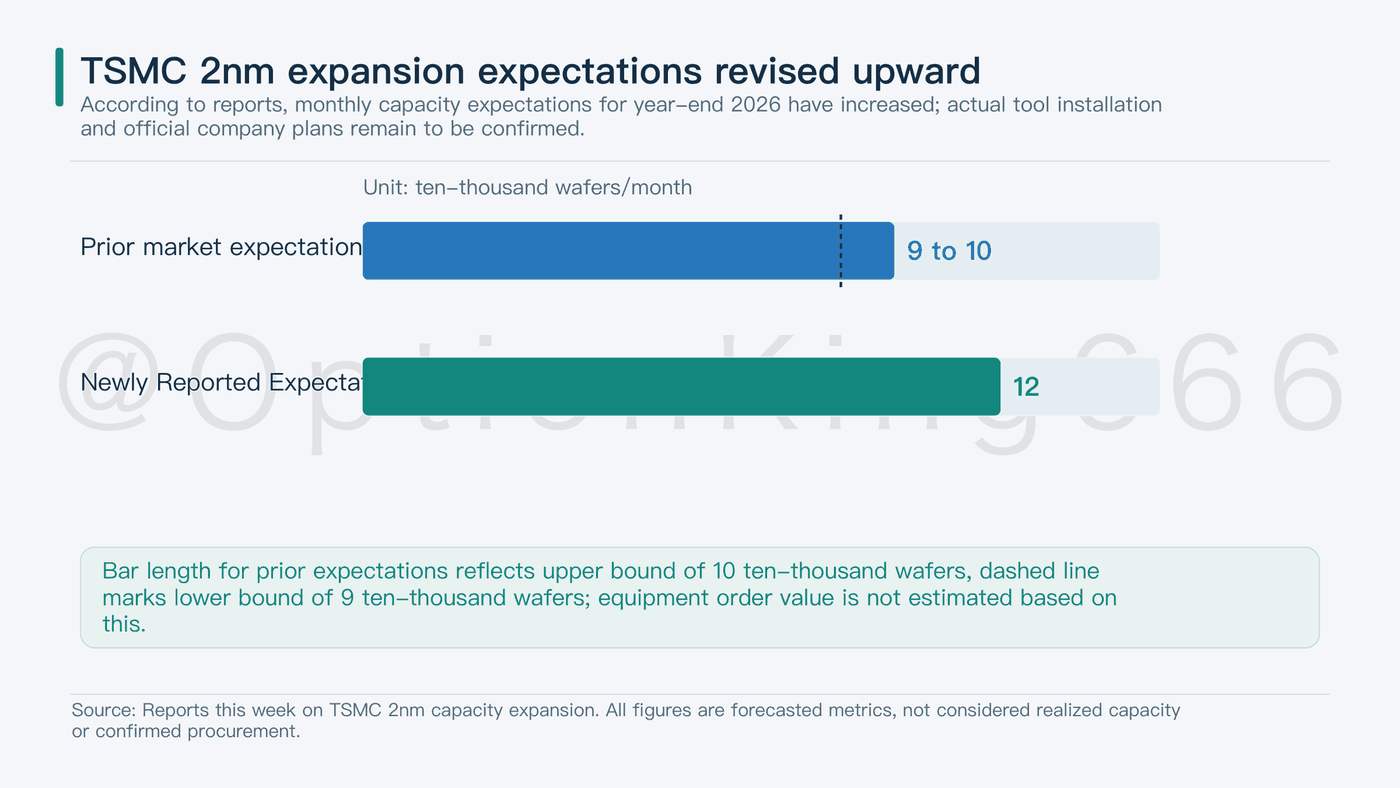
TSMC’s leading-edge capacity expansion remains the cornerstone of front-end WFE demand. Press reports indicate that tier-1 customers have increased 2nm capacity bookings, potentially pushing month-end capacity to 120,000 wafers per month (wpm) by year-end, up from previous market expectations of 90,000–100,000 wpm. If realized, this implies accelerated tool move-ins and capacity installation; however, this remains media-sourced reporting and should not be treated as a confirmed, company-guided tool deployment plan.
JPMorgan’s analysis suggests that incremental capacity may still not eliminate supply tightness. The bank projects that even after TSMC expands 3nm capacity further through 2027, the supply-demand deficit could widen. While this supports an extended equipment procurement cycle, it does not imply that every equipment supplier will capture orders proportionally.
Furthermore, capacity expansion must be delineated between greenfield builds and line conversions. Reports note that TSMC continues to repurpose certain 5nm tools for 3nm production. Capacity growth can be driven by either newly procured equipment or asset optimization across existing lines. Modeling equipment revenue requires disaggregating new shell buildouts, line conversions, and tool reuse; wafer capacity growth cannot simply be treated as a 1:1 proxy for new equipment sales.
Samsung Electronics offers another potential demand vector. The company raised its 2029 foundry revenue target for high-performance computing (HPC) to 66%, reflecting a structural portfolio pivot toward high-compute workloads. However, press reports citing 2nm yields nearing 60% have not been officially confirmed by the company, and reported yield improvements still require rigorous validation against customer silicon benchmarks in power, thermal dissipation, and volume manufacturing stability.
ASML’s growth thesis is driven concurrently by shipment volumes and ASP expansion, with execution risks shared across customer capex timing and supply chain readiness. UBS maintained its Buy rating and €2,350 price target, forecasting 2027 revenue of €58.56B. The bank emphasized that the high revenue contribution from EUV and DUV immersion platforms magnifies operational leverage to product transitions and pricing dynamics.
