
Contents
Market Wrap
US Stocks: 52-Week Highs
US Stock Rankings Triptych
AI & Semiconductor Value Chain
AI Models, Applications & CapEx
Hyperscaler & Cloud CapEx
AI Cloud & Data Center Operators
GPUs, CPUs & ASICs
Memory & Storage (HBM / DRAM / NAND / SSD / HDD)
Foundry & Advanced Packaging
Semi Equipment, Test & Power Semiconductors
Optical Communications & High-Speed Interconnects
Space, Satellites & Autonomous Driving
Internet & Digital Platforms
Enterprise Software & SaaS
Consumer Electronics & Smart Vehicles
Huang's Selected Portfolio
Storage Index Performance
US Memory Turnover Share
Coordinated price cuts across frontier AI agent models are accelerating downstream adoption, transmitting fresh demand across cloud compute clusters, memory subsystems, and high-speed networking fabrics. While US semiconductor equities outperformed the broader market on September 22, the pace of top-line revenue conversion remains gated by infrastructure deployment schedules, power availability, and customer qualification cycles.
404K SEMI-AI | 2026-09-23
Market Wrap
At the close on September 22, the S&P; 500 edged up 0.01%, the Nasdaq 100 gained 0.80%, and the S&P; 500 Equal Weight Index rose 0.13%. Sector performance diverged: Technology ETFs climbed 0.60% and Semiconductor ETFs gained 1.66%, outperforming the broader market, while Communication Services fell 1.06%. Capital continues to rotate toward silicon and physical infrastructure, whereas internet platforms delivered mixed results.
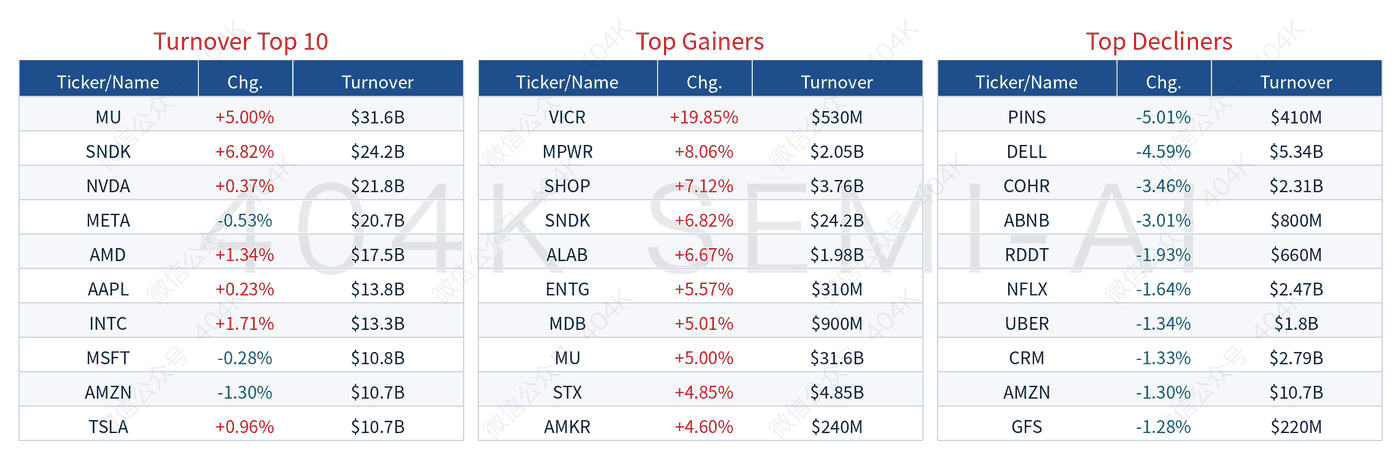
Among leading single stocks, Micron rose 5.00%, SanDisk surged 6.82%, NVIDIA added 0.37%, and AMD gained 1.34%, while Meta slipped 0.53% and Microsoft fell 0.28%. Semiconductor strength coincided with a flurry of model releases, compute rental price hikes, and packaging bottleneck updates, though individual moves should not be attributed to single headlines. Going forward, the primary operational focus remains hyperscaler GPU deployment timelines and order-to-revenue conversion.
Incremental catalysts are emerging from foundational models and agentic applications. OpenAI and Anthropic simultaneously rolled out lower-cost models on September 22, while Meta's Muse continued expanding into commerce and travel workflows. While falling API call costs stimulate usage volume, they also place greater processing burdens on cloud compute, memory, and high-speed interconnects. Where economic profit ultimately settles will depend on enterprise monetization, infrastructure utilization rates, and capital buildout costs.
US Stocks: 52-Week Highs

US Stock Rankings Triptych
AI & Semiconductor Value Chain
AI Models, Applications & CapEx
OpenAI:
1) On September 22, OpenAI launched GPT-6 Sol and Luna, targeting complex research workflows and low-cost, high-concurrency tasks, respectively. Both models are priced 50% below their GPT-5.6 counterparts: Sol is priced at $2.00 per 1M input tokens and $10.00 per 1M output tokens, while Luna costs $0.10 per 1M input tokens and $0.50 per 1M output tokens.
2) OpenAI plans to grant independent institutions deeper audit access across training, evaluation, and deployment stages. While lower API pricing expands developer adoption, enterprise procurement will hinge on blended task-level economics and safety evaluations.
Anthropic:
1) Released Claude Opus 5.5, delivering ~40% lower cost per task on typical workloads and >30% faster generation speeds compared to Opus 5. Pricing is set at $4.00 per 1M input tokens and $20.00 per 1M output tokens.
2) The model is live across Claude, AWS, Google Cloud, and Microsoft Azure. Anthropic's system card highlighted vulnerabilities regarding spontaneous prompt injection. Although lower costs and capability improvements encourage longer-horizon agentic tasks, enterprise clients must verify execution reliability.
Moonshot AI & DeepSeek: Regulators are reportedly investigating allegations that both firms transmitted user data to Claude, with Anthropic citing interaction logs exceeding 23 million and 12 million sessions, respectively. These figures represent alleged interaction counts rather than confirmed regulatory violations. Technical capability, training data compliance, and cross-platform data pipelines must be evaluated together, with official regulatory findings serving as the ultimate guidepost.
Hyperscaler & Cloud CapEx
AI Infrastructure Financing: Goldman Sachs CEO David Solomon estimated that global AI compute buildouts could require $8 trillion in capital financing over the next five years. This scale is material against the ~$30 trillion US Treasury market and ~$12 trillion US corporate bond market. Investors should treat this figure as an estimate of capital demand rather than committed expenditure; rising capital costs will raise return hurdle rates for data center projects.
Google: Google disclosed that its 2026 TPU 8t Superpod will scale to 9,600 chips per pod, utilizing Optical Circuit Switches (OCS) to dynamically reconfigure network topology after hardware failures. As cluster sizes expand, the financial penalty of network downtime escalates; OCS primarily adds value by bypassing node failures and reducing redundant electro-optical conversions. Looking ahead, investors should track optical port procurement volumes and merchant sourcing mix rather than transceiver headline bandwidth alone.
Meta:
