
Contents
Market Wrap
US Equities Daily Rankings
AI & Semiconductor Value Chain
AI Models, Applications & CapEx
AI Cloud & Data Center Operators
GPUs, CPUs & ASICs
Memory & Storage (HBM / DRAM / NAND / SSD / HDD)
Foundries
Semiconductor Equipment & Testing
Optical Communications & Networking
Servers, Networking, Connectors & Power
Internet & Platforms
Software & SaaS
Consumer Electronics & Smart Mobility
Robotics & Autonomous Driving
Huang's Core Portfolio
Memory Index Performance
US Memory Turnover Share
Micron's quarterly results and forward guidance beat expectations, but transition costs continue to squeeze near-term gross margins. Meanwhile, hyperscale cloud projects must navigate persistent hurdles across grid interconnection, advanced packaging, and testing. On the software side, monetization gathers momentum: Synopsys secured a major multi-year IP license, Microsoft is testing premium enterprise tier upgrades, and autonomous agents are beginning to reshape monetization models across e-commerce and content platforms.
404K SEMI-AI | October 1, 2026
Market Wrap
US equities closed mixed on September 30, with tech outperforming amid broader market divergence. The S&P; 500 ETF slipped 0.21%, the Nasdaq 100 ETF gained 0.25%, and the Dow Jones ETF dropped 0.84%. The equal-weight S&P; 500 ETF fell 0.71%, underperforming its cap-weighted benchmark; mega-cap tech resilience has yet to broaden across the wider market.
Software led gains, while semiconductors extended recent relative strength. Software ETFs climbed 1.20%, cloud ETFs gained 0.76%, and cybersecurity ETFs rose 1.10%; the semiconductor ETF edged up 0.35%, bringing its 20-day gain to 11.70%. Micron issued robust post-market revenue guidance, though converting top-line expansion into earnings and cash flow still hinges on node transition costs, grid power availability, and equipment lead times.
Flows were also influenced by quarter-end rebalancing. Goldman Sachs estimated US pension funds would sell $33B in equities around late September, while trend-following CTA strategies could provide buying support in flat markets but accelerate selling if the market declines—a conditional flow dynamic. On the macro front, the core PCE price index rose 0.2% MoM, coming in below the 0.3% consensus, though interest rate constraints on tech valuations warrant continued attention.
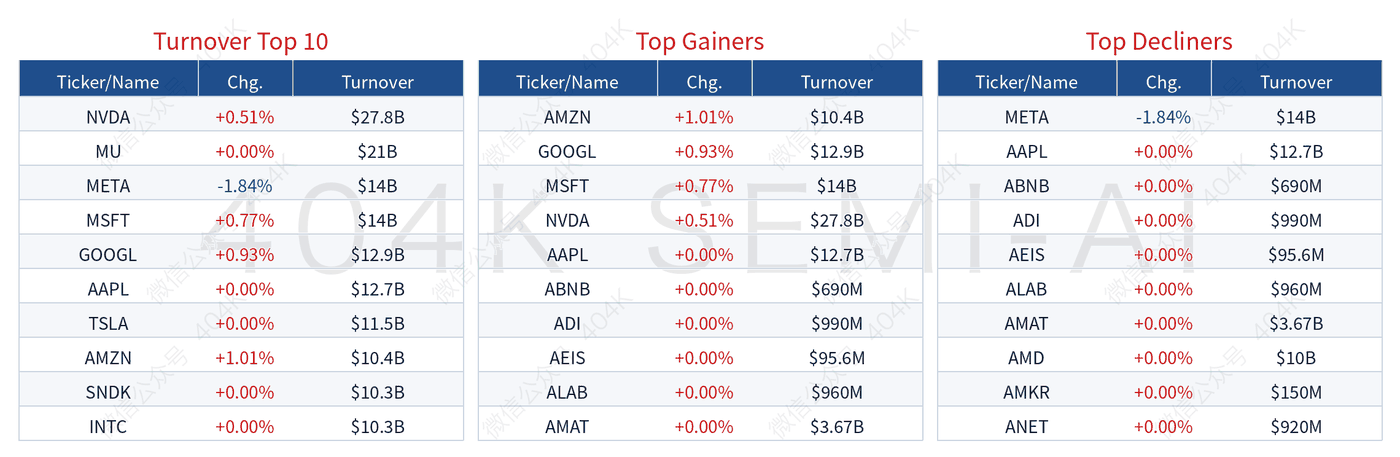
The rankings below cover tech-related equities, with gainers and losers filtered for market caps above $10B; turnover is calculated from price and volume.
US Equities Daily Rankings
AI & Semiconductor Value Chain
AI Models, Applications & CapEx
OpenAI
1) ARR is reportedly approaching $70B, up ~70% since July. The company is seeking to raise at least $30B at a $1.4T valuation and plans to delay its IPO. As both top-line growth and capital requirements surge, the key question is whether incremental revenue can sustain ongoing investment intensity.
2) The CFO stated that available compute capacity for 2026 is effectively sold out, with very limited headroom remaining for 2027. Rapid model revenue growth coexists with compute scarcity; once financing closes, investors must monitor actual usable compute deployments.
Anthropic
1) S-1/prospectus disclosures reveal $2.16B in 2025 revenue (47% of total) was generated via AWS and Google Cloud distribution, with associated distribution fees of $351M. Cloud partners act as both compute providers and customer acquisition channels; channel reliance and distribution costs are critical metrics for evaluating revenue quality.
2) Reports indicate a potential compute deal with SpaceX could reach $84.5B. This figure represents an aggregate potential contract value rather than current-period expense or delivered capacity. Given high channel dependency, investors should track compute procurement commitments, end-customer adoption, and the trajectory of direct sales.
Google
1) Released Gemini 4 Argon, initially accessible to cyber defense professionals. Google reported leads in 13 of 19 benchmarks, posting a DeepSWE score of 77.9% versus 74.2% for Opus 5.5 and 74.1% for Astra, with output limits expanded to 1M tokens.
2) Benchmark gains must translate into production tasks. Reports suggest some internal skepticism regarding performance in coding and front-end design, though Google denied underperformance; scaling model size could also elevate inference costs. Assessment should focus on task completion rates and unit economics rather than benchmark rankings alone.
DeepSeek: Open-sourced TileLang for Huawei's Ascend 950, targeting chip performance optimization and developer onboarding. For domestic Chinese AI hardware, software tooling that minimizes developer migration friction is a critical variable alongside silicon specs. This release focuses on toolchain-silicon synergy; real-world model execution efficiency, porting overhead, and developer adoption will determine whether it drives production deployments.
Amazon
1) Signed a 20-year PPA with Constellation Energy for 690 MW from the Calvert Cliffs nuclear station, of which 190 MW represents new capacity scheduled to come online between 2030 and 2032. The agreement is expected to catalyze over $3B in infrastructure investment in Maryland, though new power generation remains subject to multi-year construction cycles.
2) Reports indicate Trainium 3 shipments face component shortages and packaging bottlenecks. In-house ASIC demand, manufacturing delivery, and power procurement must be evaluated separately; long-term clean energy PPAs do not resolve immediate assembly constraints. Meanwhile, an expanded multi-year partnership with Synopsys continues to support Amazon's custom silicon roadmap.
AI Cloud & Data Center Operators
Oracle: Power delivery for the Port Washington campus faces delay risks. Reports indicate a reopened transmission review could push substantial energization out to mid-2028, trailing management's 2027 target; the site depends on new high-voltage interconnections and regulatory sign-offs. Baseline projections model partial energization around December 2027 and the full 1.3 GW capacity by roughly October 2028, leaving substantial timeline uncertainty. The next milestone is an application completeness determination expected around October 19; capacity delivery and revenue recognition must be tracked against regulatory milestones.
