
目录
Post-Market Wrap
US Equities: 52-Week Highs
US Equities: Top Rankings Triptych
AI & Semiconductor Value Chain
AI Models, Applications & Capex
GPU / CPU / ASIC
HBM / DRAM / NAND / SSD / HDD
Foundry
Semiconductor Equipment & Testing
Optical Communications & Optics Supply Chain
Servers, Racks, Networking, Thermal & Power
Space & Satellites
Internet & Platforms
Software & SaaS
Consumer Electronics & Smart Mobility
Huang's Focus Portfolio
Memory Index Trend
U.S. Memory Turnover Share
AI infrastructure demand continues broadening beyond compute silicon. Qualcomm's partnership with Amazon spans custom chips and optical interconnects, Vertiv raised its medium-to-long-term growth targets, and Dell’s order backlog continues to build. Supply bottlenecks center on memory, packaging, and power, while software and platform players still need to prove that agent-driven usage translates into revenue and profit.
404K SEMI-AI | 2026-09-09
Post-Market Wrap
At the September 8 US market close, the S&P; 500 ETF slipped 0.57%, the Nasdaq 100 ETF dipped 0.15%, and the equal-weighted S&P; 500 ETF dropped 0.94%. Meanwhile, the Semiconductor ETF gained 1.19% and the Tech Sector ETF rose 0.28%. Hardware supply chains showed relative strength, but lagging equal-weight performance indicates rallies have not yet broadened across the wider market.
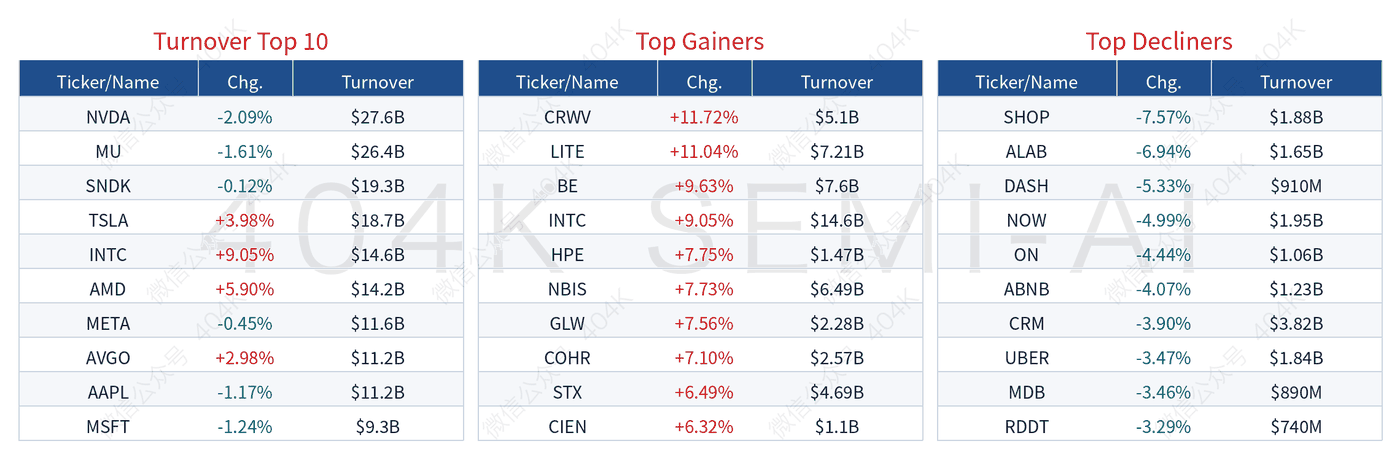
Semiconductor names diverged internally: Intel rallied 9.05%, AMD gained 5.90%, and Broadcom rose 2.98%, while NVIDIA declined 2.09%. Data center infrastructure was more active, with Hewlett Packard Enterprise (HPE) surging 7.75%, Vertiv climbing 3.67%, and Dell rising 1.86% to a fresh 52-week high. On the software side, ServiceNow dropped 4.99% and Salesforce fell 3.90%, as the gap between surging usage and tangible commercial monetization remains under close scrutiny.
The most critical trend to monitor is that the AI buildout is now simultaneously competing for compute, connectivity, and power capacity. Qualcomm’s new partnership ties custom silicon to optical interconnects, Vertiv raised its medium-to-long-term growth targets, and semiconductor equipment makers flagged cleanroom and memory capacity constraints. While order backlogs and product roadmaps demonstrate robust demand, actual shipment execution, gross margins, and cash flows will dictate the pace of value realization.
US Equities: 52-Week Highs

The following turnover and performance rankings are restricted to tech-related equities, with a $10B market-cap threshold applied to the top gainers/losers. Turnover is calculated using closing prices and trading volume.
US Equities: Top Rankings Triptych
AI & Semiconductor Value Chain
AI Models, Applications & Capex
OpenAI
1) Reports indicate GPT-6 Astra was trained on over 100,000 GPUs for the first time, expanding target workloads into advanced reasoning, software engineering, and computer use. Morgan Stanley notes that such workloads could significantly expand inference demand, shifting supply-chain bottlenecks downstream to power, substrates, advanced memory packaging, and networking.
2) ChatGPT monthly active users (MAUs) reportedly surpassed 1B, with advertising revenue reaching a $1B annualized run rate (ARR) and targeting $2.5B by year-end. While ARR reflects current monetization velocity, sustained long-term revenue depends on ad infrastructure maturation and commercial user intent conversion.
Anthropic
1) Anthropic has reportedly locked in at least 14.8 GW of compute capacity, representing a $517B compute commitment. Its IPO timeline has shifted to mid-October, and the company abandoned a potential ~$6B acquisition of Decart following due diligence. Capacity commitments and financing cadence warrant joint monitoring.
2) Anthropic engineers disclosed that Claude Code removed 80% of its system prompts and reduced few-shot examples in tool descriptions, as internal benchmarks showed excessive examples constrained model performance. While architectural refinements are altering application development paradigms, they should not be extrapolated directly into compute cost deflation.
AI Infrastructure Buildout
1) Morgan Stanley projects hyperscaler capex to surge ~60% to $550B in 2027 before moderating to 12% growth in 2028, with chips, power, and physical infrastructure emerging as primary bottlenecks. As long-term demand forecasts escalate, verifying deliverable power and shell capacity becomes increasingly critical.
2) Evercore ISI scenario models project total data center capacity of 208–250 GW by 2030, with AI capacity accounting for 149–189 GW, reinforcing multi-year secular expansion trends.
3) An analysis of $244B in debt across Google, Amazon, Meta, and Oracle shows that $98.25B matures after 2045, carrying a principal-weighted average coupon of 6.00%. While extended maturities mitigate near-term refinancing pressure, persistent debt-service obligations will continue absorbing operational cash flow.
#### Hyperscale / Cloud Capex
Google
1) Google Cloud reportedly features 17 product lines exceeding $1B in annual run rate, with its TPU business more than double the size of the second-largest hyperscaler's comparable segment. AI server payback periods remain under 2 years, with in-house silicon shortening them further.
2) Third-party benchmarks indicate TPUv7 Ironwood achieves up to ~50% higher inference performance-per-dollar versus B200/B300 under FP8 aggregated serving modes. This advantage depends on specific benchmark parameters; TorchTPU, scheduled for open-source release in mid-October, will be more decisive for lowering developer migration friction.
3) Google now processes over 3,000 trillion tokens monthly, up 7x YoY, requiring balanced execution between demand scaling and unit compute cost controls.
Meta
1) Meta is reportedly collaborating with Broadcom to deploy 3 GW of proprietary MTIA silicon before 2028. AMD also disclosed that Meta, OpenAI, and Anthropic plan multi-gigawatt deployments across multiple GPU generations, highlighting dual-track sourcing spanning in-house ASICs and merchant GPUs.
2) Procurement is advancing along parallel tracks: custom silicon drives bespoke ASIC and interconnect demand, while general-purpose GPUs continue handling diverse, dynamic workloads. Going forward, execution must be tracked by product generation and deployment footprint, differentiating between training and inference allocations.
