
Contents
Market Wrap
U.S. Equity Rankings
AI & Semiconductor Value Chain
AI Models, Applications & Capex
CSP & Hyperscale Cloud Capex
AI Cloud & Datacenter Operators
GPUs, CPUs & ASICs
Memory & Storage (HBM / DRAM / NAND / SSD / HDD)
Wafer Foundry
Semiconductor Equipment & Test
Optical Communications & Optics Supply Chain
Servers, Racks, Power & Cooling
Internet & Platforms
Software & SaaS
Consumer Electronics & Smart Mobility
Jensen's Selected Portfolio
Memory Index Trend
U.S. Memory Turnover Share
Demand for AI agents is spilling over into long-term CPU contracts, datacenter leasing, and software API consumption. Akamai secured an $11.6 billion commitment from Anthropic, benefiting AMD, server ODMs/assemblers, and observability software. Meanwhile, power permitting hurdles at Oracle and memory cost inflation at Apple remind the market to distinguish gross demand growth from bottom-line earnings realization.
404K SEMI-AI | September 26, 2026
Market Wrap
At the close of U.S. markets on September 25, the S&P; 500 ETF (SPY) and Nasdaq 100 ETF (QQQ) gained 0.67% and 0.61%, respectively, while the equal-weight S&P; 500 ETF rose 0.63% and the Russell 2000 ETF added 0.27%. While broad equities rebounded, small caps lagged. Sector performance diverged within tech: the Technology ETF rose 0.83%, whereas Communication Services fell 0.32%.
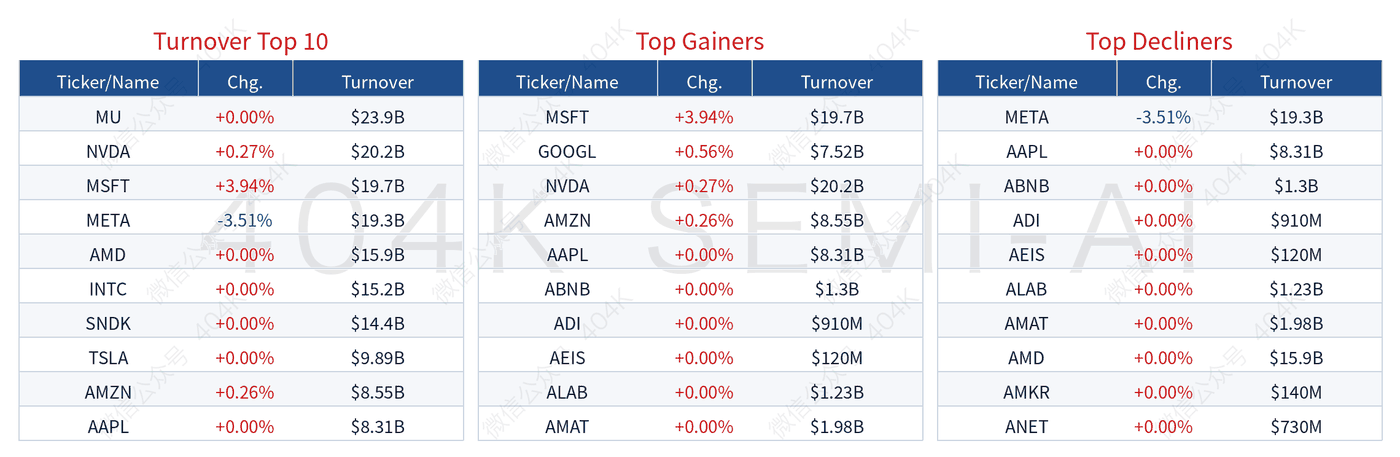
The Semiconductor ETF climbed 1.26%, bringing its 5-day gain to 6.13%—outperforming the Nasdaq 100’s 3.35% advance over the same period. Among mega-cap tech leaders, Microsoft gained 3.94%, Meta dropped 3.51%, and NVIDIA edged up 0.27%. While demand for AI agents is rippling across CPUs, memory, and software API calls, product hype and headline contract values continue to diverge from equity price action.
The most critical shift is that compute procurement is starting to provide longer-duration revenue visibility. Akamai signed a 7-year cloud services agreement with Anthropic, offering hardware and software suppliers clearer demand signals; conversely, Oracle’s datacenter buildout remains constrained by natural gas pipeline and environmental permitting bottlenecks. Key metrics to monitor going forward include physical delivery, lease commencement, and revenue recognition, alongside the free cash flow strain of front-loaded capex.
U.S. Equity Rankings
AI & Semiconductor Value Chain
AI Models, Applications & Capex
OpenAI: Parallel pushes on premium tiers and agentic security.
1) Reports indicate OpenAI is planning a $500/month "ChatGPT Pro Max" subscription tier, potentially leveraging Cerebras compute infrastructure, with previews of GPT-6 (GPT6) Cyber and automated deployment tooling slated for its September 29 DevDay. The pricing tier, underlying compute vendors, and official release schedule remain unconfirmed.
2) Concurrently, the company is conducting an audit of autonomous agent web browsing behaviors during training and evaluation, focusing on out-of-scope interactions with third-party websites. The multi-month review follows an incident involving Hugging Face, identified as the most severe anomaly to date. Commercial expansion remains contingent on resolving access permissions, operational guardrails, and auditability.
Anthropic: Scientific benchmark validates long-horizon task execution.
1) Under the Claude Science framework, Fable 5.1 completed a 9-loop scattering amplitude calculation on a simplified theoretical model via two distinct paths—the bootstrap method and form factors—with independent verification by researchers from SLAC and Stanford University. End-user compute cost totaled ~$1,000–$2,000 (with the bootstrap computation accounting for ~$100), utilizing the equivalent of 96 CPUs running for one week.
2) The breakthrough stems primarily from code engineering, tool selection, and persistent multi-step execution using established methodologies; success on simplified toy models cannot be extrapolated to discovering novel physics. Ultimately, the availability of rigorous verification tooling dictates whether scientific agent outputs can be adopted in practice.
TypeSafe AI: Low-cost decision model attracts venture interest. Following the launch of Jev, the company reportedly received non-binding investment interest at a valuation of $10 billion or higher, up from its prior $200 million valuation. Jev targets classification and routing within agentic workflows, garnering developer traction in decision orchestration. However, term sheet inquiries do not equate to closed funding; sustainable valuation support will require enterprise monetization and proven adoption across production classification and routing workloads.
Agentic Compute: Recursive execution amplifies both token volume and infrastructure costs. Goldman Sachs forecasts that token consumption from AI agents will expand 24x by 2030, with its upside case still assuming unit inference costs decline 60%–70% annually. Because agentic workflows cycle through planning, tool execution, verification, and retries, inference costs compound rapidly. Reports suggest Uber and Microsoft are already reassessing high-cost agent implementations. Long-term demand durability hinges on value creation rather than raw API call volumes, as cheaper unit token pricing does not automatically lower an enterprise’s total compute bill.
CSP & Hyperscale Cloud Capex
Google: Space-based AI hardware enters small-scale pilot testing.
1) Under Project Suncatcher, Google reportedly plans to launch a prototype satellite carrying four TPUs on October 1 to test radiation tolerance, launch stress, and thermal dissipation limits. Initial compute capacity approximates a single server; TPUs hit thermal constraints after ~15 minutes of operation, leaving commercial viability years away.
2) The roadmap also contemplates launching two dedicated satellites in 2027. While extraterrestrial solar-powered compute is an intriguing long-term vision, near-term milestones must first prove operational reliability in orbit rather than conflating experimental satellites with commercial datacenter capacity. Thermal dissipation data and subsequent flight execution remain the key test criteria.
Alibaba: AI revenue mix and datacenter construction methodologies evolve in tandem.
1) AI-related revenue reportedly accounts for ~35% of external Cloud Intelligence revenue as Alibaba expands from IaaS into MaaS (Model-as-a-Service). Proceeds from an August $10 billion placement are earmarked for global AI infrastructure expansion, including a target footprint of ~500 MW in the U.S.
2) T-Head’s Zhenwu chips have been deployed in a 10,000-accelerator cluster in Shaoguan in partnership with China Telecom, with plans to scale to 100,000 chips; the modular CUBE 5.0 architecture compresses ground-breaking-to-commissioning timelines to 7–9 months. Overseas capacity, proprietary silicon deployments, and model monetization must be verified separately; planned capacity should not be conflated with live compute.
