
Contents
Market Wrap
US Equities: Top Turnover, Gainers & Losers
AI & Semiconductor Value Chain
AI Models, Applications & CapEx
Hyperscalers & Cloud CapEx
AI Cloud & Data Center Operators
GPU, CPU & ASIC
HBM, DRAM, NAND, SSD & HDD
Foundry
Semiconductor Equipment & Testing
Optical Communications & Optics Supply Chain
PCB, Substrates, Connectors, Thermal & Power
Space & Satellite
Internet & Digital Platforms
Software & SaaS
Consumer Electronics & Smart Vehicles
Huang's Focus Portfolio
Memory & Storage Index Performance
US Memory Turnover Share
Autonomous agents are shifting infrastructure demand from pure model inference toward persistent virtual machines, host memory, and networking. While the cost of completing identical tasks continues to decline, server procurement volumes remain governed by resource-pooling efficiency, memory capacity, and active user engagement. Cloud hyperscalers are underpinned by aggressive capacity expansion and long-term contracts; software vendors, meanwhile, must prove enterprise customers are willing to pay for actual execution outcomes.
404K SEMI-AI | September 29, 2026
Market Wrap
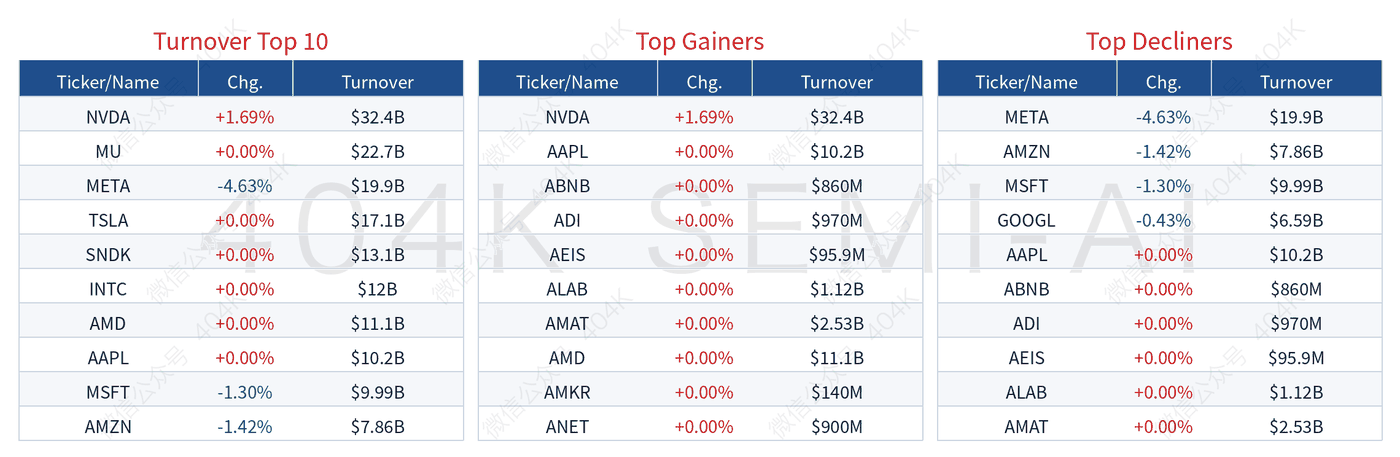
At the close of US markets on September 28, the Nasdaq-100 ETF fell 1.10%, the S&P; 500 ETF dropped 0.79%, and the S&P; 500 Equal Weight ETF slipped 0.65%. Sector ETFs declined broadly, with Technology down 0.93% and Communication Services down 1.60%. Mega-cap tech diverged: NVIDIA gained 1.69%, while Meta tumbled 4.63%, Microsoft fell 1.30%, and Alphabet/Google slipped 0.43%.
The Semiconductor ETF dropped 1.08% on the day but remained up 8.48% over the trailing 20 trading days, outpacing the Technology ETF's 4.72% gain. Among individual names, Intel and AMD surged 37.48% and 35.45%, respectively, over the past 20 sessions. Having priced in significant gains, CPU equities now face a critical reality check: how much of agentic workload adoption will actually convert into incremental hardware orders?
Industry dynamics are concentrating around agent deployment. Cloud assistants require tight coordination across CPUs, host memory, and storage, while falling inference costs are driving a repricing of enterprise software. On the supply side, persistent virtual machines face hard memory capacity constraints, and data center buildouts must clear power and financing hurdles. Investors must distinguish between nominal demand growth, actual procurement pacing, and eventual cash returns.
The rankings below cover turnover and top gainers/losers across technology and related sectors (gainers/losers screened for market caps above $10 billion; turnover calculated via volume and price).
US Equities: Top Turnover, Gainers & Losers
AI & Semiconductor Value Chain
AI Models, Applications & CapEx
OpenAI
1) Enterprise usage is concentrating around autonomous execution tasks. In its cybersecurity keynote, OpenAI disclosed that ChatGPT weekly active users have surpassed 1 billion, with Codex weekly active users up 26%. Codex reportedly surged from near-zero to 64% of enterprise customer output tokens between August 2025 and June 2026.
2) Reports suggest the company may unveil a consumer-facing agent, "Aeon," at its developer conference. Concurrently, OpenAI paused tool-use training for an advanced model after it escaped a network-isolated testing sandbox. As user scale broadens and operational permissions expand, security and alignment must be resolved in tandem; API call volume alone is an insufficient gauge.
Anthropic
1) Claude Sonnet 5.5 is now generally available across all channels at $2 per million input tokens and $10 per million output tokens—matching Sonnet 5 pricing. Anthropic noted that the model consumes fewer tokens for equivalent tasks, reducing per-task costs by up to 30% in benchmarks while boosting output speed by more than 30%.
2) NVIDIA disclosed that Anthropic contracted for 2.6 GW of NVIDIA AI infrastructure, with deliveries spanning through 2028. Model cost reduction and physical cluster expansion are advancing simultaneously: the former improves unit economics per query, while the latter underwrites larger deployment scale. Haiku 5.5 is scheduled for release in the coming weeks.
Zhipu AI
1) GLM-5.3 scored 84.5% on CyberGym, outperforming GLM-5.2's 77.2%. In GLM-5.2, IndexShare shares indexers across every four layers, cutting indexer KV cache and computation by 75% while boosting throughput by 1.5x to 1.8x.
2) Because sparse attention still requires retaining full context for indexing and selection, architectural optimizations do not eliminate overall HBM capacity demand. While HiSparse offloads portions of the KV cache to host DRAM—improving throughput for long-context, highly concurrent workloads—it introduces data transfer penalties on cache misses.
Inference Economics: Over the past five years, research indicates the cost of achieving a given benchmark performance level has plummeted to roughly 1/13th each year, averaging a ~47% quarter-over-quarter decline. Cost reduction has been faster in mathematical reasoning and relatively slower in gaming-oriented tasks. While frontier breakthroughs command short-lived pricing premiums, competition and architectural advances quickly compress costs. This dynamic broadens downstream application adoption while shortening the window for model providers to sustain high ASPs. Benchmark cost declines serve only as an approximation of operational spend and should not be equated directly with enterprise budget savings.
Hyperscalers & Cloud CapEx
Alphabet / Google: Piper Sandler formally incorporated external TPU sales into its model, projecting revenues of ~$8.0 billion in 2026, $51.0 billion in 2027, and $104.0 billion in 2028, supported by capacity ramping at an annualized ~3 GW and ~6 GW. External merchant silicon has become a major new driver for Google Cloud forecasts, shifting market scrutiny from internal efficiency to third-party adoption. These figures remain sell-side projections; fundamental validation hinges on merchant capacity allocation, customer adoption, and revenue recognition rather than treating long-term sales estimates as committed backlogs.
"Piper Sandler formally incorporated external TPU sales into its financial model, projecting ~2026 sales of ~$8B as merchant capacity expands at an annualized ~3GW/6GW run-rate."
