
Contents
Market Wrap
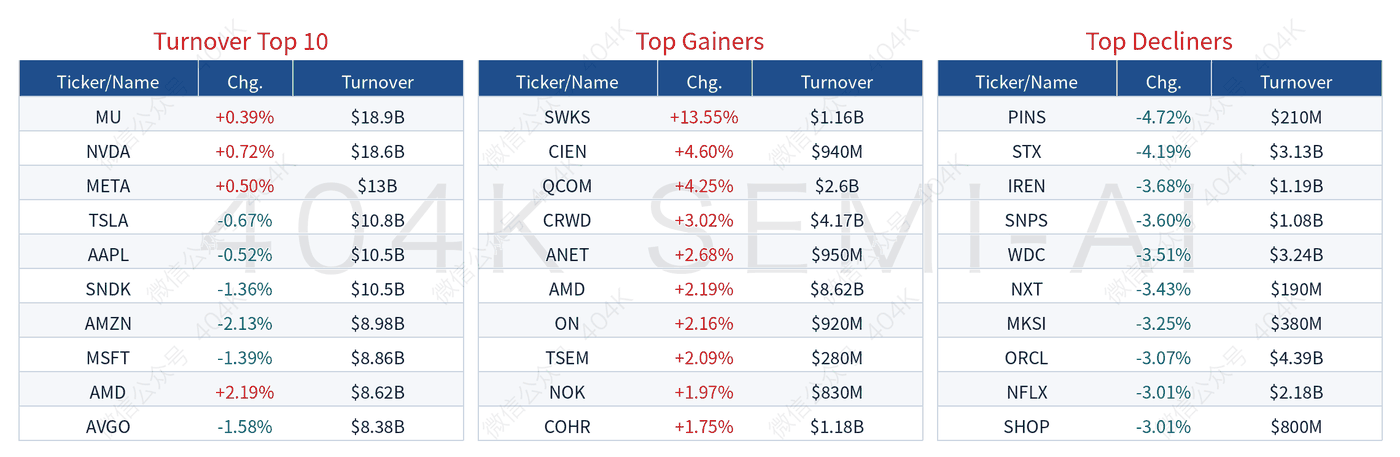
US Equity Top Movers
AI & Semiconductor Value Chain
AI Models, Applications & Capex
Cloud Capex, AI Clouds & Data Center Infrastructure
Compute: GPU, CPU & ASIC
Memory & Storage: HBM, DRAM, NAND & Storage Media
Foundries
Semiconductor Equipment & Test
Optical Communications & Optics Supply Chain
High-Speed Interconnect, Thermal & Power Systems
Internet & Digital Platforms
Software & SaaS
Consumer Electronics & Smart Mobility
Huang's Focus Portfolio
Memory Index Performance
US Memory Turnover Share
As the cadence of frontier model training recalibrates, commercial demand for deployed models continues to surge. Broadcom reaffirmed its AI chip revenue targets, while enterprise software platforms are embedding autonomous agents directly into sales, cybersecurity, and analytics workflows. Meanwhile, memory bandwidth, high-speed interconnects, and grid energization remain persistent delivery bottlenecks. Investors must distinguish between training moderation and inference expansion, while monitoring whether backlogs ultimately convert into realized revenue.
404K SEMI-AI | September 16, 2026
Market Wrap
At the September 15 close, US equity ETFs finished lower across the board: the S&P; 500 ETF declined 0.37%, the Nasdaq 100 ETF fell 0.60%, and the Russell 2000 ETF lost 0.94%. The Technology ETF dipped 0.28%, while the Semiconductor ETF edged up 0.11%. Despite this modest single-day reprieve, semiconductors remain down 8.75% over the trailing 20 trading sessions, indicating that underlying sector pressure persists.
Divergence within tech continued. AMD gained 2.19% and NVIDIA rose 0.72%, whereas Broadcom dropped 1.58% and Oracle fell 3.07%. In optical networking, Ciena rallied 4.60%, while storage lagged, with Seagate and Western Digital down 4.19% and 3.51%, respectively. Performance across silicon, optics, and memory remains desynchronized, underscoring the need to independently assess order books, delivery execution, and Capex ROI across sub-sectors.
Operationally, the defining development is the diffusion of inference demand into core enterprise workflows. Broadcom reiterated long-term AI silicon revenue guidance, Salesforce integrated multi-model capabilities, and Micron alongside Astera Labs advanced high-capacity memory and controller architectures. Concurrently, OpenAI has temporarily moderated its frontier training pace, and data centers face ongoing power and construction constraints—meaning expanding paper demand cannot be directly equated to timely revenue recognition.
US Equity Top Movers
AI & Semiconductor Value Chain
AI Models, Applications & Capex
OpenAI: Training cadence recalibration coincides with improving inference unit economics.
Frontier Training Slowdown: The CFO indicated that OpenAI has temporarily slowed frontier model training. If researchers determine that safety and alignment necessitate it, development could be further decelerated or halted, with commercial agreements adjusted accordingly.
Agentic Economics: Astra reportedly achieved an ~9% reduction in per-task completion cost versus Sol on Terminal-Bench 4.0 and cut task completion time by ~47% on OSWorld. Willingness to pay should be evaluated by total cost per completed job and overall success rates, rather than per-token pricing alone.
Reliability Constraints in Long-Horizon Tasks: Complex workflows face compounding reliability hurdles: assuming independent steps, a 99% per-step success rate yields an aggregate completion rate of only ~37% across a 100-step chain.
Anthropic: Production application footprints and upstream procurement requirements continue to expand.
Alignment Window vs. Capacity Consumption: Dario Amodei called for an additional 1–2 years to advance safety alignment, while emphasizing that demand for existing models is already sufficient to absorb the industry's available compute capacity. Discussions around moderating frontier R&D; coexist with surging inference resource requirements for deployed models.
Memory Procurement Scale: Edgewater estimates Anthropic’s 2027 memory demand at 40B to 50B 1Gb-equivalent units, with ~20% procured directly and the remainder secured through server OEMs, silicon vendors, and neoclouds. Key metrics to monitor include actual procurement volumes, the direct-sourcing mix, and vendor on-time delivery execution.
Google: Real-time voice models target both low-cost deployment and complex multi-step reasoning.
Gemini 3.8 Live & Extended Thinking: Gemini 3.8 Live is engineered for scale, while its Extended Thinking variant incorporates multi-step reasoning, enabling continuous dialogue and progress updates during long-horizon tasks. Both models support automatic switching across 97 languages, near-real-time visual understanding, and background tool execution.
Pricing and Enterprise Benchmarking: Audio input is priced at $0.005/minute and output at $0.018/minute. Evaluation benchmarks evaluate multi-step workflows in contact-center environments, requiring the model to sustain dialogue, follow complex business logic, and accurately execute tool calls—metrics far more representative of commercial deployment viability than mere vocal naturalness.
