
Contents
Market Wrap
US Equities: 52-Week Highs
US Stocks: Daily Leaderboards
AI & Semiconductor Value Chain
AI Models, Applications & Hyperscaler Capex
CSP & Hyperscale Infrastructure Capex
AI Cloud & Data Center Operators
GPUs, CPUs & Custom ASICs
Memory & Storage (HBM / DRAM / NAND / SSD / HDD)
Foundry & Wafer Fabrication
Semiconductor Equipment & Metrology/Testing
Optical Communications & Interconnects
High-Speed Interconnects, Power & Thermal Management
Space & Satellite
Internet & Platforms
Enterprise Software & SaaS
Consumer Electronics & Smart Mobility
Jensen's Alpha Portfolio
Memory Index Trend
US Memory Turnover Share
AI demand continues to broaden into CPUs, on-premises servers, optical interconnects, and power infrastructure. Nebius raised GPU rental rates while CoreWeave's new customer commitments sustained momentum; Dell demonstrated significant TCO advantages for on-premises deployments. Expanding order books, however, are accompanied by rising financing and construction costs, while software vendors must demonstrate monetization through subscription growth and free cash flow.
404K SEMI-AI | September 18, 2026
Market Wrap
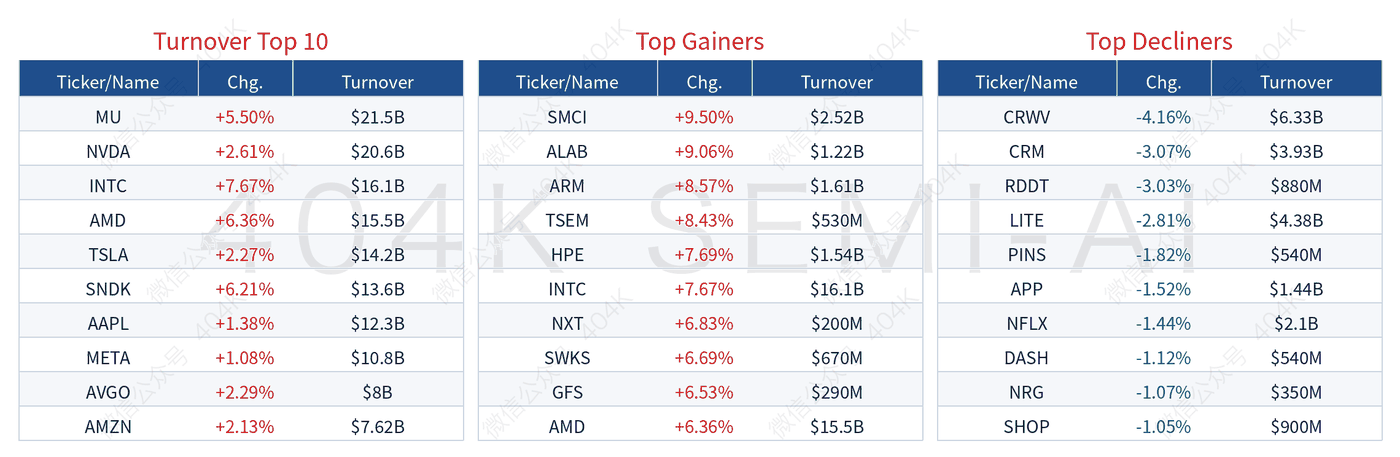
At the close on September 17, US equities were led higher by mega-cap tech, though market breadth remained uneven. The SPDR S&P; 500 ETF (SPY) rose 1.09% and the Invesco QQQ Trust gained 1.63%, while the Invesco S&P; 500 Equal Weight ETF (RSP) and Russell 2000 ETF (IWM) added a modest 0.40% and 0.42%, respectively. By sector, the Technology Select Sector SPDR ETF (XLK) gained 2.26% and the VanEck Semiconductor ETF (SMH) rallied 2.86%, whereas Communication Services (XLC) slipped 0.58%.
CPUs and server vendors outperformed: Intel rose 7.67%, AMD gained 6.36%, and Arm jumped 8.57%; Super Micro Computer (SMCI), Hewlett Packard Enterprise (HPE), and Dell surged 9.50%, 7.69%, and 4.46%, respectively. AI workload requirements are expanding into infrastructure needed for on-premises inference and autonomous agents. While Dell hit a 52-week high, SMH has gained just 0.04% over the trailing 20 trading sessions—underlining that sustained momentum requires ongoing order verification.
Dispersion was equally pronounced across cloud providers and enterprise software. Nebius gained 4.12% and Oracle climbed 5.19%, while CoreWeave fell 4.16%; Salesforce slid 3.07%, while Cloudflare rose 2.86%. Rising GPU rental rates and backlog expansion corroborate underlying compute demand, but financing structures, organic growth, and valuations dictate equity performance. Key near-term signposts: whether rental pricing translates into cash flow, whether on-premises TCO savings drive enterprise deployments, and whether software monetization catches up to usage.
US Equities: 52-Week Highs

The following turnover and performance leaderboards cover tech and related value-chain equities, with gainers/losers filtered for companies with market caps above $10B. Turnover is calculated from closing prices and trading volumes.
US Stocks: Daily Leaderboards
AI & Semiconductor Value Chain
AI Models, Applications & Hyperscaler Capex
OpenAI: Capital Remains Focused on Compute; ROI to Govern Expansion Cadence.
1) The CFO stated that the company raised $122B in Q1 2026 to preserve financial flexibility, with IPO timing proceeding on its own schedule. Management remains focused on securing additional compute, but any future capex adjustments will be driven strictly by ROI.
2) HSBC noted that nearly half of major cloud providers' backlog stems from OpenAI and Anthropic combined—or in some cases, just one of them. While anchor clients validate compute demand, extreme customer concentration means contract commitments must be evaluated alongside actual commercial monetization.
Anthropic: Claude Converts Code Capabilities into Computational Biology Cost Reductions.
1) Anthropic's research team optimized over 30 biological models in under four weeks, achieving an average ~4x speedup (and nearly 2x with bit-for-bit identical outputs). Across 16 targets, binder design achieved simulation scores comparable to earlier benchmarks at ~$150 per run, reducing GPU hours by ~2 orders of magnitude.
2) A low-memory mode enabled accurate modeling of systems exceeding 10,000 tokens; however, scaling to 31,000–70,000+ tokens still exhibited predictive errors—underscoring that execution success cannot be conflated with scientific validation.
3) Claude Code is piloting cloud-based multithreaded task execution for select Pro and Max users, allowing processes to continue running after users close their laptops. As scientific computing and persistent agentic workflows expand model utility, real-world reliability remains the primary hurdle.
CSP & Hyperscale Infrastructure Capex
Google: TPU Expansion Hinges on Debt Financing and Power Interconnection.
1) Ten banks reportedly provided a $22B loan to Crux AI, a joint venture between Blackstone and Google, to finance TPU procurement; the associated 500 MW facility is slated to come online in 2027. Proprietary silicon demand is increasingly being converted into physical infrastructure via dedicated project financing.
2) Separately, Google's data center campus in Fort Wayne, Indiana, is undergoing major construction, with projected power capacity reaching up to 1,200 MW. Because financing, construction, and grid energization occur on distinct timelines, investors must track whether procurement commitments translate into operational compute on schedule.
AI Cloud & Data Center Operators
Oracle: Legacy GPU Lease Renewals Extend Asset Payback Horizons.
Oracle reported that 100% of GPU capacity up for renewal in Q1 was either extended or resold at a 20% premium over previous contract rates, with the vast majority of these GPUs having been in service for four years or longer. This demonstrates that older hardware can retain robust rental value. For cloud operators, economic useful life is governed by realized lease rates and utilization rather than next-generation silicon launch cadences. The key going forward is whether such renewal premiums can be sustained.
