
Contents
Post-Market Wrap
US 52-Week Highs
US Equity Rankings Triptych
AI & Semiconductor Value Chain
Frontier Models, Applications & Enterprise AI Capex
Hyperscalers & Cloud Capex
AI Cloud & Datacenter Infrastructure
Silicon, Processors & Compute Accelerators
Memory, Storage & Advanced Packaging
Semiconductor Foundry
Semiconductor Equipment & Test
Optical Networking, High-Speed Interconnect, Power & Thermal
Internet & Consumer Platforms
Enterprise Software & SaaS
Consumer Tech & Autonomous Mobility
Huang Focus Portfolio
Memory Index Performance
US Memory Turnover Share
AI agents are shifting the competitive landscape from answering queries to executing end-to-end tasks. Meta is aggressively pushing into shopping and payment workflows, while Google faces mounting concerns over the disintermediation of high-value search queries. On the infrastructure side, GPU rental rates, memory supply-demand dynamics, and laser diode lead times all point to persistent capacity bottlenecks. For enterprise software vendors, sustainable monetization hinges on whether incremental usage converts into recurring revenue and whether enterprise customers are willing to pay for continuous consumption.
404K SEMI-AI | 2026-09-24
Post-Market Wrap
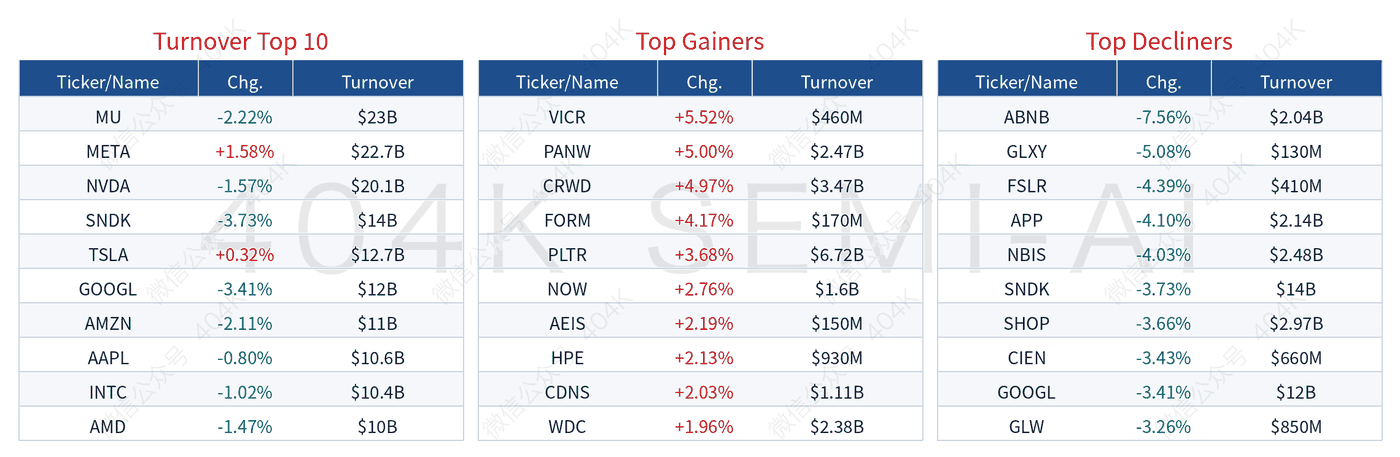
At the close on September 23, US markets retreated across the board: the S&P; 500 ETF dropped 0.68%, the Nasdaq 100 ETF fell 0.77%, and the Russell 2000 ETF lost 1.80%. The Technology Select Sector ETF slipped 0.38%, while the Semiconductor ETF declined 1.09%. Small caps experienced a sharper pullback, and megacap tech saw continued dispersion: Meta gained 1.58% while Alphabet/Google slid 3.41%, reflecting the market's ongoing re-evaluation of how autonomous agents will reshape search gateways and core advertising business models.
Over a 20-trading-day horizon, the Nasdaq 100 ETF rose 4.36%, while the S&P; 500 Equal Weight ETF fell 4.72%. The Semiconductor ETF rallied 8.10% over the same period, posting a 20-day Relative Strength Rating of 88.9. Headline index resilience has not broadened across the wider market. Single-stock performance diverged substantially: CrowdStrike gained 4.97%, Micron dropped 2.22%, and Dell edged up 0.17%, underscoring desynchronized fundamentals across cybersecurity software, memory, and enterprise servers.
The most critical structural shift to track is that AI agents are simultaneously contesting search, e-commerce, and travel discovery while driving baseline compute demand sharply higher. The expansion of Muse's digital wallet and partner ecosystem raises critical questions regarding platform take-rate distribution. Meanwhile, Nebius plans another round of GPU rental price hikes, and Dell continues to emphasize surging inference workloads alongside component shortages. Going forward, investors must independently verify gateway traffic, monetizable usage, and physical datacenter delivery—none of which automatically translate into bottom-line earnings growth.
US 52-Week Highs

US Equity Rankings Triptych
AI & Semiconductor Value Chain
Frontier Models, Applications & Enterprise AI Capex
OpenAI
1) Voice Mode integrates into enterprise workflows: The updated Voice Mode now connects with email, calendar, and Slack plugins, powered by the GPT-6 family (GPT-6 Astra, Sol, and Luna). ChatGPT Work also handles complex multi-step tasks via voice, marking a product transition from conversational chat to autonomous tool execution.
2) Clinical evaluation benchmark: OpenAI introduced MentalHealthBench, spanning 19 languages and developed in collaboration with over 80 clinicians across 22 countries. GPT-6 Astra scored 57.3 compared to 32.1 for GPT-4o. Because scoring still partially relies on model-as-a-judge methodologies, benchmark gains must be distinguished from real-world clinical efficacy.
Anthropic
1) Claude Opus 5.5 release: Competition is increasingly focusing on cost-performance efficiency. Claude Marketplace expanded access across developer tools, autonomous agents, and professional services, simultaneously advancing connectors, software procurement, and enterprise implementations.
2) Reverse transcriptase discovery: Anthropic reported that ~950 Claude agents screened over 200,000 reverse transcriptases in 21 hours, discovering a novel enzyme system dubbed ART. While wet-lab experiments were executed by human scientists, commercial utility remains under investigation.
3) Wholesale datacenter capacity talks: Anthropic is reportedly in preliminary discussions to lease up to 1 GW of direct capacity from Stream Data Centers, evaluating both Google TPUs and NVIDIA GPUs. These discussions remain non-binding, and final hardware allocation cannot yet be determined.
Enterprise AI Procurement: Budgets continue to expand, but corporate procurement is increasingly prioritizing tangible ROI. A survey of 10 enterprises showed that 9 are increasing AI spend, even as model switching, prompt caching, and vendor negotiations compress unit inference costs. Incremental budgets are shifting toward API calls, agentic workflows, and production applications with measurable returns. For software vendors, seat count growth and consumption-based volume are decoupling; whether pilot projects transition into core operational workflows will dictate revenue durability far more than feature rollouts.
