
Contents
Market Wrap
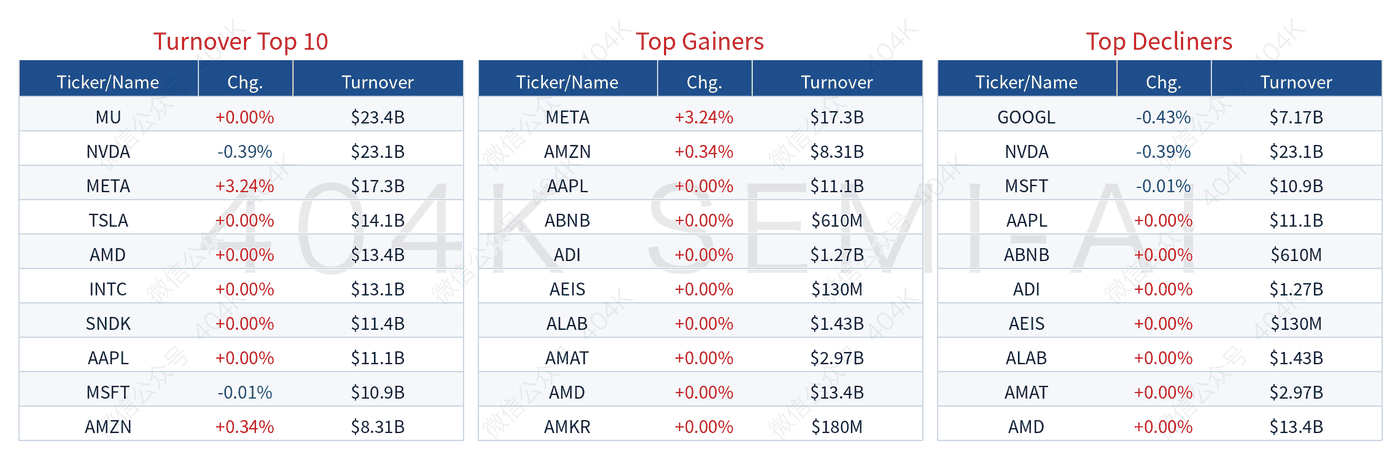
US Equity Leaderboard Triptych
AI & Semiconductor Value Chain
AI Models, Applications & Capex
CSPs & Cloud Capex
AI Cloud & Data Center Operators
GPU/CPU/ASIC
Memory & Storage: HBM / DRAM / NAND / SSD / HDD
Pure-Play Foundry
Semiconductor Equipment & Test
Optical Communications, Networking & Server Infrastructure
Space & Satellite
Internet & Consumer Tech Platforms
Enterprise Software & SaaS
Consumer Electronics & Intelligent Vehicles
Huang's Portfolio
Memory Index Performance
US Memory Turnover Share
Enterprise AI agent competition is shifting revenue distribution across the tech stack. OpenAI is expanding into collaboration, coding, and enterprise marketplaces, while Meta is pushing Muse to small businesses. Long-running tasks are driving incremental demand for NAND flash, networking, and power infrastructure, while traditional application software must prove that customers are still willing to pay for standalone seats. Key catalysts to watch include Micron’s earnings, Marvell’s Investor Day, and the conversion pace from agent trials to recurring paid workloads.
404K SEMI-AI | 2026-09-30
Market Wrap
On September 29, the Nasdaq 100 gained 0.39%, while the S&P; 500 slipped 0.08% and the Russell 2000 fell 0.25%. Semiconductor ETFs gained 1.32%, outperforming broad tech ETFs (+0.16%). While tech and semiconductors retain relative strength, index divergence suggests selective outperformance rather than a broad-based recovery in market risk appetite.
Among mega-caps, Meta gained 3.24% and Amazon added 0.34%, while Alphabet (Google) slipped 0.43%, Nvidia fell 0.39%, and Microsoft eased 0.01%. Underlying business shifts matter more than single-day fluctuations: OpenAI is expanding into enterprise workflows, Meta is scaling enterprise agents, and competition is simultaneously impacting foundation model procurement, SaaS applications, and underlying infrastructure.
Capital flows continue to favor hardware enablers capable of absorbing tangible demand. Semiconductor ETFs are up 9.22% over the past 20 trading sessions, compared to a 4.33% decline in the equal-weighted S&P; 500 ETF. Critical milestones ahead include memory pricing trajectory, cloud backlog conversion, and software monetization: scaling agent usage affects top- and bottom-line economics across these segments in vastly different ways.
US Equity Leaderboard Triptych
AI & Semiconductor Value Chain
AI Models, Applications & Capex
OpenAI
1) OpenAI's annualized revenue run-rate (ARR) has reportedly surged over 70% since early Q3 to nearly $70B, with enterprise business revenue growing more than 100%. At DevDay, OpenAI unveiled Dots (an always-on agent), ChatGPT Space (a collaborative workspace), and an enterprise Marketplace, expanding competition into discrete workflow execution.
2) GPT-6.1 Sol is priced at one-fifth the cost of Astra, with cached prompt/input pricing discounted by 95% compared to standard rates; a new $500/month Pro tier was also introduced. By running low-cost daily models alongside premium high-speed tiers, OpenAI requires enterprise buyers to balance task scale against per-task cost.
3) OpenAI is reportedly seeking to raise at least $30B at an approximate $1.4T valuation, while pausing the rollout of GPT-6.1 Astra due to licensing constraints and operational reporting/governance issues. Commercial expansion remains bounded by safety guardrails and financing conditions.
Anthropic
1) Anthropic reportedly generated nearly $4.6B in revenue in 2025 alongside an operating loss of $8.06B, with compute and infrastructure spend totaling $7.33B. Long-term infrastructure commitments reached $518B, approximately 80% of which are non-cancellable or take-or-pay. Top-line growth must be weighed against these massive long-term payment liabilities.
2) Claude Sonnet 5.5 is priced at $2/million input tokens and $10/million output tokens—half the price of Opus 5.5. Enterprise transaction data shows the share of enterprise customers paying exclusively for Anthropic (and not OpenAI) rose from 4.5% last year to 23.1%. This reflects shifting enterprise procurement dynamics rather than direct revenue market share.
3) In the same dataset, the share of enterprises paying exclusively for OpenAI dropped from 60.6% to 19.2%. As model procurement competition intensifies, whether price cuts can drive sufficient volume elasticity to offset lower per-unit pricing remains the critical test for revenue durability.
Zhipu AI: GLM-5.3 introduces advanced cyber capabilities to open-weight models, setting higher performance bars for defensive software. In benchmark evaluations published by Anthropic, GLM-5.3 achieved 50 end-to-end exploits across 410 ExploitBench trials (compared to 56 for Claude Mythos Preview); in a separate binary exploitation benchmark, it demonstrated a 4% full control-flow hijacking rate. These specific test results cannot be extrapolated to real-world success rates across all environments. The evaluation also highlighted a noticeable gap between the model's out-of-the-box safeguards and post-jailbreak/modified defenses, signaling that enterprise deployments must balance task capability against permission controls.
CSPs & Cloud Capex
Google / Alphabet
1) Piper Sandler projects that Google's TPU business could scale from ~$8B in 2026 to $51B in 2027 and $104B in 2028, driving Google Cloud revenue estimates 15% to 17% above Street consensus. The core assumption is that demand for in-house silicon will reliably convert into monetizable cloud compute.
2) Goldman Sachs raised its 2027 capex forecast for Google from $253B to $507B. While revenue opportunities are expanding, buildout capex is accelerating in tandem, requiring sustained infrastructure utilization and firm pricing to generate acceptable returns on invested capital. Furthermore, the TPU supply chain remains sensitive to mass production timelines and shifting customer procurement patterns, cautioning against viewing long-term projections in isolation.
Amazon: Managed agent services are emerging as a primary on-ramp for cloud infrastructure. OpenAI announced a partnership with AWS to run managed AI agents on AWS infrastructure, extending workload demand from simple model API calls to continuous task execution. Goldman Sachs lifted its 2027 capex estimate for Amazon from $301B to $505B. While the partnership adds meaningful cloud workloads, capex precedes revenue, which accrues only over time with actual customer consumption. Investors must track real-world agent execution volume and fleet utilization rather than treating partnership announcements as upfront revenue.
Microsoft: Cloud investment and enterprise AI revenue must scale in lockstep. Goldman Sachs raised its 2027 capex projection for Microsoft from $227B to $373B. Separately, Jefferies identified Microsoft’s custom XPU as a key growth catalyst for Marvell Technology, estimating the program could reach $12B by CY2029—though this remains a supply-chain estimate rather than confirmed procurement commitments from Microsoft. While aggressive capex, custom silicon programs, and enterprise workflow adoption all signal expanding infrastructure demand, investors must track actual deployment schedules and production workloads to avoid double-counting semiconductor opportunities and end-market cloud revenue.
