
Contents
Market Wrap
US Equities: 52-Week Highs
Daily US Market Leaderboards
AI & Semiconductor Value Chain
Frontier Models, AI Applications & Capex
Hyperscalers & Cloud Capex
AI Neoclouds & Data Center Operators
GPU, CPU & Custom Silicon
Memory & Storage (HBM, DRAM, NAND & HDD)
Semiconductor Foundry
Semiconductor Equipment & Test
Advanced Packaging, OSAT & Substrates
Passives, MLCC & Power Delivery
Optical Networking & Transceivers
Internet & Consumer Platforms
Software & Enterprise SaaS
Consumer Tech & Intelligent Mobility
Jensen Huang's Curated Portfolio
Memory & Storage Index Performance
US Memory Stocks Turnover Share
Surging short-term compute pricing has lifted earnings expectations for AI neoclouds, notably CoreWeave and Nebius. Realizing these gains, however, hinges on timely hardware delivery, grid power availability, and operational uptime. Meanwhile, optical interconnect supply bottlenecks and HBM advanced packaging verification requirements continue to direct capital expenditure toward critical supporting infrastructure.
404K SEMI-AI | September 25, 2026
Market Wrap
At the close on September 24, the S&P; 500 ETF slipped 0.13%, the Nasdaq-100 ETF edged down 0.09%, and the S&P; 500 Equal Weight ETF fell 0.53%. Broad-market losses were contained, but equal-weight underperformance highlighted the absence of broad participation. The Technology ETF fell 0.59%, while the Communication Services ETF gained 1.10%, underscoring continued divergence within Mega-Cap Tech.
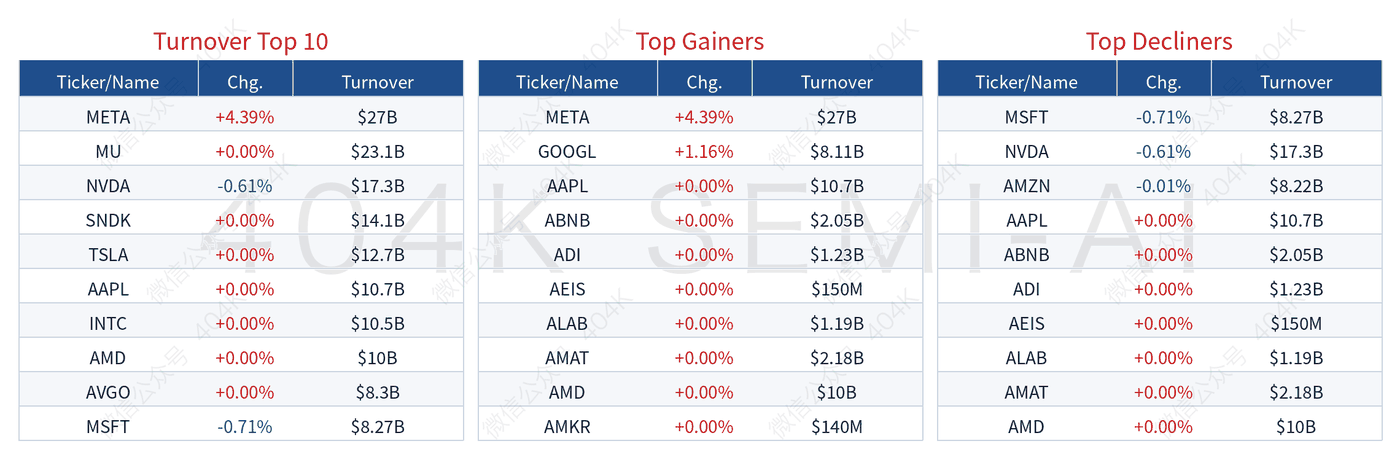
The Semiconductor ETF declined 0.17%, though it remains up 7.10% over the trailing 5 sessions and 8.03% over 20 days. Meta rallied 4.39% to a fresh 52-week high, and Alphabet (Google) gained 1.16%, while NVIDIA shed 0.61% and Microsoft eased 0.71%. Growing market enthusiasm for consumer-facing AI agents diverged from the hardware supply chain following its prior rebound.
Fundamental developments centered on rental pricing and delivery execution: short-term compute premiums drove upward revisions to AI cloud earnings, while Oracle's payment deferral dispute at a data center site underscored ongoing power and construction bottlenecks. Optical networking demand expanded further, and SK Hynix began shifting HBM failure screening upstream. Ultimately, converting elevated spot quotes into bottom-line earnings still depends on energized capacity, operational uptime, and financing costs.
US Equities: 52-Week Highs

Daily US Market Leaderboards
AI & Semiconductor Value Chain
Frontier Models, AI Applications & Capex
OpenAI: Model price cuts are decoupling enterprise token consumption from total software budgets. GPT-6 Sol and Luna reportedly reduce API costs by 50% relative to prior-generation counterparts; as enterprises accomplish the same workloads at lower unit costs, volume expansion may not proportionally expand spend. On Apple devices, ChatGPT integration engagement and conversion still trail expectations, as opt-in defaults and multi-step setups create onboarding friction. App-level monetization must be evaluated across query volume, unit pricing, and real activation rates.
Anthropic:
1) Preference alignment remains the primary bottleneck for agentic autonomy. In Project Swap—a book exchange trial involving 201 employees—Claude achieved 61% pairwise accuracy in predicting personal preferences. Actual market allocation efficiency scored 0.55 versus an optimal 0.89 benchmark, with preference articulation errors accounting for 85% of the performance gap.
2) Participants were willing to delegate an average of 30% of their annual book budgets to AI agents; however, an internal employee sample, absence of monetary incentives, and lack of adversarial testing constrain extrapolation.
3) Opus 5.5 reportedly lowers inference costs by 40% compared to previous frontier models. While stronger models and richer user context improve utility, sustained commercialization requires verifying users' willingness to pay recurring fees and grant ongoing authorization.
DeepSeek: Top-line revenue growth is establishing observable commercial viability for model investments. Annualized run-rate revenue has reportedly surpassed $1 billion, with gross margins reaching 82.9% from January through July. The company is advancing a RMB 50 billion funding round at a RMB 500 billion valuation, targeting a late-October close. Run-rate revenue merely reflects current velocity, and the funding round remains in progress. Going forward, investors must monitor actual capital closing, sustained revenue expansion, and compute costs—rather than conflating high gross margins with robust free cash flow.
Hyperscalers & Cloud Capex
Google:
1) Model competition continues to drive down unit costs. Gemini 3.8 Flash scored 89.2% on ARC-AGI-2 at $0.40 per task, and 98.5% on ARC-AGI-1 at $0.21 per task. Benchmarks across distinct evaluation suites should not be conflated.
2) Gemini 4 has entered post-training, with the team aiming to release early checkpoints soon; full commercial release awaits formal scheduling.
3) Google partnered with Planet to develop a prototype satellite launching on SpaceX's Transporter-18 mission to test TPU survivability and operation in orbit. This validates hardware resilience under space conditions, though fully operational orbital AI infrastructure remains distant.
Meta: Captive capacity and custom silicon will dictate whether Meta can absorb surging compute costs as consumer agents scale. BofA estimates Meta will deploy 5–6 GW of proprietary data center capacity by 2027 at ~$200 billion in capex, with custom silicon initiatives potentially generating ~$8.5 billion in cost savings. Muse provides users with dedicated cloud-hosted virtual computers, consuming substantial CPU, DRAM, browser, and storage resources beyond model inference alone. Because both capacity and savings figures are Wall Street estimates, actual outcomes depend on execution velocity and realized unit-service costs.
AI Neoclouds & Data Center Operators
Oracle: EPC execution risks are spilling into commercial payment schedules. Oracle reportedly issued a force majeure notice to Blue Owl, the developer of the "Project Jupiter" campus in New Mexico, seeking to defer lease payments if the facility fails to energize by 2028, while retaining its anchor tenant status. The campus is designed for 2.45 GW and backed by an $18 billion loan syndicate comprising ~20 banks. An Oracle spokesperson reiterated that the project remains on track. Revenue recognition must be assessed across utility interconnection permits, construction timelines, and contractual lease liabilities.
