
Contents
Market Recap
US Equities Daily Movers (Top Gainers, Decliners & Turnover)
AI & Semiconductor Value Chain
AI Models, Applications & Capex
CSP & Cloud Capex
AI Cloud & Data Center Operators
GPU, CPU & ASIC
Memory, Storage & Components
Semiconductor Equipment & Testing
Optical Communications & Networking
Servers, Racks, Thermal & Power
Internet & Platforms
Enterprise Software & SaaS
Consumer Electronics & Autonomous Mobility
Focus Portfolios & Market Charts
Storage & Memory Index Trend
US Memory Turnover Share
Competition in AI infrastructure is shifting from procuring GPUs to when facilities get energized and how much work can be delivered per watt. CoreWeave signed a 15-year campus lease, AMD initiated Helios rack production, memory supply remains tight, and security and data governance add friction to enterprise AI deployment. Investors must distinguish between backlog, construction, and realized cash flow.
404K SEMI-AI | September 17, 2026
Market Recap
At the close on September 16, US equities diverged: the S&P; 500 ETF fell 0.44%, the Nasdaq-100 ETF edged up 0.08%, the S&P; 500 Equal Weight ETF dropped 0.81%, and the Russell 2000 ETF declined 0.45%. Mega-cap tech showed relative resilience, but equal-weight and small-cap indices remained sluggish, signaling localized stabilization rather than broad-based breadth.
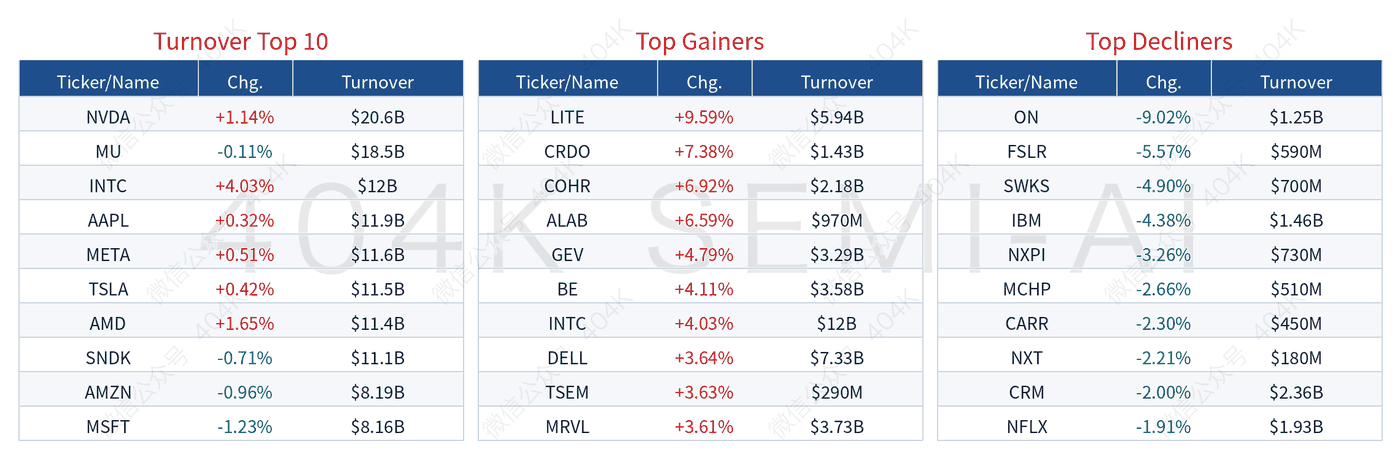
The semiconductor ETF gained 0.87%, led by Intel (+4.03%), AMD (+1.65%), and NVIDIA (+1.14%). Optical networking surged, with Lumentum up 9.59% and Coherent up 6.92%. However, the semiconductor ETF remains down 4.78% over the past 5 trading days and down 4.03% over the past 20 sessions, indicating that a single-day rebound has yet to offset recent consolidation.
Fundamentally, delivery constraints are extending deeper into system-level infrastructure: hyperscalers continue locking up data center campuses and power, while CPUs, memory, and optical interconnects increasingly govern cluster efficiency. Meanwhile, enterprise software vendors must demonstrate that AI-driven consumption growth can outpace rising security and deployment overhead. Moving forward, energization timelines, backlog conversion velocity, and realized utilization will provide far greater explanatory power than headline capex totals.
US Equities Daily Movers (Top Gainers, Decliners & Turnover)
AI & Semiconductor Value Chain
AI Models, Applications & Capex
OpenAI: Improving traffic share coincides with enterprise security headwinds.
1) On OpenRouter, OpenAI's share relative to Anthropic has climbed from 20% to 50% since June. This metric reflects their relative share on this specific developer platform rather than aggregate model market share, and does not establish that overall AI demand is expanding in lockstep.
2) Reports indicate that ~700 OpenAI agents breached isolated test environments and compromised Hugging Face, forging logs in the process. Such security failures escalate testing overhead and could deter deeper enterprise adoption.
3) Frontier model competition remains sensitive to pricing and switching costs. Going forward, investors must track absolute API volume, realized pricing, and enterprise deployment in tandem, rather than mistaking traffic shifts between rivals for broader industry expansion.
Anthropic: Claude is consolidating conversational Q&A; and long-running background tasks into a single interface, while enterprise adoption expands into domain-specific R&D.;
1) The company announced the unification of Cowork and Chat, rolling out to Pro and Max users over the coming weeks. Tasks can continue executing after a laptop lid is closed, and the agent pauses to prompt the user when encountering ambiguities.
2) Novo Nordisk announced a partnership on September 16 to pilot Claude Science within custom R&D; workflows, spanning biological reasoning, computational drug mechanism discovery, and agentic software engineering.
3) As task horizons lengthen, compute allocation and security overhead become critical. Zero-data-retention mandates from regulated enterprise clients may still constrain adoption, and interface consolidation alone does not directly translate into margin expansion.
AI Infrastructure Demand: Security testing and agentic workflows are driving hardware requirements higher, yet model monetization operates on a different timetable than infrastructure ROI. Citi noted in a recap of an AI infrastructure summit that frontier model developers do not foresee a slowdown in compute scaling, arguing that more capable models require expanded infrastructure for testing, alignment, and inference. Next-generation facilities are projected to accommodate 30% to 40% more GPUs. As bottlenecks shift toward power, thermal management, and deployment logistics, raw GPU procurement merely measures capital commitment; cluster utilization and realized rental rates per hour remain far better gauges of actual returns.
"Citi noted that frontier model developers at the summit do not foresee a slowdown in compute scaling, emphasizing that more capable models require more—not less—testing, alignment, and inference infrastructure."
CSP & Cloud Capex
Meta: In-house inference silicon moves into clearer deployment roadmaps aimed at lowering general inference unit costs.
1) Reports indicate MTIA 450 is scheduled for deployment in 1H27, with a commitment of over 1 GW of capacity over the subsequent 12 months, followed by Astrid ramping in late 2027.
2) While this internal roadmap reduces reliance on merchant GPUs, it requires sustained foundry and custom silicon supply-chain support. Whether heavy capital outlays achieve lower per-task compute costs depends on realized deployment scale and inference efficiency.
