Contents
Core Weekly Thesis
Weekly Chronology & Progression
Memory Universe Weekly Performance
DRAM / HBM: Supply Allocation, Long-Term Agreements, and Qualification Moats
LPDDR / SoCAMM: AI CPUs and Rack-Level Memory Spillover
NAND / eSSD: Inference Caching, RAG, and Enterprise SSD Pricing Elasticity
Nearline HDDs: AI Data Lakes, Exabyte Deliveries, and Cash Realization
WFE Equipment, Test, and Materials: Second-Order Memory Capex Beneficiaries
Downstream Cost Transmission & Demand Destruction: Servers, Networking, Smartphones, PCs, and EVs
Investment Hierarchy, Risk Matrix, and Falsification Framework
What to Watch Next Week
Super-normal memory margins are securing longer-duration contract backing, even as the burden of pricing pressure shifts downstream. This week, we prioritize DRAM and HBM backed by contractual insulation, followed by pricing elasticity in enterprise SSDs (eSSDs). Downstream capacity additions, client de-spec'ing, and capital return execution will ultimately dictate whether headline operating margins translate into enduring shareholder value.
Core Weekly Thesis
Two structural shifts are unfolding simultaneously across the memory value chain: memory makers are locking in future supply further out along the curve, while downstream customers are aggressively reassessing the per-system memory density they truly require. Long-term supply commitments extend cash-flow visibility; downstream optimization caps unconstrained demand forecasts. Evaluating both forces in tandem is essential to distinguishing durable structural growth from earnings already pulled forward.
Micron's latest earnings report provided concrete fundamental ballast for the bull thesis. The company has secured 26 strategic customer agreements (SCAs)—some extending out to 2031—while guiding for tighter industry supply-demand dynamics in 2027 and 2028 than in 2026. Resilient enterprise SSD demand is corroborated by independent pricing surveys: industry forecasts cited by Goldman Sachs position eSSDs as the strongest segment for Q4 price increases. Long-term contracts, trailing execution, and forward price vectors are aligned in the same positive direction—yet they do not eradicate underlying cyclicality.
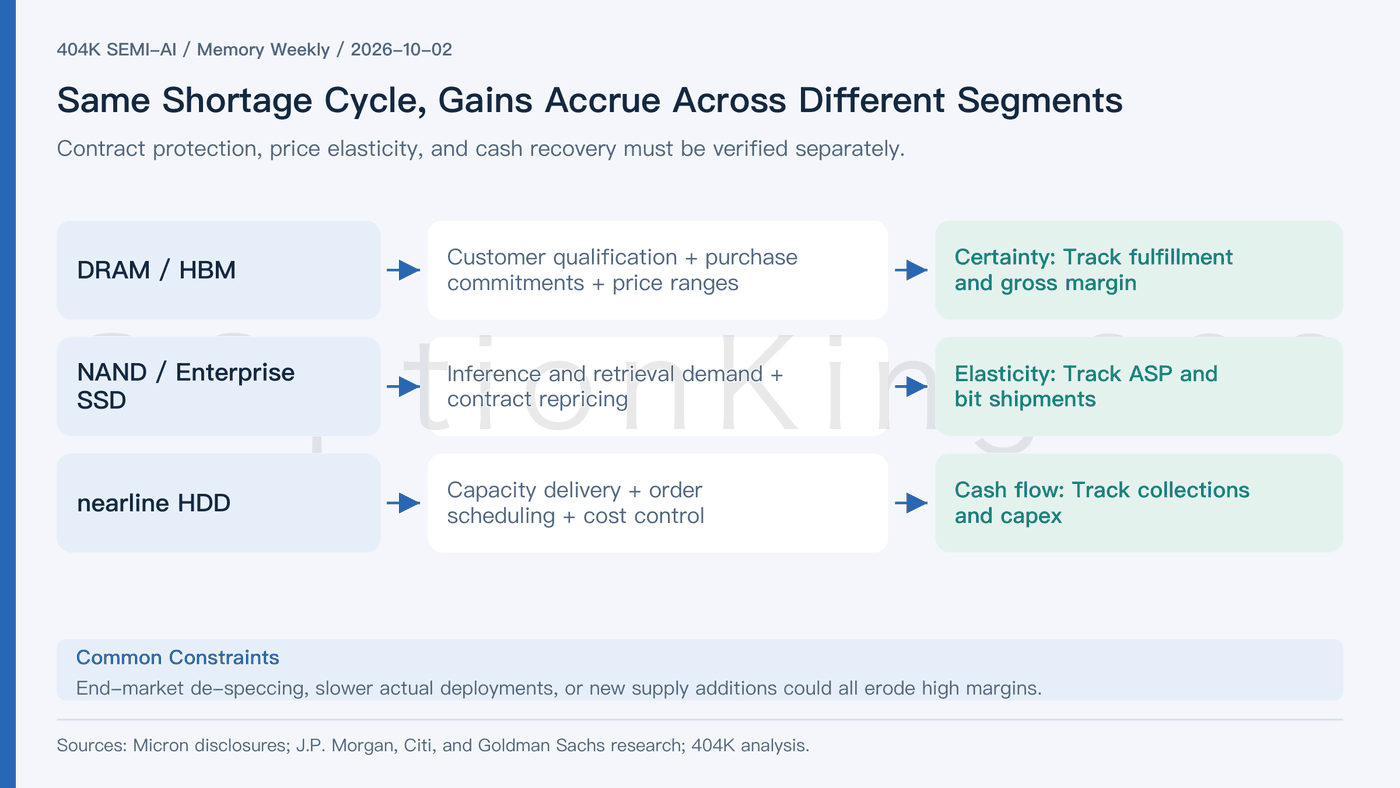
The primary source of alpha this week lies in recognizing that fundamental visibility, pricing elasticity, and cash generation stem from fundamentally different drivers:
DRAM and HBM visibility is anchored in rigorous customer qualifications and binding contractual commitments.
NAND and enterprise SSD elasticity is driven by rapid contract repricing and high-margin product mix shifts.
Nearline HDDs must prove their economic returns through raw exabyte shipments and working-capital cash conversion.
WFE equipment vendors' revenue recognition remains separated from memory capex announcements by cleanroom construction timelines, tool move-in schedules, and acceptance sign-offs; headline memory capex cannot be conflated 1:1 with near-term tool billings.
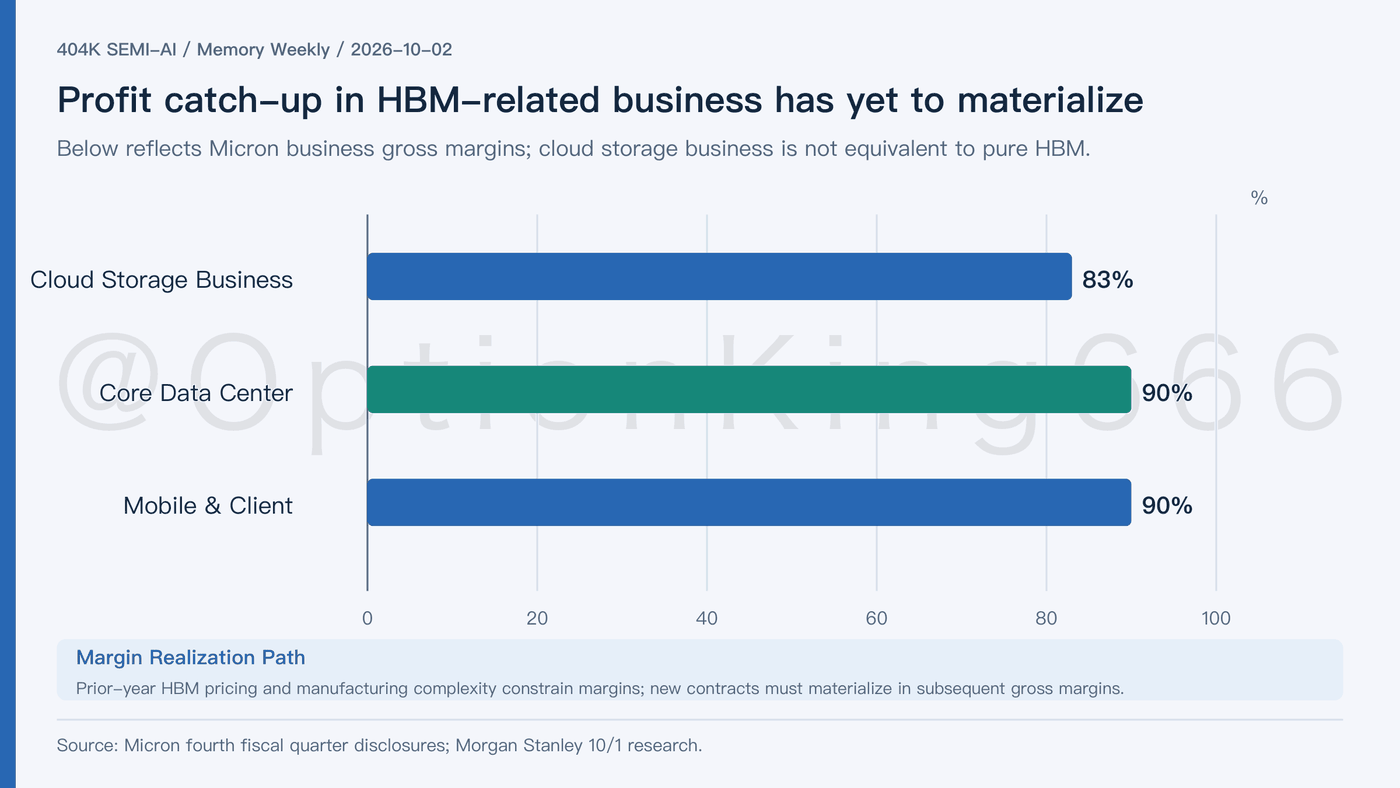
Disparities are also widening within high-margin tiers. Micron’s Cloud Memory business posted a gross margin of 83% in fiscal Q4—meaningfully lower than the 90% recorded in its core Data Center and Mobile Client segments. This demonstrates that near-term HBM shipment growth does not automatically lift consolidated corporate gross margins. Legacy fixed-price contracts and elevated advanced packaging complexity temporarily cap profitability; the next phase of margin expansion hinges entirely on contract repricing. For investors, architectural technological leadership and quarterly cash-flow capture remain two distinct propositions requiring separate empirical proof.
Simultaneously, credible counter-evidence is emerging that coexists with supply tightness: tier-1 hyperscalers and OEMs are exploring lower HBM layer counts, consumer-facing end-market procurement remains sluggish, and select NAND wafer spot prices have softened. Memory makers will predictably allocate scarce wafers to high-paying data center accounts, forcing price-sensitive consumer and edge segments to absorb cost hikes, downgrade memory configurations, or curtail build plans. Consequently, we maintain a positive view on memory vendor earnings durability while paring back expectations of synchronized across-the-board pricing power and uniform equipment tool-ins.
Weekly Chronology & Progression
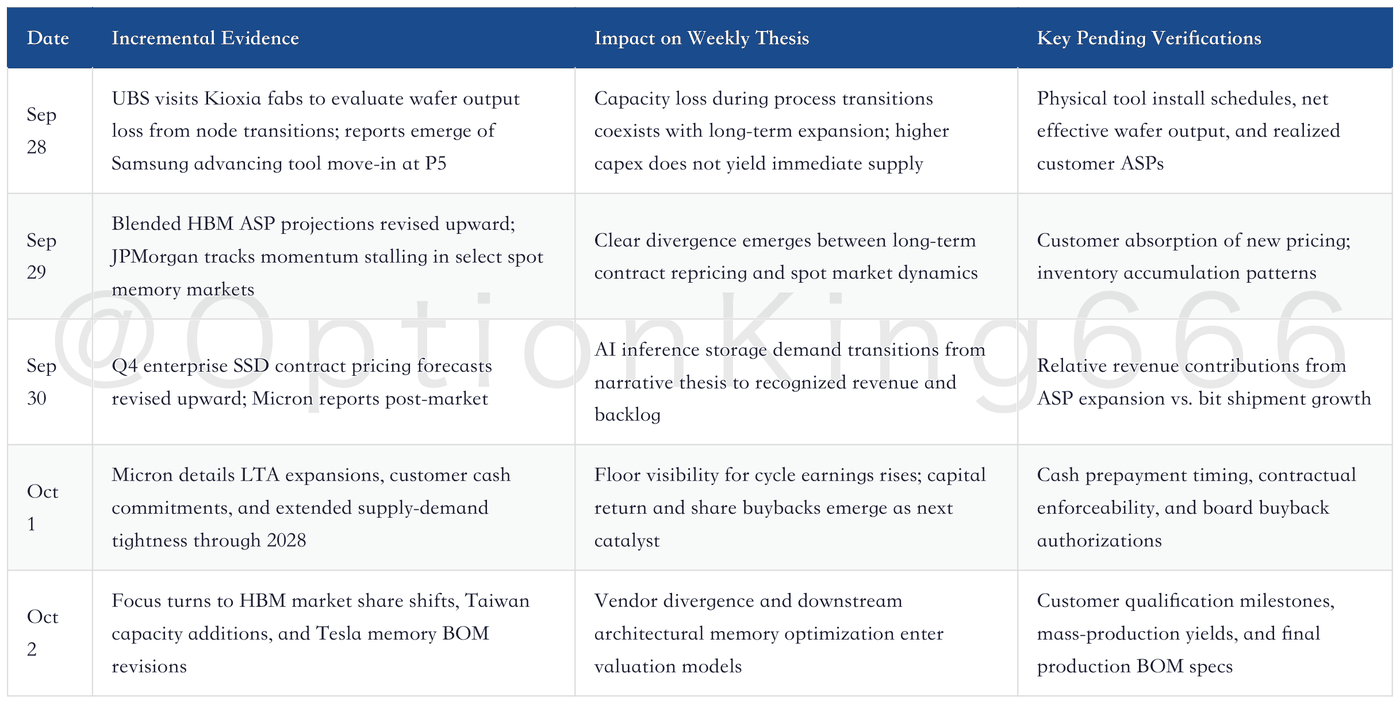
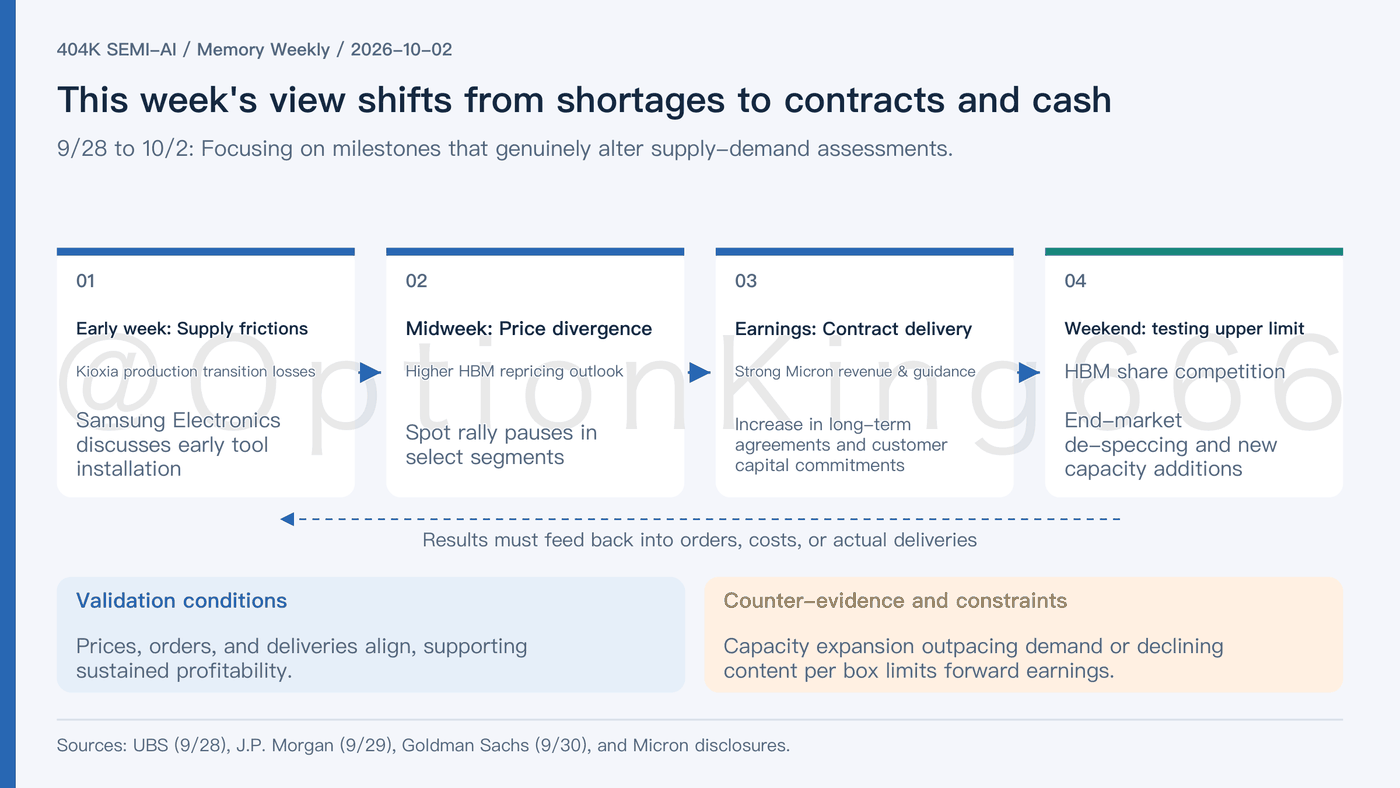
Over the past week, the analytical narrative evolved from generic "procurement anxiety" to "contractual execution and realized cash deposits," before running into constraints around client de-spec'ing and long-term capacity expansion. Chronologically, the pivotal thesis-shifting developments clustered around specific inflection points:
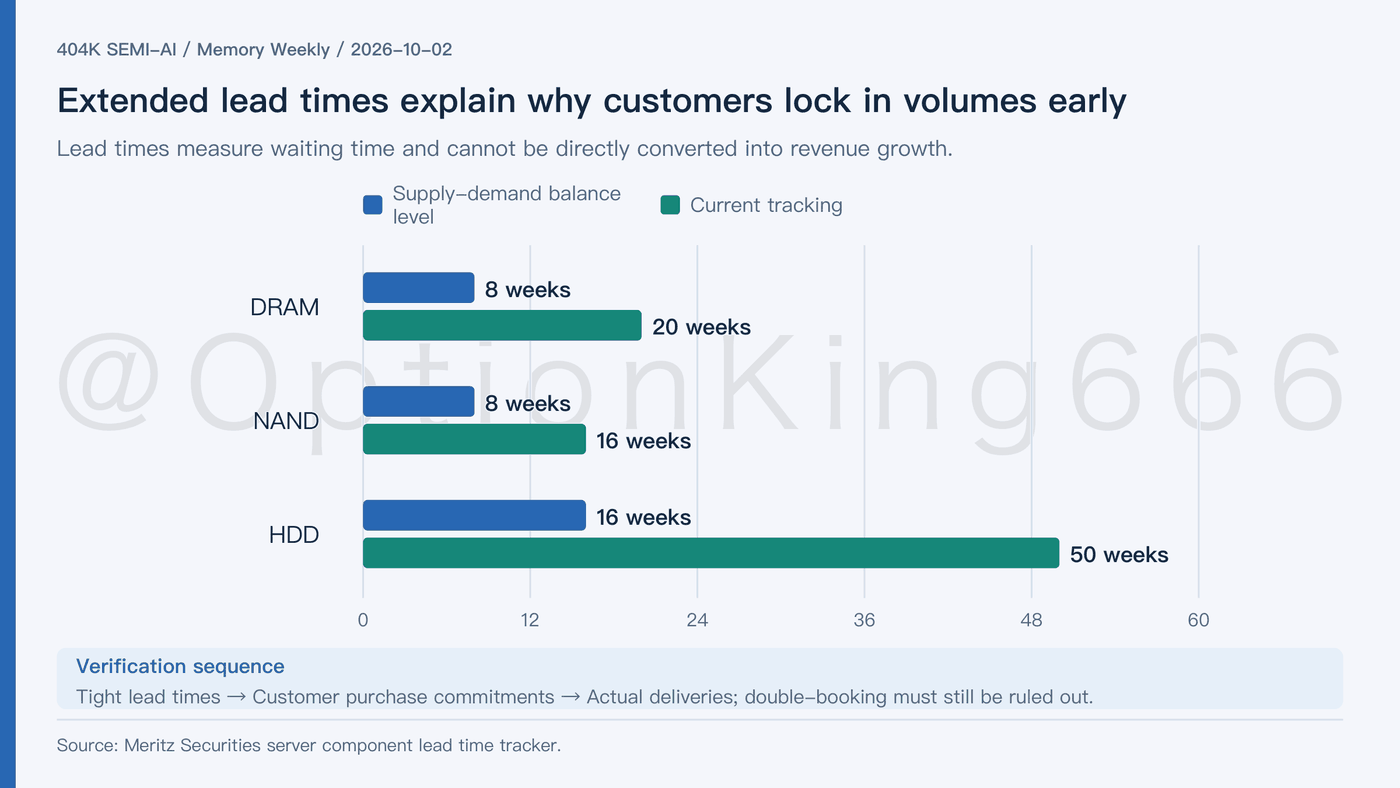
Lead-time data early in the week clearly explains why hyperscale buyers are rushing to commit forward capital. In Meritz Securities' server component tracking, lead times for DRAM, NAND, and HDDs remain stretched well above supply-demand equilibrium levels. Extended lead times strip procurement teams of just-in-time replenishment flexibility, forcing them to prioritize wafer allocation quotas. However, extended lead times do not indicate the absolute trajectory of future industry revenue growth, nor do they rule out phantom double-booking.
Empirical confidence sharpens when lead times are paired with Micron's verified balance-sheet cash receipts. A vendor’s qualitative claim of robust demand may reflect uncommitted order indications; a customer’s willingness to wire substantial non-refundable cash deposits carries real opportunity costs of capital. While this shifts the probability toward sustained high mid-cycle profitability, uncommitted financial promises cannot be recognized as realized income, nor do they guarantee downstream deployment velocity.
Echo-chamber repetition of a single headline does not increase analytical independence. Multiple sell-side model revisions following Micron’s print were simply reactive adjustments to a single corporate disclosure. Far more valuable cross-validation emerged from independent data points: Kioxia’s fab-level transition frictions, third-party enterprise SSD pricing surveys, and downstream hardware OEMs' escalating bill-of-materials (BOM) cost inflation. These triangulate the cycle across physical supply, realized pricing, and buyer elasticity.
Memory Universe Weekly Performance
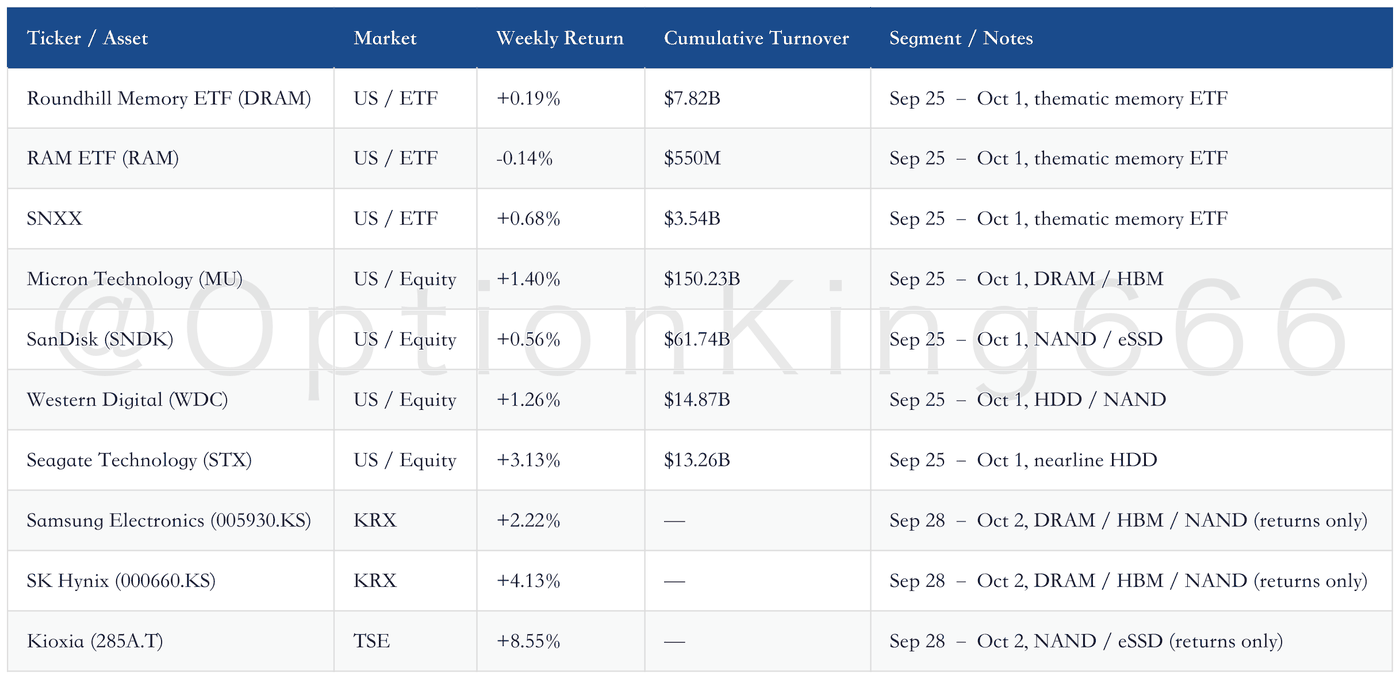
Memory equities trended higher this week, but share prices did not re-rate to the full extent of forward earnings revisions. Given asynchronous trading sessions and reporting calendars across US and Asian exchanges, performance is best evaluated within respective local trading windows rather than treating returns as synchronized trades.
DRAM / HBM: Supply Allocation, Long-Term Agreements, and Qualification Moats
Micron's forward revenue guidance is far more constructive than its trailing quarterly beat. Despite fiscal Q4 benefiting from an extra 14th week, Micron guided for sequential top-line growth in fiscal Q1 on a normalized 13-week schedule. Normalizing revenue on a per-week run-rate basis removes calendar distortion (note: this serves as normalized comparative analysis, not official corporate guidance):
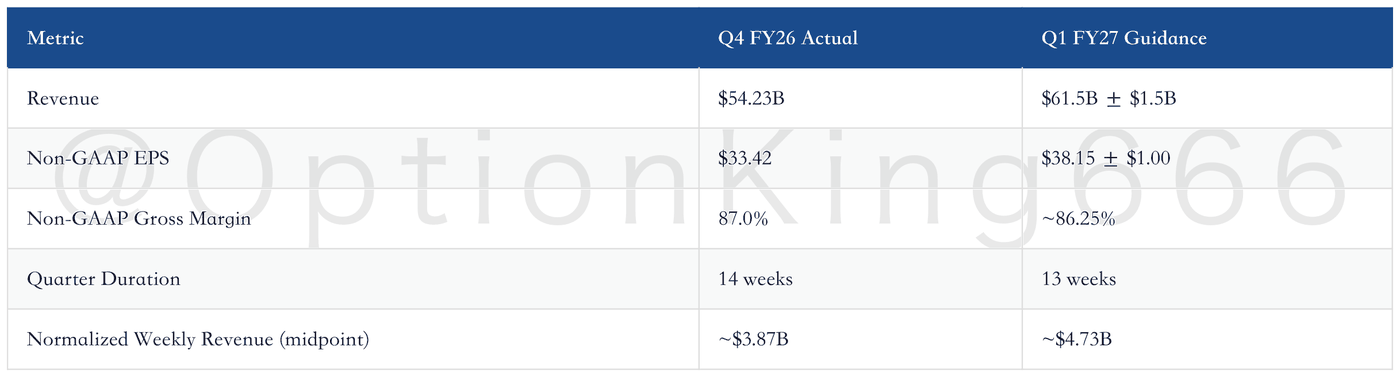
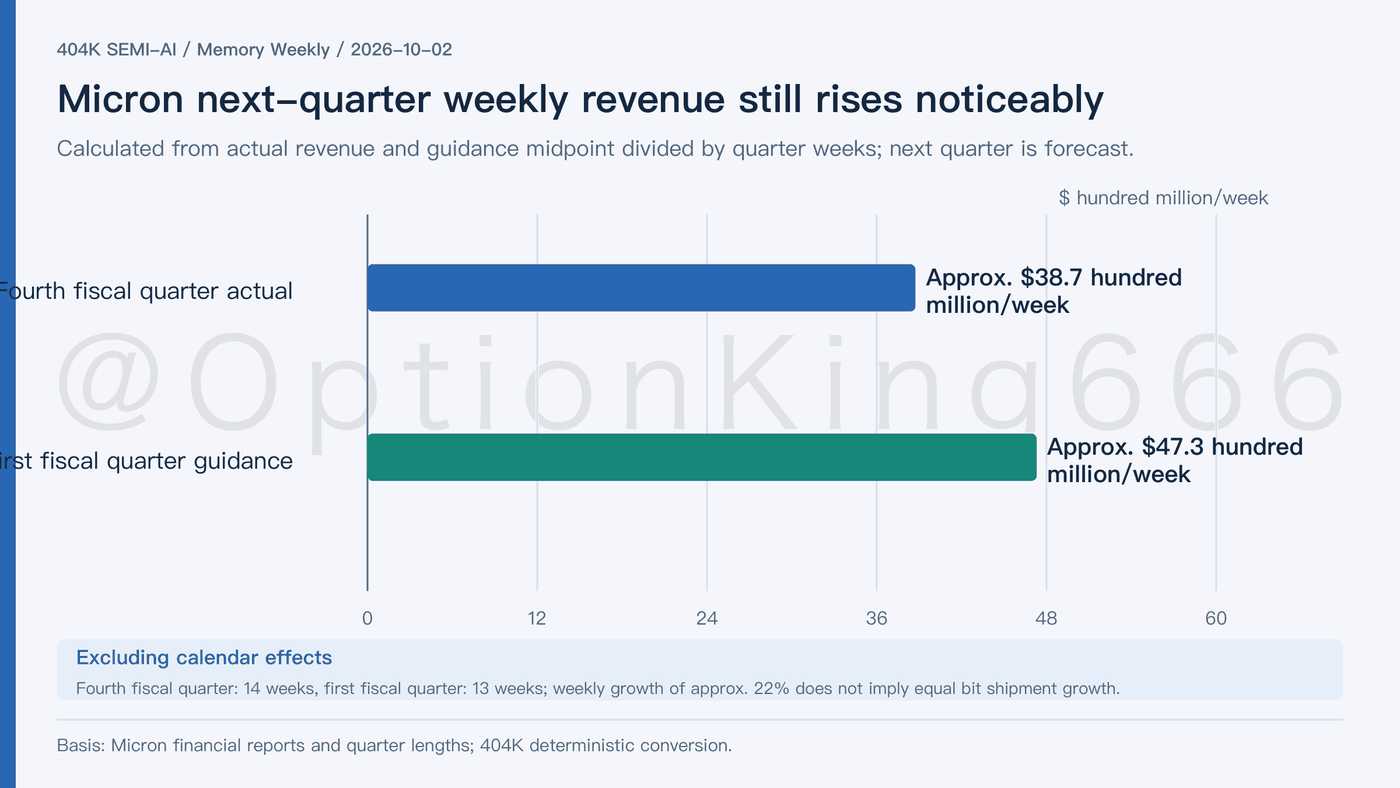
On a normalized basis, weekly revenue expands by approximately 22% sequentially, confirming that the return to a standard quarter does not mask underlying top-line momentum. However, top-line acceleration cannot be directly equated with accelerated bit output. Blended DRAM price increases contributed substantially to incremental dollar gains; true supply capability must be evaluated separately via bit shipments, node migrations, and defect densities.
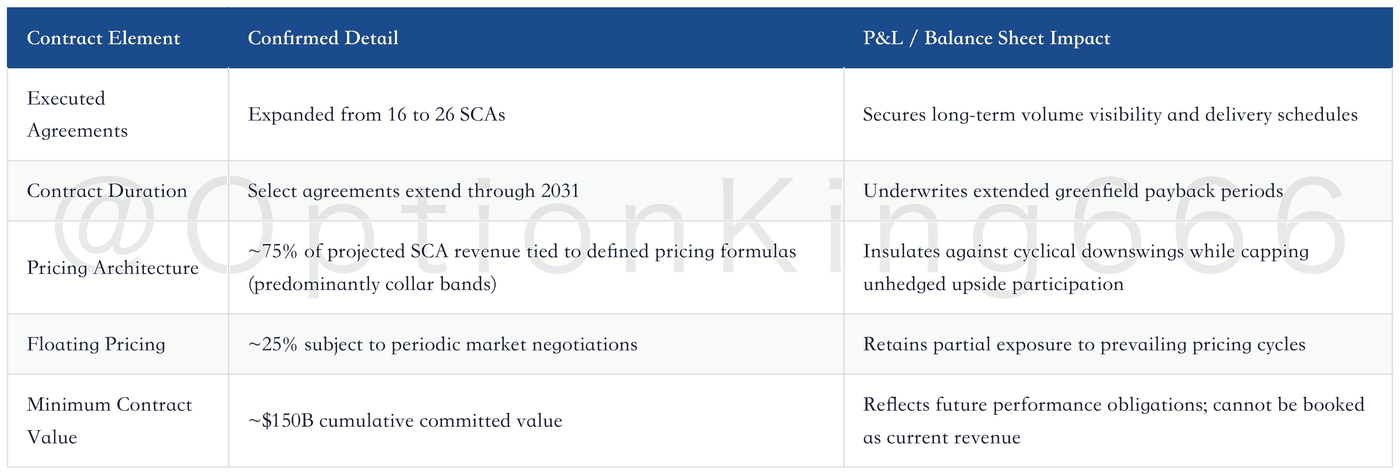
The expansion of Micron's strategic agreements structurally alters risk allocation between supplier and customer. Hyperscalers exchange prepayments and multi-year purchase commitments for guaranteed wafer allocations, while Micron leverages pricing collars and volume schedules to de-risk greenfield capex. This de-risks fab financing, but inherently caps the company’s upside capture if spot pricing spikes further.
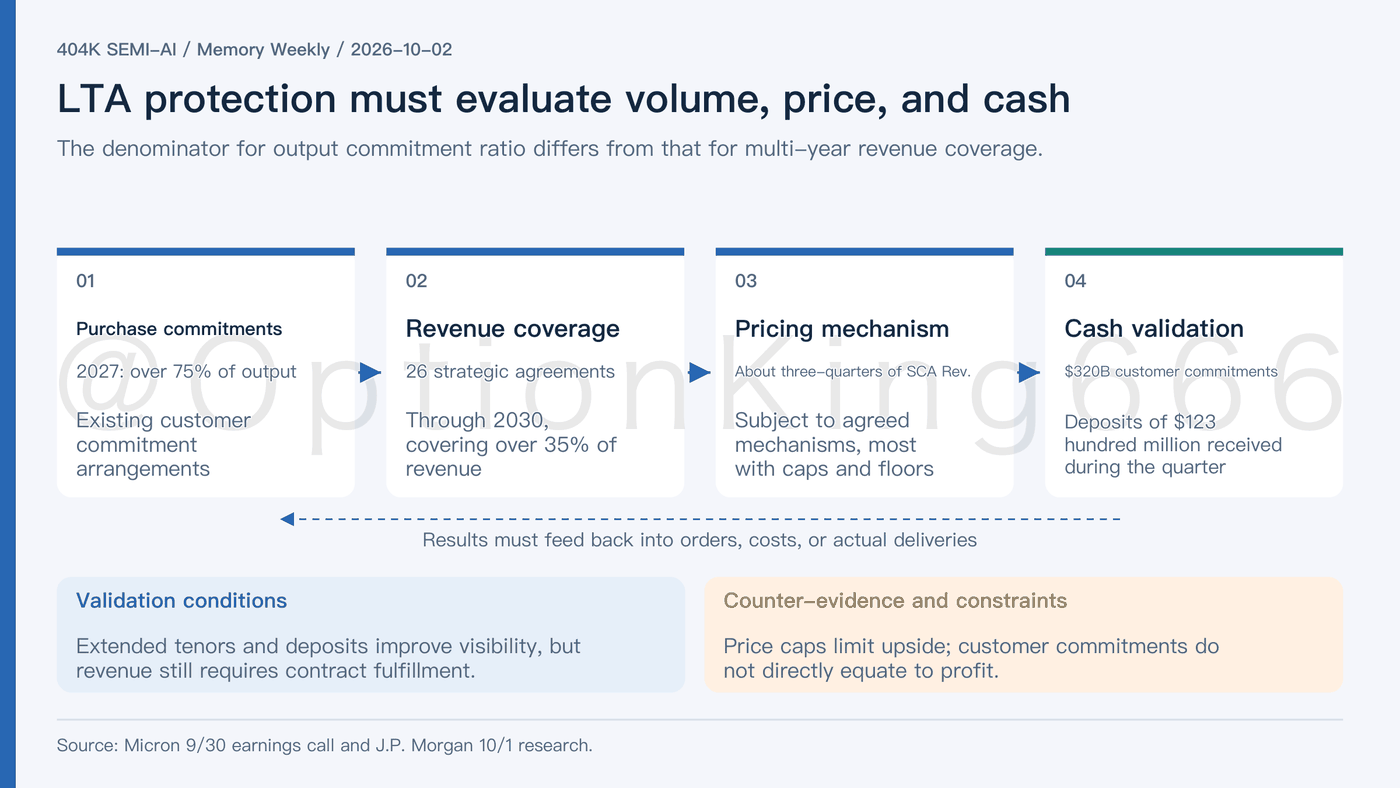
Crucially, investors must distinguish among committed bit output, LTA revenue coverage, and actual cash collected:
Committed output: Over 75% of Micron’s projected 2027 output is contracted under customer commitments (including SCAs and other commercial arrangements).
Revenue coverage: 26 SCAs cover more than 35% of cumulative projected revenue through 2030 (a distinctly different denominator and timeframe).
Customer financial commitments: Total $32 billion, of which $12.3 billion in customer deposits was actually received on the balance sheet through fiscal Q4. It is an analytical error to book total commitments as current liquid cash.
The next leg of HBM margin expansion relies on contract repricing. While Micron's Cloud Memory business expanded revenue sequentially in Q4, segment gross margin remained at 83%—trailing the 90% recorded in core Data Center and Mobile Client businesses. Management noted that broader memory price appreciation was diluted by a rising mix of HBM. Note that Cloud Memory encompasses HBM alongside other cloud-targeted products; it is not a pure-play HBM reporting line.
Fixed-price annual contracts cause HBM realized pricing to lag commoditized DRAM market inflections. Memory makers have absorbed advanced packaging costs, yield fallout, and high silicon wafer penalties, but have yet to capture current spot pricing. Consequently, whether 2027 contract renewals successfully compress this gross margin gap is far more predictive of forward earnings revisions than trailing HBM top-line growth.
Morgan Stanley estimates that if Cloud Memory gross margins catch up to Micron's other high-margin business units, it could add approximately $9.00 in quarterly EPS. However, this remains a conditional scenario dependent on simultaneous yield improvements, packaging cost reductions, and price realization—it cannot be treated as locked-in profit. For Micron, the margin expansion roadmap is clearer, but execution is still pending.
Sell-side projections for future HBM ASP increases diverge widely. JPMorgan projects blended 2027 HBM ASPs to rise 54%, whereas external industry forecasts call for a 121% surge; Goldman Sachs models an even more aggressive trajectory for Samsung. These forecasts encompass different company footprints, product generations, and customer mixes—they cannot be averaged casually, nor can blended ASP gains be interpreted as price hikes on identical product specs.
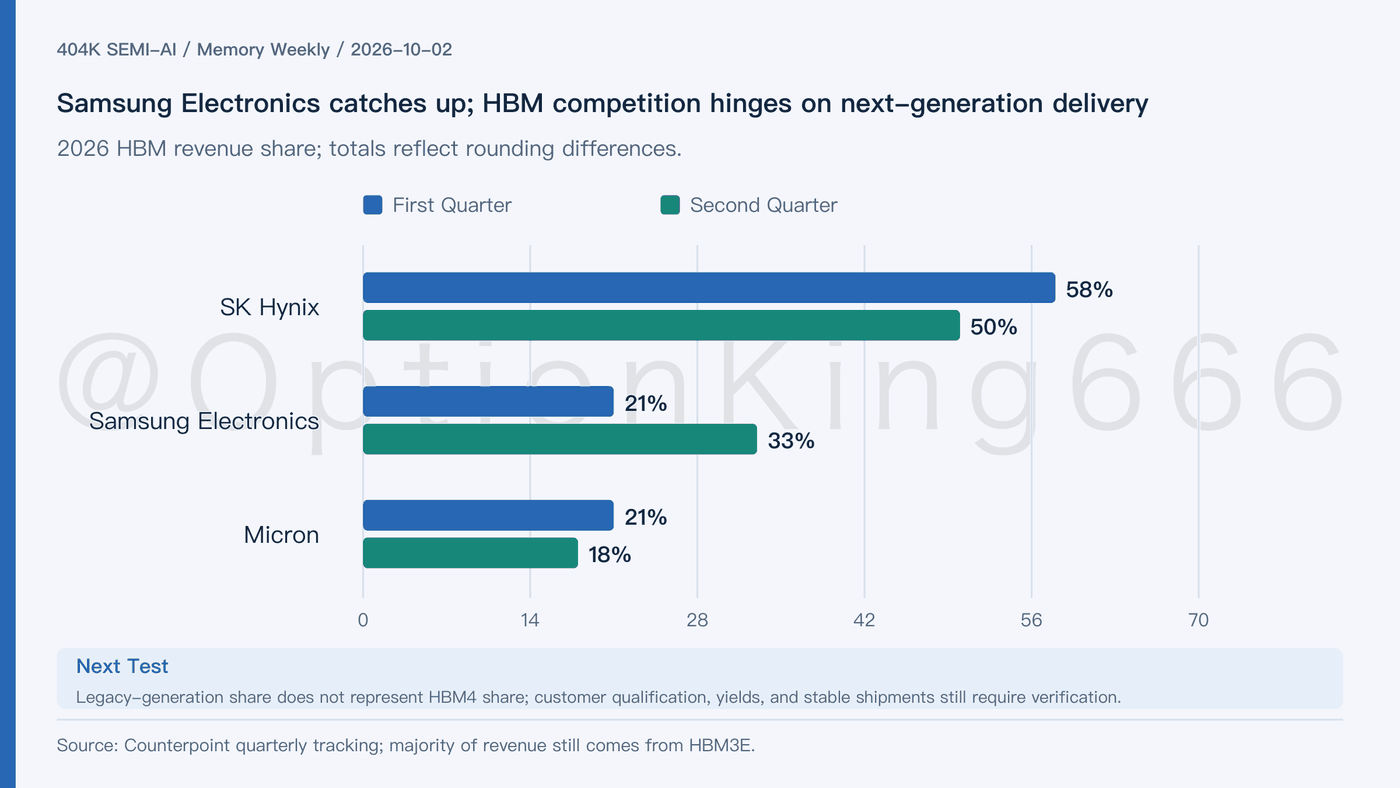
Samsung Electronics' investment thesis centers on market share recovery. A sharp rebound in Samsung’s HBM revenue share during Q2 2026 confirms shifting competitive momentum; however, the vast majority of that revenue was still derived from HBM3E. Extrapolating legacy-generation share directly into HBM4 prematurely bypasses two critical gates: tier-1 customer qualification and mass-production advanced-node packaging yields.
SK Hynix remains the market leader, but must continuously defend its franchise with flawless delivery. Bernstein highlighted concerns regarding potential transition friction in HBM4; conversely, Daishin Securities argued that market quality debates have not disrupted operational execution, noting zero confirmation of actual shipment cancellations. The crux of the debate is whether technical hurdles can be resolved before customer volume schedules kick in. Speculative friction should not be conflated with confirmed product recalls.
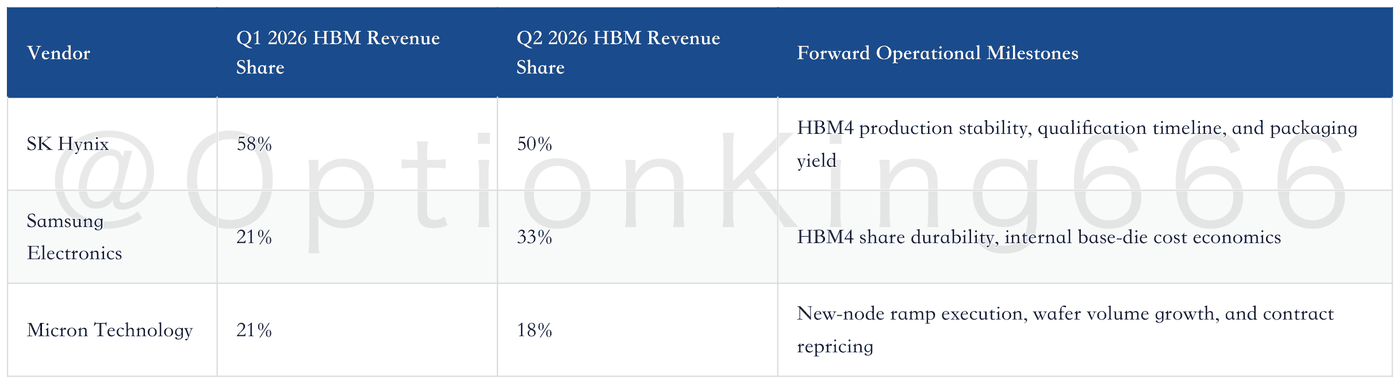
(Note: Data reflects industry tracker estimates; rounding differences exist. Bernstein’s forward bit shipment share projections and JPMorgan’s revenue share models measure distinct metrics; unit volume, bit density, and dollar revenue rankings diverge based on ASPs and generational transitions.)