目录
Divergence Amid Tight Supply: HBM Delivery Competition Intensifies; Flash Contracts and Customer Budgets Set Pricing Headroom
This Week’s Assessment
How the Week Developed
Weekly Performance of Memory and Storage Securities
DRAM/HBM: Supply Allocation, Long-Term Agreements, and Customer Qualification
LPDDR/SoCAMM: AI Demand Expands into CPU and Rack Memory
NAND/eSSD/SSD: Inference, RAG, and Enterprise SSD Upside
HDD: AI Data Lakes, Nearline Exabytes, and Cash Flow
Equipment, Testing, and Materials: Second-Order Benefits from Memory Capex
Downstream Costs and Demand Destruction: Servers, Networking, Smartphones, PCs, and EVs
Investment Priorities, Risks, and Thesis Invalidation
What to Watch Next Week
Divergence Amid Tight Supply: HBM Delivery Competition Intensifies; Flash Contracts and Customer Budgets Set Pricing Headroom
The tight-supply thesis remains intact, but sustainable margins increasingly depend on customer qualification, contractual commitments, and buyer budgets. For HBM, the priority is delivery; for enterprise SSDs, inference demand and long-term agreements; for HDDs, converting purchasing intentions into firm commitments. Lower device specifications and rising supply are the key counterarguments to monitor.
This Week’s Assessment
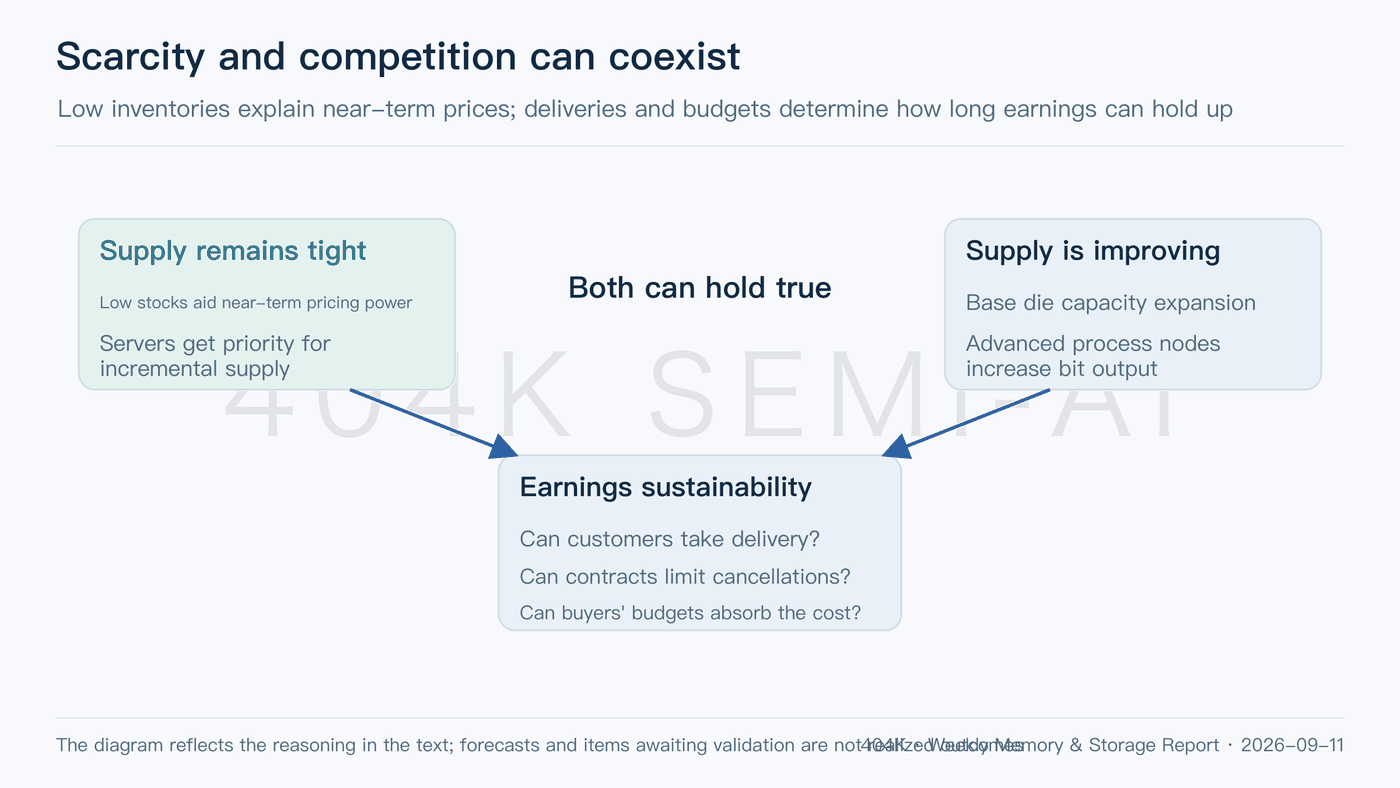
Memory and storage investments warrant closer scrutiny of revenue quality. Low inventories and high prices explain current earnings. Customers accepting deliveries, enforceable cancellation terms, and returns on capacity expansion determine how long those earnings can last. Tight industry supply can coexist with intensifying competition among suppliers; shortages do not eliminate company-specific execution risk.
On September 7, KB Securities estimated that Samsung Electronics and SK hynix held less than 10 days of memory inventory, arguing that HBM expansion was crowding out conventional DRAM supply. Later in the week, reports of Samsung expanding HBM4 base-die production and SK hynix accelerating advanced-node transitions underscored suppliers’ efforts to address shortages. Low inventories support near-term pricing, while improving output could limit subsequent price increases.
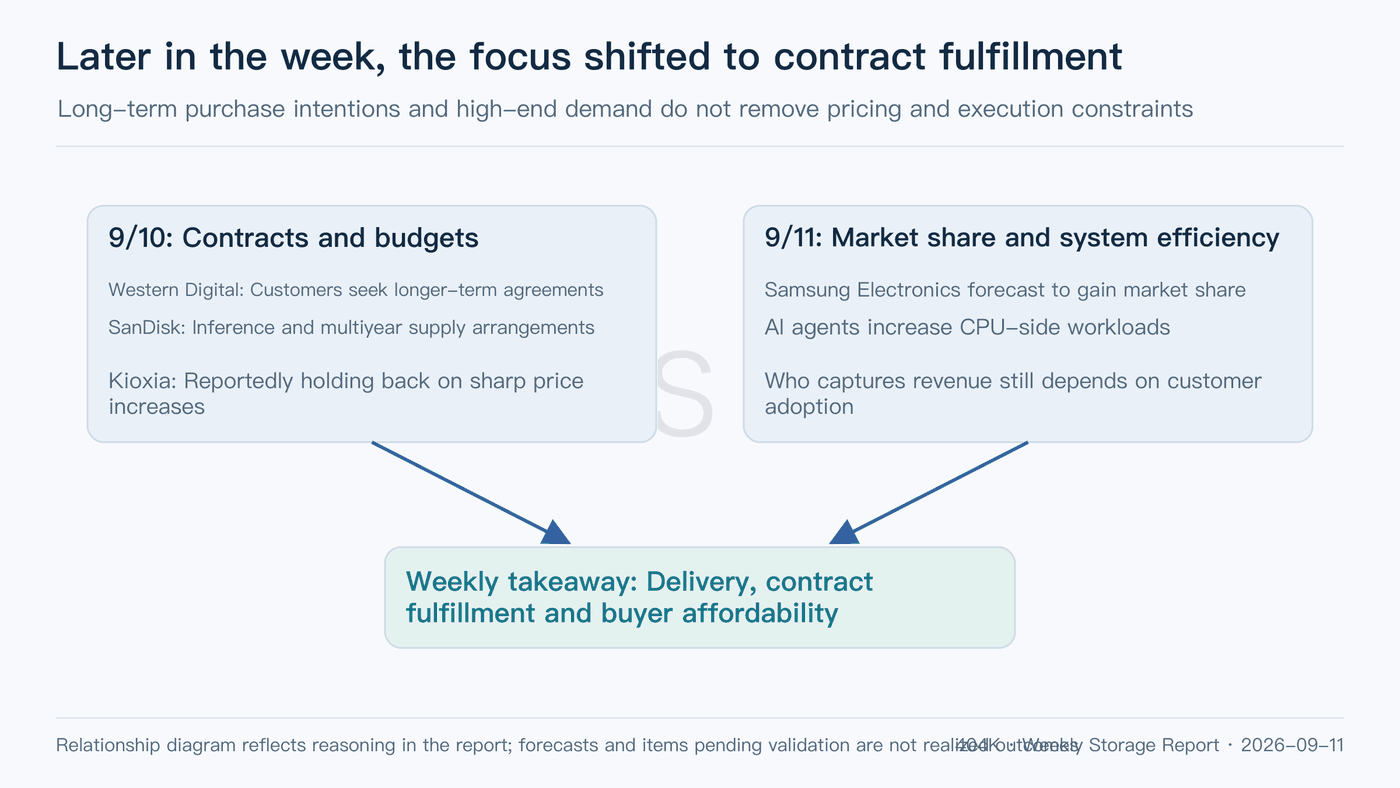
Buyer behavior is also changing. Western Digital’s customers want purchasing arrangements extending through 2030 and 2031, but the company explicitly said those agreements remained unsigned. Kioxia, meanwhile, reportedly began asking its sales teams to moderate large price increases. Together, these developments suggest that customers will make longer commitments for supply certainty but remain sensitive to the final bill.
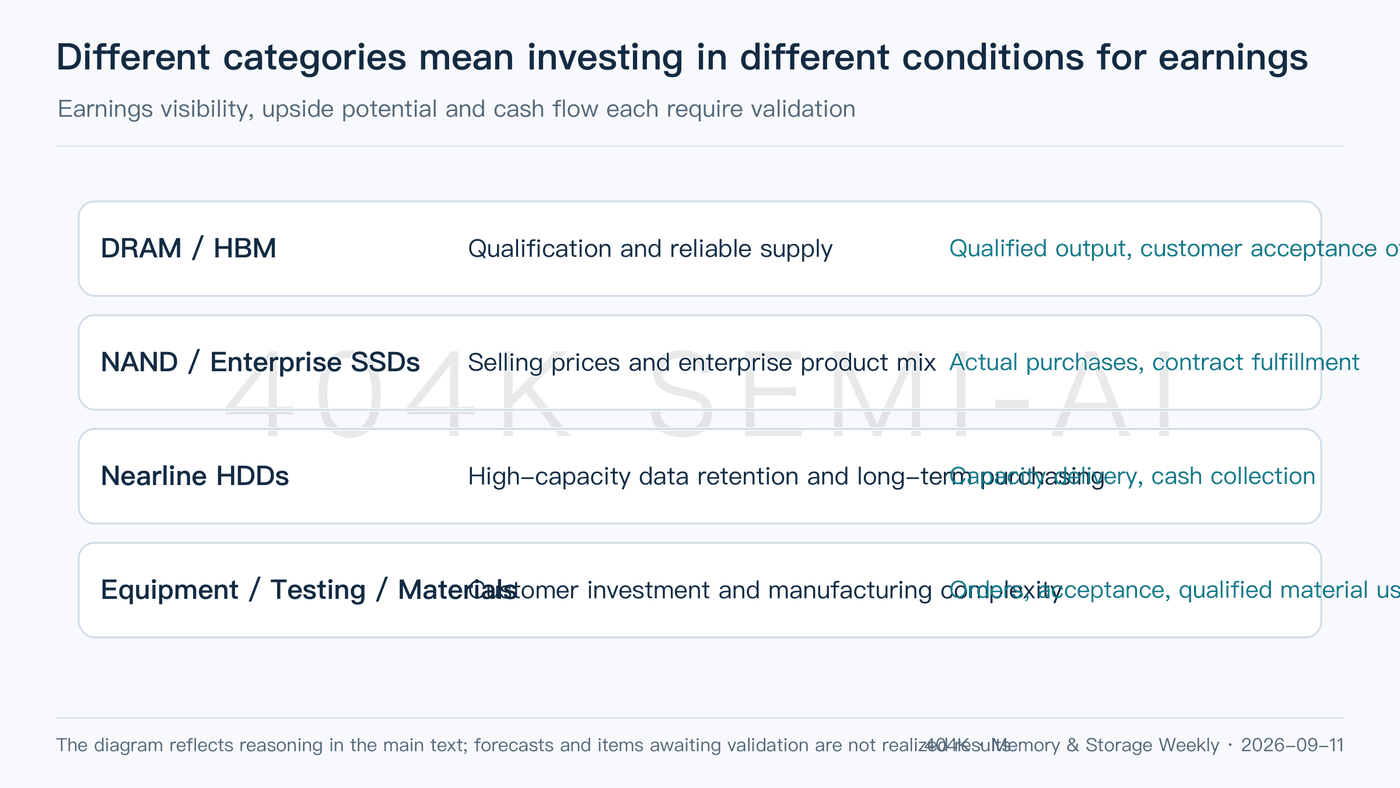
Investment priorities should distinguish earnings visibility, upside sensitivity, and cash generation. Visibility in HBM and high-end DRAM comes from reliable supply after qualification and close customer collaboration. Enterprise SSD upside comes from higher average selling prices and a larger enterprise revenue mix. HDD value requires evidence of high-capacity deliveries, binding orders, and free cash flow. Equipment, testing, and materials suppliers also depend on customers following through with investment.
Product labels alone do not justify a premium. Unstable yields on new HBM products can prevent revenue growth from improving unit costs. Strong NAND demand can still encounter budget limits on price increases. Longer HDD lead times do not establish multiyear profit protection. Assessing an improving industry and deciding whether a particular stock is worth owning are separate tasks.
This week supports continued research into high-end memory and enterprise storage, but does not justify raising earnings assumptions across every category. For SK hynix, Micron, and Samsung Electronics, verify actual high-end shipments. For SanDisk and Kioxia, focus on contract execution and enterprise SSD revenue. For Seagate Technology and Western Digital, track nearline capacity shipments and cash collection. Low-end smartphones and PCs should also be assessed as casualties of rising memory costs.
How the Week Developed
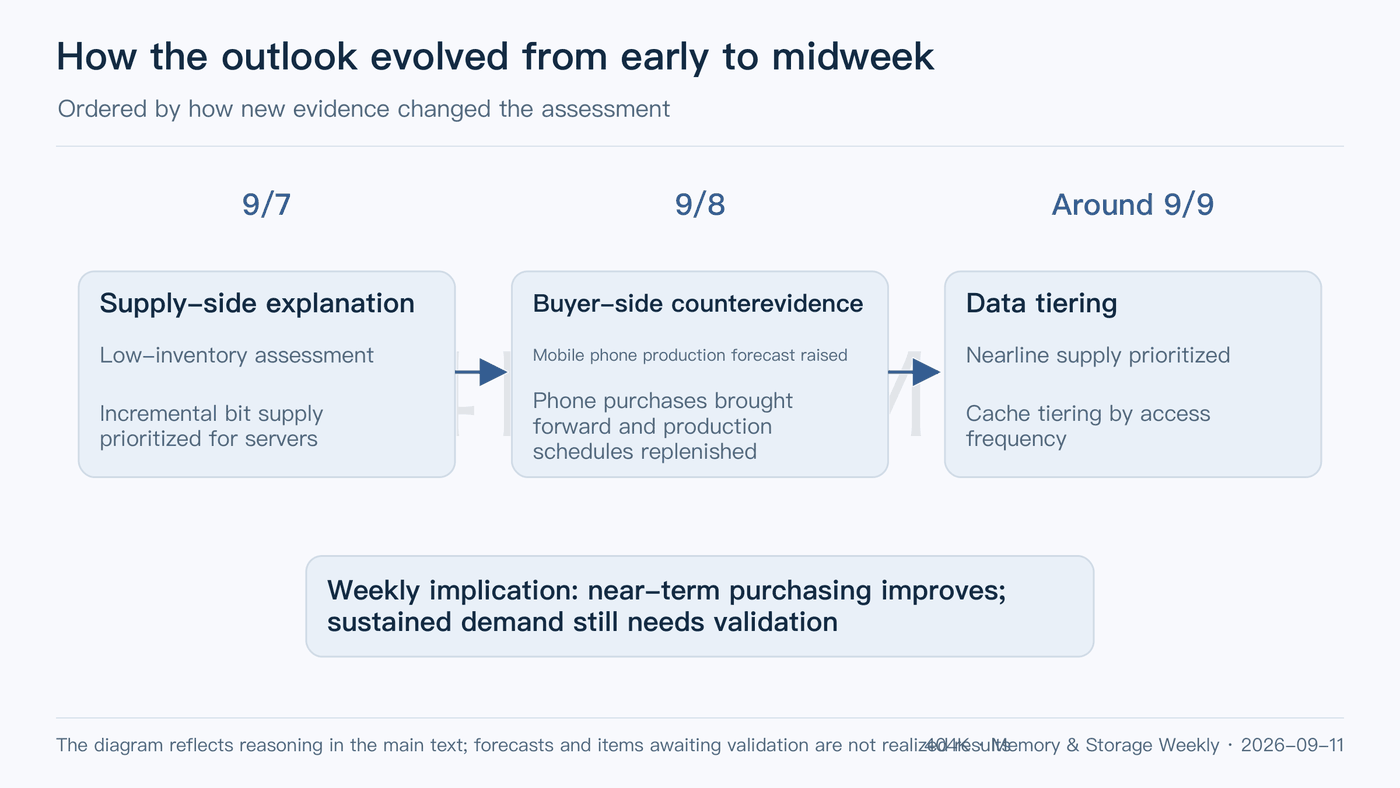
Early in the week, the most useful development was a clearer breakdown of supply tightness by category. DRAM industry information on September 7 attributed revenue growth primarily to pricing, with incremental bits directed first toward servers. KB Securities issued its low-inventory assessment the same day. The former explains revenue growth; the latter explains continued supplier bargaining power. Neither establishes unlimited end-market tolerance for price increases.
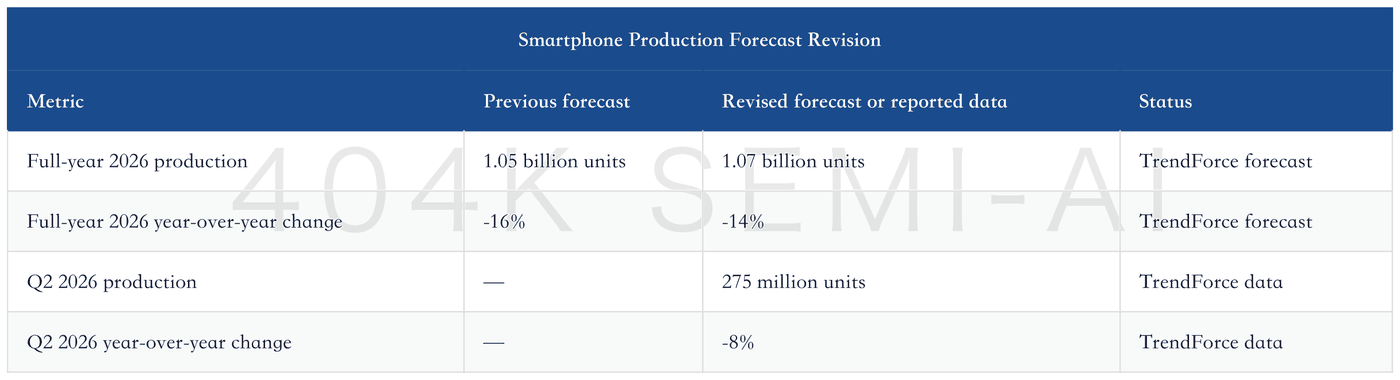
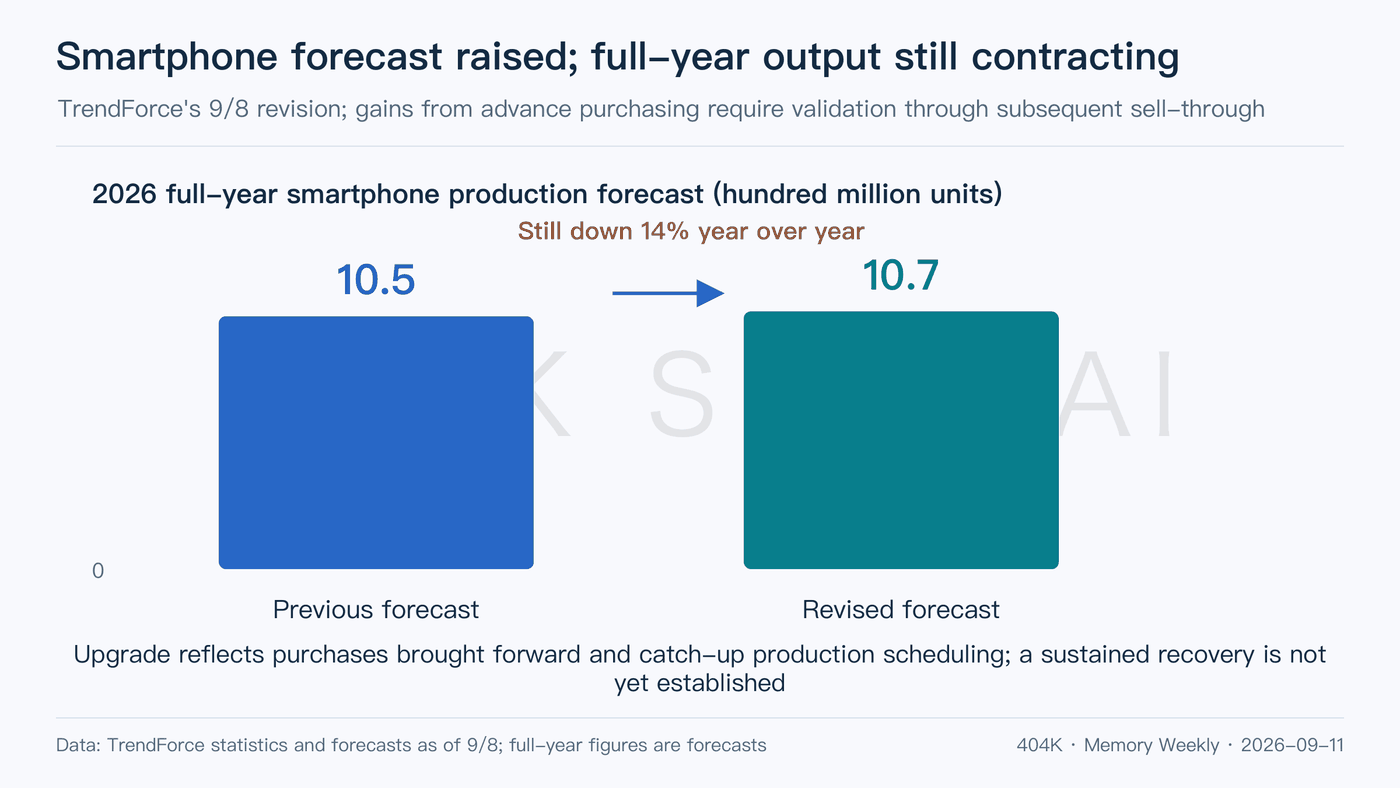
On September 8, TrendForce raised its full-year smartphone production forecast while highlighting purchases brought forward and brands restoring production schedules. This was the week’s most important downstream counterargument: stronger procurement may pull future demand into the present. It can help memory suppliers absorb current output while leaving slower demand later. A short-term replenishment cycle should not be treated as a broad consumer-electronics recovery.
Around September 9, reports that prioritizing nearline drives was tightening mainstream HDD supply, alongside SK hynix’s discussion of memory tiers based on data-access frequency, broadened the focus from individual chips to how data is stored. The former shows different drive applications competing for supply; the latter shows a single inference task using multiple memory and storage tiers.
September 10 brought more direct signals on contracts and budgets. Western Digital disclosed customer interest in longer agreements. Reports of SanDisk’s conference remarks emphasized NAND demand from inference, retrieval-augmented generation, and caching, alongside multiyear supply arrangements. An interview report on Kioxia that day discussed restraint on large price increases. Together, these developments shifted the question from whether suppliers can raise prices to how supply commitments can secure more stable revenue.
On September 11, KB Securities forecast further HBM share gains for Samsung Electronics, highlighting the potential for continued shifts in customer allocation within HBM. Technical discussions of agentic workloads also emphasized coordination among CPUs, memory, storage, and scheduling. AI can expand the memory and storage market, but product fit and purchasing decisions still determine who captures the revenue.
The week’s evidence points to stronger high-end demand, greater supplier interest in securing customers, and more active cost control by buyers. Low inventories supporting continued tightness must be weighed against node transitions that expand supply. Inference demand supporting enterprise SSDs remains subject to budgets, software efficiency, and customer validation. No single optimistic forecast can substitute for assessing these relationships.
Weekly Performance of Memory and Storage Securities
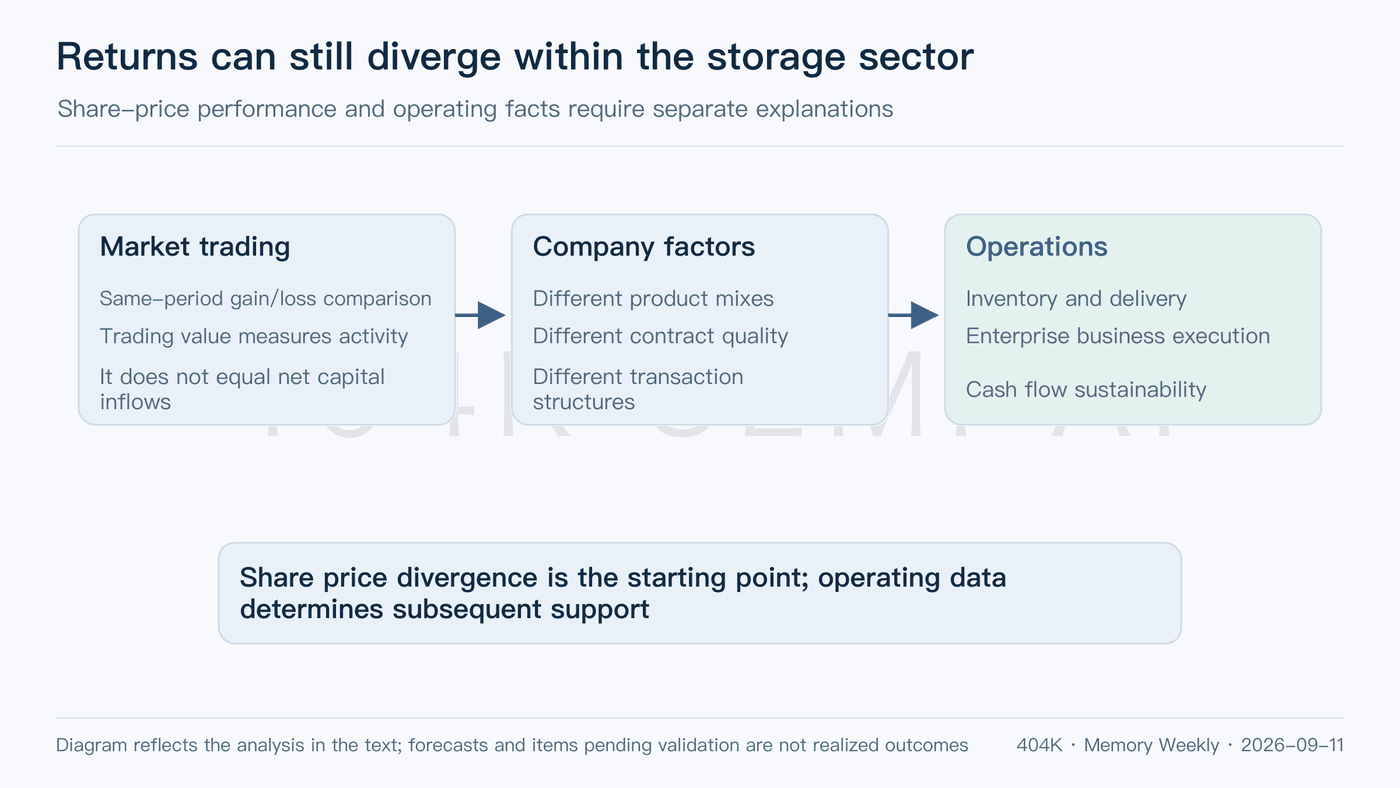
This week’s market performance reflected divergence within the sector. U.S. stocks and ETFs use September 3–10, while Korean and Japanese stocks use September 7–11; these windows do not support precise cross-market rankings. Aggregate trading value measures activity, not net inflows.
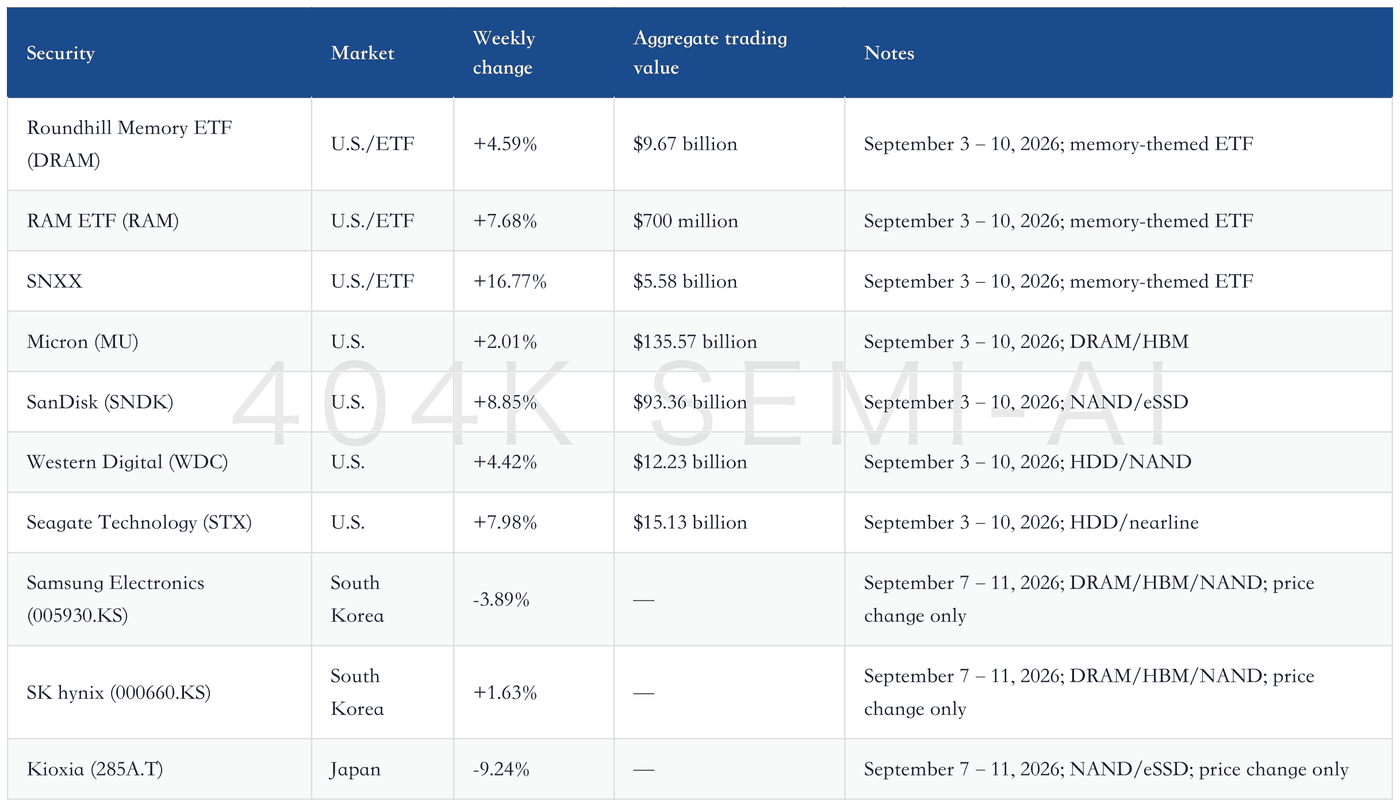
Within the same U.S. trading window, SanDisk and Seagate outperformed Micron, but share-price performance does not validate supply execution or earnings. Samsung and SK hynix moved in opposite directions, as did SanDisk and Kioxia—a reminder that shared product exposure does not imply shared returns. Contracts, product mix, and market trading structure all influence stock prices.
The ETFs should be assessed as trading instruments; their gains are not multiples of industry earnings growth. Inventories, qualification, enterprise business trends, and long-term agreements remain more informative for operating analysis. Improvements in these variables can underpin further price performance. One week of active trading alone does not establish sustained institutional allocation.
DRAM/HBM: Supply Allocation, Long-Term Agreements, and Customer Qualification
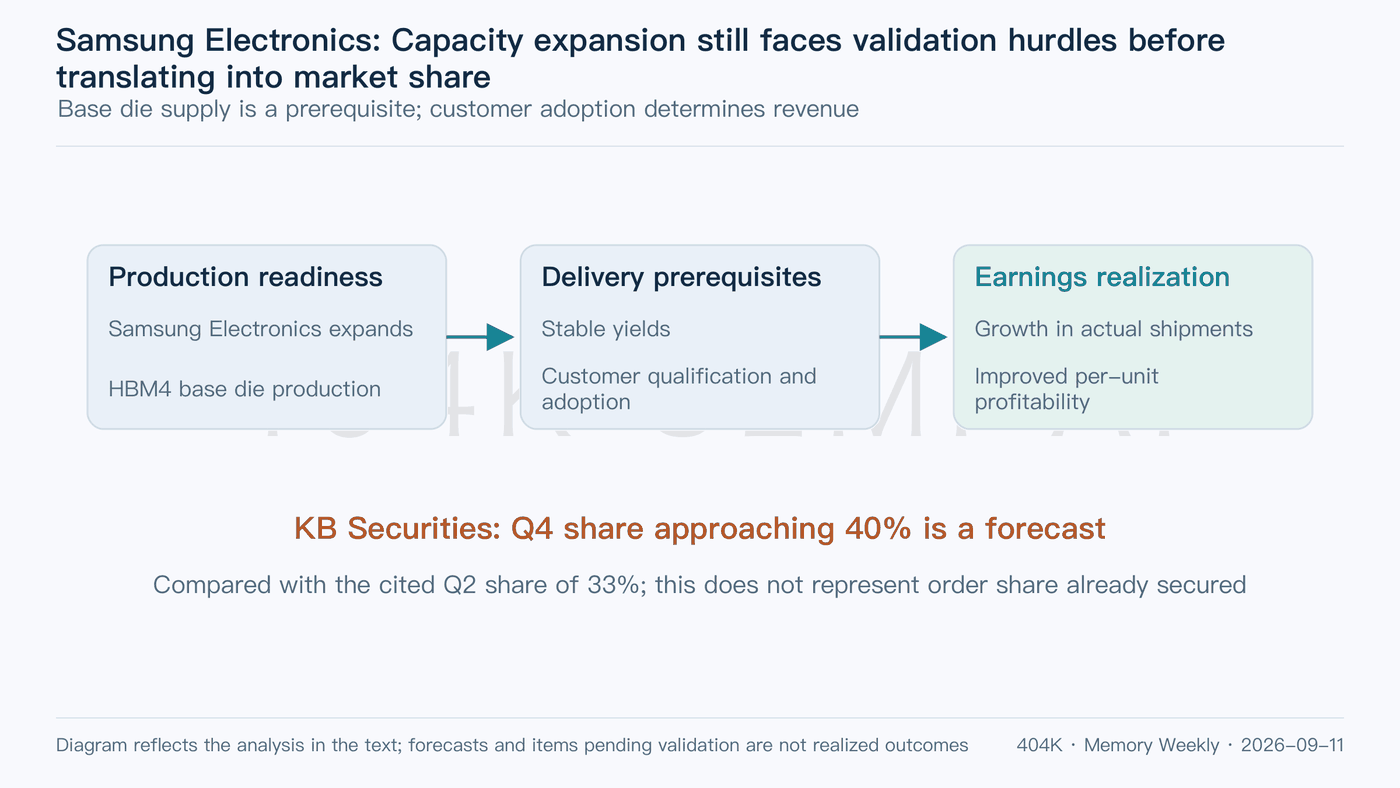
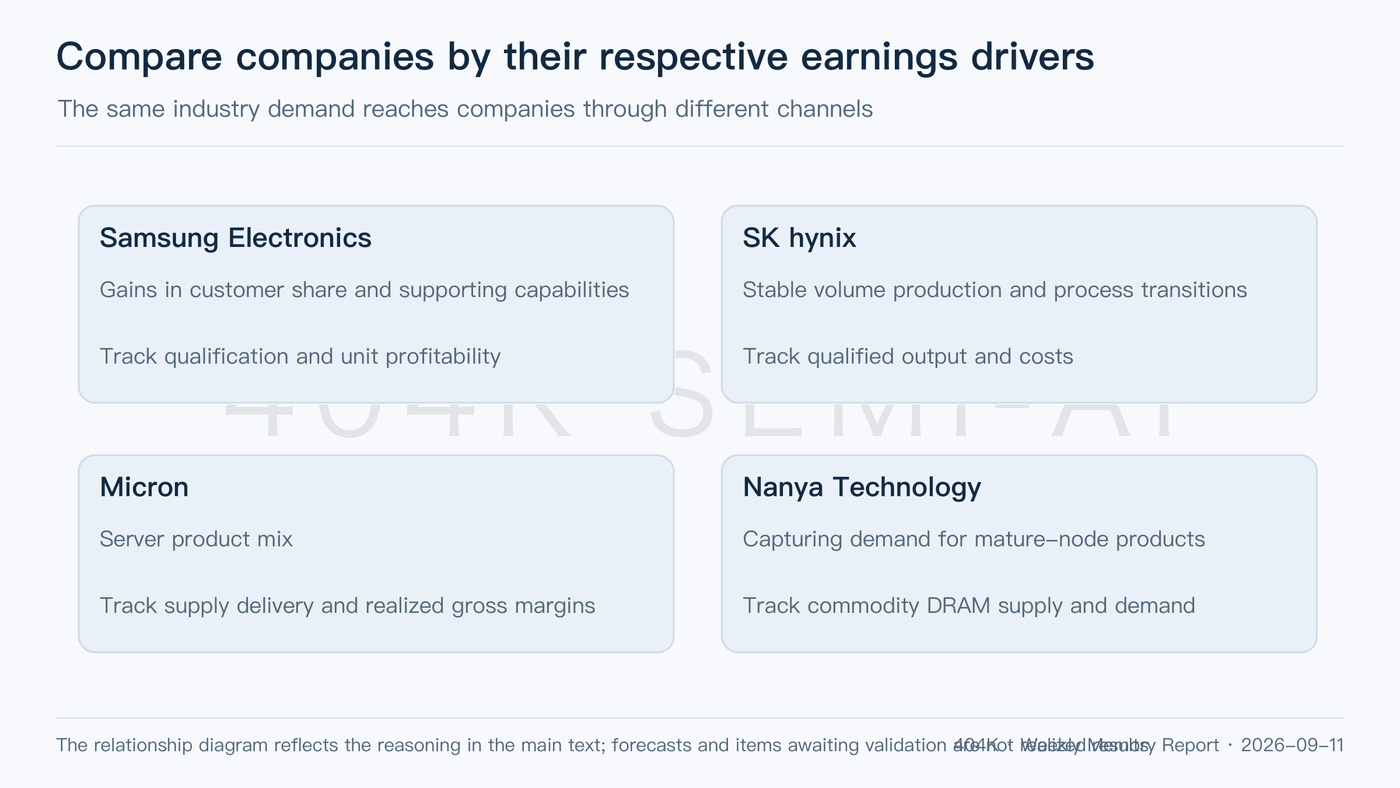
The most valuable HBM supply is product that customers can already use reliably. Samsung Electronics’ base-die expansion and SK hynix’s faster 1c transition address supporting capacity and output per wafer, respectively. Both can improve delivery capability, but both require adequate yields and customer qualification. Higher wafer starts do not automatically mean more qualified output.
Samsung’s expansion of HBM4 base-die production helps address a necessary supply component. The base die handles data transmission between stacked DRAM and the system chip, so stable volume production affects delivery of the entire HBM product. Profit should not be projected by simply assuming full utilization.
Samsung Electronics: HBM Base-Die Capacity Allocation and Market-Share Forecasts
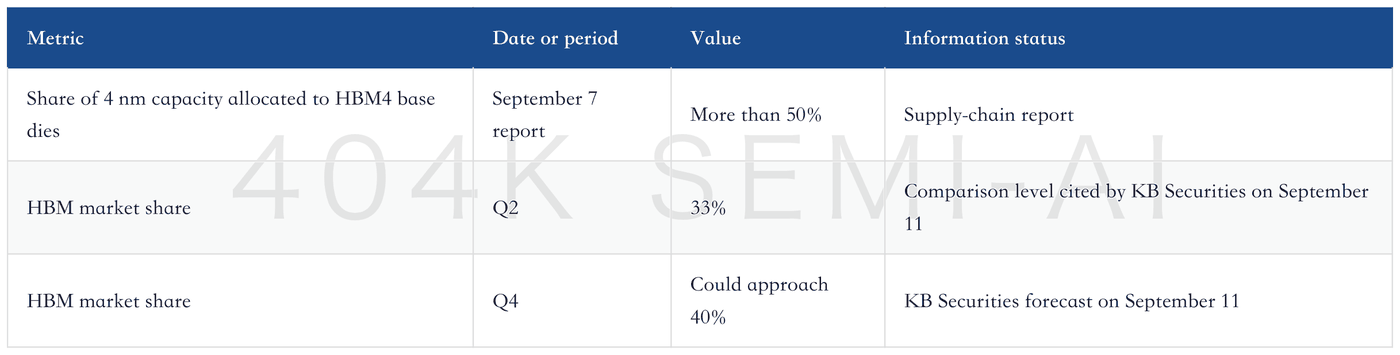
The projected share gain is a brokerage forecast, not an order share already secured. Slower qualification, a weaker product mix, or delivery delays could postpone the increase. Even if the forecast is achieved, unit profitability still needs to improve alongside it.
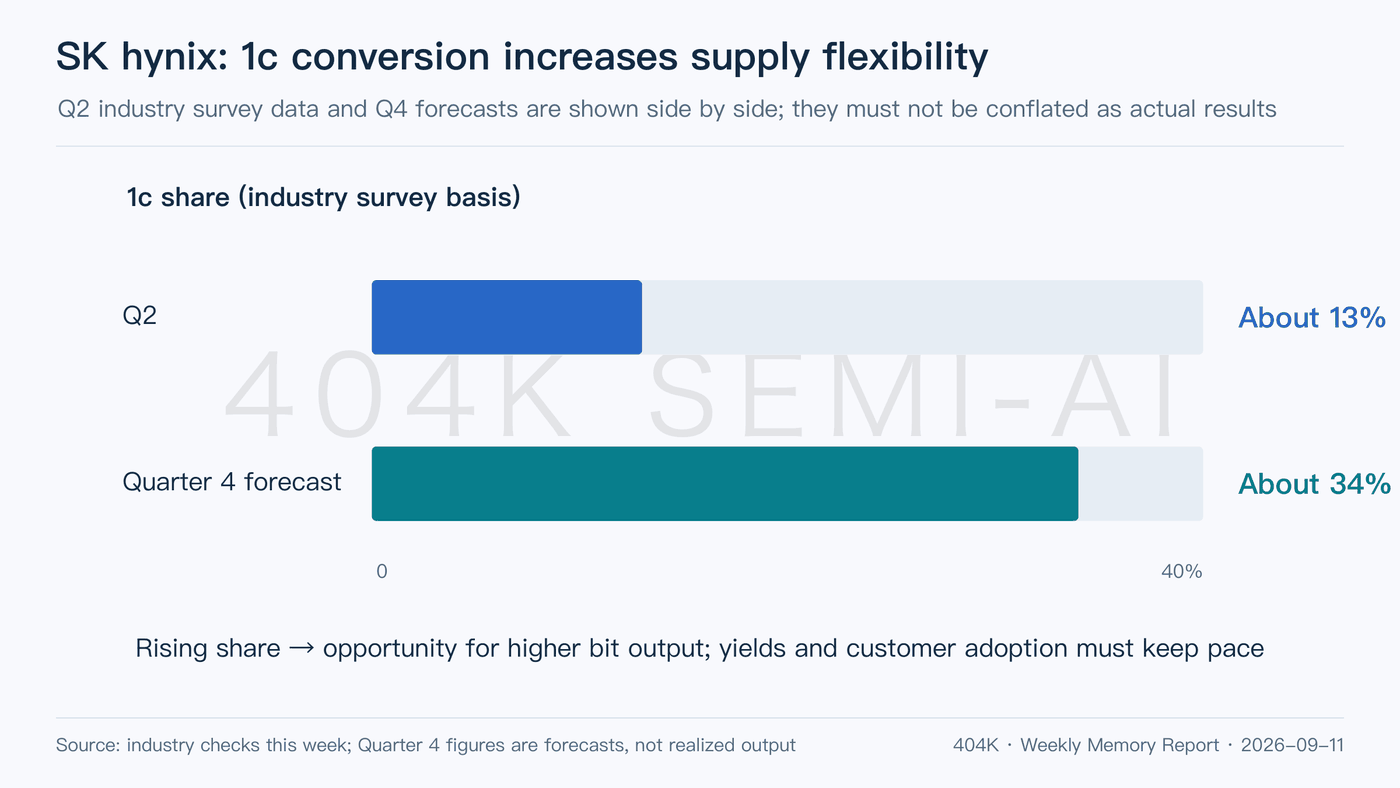
For SK hynix, the key question is whether advanced-node transitions can improve both output and cost. Industry research this week projected a further increase in its 1c share.
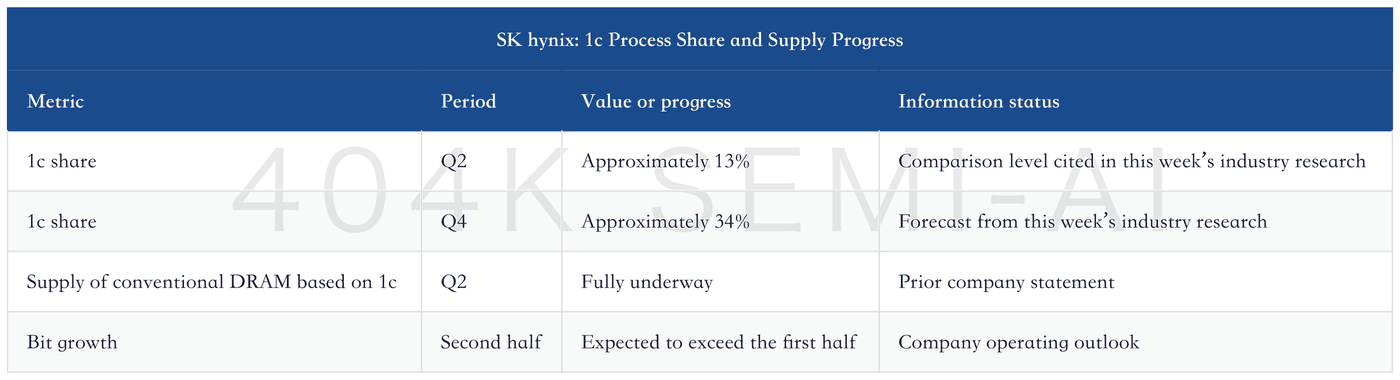
Industry forecasts and company guidance use different frames of reference; neither should be presented as completed results.
Advanced nodes increase bits per wafer, providing a supply-growth path that does not depend entirely on new fabs. For SK hynix, this is an opportunity to preserve cost competitiveness. For the industry, it means effective supply can improve without a large increase in wafer starts. A common blind spot in shortage-driven trades is treating wafer volume as a proxy for bit supply.
Transitions also consume resources. As advanced nodes account for more production lines, actual yields, qualified deliveries, and customer adoption must progress together. A smooth transition could help SK hynix remain competitive as high-end products advance. If output grows more slowly than planned, low inventories may persist, but the company’s own earnings delivery could suffer. An industry benefit is not automatically a company execution benefit.
Micron, SK hynix, and Samsung should be compared using the same operating questions. This week’s DRAM industry information linked Micron’s growth to its greater server exposure. That supports examining its benefit from server demand, but is insufficient for a precise valuation ranking. Samsung’s upside is more closely tied to customer share and supporting capacity; SK hynix’s to stable volume production and node transitions; and Micron’s to converting its server mix into sustained shipments and profit.
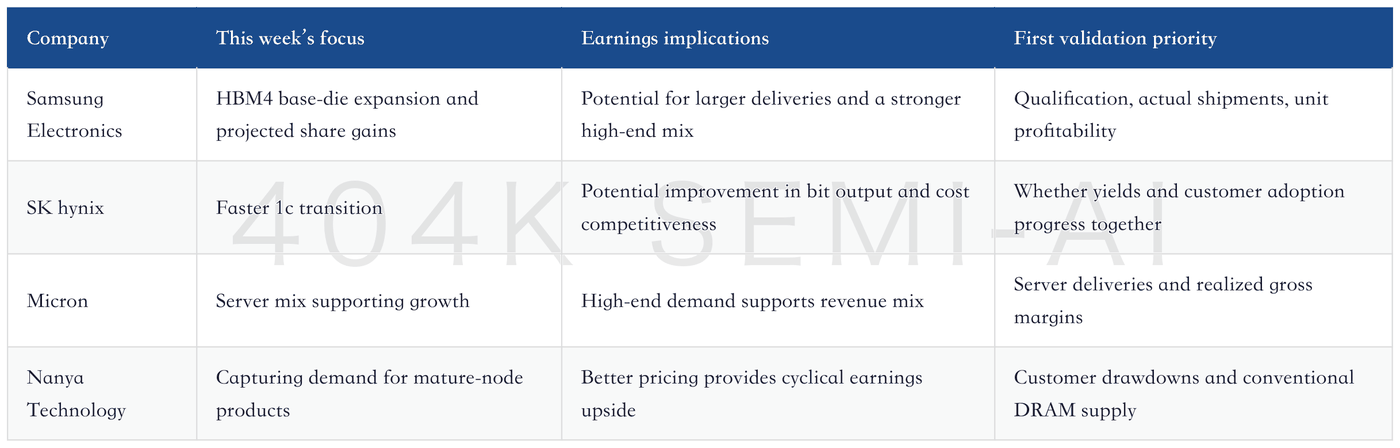
Nanya’s opportunity differs from HBM. Leading suppliers’ shift toward advanced products leaves room for mature-node producers, but that opportunity remains sensitive to conventional DRAM supply and customer demand. If advanced nodes release more bits or downstream customers reduce specifications, mature-product pricing sensitivity may change first. The visibility associated with qualified high-end customer relationships cannot simply be applied to mature-node products.
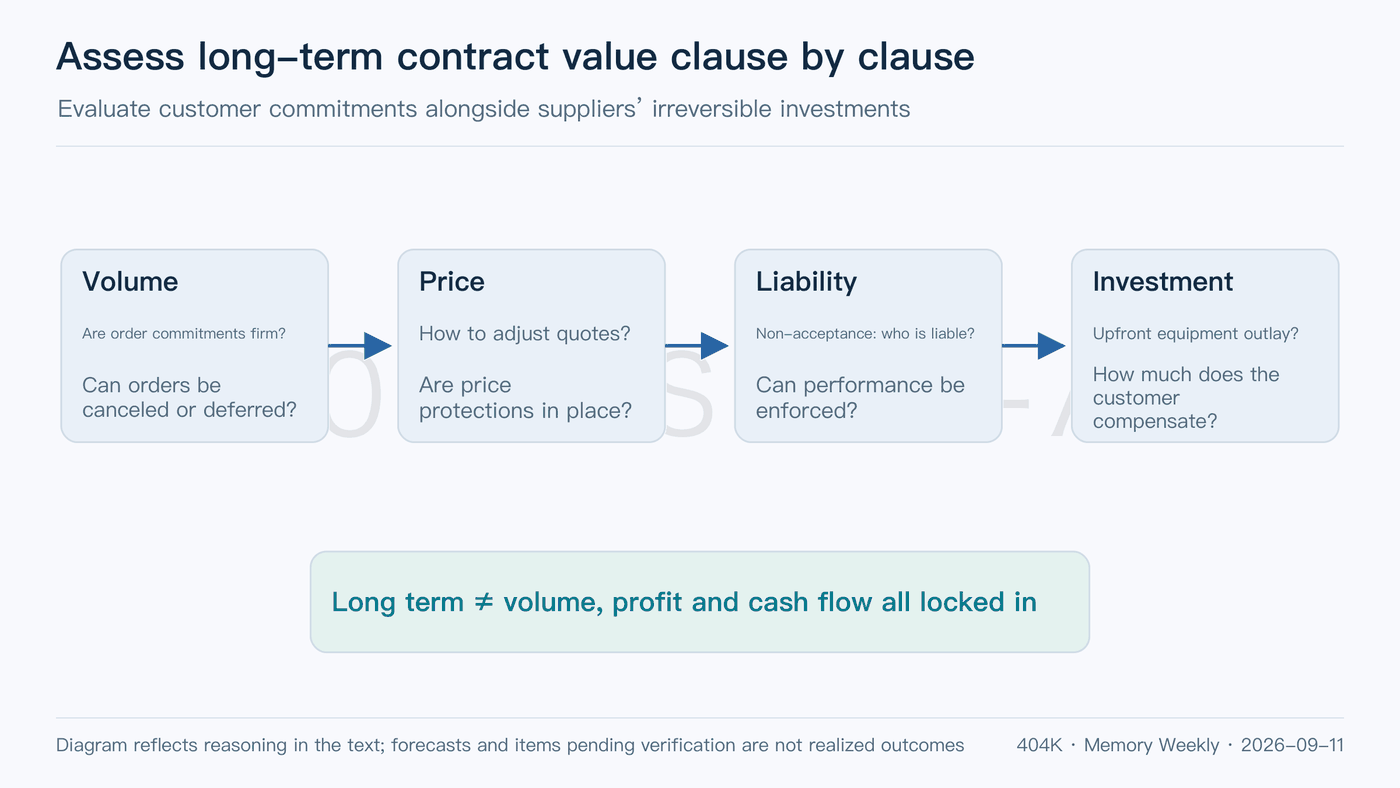
Long-term agreements can reduce demand uncertainty, but their value depends on individual terms. A long purchasing period does not make volumes noncancelable. Committed volumes do not necessarily imply fixed prices or a profit floor. Prepayments must be assessed against the capital spending suppliers promise in return. Volume commitments, price adjustments, cancellation liability, and investment compensation should be evaluated together.
In institutional investor discussions this week, Samsung emphasized preparing buildings and cleanrooms first, then installing equipment against confirmed customer demand. This sequence can improve investment discipline, but reduces oversupply risk only when demand commitments are sufficiently firm. If customers retain substantial flexibility after equipment investment becomes irreversible, the agreements offer less protection than their headlines suggest.
Samsung Securities’ alternative scenario deserves attention: a new wave of capacity could compress unit profitability from 2027 onward, even with strong absolute AI demand. This view depends on supply ramps and changes in demand growth; it is not evidence that the cycle has already turned. Its disagreement with KB Securities is fundamentally about the speed of effective output growth and customers’ ability to absorb supply, rather than whether AI demand exists.
LPDDR/SoCAMM: AI Demand Expands into CPU and Rack Memory
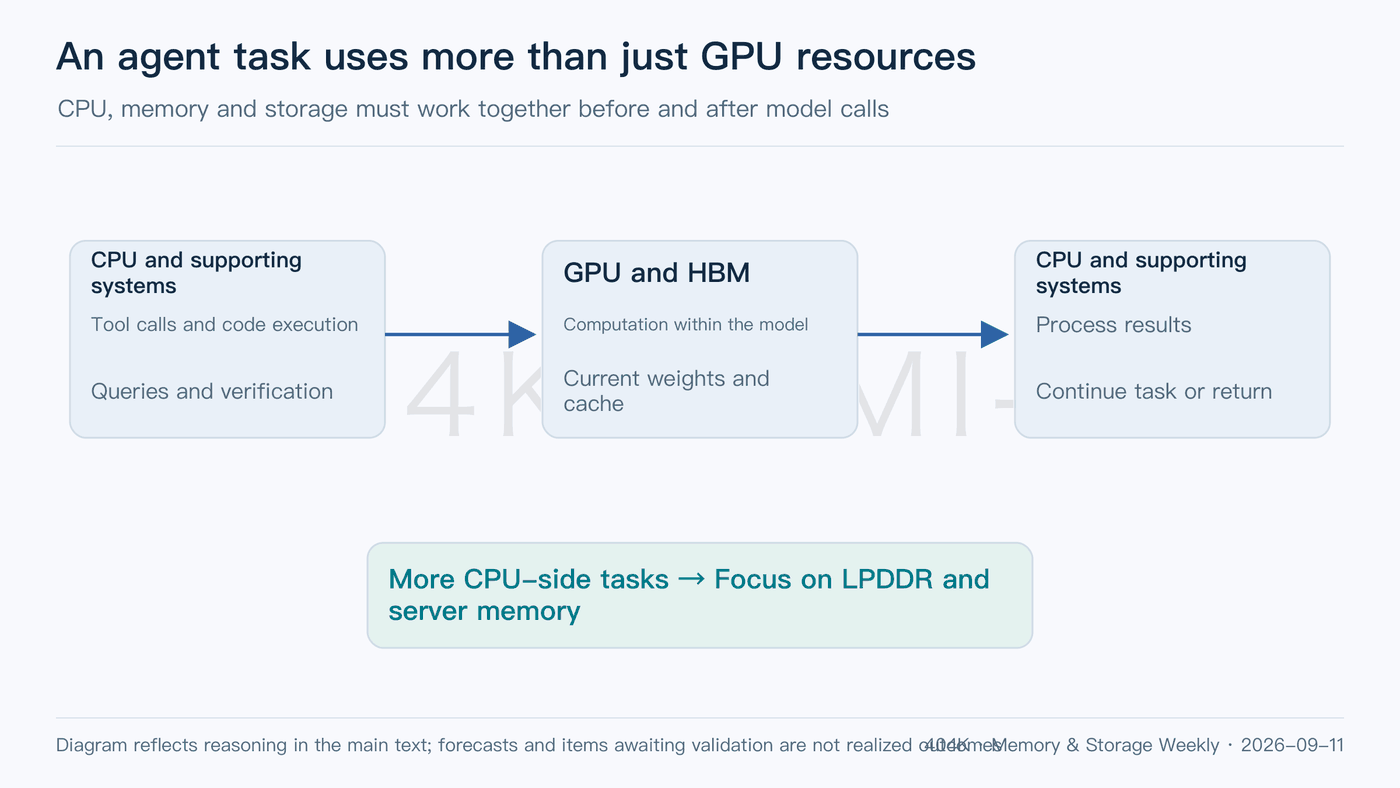
AI’s impact on memory demand is extending to CPUs. Technical discussions of agents this week highlighted the CPU and surrounding systems required for tool calls, code execution, database queries, and task verification. GPUs perform much of the computation within models, but task completion speed also depends on timely execution of the work before and after model calls.
This week’s DRAM industry information also cited demand for LPDDR5X and high-capacity RDIMMs, showing why server procurement should be assessed beyond HBM. LPDDR is low-power DRAM; RDIMMs are memory modules used in servers. Platforms make different choices, but share the need to balance capacity, bandwidth, and power against workload requirements. Higher capacity supports bit demand, while revenue ultimately depends on purchase prices and product mix.
SoCAMM belongs in the CPU memory-module analysis. Cost discussions around the Vera platform reinforced the importance of CPU-side memory, but a single estimate cannot establish a universal cost share for AI racks. More useful checks are the modules system customers adopt, installed capacity, the timing of volume deliveries, and whether the configuration improves useful throughput in actual workloads.
New low-power memory specifications create upgrade opportunities; customer adoption determines revenue. In its LPDDR6 presentation this week, CXMT emphasized bandwidth and power improvements over the previous generation. These product claims indicate its development direction, but establish neither the pace of large-scale replacement nor customer qualification. Across LPDDR, supply growth and specification upgrades can occur simultaneously.
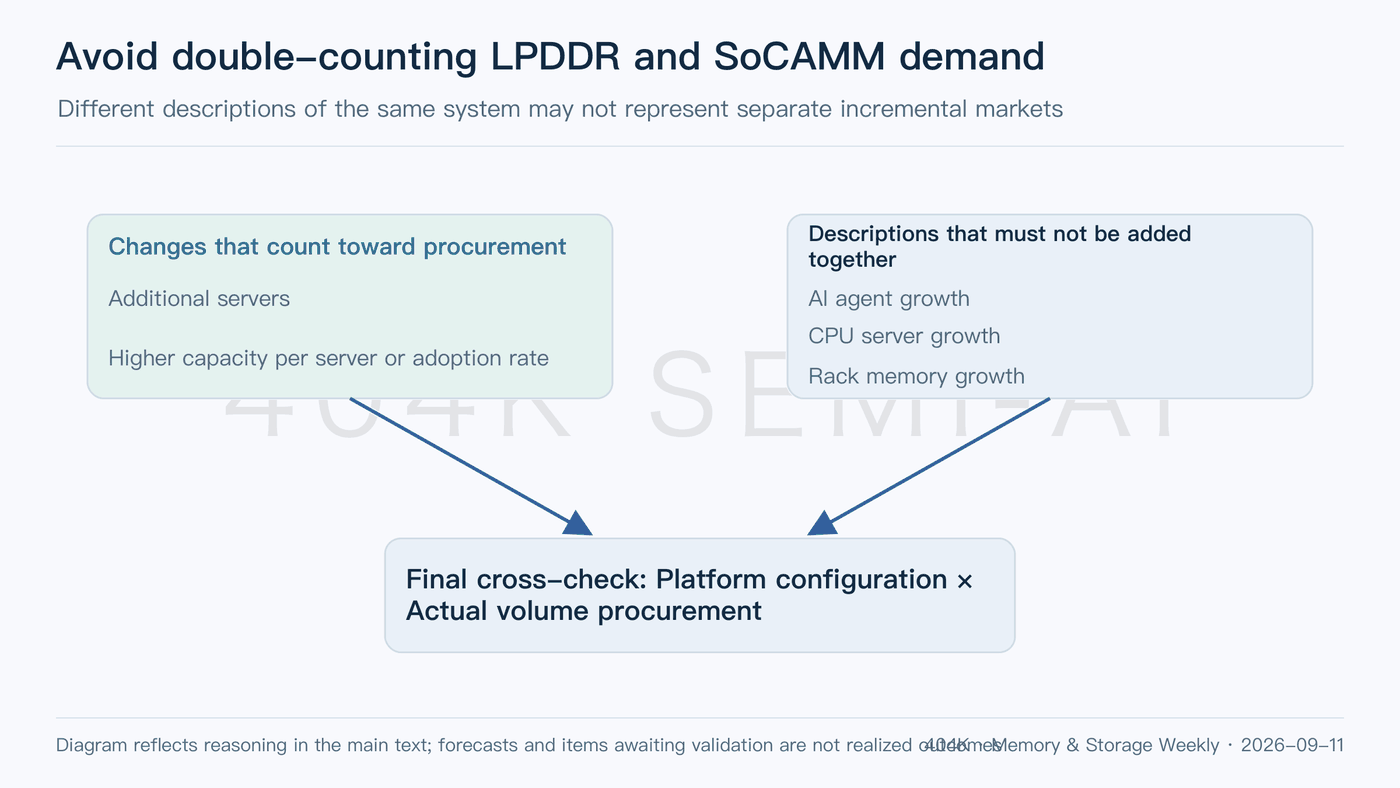
Demand estimates should avoid adding agents, CPU servers, and rack memory as independent incremental markets. They may describe the same workloads and systems. Incremental supplier revenue requires changes in server deployments, memory capacity per system, or actual adoption rates. Greater product complexity also does not mean every component increases proportionately.
System utilization is a risk. Faster CPU scheduling and greater cache reuse can allow the same capacity to support more tasks. Conversely, long waits for tool execution can prevent additional memory from generating sufficient returns. LPDDR and SoCAMM investment analysis should therefore track both hardware configurations and task efficiency, rather than extrapolating memory purchases solely from model-call volumes.
NAND/eSSD/SSD: Inference, RAG, and Enterprise SSD Upside
The enterprise SSD opportunity comes from repeated data use, as well as data retention. Reports of SanDisk’s conference remarks this week connected inference, longer contexts, retrieval-augmented generation (RAG), and caching. RAG retrieves external data before generating an answer, making reads, retrieval, and cache management part of service performance. Storage performance therefore directly affects compute utilization.
There is a distinct technical basis for this demand. A September 7 discussion of disaggregated inference noted that prompt processing and token generation can run on different devices, but the key-value cache (KV cache) must be transferred or accessed across devices. Retaining state can avoid recomputation, at the cost of capacity and data movement. Whether enterprises buy more SSDs depends on whether compute savings exceed those additional costs.
NAND revenue therefore cannot be estimated simply from generated text volumes. Storing source data, building retrieval databases, and retaining reusable caches affect capacity and access patterns differently. Hot data requires faster access; less frequently used data places greater emphasis on cost. For enterprise SSD suppliers, workload-specific performance, endurance, and customer validation matter more than a generic forecast of AI storage capacity.
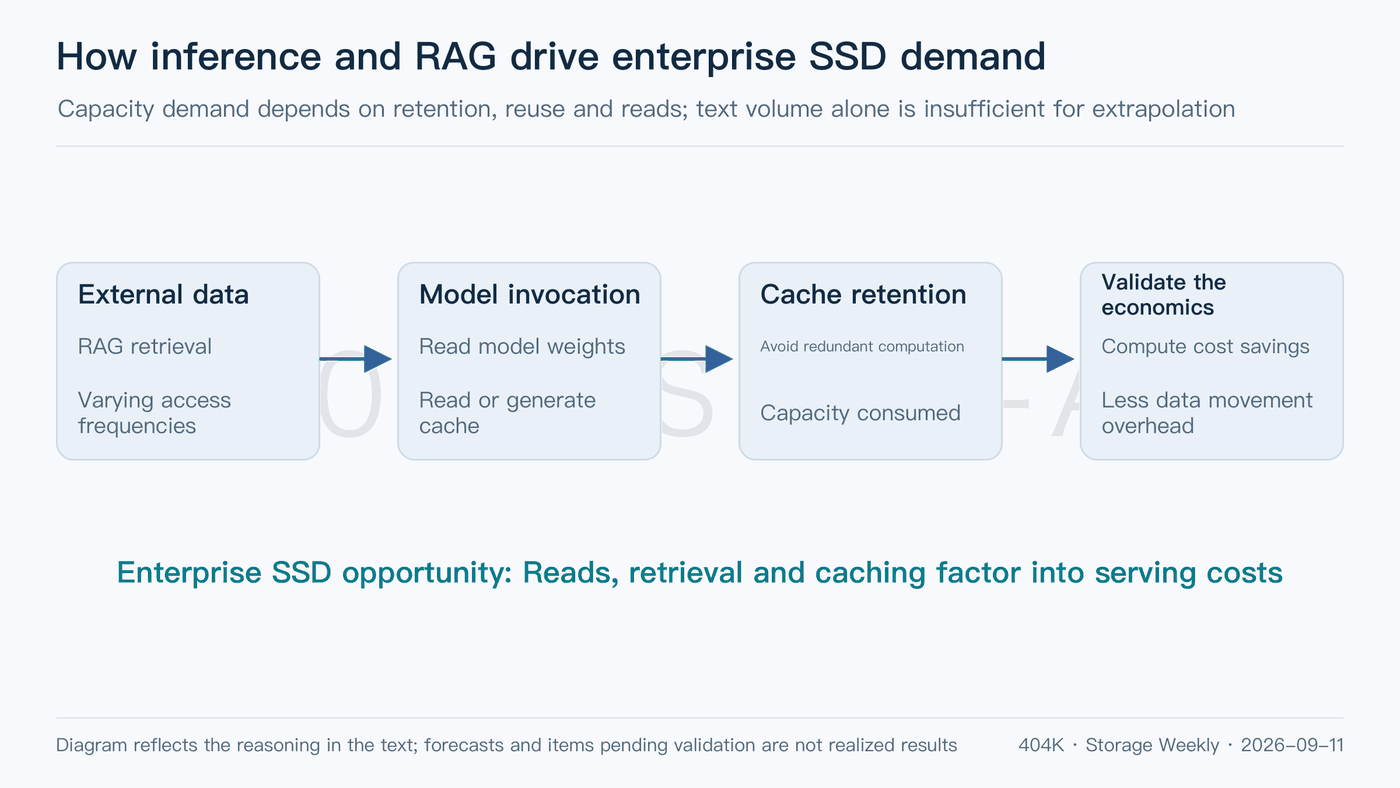
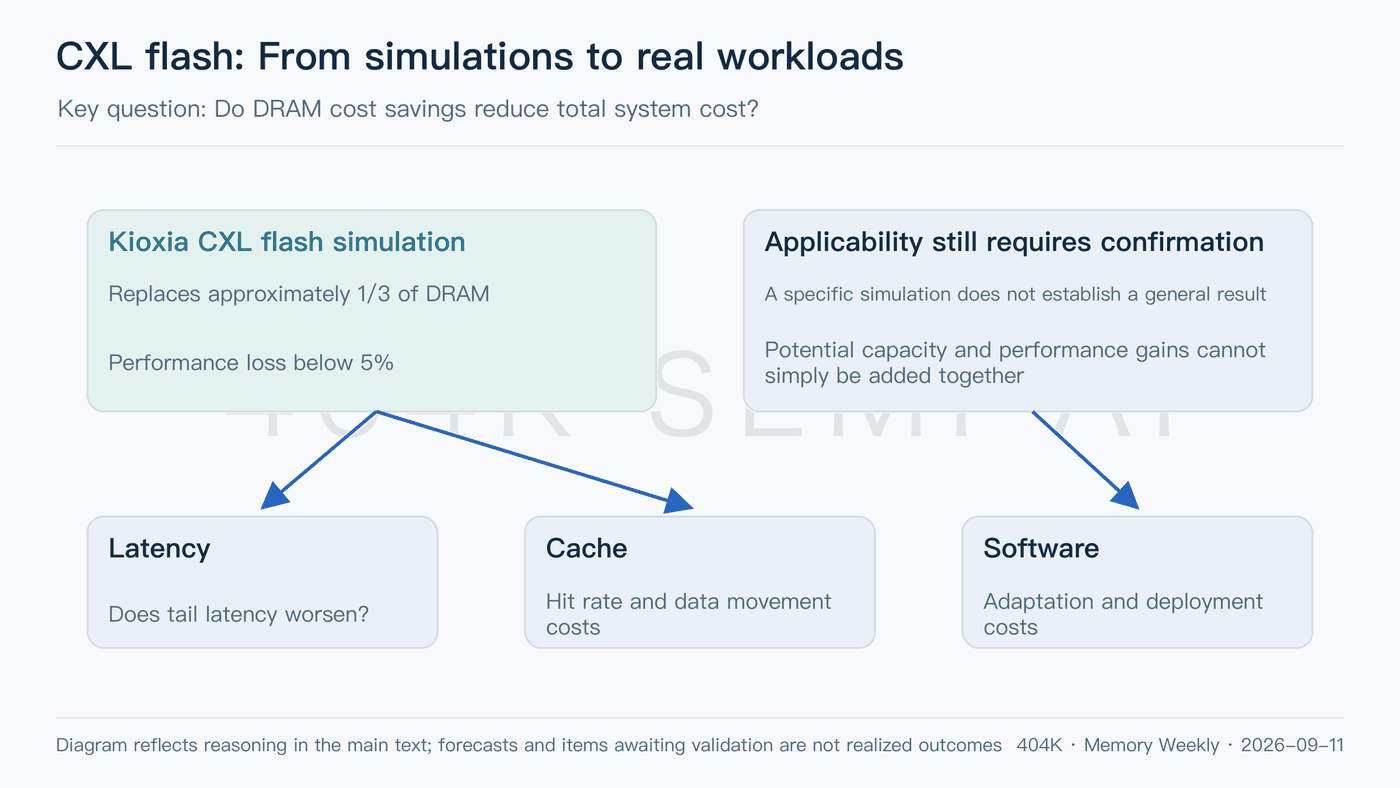
Tiered storage expands NAND’s applications while defining its limits. In forum remarks this week, SK hynix discussed keeping active weights and caches in HBM, moving temporarily inactive but potentially reusable data to other tiers, and using SSDs for longer-term cache retention. This allocates data by access frequency; it does not establish that flash can replace HBM without conditions.
Kioxia’s CXL flash demonstration offers a direction to test, but its simulation results and statements of potential must be kept separate.

These simulation results and potential benefits should not be combined into an outcome available simultaneously across all workloads.
Investment analysis needs physical samples and validation on real tasks. Key questions include whether replacement worsens tail latency, whether data hits the cache, the scale of migration overhead, and any host-software modifications required. If network, software, or waiting costs offset DRAM savings, the technical approach may remain valid while commercial adoption proceeds more slowly than expected.
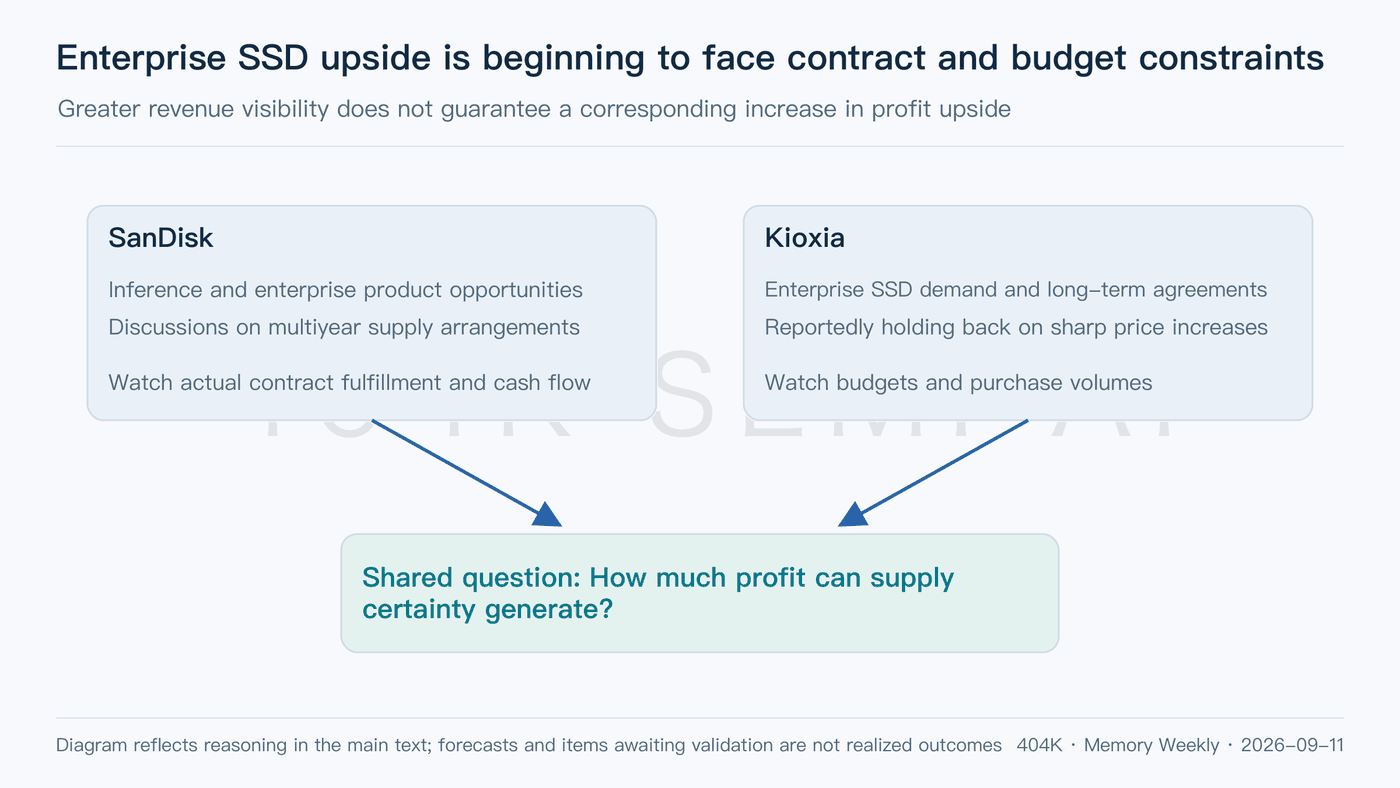
SanDisk’s upside centers on enterprise products and contract execution. Reports of its September 10 conference remarks said the company was exchanging supply certainty for multiyear demand commitments, with discussions covering volumes, price adjustments, and customer performance safeguards. These remarks support investigating improved business stability. Until sustained execution and cash flow are visible, however, reported long-term profit targets should not be treated as locked-in earnings.
Kioxia illustrates the other side of the same industry. According to an interview report this week, it asked sales teams to moderate large price increases for data-center customers while continuing to expand long-term contract coverage. This acknowledges finite buyer budgets, not disappearing demand. Enterprise customers may absorb costs better than low-end consumer-electronics buyers, but still require an adequate return.
Together, the two companies illustrate a more complete enterprise SSD thesis than a simple bet on NAND prices: qualify products in customer systems, secure longer purchasing commitments through reliable delivery, and retain pricing and mix improvements in profit. Longer orders can improve revenue visibility without increasing earnings upside if customers continue demanding price concessions.
NAND analysis should separate price, bits, and product mix. Higher unit prices can increase revenue even with modest shipment growth, but also raise buyer costs. A greater enterprise mix can improve revenue quality if it has translated into deliverable orders. Consolidated revenue growth alone does not measure demand strength, and enterprise SSD improvements should not be extrapolated to consumer SSDs.
Kioxia’s progress in liquid-cooled data-center storage equipment is evidence of product capability rather than pricing alone. Early-week reports said samples had been delivered, with mass production possible as early as October. Liquid cooling aims to address thermal constraints in high-performance equipment. Successful customer validation could allow products to sustain performance under heavy loads. For now, the relevant milestones are sample-to-production conversion, adoption, and reliability; a large contribution should not be booked in advance.
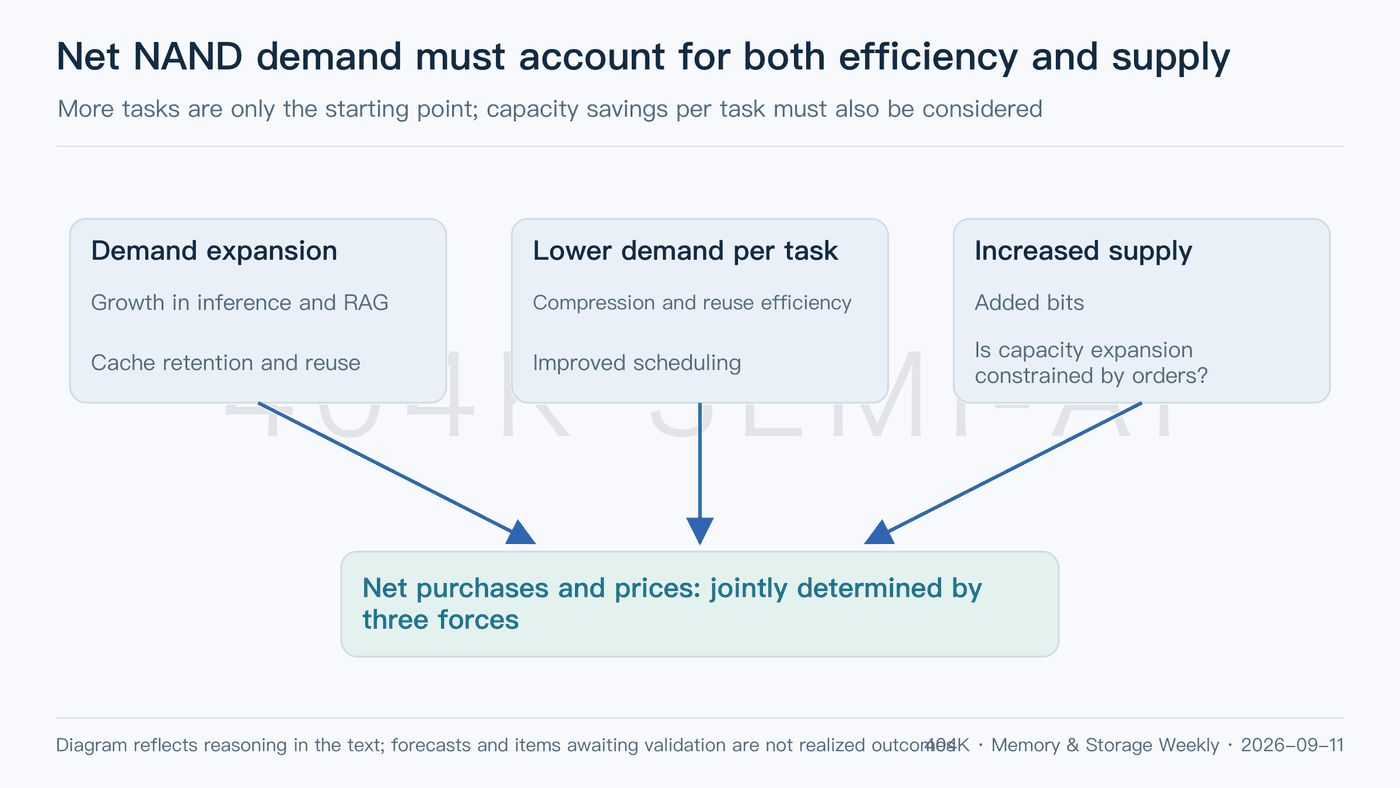
There are two counterarguments to monitor. On supply, expansion without binding orders could add bits and pressure prices first. On demand, better cache compression, reuse, and scheduling could reduce capacity required per task. Aggregate procurement will keep expanding only if task volumes and retention needs grow faster than efficiency improves. Demand and efficiency belong in the same calculation.
HDD: AI Data Lakes, Nearline Exabytes, and Cash Flow
The most useful HDD development this week was customer discussion of longer purchasing arrangements. Reports of Western Digital’s remarks at the Citi conference clearly distinguished customer requests from signed agreements: customers wanted supply secured through 2030 and 2031, but the company had not signed those agreements at the time. This supports stronger long-term demand intentions, not secured multiyear revenue.
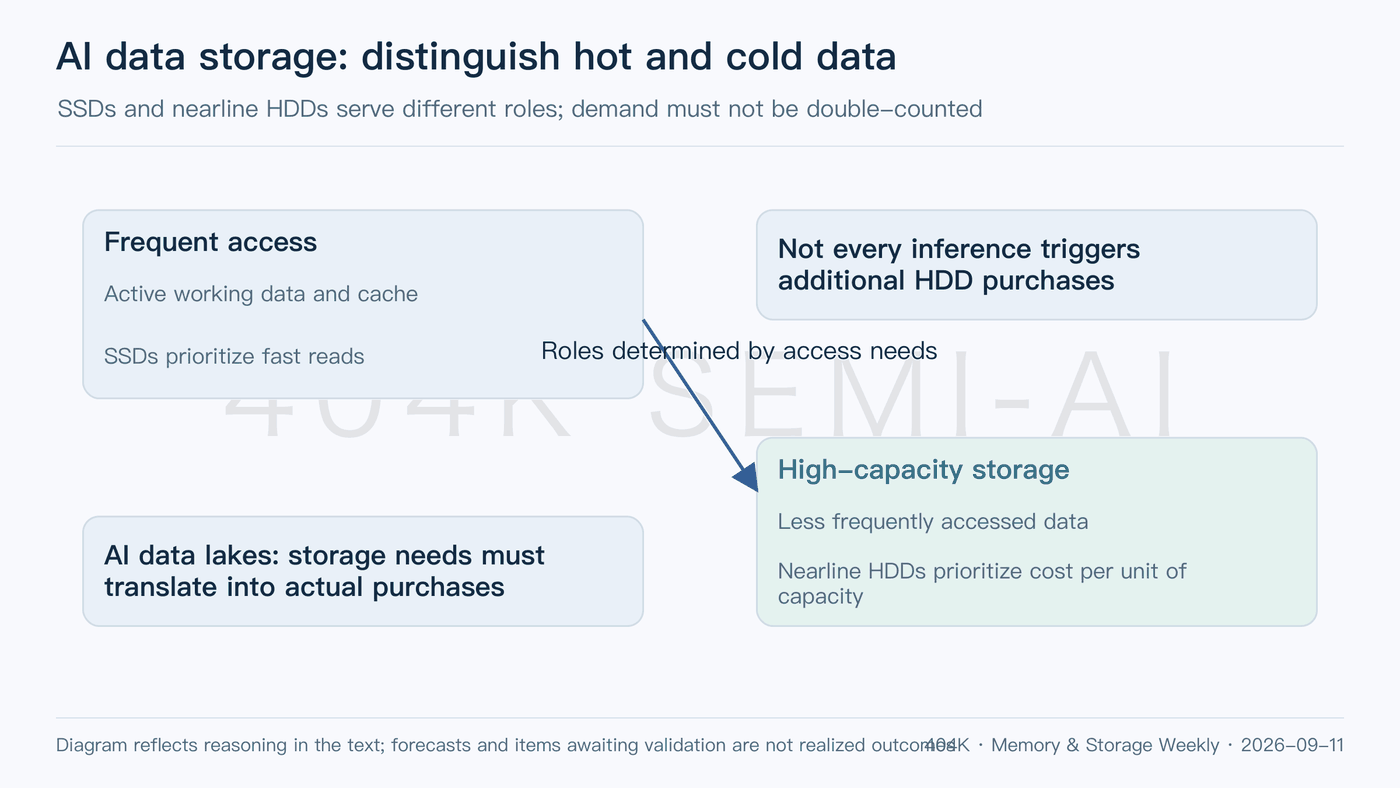
AI data lakes retain large volumes of data with different access frequencies. SSDs handle rapid reads and some caching, while nearline HDDs are better suited to retaining large volumes under cost constraints. This reflects the week’s industry discussion of hot and cold data; it does not imply that every inference call directly creates another HDD purchase.
Seagate and Western Digital both require analysis of major-customer demand and supply discipline, with company-specific validation. Nearline HDD investment models must also account for other suppliers. Focusing on two leaders does not mean the market has only two manufacturers. Concentration can influence bargaining power, but product delivery and customer procurement determine realized returns.
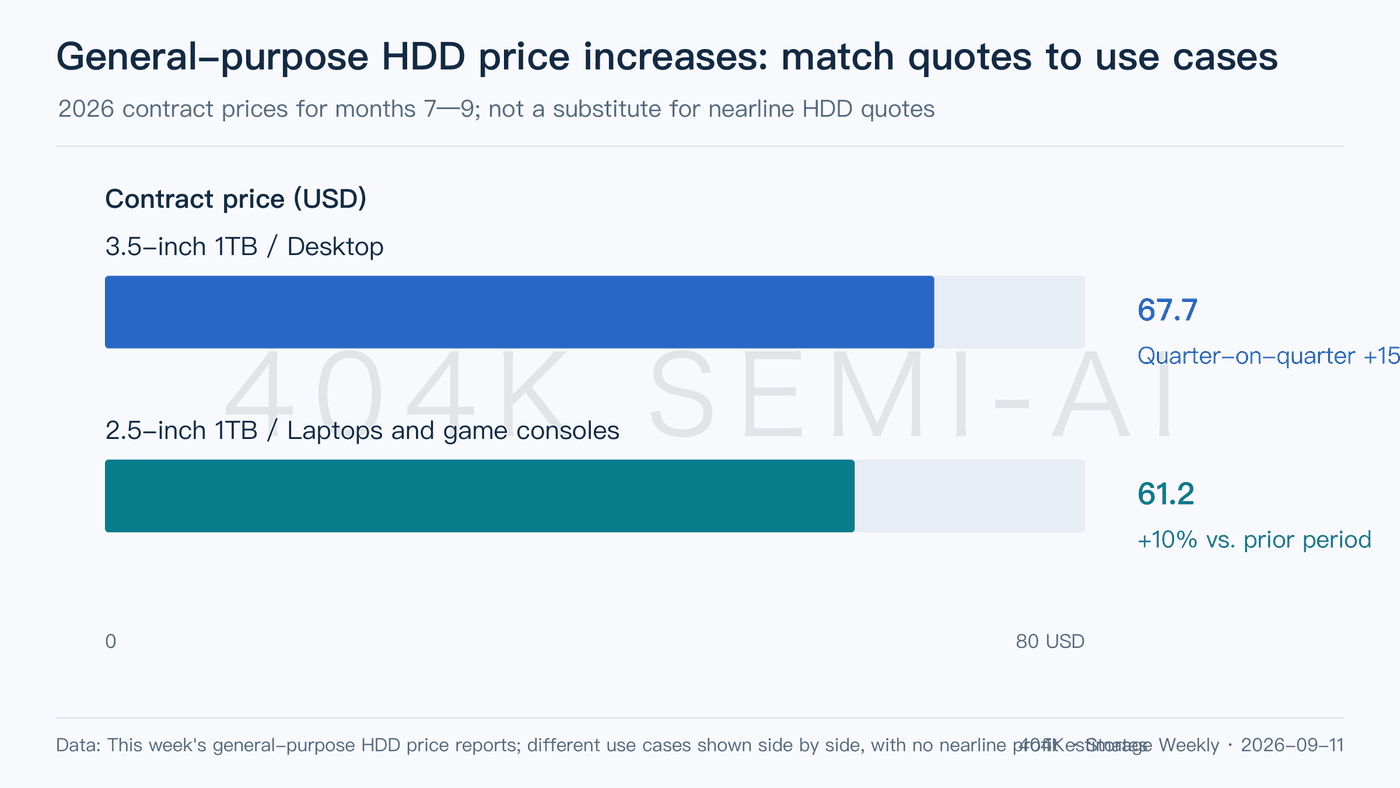
Rising mainstream HDD prices indicate tighter supply allocation, but are not a substitute for nearline pricing. Reports this week linked price increases for desktop, notebook, and game-console drives to manufacturers prioritizing high-capacity nearline products. These categories differ in capacity, application, and customers. Pricing changes show the direction of transmission but cannot be used directly to estimate nearline profits.

Nearline deliveries are better measured in exabytes (EB), or 10^18 bytes, alongside revenue per unit of capacity. Drive units and aggregate capacity can grow at different rates, while higher capacity per drive also affects unit pricing. Changes in quotes or lead times must therefore be followed by evidence of capacity shipped and profit per unit of capacity.
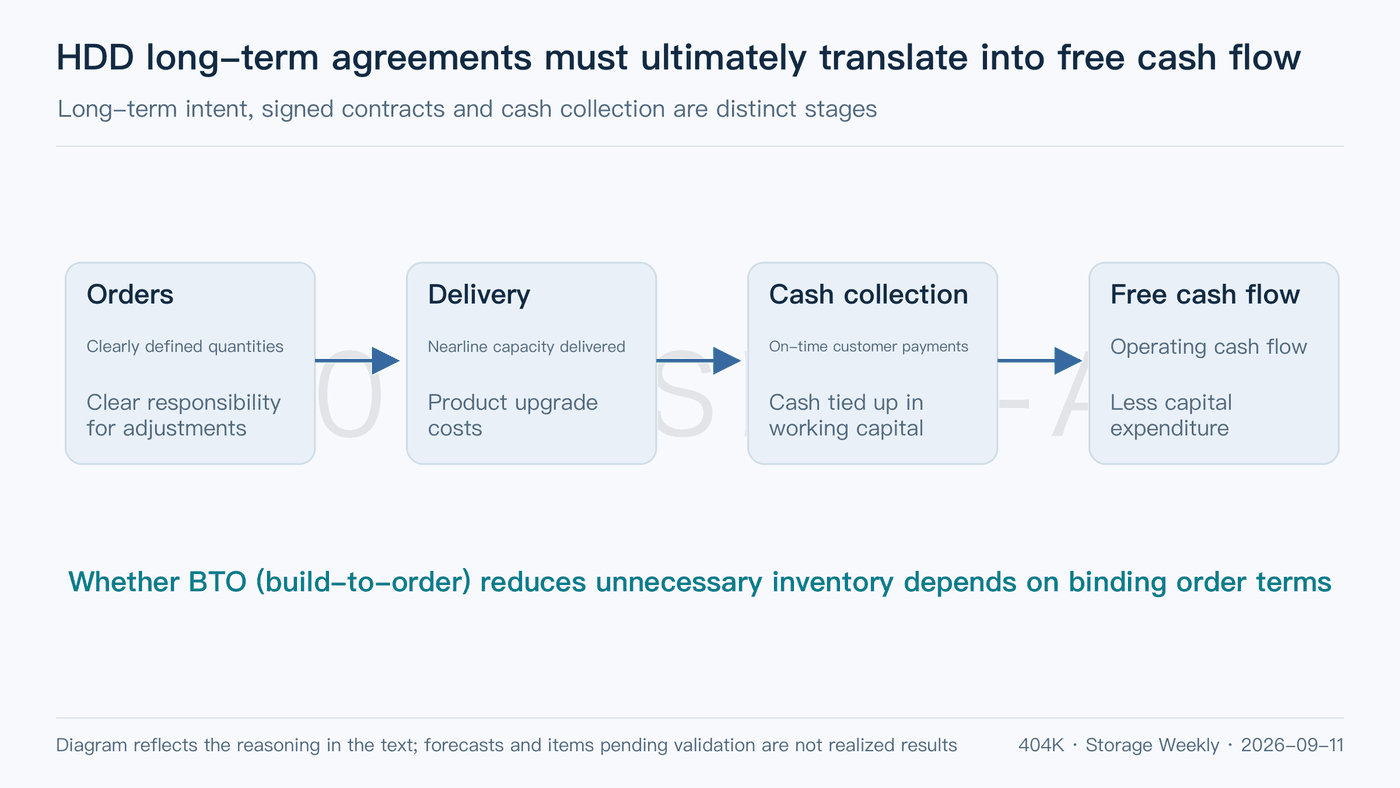
The HDD cash-flow thesis rests on build-to-order production, delivery, and collection. Build-to-order (BTO) can reduce unnecessary inventory only when customer requirements are reasonably clear and order adjustments are limited. If customers merely reserve supply while suppliers build inventory and invest in equipment, improved order visibility can still tie up more cash.
Free cash flow (FCF) must be assessed after capital expenditures. Higher prices may not fully offset new-product spending, manufacturing ramps, and working-capital growth. Conversely, if capacity growth comes from more efficient product upgrades and collections remain steady, the same revenue can generate more cash. This week’s discussions of long-term procurement provide direction, but operating data must establish the scale of any cash-flow improvement.
Western Digital and Seagate should therefore be ranked on more than weekly share-price gains. Nearline capacity deliveries, realized pricing, upgrade costs, and cash collection are more informative. If long-term agreements remain unsigned or customers postpone deliveries, reduce assumptions of long-term visibility. If contracts and collections improve together, confidence in sustained cash generation can rise.
Equipment, Testing, and Materials: Second-Order Benefits from Memory Capex
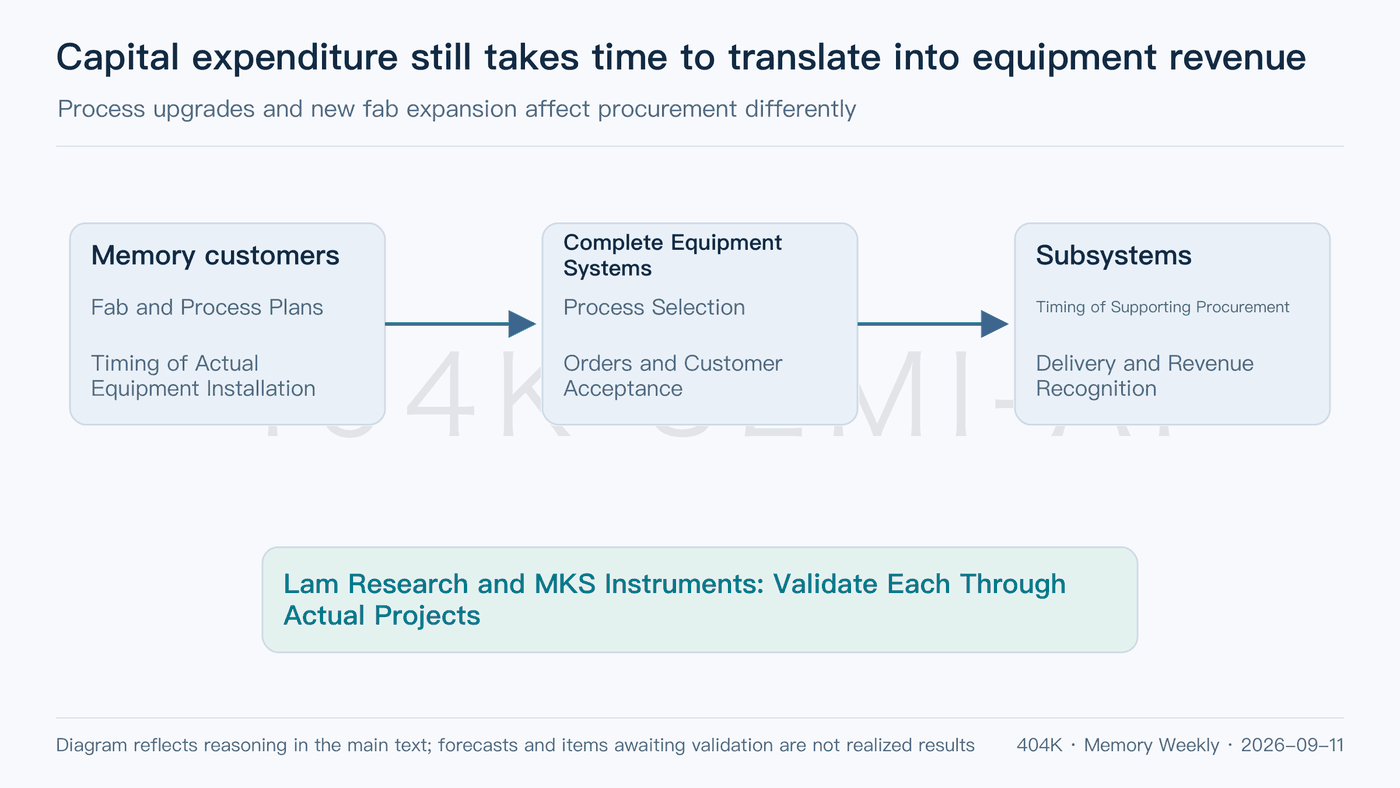
The transmission from memory expansion to equipment revenue depends on installation timing and process choices. A fab’s higher capex plan does not mean every equipment supplier receives orders simultaneously. Building facilities before installing equipment against customer demand can also spread spending across stages. Equipment investments should follow actual memory projects, rather than allocating industry capex proportionately to every supplier.
SK hynix’s node-transition information this week shows that some supply growth comes from technology upgrades. Samsung’s base-die production and custom-HBM discussions point to more joint design and supporting process steps. These developments warrant monitoring etch, deposition, inspection, and testing requirements, but the benefits must be confirmed through tool demand, orders, and customer acceptance.
Lam Research and MKS Instruments require separate analysis. Reports of Morgan Stanley’s equipment views this week compared subsystem suppliers such as MKS with equipment manufacturers. More practical questions for memory investors are which processes customer upgrades require, when equipment manufacturers purchase subsystems, and when deliveries become revenue. A reported valuation discount alone is insufficient to rank MKS ahead of Lam.
The case for testing benefits is more specific than a broad capacity-expansion narrative. Reports of FormFactor’s Citi conference remarks cited testing complexity from advanced packaging, chiplets, and HBM as growth drivers. Technical discussions at this week’s trade show also emphasized identifying defective dies before completing high-value packages. Company commentary and manufacturing requirements reinforce the case for greater testing intensity.
More testing does not translate automatically into more revenue for testing suppliers. Test duration, parallel efficiency, equipment utilization, and customer adoption jointly determine procurement. More efficient equipment may reduce the number of tools required per chip. Slow qualification can also leave prepared capacity generating costs before revenue. Orders, utilization, and revenue recognition matter more than the number of test procedures.
For testing-chain stocks such as DI, evidence of memory-customer orders and product compatibility should precede earnings-upside assumptions. ASML’s long-term technology roadmap is better assessed against customer process plans; distant technology discussions are not current-week memory orders. Equipment categories occupy different validation stages and should not share the same assumed monetization timeline simply because they fit one theme.
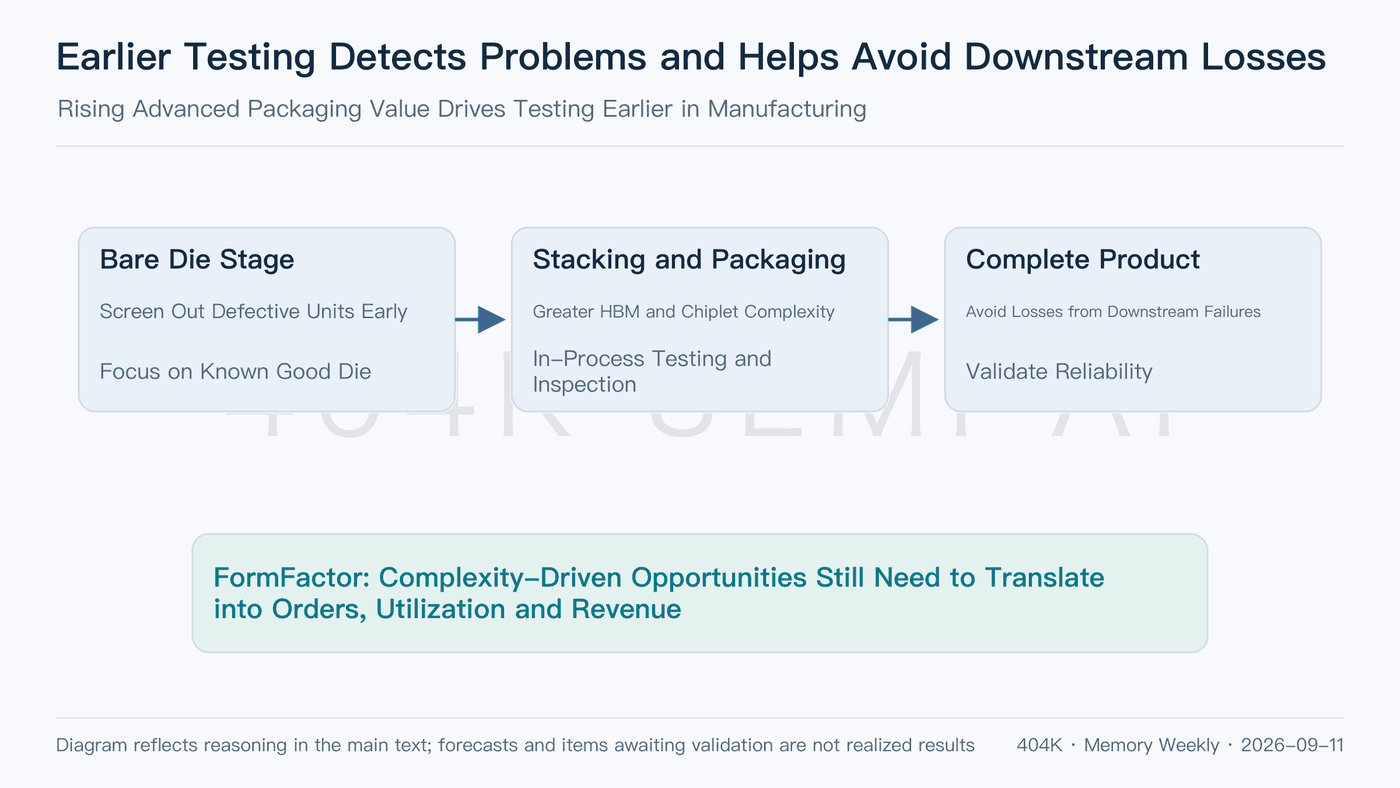
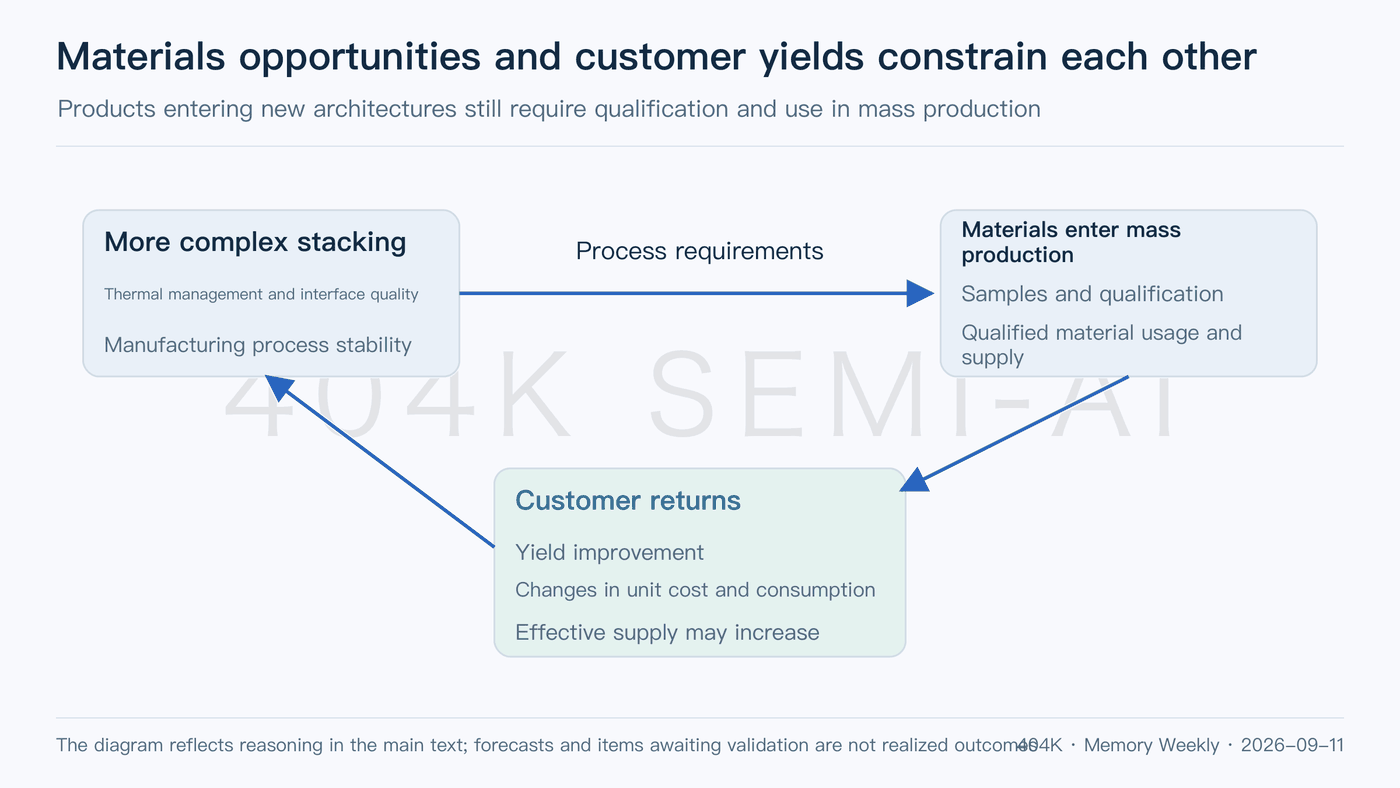
Higher yield requirements create both opportunity and risk for materials suppliers. Advanced stacking and more complex packaging require stable thermal management, interface quality, and manufacturing processes. This week’s system-integration discussions identified both cooling and testing as constraints, showing why additional chip supply alone may not resolve finished-product delivery bottlenecks.
For materials suppliers, valuable incremental demand consists of qualified usage and customer adoption, not simply inclusion in a new architecture. Sample approval, production entry, and volume supply may be separated by considerable time. Changes in formulations or processes can also invalidate earlier test results. Qualification progress, use in mass production, and consumption per unit should guide forecasts.
These suppliers’ interests do not always align with those of memory manufacturers. Stricter process requirements may increase equipment and materials content while raising manufacturers’ costs. Better yields can reduce consumption per unit and expand effective supply. Equipment and testing investments therefore require two questions: why customers must buy, and whether those purchases improve customer returns. Sustained follow-on orders depend on the latter.
Downstream Costs and Demand Destruction: Servers, Networking, Smartphones, PCs, and EVs
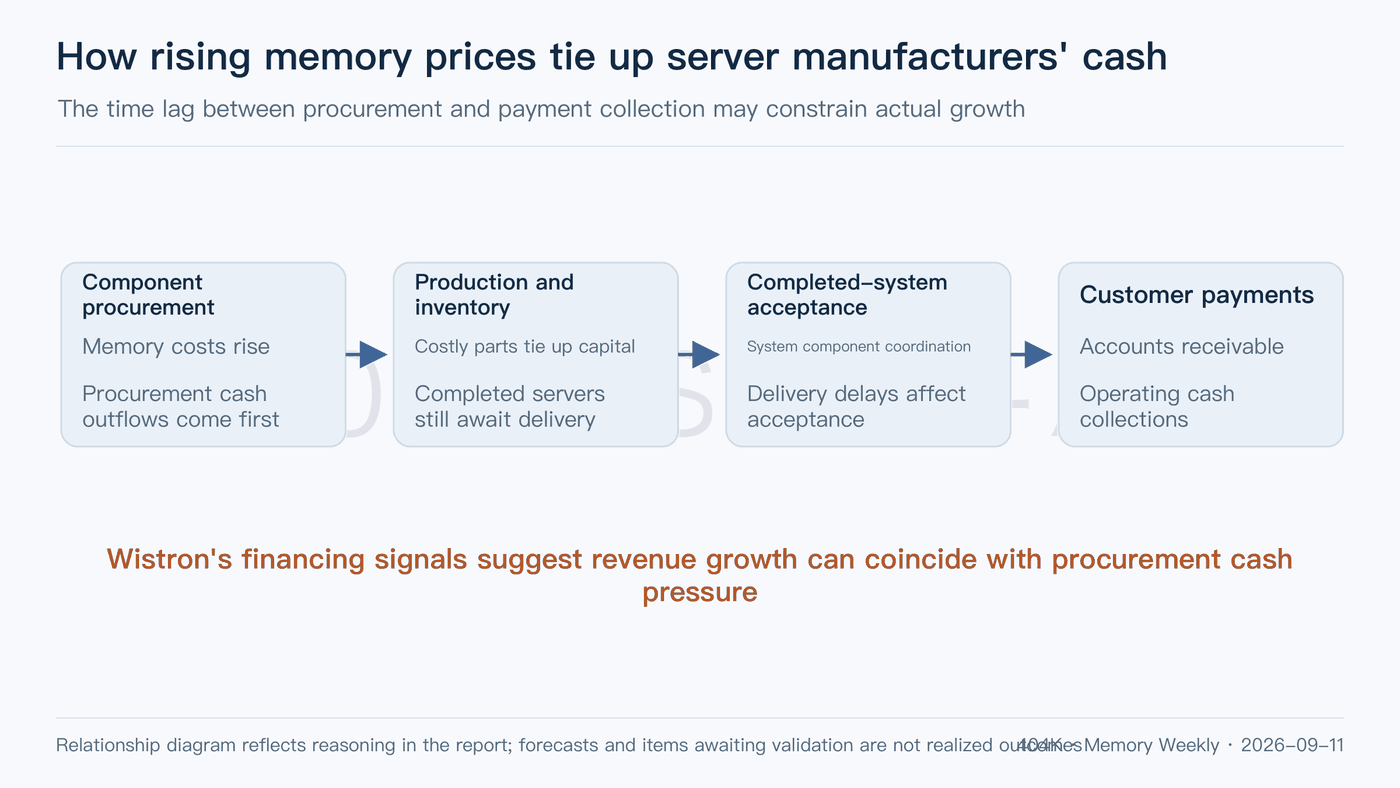
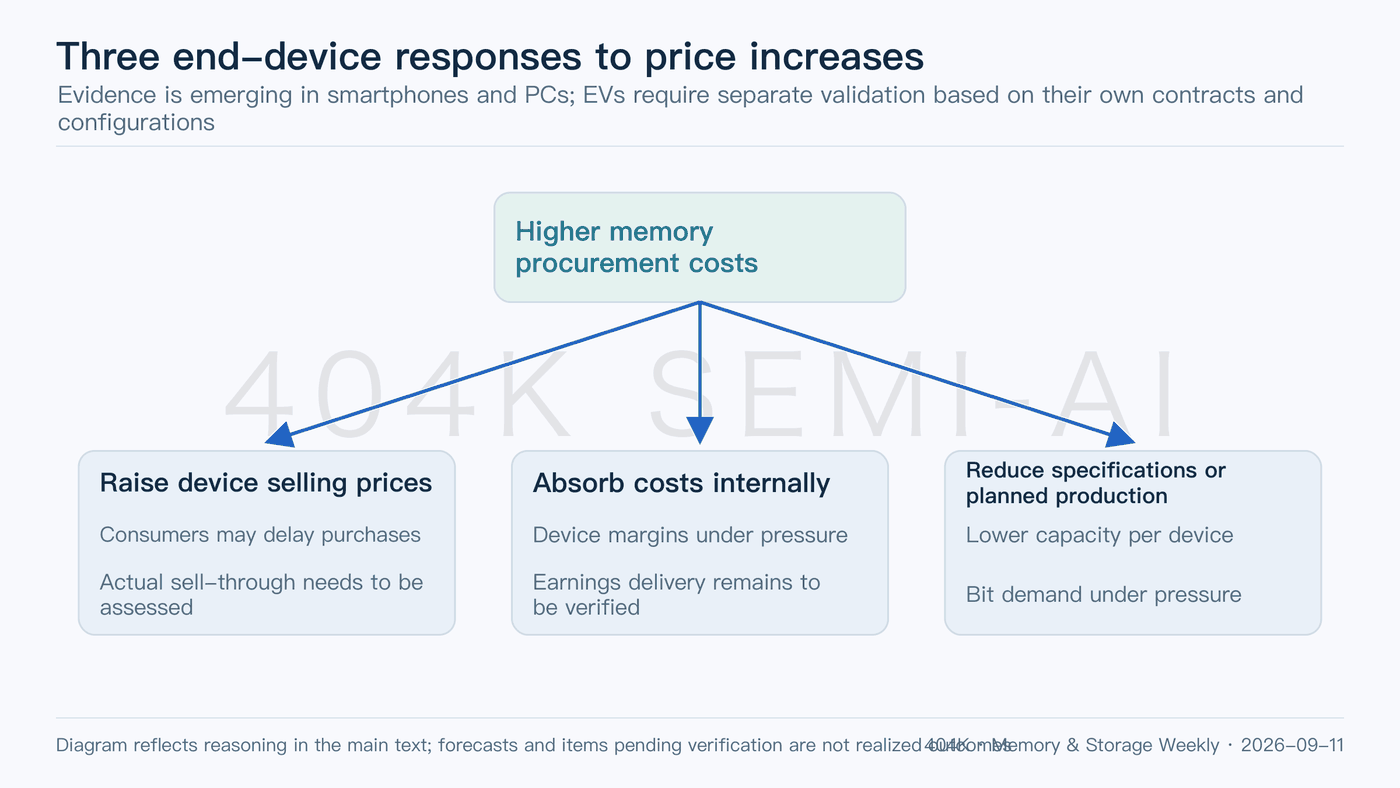
The first pressure on server manufacturers may emerge in procurement funding. Financing information on Wistron this week said proceeds would primarily fund AI-server raw-material purchases. The operating implication is clear even without relying on the reported financing amount: increasingly expensive components must be purchased before system delivery and customer payment, tying up more cash during production.
Memory price increases and server revenue growth can therefore coexist with cash-flow pressure at system manufacturers. Customer resilience requires a combined assessment of inventories, receivables, payables, and operating cash flow. Continued orders are only the starting point. Slower collections and sustained financing needs may eventually constrain procurement, reaching upstream suppliers as delayed deliveries or price renegotiations.
Networking equipment and servers share another risk: delays anywhere in the system can postpone acceptance of the finished product. Disaggregated inference requires state transfer and coordination between networking and storage. Slow data migration can leave incremental capacity underused. System deliveries and customer payments are the appropriate focus; an unverified, uniform memory-cost ratio should not be assigned to networking equipment.
Smartphones offer the clearest window into demand destruction. On September 8, TrendForce raised its full-year production forecast from 1.05 billion to 1.07 billion units, while emphasizing purchases brought forward and brands replenishing production schedules. A forecast upgrade can coexist with industry contraction: near-term conditions are better than previously expected, but total demand has not returned to growth.
Investment analysis must distinguish purchases brought forward from sustained consumption. Consumers may buy now to avoid future price increases, while brands may procure memory early to avoid shortages. Both can lift upstream orders and current smartphone output without guaranteeing subsequent sales. Retail sell-through and channel inventories matter; stronger memory drawdowns alone do not establish stronger smartphone demand.
Brands also differ in their ability to absorb costs. Mizuho argued this week that Apple and Samsung Electronics are relatively advantaged by supply allocations and flagship-heavy product mixes, while volume-focused brands face greater pressure. This is a relative competitive assessment, not a prediction that either company’s smartphone profits must rise. Securing components is the first step; consumer willingness to keep buying after price increases determines how much profit is retained.
PCs are already showing signs of configuration adjustments. Reports on PC DRAM this week said system manufacturers were struggling to pass all costs to notebook buyers, with some demand shifting toward lower-capacity models. For memory suppliers, capacity per system can fall even without a material decline in PC units, pressuring bit demand. Tracking PC shipments alone can miss this change.
EVs and other end markets require narrower conclusions. Higher memory prices can increase hardware costs, but contracts, configurations, and qualification cycles differ by product. Smartphone price increases cannot simply be applied to vehicles. Automotive memory procurement prices, configuration changes, and deliveries remain variables to monitor; unverified specification cuts in an end market should not yet be counted as lower industry demand.
Investment Priorities, Risks, and Thesis Invalidation
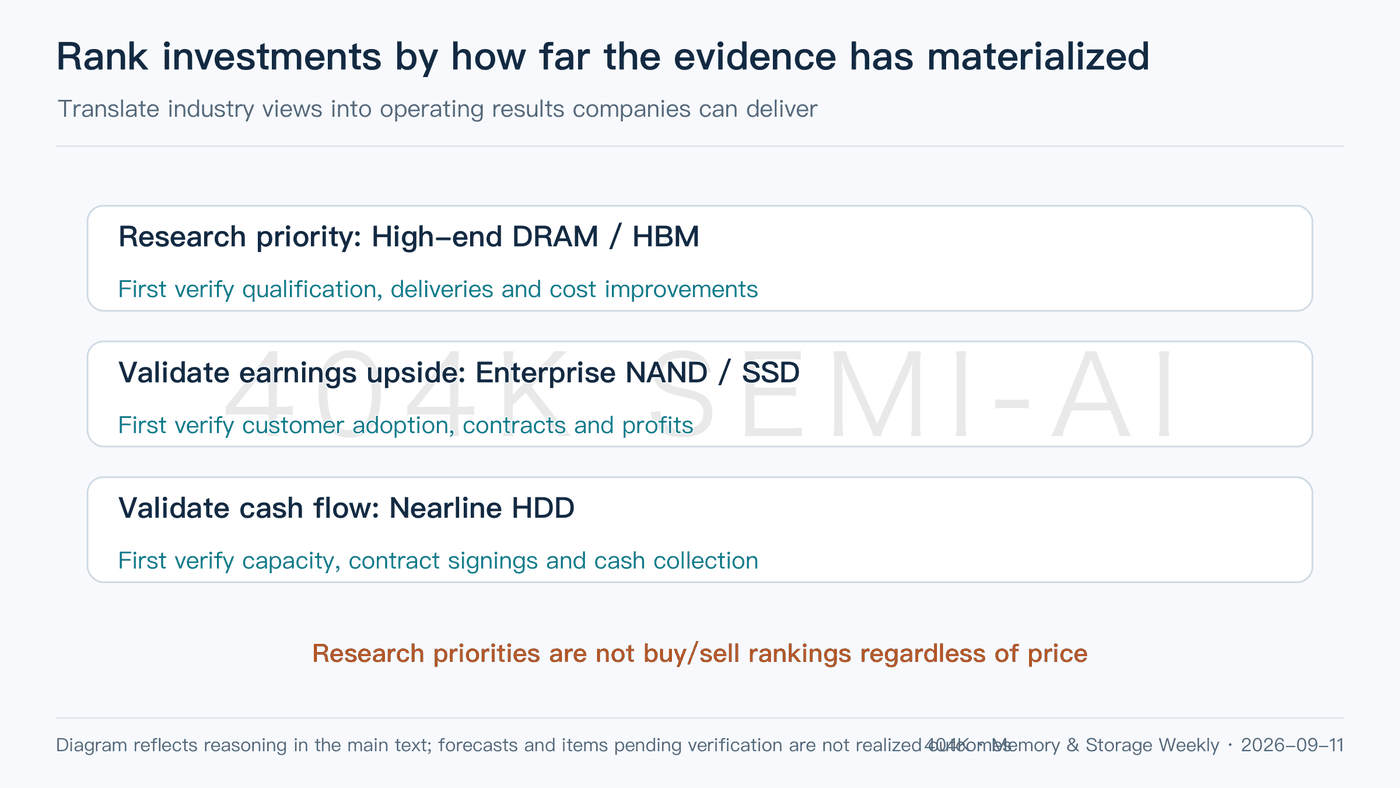
High-end DRAM/HBM remains the first research priority, followed by NAND/SSD suppliers with enterprise products and established customers, with HDD exposure assessed through contracts and cash flow. This ranking reflects confidence in the evidence. It is neither a trading ranking based on one week’s returns nor a claim that the first category is more attractive at any valuation.
High-end memory must first demonstrate delivery. Samsung’s projected share gains require customer adoption; SK hynix’s node transition requires qualified output; Micron’s server mix must continue converting into revenue. If these conditions hold, mix and cost improvements could sustain company earnings even as industry price increases slow. Industry shortages alone cannot guarantee execution.
Enterprise SSD and HDD investment appeal varies with contract quality. SanDisk and Kioxia must show that multiyear arrangements improve realized revenue and collections. Western Digital must convert long-term customer intentions into signed contracts. Seagate needs nearline deliveries and cash flow to demonstrate returns on product upgrades. Confidence in durability rises as information moves closer to actual contract performance.
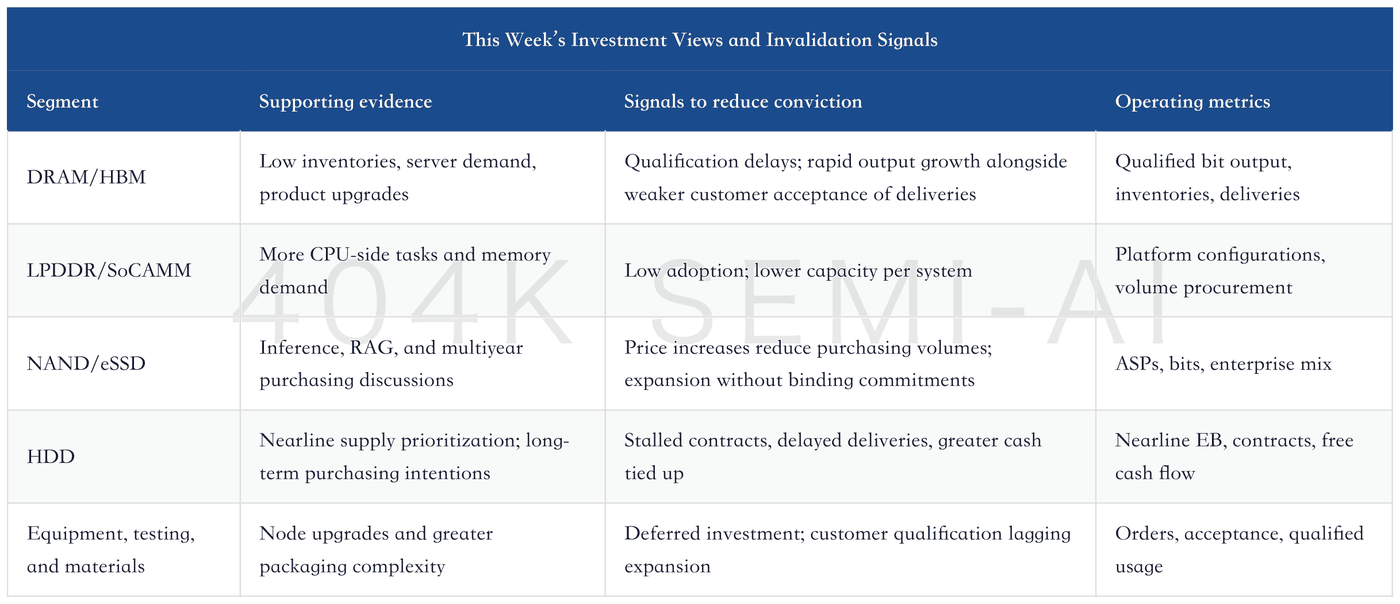
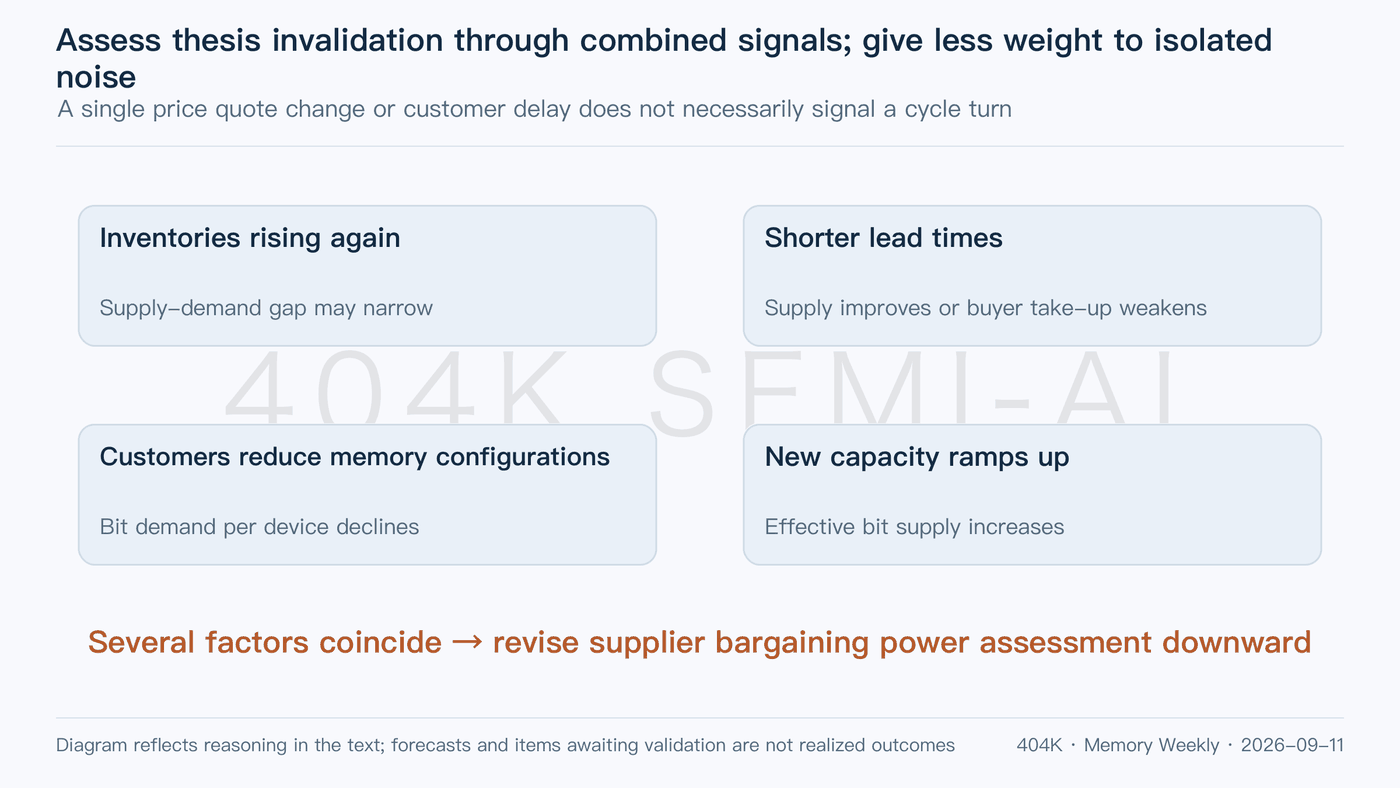
The greatest concern is several modest changes occurring together. One price cut need not mark a cycle turn, and one customer delay may reflect scheduling. But rising inventories, shorter lead times, specification reductions, and new-capacity ramps together would warrant lower expectations for supplier bargaining power. Conversely, higher quotes accompanied by slower actual deliveries are not evidence of stronger earnings.
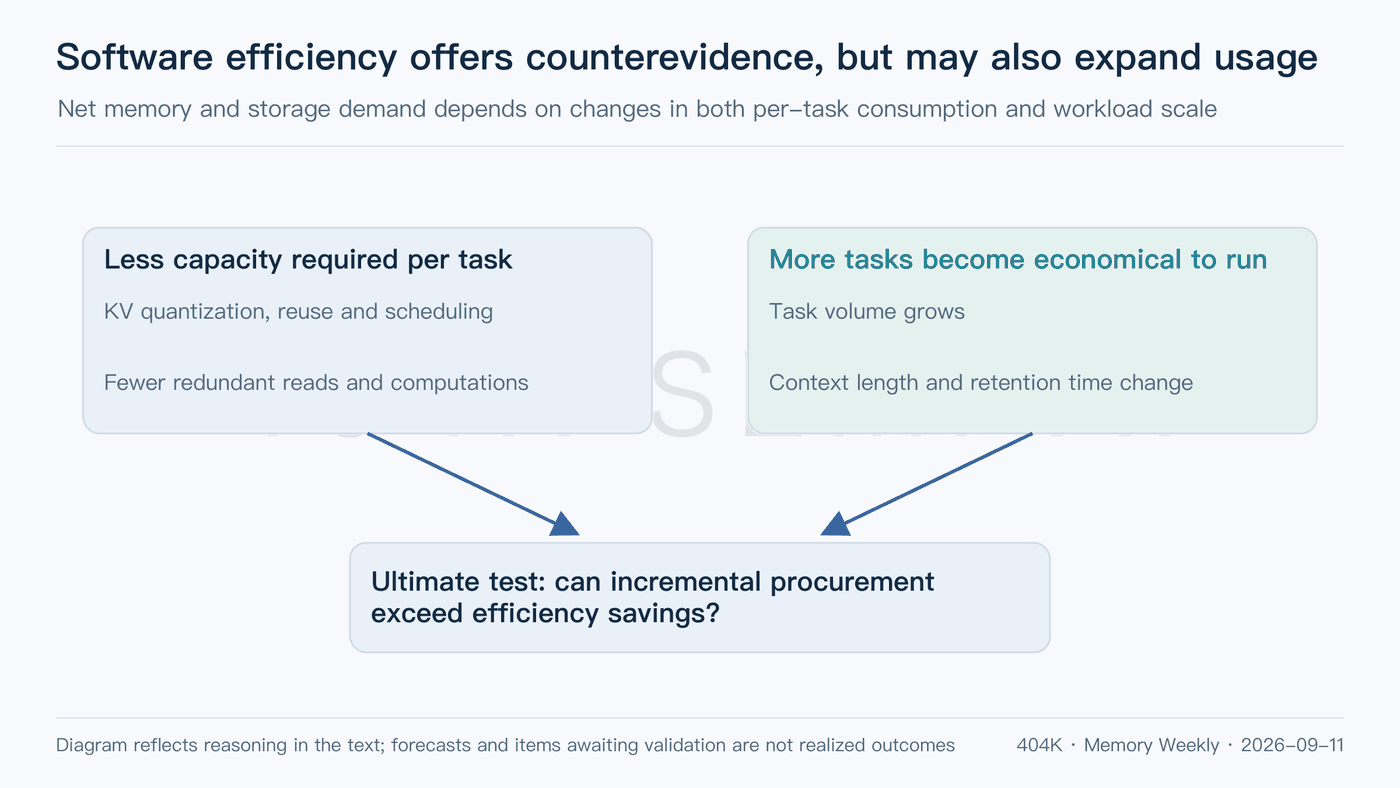
Software efficiency remains an essential counterargument. KV quantization, cache reuse, batching, and better scheduling can reduce repeated reads or computation. This week’s inference discussions do not support treating these improvements as uniformly negative for storage demand, because efficiency can make more tasks economical. The relevant comparison is the net effect of lower capacity per task against growth in task volumes, context length, and retention time.
Trading risk should be separated from operating risk. Information related to the Bank of Korea this week suggested that overseas leveraged products linked to technology stocks could transmit volatility into underlying shares through hedging and arbitrage. Higher interest rates can also reduce the present value of future earnings without any decline in orders. A share-price pullback alone does not establish weaker memory demand; crowded leveraged trading likewise prevents a short-term rally from serving as new industry evidence.
Portfolio decisions should not allow long-term industry conviction to obscure near-term valuation risk. Set expectations for delivery, contracts, and cash flow, then assess how much improvement the purchase price already discounts. If the current valuation depends on distant high-profit forecasts while near-term validation keeps slipping, reduce confidence. If the company consistently delivers, temporary market volatility need not change the operating assessment each day.
What to Watch Next Week
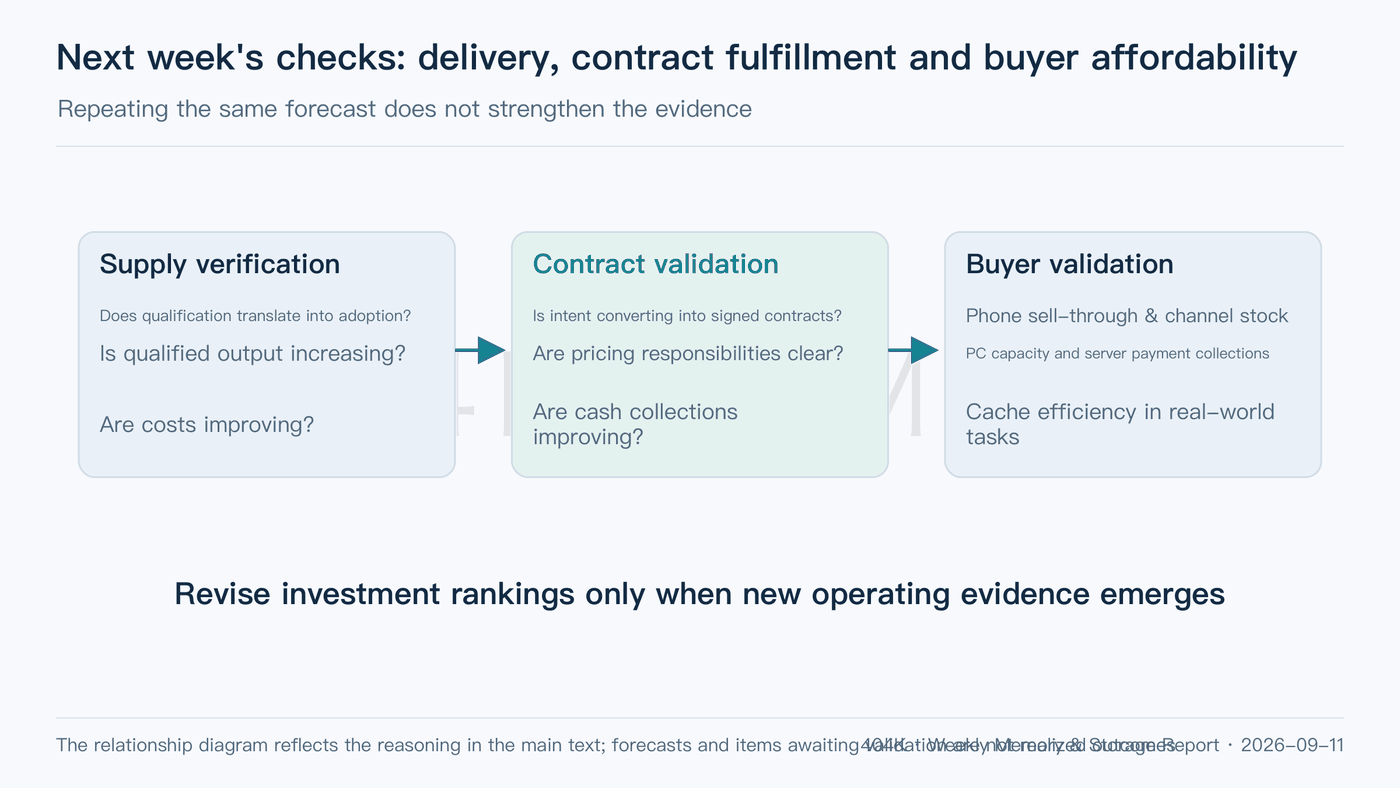
First, assess whether actual supply is catching up with supply commitments. New company disclosures on Samsung’s HBM4 customer adoption, SK hynix’s qualified advanced-node output, and Micron’s server-product deliveries should take precedence over repeated optimistic industry forecasts. The questions are whether deliveries are expanding, customers are accepting them, and costs are improving—not merely whether another product generation has entered the roadmap.
Second, look for more binding contract terms. Western Digital’s signing progress, and any further detail from SanDisk and Kioxia on delivery volumes, price adjustments, and execution, matter more than agreement length alone. Customer prepayments, noncancelable clauses, price protection, and capital spending must align before confidence in stable cash flow can rise.
Finally, watch for buyers reducing actual procurement. Smartphone sell-through must absorb production brought forward; PC capacity per system may face further cuts; and server manufacturers’ collections must keep pace with procurement funding. These factors determine how far prices can rise. For inference, track real-workload latency, cache hit rates, and capacity savings. Repetition of existing views does not justify a stronger conclusion next week. Investment priorities should change only with new evidence on delivery, contract execution, and buyer affordability.