Contents
Weekly Synthesis
Cloud Revenue and AI Capital Expenditures
Datacenters, Compute Procurement, and Custom Silicon
Foundation Models, Enterprise Software, and Application Monetization
Divergence: Hyperscaler M7 vs. Neo-Cloud Providers
Analytical Divergence, Falsification Triggers, and What to Track Next Week
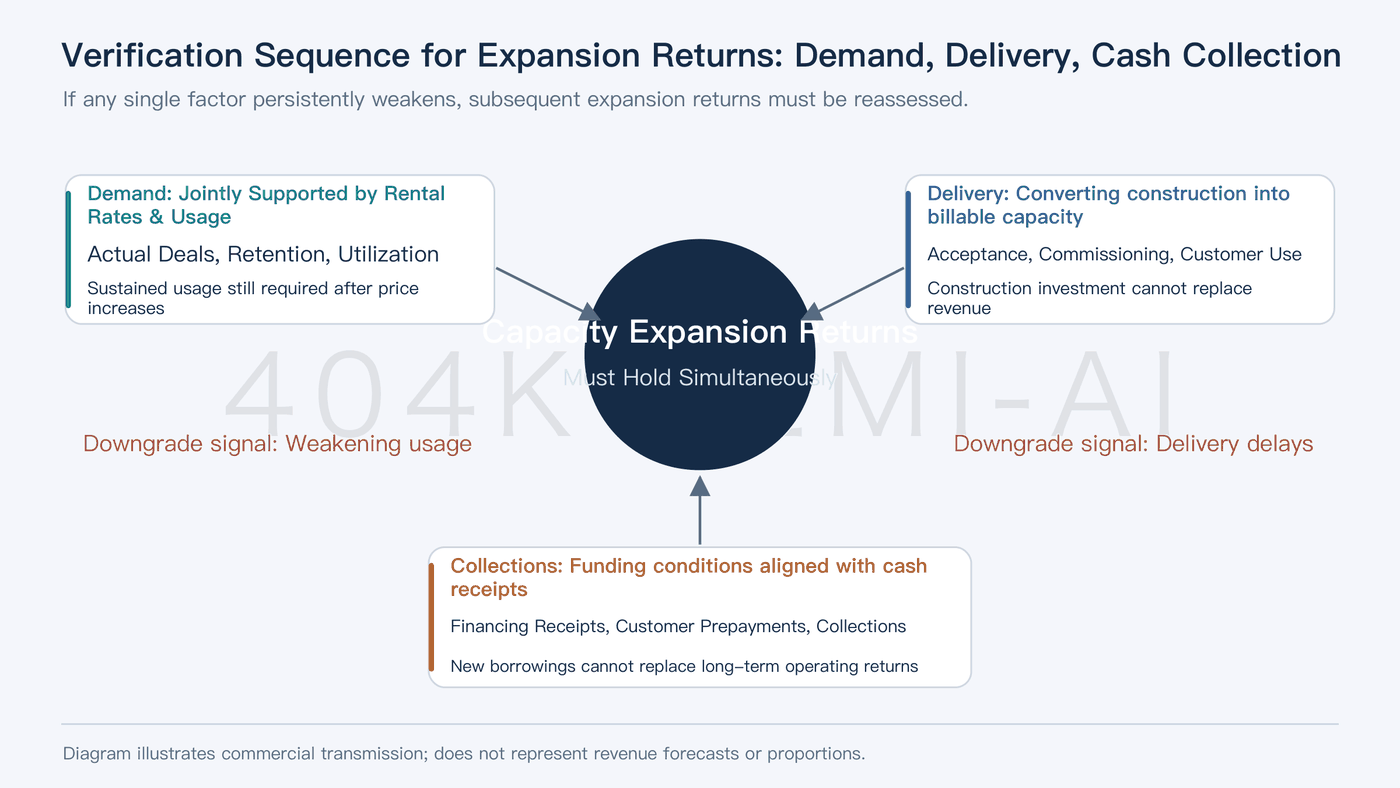
Cloud compute rental rates and booking momentum remained firm this week, but capacity expansion bottlenecks are increasingly concentrated in power interconnection, project financing, and customer payment terms. While Alphabet (Google) and Amazon seek returns on proprietary silicon, Microsoft emphasizes customer diversification. For neo-cloud providers, translating capacity shortages into hard cash flow depends on executing physical deliveries, sustaining high utilization, and securing viable financing structures simultaneously.
Weekly Synthesis
Cloud compute demand remains robust, but the lag between securing bookings and realizing cash collections is widening. Across the board—from Google's commentary on custom silicon payback periods and Microsoft's push to build compute for a broader enterprise base, to late-week price hikes and funding announcements by neo-clouds—the core question converges: can demand translate into collectible service revenue quickly enough after upfront hardware capital outlays?
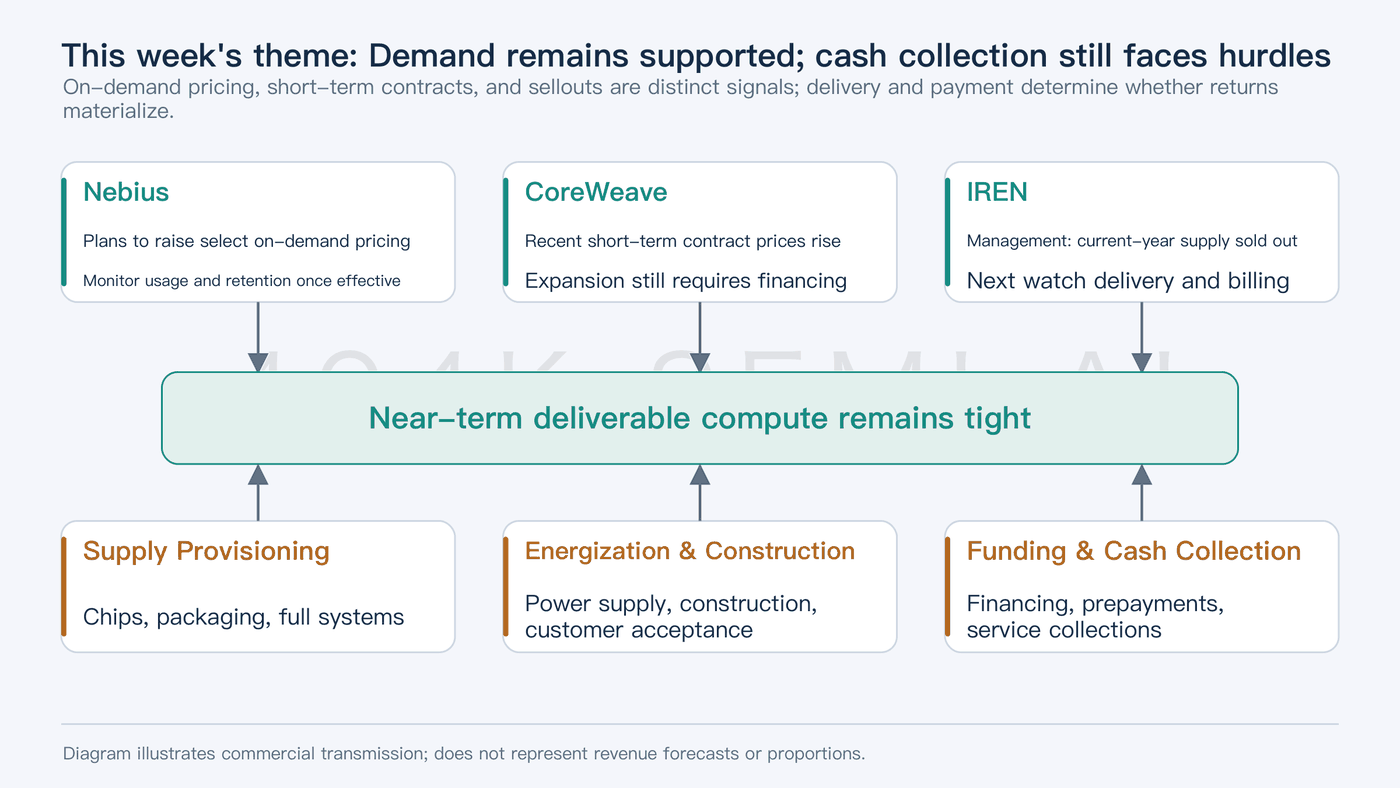
The most tangible shift on the demand side is pricing power. Nebius plans to raise on-demand pricing on select GPUs effective October 1; CoreWeave reported higher realized rates on recent short-term contracts; and IREN management stated that its 2026 capacity is fully sold out. Spanning on-demand rates, short-term commitments, and bulk capacity sales, these signals reaffirm that near-term deliverable compute remains tight—though they cannot be mechanically extrapolated into sector-wide revenue growth.
Supply-side friction is also crystallizing. Custom silicon faces manufacturing and advanced packaging lead times; data centers must secure power interconnection and complete construction; and clusters require substantial funding before generating operational revenue. Google's reported involvement in Crux AI's financing, CoreWeave's proposed debt and equity capital raise, and Amazon linking backup generator procurement to equity warrants all illustrate that capacity expansion is simultaneously testing procurement, financing structures, and physical execution.
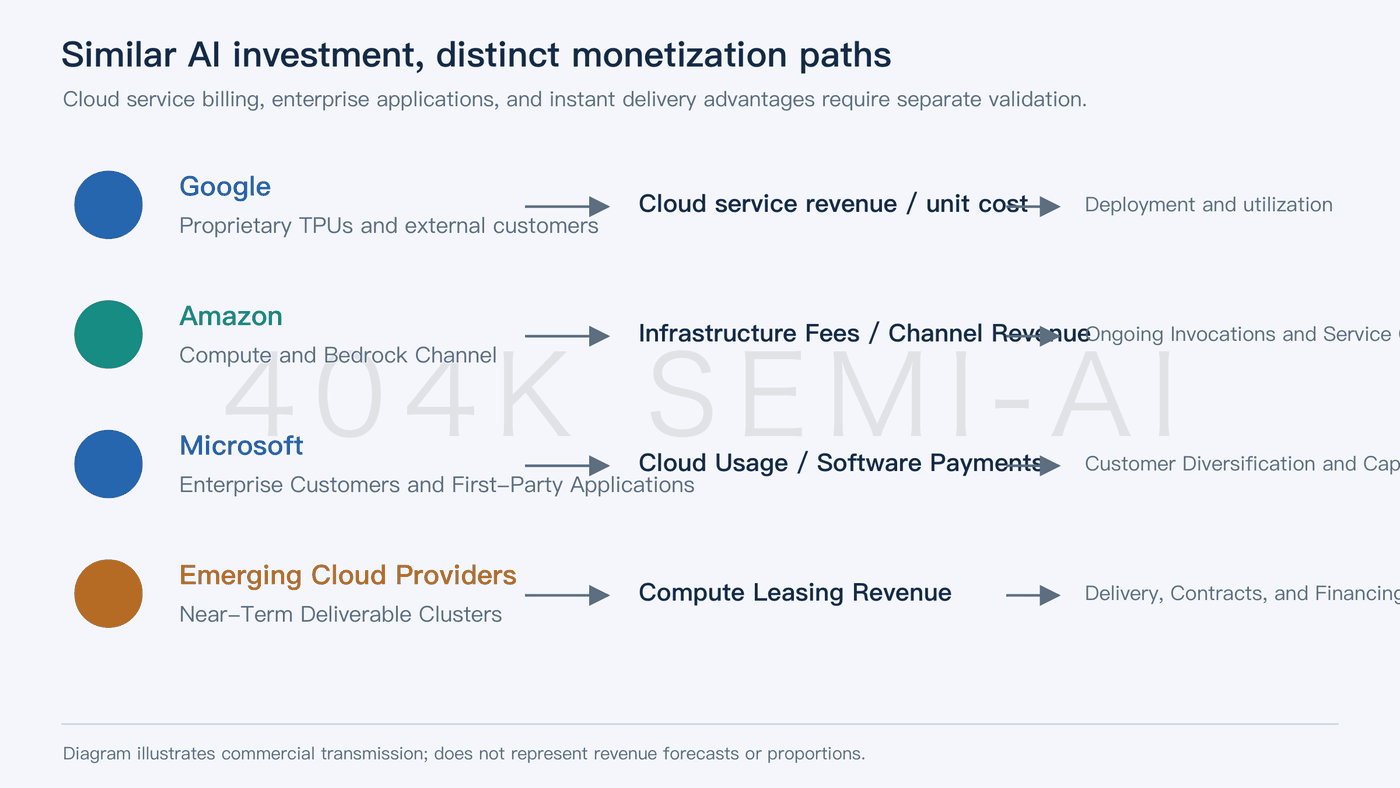
Companies are best evaluated by their monetization models rather than purely by the headline scale of their AI capex. For Google, the crux is whether in-house silicon can compress service costs while attracting external cloud customers. For Amazon, it is the ability to monetize compute, model distribution channels, and enterprise cloud workloads in tandem. For Microsoft, the priority is allocating capacity across a broader enterprise cohort and proprietary applications, mitigating ROI concentration risk from a handful of frontier model developers.
For neo-cloud providers, competitive advantage is defined by time-to-delivery. Clusters ready to come online in the near term can command premium pricing, whereas longer-dated builds remain exposed to construction delays and capital market risk. Even under the common label of "compute revenue," selling hourly GPU instances, delivering dedicated clusters via multi-year take-or-pay contracts, and hosting managed model endpoints entail vastly different cost structures and operational counterparty risks. Operating margins cannot be meaningfully compared without adjusting for these structural differences.
The investment thesis remains two-sided: near-term scarcity bolsters rental rates and order books, yet massive upfront capital expenditures do not automatically guarantee attractive returns. If premium pricing is confined to limited short-term deals, or if customers trade higher nominal rates for lower upfront prepayments, an apparent uplift in revenue visibility may actually widen funding deficits. Next week, investors should scrutinize delivery schedules and contractual payment terms before factoring in expansion returns.
Cloud Revenue and AI Capital Expenditures
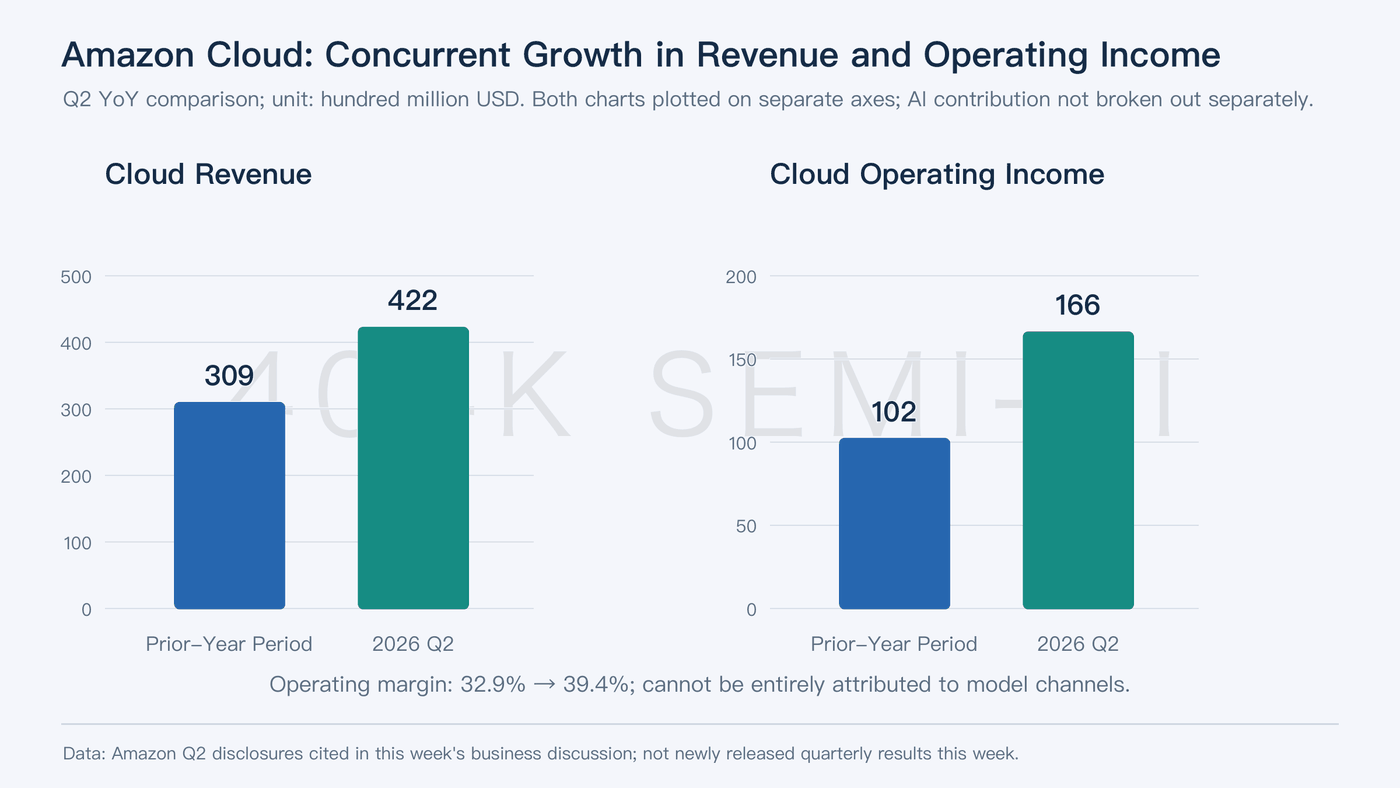
AWS growth provides underlying demand support, though profit attribution warrants analytical discipline. Recent market commentary around Amazon Web Services (AWS) referenced its Q2 results released on July 30, which showed year-over-year gains in both net sales and operating income. This serves as baseline financial context rather than newly reported earnings this week. While managed model services delivered incremental uplift, the entire segment-level margin expansion should not be attributed solely to Anthropic's Claude.
AWS Revenue and Operating Profit Expand, Though Model Channel Contribution Remains Undisclosed

Amazon operates concurrently as an infrastructure provider and a foundation-model distribution channel. When enterprises invoke Claude through Amazon Bedrock, Amazon monetizes both underlying compute infrastructure consumption and marketplace distribution commissions. Compared to pure hardware colocation/rental, this multi-tiered architecture allows continuous monetization as enterprise model adoption scales. However, ultimate profitability is governed by API token consumption volumes, pricing structures, and underlying inference serving costs; channel share alone does not equate to cash flow realization.
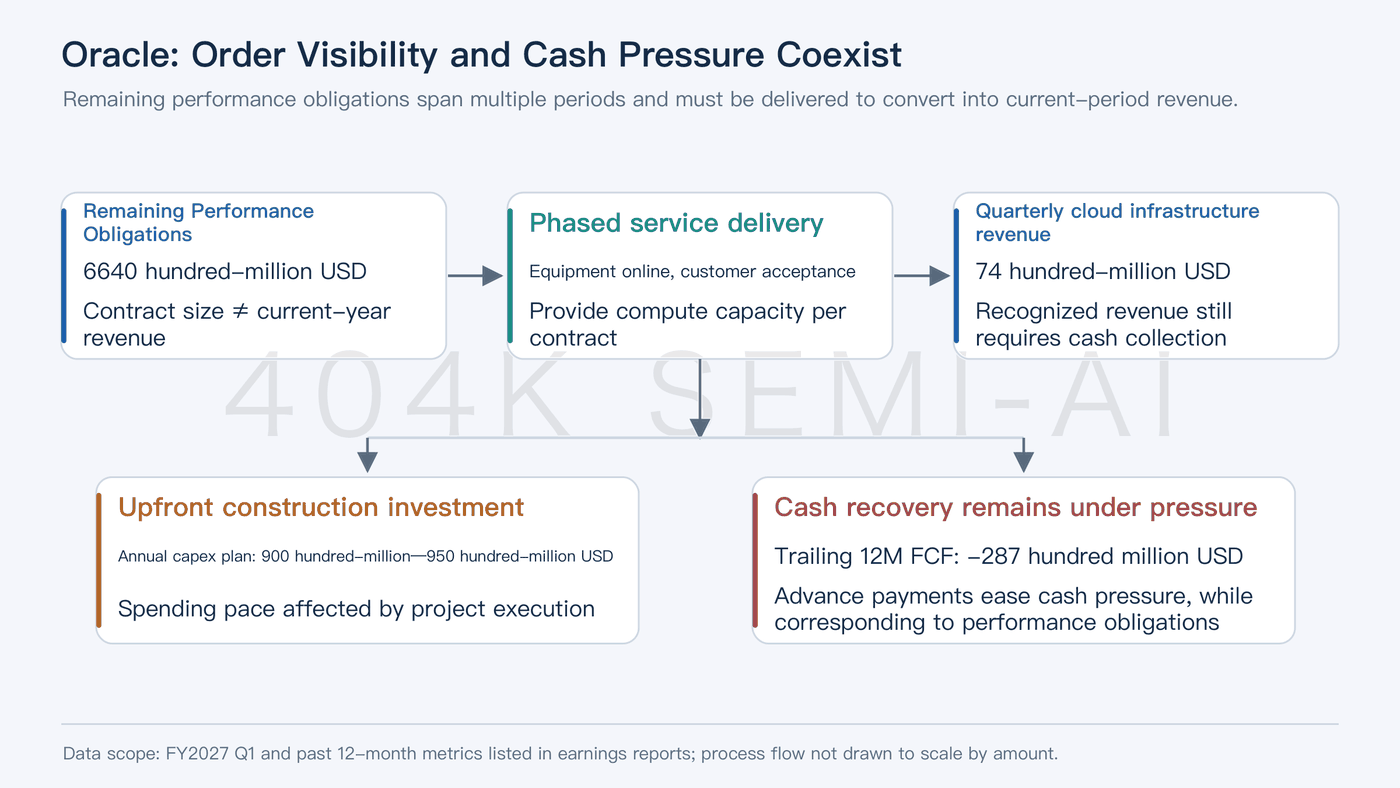
Oracle illustrates that hyper-growth in cloud infrastructure can coexist with acute free cash flow pressure. In reports surrounding its Q1 FY2027 earnings, Oracle Cloud Infrastructure (OCI) posted rapid revenue expansion, with a massive Remaining Performance Obligation (RPO) backlog providing multi-year demand visibility. Concurrently, aggressive datacenter capex continues to weigh heavily on free cash flow. The analytical focus must center on the velocity of backlog burn and whether cash collections from customers keep pace with upfront hardware and facility outlays.
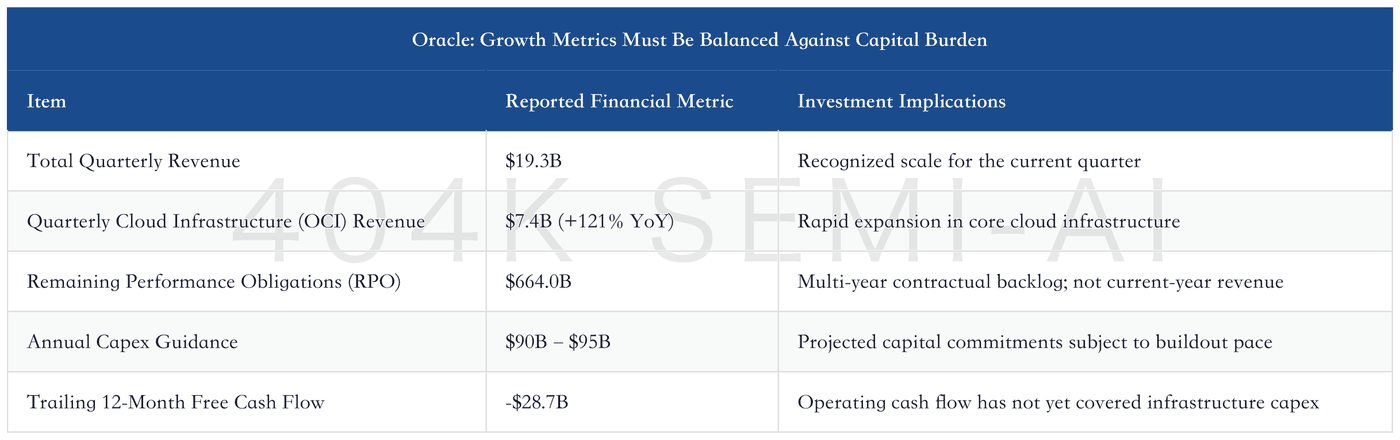
A massive backlog only converts into GAAP revenue as capacity is energized and services are delivered. While upfront customer prepayments relieve datacenter buildout financing burdens, they represent future performance liabilities. Consequently, high customer concentration, construction delays, or lower prepayment ratios could trigger liquidity strain well before any revenue deceleration shows up. While restructuring and cost controls support baseline operating efficiency, they are no substitute for bringing datacenters online on schedule and securing continuous cash collections.
Microsoft's commentary reframes the capex debate around customer diversification and workload resilience. CEO Satya Nadella underscored that infrastructure must support a broad base of third-party enterprise customers and Microsoft’s first-party applications, rather than being built exclusively around a few frontier model labs. For hyperscalers, customer diversification ensures that identical compute assets can be dynamically redeployed to alternate enterprise workloads should any single anchor client decelerate spending.
However, this architecture carries inherent trade-offs. A multi-tenant general-purpose cloud must accommodate heterogeneous models, diverse hardware accelerators, and complex enterprise compliance environments, sacrificing some of the bespoke performance optimizations achievable in dedicated single-tenant clusters. Whether a "long-tail" customer strategy yields superior ROIC depends on whether aggregate enterprise adoption sustains high utilization and effectively amortizes software, networking, and operational overhead. Headline customer counts alone do not guarantee superior capital efficiency.
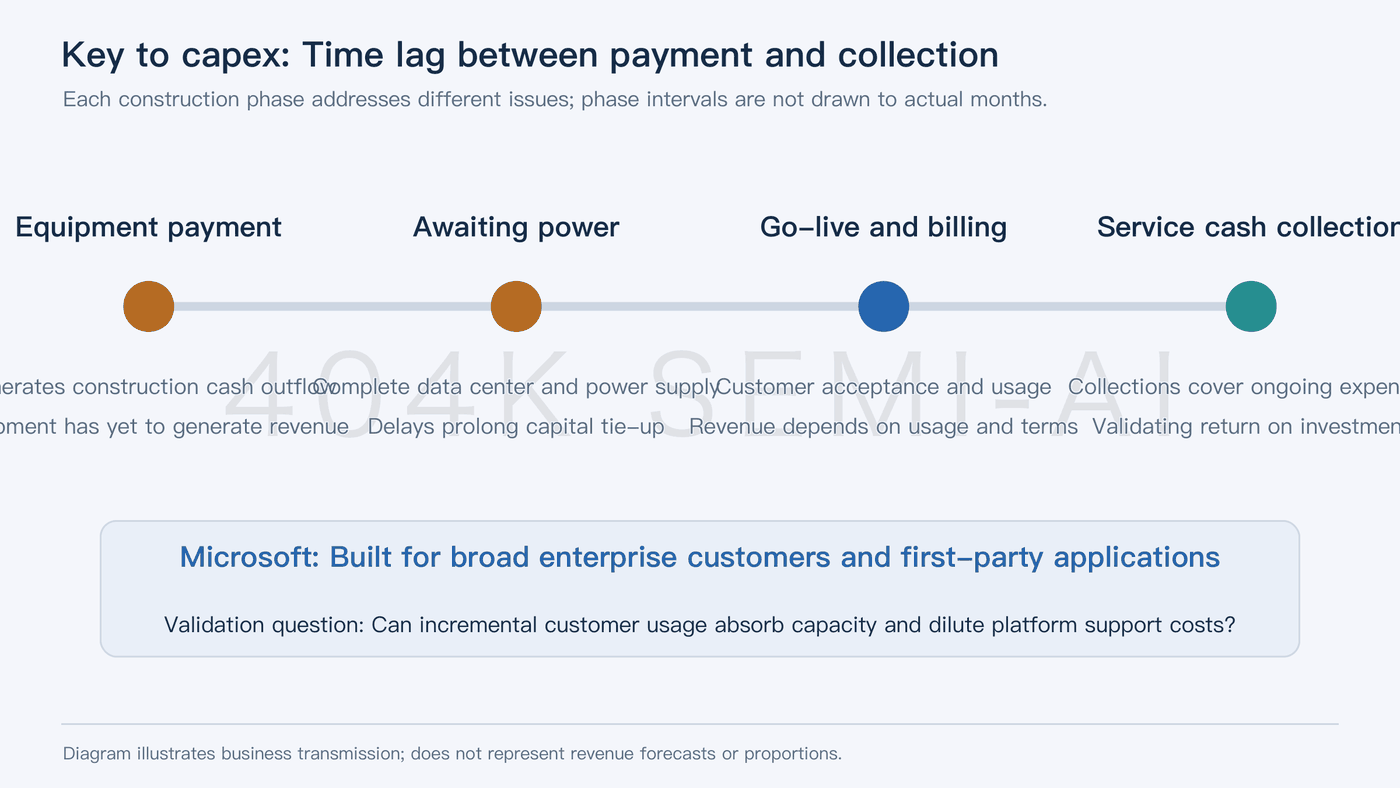
The most constructive way to evaluate capex across players is to map payments, capacity energization, and revenue recognition along a unified timeline. Hardware procurement triggers immediate cash outflows, followed by an idle interim awaiting grid interconnection during which no billable revenue is generated. Once energized, cash realization remains governed by utilization rates and contractual billing terms. If construction-in-progress expands faster than billable capacity, near-term free cash flow will deteriorate even if secular demand remains intact. Comparative cross-company analysis must also differentiate between direct cash purchases, capital leases, and customer-funded prepayments rather than ranking heterogeneous capex definitions side by side.
Microsoft's dialogue regarding a hybrid "build-versus-lease" strategy also highlights how procurement structures shift the locus of risk. Third-party leasing rapidly supplements near-term capacity, whereas self-build models require direct assumption of physical construction and hardware depreciation risks. Both require substantial capital; operating leases and off-balance-sheet commitments should not be mistaken for a reduced economic burden merely because they bypass direct headline capex. Cross-peer evaluation must track underlying contractual payment liabilities.
Datacenters, Compute Procurement, and Custom Silicon
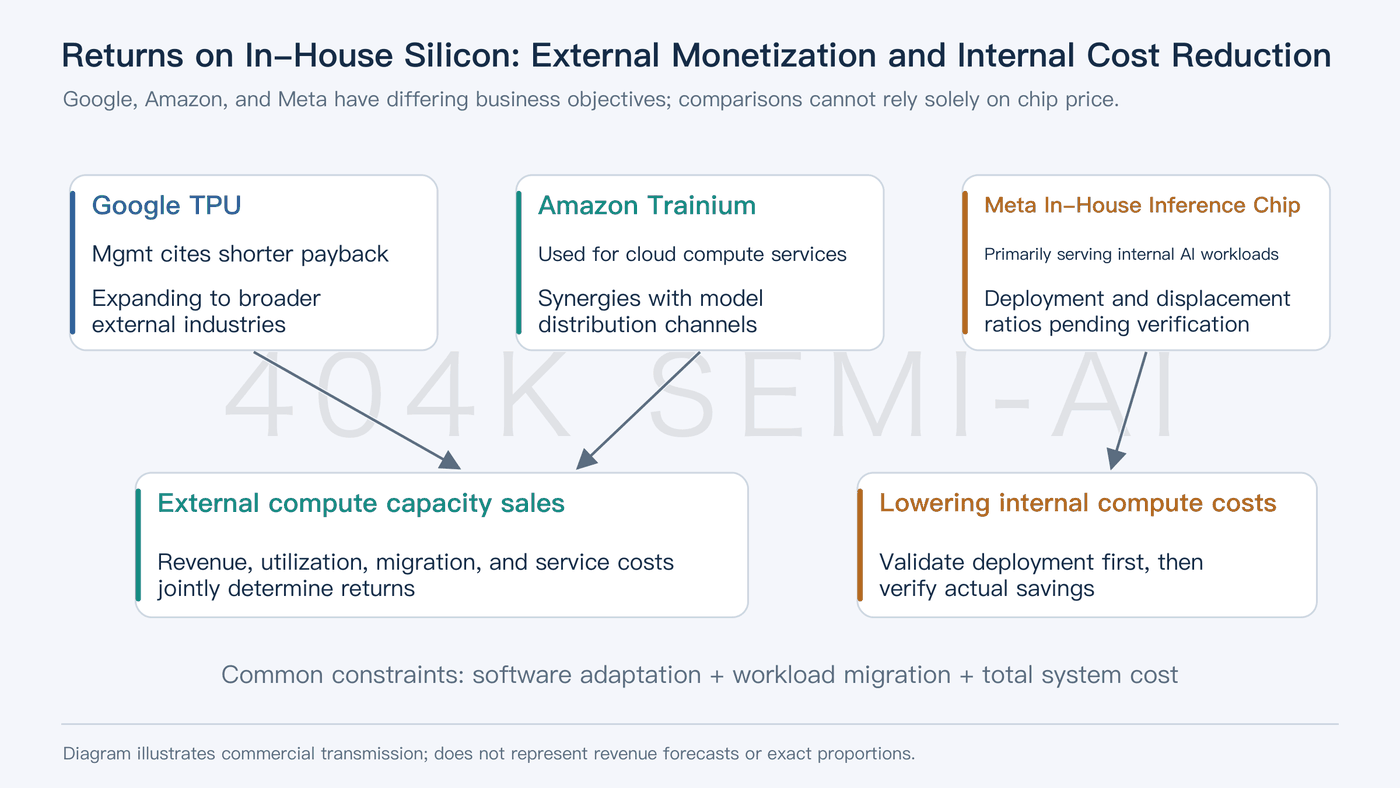
Google's custom silicon advantage must ultimately be demonstrated through capital recovery. Google Cloud CEO Thomas Kurian noted that while general AI servers have a payback period of under two years, Google's in-house silicon achieves payback in roughly half that time (approximately one year). While this underpins the economic rationale for expanding Tensor Processing Unit (TPU) investments, it represents management commentary on capital payback rather than a direct proxy for audited project IRR or segment-level cloud operating margins.
Achieving compressed payback periods requires both sustained customer adoption and pricing power that comfortably covers fully loaded infrastructure costs. Google noted TPU adoption expanding into financial services, biopharma, and scientific computing, broadening the spectrum of addressable enterprise workloads. Diversifying customer demand beyond frontier research labs broadens the revenue base for custom silicon; conversely, software stack adaptation frictions, workload migration hurdles, or suboptimal cluster utilization could readily elongate the payback timeline.
Amazon's Trainium and Meta's in-house inference ASICs target comparable cost efficiencies, albeit with distinct strategic mandates. Amazon monetizes compute externally via AWS cloud services, whereas Meta deploys custom silicon internally to depress serving costs for its proprietary consumer AI workloads. BofA Securities' estimates regarding Meta's ASIC-driven cost savings rely heavily on projected deployment scale and substitution ratios. At this stage, investors should monitor physical cluster rollouts and actual workload migrations rather than prematurely capitalizing theoretical cost savings into margin forecasts.
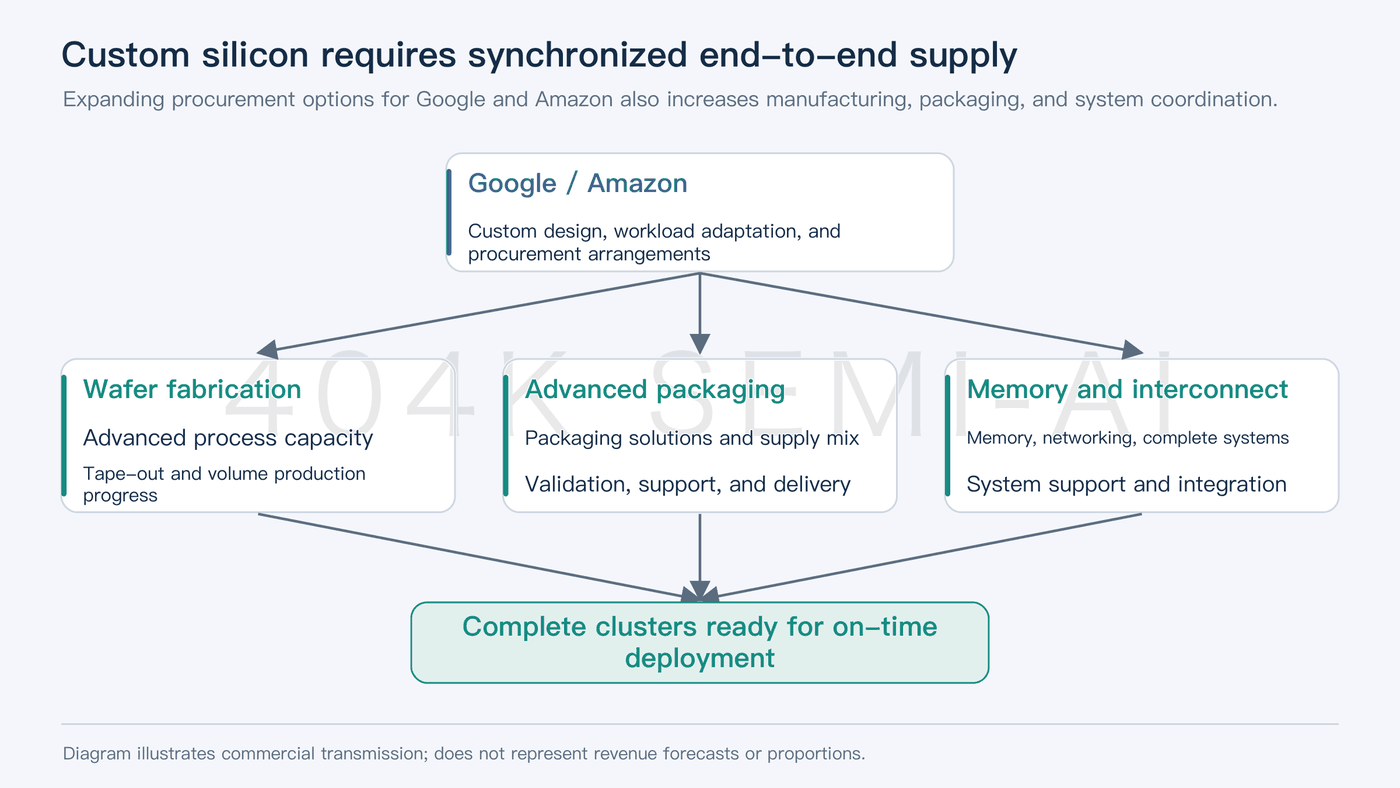
In-house silicon expands architectural optionality but thrusts hyperscalers into complex multi-tier supply chain choreography. Industry supply-chain checks indicate that Amazon is scaling wafer tape-outs for proprietary AI silicon, while MediaTek is actively securing leading-edge foundry nodes and advanced packaging capacity supported by Google TPU orders. Reports also suggest Google is evaluating dual-sourcing strategies across packaging providers. Final capacity allocations and volume splits remain subject to formal purchase orders and should not be treated as finalized commitments.
For Google and Amazon, tape-out completion marks only the initial milestone. Silicon wafers, advanced packaging, high-bandwidth memory (HBM), custom networking fabrics, and server system integration must align seamlessly; bottlenecking at any single node risks stranding upstream components as non-revenue-generating inventory. While diversifying vendor ecosystems mitigates concentration risk, it introduces significant qualification and integration friction. Investors should evaluate the fully loaded, on-schedule system-level deployment cost rather than raw die procurement pricing alone.
NVIDIA remains deeply entrenched across hyperscaler roadmaps alongside proprietary ASIC initiatives. General-purpose GPUs and domain-specific ASICs target differentiated workloads, prompting cloud providers to maintain heterogeneous computing estates. Scaling internal ASICs does not imply an immediate dollar-for-dollar reduction in GPU procurement; only coordinated shifts in workload migration, normalized inference/training unit costs, and audited capex allocations would demonstrate structural substitution. Isolated silicon benchmark comparisons are insufficient to substantiate displacement.
NVIDIA's custom HBM subsystem designs offered to ASIC clients are reportedly coupled with the adoption of its proprietary interconnect fabrics. Consequently, hyperscalers adopting proprietary compute silicon may still source critical networking and system IP from NVIDIA. The gross margin leverage gained from custom ASICs must therefore be net of proprietary interconnect licensing, software development (e.g., CUDA parity/compilers), and ongoing generational refresh outlays. Trimming silicon-level BOM costs does not translate into equivalent percentage savings at the full system level.
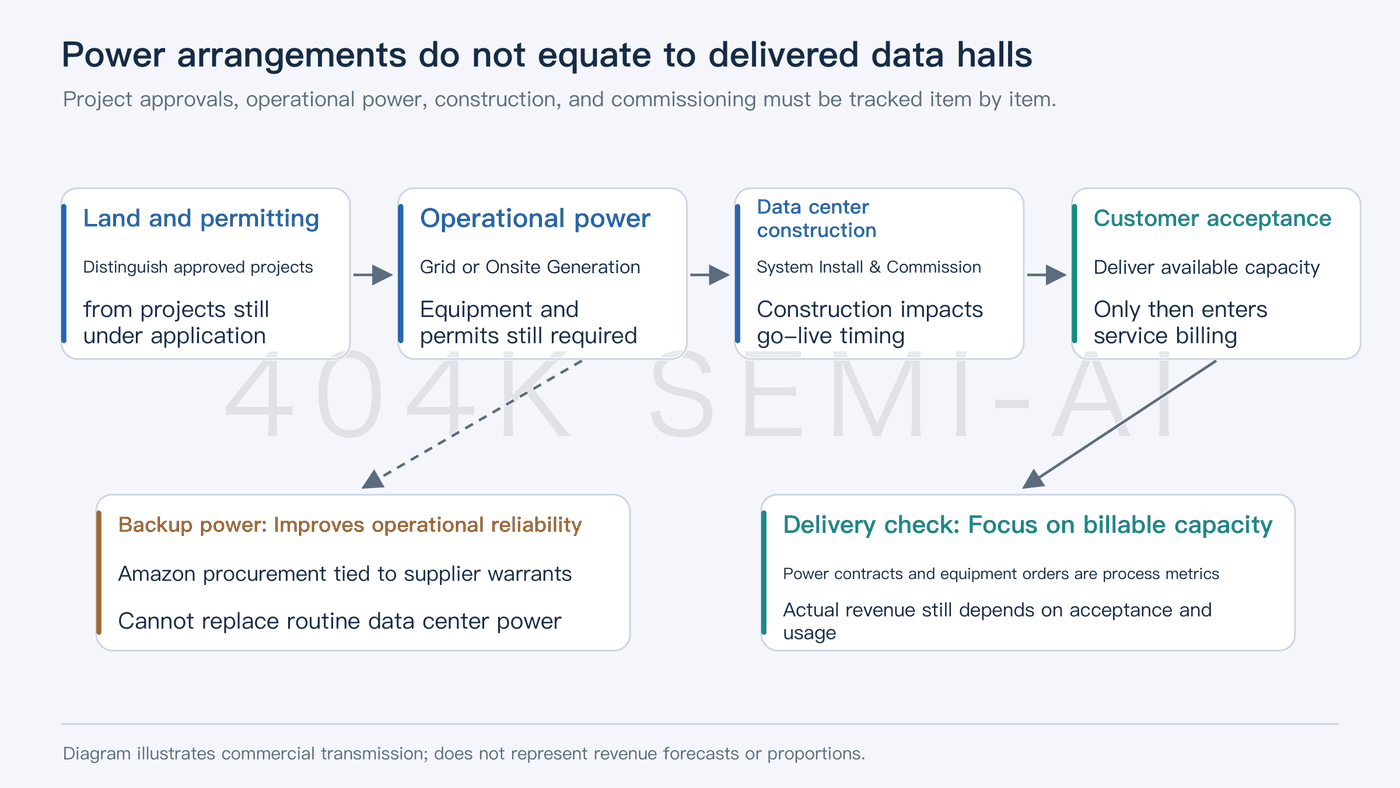
Power purchase agreements and silicon purchase orders must both clear physical infrastructure construction before generating cloud revenue. Industry research this week underscores that tallying headline regulatory/zoning moratoriums differs fundamentally from quantifying megawatts of delayed capacity. Grandfathered approvals, active construction sites, and greenfield applications face divergent hurdles. When assessing Microsoft, Google, Amazon, and neo-cloud operators, capacity pipelines should be audited on a facility-by-facility basis—tracking zoning permits, substation interconnections, and commissioning—rather than extrapolating localized municipal bottlenecks into a universal buildout freeze.
Behind-the-meter and on-site power generation offer bridging solutions for power-constrained projects, yet they demand long-lead turbomachinery, fuel supply logistics, emissions permits, and dedicated operational maintenance. On-site power cannot compress construction timelines to zero, nor can equipment orders be equated with operational capacity. Capacity expansion assumptions must be grounded in energized megawatts and customer-accepted white space; accumulating land parcels and interconnection MOUs does not eliminate execution risk.
Amazon's procurement arrangement with Generac for backup generators offers a clear case study: a portion of equity warrants vest in tranches tied to procurement cash disbursements, aligning vendor incentives with customer scale. While this secures long-term supply-chain priority, backup generators address operational resilience during grid outages—they are not a surrogate for baseload utility interconnection. Furthermore, contractual procurement ceilings should not be confused with fully realized near-term purchase volumes.
Foundation Models, Enterprise Software, and Application Monetization
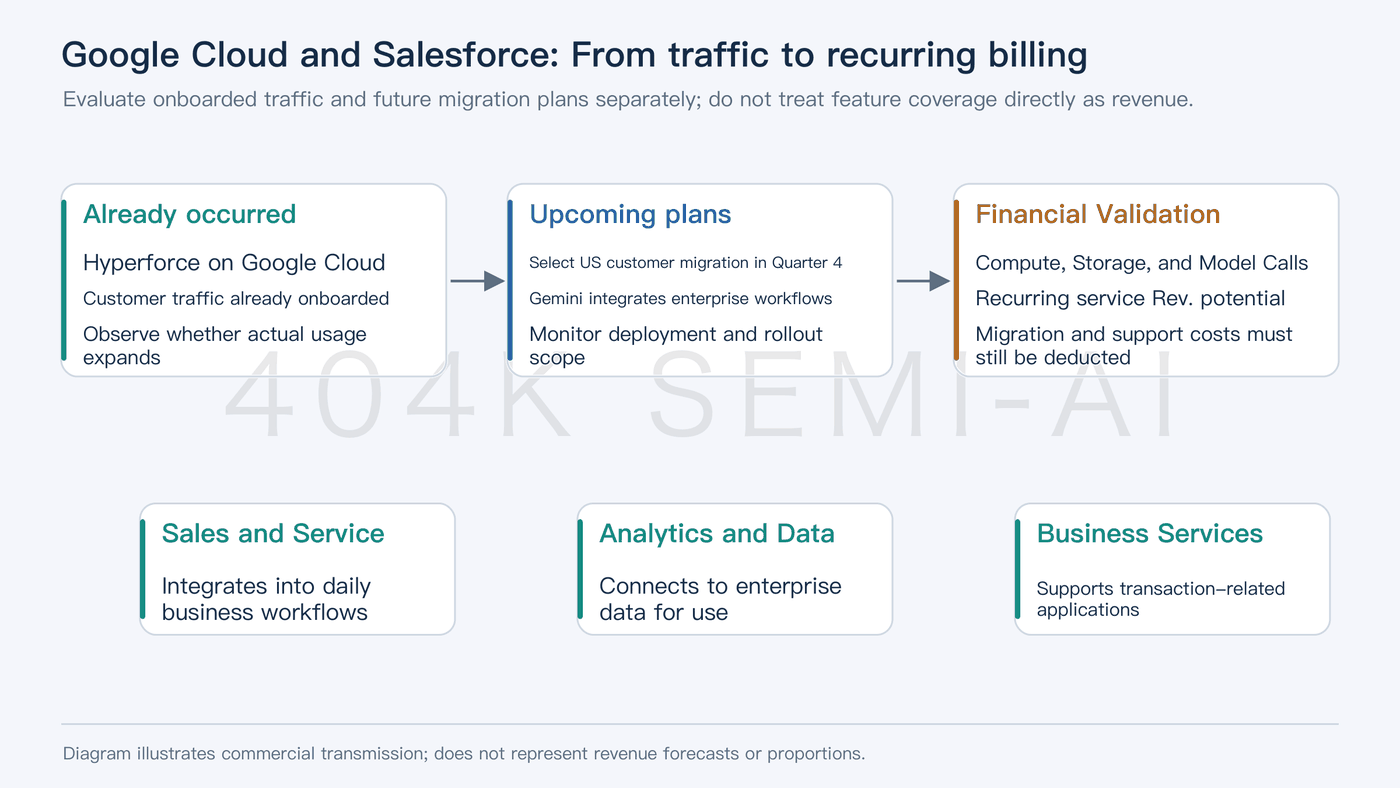
The expanded partnership between Google Cloud and Salesforce channels foundation model capabilities directly into live enterprise production traffic. Strategic updates reveal that Salesforce Hyperforce running on Google Cloud is actively handling enterprise production traffic, with a subset of US customers scheduled to begin migrations in Q4. Furthermore, Google's Gemini models will integrate into enterprise workflow platforms such as Agentforce. The former represents active, billable cloud infrastructure utilization, whereas the latter reflects multi-phase product roadmap and migration plans; revenue recognition must treat the two distinctly.
For Google, the strategic value extends beyond securing another front-end distribution channel for Gemini. Binding proprietary enterprise data and CRM software directly to Google Cloud infrastructure stimulates recurring compute, storage, and API inference consumption. Embedding autonomous agents into daily sales, service, and analytics workflows drives programmatic, recurring query volumes. However, the breadth of announced software features does not indicate current customer monetization, and headline scope alone should not trigger premature upward revisions to Google Cloud revenue.
Near-term tracking should focus on migration timetables, general availability rollout scopes, and audited enterprise adoption before underwriting revenue conversion. If feature integration proceeds smoothly but enterprise workload migration lags, revenue realization will be deferred; conversely, if enterprise onboarding demands significant professional services and integration support, margin expansion may trail top-line gains. In enterprise cloud infrastructure, audited consumption data provides a far more reliable gauge of ROIC than canned product demonstrations.
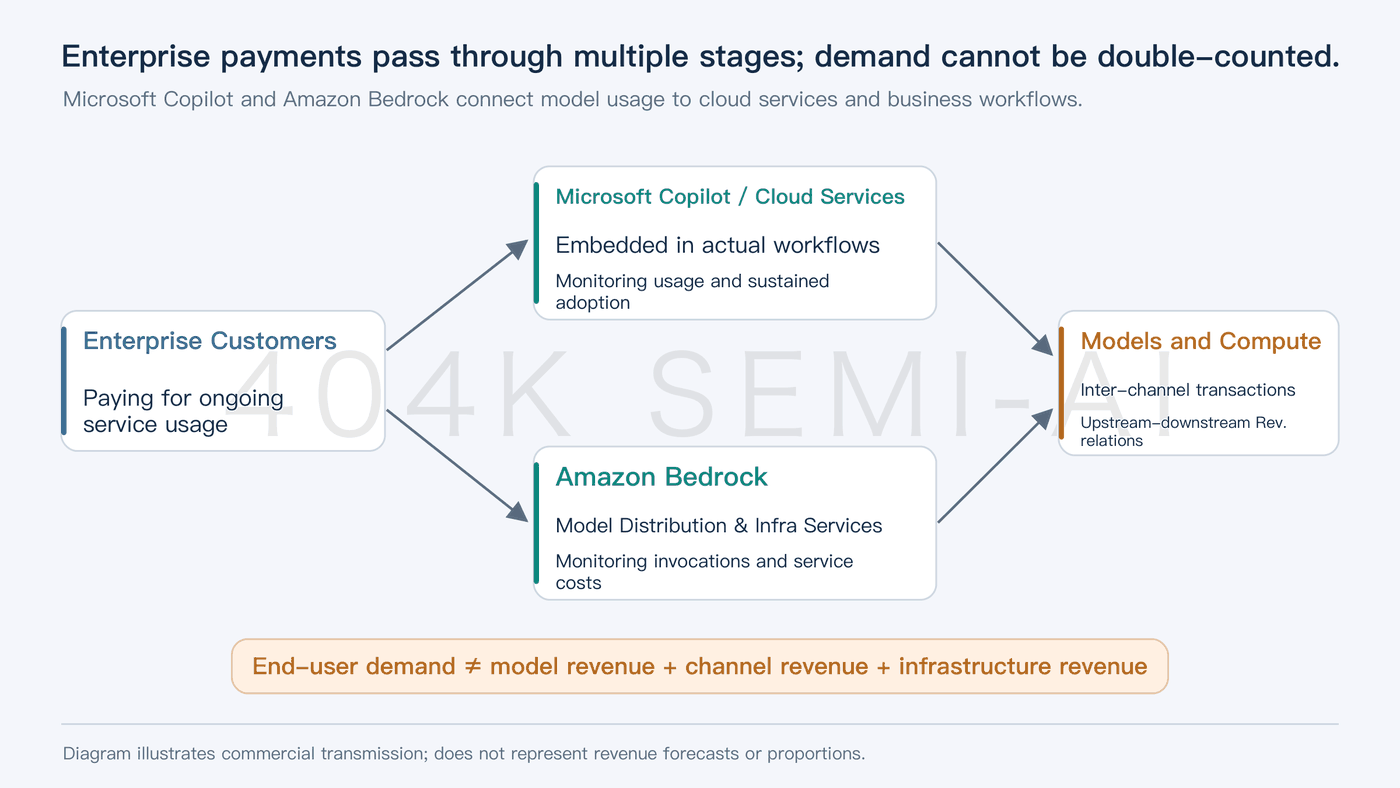
Microsoft and Amazon are vying for mission-critical enterprise layers that command durable, long-term subscription revenue. Microsoft embeds Copilot into core daily business workflows, while Amazon captures enterprise inference traffic via Bedrock. Both demonstrate that cloud monetization extends well beyond baseline compute cycles. However, complex intercompany transactions exist among model developers, marketplace distributors, and infrastructure hosters; naively summing headline revenues across the value chain inevitably double-counts end-market demand.
Microsoft's enterprise cloud expansion in financial services provides a tangible benchmark for specialized workload migration. In partnership with Marvell Technology and Utimaco, Microsoft launched Azure Payment HSM v2, a managed payment hardware security module entering public preview on September 17 across US West and West Europe. By transferring dedicated HSM hardware and cryptographic payment compliance to a managed cloud tier, the solution directly addresses bank demand to reduce on-premises datacenter footprints. However, public preview status should not be equated with scaled commercial revenue.
For specialized enterprise services, commercial value drivers—such as reducing operational overhead, meeting strict regulatory compliance, and guaranteeing five-nines uptime—matter far more than raw model parameter counts. Sustained adoption hinges on operational stability and compliance rather than novelty. Microsoft and Amazon's structural moats must be demonstrated through net revenue retention, consumption metrics, and service delivery cost discipline; their vast enterprise footprints alone do not guarantee identical returns across every incremental AI investment.
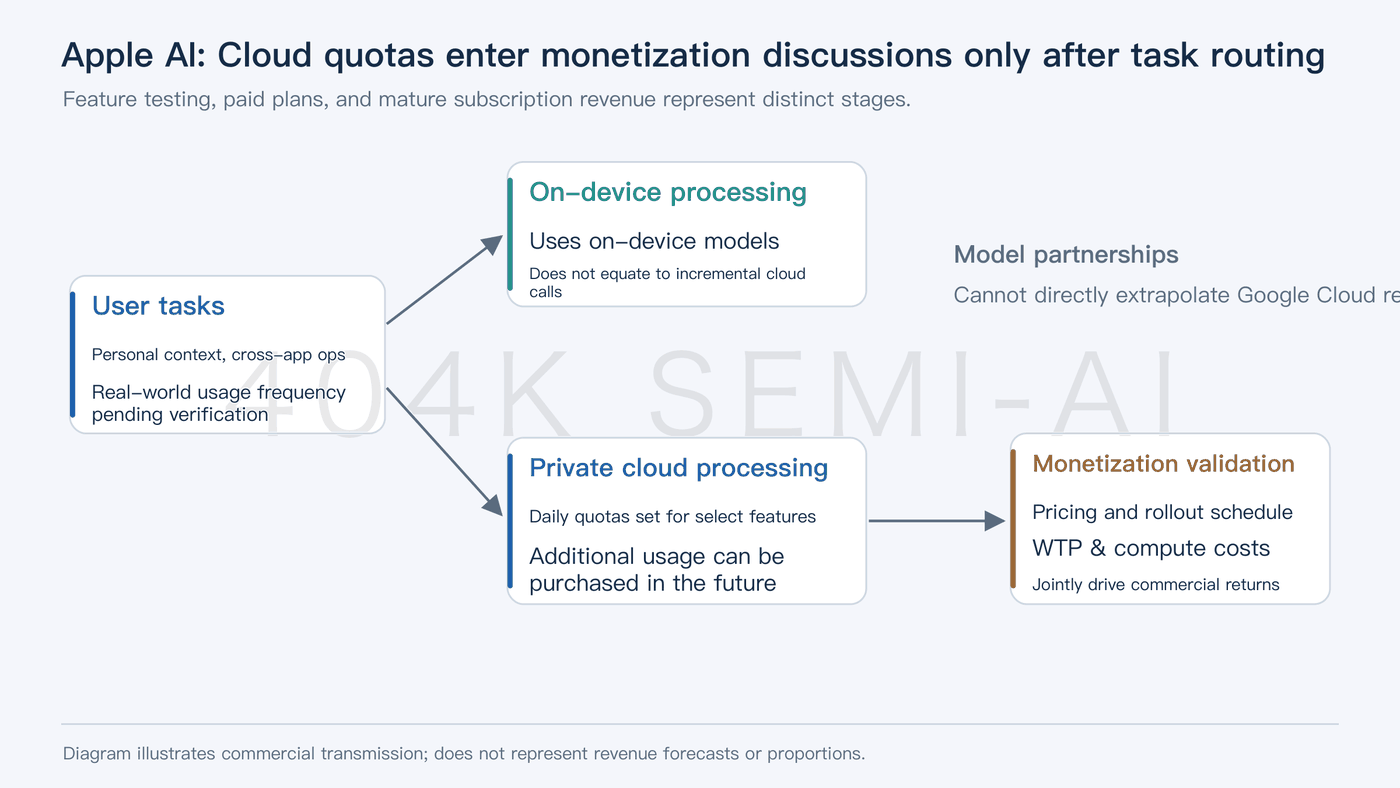
Apple's hybrid AI quota architecture directly links cloud inference costs to consumer willingness-to-pay. According to beta product updates, the overhauled Siri supports personal context and cross-app orchestration, dynamically routing workloads between on-device neural engines and Private Cloud Compute. Certain advanced cloud-side features are governed by daily usage quotas, with pathways for users to purchase additional capacity. For datacenter infrastructure, the crucial takeaway is that cloud inference compute is developing explicit unit-level monetization mechanisms.
This architectural shift does not yet constitute a mature, recurring subscription revenue stream. Retail pricing, commercial availability schedules, and daily active query intensity remain unproven; furthermore, higher on-device execution efficiency directly cannibalizes offloaded cloud compute intensity. Google's reported model collaboration with Apple does not imply that every query converts identically into Google Cloud revenue; commercial revenue-sharing terms and service scopes require independent confirmation.
Simultaneously, competitive deflation in frontier model pricing threatens to erode the solvency and payment capacity of downstream AI startups. Channel checks with early-stage AI firms indicate that compute vendors are demanding longer contractual commitments and substantial upfront prepayments. For cloud providers, this provides upfront cash collateral; for startups, it imposes an onerous liquidity burden before product-market fit and stable revenue are achieved. If model pricing compresses while compute rental rates firm up, clients will inevitably compress query token lengths, optimize model distillation, or migrate to cheaper architectures. The durability of rising rental rates ultimately depends on downstream customer unit economics.
Specific customer interviews highlighted compute commitments lengthening from one to three years, accompanied by mandatory 30% to 40% upfront prepayments. While these terms reflect idiosyncratic contracts rather than a universal industry standard, they underscore a critical demand-side constraint: willingness to consume compute does not guarantee the balance-sheet liquidity required to lock in capacity. Evaluating the foundation model sector requires assessing product ARR alongside procurement cash flow terms.
Divergence: Hyperscaler M7 vs. Neo-Cloud Providers
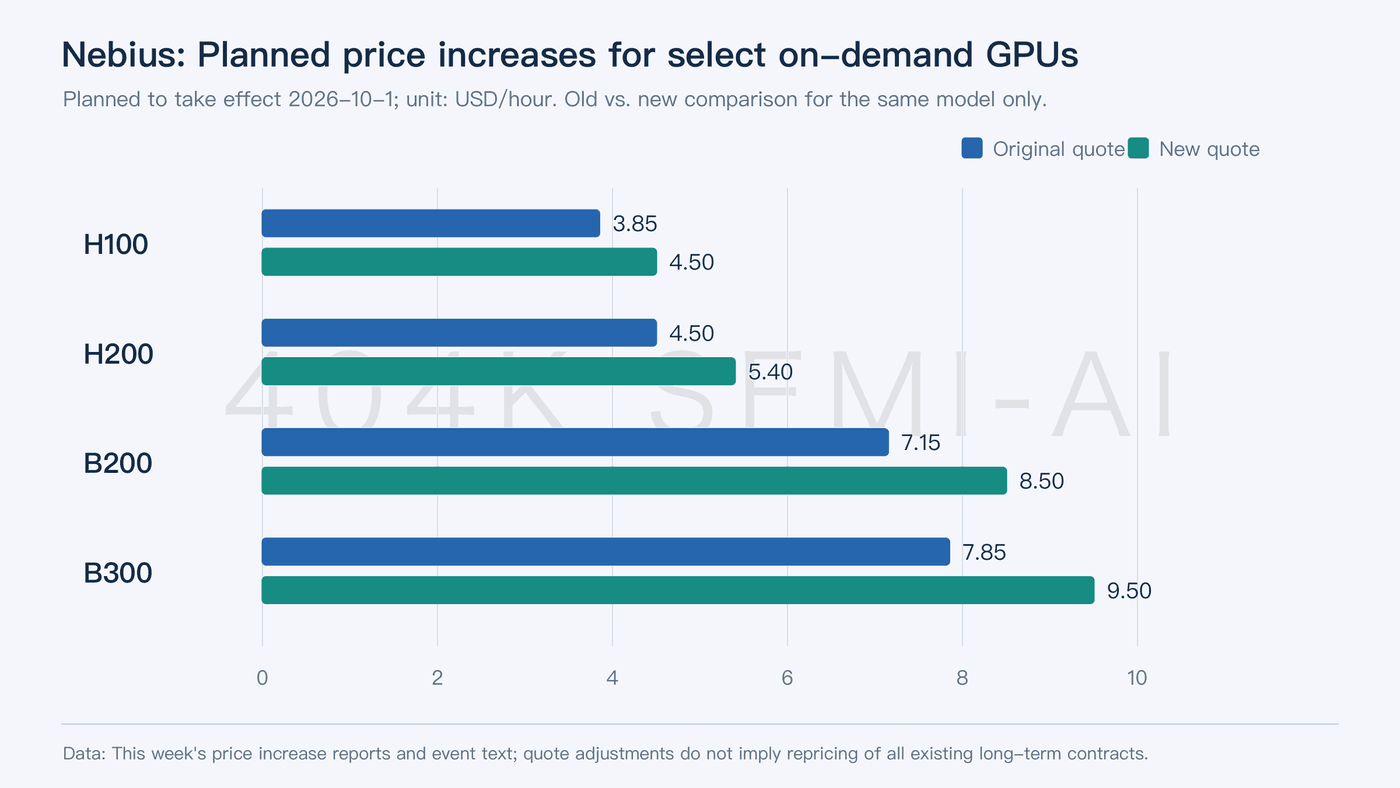
Nebius's rate hikes provide an unambiguous signal of near-term spot capacity tightness, though revenue realization lies ahead. Media reports outline the following on-demand GPU pricing adjustments planned by Nebius, effective October 1. Because hardware specifications and service configurations differ across generations, the table evaluates only the delta between old and new prices for each respective GPU model, rather than asserting cross-architecture price-to-performance rankings.
Nebius Select GPU On-Demand Pricing Hikes (Effective Oct 1; Utilization Subject to Post-Implementation Verification)

Increases in on-demand rack rates do not trigger immediate repricing across existing long-term contracted capacity. Top-line impact depends on the proportion of spot customers, billable instance hours, and customer retention post-hike; if clients curtail runtime hours in response, nominal price increases will be diluted. Similarly, CoreWeave's disclosed annualized pricing on short-term contracts reflects clearing prices under specific duration and delivery windows, which should not be conflated with the blended average selling price (ASP) of its entire fleet over multi-year horizons.
On physical execution, Nebius's Madrid facility has come online, with subsequent phases slated to commission over the coming weeks. Phased commissioning brings capacity online incrementally; initial phase energization should not be misconstrued as the full planned capacity generating billable revenue. Synthesizing energized capacity data with prevailing rack rates is critical to discerning whether rate hikes are merely lifting unit gross margins or expanding overall billable revenue scale.
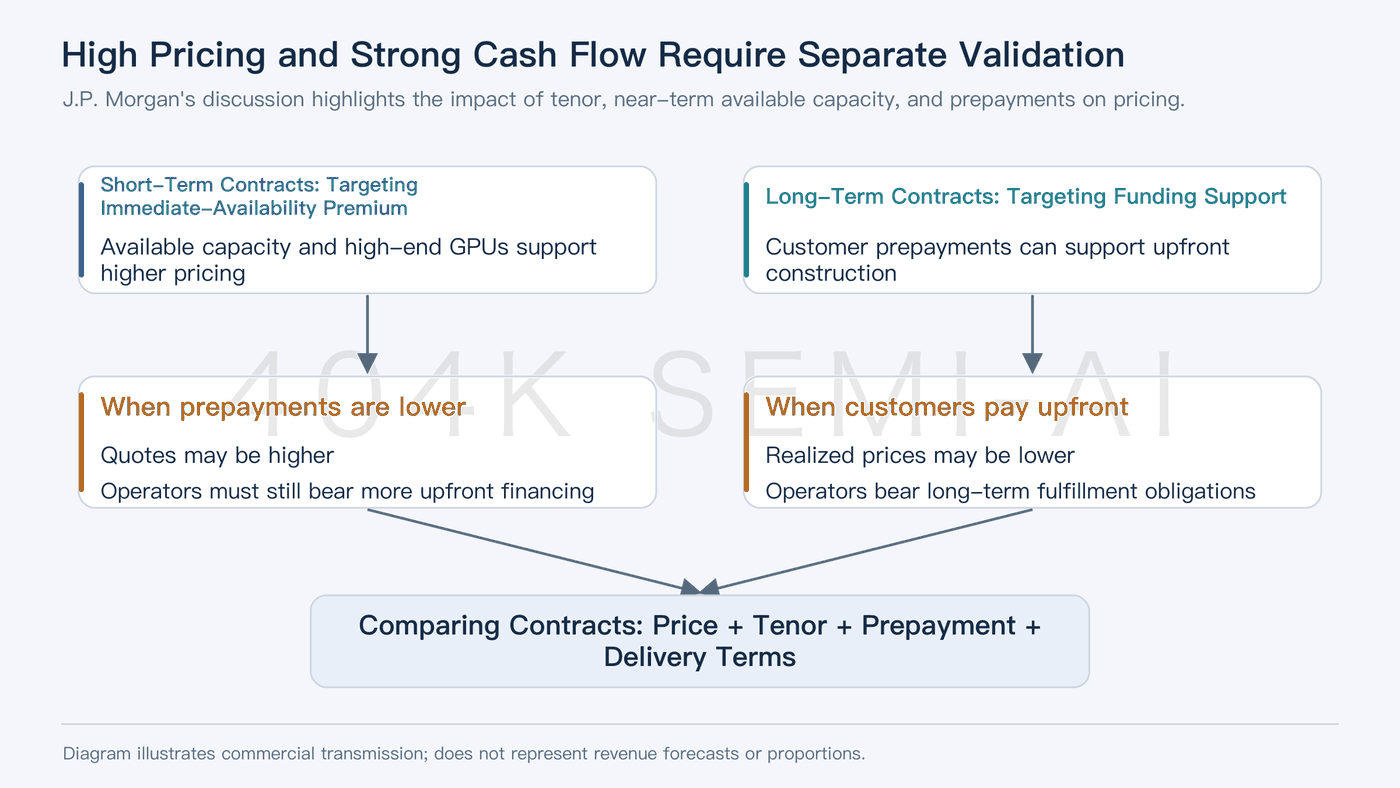
Premium pricing in the neo-cloud tier is intrinsically tied to differentiated contract durations and cash flow structures. Analysis from J.P. Morgan notes that immediate capacity availability, leading-edge GPUs, shorter durations, and lower upfront prepayment requirements combine to command higher headline pricing. Consequently, a multi-year enterprise contract providing upfront capital contributions in exchange for discounted rates represents a fundamentally different financial transaction than a short-term tenant paying spot premiums for instant turn-up. Comparing business quality strictly on annualized revenue-per-megawatt misses this structural dichotomy.
CoreWeave plans to issue $3.0 billion in convertible senior notes alongside an at-the-market (ATM) equity offering facility for up to 35 million shares. These remain financing plans; final proceeds, effective cost of capital, and shareholder dilution remain subject to execution. Concurrently, CoreWeave stated that contracted power capacity expanded from 3.7 GW at the end of June to approximately 4.2 GW. While higher contracted power expands the pipeline for long-term growth, it does not prove that the underlying megawatts are built, energized, or generating billable revenue.
For Crux AI—backed by Google and Blackstone—reports pointed to an approximately $22.0 billion debt facility backed by custom silicon, alongside a $5.0 billion equity commitment. Conflicting accounts emerged during the week regarding loan syndication status; the facility should be treated as pending closing and drawdown verification. While this demonstrates innovative asset-backed financing structures for custom ASICs, it does not establish that secondary-market residual value for proprietary chips is broadly accepted, nor should headline debt-and-equity financing totals be conflated with cloud service revenues.
Future analysis on Crux AI must scrutinize the borrowing entity, credit guarantees, recourse structures, and the duration matching between underlying customer off-take contracts and debt maturities. Google's strategic involvement does not imply that debt liabilities sit directly on Alphabet's balance sheet; conversely, housing liabilities within an off-balance-sheet vehicle does not imply Google is entirely insulated from counterparty exposure. Assessing the net impact on Google's capital efficiency requires clarity on ultimate contractual recourse.
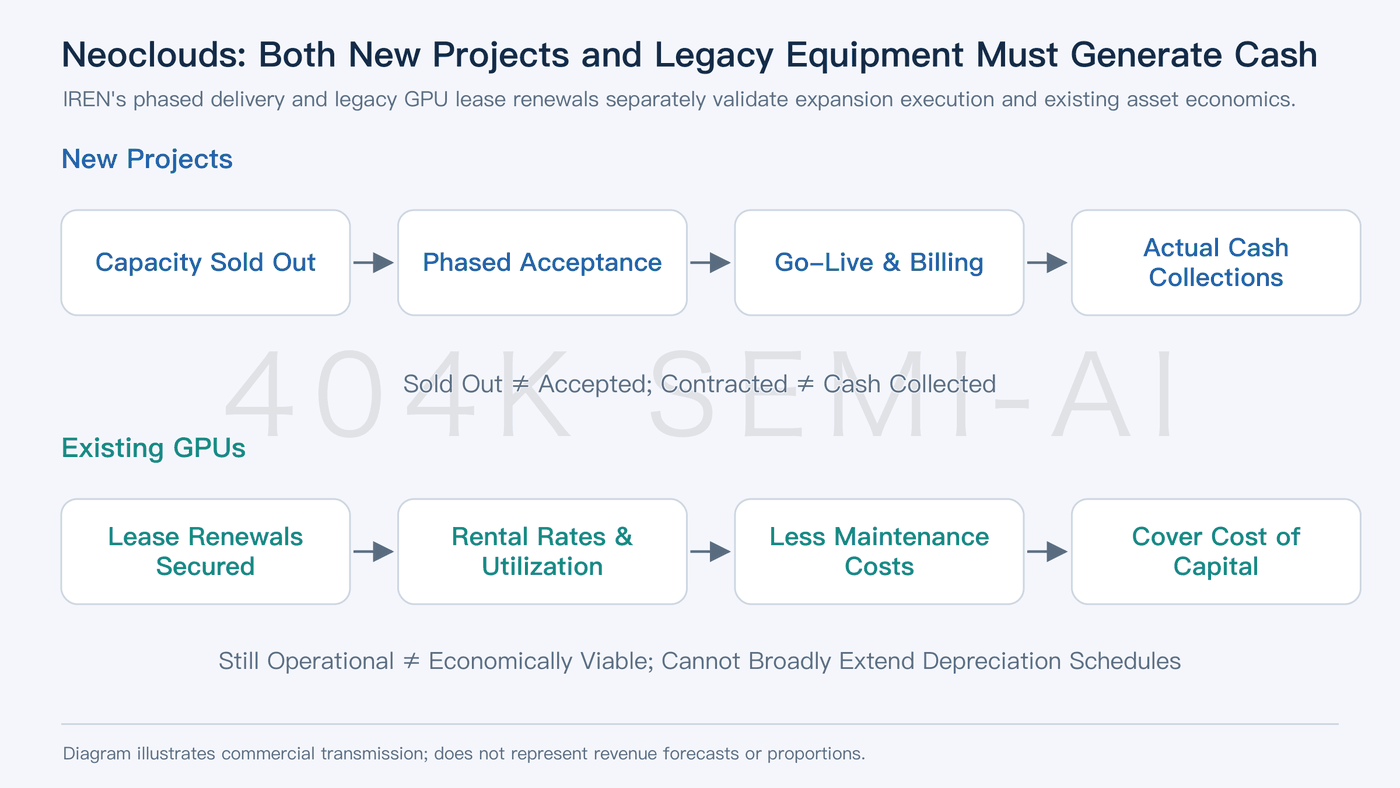
IREN's operational progress provides concrete delivery milestones, though commercial billing remains the ultimate test. IREN's Chief Commercial Officer stated that Phase 1 of its anchor contract with Microsoft has been completed, and its 2026 capacity pipeline is fully sold out. While management commentary links commercial demand directly to physical execution, subsequent verification must track phase-by-phase energization, formal customer commissioning acceptance, and GAAP revenue recognition. A "sold-out" capacity book demonstrates offtake interest but does not eliminate the need to evaluate customer creditworthiness and contractual delivery hurdles.
Counterparty diversification across the hyperscale ecosystem warrants equal attention. Anthropic reportedly entered into a six-year, $13.7 billion GPU compute services agreement with Rumble, contingent upon phased datacenter completion and staged capacity deployment. For incumbent hyperscalers, this signals frontier model developers diversifying compute sourcing beyond the Big Three; for the emerging host, it brings substantial single-customer concentration alongside massive upfront capital commitments.
Sustained contract demand for legacy GPU architectures provides another pillar for neo-cloud cash amortization. Reports of A100 contract extensions confirm that leading-edge hardware launches do not instantly render prior-generation clusters obsolete. However, hardware operability, market rental viability, and net cash generation after power, maintenance, and debt service represent distinctly higher economic hurdles. Contract extensions alone do not justify blanket extensions of useful depreciation schedules across all GPU assets; the economic baseline requires that renewal rental rates, fleet utilization, and ongoing maintenance capex remain in balance.
A structural duration mismatch exists between short-term spot price spikes and long-lived datacenter assets. Clusters must operate over multi-year lifecycles, and once short-term tenancies expire, operators face potentially softer supply-demand dynamics and tighter capital markets. Consequently, near-term firming in realized rates should inform near-term revenue projections, while long-term ROIC demands durable multi-year tenant retention, manageable hardware upgrade cycles, and viable debt refinancing conditions.
Analytical Divergence, Falsification Triggers, and What to Track Next Week
The primary debate in cloud compute is whether acute near-term shortages can justify mounting forward capital commitments. The bull thesis leans on pricing power, expanding order backlogs, compressed in-house silicon payback cycles, and broadening enterprise workload penetration. The bear thesis cautions that elevated spot rates are transitory, forward datacenter construction is draining liquidity, and foundation model clients are buckling under unsustainable compute bills. Both dynamics can coexist; distinguishing between them requires tracking GAAP revenue conversion and customer cash payment cadence.
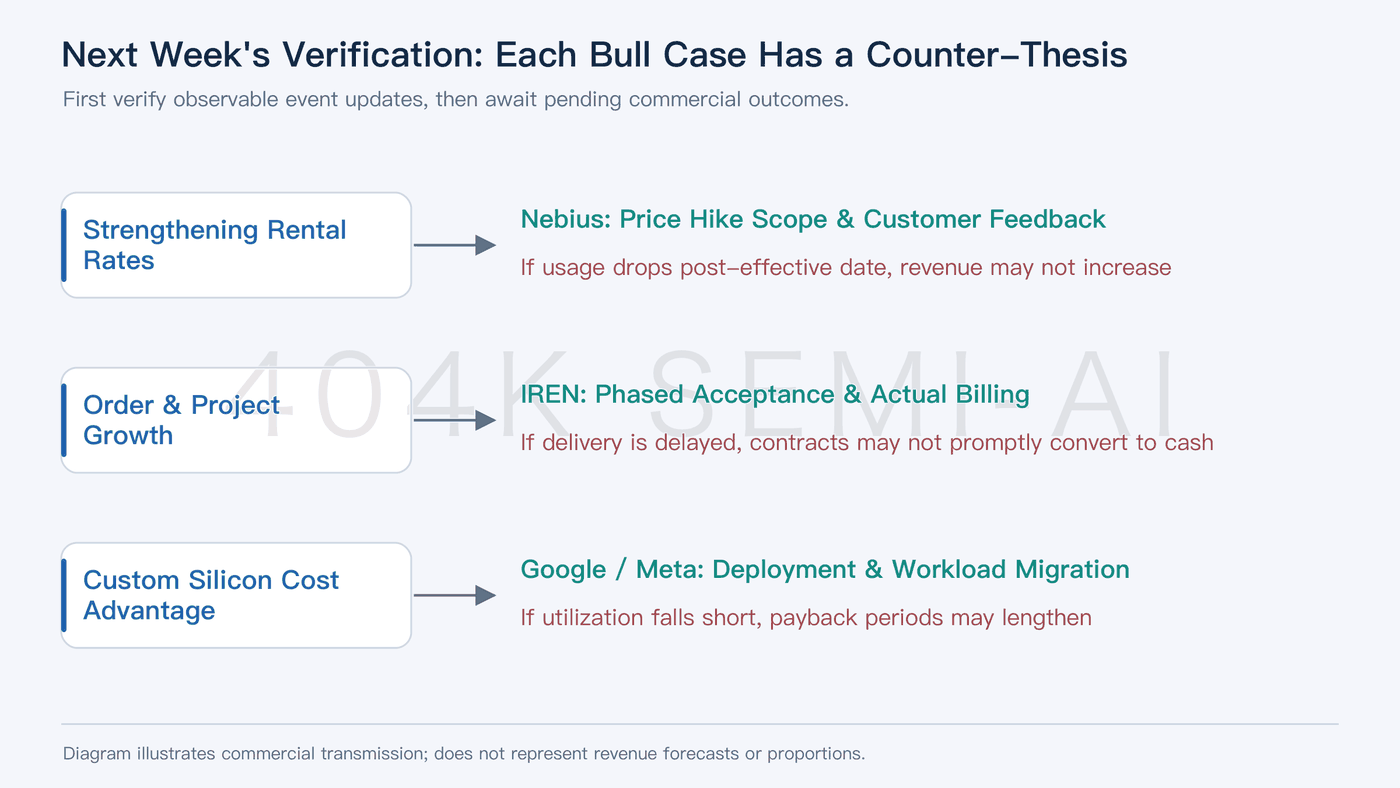
Google's compressed payback commentary cannot be generalized across all cloud peers; Nebius's on-demand rate hikes cannot be extrapolated to locked-in long-term contracts; and IREN's sold-out capacity does not derisk unbuilt greenfield pipelines across the industry. Falsification checks must map directly to each bullish assumption:
If rack rates appear robust, audit realized transaction volumes and fleet utilization.
If contract backlogs expand, audit physical commissioning acceptance and cash collections.
If in-house silicon claims lower costs, audit commercial cluster deployment scale and fully burdened lifecycle operating expenses.
Priorities for the coming week center on near-term catalyst verification:
Nebius: Prior to the October 1 effective date for rate increases, assess the contract scope and customer churn/retention feedback rather than prematurely modeling margin expansion.
CoreWeave: Monitor final pricing terms, execution progress, and dilution metrics across the proposed convertible note and equity offerings.
Crux AI: Verify debt syndication closing, credit documentation, and initial drawdown conditions.
IREN / Microsoft: Track subsequent disclosures regarding milestone acceptance and energization for subsequent phases.
Where updates are pending, maintain existing ratings rather than treating normal execution lead times as negative news.
Forward research must synthesize demand visibility, physical delivery, and cash collection simultaneously:
Google / Salesforce: Focus on whether Q4 customer migrations progress on schedule and whether enterprise token query volumes scale.
Microsoft: Monitor whether incremental datacenter capacity is absorbed by broader enterprise cohorts and proprietary applications.
Amazon: Assess whether AWS net sales, operating profit, and Bedrock model consumption maintain concurrent upward momentum.
Meta: Audit physical ASIC deployment scale and internal workload migration before underwriting theoretical operating cost savings.
Capex risk indicators must be monitored with greater specificity. If construction-in-progress and advance equipment deposits mount while billable energized capacity lags, working capital deficits will compound. If incremental debt issuance is increasingly diverted toward refinancing existing maturities amid declining customer prepayment ratios, capital availability is structurally deteriorating. Conversely, on-time cluster energization, sticky enterprise consumption, and expanding operational cash collections provide the requisite foundation to justify subsequent capital deployments.
We maintain a constructive fundamental view on underlying cloud compute demand, while tightening underwriting criteria for cash collections and capital recycling. In portfolio positioning, prioritize operators that demonstrate clear visibility into customer identities, binding delivery timelines, explicit monetization models, and viable funding sources. Only when rental rates, utilization rates, and cash collections reinforce one another can near-term capacity scarcity translate into durable shareholder value; persistent deterioration across any of these pillars warrants downgrading expected returns on capacity expansion.