
Contents
Market Wrap
US Stock Leaderboards
AI & Semiconductor Value Chain
AI Models, Applications & CapEx
CSP & Cloud CapEx
AI Cloud & Data Center Operators
GPUs, CPUs & ASICs
HBM, DRAM, NAND, SSDs & HDDs
Foundry
Semiconductor Equipment & Testing
Optical Communications, Optical Chain, Thermal & Power
Internet & Platforms
Software & SaaS
Consumer Electronics & Smart Vehicles
Jensen's Selected Portfolio
Memory Index Performance
US Memory Turnover Share
Micron's order visibility continues to lengthen and cloud compute pricing is rising further as AI demand spills into memory, interconnect, and power infrastructure. While long-term agreements (LTAs) help lock in top-line revenue, gross margins remain subject to product mix shifts, heavy CapEx, and physical delivery costs. On the software side, the key metrics to track remain verifiable bookings, enterprise customer migrations, and paid conversion.
404K SEMI-AI | October 2, 2026
Market Wrap
At the close on October 1, the S&P; 500 ETF gained 0.19% and the Nasdaq 100 ETF rose 0.34%, while the S&P; 500 Equal Weight ETF advanced 0.59% and the Russell 2000 ETF added 0.56%. Equal-weight and small-cap indices outperformed mega-cap benchmarks. Divergence persisted within tech: the Technology ETF gained 1.10%, while the Communication Services ETF slipped 0.30%.
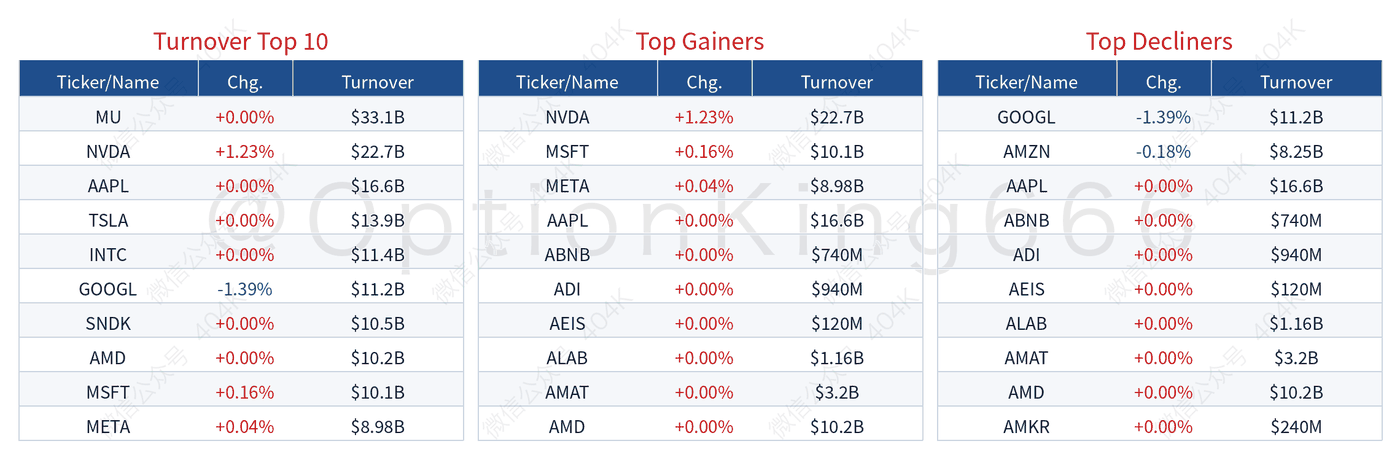
The Semiconductor ETF advanced 1.46%, extending its 20-day rally to 12.24% and outpacing the Technology ETF's 7.79% gain over the same period. Among mega-caps, NVIDIA rose 1.23% and Microsoft edged up 0.16%, while Alphabet fell 1.39%. Model releases, earnings prints, and infrastructure awards continue to inject positive momentum, but market reactions are increasingly differentiating top-line growth from the escalating costs required to deliver it.
Micron extended its memory shortage outlook to 2028, with LTA discussions and signings stretching even further out. Concurrently, AWS and CoreWeave implemented further compute rental price hikes. While severe supply constraints underpin pricing power, they also inflate customer budgets. Going forward, the critical checkpoints will be whether LTAs protect vendor profitability, whether compute capacity can be delivered on schedule, and whether software clients convert pilots into sustained paid subscriptions.
US Stock Leaderboards
AI & Semiconductor Value Chain
AI Models, Applications & CapEx
OpenAI: Mega-funding continues to underwrite frontier models and compute buildout.
1) Reports indicate the latest funding round is largely finalized, securing $122 billion in total commitments at an $852 billion post-money valuation. NVIDIA and SoftBank each funded the final $10 billion of their respective $30 billion commitments, with Amazon contributing $50 billion.
2) The company is reportedly seeking to raise an additional $30 billion at an ~ $1.4 trillion valuation, which should be distinguished from already completed transactions. On the application layer, ad budget expansion faces measurement and attribution hurdles; securing capital and generating commercial returns remain two distinct milestones.
Anthropic: Scientific research adoption expands as valuation debates focus on ROI.
1) Claude, paired with BootLoops, reportedly reproduced weeks of scientific research in 20 minutes, solving 15 previously unresolved elliptic Feynman integrals; the program has advanced 36 paper manuscripts across 18 domains in three months. Expert calibration, proof verification, and computational checks remain indispensable.
2) The company is reportedly eyeing an IPO as early as mid-November, though the timeline remains fluid. Preliminary valuation discussions range from ~$1.5 trillion to $2.0 trillion; debate centers on heavy data center depreciation and interest rate headwinds rather than a finalized offering price.
OpenRouter: AI agents become heavy users, but token volume does not equal revenue. On a 7-day moving average, agent token consumption reached 7.3 trillion tokens versus ~1.4 trillion tokens for human prompts, with a typical agent request carrying ~15x the token load of a human prompt. Tool definitions, expanded context windows, and iterative reasoning loops drive substantially higher query volumes. However, because the vast majority of agent tokens consist of cached prompts, operational cost growth significantly lags token growth. While this metric provides visibility into inference demand, it cannot be directly mapped to model vendors' top-line revenue growth.
Runway: Video generation pivots toward production pipelines and physical world simulation. At its AI Summit, the company broadened its roadmap toward "world simulators," emphasizing spatial physics and cross-scene consistency; representatives from Google DeepMind, NVIDIA, and Wayve participated in discussions on robotics and autonomous agent training. On the product side, Runway strengthened integrations with Adobe Premiere Pro and DaVinci Resolve, launching a real-time safety system and the DIFFUSE workflow integration platform. Near-term commercial progress remains rooted in creative studio production, while utilizing world models for robotics training remains pre-revenue.
CSP & Cloud CapEx
Alphabet / Google: Low model pricing drives customer acquisition while cloud growth must outrun asset intensity.
1) Citi noted on October 1 that Gemini 4 Argon secured top rankings across 14 of 19 industry benchmarks, expanding its maximum output window to 1 million tokens; introductory pricing is set at $2 per 1M input tokens and $10 per 1M output tokens.
2) JPMorgan projects Google's 2027 CapEx will reach $378 billion with free cash flow of -$115 billion, while anticipating Google Cloud revenue growth to accelerate in 2H. Citi forecasts 2027 Cloud revenue of $205.601 billion (+96.5% YoY). Both brokers remain bullish on structural cloud demand, though intermediate free-cash-flow drag must be validated by converting backlog into billable revenue.
Meta: Enterprise agent adoption elevates host CPU procurement. Morgan Stanley modeled on September 30 that assuming Muse consumes 25% of its weekly token quota, the monthly serving cost per user reaches $37.12 ($24.35 for GPU inference and $12.77 for CPU sandboxing). The bank estimates Meta's 2026 CPU compute procurement will equate to 643 million virtual CPU (vCPU) cores sourced from AMD, NVIDIA, and AWS. While hardware supply projections can support large-scale deployment, actual CapEx will depend on daily active user rates and session duration; serviceable capacity must not be conflated with active paying users.
Amazon: GPU rental price hikes advance in tandem with long-term power PPAs.
1) AWS reportedly plans to increase GPU Reserved Instance pricing by 15% on October 7, following a 20% hike in July; cumulative YTD price increases for H100/H200 and B200/B300 instances range between ~40% and 75%. These hikes apply to specific high-demand instances rather than the broader cloud catalog.
2) Amazon signed a 20-year nuclear power purchase agreement with Constellation Energy to secure 690 MW of dedicated supply, with new generation scheduled to interconnect between 2030 and 2032. Short-term pricing reflects acute capacity shortages, while long-term power contracting determines whether physical expansions can ultimately be delivered.
