
Contents
Market Wrap
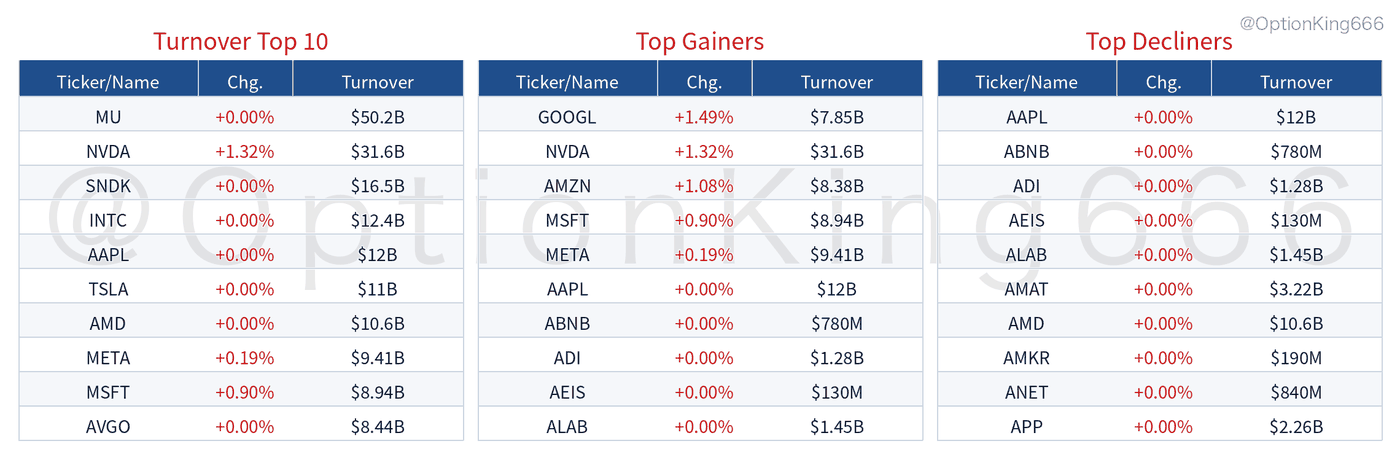
U.S. Equities Leaderboard Triptych
AI & Semiconductor Value Chain
AI Models, Applications & CapEx
CSPs & Cloud CapEx
AI Cloud & Data Center Operators
GPU, CPU & ASIC
Memory & Storage (HBM / DRAM / NAND / SSD / HDD)
Foundry
Semiconductor Equipment & Testing
High-Speed Interconnect, Optical Communications & Power/Cooling
Internet & Platforms
Software & SaaS
Consumer Electronics & Smart Vehicles
Huang's Curated Portfolio
Memory Index Performance
U.S. Memory Turnover Share
AI demand continues to drive investments in chips, memory, and data centers, but order realization is increasingly gated by power delivery, construction speed, and project financing. Micron’s long-term purchase commitments expand, Amazon explores GPU sale-leasebacks, and software clients focus on whether AI agents deliver tangible cost savings. Hardware scarcity and software application returns must be evaluated separately.
404K SEMI-AI | 2026-10-03
Market Wrap
On October 2, U.S. tech equities strengthened. The S&P; 500 and Nasdaq 100 ETFs gained 0.66% and 0.96%, respectively. The semiconductor ETF climbed 2.02%, outperforming the broader technology sector ETF’s 0.98% advance. Over the past 20 trading sessions, the semiconductor ETF is up 14.06%, keeping tech hardware among the strongest market segments.
Gains broadened into equal-weight and small-cap indices on the day, though divergence persists over longer timeframes. The equal-weight S&P; 500 ETF gained 0.52% and the Russell 2000 ETF rose 0.86% on the session, but over the last 20 trading days, they are down 4.53% and 4.66%, respectively, while the Nasdaq 100 ETF gained 4.38%. The broader market rebound has not yet erased the performance gap between mega-cap tech and the average stock.
Across the industry, expansion costs continue to escalate: rising memory prices are lifting end-device costs, data center commissioning is constrained by power grid connections and regulatory permitting, and GPU financing structures are scrutinizing depreciation schedules and residual asset values much more rigorously. While surging cloud backlogs support top-line demand, a substantial gap separates contractual bookings, energized capacity, and recognized revenue. Concurrently, enterprise software must prove that AI-driven execution speeds convert into measurable customer return on investment.
U.S. Equities Leaderboard Triptych
AI & Semiconductor Value Chain
AI Models, Applications & CapEx
OpenAI
1) Reports indicate the company closed its final $20 billion funding tranche, with Nvidia and SoftBank each investing $10 billion, bringing its post-money valuation to $852 billion. While the financing supports further infrastructure scaling, revenue realization remains dependent on product adoption and paid conversion.
2) The company stated that redesigning its inference software stack with Astra allowed GPT-6.1 Sol to approach Astra-level capability at roughly one-fifth the cost; this reflects the company's internal claims regarding capability and pricing.
3) ChatGPT's financial management features are expanding to U.S. Free and Go tiers, enabling account integration via Plaid and Experian. Meanwhile, OpenAI is partnering with Lockheed Martin on mathematical and physics challenges in F-35 sensor R&D;, continuing to broaden its enterprise footprint.
Anthropic
1) Compute procurement strategies are shifting. Anthropic is reportedly expanding from leasing Google Cloud compute toward directly purchasing TPUs, developing and leasing dedicated data centers, and exploring custom in-house silicon. Having inked agreements with over 10 cloud service providers, the company is diversifying supply while taking on greater construction and financing responsibilities.
2) In agent benchmark evaluations, Claude Sonnet 5.5 ranked 3rd with a median task cost of $2.74, while 2nd-place Opus 5.5 logged a cost of $1.58. Model list prices do not directly equate to the actual compute cost required to complete complex tasks.
3) Anthropic believes models matching or exceeding human capabilities could arrive within the next few years. This represents a technical outlook; commercial procurement must still be validated by task quality, unit cost, and operational reliability.
Perplexity
1) The company continues to roll out open models and developer tooling. A 27-billion-parameter version of its multimodal decision model, pplx-decider-v1, scored an average of 85.7% across 11 benchmarks; a preview release of its context embedding model has also been introduced.
2) Its 600-million-parameter on-device personal data classifier, PII-Tracer, determines whether hybrid computing tasks should remain locally on Mac hardware, supported by an evaluation suite covering 13 languages and 13,000 dialogues.
3) The WANDR research agent benchmark features 500 tasks and 170,000 source-backed entries. Perplexity’s product roadmap spans foundation models, privacy routing, and research rigor; future validation will depend on whether these tools reduce task execution costs and errors.
AI Agent Supply & Demand
1) Scenario modeling based on projected High-Bandwidth Memory (HBM) shipments from 2025 to 2027 suggests that incremental compute running frontier models could deliver working hours equivalent to 140 million to 700 million full-time employees. With high-efficiency models, theoretical concurrency would be substantially higher. Notably, this metric reflects addressable capacity hours rather than realized human labor displacement.
2) Even if only 20% of total compute capacity is deployed for revenue-generating inference, baseline assumptions imply annualized AI spending of $2.6 trillion to $5.3 trillion. If leading AI lab revenues sustain a 5x annual growth rate, reaching ~$1 trillion in annualized revenue by late 2027, whether downstream end-user demand can keep pace with infrastructure buildouts remains the primary risk.
Agent Costs & Reliability
1) Research benchmarks show Codex costs approximately $16 to $18 per agent-hour, while Claude Code ranges from $24 to $50, both calculated at API interface pricing. Coding agents can consume up to 1,000 times more compute than simple conversational interactions; when repeating identical tasks, maximum token consumption typically doubles minimum usage and can reach up to 30x.
2) Declining unit API prices do not necessarily reduce overall cloud bills. Amazon reportedly had an incomplete task running unattended in the background for five months, resulting in an 860% budget overrun exceeding $1 million. Enterprise buyers must manage task frequency, runtime durations, and failure retry logic to verify whether agents truly lower operating costs.
