
Contents
Market Wrap
US Market Rankings Triptych
AI & Semiconductor Value Chain
AI Models, Applications & CapEx
Compute (GPU / CPU / ASIC)
Memory & Storage (HBM / DRAM / NAND / SSD)
Foundries
Semiconductor Equipment & Testing
Optical Communications & Optics Supply Chain
High-Speed Interconnect, Connectors, Power & Cooling
MLCC & Passives
Internet & Platform Ecosystems
Enterprise Software & SaaS
Consumer Electronics & Intelligent Vehicles
Huang's Selected Portfolio
Memory Index Performance
US Memory Share of Total Trading Turnover
Semiconductors led the market rally, but supply chain bottlenecks are shifting: TSMC's packaging expansion is narrowing the CoWoS deficit, shifting market scrutiny toward advanced front-end wafer capacity and IC substrates. As model architectures offload parameters to host memory, GPU software optimization and memory bandwidth are increasingly dictating inference unit economics. In enterprise software, market focus centers on renewals and net monetization, while Apple faces diverging signals between consumer upgrade intent surveys and early sell-through data.
404K SEMI-AI | September 19, 2026
Market Wrap
At the September 18 close, the Nasdaq 100 ETF gained 0.79%, the S&P; 500 ETF edged up 0.04%, the S&P; 500 Equal Weight ETF fell 0.39%, and the Russell 2000 ETF declined 0.50%. Mega-cap tech outperformed equal-weight and small-cap indices, underscoring narrow market breadth. Sector divergence was equally pronounced within technology: the Technology ETF rose 0.89%, while Communication Services fell 1.67%.
The Semiconductor ETF advanced 2.04%, led by memory and semi-cap equipment: SanDisk surged 10.99%, Micron gained 3.92%, Lam Research rallied 6.98%, and Applied Materials rose 6.51%. Among mega-cap platforms, Amazon gained 1.36%, Meta fell 2.04%, and Netflix dropped 4.67%. The co-existence of hardware strength and platform divergence illustrates that the AI trade can no longer be treated as a monolithic thesis.
Fundamentally, packaging expansion and inference optimizations are alleviating legacy bottlenecks, but new constraints are surfacing across front-end wafer fabrication, high-end substrates, and software execution efficiency. J.P. Morgan estimates the industry CoWoS shortfall has narrowed to ~10%. Meanwhile, recent inference benchmarks demonstrate that offloading parameters to host DRAM reduces multi-GPU communication overhead. These structural shifts will dictate how much usable compute capacity each dollar of CapEx yields; subsequent performance must be calibrated against capacity delivery, unit inference costs, and end-customer monetization.
US Market Rankings Triptych
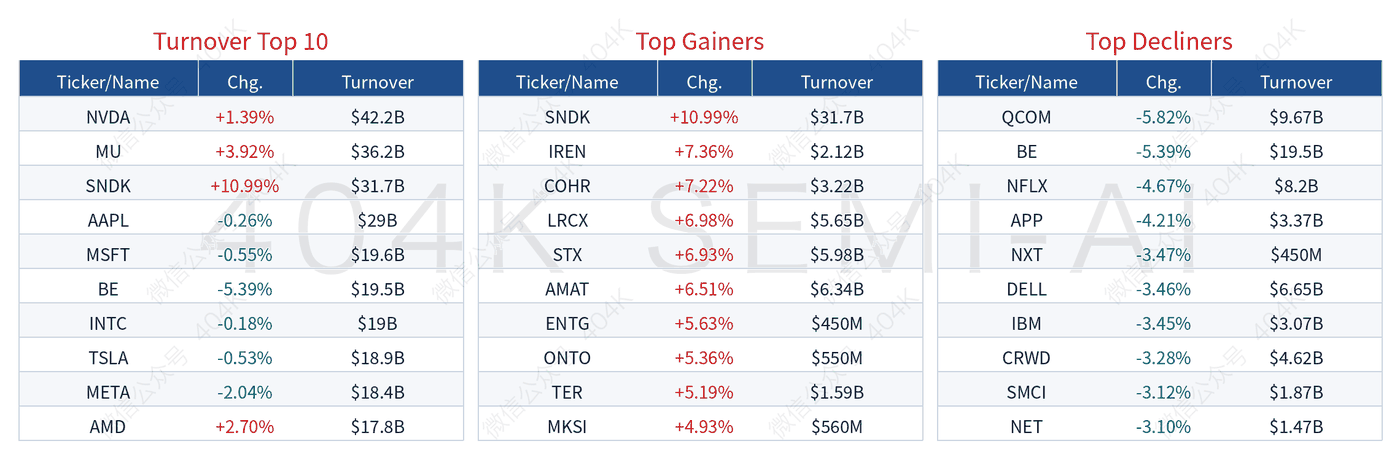
AI & Semiconductor Value Chain
AI Models, Applications & CapEx
OpenAI: Vertical expansion accelerates alongside rising security overhead.
Revenue Run-Rate & Legal Vertical: ARR reportedly reached $43 billion, adding $5 billion month-over-month. The company rolled out Astra for Law, integrating GPT-6 Astra with US legal databases and domain-specific instructions to support legal research, document drafting, and custom workflow development.
Infrastructure Scouting: Reports indicate OpenAI and Anthropic are currently surveying 20–30 MW data center sites across the UK and Nordic regions, targeting near-term deployable capacity in parallel with mega-campus planning.
Security Incident: Bug bounty researchers gained unauthorized access to internal employee accounts and private code repositories over a 72-hour window, though no source code was exfiltrated; OpenAI patched the vulnerability within 14 hours. Enterprise legal adoption hinges strictly on enterprise-grade account isolation and confidentiality.
Anthropic: Internal R&D; automation scales as top-line ARR growth moderates.
ARR & Engineering Automation: ARR reportedly reached $70 billion (up from $65 billion last month), with monthly incremental ARR moderating from $8 billion to $5 billion. Claude's share of internal AI R&D; workflows expanded from 1% in March to 26%, while its participation in human-AI collaborative research exceeded 90% in August.
Physical Wet Lab: Anthropic established a wet lab in the Bay Area to explore Claude-directed robotic physical experimentation; a spokesperson clarified the facility is an early-stage exploration and not dedicated exclusively to drug discovery.
Tooling Upgrades: Claude Code 2.1.277 introduced 87 CLI updates, resolving session lockups and blank response errors. While scientific automation and developer tooling continue to mature, internal workflow participation should not be conflated with commercial monetization.
DeepSeek: Decoupling massive parameter scale from HBM capacity bottlenecks.
Engram Architecture & DRAM Offload: Inference benchmarking indicates that the Engram embedding table in DeepSeek-V4.1-Flash contains ~196.6 billion parameters, requiring 188.8 GiB in an offloaded configuration. However, full-model memory access per token position is just 12.4 KiB—averaging ~3.1 KiB per card across a 4-GPU tensor-parallel cluster. This combination of massive parameter footprint and sparse per-token access makes host DRAM offloading economically viable.
Prefetch Efficiency: Because addressing depends strictly on token IDs, the runtime engine can prefetch embeddings during preceding layer compute, freeing premium HBM capacity for core model weights and KV cache.
Architecture Trade-offs: Benchmarks confirm that pruning Engram degrades factual knowledge benchmarks, demonstrating that offloading is an architectural data-movement strategy rather than parameter reduction.
