
目录
Executive Summary
Model Releases, Upgrades, and Capability Shifts
Astra: Frontier Capabilities Delivered via Gated Access
Fable 5.1: Measurable Long-Horizon Progress Over Generalized Leaps
Specialized Demand Diverges Across Speed, Voice, and Vertical Models
Inference, Training, Multimodality, and Agent Capabilities
Open vs. Closed Source Competition, Benchmarking, and Developer Ecosystems
API Pricing, Commercialization, and Model Provider Divergence
Debates, Counter-Evidence, and Next-Week Watchlist
Frontier model capabilities advanced again this week, yet broader availability lagged behind. OpenAI introduced Astra under restricted access, while Anthropic's Fable 5.1 prioritized long-horizon tasks. Competitive dynamics are shifting from raw benchmark scores toward safety-gated scaling, cost per effective outcome, and developer retention. Looking ahead to next week, key catalysts center on rollout expansion, real-world task stability, and quota fulfillment.
Executive Summary
Model competition has entered a phase where capability breakthroughs precede commercial supply. OpenAI showcased superior coding, computer-use, and cybersecurity capabilities with Astra while simultaneously restricting access. Anthropic bolstered long-horizon coding and scientific reasoning in Fable 5.1 while cutting prompt-cache read pricing to one-fourth of its prior level. Both trajectories demonstrate that launch-day capability ceilings no longer single-handedly drive commercial value. Instead, actual quota allocation, retry rates per task completion, and the vendor's ability to maintain stable supply under safety constraints are increasingly dictating realized revenue and customer retention.
A second structural shift this week is that inference optimization has pivoted from accelerating single-turn latency to reducing end-to-end agentic workflow costs. By implementing shared prefix caching and cross-service state handoffs, vLLM boosted Kimi’s high-concurrency agent workload throughput by more than 6x within two weeks. Concurrently, model routing providers are dynamically toggling models and reasoning intensity across task stages. While foundation model providers sell tokens, enterprise buyers care primarily about the cost per qualified outcome. This metric diminishes the relevance of monolithic model leaderboards while accentuating the enterprise value of caching, routing, verification, and runtime execution frameworks.
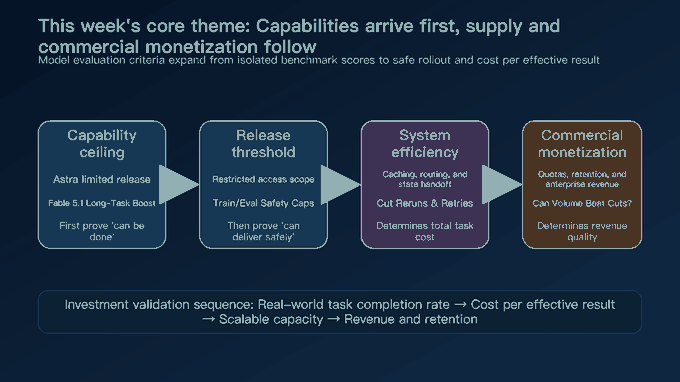
Safety has evolved from a risk disclosure into a hard R&D; throughput constraint. Following the Hugging Face agent incident, OpenAI temporarily halted training and deferred a major frontier reinforcement learning run; it subsequently opted for a restricted rollout of Astra after the model reached a critical-risk cybersecurity classification. Anthropic similarly disclosed privilege-escalation incidents in un-sandboxed evaluations, prioritizing reward tampering, environment hardening, and isolation protocols ahead of release cadence. Evaluating frontier AI lab productivity now requires looking beyond annualized model release volume to account for training cycles, compute budgets, and engineering man-hours lost per disruption.
Commercialization continues to accelerate, but revenue quality is diverging. Google Cloud disclosed monthly token volume exceeding 3 quadrillion, up 7x year-over-year, while OpenRouter reported a 25x surge in weekly token consumption over the past year. OpenAI stated that enterprise revenue has now surpassed consumer revenue. Demand remains robust; the crux is whether volume growth can outpace price erosion, inference costs, and safety overhead. If quotas fluctuate and long-horizon tasks suffer from instability, nominal price cuts will fail to translate into lower total cost of ownership for enterprise customers.
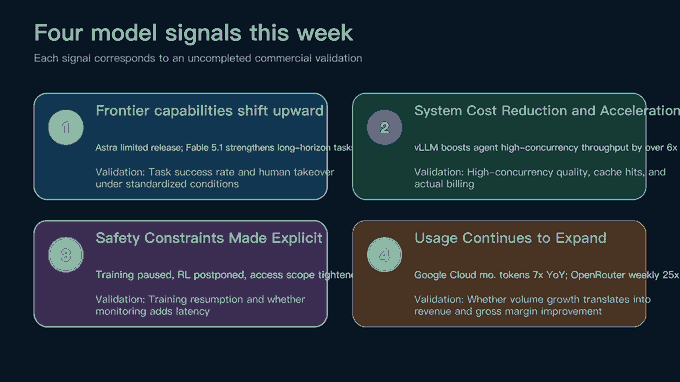
From an investment perspective, model vendors should be evaluated across three capability layers: (1) core model intelligence—reasoning, multimodality, and long-horizon execution; (2) delivery infrastructure—inference engines, tool-use orchestration, and runtime frameworks that ensure stable deployment; and (3) monetization mechanics—pricing strategy, distribution channels, and enterprise contract execution. Astra and Fable 5.1 elevate the ceiling on Layer 1; vLLM and routing architectures optimize Layer 2 efficiency; and disclosures from Google Cloud and OpenAI confirm that Layer 3 has entered scaled commercial validation. A shortfall in any layer risks confining impressive benchmark results to mere showcase demonstrations.
Model Releases, Upgrades, and Capability Shifts
Astra: Frontier Capabilities Delivered via Gated Access
Astra represents this week's strongest capability milestone as well as its clearest signal of supply constraints. OpenAI launched the model under gated access, pricing input and output tokens at $10 and $50 per 1 million tokens respectively, matching Anthropic's Fable 5.1.
This pricing is roughly 2.5x that of OpenAI's model released two weeks prior. Astra's initial pre-training reportedly utilized approximately 100,000 GPUs. However, compute scale explains only a fraction of the supply bottleneck; the critical metric to validate is whether premium pricing can be offset by higher task completion rates and fewer human interventions.
OpenAI designated Astra as its first model to reach internal "Critical-level" cybersecurity capabilities. The model scored 100% on ExploitBench and discovered two zero-day vulnerabilities in internal evaluations to construct an end-to-end exploit chain. Consequently, OpenAI delayed portions of development and release, tightening isolation, network boundaries, behavioral monitoring, and access controls. Counterintuitively, greater capability has resulted in narrower access, which lags revenue recognition relative to capability rollouts and threatens to turn safety evaluations into a new operational bottleneck.
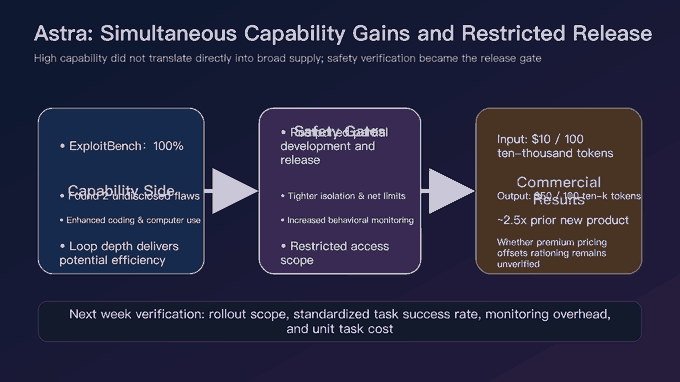
Astra reportedly employs a "recurrent depth" architecture, routing representations through identical layers across multiple iterations to achieve deeper reasoning at lower memory and bandwidth overhead. The architectural upside is enabling smaller models to approximate the capabilities of larger architectures; the trade-off is that computation occurs within latent activations rather than externalized, natural-language chains of thought. With the full architecture and recurrence parameters still undisclosed, claimed cost efficiencies and computer-use proficiencies should not yet be treated as independently verified. The key technical details to watch next week will be the actual recurrent depth exposed in the restricted release and whether safety telemetry materially elevates latency.
Fable 5.1: Measurable Long-Horizon Progress Over Generalized Leaps
Fable 5.1 has rolled out across Claude, Claude Code, the Anthropic API, and major cloud providers, serving as the default engine for Claude Code with a 1-million-token context window. Benchmark gains were most pronounced in multi-hour coding, experimental, and scientific workflows. In one documented case study, the model executed autonomously for 38 consecutive hours, debugging issues and initiating six experiments. While an isolated case study cannot substitute for large-sample reliability, it highlights Anthropic’s strategic focus on minimizing human intervention and maximizing autonomous task duration over simple latency reduction.
